THE THREE GREAT
GREEK TRIUMVIRATE
: SOCRATES , PLATO
and ARISTOTLE
Prepared by: Raizza
Corpuz
 World-renowned classical Greek
philosophers.
 The trio of Plato, Socrates (his
teacher) and Aristotle (his student)
laid the fundamentals of Western
philosophy.
SOCRATES
 Socrates: Athens' street-corner
philosopher
 Socrates was the big-city
philosopher in ancient Athens.
 Accused and convicted of corrupting
the youth, his only real crime was
embarrassing and irritating a number
of important people.
 His punishment was death.
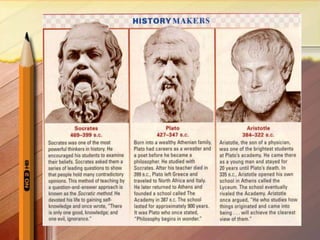
Socrates
Socrates didn't write books; he just
liked to ask probing and sometimes
humiliating questions, which gave
rise to the famous Socratic Method
of Teaching.
A man of VIRTUE
Famous quote: "The unexamined life is
not worth living."
PLATO
 Plato: The philosopher who would
be king
 An aristocratic man with plenty of
money
 the man's real (and little known)
name was Aristocles; Plato was just
a nickname given to him by his
friends, whose original connotation
made reference to his broad
shoulders.
Plato
 Plato became an enthusiastic and
talented student of Socrates and
wrote famous dialogues featuring his
teacher verbally grappling with
opponents
 believed in the pre-existence and
immortality of the soul, holding that
life is nothing more than the
imprisonment of the soul in a body
Plato
 In addition to the physical world,
there is a heavenly realm of greater
reality consisting in Forms, Ideals, or
Ideas (such as Equality, Justice,
Humanity,
 He wrote a famous treatise (The
Republic) on the ideal society, in
which he expressed the thought that
a philosopher, of all people, who
should be king and so on).
ARISTOTLE
 Aristotle: A long walk to the
Golden Mean
 Aristotle was Plato's best student. He
went on to become the very well-paid
tutor of Alexander the Great
 probably the highest paid
philosopher in history
 Aristotle started his own
philosophical school when he was 50
years old.
Aristotle
 Although he lived only ten more
years, he produced nearly a
thousand books and pamphlets, only
a few of which have survived.
 This great thinker was called
a peripatetic philosopher (peripateo
= "to walk around") because he liked
to lecture to his students while taking
a walk
Aristotle
 A key theme in Aristotle's thought is
that happiness is the goal of life.
Aristotle was a good deal less other-
worldly than Plato
 He voluntarily went into exile from
Athens when conditions became a
bit politically dangerous for him, in
his words, "lest Athens sin twice
against philosophy.
Aristotle
 The founder of logical theory,
Aristotle believed that the greatest
human endeavor is the use of reason
in theoretical activity.
 One of his best known ideas was his
conception of "The Golden Mean" —
"avoid extremes," the counsel of
moderation in all things.
The three triumvirate PHILOSOPHY. rpc

The three triumvirate PHILOSOPHY. rpc

  • 1.
    THE THREE GREAT GREEKTRIUMVIRATE : SOCRATES , PLATO and ARISTOTLE Prepared by: Raizza Corpuz
  • 2.
     World-renowned classicalGreek philosophers.  The trio of Plato, Socrates (his teacher) and Aristotle (his student) laid the fundamentals of Western philosophy.
  • 4.
    SOCRATES  Socrates: Athens'street-corner philosopher  Socrates was the big-city philosopher in ancient Athens.  Accused and convicted of corrupting the youth, his only real crime was embarrassing and irritating a number of important people.  His punishment was death.
  • 5.
    Socrates Socrates didn't writebooks; he just liked to ask probing and sometimes humiliating questions, which gave rise to the famous Socratic Method of Teaching. A man of VIRTUE Famous quote: "The unexamined life is not worth living."
  • 6.
    PLATO  Plato: Thephilosopher who would be king  An aristocratic man with plenty of money  the man's real (and little known) name was Aristocles; Plato was just a nickname given to him by his friends, whose original connotation made reference to his broad shoulders.
  • 7.
    Plato  Plato becamean enthusiastic and talented student of Socrates and wrote famous dialogues featuring his teacher verbally grappling with opponents  believed in the pre-existence and immortality of the soul, holding that life is nothing more than the imprisonment of the soul in a body
  • 8.
    Plato  In additionto the physical world, there is a heavenly realm of greater reality consisting in Forms, Ideals, or Ideas (such as Equality, Justice, Humanity,  He wrote a famous treatise (The Republic) on the ideal society, in which he expressed the thought that a philosopher, of all people, who should be king and so on).
  • 9.
    ARISTOTLE  Aristotle: Along walk to the Golden Mean  Aristotle was Plato's best student. He went on to become the very well-paid tutor of Alexander the Great  probably the highest paid philosopher in history  Aristotle started his own philosophical school when he was 50 years old.
  • 10.
    Aristotle  Although helived only ten more years, he produced nearly a thousand books and pamphlets, only a few of which have survived.  This great thinker was called a peripatetic philosopher (peripateo = "to walk around") because he liked to lecture to his students while taking a walk
  • 11.
    Aristotle  A keytheme in Aristotle's thought is that happiness is the goal of life. Aristotle was a good deal less other- worldly than Plato  He voluntarily went into exile from Athens when conditions became a bit politically dangerous for him, in his words, "lest Athens sin twice against philosophy.
  • 12.
    Aristotle  The founderof logical theory, Aristotle believed that the greatest human endeavor is the use of reason in theoretical activity.  One of his best known ideas was his conception of "The Golden Mean" — "avoid extremes," the counsel of moderation in all things.