Social Media for
                                         Lobbying and Advocacy


                                             Giulia McPherson
                                                 CARE USA
                                               August 14, 2012


© 2005, CARE USA. All rights reserved.
CARE Overview
    CARE is a leading humanitarian organization dedicated to fighting poverty and
      social injustice, placing a special emphasis on investing in women and girls.
      In 2011, CARE worked in 84 countries to reach more than 122 million people with life saving
       poverty-fighting programs, including maternal and child health, education, food and clean
       water and more. We also responded to humanitarian emergencies like the food crisis in the
       Horn of Africa, and advocated for policy change to help improve the lives of the world's
       poorest people.
      CARE’s Advocacy Agenda includes:
             Securing effective funding for foreign assistance
             Tackling global hunger and food insecurity
             Increasing access to maternal and reproductive health
             Assisting in emergencies and conflict situations
             Promoting gender empowerment


© 2005, CARE USA. All rights reserved.
CARE’s U.S. Advocacy Structure
      Although CARE’s programs improve the lives of millions of people each year,
          lasting change requires effective economic, political and social policies.

     Government Relations
       Facilitates U.S.-based relationships with Congress and the Administration

       Supports district-level targets with key policymakers


     Learning Tours
       Comprehensive, multi-day trip for policymakers and those who can influence
         policy to gain firsthand knowledge of the core issues poor communities face.

     Citizen Advocacy
       Facilitate communication between constituents and their members of Congress
          about the importance of investing in efforts to promote global development.
       Targets key policymakers at state/district level


© 2005, CARE USA. All rights reserved.
Citizen Advocacy @ CARE
The History of CARE’s Citizen Advocacy Work:
      CARE launched its Reproductive Health Education Program in 1998, which engaged
       donors to form a nationwide network of advocates interested in improving women’s
       health and the lives of families around the world.
      Formally established the CARE Action Network in 2002, a nationwide network of
       advocates supporting CARE’s advocacy agenda now totaling over 170,000 people.


    CARE’s Citizen Advocacy team recruits, educates and mobilizes individuals and
               works through partnerships to advance CARE’s policy agenda


      Recruit -Tiered advocate structure; State/District Chairs
      Educate – Advocacy trainings; conference calls and webinars; local/regional events
      Mobilize - In-District Meetings; Action Alerts; National Day of Action; CARE
       National Conference


© 2005, CARE USA. All rights reserved.
CARE’s Social Media Presence
      Facebook (63,993 likes)
             Post advocacy articles, event information, advocacy successes
             Leverage web-based outreach including action alerts and e-newsletter
             Group for State/District Chairs
      Twitter (490,100 followers; @CARE)
             Interact with advocates and policymakers
      YouTube (http://www.youtube.com/careusa)
             Videos from policymaker trips, advocacy-related events
      Blogs & Action Center             (www.care.org)

             Provides space for in-depth explanation of policy issues
             Share links through social media outlets


                                                                                     5
© 2005, CARE USA. All rights reserved.
Spread Advocacy Messages
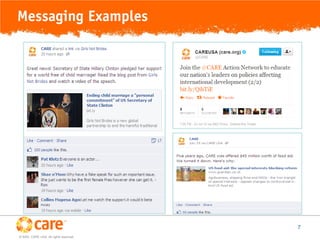
Social media is an effective way to raise awareness about poverty-focused
              issues in a manner that is timely and interactive.

      Post policy-related resources including articles, event information and policy
       papers
      Promote events including geographically targeted invitations to advocacy-specific
       events
      Integrate with long-term awareness-raising and fundraising campaigns on
       specific issues to create compelling narrative and context for future action
      Grow list of advocates through easy sign-up method and by promoting social
       media outlets as often as possible
      Take advantage of interactive opportunities including questions and surveys


                                                                                        6
© 2005, CARE USA. All rights reserved.
Messaging Examples


                                         7
© 2005, CARE USA. All rights reserved.
Mobilize Advocates
Citizen advocacy plays a critical role in policy change and can be executed
                         through a variety of outlets

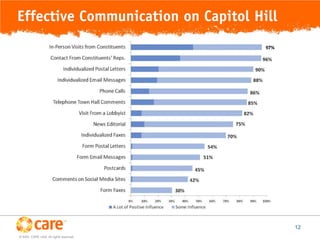
      The most effective means of communication remains in-person meetings with
       constituents, followed by personal phone calls and e-mails
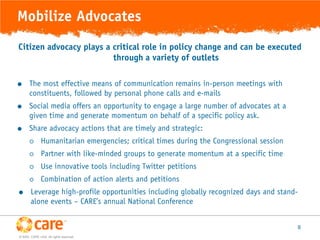
      Social media offers an opportunity to engage a large number of advocates at a
       given time and generate momentum on behalf of a specific policy ask.
      Share advocacy actions that are timely and strategic:
             Humanitarian emergencies; critical times during the Congressional session
             Partner with like-minded groups to generate momentum at a specific time
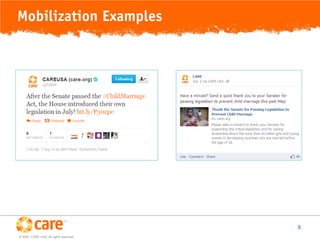
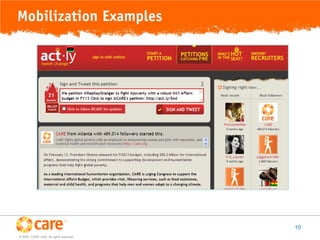
             Use innovative tools including Twitter petitions
             Combination of action alerts and petitions
      Leverage high-profile opportunities including globally recognized days and stand-
       alone events – CARE’s annual National Conference


                                                                                          8
© 2005, CARE USA. All rights reserved.
Mobilization Examples


                                         9
© 2005, CARE USA. All rights reserved.
Mobilization Examples


                                         10
© 2005, CARE USA. All rights reserved.
Policymakers & Social Media
    Policymakers are increasingly using social media as a tool to communicate with
              their constituents by both sharing and receiving information.


      Congressional offices are integrating social media tools into their operations, both to gain an
       understanding of constituents' opinions and to communicate information about the Member's
       views.
             64% of congressional staff surveyed think Facebook is an important way to understand
              constituents' views
             74% think it is important for communicating their Member's views.
      Congressional offices are using social media to help gauge public opinion, augmenting
       traditional tools used for that purpose.
             64% of the senior managers and social media managers surveyed think Facebook is a
              somewhat or very important tool for understanding constituents' views and opinions
             42% say Twitter is somewhat or very important
             34% say YouTube is somewhat or very important tool for understanding constituents'
              views and opinions.
                                                                  Source: Congressional Management Foundation (2010)


                                                                                                                11
© 2005, CARE USA. All rights reserved.
Effective Communication on Capitol Hill


                                          12
© 2005, CARE USA. All rights reserved.
Questions?


                                           Giulia McPherson
                                         gmcpherson@care.org
                                          @giuliamcpherson


                                                               13
© 2005, CARE USA. All rights reserved.

Social Media for Lobbying and Advocacy

  • 1.
    Social Media for Lobbying and Advocacy Giulia McPherson CARE USA August 14, 2012 © 2005, CARE USA. All rights reserved.
  • 2.
    CARE Overview CARE is a leading humanitarian organization dedicated to fighting poverty and social injustice, placing a special emphasis on investing in women and girls.  In 2011, CARE worked in 84 countries to reach more than 122 million people with life saving poverty-fighting programs, including maternal and child health, education, food and clean water and more. We also responded to humanitarian emergencies like the food crisis in the Horn of Africa, and advocated for policy change to help improve the lives of the world's poorest people.  CARE’s Advocacy Agenda includes:  Securing effective funding for foreign assistance  Tackling global hunger and food insecurity  Increasing access to maternal and reproductive health  Assisting in emergencies and conflict situations  Promoting gender empowerment © 2005, CARE USA. All rights reserved.
  • 3.
    CARE’s U.S. AdvocacyStructure Although CARE’s programs improve the lives of millions of people each year, lasting change requires effective economic, political and social policies.  Government Relations  Facilitates U.S.-based relationships with Congress and the Administration  Supports district-level targets with key policymakers  Learning Tours  Comprehensive, multi-day trip for policymakers and those who can influence policy to gain firsthand knowledge of the core issues poor communities face.  Citizen Advocacy  Facilitate communication between constituents and their members of Congress about the importance of investing in efforts to promote global development.  Targets key policymakers at state/district level © 2005, CARE USA. All rights reserved.
  • 4.
    Citizen Advocacy @CARE The History of CARE’s Citizen Advocacy Work:  CARE launched its Reproductive Health Education Program in 1998, which engaged donors to form a nationwide network of advocates interested in improving women’s health and the lives of families around the world.  Formally established the CARE Action Network in 2002, a nationwide network of advocates supporting CARE’s advocacy agenda now totaling over 170,000 people. CARE’s Citizen Advocacy team recruits, educates and mobilizes individuals and works through partnerships to advance CARE’s policy agenda  Recruit -Tiered advocate structure; State/District Chairs  Educate – Advocacy trainings; conference calls and webinars; local/regional events  Mobilize - In-District Meetings; Action Alerts; National Day of Action; CARE National Conference © 2005, CARE USA. All rights reserved.
  • 5.
    CARE’s Social MediaPresence  Facebook (63,993 likes)  Post advocacy articles, event information, advocacy successes  Leverage web-based outreach including action alerts and e-newsletter  Group for State/District Chairs  Twitter (490,100 followers; @CARE)  Interact with advocates and policymakers  YouTube (http://www.youtube.com/careusa)  Videos from policymaker trips, advocacy-related events  Blogs & Action Center (www.care.org)  Provides space for in-depth explanation of policy issues  Share links through social media outlets 5 © 2005, CARE USA. All rights reserved.
  • 6.
    Spread Advocacy Messages Socialmedia is an effective way to raise awareness about poverty-focused issues in a manner that is timely and interactive.  Post policy-related resources including articles, event information and policy papers  Promote events including geographically targeted invitations to advocacy-specific events  Integrate with long-term awareness-raising and fundraising campaigns on specific issues to create compelling narrative and context for future action  Grow list of advocates through easy sign-up method and by promoting social media outlets as often as possible  Take advantage of interactive opportunities including questions and surveys 6 © 2005, CARE USA. All rights reserved.
  • 7.
    Messaging Examples 7 © 2005, CARE USA. All rights reserved.
  • 8.
    Mobilize Advocates Citizen advocacyplays a critical role in policy change and can be executed through a variety of outlets  The most effective means of communication remains in-person meetings with constituents, followed by personal phone calls and e-mails  Social media offers an opportunity to engage a large number of advocates at a given time and generate momentum on behalf of a specific policy ask.  Share advocacy actions that are timely and strategic:  Humanitarian emergencies; critical times during the Congressional session  Partner with like-minded groups to generate momentum at a specific time  Use innovative tools including Twitter petitions  Combination of action alerts and petitions  Leverage high-profile opportunities including globally recognized days and stand- alone events – CARE’s annual National Conference 8 © 2005, CARE USA. All rights reserved.
  • 9.
    Mobilization Examples 9 © 2005, CARE USA. All rights reserved.
  • 10.
    Mobilization Examples 10 © 2005, CARE USA. All rights reserved.
  • 11.
    Policymakers & SocialMedia Policymakers are increasingly using social media as a tool to communicate with their constituents by both sharing and receiving information.  Congressional offices are integrating social media tools into their operations, both to gain an understanding of constituents' opinions and to communicate information about the Member's views.  64% of congressional staff surveyed think Facebook is an important way to understand constituents' views  74% think it is important for communicating their Member's views.  Congressional offices are using social media to help gauge public opinion, augmenting traditional tools used for that purpose.  64% of the senior managers and social media managers surveyed think Facebook is a somewhat or very important tool for understanding constituents' views and opinions  42% say Twitter is somewhat or very important  34% say YouTube is somewhat or very important tool for understanding constituents' views and opinions. Source: Congressional Management Foundation (2010) 11 © 2005, CARE USA. All rights reserved.
  • 12.
    Effective Communication onCapitol Hill 12 © 2005, CARE USA. All rights reserved.
  • 13.
    Questions? Giulia McPherson gmcpherson@care.org @giuliamcpherson 13 © 2005, CARE USA. All rights reserved.