Welcome to our presentation
Presentation Title: Community Awareness
ferdousalam54@gmail.com
Dsm.BRUR
Community
awareness
Community Awareness is generally defined as
knowledge created through interaction between
community people and its environment, a setting
bounded in space and time. It involves states of
knowledge as well as dynamic process of perception and
action. It is the knowledge that must be maintained and
kept updated to complete some tasks in the environment.
Community Awareness generation is considered as core
element of successful disaster risk reduction.
uuuuuu
Fig: Community awareness
PRINCIPLE OF
COMMUNITY
AWARENESS
GENERATION
The community awareness generation should be
based on the following broad principles
 An ideal campaign has to be sustained over time to foster
changes in social and behavioral norms.
 The strategy for generating community awareness should
be designed and implemented with a clear understanding
of local perspectives and requirements with materials
reflecting local conditions in a community.
 The strategy should target all sections of the society
including decision makers, professionals, public and
individuals living in vulnerable areas.
.
 It postulates that different types of messages and delivery
systems should be used to reach various target
audiences at different community.
 Community awareness generation framework should
follow the target audience's segmentation i.e. grouping by
demographic, social, economic variables to create
messages that are salient, effective, oriented which is
attractive for the community people.
COMMUNITY AWARENESS PROCESS
Community awareness process based on probable or
upcoming disaster strike
Community
mapping
Appreciative
Inquiry
Historical
timelines and
trends
METHODOLOGY FOR AWARENESS
GENERATION AND DISSEMINATION
 Educational curriculum
 Quiz, Declamations and Debates
 Messages during Assembly
 Focus group discussion about disaster
 Social networking
 Social media
 Workshops, Seminars, Orientation programmes and Lectures
 Field visits to disaster affected /hit areas
 Notices
 Posters, leaflets, brochures etc.
 Cartoons
 Photographs
 Films, Film clips, Videos and advertisements
 Dance, Drama, folksongs and street plays
 Games based on knowledge about disasters
 Short radio/television features
 Talks/Presentations
 Door to door awareness campaigns
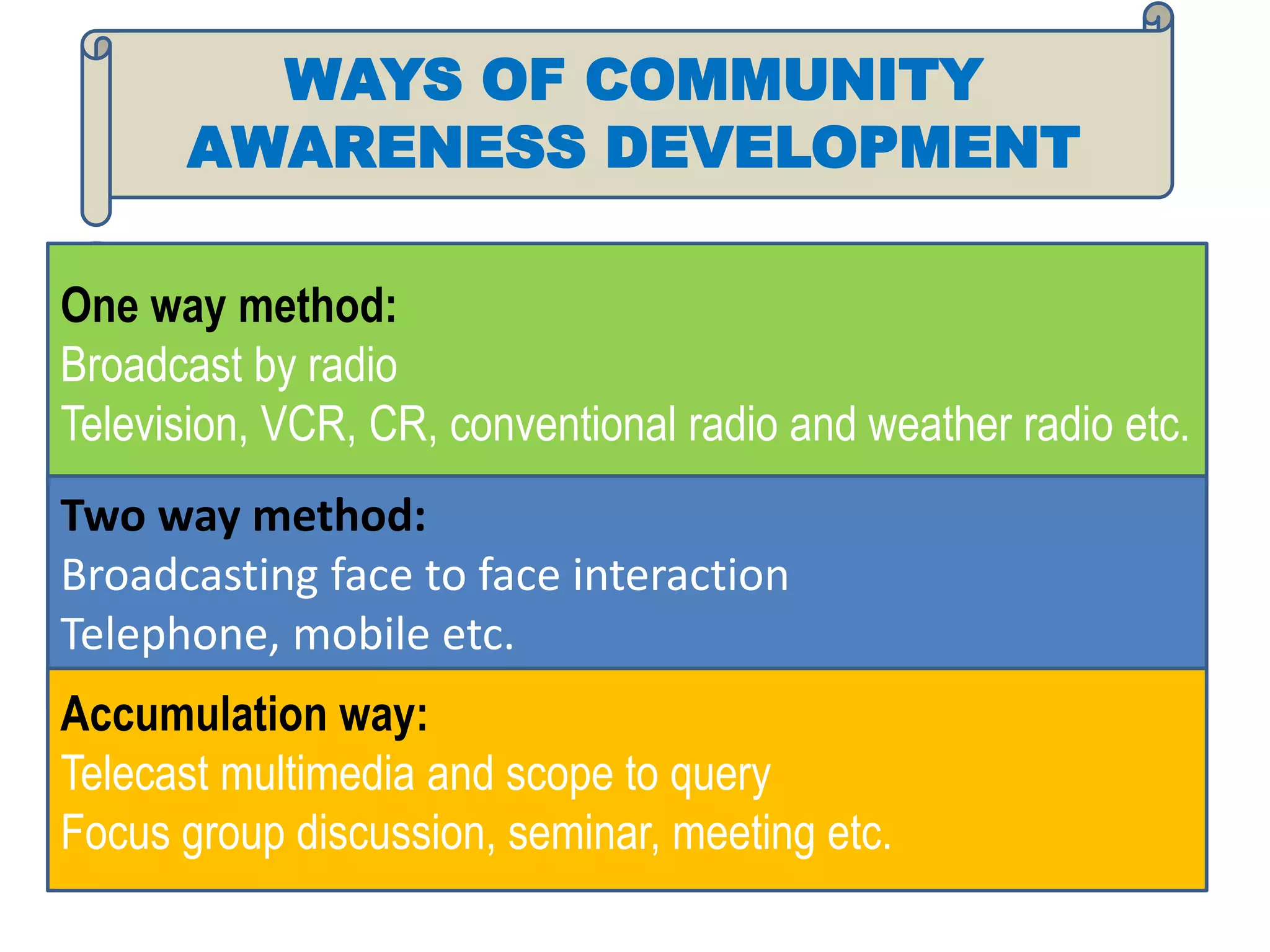
WAYS OF COMMUNITY
AWARENESS DEVELOPMENT
One way method:
Broadcast by radio
Television, VCR, CR, conventional radio and weather radio etc.
Two way method:
Broadcasting face to face interaction
Telephone, mobile etc.
Accumulation way:
Telecast multimedia and scope to query
Focus group discussion, seminar, meeting etc.
COMMUNITY AWARENESS AND DISASTER
RISK REDUCTION
There are four key approaches to community awareness for
disaster risk reduction
Campaigns
Informal education
Participatory learning
Formal school-based
interventions
campaigns
There are many examples of large-scale national and
international public awareness campaigns that have led to
massive social change. Campaigns comprise a set of activities
that may include
 Publications, including billboards, posters, newspaper or
magazine Coverage, information cards, flyers, bookmarks
and brochures
 Curricula, modules and presentations, including slide
presentations and oral presentations
 E-learning
 Performing and cultural arts
 Games and competitions
 Audio and video materials
 Web pages and activities
Campaign-planning
template
Participatory learning
People are especially motivated by approaches in which they
themselves participate in a solution, and especially when they
believe it is their own idea. The focus of participatory learning is to
engage people in discovery and problem solving for disaster risk
reduction. This involves using language, stories, songs and traditions
to strengthen the emerging culture of prevention.
 The organizational level – headquarters, branches,
schools, businesses, workplaces, homes
 The community level – being scaled up to reach villages,
towns, cities, school systems, and regions.
 The population level – being expanded to incorporate
entire urban populations, by taking advantage of internet-
based tools and social media. Parallel tools specifically for
use with children and for marginalized populations can be
valuable as well.
There are three elements of participatory learning can be
applied at three levels:
Informal education
The focus of informal education is taking advantage of brief moments
and encounters to stimulate thinking and engage people in discovery
of actions and behavior's to increase safety and resilience. Informal
education in communities and schools is the most flexible of all
approaches with respect to setting, audience and timeframe. The
various types of informal education are shown in table.
Specific tools that can be used for informal education include
Publications – posters, guidelines, flyers, brochures, booklets, activity books,
paper models, comic books, story books, coloring books, assembly kits and
teacher resources
E-learning – self-study curricula
Performing and cultural arts – plays, dances, poems, songs, street theatre,
puppet theatre etc.
Formal school-based
interventions
The focus of formal school-based interventions covers two areas:
school disaster management and disaster risk reduction in school
curricula. These are considered to be formal because accountability
and responsibility for school safety and curricula belong exclusively
to education authorities, so they require support for long-term
planning and capacity building.
The following elements are essential
 An incident command
 Community-based first aid type of system to organize
 light search and rescue
 Fire suppression
 Communications
 Psychosocial support
 Shelter
 Nutrition
 Evacuation
 Student–family reunification procedures
School drills
School drills form a vital part of the school disaster management
process, and provide an intensive learning experience. They should
be followed by reflection and assessment by all members of the
school community. Depending on hazards faced, there several major
types of drills that can be practiced.
 Building evacuation (if the building is unsafe)
 Shelter in place (a procedure for taking shelter if the
outdoors is unsafe)
 Lockdown (keeping students inside in case of violent attack).
 Many individual skills and protocols can also be practiced
separately, and as part of more complete simulation drills:
 Student release procedures (safe family reunification)
 Drop, cover and hold (for earthquake)
 Putting on life jackets and practicing water safety (for flood or
tsunami)
 Extinguishing small fires stop, drop, and roll (when on fire)
 Light search and rescue
Curriculum work
School-based curriculum work in disaster reduction takes three main
forms, each appropriate to different context:
 Infusion throughout the curriculum (multi-subject, using
readings, examples, problems and activities).
 Tools in this area fall into the category of curricula, modules
and presentations, including: textbooks ,modules ,case studies
,exercises ,Hands-on learning materials
 Informal education tools such as- Publications – posters,
guidelines, flyers, brochures, booklets, activity books, paper
models, comic books, story books, coloring books, assembly kits
and teacher resources .
 Performing and cultural arts – plays, dances, poems, songs,
street theatre, puppet theatre etc.
Dear audience ,have
you got any query?
Thanks to all

Community awareness

  • 1.
    Welcome to ourpresentation Presentation Title: Community Awareness ferdousalam54@gmail.com Dsm.BRUR
  • 2.
    Community awareness Community Awareness isgenerally defined as knowledge created through interaction between community people and its environment, a setting bounded in space and time. It involves states of knowledge as well as dynamic process of perception and action. It is the knowledge that must be maintained and kept updated to complete some tasks in the environment. Community Awareness generation is considered as core element of successful disaster risk reduction.
  • 3.
  • 4.
    PRINCIPLE OF COMMUNITY AWARENESS GENERATION The communityawareness generation should be based on the following broad principles  An ideal campaign has to be sustained over time to foster changes in social and behavioral norms.
  • 5.
     The strategyfor generating community awareness should be designed and implemented with a clear understanding of local perspectives and requirements with materials reflecting local conditions in a community.  The strategy should target all sections of the society including decision makers, professionals, public and individuals living in vulnerable areas. .
  • 6.
     It postulatesthat different types of messages and delivery systems should be used to reach various target audiences at different community.  Community awareness generation framework should follow the target audience's segmentation i.e. grouping by demographic, social, economic variables to create messages that are salient, effective, oriented which is attractive for the community people.
  • 7.
    COMMUNITY AWARENESS PROCESS Communityawareness process based on probable or upcoming disaster strike Community mapping Appreciative Inquiry Historical timelines and trends
  • 8.
    METHODOLOGY FOR AWARENESS GENERATIONAND DISSEMINATION  Educational curriculum  Quiz, Declamations and Debates  Messages during Assembly  Focus group discussion about disaster  Social networking  Social media  Workshops, Seminars, Orientation programmes and Lectures  Field visits to disaster affected /hit areas
  • 9.
     Notices  Posters,leaflets, brochures etc.  Cartoons  Photographs  Films, Film clips, Videos and advertisements  Dance, Drama, folksongs and street plays  Games based on knowledge about disasters  Short radio/television features  Talks/Presentations  Door to door awareness campaigns
  • 10.
    WAYS OF COMMUNITY AWARENESSDEVELOPMENT One way method: Broadcast by radio Television, VCR, CR, conventional radio and weather radio etc. Two way method: Broadcasting face to face interaction Telephone, mobile etc. Accumulation way: Telecast multimedia and scope to query Focus group discussion, seminar, meeting etc.
  • 11.
    COMMUNITY AWARENESS ANDDISASTER RISK REDUCTION There are four key approaches to community awareness for disaster risk reduction Campaigns Informal education Participatory learning Formal school-based interventions
  • 12.
    campaigns There are manyexamples of large-scale national and international public awareness campaigns that have led to massive social change. Campaigns comprise a set of activities that may include  Publications, including billboards, posters, newspaper or magazine Coverage, information cards, flyers, bookmarks and brochures
  • 13.
     Curricula, modulesand presentations, including slide presentations and oral presentations  E-learning  Performing and cultural arts  Games and competitions  Audio and video materials  Web pages and activities
  • 14.
  • 15.
    Participatory learning People areespecially motivated by approaches in which they themselves participate in a solution, and especially when they believe it is their own idea. The focus of participatory learning is to engage people in discovery and problem solving for disaster risk reduction. This involves using language, stories, songs and traditions to strengthen the emerging culture of prevention.
  • 16.
     The organizationallevel – headquarters, branches, schools, businesses, workplaces, homes  The community level – being scaled up to reach villages, towns, cities, school systems, and regions.  The population level – being expanded to incorporate entire urban populations, by taking advantage of internet- based tools and social media. Parallel tools specifically for use with children and for marginalized populations can be valuable as well. There are three elements of participatory learning can be applied at three levels:
  • 17.
    Informal education The focusof informal education is taking advantage of brief moments and encounters to stimulate thinking and engage people in discovery of actions and behavior's to increase safety and resilience. Informal education in communities and schools is the most flexible of all approaches with respect to setting, audience and timeframe. The various types of informal education are shown in table.
  • 18.
    Specific tools thatcan be used for informal education include Publications – posters, guidelines, flyers, brochures, booklets, activity books, paper models, comic books, story books, coloring books, assembly kits and teacher resources E-learning – self-study curricula Performing and cultural arts – plays, dances, poems, songs, street theatre, puppet theatre etc.
  • 19.
    Formal school-based interventions The focusof formal school-based interventions covers two areas: school disaster management and disaster risk reduction in school curricula. These are considered to be formal because accountability and responsibility for school safety and curricula belong exclusively to education authorities, so they require support for long-term planning and capacity building. The following elements are essential
  • 20.
     An incidentcommand  Community-based first aid type of system to organize  light search and rescue  Fire suppression  Communications  Psychosocial support  Shelter  Nutrition  Evacuation  Student–family reunification procedures
  • 21.
    School drills School drillsform a vital part of the school disaster management process, and provide an intensive learning experience. They should be followed by reflection and assessment by all members of the school community. Depending on hazards faced, there several major types of drills that can be practiced.  Building evacuation (if the building is unsafe)  Shelter in place (a procedure for taking shelter if the outdoors is unsafe)
  • 22.
     Lockdown (keepingstudents inside in case of violent attack).  Many individual skills and protocols can also be practiced separately, and as part of more complete simulation drills:  Student release procedures (safe family reunification)  Drop, cover and hold (for earthquake)  Putting on life jackets and practicing water safety (for flood or tsunami)  Extinguishing small fires stop, drop, and roll (when on fire)  Light search and rescue
  • 23.
    Curriculum work School-based curriculumwork in disaster reduction takes three main forms, each appropriate to different context:  Infusion throughout the curriculum (multi-subject, using readings, examples, problems and activities).  Tools in this area fall into the category of curricula, modules and presentations, including: textbooks ,modules ,case studies ,exercises ,Hands-on learning materials
  • 24.
     Informal educationtools such as- Publications – posters, guidelines, flyers, brochures, booklets, activity books, paper models, comic books, story books, coloring books, assembly kits and teacher resources .  Performing and cultural arts – plays, dances, poems, songs, street theatre, puppet theatre etc.
  • 25.
  • 26.

Editor's Notes

  • #8 1. Community mapping: Ask the community to draw a map or build a model of their community. Ask them to think about a “bird‟s eye” view of what their community looks like and get them to visualize this in a drawing or model. It could be a situational (e.g. as the community exists today) or a vision map (e.g. what they want their community to look like in the future). Appreciative Inquiry: Instead of starting off talking about problems in a community, start with discussions of the good things or the things they appreciate about their community. What are some things they are proud of when they think of their community? What are some significant good things that have happened in the history of their community? What makes their community special? 3. Historical timelines and trends: Another method of getting a community to discuss their good things and bad things is to have them share historical events that have occurred in their community. When did it start? What are the major events of the community and when did they happen? We could vary it a bit and ask them, based on the history and timeline they come up with, what do they think will happen in the future in their community?