Community media  approaches & communication for social change Alfonso Gumucio-Dagron Managing Director, Programmes Communication for Social Change Consortium Communication and Poverty Reduction Strategies by the Year 2015 Bellagio Study and Conference Centre November 8-11, 2004
People are finding new and more direct ways to get involved in public life and decision-making –marking a shift from representative democracy to what is often called participatory democracy. Kumi Naidoo Drafting strategy papers in Washington that are subsequently signed off by governments in the name of the people should be a thing of the past. James Wolfensohn
The cemetery of development Half century  of missed opportunities: Water pumps without water Roads that lead nowhere Hospitals without health staff Schools without teachers & books Dusty video & radio equipment  Backyards full of rusty donated vehicles Immunisation rates down, HIV/AIDS up “ White elephants” in Africa, Asia and Latin America
Who’s fault? Government corruption Vertical planning from development agencies No dialogue with beneficiaries  Communication absent in the process Knowledge arrogance Weak community organization Illegitimate local leadership Submissive relations with power structures No sense of ownership No capacity to voice community views Planners Community
Models and paradigms Diffusion of innovations Social Marketing Health promotion  Education & Entertainment Alternative, dialogic communication Development communication Communication for social change
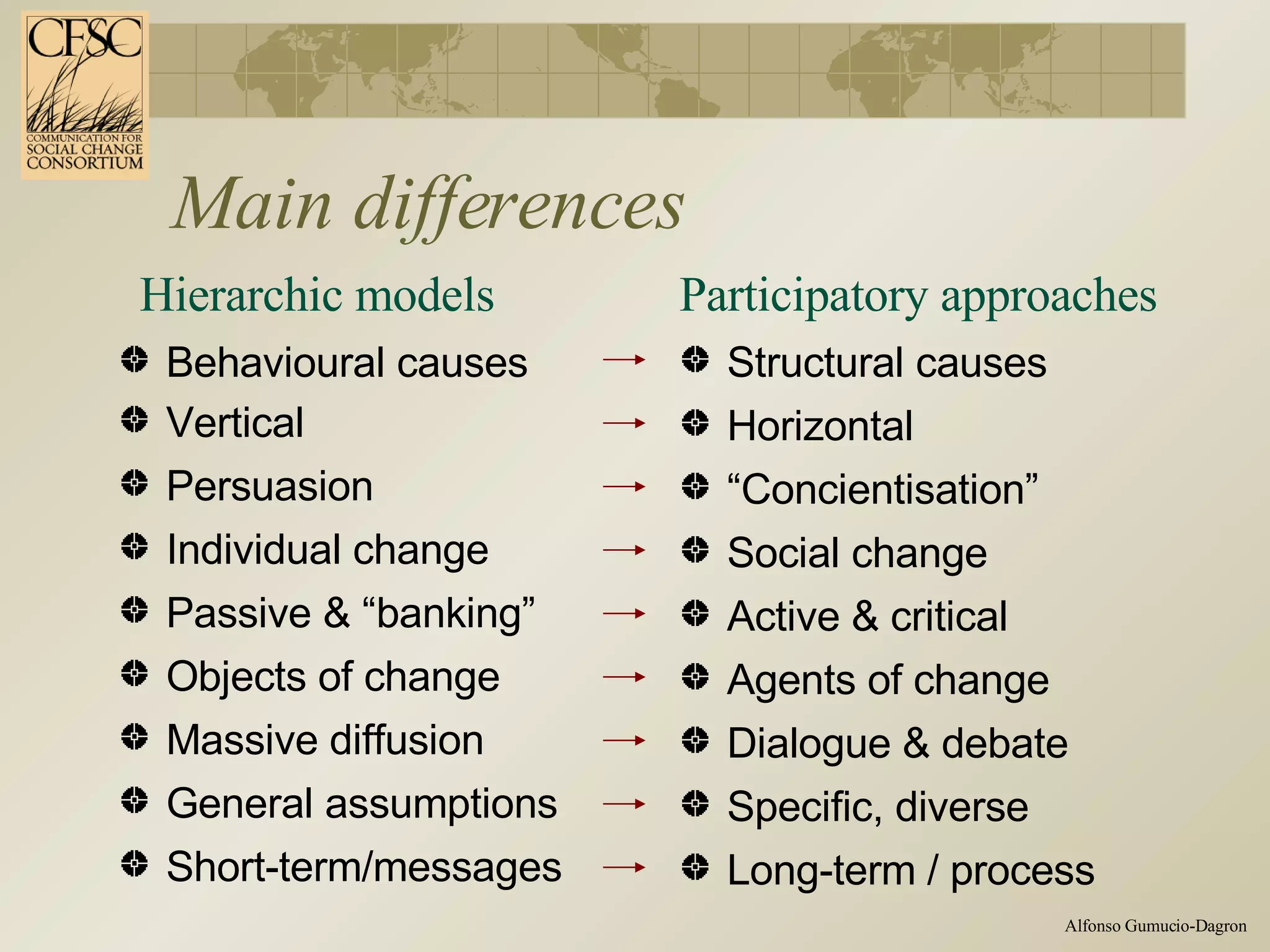
Main differences Hierarchic models Participatory approaches Behavioural causes Individual change Passive & “banking” Objects of change Massive diffusion General assumptions Short-term/messages “ Concientisation” Horizontal Structural causes Vertical Persuasion Long-term / process Specific, diverse Dialogue & debate Agents of change Active & critical Social change
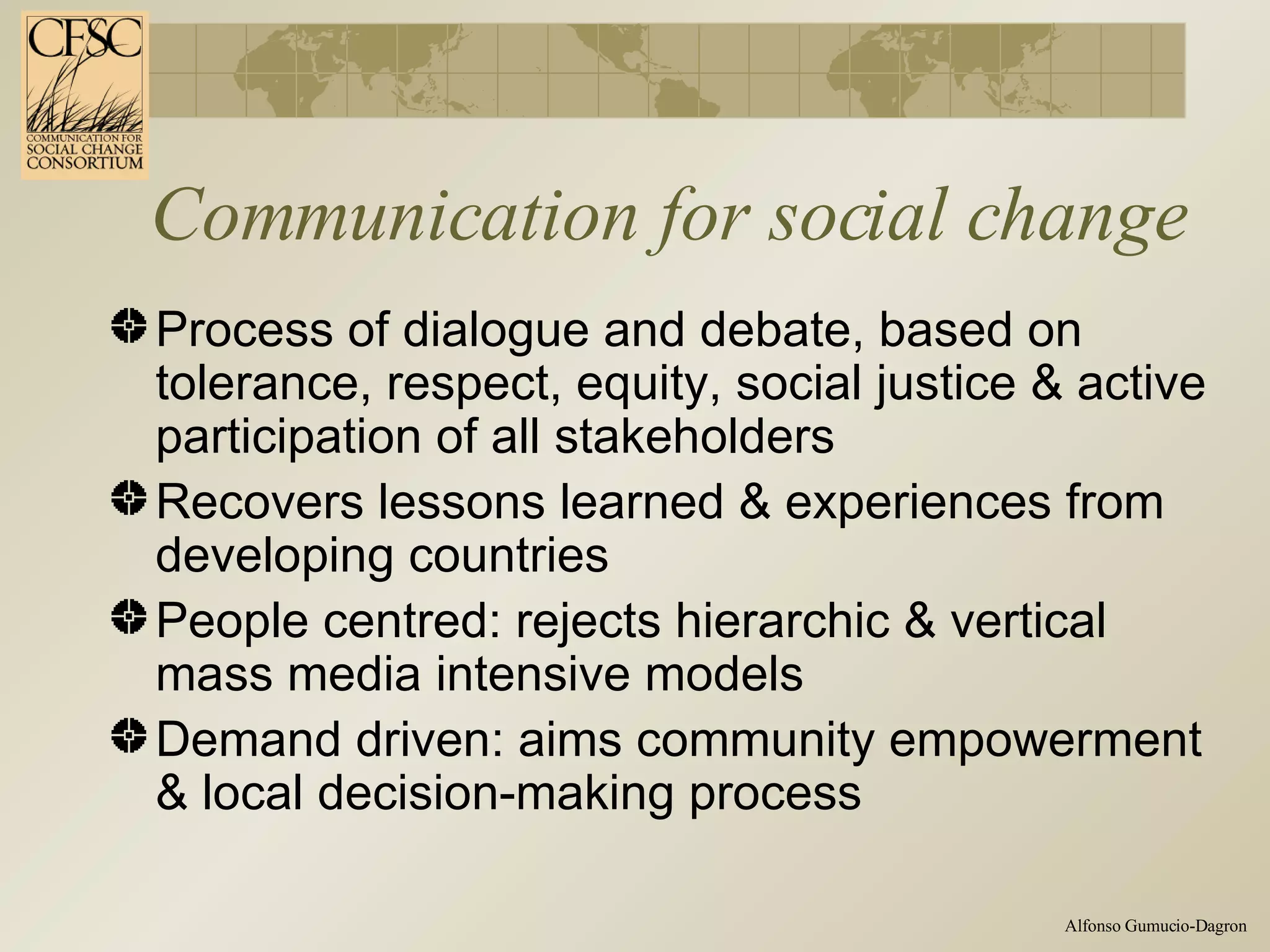
Communication for social change Process of dialogue and debate, based on tolerance, respect, equity, social justice & active participation of all stakeholders  Recovers lessons learned & experiences from developing countries People centred: rejects hierarchic & vertical mass media intensive models  Demand driven:  aims community empowerment & local decision-making process
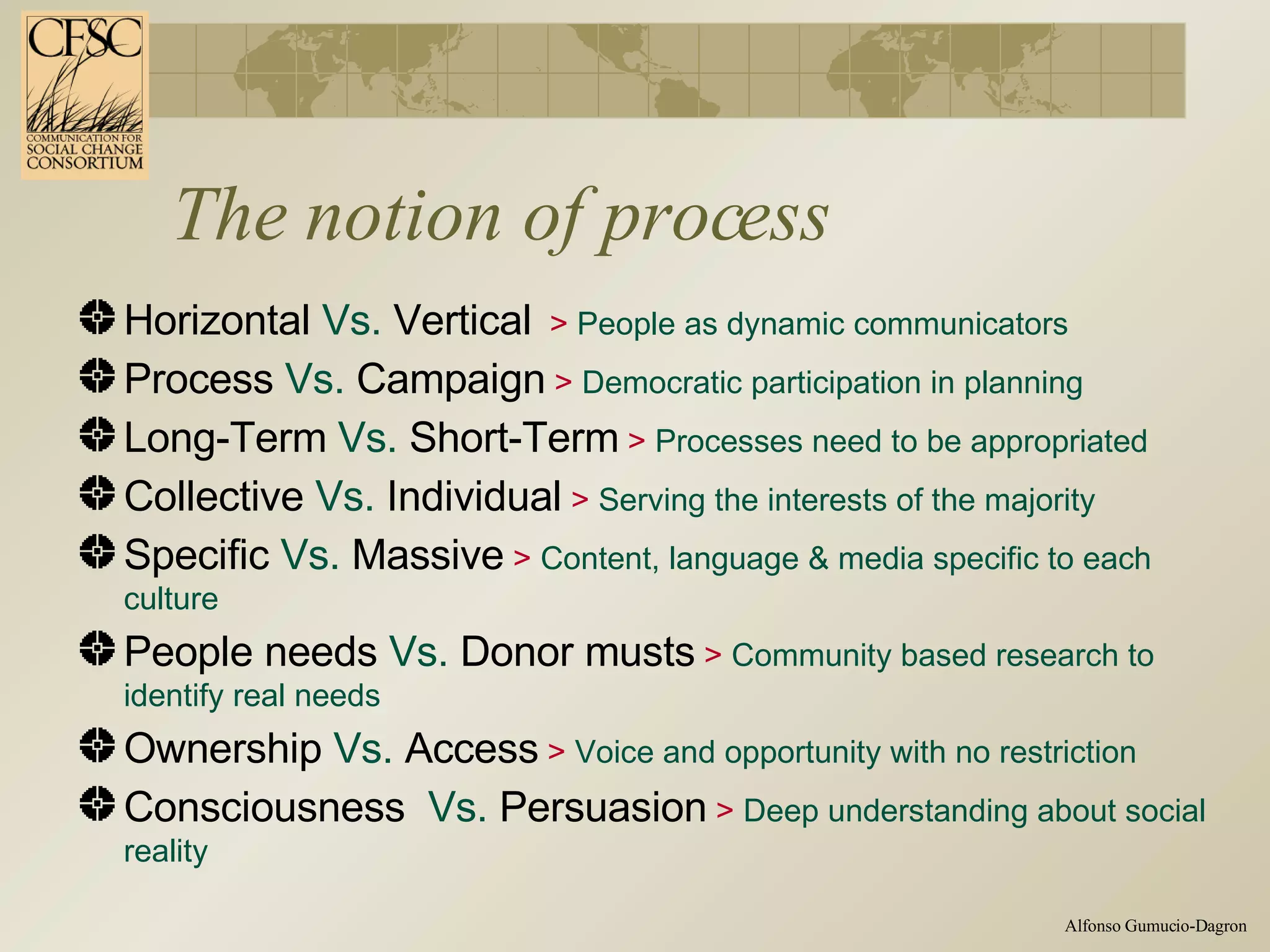
The notion of process Horizontal   Vs.   Vertical   >  People as dynamic communicators Process   Vs.   Campaign  >  Democratic participation in planning Long-Term   Vs.   Short-Term  >  Processes need to be appropriated Collective   Vs.   Individual  >  Serving the interests of the majority Specific   Vs.   Massive  >  Content, language & media specific to each culture People needs   Vs.   Donor musts  >  Community based research to identify real needs Ownership   Vs.   Access  >  Voice and opportunity with no restriction Consciousness   Vs.   Persuasion  >  Deep understanding about social reality
CFSC Principles [1]  Sustainability of social changes happens when individuals & communities affected become owners of the communicational process & contents  [2]  CFSC, horizontal & participatory, aims to strengthen community links and amplify the voices of the poorest; based on the notion of the appropriation of the communicational process and the development of local contents [3]  Communities should be the agents of their own social change and master the communication process
[4]  Emphasis on promoting dialogue, debate & negotiation, building alliances; rather than: persuasion, pure transfer of information & external knowledge [5]  The CFSC process should go beyond individual behaviours and take into consideration social norms, current policies, local culture & tradition, and the general context of development [6]  Dialogue & participation are key to strengthen cultural identity, trust, commitment, ownership of ideas & expressions, and community organisation
[7]  CFSC rejects the linear model of transmission of information from a central sender towards a individual receiver, and promotes a circular process of interactions where knowledge is shared and collective action is taken
The new communicator Facilitator of dialogue & debate Theoretical & practical balance: process oriented Direct experience in development - community Knowledge of communication practices Strategic, long term thinking Understanding technology is just a tool Flexibility in the alternative use of media Role of amplifying the voices of voiceless Work rooted in cultural identity & dialogue
A question of  power Communication for social change contributes to put the decision-making about development in the hands of the people It consolidates the capability of communities to confront with planners their own ideas about development Within  the community itself it favours the strengthening of democratic process
A question of  identity Communication for social change contributes to emphasize cultural pride and self-esteem Reinforces the social tissue through strengthening indigenous & local forms of organisation Protects traditions and cultural values, while being able to incorporate new elements
Tales of diversity 50 years of participatory communication Thousands of simultaneous experiences Radio, video, print, theatre, internet Against all odds – globalisation, privatisation Surprising capability to survive and replicate Strength based in multiplication, not individual growth The will to empower their voices
Community media Radio:  Radio stations (Latin America, Africa, Asia, South Pacific) Video:  Maneno Mengi (Tanzania), tool to analyse and plan & SEWA illiterate women (India) Theatre:  Promoting immunization (Nigeria) & Wan Smol Bag (Vanuatu) New ICTs:  S.M. Swaminathan Foundation- knowledge centres (India)
Conditions for Community Media [1]  Community participation & appropriation [2]  Language & cultural pertinence  [3]  Development of local contents [4]  Use of appropriate technology [5]  Networking & convergence
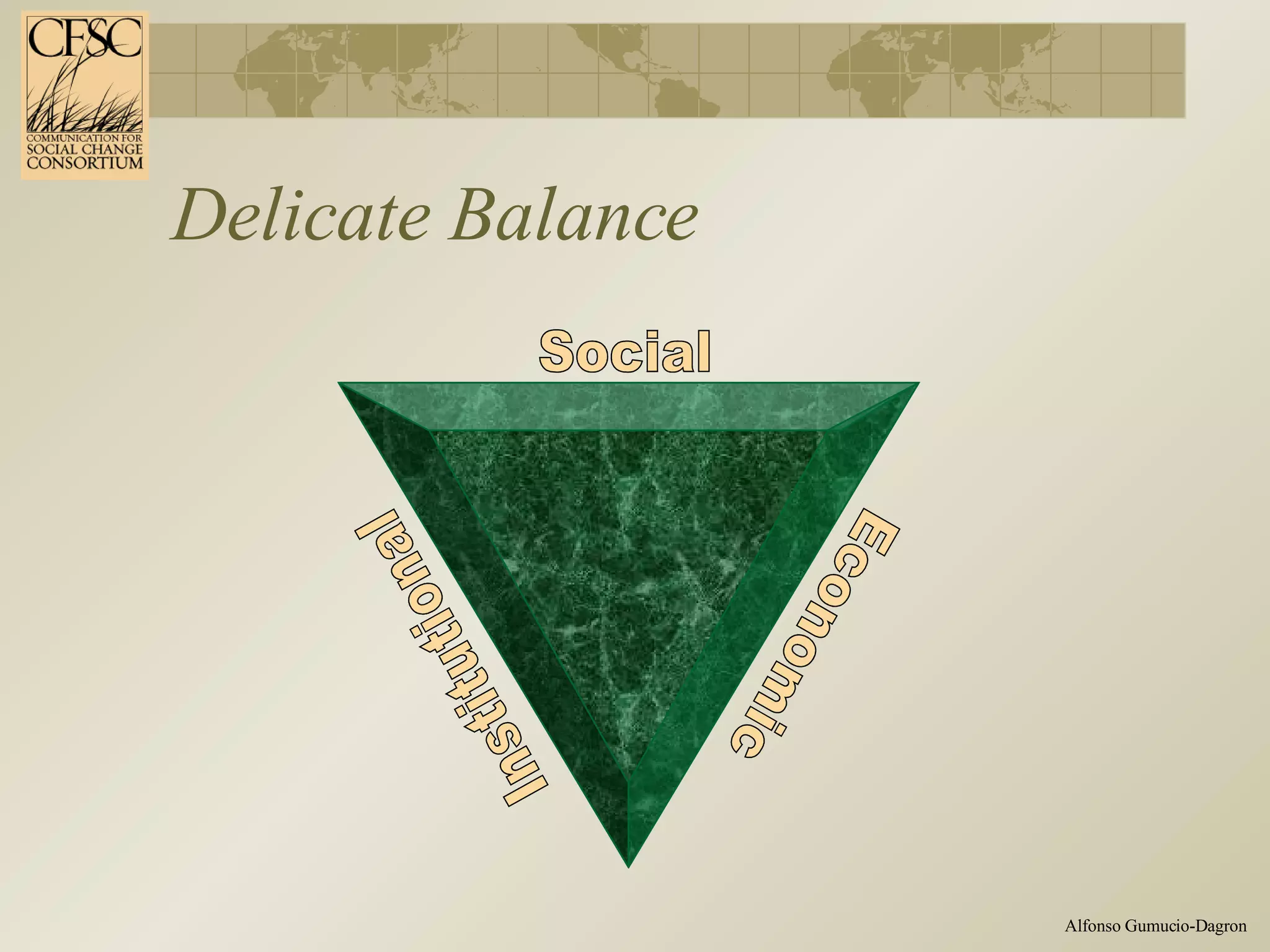
Delicate Balance Social Institutional Economic
Integral Sustainability Institutional Sustainability Enabling environment: Laws and regulations & Public policies Ownership of media –participatory planning Human resources & internal democracy - training  Appropriate technology – the right choices Social Sustainability  Coherence of communicational strategy Social appropriation & ownership Role of local organisations Language and cultural pertinence, local contents Incidence, credibility and social impact Economic Sustainability Local institutions: NGOs, cooperatives, unions Cooperation agencies & programmes  Contributions from the community: in-kind or advertising
Limitations for collaboration No specialised staff in the field Improvisation: journalists, nurses, etc. Confusing language: information / communication communications / communication access / participation Communication budgets mostly for mass media Managerial decision making based on criteria not related to communication
New directions Facilitate dialogue between academic,  development organisations, communities  Elevate hierarchy of communicators  Need to develop the discipline of CFSC Master in CFSC - regional Body of knowledge - 2,335 entries Anthology - 100 authors [emphasis in “hidden” authors Africa, Asia, Latin America] Research on process indicators & evaluation
Going to scale Urgency leads to bad planning & frustrating experiences Confusing scale with short-cuts Looking at citizen media with the crystal of mass media Overestimating mass media Bypassing cultural specificities
The evaluator from the outer world “ Prove” with data that you are worth Unfair vertical measurement of CFSC initiatives External evaluators use methodologies that are alien to social & cultural reality  No specific indicators yet to evaluate  process  of participatory & citizens communication Need to evaluate  qualities  not just quantities New evaluation tools needed - new attitudes Less accountants and more social scientists Participatory evaluation  –  community should speak
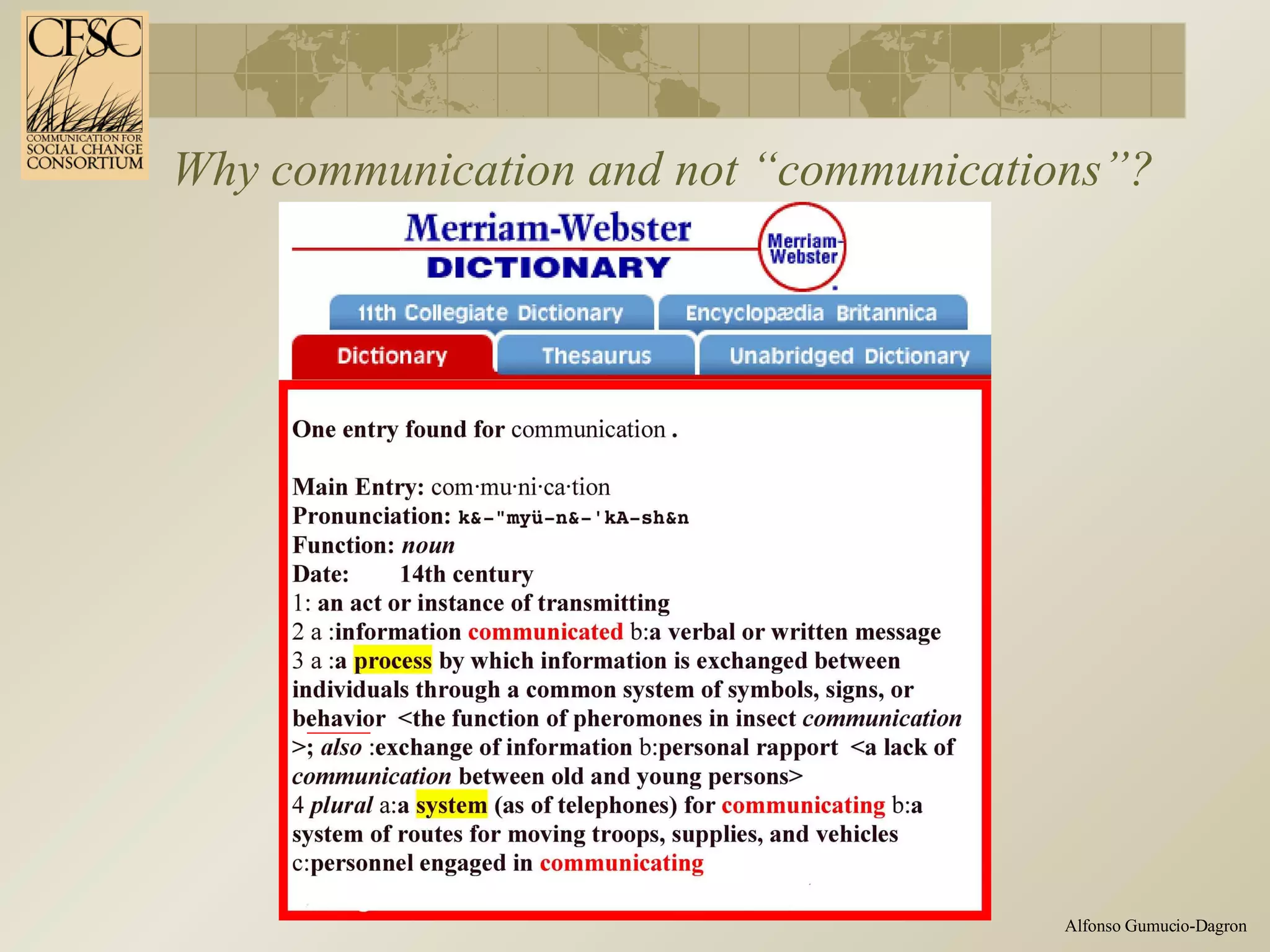
Why communication and not “communications”?

Community Media Approches and the MDGs

  • 1.
    Community media approaches & communication for social change Alfonso Gumucio-Dagron Managing Director, Programmes Communication for Social Change Consortium Communication and Poverty Reduction Strategies by the Year 2015 Bellagio Study and Conference Centre November 8-11, 2004
  • 2.
    People are findingnew and more direct ways to get involved in public life and decision-making –marking a shift from representative democracy to what is often called participatory democracy. Kumi Naidoo Drafting strategy papers in Washington that are subsequently signed off by governments in the name of the people should be a thing of the past. James Wolfensohn
  • 3.
    The cemetery ofdevelopment Half century of missed opportunities: Water pumps without water Roads that lead nowhere Hospitals without health staff Schools without teachers & books Dusty video & radio equipment Backyards full of rusty donated vehicles Immunisation rates down, HIV/AIDS up “ White elephants” in Africa, Asia and Latin America
  • 4.
    Who’s fault? Governmentcorruption Vertical planning from development agencies No dialogue with beneficiaries Communication absent in the process Knowledge arrogance Weak community organization Illegitimate local leadership Submissive relations with power structures No sense of ownership No capacity to voice community views Planners Community
  • 5.
    Models and paradigmsDiffusion of innovations Social Marketing Health promotion Education & Entertainment Alternative, dialogic communication Development communication Communication for social change
  • 6.
    Main differences Hierarchicmodels Participatory approaches Behavioural causes Individual change Passive & “banking” Objects of change Massive diffusion General assumptions Short-term/messages “ Concientisation” Horizontal Structural causes Vertical Persuasion Long-term / process Specific, diverse Dialogue & debate Agents of change Active & critical Social change
  • 7.
    Communication for socialchange Process of dialogue and debate, based on tolerance, respect, equity, social justice & active participation of all stakeholders Recovers lessons learned & experiences from developing countries People centred: rejects hierarchic & vertical mass media intensive models Demand driven: aims community empowerment & local decision-making process
  • 8.
    The notion ofprocess Horizontal Vs. Vertical > People as dynamic communicators Process Vs. Campaign > Democratic participation in planning Long-Term Vs. Short-Term > Processes need to be appropriated Collective Vs. Individual > Serving the interests of the majority Specific Vs. Massive > Content, language & media specific to each culture People needs Vs. Donor musts > Community based research to identify real needs Ownership Vs. Access > Voice and opportunity with no restriction Consciousness Vs. Persuasion > Deep understanding about social reality
  • 9.
    CFSC Principles [1] Sustainability of social changes happens when individuals & communities affected become owners of the communicational process & contents [2] CFSC, horizontal & participatory, aims to strengthen community links and amplify the voices of the poorest; based on the notion of the appropriation of the communicational process and the development of local contents [3] Communities should be the agents of their own social change and master the communication process
  • 10.
    [4] Emphasison promoting dialogue, debate & negotiation, building alliances; rather than: persuasion, pure transfer of information & external knowledge [5] The CFSC process should go beyond individual behaviours and take into consideration social norms, current policies, local culture & tradition, and the general context of development [6] Dialogue & participation are key to strengthen cultural identity, trust, commitment, ownership of ideas & expressions, and community organisation
  • 11.
    [7] CFSCrejects the linear model of transmission of information from a central sender towards a individual receiver, and promotes a circular process of interactions where knowledge is shared and collective action is taken
  • 12.
    The new communicatorFacilitator of dialogue & debate Theoretical & practical balance: process oriented Direct experience in development - community Knowledge of communication practices Strategic, long term thinking Understanding technology is just a tool Flexibility in the alternative use of media Role of amplifying the voices of voiceless Work rooted in cultural identity & dialogue
  • 13.
    A question of power Communication for social change contributes to put the decision-making about development in the hands of the people It consolidates the capability of communities to confront with planners their own ideas about development Within the community itself it favours the strengthening of democratic process
  • 14.
    A question of identity Communication for social change contributes to emphasize cultural pride and self-esteem Reinforces the social tissue through strengthening indigenous & local forms of organisation Protects traditions and cultural values, while being able to incorporate new elements
  • 15.
    Tales of diversity50 years of participatory communication Thousands of simultaneous experiences Radio, video, print, theatre, internet Against all odds – globalisation, privatisation Surprising capability to survive and replicate Strength based in multiplication, not individual growth The will to empower their voices
  • 16.
    Community media Radio: Radio stations (Latin America, Africa, Asia, South Pacific) Video: Maneno Mengi (Tanzania), tool to analyse and plan & SEWA illiterate women (India) Theatre: Promoting immunization (Nigeria) & Wan Smol Bag (Vanuatu) New ICTs: S.M. Swaminathan Foundation- knowledge centres (India)
  • 17.
    Conditions for CommunityMedia [1] Community participation & appropriation [2] Language & cultural pertinence [3] Development of local contents [4] Use of appropriate technology [5] Networking & convergence
  • 18.
    Delicate Balance SocialInstitutional Economic
  • 19.
    Integral Sustainability InstitutionalSustainability Enabling environment: Laws and regulations & Public policies Ownership of media –participatory planning Human resources & internal democracy - training Appropriate technology – the right choices Social Sustainability Coherence of communicational strategy Social appropriation & ownership Role of local organisations Language and cultural pertinence, local contents Incidence, credibility and social impact Economic Sustainability Local institutions: NGOs, cooperatives, unions Cooperation agencies & programmes Contributions from the community: in-kind or advertising
  • 20.
    Limitations for collaborationNo specialised staff in the field Improvisation: journalists, nurses, etc. Confusing language: information / communication communications / communication access / participation Communication budgets mostly for mass media Managerial decision making based on criteria not related to communication
  • 21.
    New directions Facilitatedialogue between academic, development organisations, communities Elevate hierarchy of communicators Need to develop the discipline of CFSC Master in CFSC - regional Body of knowledge - 2,335 entries Anthology - 100 authors [emphasis in “hidden” authors Africa, Asia, Latin America] Research on process indicators & evaluation
  • 22.
    Going to scaleUrgency leads to bad planning & frustrating experiences Confusing scale with short-cuts Looking at citizen media with the crystal of mass media Overestimating mass media Bypassing cultural specificities
  • 23.
    The evaluator fromthe outer world “ Prove” with data that you are worth Unfair vertical measurement of CFSC initiatives External evaluators use methodologies that are alien to social & cultural reality No specific indicators yet to evaluate process of participatory & citizens communication Need to evaluate qualities not just quantities New evaluation tools needed - new attitudes Less accountants and more social scientists Participatory evaluation – community should speak
  • 24.
    Why communication andnot “communications”?