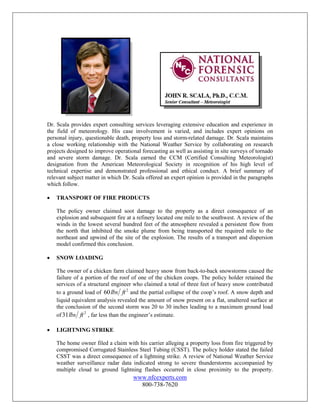
Dr. Scala provides expert consulting services leveraging extensive education and experience in
the field of meteorology. His case involvement is varied, and includes expert opinions on
personal injury, questionable death, property loss and storm-related damage. Dr. Scala maintains
a close working relationship with the National Weather Service by collaborating on research
projects designed to improve operational forecasting as well as assisting in site surveys of tornado
and severe storm damage. Dr. Scala earned the CCM (Certified Consulting Meteorologist)
designation from the American Meteorological Society in recognition of his high level of
technical expertise and demonstrated professional and ethical conduct. A brief summary of
relevant subject matter in which Dr. Scala offered an expert opinion is provided in the paragraphs
which follow.

   TRANSPORT OF FIRE PRODUCTS

    The policy owner claimed soot damage to the property as a direct consequence of an
    explosion and subsequent fire at a refinery located one mile to the southwest. A review of the
    winds in the lowest several hundred feet of the atmosphere revealed a persistent flow from
    the north that inhibited the smoke plume from being transported the required mile to the
    northeast and upwind of the site of the explosion. The results of a transport and dispersion
    model confirmed this conclusion.

   SNOW LOADING

    The owner of a chicken farm claimed heavy snow from back-to-back snowstorms caused the
    failure of a portion of the roof of one of the chicken coops. The policy holder retained the
    services of a structural engineer who claimed a total of three feet of heavy snow contributed
    to a ground load of 60 lbs ft 2 and the partial collapse of the coop’s roof. A snow depth and
    liquid equivalent analysis revealed the amount of snow present on a flat, unaltered surface at
    the conclusion of the second storm was 20 to 30 inches leading to a maximum ground load
    of 31 lbs ft 2 , far less than the engineer’s estimate.

   LIGHTNING STRIKE

    The home owner filed a claim with his carrier alleging a property loss from fire triggered by
    compromised Corrugated Stainless Steel Tubing (CSST). The policy holder stated the failed
    CSST was a direct consequence of a lightning strike. A review of National Weather Service
    weather surveillance radar data indicated strong to severe thunderstorms accompanied by
    multiple cloud to ground lightning flashes occurred in close proximity to the property.
                                      www.nfcexperts.com
                                        800-738-7620
Lightning detection network data identified seven strikes within approximately one mile of
    the property, the closest of these occurred between .20 and .35 miles to the southeast. The
    absence of a direct strike to the property required the current to travel via electrical lines or
    conduit resulting in a likely explanation for the CSST failure.

   WATER INFILTRATION

    The property manager of a three-story building claimed interior water damage to a second
    floor apartment following the displacement of a parapet cap on an exterior wall. The
    dislodging of the cap was claimed by the PM to be associated with a high wind event
    enabling precipitation to enter through the resultant opening. A review of peak wind gusts
    within several weeks of the date of loss failed to identify a specific event capable of exerting
    a wind force from the required direction to lift and displace the parapet cap. The amount of
    water entering the compromised cap and the underlying brickwork was calculated per inch of
    precipitation and over a several month period. The results produced a singular conclusion: the
    failure of the parapet cap occurred gradually leading to repeated episodes of water intrusion
    and the observed property damage.

   HAIL DAMGE

    The policy holder filed a claim for hail damage to his home citing a specific date of loss. A
    review of National Weather Service weather surveillance radar data identified the movement,
    intensity and potential wind speeds associated with severe thunderstorms that developed in
    close proximity to the claim. The most intense of these storms was accompanied by large hail
    (1.25” to 2.5” in diameter). The radar data and derived hail swath analysis indicated the
    damaging hail storm bypassed the property to the southwest nullifying the basis of the claim.

   ILLUMINATION

    The shooting occurred at 6:10 am, two weeks before Christmas. A hunter upon hearing what
    he believed to be was the foraging movements of a deer fired in the direction of the muted
    sounds. His shot struck another hunter who was the source of the noise and killed him.
    Visibility at the time of the shooting was reduced by low clouds and light rain. The shooting
    occurred 69 minutes prior to sunrise and 39 minutes prior to the onset of civil twilight (period
    of time prior to sunrise or after sunset when indirect natural lightning is sufficient to discern
    objects on the ground). The State Game Commission prohibits hunting prior to civil twilight.

   MOTOR VEHICLE ACCIDENT

    The plaintiff (an on-duty police officer) was engaged in an automobile pursuit when he lost
    control of his patrol car after crossing ice on the roadway. The officer’s vehicle jumped the
    curb and sidewalk before striking a second vehicle stopped at an adjacent drive-thru resulting
    in property damage and significant personal injury. The plaintiff alleged a leaky fire hydrant
    contributed the water which led to the formation of ice on the roadway. The accident
    occurred during a prolonged period of exceptionally cold weather based on review of the
    local climate data. The leaky fire hydrant provided a constant source of running water that
    flowed onto a sub-freezing surface leading to a continuous buildup of ice. Sodium chloride as
    a deicing agent is known to be ineffective at these extreme temperatures.


                                      www.nfcexperts.com
                                        800-738-7620

Meteorologist in Forensics

  • 1.
    Dr. Scala providesexpert consulting services leveraging extensive education and experience in the field of meteorology. His case involvement is varied, and includes expert opinions on personal injury, questionable death, property loss and storm-related damage. Dr. Scala maintains a close working relationship with the National Weather Service by collaborating on research projects designed to improve operational forecasting as well as assisting in site surveys of tornado and severe storm damage. Dr. Scala earned the CCM (Certified Consulting Meteorologist) designation from the American Meteorological Society in recognition of his high level of technical expertise and demonstrated professional and ethical conduct. A brief summary of relevant subject matter in which Dr. Scala offered an expert opinion is provided in the paragraphs which follow.  TRANSPORT OF FIRE PRODUCTS The policy owner claimed soot damage to the property as a direct consequence of an explosion and subsequent fire at a refinery located one mile to the southwest. A review of the winds in the lowest several hundred feet of the atmosphere revealed a persistent flow from the north that inhibited the smoke plume from being transported the required mile to the northeast and upwind of the site of the explosion. The results of a transport and dispersion model confirmed this conclusion.  SNOW LOADING The owner of a chicken farm claimed heavy snow from back-to-back snowstorms caused the failure of a portion of the roof of one of the chicken coops. The policy holder retained the services of a structural engineer who claimed a total of three feet of heavy snow contributed to a ground load of 60 lbs ft 2 and the partial collapse of the coop’s roof. A snow depth and liquid equivalent analysis revealed the amount of snow present on a flat, unaltered surface at the conclusion of the second storm was 20 to 30 inches leading to a maximum ground load of 31 lbs ft 2 , far less than the engineer’s estimate.  LIGHTNING STRIKE The home owner filed a claim with his carrier alleging a property loss from fire triggered by compromised Corrugated Stainless Steel Tubing (CSST). The policy holder stated the failed CSST was a direct consequence of a lightning strike. A review of National Weather Service weather surveillance radar data indicated strong to severe thunderstorms accompanied by multiple cloud to ground lightning flashes occurred in close proximity to the property. www.nfcexperts.com 800-738-7620
  • 2.
    Lightning detection networkdata identified seven strikes within approximately one mile of the property, the closest of these occurred between .20 and .35 miles to the southeast. The absence of a direct strike to the property required the current to travel via electrical lines or conduit resulting in a likely explanation for the CSST failure.  WATER INFILTRATION The property manager of a three-story building claimed interior water damage to a second floor apartment following the displacement of a parapet cap on an exterior wall. The dislodging of the cap was claimed by the PM to be associated with a high wind event enabling precipitation to enter through the resultant opening. A review of peak wind gusts within several weeks of the date of loss failed to identify a specific event capable of exerting a wind force from the required direction to lift and displace the parapet cap. The amount of water entering the compromised cap and the underlying brickwork was calculated per inch of precipitation and over a several month period. The results produced a singular conclusion: the failure of the parapet cap occurred gradually leading to repeated episodes of water intrusion and the observed property damage.  HAIL DAMGE The policy holder filed a claim for hail damage to his home citing a specific date of loss. A review of National Weather Service weather surveillance radar data identified the movement, intensity and potential wind speeds associated with severe thunderstorms that developed in close proximity to the claim. The most intense of these storms was accompanied by large hail (1.25” to 2.5” in diameter). The radar data and derived hail swath analysis indicated the damaging hail storm bypassed the property to the southwest nullifying the basis of the claim.  ILLUMINATION The shooting occurred at 6:10 am, two weeks before Christmas. A hunter upon hearing what he believed to be was the foraging movements of a deer fired in the direction of the muted sounds. His shot struck another hunter who was the source of the noise and killed him. Visibility at the time of the shooting was reduced by low clouds and light rain. The shooting occurred 69 minutes prior to sunrise and 39 minutes prior to the onset of civil twilight (period of time prior to sunrise or after sunset when indirect natural lightning is sufficient to discern objects on the ground). The State Game Commission prohibits hunting prior to civil twilight.  MOTOR VEHICLE ACCIDENT The plaintiff (an on-duty police officer) was engaged in an automobile pursuit when he lost control of his patrol car after crossing ice on the roadway. The officer’s vehicle jumped the curb and sidewalk before striking a second vehicle stopped at an adjacent drive-thru resulting in property damage and significant personal injury. The plaintiff alleged a leaky fire hydrant contributed the water which led to the formation of ice on the roadway. The accident occurred during a prolonged period of exceptionally cold weather based on review of the local climate data. The leaky fire hydrant provided a constant source of running water that flowed onto a sub-freezing surface leading to a continuous buildup of ice. Sodium chloride as a deicing agent is known to be ineffective at these extreme temperatures. www.nfcexperts.com 800-738-7620