INTRODUCTION TO SOFTWARE ENGINEERING

          1- INTRODUCTION

 Prepared By:
          Ahmed Alageed


                                       1
COURSE DETAILS
This Course will cover the following Topics:
 Introduction.

 Software Process Models.

 Requirements Analysis & Specification

 Design

 Coding


                                               2
COURSE DETAILS
 Testing
 Maintenance

 Computer Aided Software Engineering
  (CASE)
 Software quality assurance

 Managing Software Projects


                                        3
LEARNING OBJECTIVES
After successfully completing the module
student should be :
 explain the software engineering principles
  and techniques that are used in developing
  quality software products
 apply software engineering principles and
  techniques     appropriately  to   develop
  moderately complex software system


                                            4
ASSESSMENT METHOD

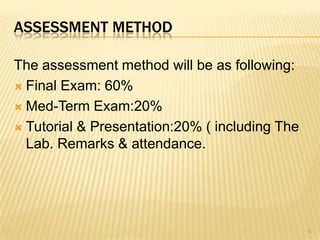
The assessment method will be as following:
 Final Exam: 60%

 Med-Term Exam:20%

 Tutorial & Presentation:20% ( including The
  Lab. Remarks & attendance.


                                                5
COURSE LAB.


   In the practical part of this course you will
    learn how to use CASE tools (UML) in
    addition to do some tutorial related to the
    course subjects.


                                                    6
CONTACT INFO.
 You can contact me at any time by Email:
            Aalageed@neelain.edu.sd
 I will be available at my office on Sat. from
  12:00 PM to 2:00 PM


                                                  7
COURSE REFERENCES

 Main Reading:
1. Software       Engineering        by       Ian
   Sommerville,     8th    edition,     Addison-
   Wesley, 2006.
2. Software    Engineering: A practitioner's
   approach by Roger S. Pressman, 6th
   edition,      McGraw-Hill        International
   edition, 2005.

                                                8
COURSE REFERENCES
    Supplementary Reading
1.   http://portal.acm.org/citation.cfm?id=1159393
2.   http://www.vnunet.com/vnunet/news/211731
     5/air-traffic-system-already-obsolete


                                                     9
1. INTRODUCTION

Instructional Objectives
 Describe what software is, different types of
  software and software quality attributes
 Describe with the problems associated with
  software and software development
 Define what software engineering is and
  explain why it is important
 State some professional issues related to
  software development

                                              10
1.1 SOFTWARE
1.1.1. What is software? [Ref.1: pg. 5-6]
 Computer      programs      and         associated
  documentation such as requirements, design
  models and user manuals in addition to data
  structure.

   Software products may be developed for a
    particular customer or may be developed for
    a general market.

                                                   11
1.1.1 WHAT IS SOFTWARE
   Software products may be
     Generic   - developed to be sold to a range of
      different customers e.g. PC software such as
      Excel or Word.
     Custom - developed for a single customer
      according to their specification.
   New software can be created by developing
    new programs, configuring generic software
    systems or reusing existing software.


                                                       12
1.1 SOFTWARE
1.1.2. Types of software [Ref.2: pg. 40-41]
 System software

 Application Software.

 Engineering and scientific software

 Embedded software

 Product-line software.

 Web-based software

 Artificial intelligence software


                                              13
1.1 SOFTWARE

1.1.3. Characteristics of Software [Ref.2: pg. 36-39]
[Ref.4]

 Software  is differ form any other thing
  that human beings build.
 Software is a logical rather than a
  physical system element. Therefore
  software has characteristics that are
  considerably different than those of
  hardware.
                                                    14
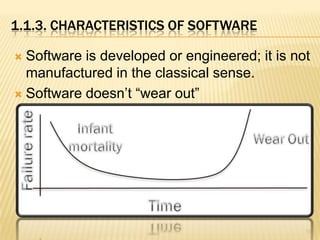
1.1.3. CHARACTERISTICS OF SOFTWARE

 Software is developed or engineered; it is not
  manufactured in the classical sense.
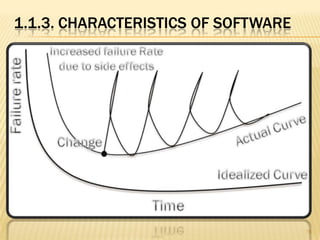
 Software doesn’t “wear out”


                                               15
1.1.3. CHARACTERISTICS OF SOFTWARE


                                     16
1.1.3. CHARACTERISTICS OF SOFTWARE
   Although the industry is moving toward
    component-based        construction,  most
    software continues to be custom built


                                             17
1.1 SOFTWARE

1.1.4. Attributes of good software [Ref.1: pg. 34-35]
 The software should deliver the required
  functionality and performance to the
  user and should be maintainable,
  dependable and acceptable.
 Maintainability
   Software   must evolve to meet changing
    needs;


                                                    18
1.1.4. ATTRIBUTES OF GOOD SOFTWARE
   Dependability
     Software   must be trustworthy;
   Efficiency
     Software should not make wasteful use of
      system resources;
   Acceptability
     Software  must accepted by the users for which it
      was designed. This means it must be
      understandable, usable and compatible with
      other systems.

                                                      19
SUCCESSFUL SOFTWARE SYSTEM
 Software development projects have not
  always been successful.
 When do we consider a software application
  successful?
     Development      completed.
     It’s useful.
     It’s usable.

     And it’s used.


                                               20
REASONS FOR FAILURE
 Schedule slippage.
 Cost-over run.

 Does not solve user’s problem.


                                   21
REASONS FOR FAILURE
   Ad hoc software development results in such
    problems:
     No planning of development works(e.g no
      milestones defined).
     Deliverables to user not identified.
     Poor understanding of user requirements.
     No control or review.
     Technical incompetence of developers.
     Poor understanding of cost and effort by both
      developer & user.

                                                      22
ENGINEERING: OTHER DISCIPLINES
   Large projects common and successfully
    done:
     Buildings  bridges, Dams.
     Power plants

     Aircrafts

    Engineering a solution:
     To design, develop( build, fabricates) an artifact
      that meets specifications efficiently, cost-
      effectively and ensuring quality
     Using scientific principles

                                                           23
ENGINEERING
   Requires well-defined approach:
    repeatable, predictable


                                      24
1.2. SOFTWARE ENGINEERING
1.2.1. What is software engineering? [Ref.1: pg.
29]

 Software engineering is an engineering
  discipline that is concerned with all aspects
  of software production.
 Software engineers should adopt a
  systematic and organised approach to their
  work and use appropriate tools and
  techniques depending on the problem to be
  solved, the development constraints and the
  resources available.                             25
WHAT IS THE DIFFERENCE BETWEEN SOFTWARE
ENGINEERING AND COMPUTER SCIENCE?
 Computer science is concerned with theory
  and fundamentals; software engineering is
  concerned with the practicalities of
  developing and delivering useful software.
 Computer science theories are still
  insufficient to act as a complete underpinning
  for software engineering (unlike e.g. physics
  and electrical engineering).


                                               26
WHAT IS THE DIFFERENCE BETWEEN SOFTWARE
ENGINEERING AND SYSTEM ENGINEERING?
 System engineering is concerned with all
  aspects     of    computer-based        systems
  development including hardware, software
  and     process      engineering.      Software
  engineering is part of this process concerned
  with developing the software infrastructure,
  control, applications and databases in the
  system.
 System engineers are involved in system
  specification, architectural design, integration
  and deployment.
                                                27
WHAT IS A SOFTWARE PROCESS?
 A set of activities whose goal is the
  development or evolution of software.
 Generic activities in all software processes
  are:
     Specification - what the system should do and its
      development constraints
     Development - production of the software system
     Validation - checking that the software is what
      the customer wants
     Evolution - changing the software in response to
      changing demands.
                                                      28
WHAT IS A SOFTWARE PROCESS MODEL?
 A simplified representation of a software
  process, presented from a specific
  perspective.
 Examples of process perspectives are
     Workflow  perspective - sequence of activities;
     Data-flow perspective - information flow;

     Role/action perspective - who does what.


                                                        29
WHAT IS A SOFTWARE PROCESS MODEL?
   Generic process models
     Waterfall;

     Iterative
            development;
     Component-based software engineering.


                                              30
1.2. SOFTWARE ENGINEERING
1.2.2. Software engineering costs [Ref.1: pg. 31-33]
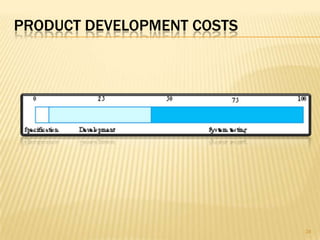
 Roughly 60% of costs are development
  costs, 40% are testing costs. For custom
  software, evolution costs often exceed
  development costs.
 Costs vary depending on the type of system
  being developed and the requirements of
  system attributes such as performance and
  system reliability.

                                                   31
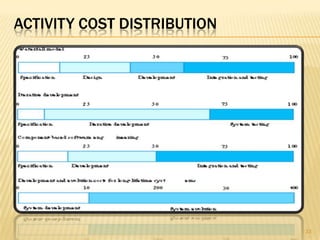
1.2.2. SOFTWARE ENGINEERING COSTS

   Distribution of costs depends on the
    development model that is used.


                                           32
ACTIVITY COST DISTRIBUTION


                             33
PRODUCT DEVELOPMENT COSTS


                            34
1.2. SOFTWARE ENGINEERING
1.2.3. What are the key challenges facing
software engineering? [Ref.1: pg. 35-36]
Heterogeneity, delivery and trust.
 Heterogeneity
   Developingtechniques for building software that
   can cope with heterogeneous platforms and
   execution environments;


                                                      35
1.2.3. WHAT ARE THE KEY CHALLENGES
FACING SOFTWARE ENGINEERING?
   Delivery
     Developing   techniques that lead to faster
      delivery of software;
   Trust
     Developing techniques that demonstrate that
      software can be trusted by its users.


                                                    36
1.2. SOFTWARE ENGINEERING
1.2.5. Professional Practice [Ref.1: pg. 36-39; Ref.2: pg.
128-149]

   Confidentiality
     Engineers      should normally respect the
      confidentiality of their employers or clients
      irrespective of whether or not a formal
      confidentiality agreement has been signed.
   Competence
     Engineers should not misrepresent their level of
      competence. They should not knowingly accept
      work which is outwith their competence.

                                                             37
1.2.5. PROFESSIONAL PRACTICE
 Intellectual   property rights
   Engineers   should be aware of local laws
    governing the use of intellectual property such
    as patents, copyright, etc. They should be
    careful to ensure that the intellectual property
    of employers and clients is protected.


                                                  38
1.2.5. PROFESSIONAL PRACTICE
 Computer     misuse
   Software  engineers should not use their
   technical skills to misuse other people’s
   computers. Computer misuse ranges from
   relatively trivial (game playing on an
   employer’s machine, say) to extremely
   serious (dissemination of viruses).


                                               39

1 se-introduction

  • 1.
    INTRODUCTION TO SOFTWAREENGINEERING 1- INTRODUCTION Prepared By: Ahmed Alageed 1
  • 2.
    COURSE DETAILS This Coursewill cover the following Topics:  Introduction.  Software Process Models.  Requirements Analysis & Specification  Design  Coding 2
  • 3.
    COURSE DETAILS  Testing Maintenance  Computer Aided Software Engineering (CASE)  Software quality assurance  Managing Software Projects 3
  • 4.
    LEARNING OBJECTIVES After successfullycompleting the module student should be :  explain the software engineering principles and techniques that are used in developing quality software products  apply software engineering principles and techniques appropriately to develop moderately complex software system 4
  • 5.
    ASSESSMENT METHOD The assessmentmethod will be as following:  Final Exam: 60%  Med-Term Exam:20%  Tutorial & Presentation:20% ( including The Lab. Remarks & attendance. 5
  • 6.
    COURSE LAB.  In the practical part of this course you will learn how to use CASE tools (UML) in addition to do some tutorial related to the course subjects. 6
  • 7.
    CONTACT INFO.  Youcan contact me at any time by Email: Aalageed@neelain.edu.sd  I will be available at my office on Sat. from 12:00 PM to 2:00 PM 7
  • 8.
    COURSE REFERENCES  MainReading: 1. Software Engineering by Ian Sommerville, 8th edition, Addison- Wesley, 2006. 2. Software Engineering: A practitioner's approach by Roger S. Pressman, 6th edition, McGraw-Hill International edition, 2005. 8
  • 9.
    COURSE REFERENCES  Supplementary Reading 1. http://portal.acm.org/citation.cfm?id=1159393 2. http://www.vnunet.com/vnunet/news/211731 5/air-traffic-system-already-obsolete 9
  • 10.
    1. INTRODUCTION Instructional Objectives Describe what software is, different types of software and software quality attributes  Describe with the problems associated with software and software development  Define what software engineering is and explain why it is important  State some professional issues related to software development 10
  • 11.
    1.1 SOFTWARE 1.1.1. Whatis software? [Ref.1: pg. 5-6]  Computer programs and associated documentation such as requirements, design models and user manuals in addition to data structure.  Software products may be developed for a particular customer or may be developed for a general market. 11
  • 12.
    1.1.1 WHAT ISSOFTWARE  Software products may be  Generic - developed to be sold to a range of different customers e.g. PC software such as Excel or Word.  Custom - developed for a single customer according to their specification.  New software can be created by developing new programs, configuring generic software systems or reusing existing software. 12
  • 13.
    1.1 SOFTWARE 1.1.2. Typesof software [Ref.2: pg. 40-41]  System software  Application Software.  Engineering and scientific software  Embedded software  Product-line software.  Web-based software  Artificial intelligence software 13
  • 14.
    1.1 SOFTWARE 1.1.3. Characteristicsof Software [Ref.2: pg. 36-39] [Ref.4]  Software is differ form any other thing that human beings build.  Software is a logical rather than a physical system element. Therefore software has characteristics that are considerably different than those of hardware. 14
  • 15.
    1.1.3. CHARACTERISTICS OFSOFTWARE  Software is developed or engineered; it is not manufactured in the classical sense.  Software doesn’t “wear out” 15
  • 16.
  • 17.
    1.1.3. CHARACTERISTICS OFSOFTWARE  Although the industry is moving toward component-based construction, most software continues to be custom built 17
  • 18.
    1.1 SOFTWARE 1.1.4. Attributesof good software [Ref.1: pg. 34-35]  The software should deliver the required functionality and performance to the user and should be maintainable, dependable and acceptable.  Maintainability  Software must evolve to meet changing needs; 18
  • 19.
    1.1.4. ATTRIBUTES OFGOOD SOFTWARE  Dependability  Software must be trustworthy;  Efficiency  Software should not make wasteful use of system resources;  Acceptability  Software must accepted by the users for which it was designed. This means it must be understandable, usable and compatible with other systems. 19
  • 20.
    SUCCESSFUL SOFTWARE SYSTEM Software development projects have not always been successful.  When do we consider a software application successful?  Development completed.  It’s useful.  It’s usable.  And it’s used. 20
  • 21.
    REASONS FOR FAILURE Schedule slippage.  Cost-over run.  Does not solve user’s problem. 21
  • 22.
    REASONS FOR FAILURE  Ad hoc software development results in such problems:  No planning of development works(e.g no milestones defined).  Deliverables to user not identified.  Poor understanding of user requirements.  No control or review.  Technical incompetence of developers.  Poor understanding of cost and effort by both developer & user. 22
  • 23.
    ENGINEERING: OTHER DISCIPLINES  Large projects common and successfully done:  Buildings bridges, Dams.  Power plants  Aircrafts Engineering a solution:  To design, develop( build, fabricates) an artifact that meets specifications efficiently, cost- effectively and ensuring quality  Using scientific principles 23
  • 24.
    ENGINEERING  Requires well-defined approach: repeatable, predictable 24
  • 25.
    1.2. SOFTWARE ENGINEERING 1.2.1.What is software engineering? [Ref.1: pg. 29]  Software engineering is an engineering discipline that is concerned with all aspects of software production.  Software engineers should adopt a systematic and organised approach to their work and use appropriate tools and techniques depending on the problem to be solved, the development constraints and the resources available. 25
  • 26.
    WHAT IS THEDIFFERENCE BETWEEN SOFTWARE ENGINEERING AND COMPUTER SCIENCE?  Computer science is concerned with theory and fundamentals; software engineering is concerned with the practicalities of developing and delivering useful software.  Computer science theories are still insufficient to act as a complete underpinning for software engineering (unlike e.g. physics and electrical engineering). 26
  • 27.
    WHAT IS THEDIFFERENCE BETWEEN SOFTWARE ENGINEERING AND SYSTEM ENGINEERING?  System engineering is concerned with all aspects of computer-based systems development including hardware, software and process engineering. Software engineering is part of this process concerned with developing the software infrastructure, control, applications and databases in the system.  System engineers are involved in system specification, architectural design, integration and deployment. 27
  • 28.
    WHAT IS ASOFTWARE PROCESS?  A set of activities whose goal is the development or evolution of software.  Generic activities in all software processes are:  Specification - what the system should do and its development constraints  Development - production of the software system  Validation - checking that the software is what the customer wants  Evolution - changing the software in response to changing demands. 28
  • 29.
    WHAT IS ASOFTWARE PROCESS MODEL?  A simplified representation of a software process, presented from a specific perspective.  Examples of process perspectives are  Workflow perspective - sequence of activities;  Data-flow perspective - information flow;  Role/action perspective - who does what. 29
  • 30.
    WHAT IS ASOFTWARE PROCESS MODEL?  Generic process models  Waterfall;  Iterative development;  Component-based software engineering. 30
  • 31.
    1.2. SOFTWARE ENGINEERING 1.2.2.Software engineering costs [Ref.1: pg. 31-33]  Roughly 60% of costs are development costs, 40% are testing costs. For custom software, evolution costs often exceed development costs.  Costs vary depending on the type of system being developed and the requirements of system attributes such as performance and system reliability. 31
  • 32.
    1.2.2. SOFTWARE ENGINEERINGCOSTS  Distribution of costs depends on the development model that is used. 32
  • 33.
  • 34.
  • 35.
    1.2. SOFTWARE ENGINEERING 1.2.3.What are the key challenges facing software engineering? [Ref.1: pg. 35-36] Heterogeneity, delivery and trust.  Heterogeneity  Developingtechniques for building software that can cope with heterogeneous platforms and execution environments; 35
  • 36.
    1.2.3. WHAT ARETHE KEY CHALLENGES FACING SOFTWARE ENGINEERING?  Delivery  Developing techniques that lead to faster delivery of software;  Trust  Developing techniques that demonstrate that software can be trusted by its users. 36
  • 37.
    1.2. SOFTWARE ENGINEERING 1.2.5.Professional Practice [Ref.1: pg. 36-39; Ref.2: pg. 128-149]  Confidentiality  Engineers should normally respect the confidentiality of their employers or clients irrespective of whether or not a formal confidentiality agreement has been signed.  Competence  Engineers should not misrepresent their level of competence. They should not knowingly accept work which is outwith their competence. 37
  • 38.
    1.2.5. PROFESSIONAL PRACTICE Intellectual property rights  Engineers should be aware of local laws governing the use of intellectual property such as patents, copyright, etc. They should be careful to ensure that the intellectual property of employers and clients is protected. 38
  • 39.
    1.2.5. PROFESSIONAL PRACTICE Computer misuse  Software engineers should not use their technical skills to misuse other people’s computers. Computer misuse ranges from relatively trivial (game playing on an employer’s machine, say) to extremely serious (dissemination of viruses). 39