Si l ti d M d li
Simulation and Modeling
By
P f S Sh k
Prof. S.Shakya
1
Si l ti d M d li
Simulation and Modeling
L 3 T 1 P 1 5
L-3, T-1, P-1.5
2
References:
1. G. Gorden, “ System simulation”
2. Jerry Banks, John S. Carson, II Barry L.
Nelson , David M. Nocol, “Discrete Event
system simulation”
3
Introduction to Modeling and simulation
4
System
 The term system is derive from the Greek word systema,
which means an organized relationship among functioning
units or components
units or components.
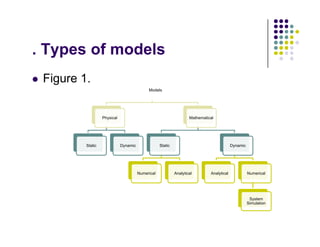
 System exists because it is designed to achieve one or more
objectives.
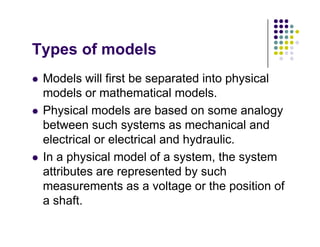
We come into daily contact with the transportation system
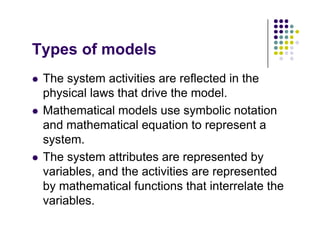
 We come into daily contact with the transportation system,
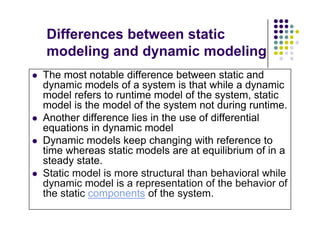
the telephone system, the accounting system, the production
system, and for two decades the computer system.
 There are more than a hundred definitions of the word
system, but most seem to have a common thread that
suggests that a system is an orderly grouping of
interdependent components linked together according to a
p p g g
plan to achieve a specific objective.
5
System
 The study of the systems concepts then has
 The study of the systems concepts, then, has
three basic implications:
1. A system must be designed to achieve a
predetermined objective
2. Interrelationships and interdependence must
exist among the components
3. The objectives of the organization as a whole
h hi h i it th th bj ti f it
have a higher priority than the objectives of its
subsystems.
6
System
 Klir* gives a collection of 24 definitions one such
 Klir gives a collection of 24 definitions one such
definition is “ A system is a collection of
components wherein individual components are
t i d b ti i t l ti hi h
constrained by connecting interrelationships such
that the system as a whole fulfills some specific
functions in response to varying demands”
*Klir, George J. , an approach to general systems
theory New York: Van Nostrand Reinhold Co
theory, New York: Van Nostrand Reinhold Co,
1969
7
S k d t k
Some keywords to know …
 System
It i ll ti f titi th t t d i t t
 It is a collection of entities that act and interact
together toward the accomplishment of some
logical end (computer, network, communication
g ( p , ,
systems, queuing systems etc.)
 Simulation
 It is an experiment in a computer where the real
system is replaced by the execution of the
program
 It is a program that mimics (imitate) the behaviour
of the real system
of the real system
Some keywords to know …
 Model
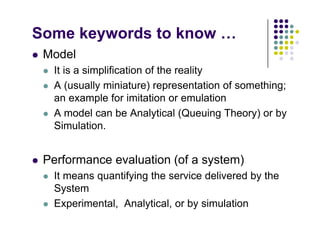
 It is a simplification of the reality
 A (usually miniature) representation of something;
an example for imitation or emulation
 A model can be Analytical (Queuing Theory) or by
Simulation.
 Performance evaluation (of a system)
 It means quantifying the service delivered by the
System
E i t l A l ti l b i l ti
 Experimental, Analytical, or by simulation
Introduction
S t
 System
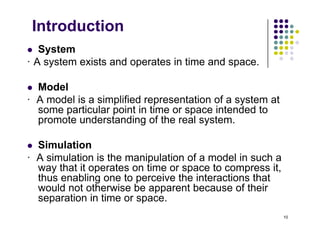
· A system exists and operates in time and space.
 Model
· A model is a simplified representation of a system at
some particular point in time or space intended to
promote understanding of the real system.
 Simulation
· A simulation is the manipulation of a model in such a
way that it operates on time or space to compress it,
thus enabling one to perceive the interactions that
would not otherwise be apparent because of their
separation in time or space.
10
separation in time or space.
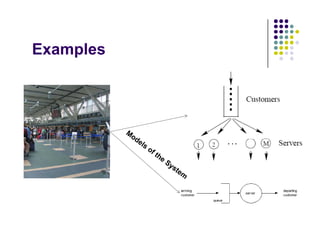
E l
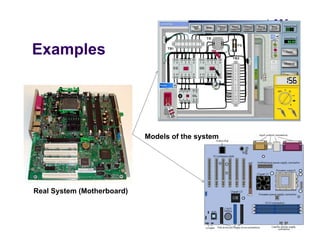
Examples
Models of the system
y
Real System (Motherboard)
E l
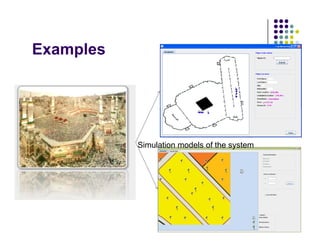
Examples
Simulation models of the system
E l
Examples
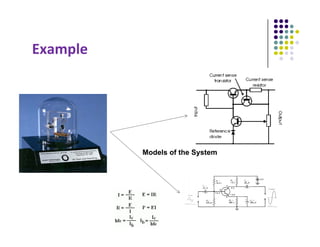
E l
Example
Models of the System
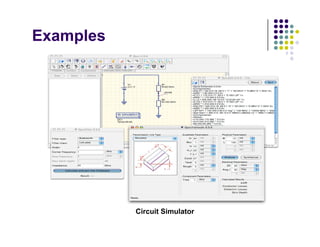
Examples
Models of the system
y
Circuit Simulator
Concept of Simulation
 Simulation is the representation of a real life
system by another system, which depicts the
important characteristics of the real system and
ll i t ti it
allows experimentation on it.
 In another word simulation is an imitation of the
reality.
y
 Simulation has long been used by the
researchers, analysts, designers and other
professionals in the physical and non physical
professionals in the physical and non-physical
experimentations and investigations.
16
Why Simulate?
Why Simulate?
 It may be too difficult, hazardous, or expensive to observe a real,
y , , p ,
operational system
 Parts of the system may not be observable (e.g., internals of a
silicon chip or biological system)
Uses of simulations
 Analyze systems before they are built
 Reduce number of design mistakes
 Optimize design
 Analyze operational systems
 Create virtual environments for training, entertainment
17
When to use Simulation
 Over the years tremendous developments have taken
place in computing capabilities and in special purpose
simulation languages, and in simulation methodologies.
Th f i l ti t h i h l b
 The use of simulation techniques has also become
widespread.
 Following are some of the purposes for which simulation
may be used
may be used.
1. Simulation is very useful for experiments with the internal
interactions of a complex system, or of a subsystem within
a complex system
a complex system.
2. Simulation can be employed to experiment with new designs
and policies, before implementing
3 Simulation can be used to verify the results obtained by
3. Simulation can be used to verify the results obtained by
analytical methods and reinforce the analytical techniques.
4. Simulation is very useful in determining the influence of
changes in input variables on the output of the system.
18
changes in input variables on the output of the system.
5. Simulation helps in suggesting modifications in the system
under investigation for its optimal performance.
T f Si l ti M d l
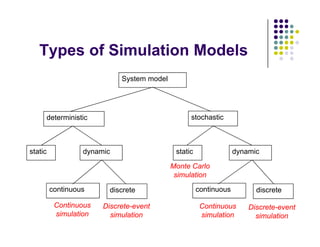
Types of Simulation Models
S t d l
System model
deterministic stochastic
static dynamic static dynamic
Monte Carlo
continuous discrete continuous discrete
simulation
Discrete-event
simulation
Continuous
simulation
Discrete-event
simulation
Continuous
simulation
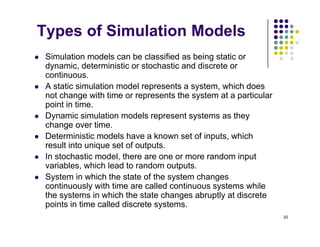
Types of Simulation Models
 Simulation models can be classified as being static or
dynamic, deterministic or stochastic and discrete or
continuous
continuous.
 A static simulation model represents a system, which does
not change with time or represents the system at a particular
point in time.
p
 Dynamic simulation models represent systems as they
change over time.
 Deterministic models have a known set of inputs, which
p ,
result into unique set of outputs.
 In stochastic model, there are one or more random input
variables, which lead to random outputs.
 System in which the state of the system changes
continuously with time are called continuous systems while
the systems in which the state changes abruptly at discrete
i t i ti ll d di t t
20
points in time called discrete systems.
Stochastic vs Deterministic
Stochastic vs. Deterministic
 Stochastic simulation: a simulation that contains
random (probabilistic) elements, e.g.,
(p ) , g ,
 Examples
 Inter-arrival time or service time of customers at a restaurant
or store
or store
 Amount of time required to service a customer
 Output is a random quantity (multiple runs required
analyze output)
analyze output)
 Deterministic simulation: a simulation containing
no random elements
 Examples
 Simulation of a digital circuit
 Simulation of a chemical reaction based on differential
equations
 Output is deterministic for a given set of inputs
St ti D i M d l
Static vs. Dynamic Models
 Static models
 Static models
 Model where time is not a significant variable
 Examples
p
 Determine the probability of a winning solitaire hand
 Static + stochastic = Monte Carlo simulation
 Statistical sampling to develop approximate solutions to
numerical problems
 Dynamic models
M d l f i th l ti f th t d
 Model focusing on the evolution of the system under
investigation over time
 Main focus of this course
C ti Di t
Continuous vs. Discrete
 Discrete
 Discrete
 State of the system is viewed as changing at discrete
points in time
 An event is associated with each state transition
 Events contain time stamp
 Continuous
 Continuous
 State of the system is viewed as changing
continuously across time
 System typically described by a set of differential
equations
T f M d l
Types of Models
Models used in system studies have been
 Models used in system studies have been
classified in many ways.
Th l ifi ti th t ill b d h
 The classification that will be used here are
illustrated in the Figure 1.
T f d l
. Types of models
Figure 1
 Figure 1.
Models
Physical Mathematical
Static Dynamic Static Dynamic
Numerical Analytical Analytical Numerical
System
Simulation
T f d l
Types of models
Models will first be separated into physical
 Models will first be separated into physical
models or mathematical models.
Ph i l d l b d l
 Physical models are based on some analogy
between such systems as mechanical and
electrical or electrical and hydraulic
electrical or electrical and hydraulic.
 In a physical model of a system, the system
attributes are represented by such
measurements as a voltage or the position of
a shaft
a shaft.
T f d l
Types of models
The system activities are reflected in the
 The system activities are reflected in the
physical laws that drive the model.
M th ti l d l b li t ti
 Mathematical models use symbolic notation
and mathematical equation to represent a
system
system.
 The system attributes are represented by
variables and the activities are represented
variables, and the activities are represented
by mathematical functions that interrelate the
variables
variables.
Differences between static
modeling and dynamic modeling
 The most notable difference between static and
dynamic models of a system is that while a dynamic
model refers to runtime model of the system, static
model is the model of the system not during runtime.
 Another difference lies in the use of differential
equations in dynamic model
 Dynamic models keep changing with reference to
time whereas static models are at equilibrium of in a
steady state.
St ti d l i t t l th b h i l hil
 Static model is more structural than behavioral while
dynamic model is a representation of the behavior of
the static components of the system.
Differences between static
d li d d i d li
modeling and dynamic modeling
 Static modeling includes class diagram and object
diagrams and help in depicting static constituents of the
system.
 Dynamic modeling on the other hand consists of sequence
y g q
of operations, state changes, activities, interactions and
memory.
 Static modeling is more rigid than dynamic modeling as it is
ti i d d t i f t
a time independent view of a system.
 It cannot be changed in real time and this is why it is
referred to as static modeling.
D i d li i fl ibl it h ith ti
 Dynamic modeling is flexible as it can change with time as
it shows what an object does with many possibilities that
might arise in time.
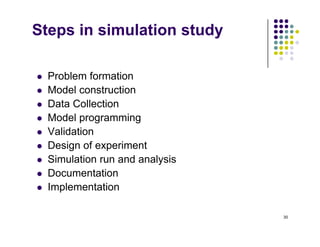
Steps in simulation study
 Problem formation
 Problem formation
 Model construction
 Data Collection
 Model programming
 Validation
 Design of experiment
 Simulation run and analysis
D t ti
 Documentation
 Implementation
30
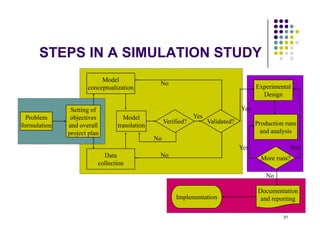
STEPS IN A SIMULATION STUDY
S i f
Model
conceptualization
No
Experimental
Design
Yes
Problem
formulation
Setting of
objectives
and overall
project plan
Model
translation
Verified?
No
Validated? Production runs
and analysis
Yes
Yes
Data
collection
No
No More runs?
Yes Yes
Documentation
and reporting
No
Implementation
31
p g
Ph I Si l ti St d
Phases In Simulation Study
Thi i di id i f h
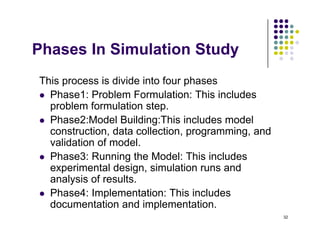
This process is divide into four phases
 Phase1: Problem Formulation: This includes
problem formulation step
problem formulation step.
 Phase2:Model Building:This includes model
construction, data collection, programming, and
lid ti f d l
validation of model.
 Phase3: Running the Model: This includes
experimental design, simulation runs and
analysis of results.
 Phase4: Implementation: This includes
d t ti d i l t ti
32
documentation and implementation.
Ph I Si l ti St d
Phases In Simulation Study
Thi i di id i f h
This process is divide into four phases
 Phase1: Problem Formulation: This includes
problem formulation step
problem formulation step.
 Phase2:Model Building:This includes model
construction, data collection, programming, and
lid ti f d l
validation of model.
 Phase3: Running the Model: This includes
experimental design, simulation runs and
analysis of results.
 Phase4: Implementation: This includes
d t ti d i l t ti
33
documentation and implementation.
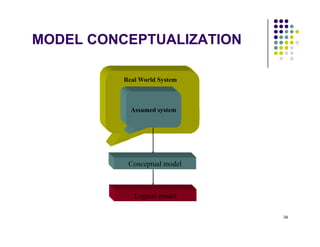
MODEL CONCEPTUALIZATION
A d
Real World System
Assumed system
Conceptual model
Logical model
34
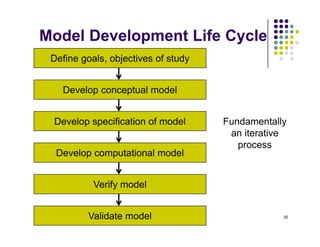
Model Development Life Cycle
Define goals, objectives of study
Develop conceptual model
Develop specification of model Fundamentally
an iterative
Develop computational model
process
Verify model
35
Validate model
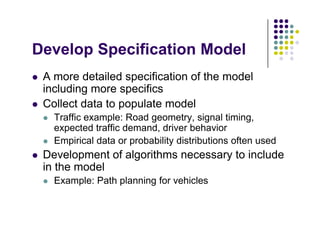
D l S ifi ti M d l
Develop Specification Model
 A more detailed specification of the model
including more specifics
 Collect data to populate model
p p
 Traffic example: Road geometry, signal timing,
expected traffic demand, driver behavior
Empirical data or probability distributions often used
 Empirical data or probability distributions often used
 Development of algorithms necessary to include
in the model
in the model
 Example: Path planning for vehicles
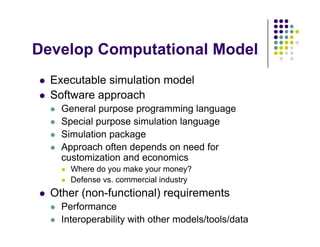
D l C t ti l M d l
Develop Computational Model
E t bl i l ti d l
 Executable simulation model
 Software approach
 General purpose programming language
 Special purpose simulation language
 Simulation package
p g
 Approach often depends on need for
customization and economics
 Where do you make your money?
 Defense vs. commercial industry
 Other (non-functional) requirements
 Performance
 Interoperability with other models/tools/data
V ifi ti
Verification
 Did I build the model right?
 Does the computational model match the
specification model?
 Largely a software engineering activity
(debugging)
(debugging)
 Not to be confused with correctness (see
d l lid ti )!
model validation)!
V lid ti
Validation
 Did I build the right model?
 Does the computational model match the
actual (or envisioned) system?
( ) y
 Typically, compare against
 Measurements of actual system
 An analytic (mathematical) model of the system
 Another simulation model
 By necessity always an incomplete activity!
 By necessity, always an incomplete activity!
 Often can only validate portions of the model
 If you can validate the simulation with 100%
y
certainty, why build the simulation?
Advantages of Simulation
 Simulation helps to learn about real system, without having
the system at all. For example the wind tunnel testing of the
d l f l d t i f ll i d l
model of an aeroplane does not require a full sized plane.
 Many managerial decision making problems are too complex
to be solved by mathematical programming.
 In many situations experimenting with actual system may not
be possible at all. For example, it is not possible to conduct
experiment, to study the behavior of a man on the surface of
moon In some other situations even if experimentation is
moon. In some other situations, even if experimentation is
possible, it may be too costly and risky,
 In the real system, the changes we want to study may take
place too slowly or too fast to be observed conveniently
place too slowly or too fast to be observed conveniently.
Computer simulation can compress the performance of a
system over years into a few minutes of computer running
time.
40
Advantages of Simulation
 Conversely, in systems like nuclear reactors where millions
of events take place per second, simulation can expand the
time to required level
time to required level.
 Through simulation, management can foresee the difficulties
and bottlenecks which may come up due to the introduction
and bottlenecks, which may come up due to the introduction
of new machines, equipments and processes. It thus
eliminates the need of costly trial and error method of trying
out the new concepts.
 Simulation being relatively free from mathematics can easily
be understood by the operating personnel and non-technical
y g
managers. This helps in getting the proposed plans accepted
and implemented.
41
 Simulation Models are comparatively flexible and can be
modified to accommodate the changing environment to the
real situation.
Advantages of Simulation
g
Si l ti t h i i i t th th th ti l
 Simulation technique is easier to use than the mathematical
models, and can be used for wide range of situations.
 Extensive computer software packages are available making
 Extensive computer software packages are available, making
it very convenient to use fairly sophisticated simulation
models.
 Simulation is a very good tool of training and has
advantageously been used for training the operating and
managerial staff in the operation of complex system.Space
engineers simulate space flights in laboratories to train the
future astronauts for working in weightless environment.
 Airline pilots are given extensive training on flight simulators,
42
g g g
before they are allowed to handle real planes.
Di d t f Si l ti
Disadvantages of Simulation
M d l b ildi i i l t i i It i t th t i
 Model building requires special training. It is an art that is
learned over time and through experience. Furthermore, if
two models are constructed by two competent individuals,
they may have similarities but it is highly unlike that they will
they may have similarities, but it is highly unlike that they will
be the same.
 Simulation results may be difficult to interpret. Since most
simulation outputs are essentially random variables, it may
be hard to determine whether an observation is a result result
of system interrelations or randomness.
 Simulation is used in some cases when an analytical solution
y
is possible, or even preferable.
 Simulation modeling and analysis can be time consuming
and expensive.
43
Areas of Applications
pp
 Manufacturing: Design analysis and optimization of
production system, materials management, capacity
planning, layout planning, and performance evaluation,
evaluation of process quality.
e a uat o o p ocess qua ty
 Business: Market analysis, prediction of consumer behavior,
and optimization of marketing strategy and logistics,
comparative evaluation of marketing campaigns.
44
Areas of Applications
pp
 Military:Testing of alternative combat strategies, air
i i i l d
operations, sea operations, simulated war
exercises, practicing ordinance effectiveness,
inventory management.
 Healthcare applications; such as planning of health
services, expected patient density, facilities
requirement, hospital staffing , estimating the
effectiveness of a health care program.
45
Areas of Applications
 Communication Applications: Such as network
design and optimization evaluating network
design, and optimization, evaluating network
reliability, manpower planning, sizing of message
buffers.
 Computer Applications: Such as designing
hardware configurations and operating system
g p g y
protocols, sharing networking. Client/Server
system architecture
 Economic applications: such as portfolio
management, forecasting impact of Govt. Policies
and international market fluctuations on the
46
and international market fluctuations on the
economy. Budgeting and forecasting market
fluctuations.
Areas of Applications
 Transportation applications: Design and testing of
alternative transportation policies transportation
alternative transportation policies, transportation
networks-roads, railways, airways etc. Evaluation of
timetables, traffic planning.
 Environment application: Solid waste management,
performance evaluation of environmental programs,
evaluation of pollution control systems.
p y
 Biological applications; Such as population genetics
and spread of epidemics.
p p
 Business process Re-engineering: Integrating business
process re-engineering with image –based work flow,
47
p g g g ,
using process modeling and analysis tool.
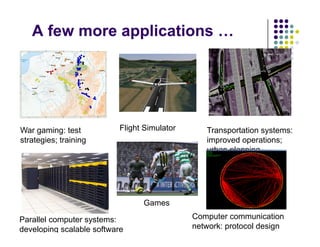
A few more applications …
War gaming: test
strategies; training
Flight Simulator Transportation systems:
improved operations;
strategies; training improved operations;
urban planning
Games
Computer communication
network: protocol design
Parallel computer systems:
developing scalable software
Games
S
Summary
 Modeling and simulation is an important,
id l d t h i ith id f
widely used technique with a wide range of
applications
 Computation power increases (Moore’s law) have
 Computation power increases (Moore s law) have
made it more pervasive
 In some cases, it has become essential (e.g., to be
economically competitive)
 Rich variety of types of models, applications, uses
 Appropriate methodologies required to
Appropriate methodologies required to
protect against major mistakes.

1-introduction-to-simulation-ioenotes.pdf

  • 1.
    Si l tid M d li Simulation and Modeling By P f S Sh k Prof. S.Shakya 1
  • 2.
    Si l tid M d li Simulation and Modeling L 3 T 1 P 1 5 L-3, T-1, P-1.5 2
  • 3.
    References: 1. G. Gorden,“ System simulation” 2. Jerry Banks, John S. Carson, II Barry L. Nelson , David M. Nocol, “Discrete Event system simulation” 3
  • 4.
    Introduction to Modelingand simulation 4
  • 5.
    System  The termsystem is derive from the Greek word systema, which means an organized relationship among functioning units or components units or components.  System exists because it is designed to achieve one or more objectives. We come into daily contact with the transportation system  We come into daily contact with the transportation system, the telephone system, the accounting system, the production system, and for two decades the computer system.  There are more than a hundred definitions of the word  There are more than a hundred definitions of the word system, but most seem to have a common thread that suggests that a system is an orderly grouping of interdependent components linked together according to a p p g g plan to achieve a specific objective. 5
  • 6.
    System  The studyof the systems concepts then has  The study of the systems concepts, then, has three basic implications: 1. A system must be designed to achieve a 1. A system must be designed to achieve a predetermined objective 2. Interrelationships and interdependence must exist among the components 3. The objectives of the organization as a whole h hi h i it th th bj ti f it have a higher priority than the objectives of its subsystems. 6
  • 7.
    System  Klir* givesa collection of 24 definitions one such  Klir gives a collection of 24 definitions one such definition is “ A system is a collection of components wherein individual components are t i d b ti i t l ti hi h constrained by connecting interrelationships such that the system as a whole fulfills some specific functions in response to varying demands” *Klir, George J. , an approach to general systems theory New York: Van Nostrand Reinhold Co theory, New York: Van Nostrand Reinhold Co, 1969 7
  • 8.
    S k dt k Some keywords to know …  System It i ll ti f titi th t t d i t t  It is a collection of entities that act and interact together toward the accomplishment of some logical end (computer, network, communication g ( p , , systems, queuing systems etc.)  Simulation  It is an experiment in a computer where the real system is replaced by the execution of the program  It is a program that mimics (imitate) the behaviour of the real system of the real system
  • 9.
    Some keywords toknow …  Model  It is a simplification of the reality  A (usually miniature) representation of something; an example for imitation or emulation  A model can be Analytical (Queuing Theory) or by Simulation.  Performance evaluation (of a system)  It means quantifying the service delivered by the System E i t l A l ti l b i l ti  Experimental, Analytical, or by simulation
  • 10.
    Introduction S t  System ·A system exists and operates in time and space.  Model · A model is a simplified representation of a system at some particular point in time or space intended to some particular point in time or space intended to promote understanding of the real system.  Simulation · A simulation is the manipulation of a model in such a way that it operates on time or space to compress it, way that it operates on time or space to compress it, thus enabling one to perceive the interactions that would not otherwise be apparent because of their separation in time or space. 10 separation in time or space.
  • 11.
    E l Examples Models ofthe system y Real System (Motherboard)
  • 12.
  • 13.
  • 14.
  • 15.
    Examples Models of thesystem y Circuit Simulator
  • 16.
    Concept of Simulation Simulation is the representation of a real life  Simulation is the representation of a real life system by another system, which depicts the important characteristics of the real system and ll i t ti it allows experimentation on it.  In another word simulation is an imitation of the reality. y  Simulation has long been used by the researchers, analysts, designers and other professionals in the physical and non physical professionals in the physical and non-physical experimentations and investigations. 16
  • 17.
    Why Simulate? Why Simulate? It may be too difficult, hazardous, or expensive to observe a real, y , , p , operational system  Parts of the system may not be observable (e.g., internals of a silicon chip or biological system) Uses of simulations  Analyze systems before they are built  Analyze systems before they are built  Reduce number of design mistakes  Optimize design  Analyze operational systems  Analyze operational systems  Create virtual environments for training, entertainment 17
  • 18.
    When to useSimulation  Over the years tremendous developments have taken place in computing capabilities and in special purpose simulation languages, and in simulation methodologies. Th f i l ti t h i h l b  The use of simulation techniques has also become widespread.  Following are some of the purposes for which simulation may be used may be used. 1. Simulation is very useful for experiments with the internal interactions of a complex system, or of a subsystem within a complex system a complex system. 2. Simulation can be employed to experiment with new designs and policies, before implementing 3 Simulation can be used to verify the results obtained by 3. Simulation can be used to verify the results obtained by analytical methods and reinforce the analytical techniques. 4. Simulation is very useful in determining the influence of changes in input variables on the output of the system. 18 changes in input variables on the output of the system. 5. Simulation helps in suggesting modifications in the system under investigation for its optimal performance.
  • 19.
    T f Sil ti M d l Types of Simulation Models S t d l System model deterministic stochastic static dynamic static dynamic Monte Carlo continuous discrete continuous discrete simulation Discrete-event simulation Continuous simulation Discrete-event simulation Continuous simulation
  • 20.
    Types of SimulationModels  Simulation models can be classified as being static or dynamic, deterministic or stochastic and discrete or continuous continuous.  A static simulation model represents a system, which does not change with time or represents the system at a particular point in time. p  Dynamic simulation models represent systems as they change over time.  Deterministic models have a known set of inputs, which p , result into unique set of outputs.  In stochastic model, there are one or more random input variables, which lead to random outputs.  System in which the state of the system changes continuously with time are called continuous systems while the systems in which the state changes abruptly at discrete i t i ti ll d di t t 20 points in time called discrete systems.
  • 21.
    Stochastic vs Deterministic Stochasticvs. Deterministic  Stochastic simulation: a simulation that contains random (probabilistic) elements, e.g., (p ) , g ,  Examples  Inter-arrival time or service time of customers at a restaurant or store or store  Amount of time required to service a customer  Output is a random quantity (multiple runs required analyze output) analyze output)  Deterministic simulation: a simulation containing no random elements  Examples  Simulation of a digital circuit  Simulation of a chemical reaction based on differential  Simulation of a chemical reaction based on differential equations  Output is deterministic for a given set of inputs
  • 22.
    St ti Di M d l Static vs. Dynamic Models  Static models  Static models  Model where time is not a significant variable  Examples p  Determine the probability of a winning solitaire hand  Static + stochastic = Monte Carlo simulation  Statistical sampling to develop approximate solutions to  Statistical sampling to develop approximate solutions to numerical problems  Dynamic models M d l f i th l ti f th t d  Model focusing on the evolution of the system under investigation over time  Main focus of this course
  • 23.
    C ti Dit Continuous vs. Discrete  Discrete  Discrete  State of the system is viewed as changing at discrete points in time  An event is associated with each state transition  Events contain time stamp  Continuous  Continuous  State of the system is viewed as changing continuously across time  System typically described by a set of differential equations
  • 24.
    T f Md l Types of Models Models used in system studies have been  Models used in system studies have been classified in many ways. Th l ifi ti th t ill b d h  The classification that will be used here are illustrated in the Figure 1.
  • 25.
    T f dl . Types of models Figure 1  Figure 1. Models Physical Mathematical Static Dynamic Static Dynamic Numerical Analytical Analytical Numerical System Simulation
  • 26.
    T f dl Types of models Models will first be separated into physical  Models will first be separated into physical models or mathematical models. Ph i l d l b d l  Physical models are based on some analogy between such systems as mechanical and electrical or electrical and hydraulic electrical or electrical and hydraulic.  In a physical model of a system, the system attributes are represented by such attributes are represented by such measurements as a voltage or the position of a shaft a shaft.
  • 27.
    T f dl Types of models The system activities are reflected in the  The system activities are reflected in the physical laws that drive the model. M th ti l d l b li t ti  Mathematical models use symbolic notation and mathematical equation to represent a system system.  The system attributes are represented by variables and the activities are represented variables, and the activities are represented by mathematical functions that interrelate the variables variables.
  • 28.
    Differences between static modelingand dynamic modeling  The most notable difference between static and  The most notable difference between static and dynamic models of a system is that while a dynamic model refers to runtime model of the system, static model is the model of the system not during runtime. model is the model of the system not during runtime.  Another difference lies in the use of differential equations in dynamic model  Dynamic models keep changing with reference to  Dynamic models keep changing with reference to time whereas static models are at equilibrium of in a steady state. St ti d l i t t l th b h i l hil  Static model is more structural than behavioral while dynamic model is a representation of the behavior of the static components of the system.
  • 29.
    Differences between static dli d d i d li modeling and dynamic modeling  Static modeling includes class diagram and object  Static modeling includes class diagram and object diagrams and help in depicting static constituents of the system.  Dynamic modeling on the other hand consists of sequence y g q of operations, state changes, activities, interactions and memory.  Static modeling is more rigid than dynamic modeling as it is ti i d d t i f t a time independent view of a system.  It cannot be changed in real time and this is why it is referred to as static modeling. D i d li i fl ibl it h ith ti  Dynamic modeling is flexible as it can change with time as it shows what an object does with many possibilities that might arise in time.
  • 30.
    Steps in simulationstudy  Problem formation  Problem formation  Model construction  Data Collection  Model programming  Validation  Design of experiment  Simulation run and analysis D t ti  Documentation  Implementation 30
  • 31.
    STEPS IN ASIMULATION STUDY S i f Model conceptualization No Experimental Design Yes Problem formulation Setting of objectives and overall project plan Model translation Verified? No Validated? Production runs and analysis Yes Yes Data collection No No More runs? Yes Yes Documentation and reporting No Implementation 31 p g
  • 32.
    Ph I Sil ti St d Phases In Simulation Study Thi i di id i f h This process is divide into four phases  Phase1: Problem Formulation: This includes problem formulation step problem formulation step.  Phase2:Model Building:This includes model construction, data collection, programming, and lid ti f d l validation of model.  Phase3: Running the Model: This includes experimental design, simulation runs and experimental design, simulation runs and analysis of results.  Phase4: Implementation: This includes d t ti d i l t ti 32 documentation and implementation.
  • 33.
    Ph I Sil ti St d Phases In Simulation Study Thi i di id i f h This process is divide into four phases  Phase1: Problem Formulation: This includes problem formulation step problem formulation step.  Phase2:Model Building:This includes model construction, data collection, programming, and lid ti f d l validation of model.  Phase3: Running the Model: This includes experimental design, simulation runs and experimental design, simulation runs and analysis of results.  Phase4: Implementation: This includes d t ti d i l t ti 33 documentation and implementation.
  • 34.
    MODEL CONCEPTUALIZATION A d RealWorld System Assumed system Conceptual model Logical model 34
  • 35.
    Model Development LifeCycle Define goals, objectives of study Develop conceptual model Develop specification of model Fundamentally an iterative Develop computational model process Verify model 35 Validate model
  • 36.
    D l Sifi ti M d l Develop Specification Model  A more detailed specification of the model  A more detailed specification of the model including more specifics  Collect data to populate model p p  Traffic example: Road geometry, signal timing, expected traffic demand, driver behavior Empirical data or probability distributions often used  Empirical data or probability distributions often used  Development of algorithms necessary to include in the model in the model  Example: Path planning for vehicles
  • 37.
    D l Ct ti l M d l Develop Computational Model E t bl i l ti d l  Executable simulation model  Software approach  General purpose programming language  General purpose programming language  Special purpose simulation language  Simulation package p g  Approach often depends on need for customization and economics  Where do you make your money?  Where do you make your money?  Defense vs. commercial industry  Other (non-functional) requirements  Performance  Interoperability with other models/tools/data
  • 38.
    V ifi ti Verification Did I build the model right?  Did I build the model right?  Does the computational model match the specification model? specification model?  Largely a software engineering activity (debugging) (debugging)  Not to be confused with correctness (see d l lid ti )! model validation)!
  • 39.
    V lid ti Validation Did I build the right model?  Did I build the right model?  Does the computational model match the actual (or envisioned) system? ( ) y  Typically, compare against  Measurements of actual system  An analytic (mathematical) model of the system  Another simulation model  By necessity always an incomplete activity!  By necessity, always an incomplete activity!  Often can only validate portions of the model  If you can validate the simulation with 100% y certainty, why build the simulation?
  • 40.
    Advantages of Simulation Simulation helps to learn about real system, without having the system at all. For example the wind tunnel testing of the d l f l d t i f ll i d l model of an aeroplane does not require a full sized plane.  Many managerial decision making problems are too complex to be solved by mathematical programming.  In many situations experimenting with actual system may not be possible at all. For example, it is not possible to conduct experiment, to study the behavior of a man on the surface of moon In some other situations even if experimentation is moon. In some other situations, even if experimentation is possible, it may be too costly and risky,  In the real system, the changes we want to study may take place too slowly or too fast to be observed conveniently place too slowly or too fast to be observed conveniently. Computer simulation can compress the performance of a system over years into a few minutes of computer running time. 40
  • 41.
    Advantages of Simulation Conversely, in systems like nuclear reactors where millions of events take place per second, simulation can expand the time to required level time to required level.  Through simulation, management can foresee the difficulties and bottlenecks which may come up due to the introduction and bottlenecks, which may come up due to the introduction of new machines, equipments and processes. It thus eliminates the need of costly trial and error method of trying out the new concepts.  Simulation being relatively free from mathematics can easily be understood by the operating personnel and non-technical y g managers. This helps in getting the proposed plans accepted and implemented. 41  Simulation Models are comparatively flexible and can be modified to accommodate the changing environment to the real situation.
  • 42.
    Advantages of Simulation g Sil ti t h i i i t th th th ti l  Simulation technique is easier to use than the mathematical models, and can be used for wide range of situations.  Extensive computer software packages are available making  Extensive computer software packages are available, making it very convenient to use fairly sophisticated simulation models.  Simulation is a very good tool of training and has advantageously been used for training the operating and managerial staff in the operation of complex system.Space engineers simulate space flights in laboratories to train the engineers simulate space flights in laboratories to train the future astronauts for working in weightless environment.  Airline pilots are given extensive training on flight simulators, 42 g g g before they are allowed to handle real planes.
  • 43.
    Di d tf Si l ti Disadvantages of Simulation M d l b ildi i i l t i i It i t th t i  Model building requires special training. It is an art that is learned over time and through experience. Furthermore, if two models are constructed by two competent individuals, they may have similarities but it is highly unlike that they will they may have similarities, but it is highly unlike that they will be the same.  Simulation results may be difficult to interpret. Since most simulation outputs are essentially random variables, it may simulation outputs are essentially random variables, it may be hard to determine whether an observation is a result result of system interrelations or randomness.  Simulation is used in some cases when an analytical solution y is possible, or even preferable.  Simulation modeling and analysis can be time consuming and expensive. 43
  • 44.
    Areas of Applications pp Manufacturing: Design analysis and optimization of  Manufacturing: Design analysis and optimization of production system, materials management, capacity planning, layout planning, and performance evaluation, evaluation of process quality. e a uat o o p ocess qua ty  Business: Market analysis, prediction of consumer behavior, and optimization of marketing strategy and logistics, and optimization of marketing strategy and logistics, comparative evaluation of marketing campaigns. 44
  • 45.
    Areas of Applications pp Military:Testing of alternative combat strategies, air i i i l d operations, sea operations, simulated war exercises, practicing ordinance effectiveness, inventory management. inventory management.  Healthcare applications; such as planning of health services, expected patient density, facilities requirement, hospital staffing , estimating the effectiveness of a health care program. 45
  • 46.
    Areas of Applications Communication Applications: Such as network design and optimization evaluating network design, and optimization, evaluating network reliability, manpower planning, sizing of message buffers.  Computer Applications: Such as designing hardware configurations and operating system g p g y protocols, sharing networking. Client/Server system architecture  Economic applications: such as portfolio management, forecasting impact of Govt. Policies and international market fluctuations on the 46 and international market fluctuations on the economy. Budgeting and forecasting market fluctuations.
  • 47.
    Areas of Applications Transportation applications: Design and testing of alternative transportation policies transportation alternative transportation policies, transportation networks-roads, railways, airways etc. Evaluation of timetables, traffic planning.  Environment application: Solid waste management, performance evaluation of environmental programs, evaluation of pollution control systems. p y  Biological applications; Such as population genetics and spread of epidemics. p p  Business process Re-engineering: Integrating business process re-engineering with image –based work flow, 47 p g g g , using process modeling and analysis tool.
  • 48.
    A few moreapplications … War gaming: test strategies; training Flight Simulator Transportation systems: improved operations; strategies; training improved operations; urban planning Games Computer communication network: protocol design Parallel computer systems: developing scalable software Games
  • 49.
    S Summary  Modeling andsimulation is an important, id l d t h i ith id f widely used technique with a wide range of applications  Computation power increases (Moore’s law) have  Computation power increases (Moore s law) have made it more pervasive  In some cases, it has become essential (e.g., to be economically competitive) economically competitive)  Rich variety of types of models, applications, uses  Appropriate methodologies required to Appropriate methodologies required to protect against major mistakes.