

ABSTRACT
•

The World Wide Web, which has started as a document bank, is rapidly
transforming to a full fledged virtual environment that facilitates
services, interaction, and communication.

•

Under this light, the Semantic Web and Web 2.0 movements can be seen
as intermediate steps of a natural evolution towards a new paradigm, the
3D Internet.

•

Here we Going to Present How to Implement 3D internet against 2D
Technology and present 3D methodologies
INTRODUCTION
•

The Internet is evolving to become the de-facto cyberspace or virtual
environment

•

Facilitating communication ,business, and entertainment on a global
scale.

•

A typical 2D website is an extremely abstract entity and consists of
nothing but a

•

Bunch of documents and pictures.
CONT’D…
•

The user immediate navigational help. Otherwise, the user would get
lost sooner or later.

•

3D internet is actually a much better alternative way of organizing
data

•
•

Which everybody knows and uses.
On the other hand, virtual worlds such as Second Life (SL)is much
younger
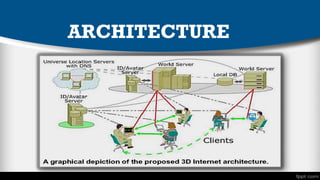
ARCHITECTURE
APPLICATIONS
•

3D Internet as an interactive virtual environment for

•

Services, interaction, and communication.

•

Social Networks: Face book, MySpace, Linked-In, …

•

Web 2.0: Wiki’s, blogs, communities, …

•

Web as a distributed computing platform: Face book, Games.
CONT’D…
WEB 2.0

 A Web 2.0 site allows its users to interact with each other as contributors to the
website's content, in contrast to websites where users are limited to the passive
viewing of information that is provided to them. 
SEMANTIC WEB:

In semantic web metadata would enable automated agents and other software to
access the Web more intelligently. The agents would be able to perform tasks
automatically and locate related information on behalf of the user.
IMPLEMENTATION USING VRML
VRML-VIRTUAL REALITY MODELLING LANGUAGE
•The VRML format is based on SGI’s Open Inventor format. It is a platform
independent format, supported by most common 3D packages. It includes
graphic, text, multimedia elements, net-work and scripting facilities.
•A VRML file contains objects named nodes. A node exists of fields and
parameters The total 54 nodes can grouped in geo-metric primitives, grouping
nodes, light sources, appearance nodes, sound, definitions and prototypes,
sensors and scripting nodes. The file is coded in UTF8.
CONT’D…
• Like most of the data formats today, a VRML world is defined as a hierarchical
scene graph. A scene consists of grouping nodes. Shapes are the components
of groups. A shape consists of geometry (primitives, indexed face sets) and
appearance (material, image texture).
• VRML enables linking to other Web resources and contains facilities for
interaction and animation. Scripting based on Java or JavaScript is possible.
With the external authoring interface is a connection between VRML and the
scripting language available.
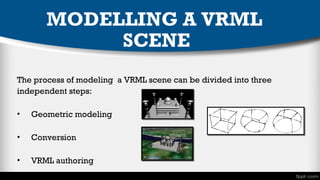
MODELLING A VRML
SCENE
The process of modeling a VRML scene can be divided into three
independent steps:
•

Geometric modeling

•

Conversion

•

VRML authoring
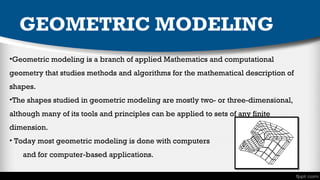
GEOMETRIC MODELING
•Geometric modeling is a branch of applied Mathematics and computational
geometry that studies methods and algorithms for the mathematical description of
shapes.
•The shapes studied in geometric modeling are mostly two- or three-dimensional,
although many of its tools and principles can be applied to sets of any finite
dimension.
• Today most geometric modeling is done with computers
and for computer-based applications. 
CONVERSION
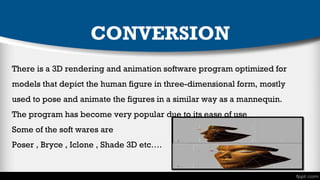
There is a 3D rendering and animation software program optimized for
models that depict the human figure in three-dimensional form, mostly
used to pose and animate the figures in a similar way as a mannequin.
The program has become very popular due to its ease of use
Some of the soft wares are
Poser , Bryce , Iclone , Shade 3D etc….
AUTHORING – USING TOOLS
FROM PARALLELGRAPHICS
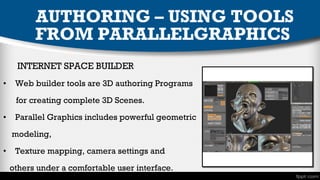
INTERNET SPACE BUILDER
•

Web builder tools are 3D authoring Programs
for creating complete 3D Scenes.

•

Parallel Graphics includes powerful geometric
modeling,

•

Texture mapping, camera settings and
others under a comfortable user interface.
VRML-Pad
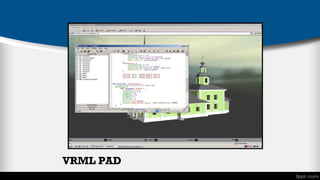
VRML Pad is Another powerful and flexible authoring tool from
Parallel Graphics that allows text editing of VRML files.
FINAL IMPLEMENTATION IN WEB
It may Be Implemented in Any of the Web creating Languages
Especially HTML
•
•

Designing walkthrough environments with VRML is despite the limitations of the
rendering quality of existing browsers an opportunity due to the open standard.
The object has to be modeled for multipurpose use from web access with l limited
bandwidth to real time VR in immersive environments .
VRML PAD
FUTURE OF 3D
INTERNET
•

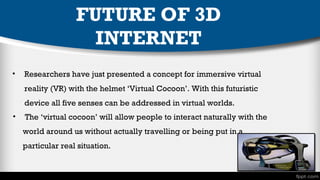
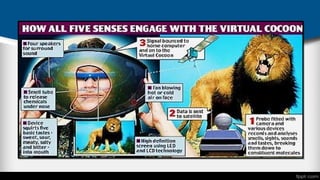
Researchers have just presented a concept for immersive virtual
reality (VR) with the helmet ‘Virtual Cocoon’. With this futuristic
device all five senses can be addressed in virtual worlds.

•

The ‘virtual cocoon’ will allow people to interact naturally with the
world around us without actually travelling or being put in a
particular real situation.
CONCLUSION
•

Provided an overview of 3d internet

•

Discussed the motivation behind it and specific research directions
in the fields of networking security,distribuited computing and
machine learning

•

There are still many research challenges on the way

•

We can use the existing hype as a driver of research and realization
of 3d internet
REFERENCES
•T. Alpcan, C. Bauckhage, and S. Agarwal. An efficient ontology-based expert
peering system. In Proc. 6th IAPR Workshop on Graph-based Repr. in Pattern Recog.
•www.hplusmagazine.com/articles/virtual-reality/virtual-cocoon
•http://www.webreference.com/3d/
abhi.globalistic@gmail.com
3D Internet

3D Internet

  • 2.
    ABSTRACT • The World WideWeb, which has started as a document bank, is rapidly transforming to a full fledged virtual environment that facilitates services, interaction, and communication. • Under this light, the Semantic Web and Web 2.0 movements can be seen as intermediate steps of a natural evolution towards a new paradigm, the 3D Internet. • Here we Going to Present How to Implement 3D internet against 2D Technology and present 3D methodologies
  • 3.
    INTRODUCTION • The Internet isevolving to become the de-facto cyberspace or virtual environment • Facilitating communication ,business, and entertainment on a global scale. • A typical 2D website is an extremely abstract entity and consists of nothing but a • Bunch of documents and pictures.
  • 4.
    CONT’D… • The user immediatenavigational help. Otherwise, the user would get lost sooner or later. • 3D internet is actually a much better alternative way of organizing data • • Which everybody knows and uses. On the other hand, virtual worlds such as Second Life (SL)is much younger
  • 5.
  • 6.
    APPLICATIONS • 3D Internet asan interactive virtual environment for • Services, interaction, and communication. • Social Networks: Face book, MySpace, Linked-In, … • Web 2.0: Wiki’s, blogs, communities, … • Web as a distributed computing platform: Face book, Games.
  • 7.
    CONT’D… WEB 2.0  A Web2.0 site allows its users to interact with each other as contributors to the website's content, in contrast to websites where users are limited to the passive viewing of information that is provided to them.  SEMANTIC WEB: In semantic web metadata would enable automated agents and other software to access the Web more intelligently. The agents would be able to perform tasks automatically and locate related information on behalf of the user.
  • 8.
    IMPLEMENTATION USING VRML VRML-VIRTUALREALITY MODELLING LANGUAGE •The VRML format is based on SGI’s Open Inventor format. It is a platform independent format, supported by most common 3D packages. It includes graphic, text, multimedia elements, net-work and scripting facilities. •A VRML file contains objects named nodes. A node exists of fields and parameters The total 54 nodes can grouped in geo-metric primitives, grouping nodes, light sources, appearance nodes, sound, definitions and prototypes, sensors and scripting nodes. The file is coded in UTF8.
  • 9.
    CONT’D… • Like mostof the data formats today, a VRML world is defined as a hierarchical scene graph. A scene consists of grouping nodes. Shapes are the components of groups. A shape consists of geometry (primitives, indexed face sets) and appearance (material, image texture). • VRML enables linking to other Web resources and contains facilities for interaction and animation. Scripting based on Java or JavaScript is possible. With the external authoring interface is a connection between VRML and the scripting language available.
  • 10.
    MODELLING A VRML SCENE Theprocess of modeling a VRML scene can be divided into three independent steps: • Geometric modeling • Conversion • VRML authoring
  • 11.
    GEOMETRIC MODELING •Geometric modeling isa branch of applied Mathematics and computational geometry that studies methods and algorithms for the mathematical description of shapes. •The shapes studied in geometric modeling are mostly two- or three-dimensional, although many of its tools and principles can be applied to sets of any finite dimension. • Today most geometric modeling is done with computers and for computer-based applications. 
  • 12.
    CONVERSION There is a 3D rendering and animation softwareprogram optimized for models that depict the human figure in three-dimensional form, mostly used to pose and animate the figures in a similar way as a mannequin. The program has become very popular due to its ease of use Some of the soft wares are Poser , Bryce , Iclone , Shade 3D etc….
  • 13.
    AUTHORING – USINGTOOLS FROM PARALLELGRAPHICS INTERNET SPACE BUILDER • Web builder tools are 3D authoring Programs for creating complete 3D Scenes. • Parallel Graphics includes powerful geometric modeling, • Texture mapping, camera settings and others under a comfortable user interface.
  • 14.
    VRML-Pad VRML Pad isAnother powerful and flexible authoring tool from Parallel Graphics that allows text editing of VRML files. FINAL IMPLEMENTATION IN WEB It may Be Implemented in Any of the Web creating Languages Especially HTML • • Designing walkthrough environments with VRML is despite the limitations of the rendering quality of existing browsers an opportunity due to the open standard. The object has to be modeled for multipurpose use from web access with l limited bandwidth to real time VR in immersive environments .
  • 15.
  • 16.
    FUTURE OF 3D INTERNET • Researchershave just presented a concept for immersive virtual reality (VR) with the helmet ‘Virtual Cocoon’. With this futuristic device all five senses can be addressed in virtual worlds. • The ‘virtual cocoon’ will allow people to interact naturally with the world around us without actually travelling or being put in a particular real situation.
  • 18.
    CONCLUSION • Provided an overviewof 3d internet • Discussed the motivation behind it and specific research directions in the fields of networking security,distribuited computing and machine learning • There are still many research challenges on the way • We can use the existing hype as a driver of research and realization of 3d internet
  • 19.
    REFERENCES •T. Alpcan, C.Bauckhage, and S. Agarwal. An efficient ontology-based expert peering system. In Proc. 6th IAPR Workshop on Graph-based Repr. in Pattern Recog. •www.hplusmagazine.com/articles/virtual-reality/virtual-cocoon •http://www.webreference.com/3d/
  • 20.