NAME: ADITYA JADHAV
CLASS: T.E-1 NO: 32
PROJECT GUIDE:
Prof. Sneha Pisey
AGENDA
INTRODUCTION
WHAT IS 3D INTERNET
3D INTERNET : WHY ?
HOW IT WORKS
SECOND LIFE
TECHICAL ISSUES AND APPLICATIONS
PROGRAMMING LANGUAGES
CONCLUSION
INTRODUCTION
 3D Internet ,also known as “Virtual World” , is a new
powerful way for you to reach consumers , business
customers , co-workers, partners, and students.
 People who take part in virtual worlds stay online
longer with a heightened level of interest. To take
advantage of that interest , diverse business and
organizations have claimed early stake in this fast
growing market
 They include technology leaders such as IBM, Microsoft
,Cisco , companies such BMW ,Toyota , Circuit City and
Coca Cola
WEB 1.0
 FIRST FACE OF WORLD WIDE WEB
 EDITED ONLY BY WEBMASTERS
 SIMILAR TO A HAND WRITTEN NOTEBOOK
 THREATENED TO PARANOID PERCEPTION
WEB 2.0
 EVERYONE CAN CONTRIBUTE TO WEB
 RICH USER INERFACE
 BEST CLASS GRAPHICS
 85% MAJORITY WEBSITES IN WEB 2.0
WEB 3.0
 USE OF METAVERSE IN WEB
 THE RISE OF INTELLIGENT SYSTEM
 BIRTH OF MOST AWAITED FUTURE INTEREST
 WEBPLACES AND WEBPAGES.
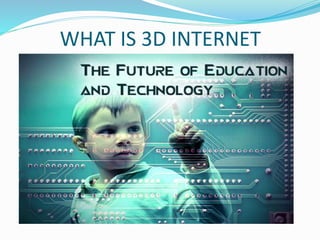
WHAT IS 3D INTERNET
WHAT IS 3D INTERNET
 3D Internet is the next generation after the current 2D
web
 3D Internet consists of interconnected services ,
presented as “VIRTUAL WORLDS”
 3D Internet is incredibly social. If you’re reading a
document , you can see other people reading the same
document.
 You can connect to other people that share your interest
and consume the same services that you do.
WHY 3D INTERNET
WHY 3D INTERNET
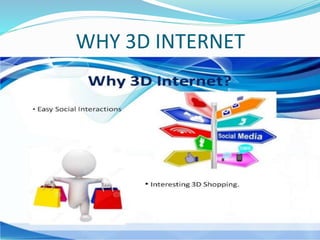
 One of the often heard arguments against the 3D Internet is in the
form of the question “why do we need it?” For most of its users the
Internet is a familiar, comfortable medium where we communicate
with each other, get our news, shop, pay our bills, and more.
 From this perspective what we have, i.e. the 2D version, seems
“sufficient” and the 3D Internet is yet another fad.
 However, if we stop and think about the nature of the Internet for a
moment we realize that it is nothing but a virtual environment
(cyberspace) where people and organizations interact with each other
and exchange information.
HOW 3D INTERNET WORKS
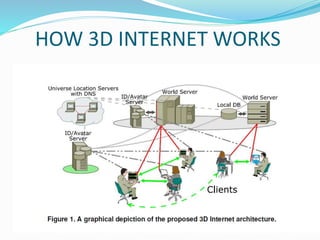
 Available virtual platform i.e SECOND LIFE
 By using artificial intelligence
 Using 3d eyewear like Google Glass
 Implementing Sixth Sense technology
 Using sensors and holographic image
HOW 3D INTERNET WORKS
SECOND LIFE
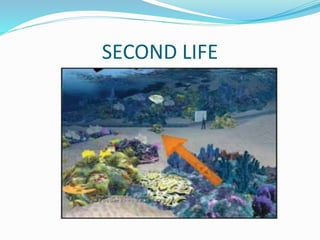
 Second Life (www.secondlife.com) is a virtual world in which
users select what appears to be a three-dimensional (3D)
character or object (an avatar) to represent them as they interact
with other people and with 3D objects.
 With the exception of what appears to be land, water, and sky,
and a programmed gravity to hold them to the land, users create
the shape and appearance and interactions of the entire world.
 Users may choose to interact with other users in real time by text
chat , voice, gestures, or programmed physical interactions, or
they change the characteristics of the environment or create and
program objects with which others may interact.
SECOND LIFE
ADVANTAGES:
 EDUCATION
 RELIGION
 EMBASSIES
 LIVE SPORT ENTERTAINMENT
TECHNICAL ISSUE:
 SPEED
 HARDWARE
PROGRAMMING LANGUAGES
• 3D on the Web began when the VRML Consortium released
the Virtual Reality Markup Language in 1994. However,
VRML never really caught on because it let developers write
only 3D content .
• In 1997, the Web3D Consortium released X3D—an XML-
based file format for representing 3D graphics that includes
VRML extensions.
• The Mozilla Foundation and the Khronos Group developing
WebGL . The technology brings hardware-accelerated 3D
graphics to the Web without plug-ins. WebGL will work in any
browser.
CONCLUSION
 3D Internet, also known as virtual worlds, is a powerful
new way for you to reach consumers, business customers,
co-workers, partners, and students.
 It combines the immediacy of television, the versatile
content of the Web, and the relationship-building strengths
of social networking sites like Face book. Yet unlike the
passive experience of television, the 3D Internet is
inherently interactive and engaging.
 Virtual worlds provide immersive 3D experiences that
replicate(and in some cases exceed) real life
THANK YOU !!!

3D Internet

  • 1.
    NAME: ADITYA JADHAV CLASS:T.E-1 NO: 32 PROJECT GUIDE: Prof. Sneha Pisey
  • 3.
    AGENDA INTRODUCTION WHAT IS 3DINTERNET 3D INTERNET : WHY ? HOW IT WORKS SECOND LIFE TECHICAL ISSUES AND APPLICATIONS PROGRAMMING LANGUAGES CONCLUSION
  • 4.
    INTRODUCTION  3D Internet,also known as “Virtual World” , is a new powerful way for you to reach consumers , business customers , co-workers, partners, and students.  People who take part in virtual worlds stay online longer with a heightened level of interest. To take advantage of that interest , diverse business and organizations have claimed early stake in this fast growing market  They include technology leaders such as IBM, Microsoft ,Cisco , companies such BMW ,Toyota , Circuit City and Coca Cola
  • 5.
    WEB 1.0  FIRSTFACE OF WORLD WIDE WEB  EDITED ONLY BY WEBMASTERS  SIMILAR TO A HAND WRITTEN NOTEBOOK  THREATENED TO PARANOID PERCEPTION
  • 6.
    WEB 2.0  EVERYONECAN CONTRIBUTE TO WEB  RICH USER INERFACE  BEST CLASS GRAPHICS  85% MAJORITY WEBSITES IN WEB 2.0
  • 7.
    WEB 3.0  USEOF METAVERSE IN WEB  THE RISE OF INTELLIGENT SYSTEM  BIRTH OF MOST AWAITED FUTURE INTEREST  WEBPLACES AND WEBPAGES.
  • 8.
    WHAT IS 3DINTERNET
  • 9.
    WHAT IS 3DINTERNET  3D Internet is the next generation after the current 2D web  3D Internet consists of interconnected services , presented as “VIRTUAL WORLDS”  3D Internet is incredibly social. If you’re reading a document , you can see other people reading the same document.  You can connect to other people that share your interest and consume the same services that you do.
  • 10.
  • 11.
    WHY 3D INTERNET One of the often heard arguments against the 3D Internet is in the form of the question “why do we need it?” For most of its users the Internet is a familiar, comfortable medium where we communicate with each other, get our news, shop, pay our bills, and more.  From this perspective what we have, i.e. the 2D version, seems “sufficient” and the 3D Internet is yet another fad.  However, if we stop and think about the nature of the Internet for a moment we realize that it is nothing but a virtual environment (cyberspace) where people and organizations interact with each other and exchange information.
  • 12.
    HOW 3D INTERNETWORKS  Available virtual platform i.e SECOND LIFE  By using artificial intelligence  Using 3d eyewear like Google Glass  Implementing Sixth Sense technology  Using sensors and holographic image
  • 13.
  • 14.
    SECOND LIFE  SecondLife (www.secondlife.com) is a virtual world in which users select what appears to be a three-dimensional (3D) character or object (an avatar) to represent them as they interact with other people and with 3D objects.  With the exception of what appears to be land, water, and sky, and a programmed gravity to hold them to the land, users create the shape and appearance and interactions of the entire world.  Users may choose to interact with other users in real time by text chat , voice, gestures, or programmed physical interactions, or they change the characteristics of the environment or create and program objects with which others may interact.
  • 15.
  • 16.
    ADVANTAGES:  EDUCATION  RELIGION EMBASSIES  LIVE SPORT ENTERTAINMENT TECHNICAL ISSUE:  SPEED  HARDWARE
  • 17.
    PROGRAMMING LANGUAGES • 3Don the Web began when the VRML Consortium released the Virtual Reality Markup Language in 1994. However, VRML never really caught on because it let developers write only 3D content . • In 1997, the Web3D Consortium released X3D—an XML- based file format for representing 3D graphics that includes VRML extensions. • The Mozilla Foundation and the Khronos Group developing WebGL . The technology brings hardware-accelerated 3D graphics to the Web without plug-ins. WebGL will work in any browser.
  • 18.
    CONCLUSION  3D Internet,also known as virtual worlds, is a powerful new way for you to reach consumers, business customers, co-workers, partners, and students.  It combines the immediacy of television, the versatile content of the Web, and the relationship-building strengths of social networking sites like Face book. Yet unlike the passive experience of television, the 3D Internet is inherently interactive and engaging.  Virtual worlds provide immersive 3D experiences that replicate(and in some cases exceed) real life
  • 19.