GUIDED BY-
Ms. SASMITA PANI
PRESENTED BY-
RUCHI RITAMBARA
Roll No.- CS-10-19
Red No.-1001230057
CONTENTS
INTRODUCTION
NEED OF 3D SEARCHING
METHODOLOGY
EXAMPLES
ADVANTAGES
LIMITATIONS
FUTURE PROSPECTUS
CONCLUSION
REFERENCS
INTRODUCTION
3D searching is a new method used to
search 3D objects in a data house in the
base of our submitted query.
A search system which is capable of
retrieving similar 3D models based on their
shape is known as the 3Dsearch engine.
NEED FOR 3D SEARCH
ENGINE
• Consider a person who wants to build a
3D virtual world representing a city scene.
He will need 3D models of cars, street
lamps, stop signs etc. Will he buy a 3D
modeling tool and build them himself?
Or, will he acquire them from a large
repository of 3D models on web?
And obviously the answer is he will search
in web for the model.
METHODOLOGY FOR 3D
SEARCHING
• Methodology used involves the following
steps
• Query formulation
• Search process
• Search result
QUERY FORMULATION
• True 3D search systems offer two principal ways to
formulate a query:
1- Users can select objects from a catalog of image
based on product groupings, such as gears or sofas.
2- They can utilize a drawing program to create a
picture of the object they are looking for. For
example, Princeton’s 3D search engine uses an
application to let users draw a 2D or 3D representation
of the object they want to find.
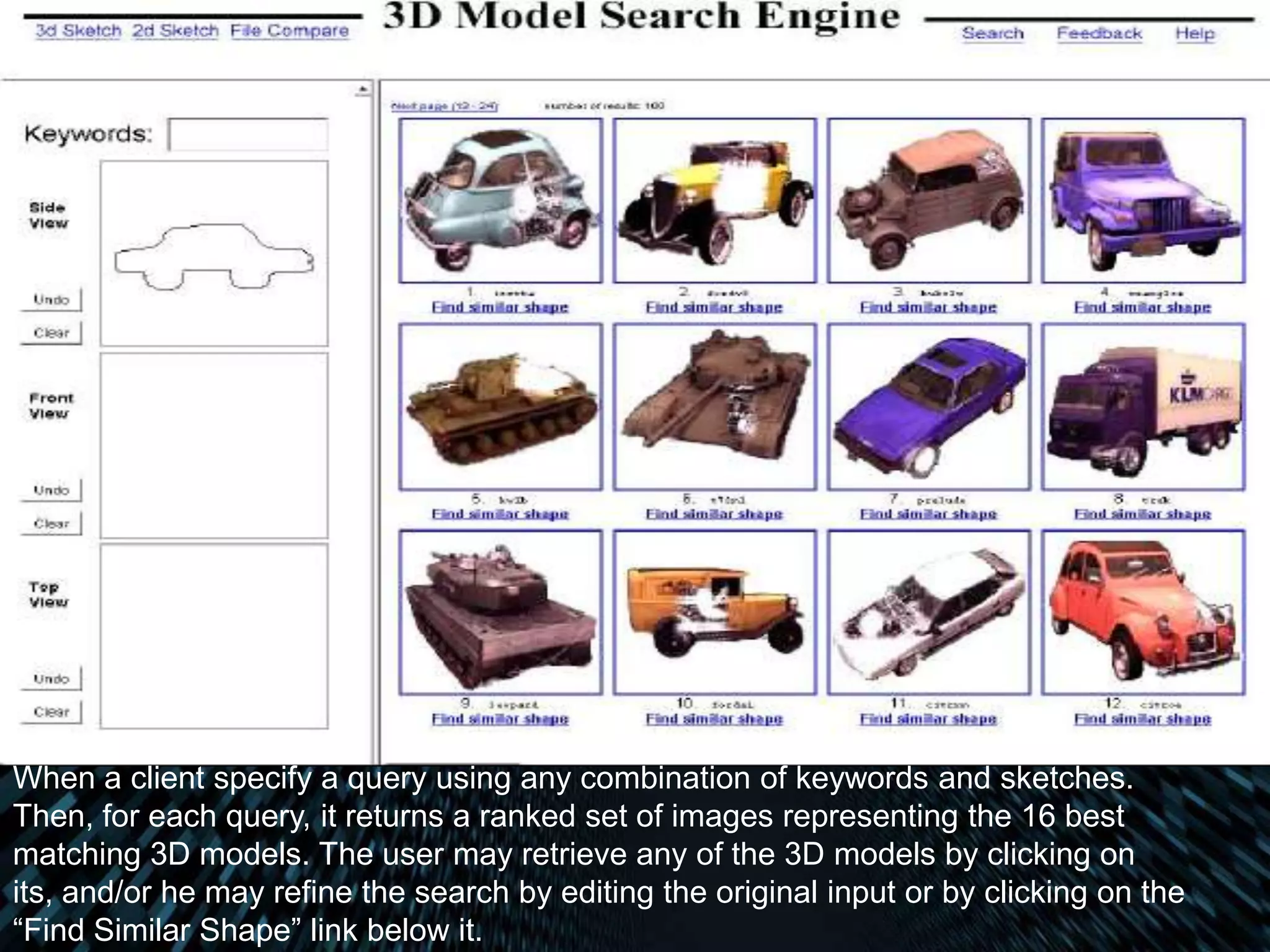
When a client specify a query using any combination of keywords and sketches.
Then, for each query, it returns a ranked set of images representing the 16 best
matching 3D models. The user may retrieve any of the 3D models by clicking on
its, and/or he may refine the search by editing the original input or by clicking on the
“Find Similar Shape” link below it.
SEARCH PROCESS
• The 3D-search system uses algorithms to
convert the selected or drawn image-
based query into a mathematical model
called the voxel model by a process called
voxelization that describes the features of
the object being sought.
• The model is then searched with those in
the repository. If match is found then the
object is returned.
Contd…
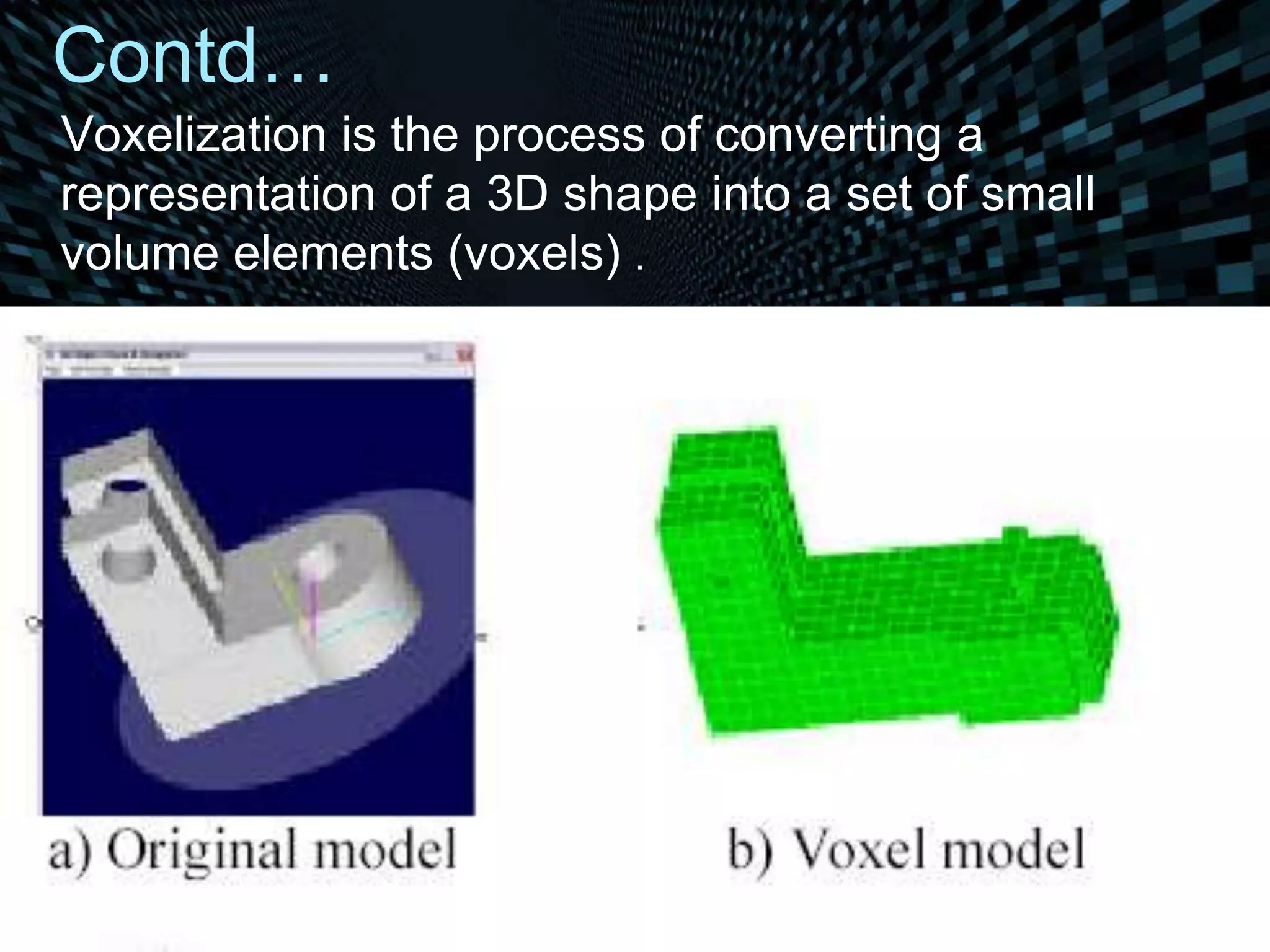
Voxelization is the process of converting a
representation of a 3D shape into a set of small
volume elements (voxels) .
SEARCH RESULT
• If the match of the 2D sketch or keyword is
obtained then the 3D model of that is
returned.
EXAMPLE OF SEARCH SYSTEM
1-3DESS
• Scientists at the Purdue Research and Education
Center for Information Systems in Engineering, led by
Professor Karthik Ramani, created a 3D shape search
technology called 3DESS (3D Engineering Search) .
• The system can analyze a query by comparing either
its feature-vector set shape representations with those
stored in the database to find the ones that are most
similar.
• When the system retrieves models in response to a
query, users can input which models more closely
resemble the object they’re seeking.
2-PRINCETON UNIVERSITY
SEARCH SYSTEM
• The Princeton search engine, like its Purdue
counterpart, uses mathematical representations to
store the salient characteristics of 3D shapes in its
data- edges, and nodes.
• The system can analyze a query by comparing either
its feature-vector set potential obstacles.
• Searchers can refine their queries by adding a text
description.
ADVANTAGES
• 3D searching is very effective in the
search process of 3D objects.
• It provides various searching process as
well.
• Query interface is a very useful term in the
search process by which we can select
any process for searching our model by
various types of queries like text search.
LIMITATIONS
• Better 2D image matching methods
• New modeling tools
FUTURE PROSPECTUS
• New query interfaces
• New matching and indexing algorithms
• New modeling tools
• New applications
CONCLUSION
• 3D search engine helps to have an idea of
3D model of any thing on web.
• Most of today’s individual and corporate
computer users don’t conduct the type of
searches that would justify paying for and
learning to use sophisticated 3D search
engines .
• However, within those markets, 3D search
could prove useful and successful.
REFERENCES
• http://www.princetonuniversity.edu
• Global Journal of Computer Science and
Technology,Volume-12 ,Issue-8 ,Version-
1.0,April 2012
• http://ieeexplore.ieee.org
NO(W)
QUERIES?

3D Searching by ruchi

  • 1.
    GUIDED BY- Ms. SASMITAPANI PRESENTED BY- RUCHI RITAMBARA Roll No.- CS-10-19 Red No.-1001230057
  • 2.
    CONTENTS INTRODUCTION NEED OF 3DSEARCHING METHODOLOGY EXAMPLES ADVANTAGES LIMITATIONS FUTURE PROSPECTUS CONCLUSION REFERENCS
  • 3.
    INTRODUCTION 3D searching isa new method used to search 3D objects in a data house in the base of our submitted query. A search system which is capable of retrieving similar 3D models based on their shape is known as the 3Dsearch engine.
  • 4.
    NEED FOR 3DSEARCH ENGINE • Consider a person who wants to build a 3D virtual world representing a city scene. He will need 3D models of cars, street lamps, stop signs etc. Will he buy a 3D modeling tool and build them himself? Or, will he acquire them from a large repository of 3D models on web? And obviously the answer is he will search in web for the model.
  • 5.
    METHODOLOGY FOR 3D SEARCHING •Methodology used involves the following steps • Query formulation • Search process • Search result
  • 6.
    QUERY FORMULATION • True3D search systems offer two principal ways to formulate a query: 1- Users can select objects from a catalog of image based on product groupings, such as gears or sofas. 2- They can utilize a drawing program to create a picture of the object they are looking for. For example, Princeton’s 3D search engine uses an application to let users draw a 2D or 3D representation of the object they want to find.
  • 7.
    When a clientspecify a query using any combination of keywords and sketches. Then, for each query, it returns a ranked set of images representing the 16 best matching 3D models. The user may retrieve any of the 3D models by clicking on its, and/or he may refine the search by editing the original input or by clicking on the “Find Similar Shape” link below it.
  • 8.
    SEARCH PROCESS • The3D-search system uses algorithms to convert the selected or drawn image- based query into a mathematical model called the voxel model by a process called voxelization that describes the features of the object being sought. • The model is then searched with those in the repository. If match is found then the object is returned.
  • 9.
    Contd… Voxelization is theprocess of converting a representation of a 3D shape into a set of small volume elements (voxels) .
  • 10.
    SEARCH RESULT • Ifthe match of the 2D sketch or keyword is obtained then the 3D model of that is returned.
  • 11.
    EXAMPLE OF SEARCHSYSTEM 1-3DESS • Scientists at the Purdue Research and Education Center for Information Systems in Engineering, led by Professor Karthik Ramani, created a 3D shape search technology called 3DESS (3D Engineering Search) . • The system can analyze a query by comparing either its feature-vector set shape representations with those stored in the database to find the ones that are most similar. • When the system retrieves models in response to a query, users can input which models more closely resemble the object they’re seeking.
  • 12.
    2-PRINCETON UNIVERSITY SEARCH SYSTEM •The Princeton search engine, like its Purdue counterpart, uses mathematical representations to store the salient characteristics of 3D shapes in its data- edges, and nodes. • The system can analyze a query by comparing either its feature-vector set potential obstacles. • Searchers can refine their queries by adding a text description.
  • 13.
    ADVANTAGES • 3D searchingis very effective in the search process of 3D objects. • It provides various searching process as well. • Query interface is a very useful term in the search process by which we can select any process for searching our model by various types of queries like text search.
  • 14.
    LIMITATIONS • Better 2Dimage matching methods • New modeling tools
  • 15.
    FUTURE PROSPECTUS • Newquery interfaces • New matching and indexing algorithms • New modeling tools • New applications
  • 16.
    CONCLUSION • 3D searchengine helps to have an idea of 3D model of any thing on web. • Most of today’s individual and corporate computer users don’t conduct the type of searches that would justify paying for and learning to use sophisticated 3D search engines . • However, within those markets, 3D search could prove useful and successful.
  • 17.
    REFERENCES • http://www.princetonuniversity.edu • GlobalJournal of Computer Science and Technology,Volume-12 ,Issue-8 ,Version- 1.0,April 2012 • http://ieeexplore.ieee.org
  • 18.