HR and Volunteers
              Stephen Peck
Operations Director – The Scout Association

             Hira Choudhury
Managing Director - Unity Insurance Services
The Scout Association

• Largest co-educational youth organisation
• 400,000 young people aged 6 to 25
• Growing at 3% per year
    • Especially 14-18 year olds (7%)
•   120,000 adult volunteers (and growing)
•   8,500 local groups
•   Staff to beneficiary ratio of 1:2080
•   Turnover £24m including subsidiaries
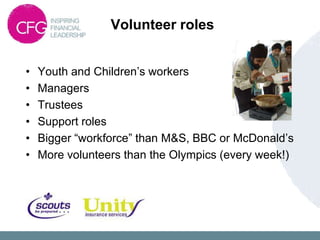
Volunteer roles


•   Youth and Children‟s workers
•   Managers
•   Trustees
•   Support roles
•   Bigger “workforce” than M&S, BBC or McDonald‟s
•   More volunteers than the Olympics (every week!)
Issues

•   Disputes between volunteers
•   Complaints from “customers”
•   Threat of litigation
•   Not following rules
•   Local interpretation of rules
•   Volunteers managing employees
Causes of volunteer disputes -
                wider trends seen
•   Volunteer asked to stop volunteering
•   Volunteer injury claim – dissatisfaction with outcome
•   Volunteer negligence causes injury to someone
•   Disputes between volunteers
•   All these can result in a grievance
•   Leading to a threat of litigation by the volunteer
What statutory rights do
                       volunteers have?
• Legal status of a person determines their statutory employment rights
• If no „employment status‟ - not eligible for „protection‟
• Fundamental is a Contract of Service
     o   Offer & acceptance
     o   Consideration
     o   Intention to create legal relations


•   But a volunteer‟s legal status is not always clear cut
Armitage vs. National Relate
                1994

• Applied to be a Volunteer counsellor but unsuccessful
• Discrimination claim brought successfully based on:
    o   A requirement to work a minimum amount of hours
    o   A requirement to repay training costs if she left earlier
    o   The training could lead to paid work


• Mutuality of obligations & consideration did exist
• This amounted to a contract of employment
• Tribunal allowed discrimination claim to be heard
Chaudri vs. Migrant Advisory
                  Service 1997

• Volunteer‟s role terminated - sexual discrimination claimed

• Expenses paid but not incurred - regarded as „consideration‟

•   Regular payment during holiday & sick - regarded as wages

• Hence role as a volunteer was infact employment and entitled to
  pursue her claim for discrimination
Murray vs. Newham Citizens
                  Advice Bureau (CAB) 2000
• Declined for voluntary adviser post. Discrimination claim brought

• Required to volunteer at set times and for minimum periods

• CAB undertook to repay expenses & provide training in return

• This amounted to consideration and mutuality of obligation
• Hence a contract of employment
• Tribunal allowed discrimination case to proceed
South East Sheffield CAB vs.
                    Grayson 2003
• Mrs Grayson brought a disability discrimination claim
• Original Tribunal found volunteers were „employed‟
• CAB appealed with a robust defence:
    o   Expectations not obligations - Language not of a contract
    o   No sanction if minimum hours were not worked
    o   An “if” contract does not mean contractual obligations
    o   Request for notice is a reasonable expectation


• Appeals Tribunal concluded volunteers did not have any contractual
  obligations and thus not in employment
• Mrs Grayson was therefore not entitled to bring her claim
Breakell vs. Shropshire Army
                    Cadet Force 2010
• A cadet force volunteer‟s work stopped – disability discrimination
  complaint brought
• Key argument – was paid allowance for loss of earnings on days
  worked and hence „employed‟

• However Judge concluded he was not in employment:
    o   No obligation for the organisation to provide work
    o   No obligation for him to accept work offered
    o   Hence no mutual obligations & no contract of employment
    o   Not entitled to claim for discrimination
X vs. Mid Sussex CAB 2011

• Disability discrimination claim brought
• Based on volunteering being a facility for future paid employment &
  a deemed as “work placement”

• The court of Appeal rejected this on the basis:
    o   Any future paid employment was merely a bi- product
    o   The volunteering was not for a limited period & nor for sole
        purpose of training – hence not a work placement
    o   Therefore no contract of employment, no right to claim
    o   Case referred to the Supreme Court for hearing in 2012
In Summary – factors affecting
                   volunteers’ rights to claim
•   There must be „Consideration‟ before a contract can be binding
•   Intention to create legal relations
•   Mutuality of obligations - both parties “bound” to do something
•   Remedy or sanction for breach
•   Are expenses paid over and above true costs
•   Are there minimum hours commitment
•   Must notice be given by volunteer
•   Will the volunteering lead to employment
The Volunteer Agreement is
                    crucial - key mitigations
• Inclusion of policy on volunteering & intentions of both parties
• Expression and language used:
    o Volunteer agreement not a contract
    o Volunteer role description and not a job description
    o Arrangements if there is a problem not disciplinary procedures
    o Arrangement if there is a problem not grievance procedures
    o Expectations and intentions not requirements or obligation
    o Re-imbursement of expenses not payment
    o Agreement „binding in honour only‟
Broader Mitigations

•   Clear role descriptions
•   Robust appointment process
•   Comprehensive induction
•   Clear line management
•   Clear agreed expectations
•   Regular reviews (renew, retire, reassign)
•   Comprehensive training
•   Time limited commitment
Summary

•   Volunteers deserve best practice
•   Take a professional approach
•   Be robust
•   Don‟t apologise for being thorough
•   Support the managers of volunteers
•   Acknowledge their motivation
•   Make them feel valued
•   Cost v Benefit
Any questions?
               Stephen Peck
  Operations Director – The Scout Association

             Hira Choudhury
Managing Director - Unity Insurance Services
Contact details for further information:

   Stephen Peck
   stephen.peck@scouts.org.uk

   Hira Choudhury
   hira.choudhury@unityins.co.uk

3C - HR & volunteers - Hira Choudhury & Stephen Peck

  • 1.
    HR and Volunteers Stephen Peck Operations Director – The Scout Association Hira Choudhury Managing Director - Unity Insurance Services
  • 2.
    The Scout Association •Largest co-educational youth organisation • 400,000 young people aged 6 to 25 • Growing at 3% per year • Especially 14-18 year olds (7%) • 120,000 adult volunteers (and growing) • 8,500 local groups • Staff to beneficiary ratio of 1:2080 • Turnover £24m including subsidiaries
  • 3.
    Volunteer roles • Youth and Children‟s workers • Managers • Trustees • Support roles • Bigger “workforce” than M&S, BBC or McDonald‟s • More volunteers than the Olympics (every week!)
  • 4.
    Issues • Disputes between volunteers • Complaints from “customers” • Threat of litigation • Not following rules • Local interpretation of rules • Volunteers managing employees
  • 5.
    Causes of volunteerdisputes - wider trends seen • Volunteer asked to stop volunteering • Volunteer injury claim – dissatisfaction with outcome • Volunteer negligence causes injury to someone • Disputes between volunteers • All these can result in a grievance • Leading to a threat of litigation by the volunteer
  • 6.
    What statutory rightsdo volunteers have? • Legal status of a person determines their statutory employment rights • If no „employment status‟ - not eligible for „protection‟ • Fundamental is a Contract of Service o Offer & acceptance o Consideration o Intention to create legal relations • But a volunteer‟s legal status is not always clear cut
  • 7.
    Armitage vs. NationalRelate 1994 • Applied to be a Volunteer counsellor but unsuccessful • Discrimination claim brought successfully based on: o A requirement to work a minimum amount of hours o A requirement to repay training costs if she left earlier o The training could lead to paid work • Mutuality of obligations & consideration did exist • This amounted to a contract of employment • Tribunal allowed discrimination claim to be heard
  • 8.
    Chaudri vs. MigrantAdvisory Service 1997 • Volunteer‟s role terminated - sexual discrimination claimed • Expenses paid but not incurred - regarded as „consideration‟ • Regular payment during holiday & sick - regarded as wages • Hence role as a volunteer was infact employment and entitled to pursue her claim for discrimination
  • 9.
    Murray vs. NewhamCitizens Advice Bureau (CAB) 2000 • Declined for voluntary adviser post. Discrimination claim brought • Required to volunteer at set times and for minimum periods • CAB undertook to repay expenses & provide training in return • This amounted to consideration and mutuality of obligation • Hence a contract of employment • Tribunal allowed discrimination case to proceed
  • 10.
    South East SheffieldCAB vs. Grayson 2003 • Mrs Grayson brought a disability discrimination claim • Original Tribunal found volunteers were „employed‟ • CAB appealed with a robust defence: o Expectations not obligations - Language not of a contract o No sanction if minimum hours were not worked o An “if” contract does not mean contractual obligations o Request for notice is a reasonable expectation • Appeals Tribunal concluded volunteers did not have any contractual obligations and thus not in employment • Mrs Grayson was therefore not entitled to bring her claim
  • 11.
    Breakell vs. ShropshireArmy Cadet Force 2010 • A cadet force volunteer‟s work stopped – disability discrimination complaint brought • Key argument – was paid allowance for loss of earnings on days worked and hence „employed‟ • However Judge concluded he was not in employment: o No obligation for the organisation to provide work o No obligation for him to accept work offered o Hence no mutual obligations & no contract of employment o Not entitled to claim for discrimination
  • 12.
    X vs. MidSussex CAB 2011 • Disability discrimination claim brought • Based on volunteering being a facility for future paid employment & a deemed as “work placement” • The court of Appeal rejected this on the basis: o Any future paid employment was merely a bi- product o The volunteering was not for a limited period & nor for sole purpose of training – hence not a work placement o Therefore no contract of employment, no right to claim o Case referred to the Supreme Court for hearing in 2012
  • 13.
    In Summary –factors affecting volunteers’ rights to claim • There must be „Consideration‟ before a contract can be binding • Intention to create legal relations • Mutuality of obligations - both parties “bound” to do something • Remedy or sanction for breach • Are expenses paid over and above true costs • Are there minimum hours commitment • Must notice be given by volunteer • Will the volunteering lead to employment
  • 14.
    The Volunteer Agreementis crucial - key mitigations • Inclusion of policy on volunteering & intentions of both parties • Expression and language used: o Volunteer agreement not a contract o Volunteer role description and not a job description o Arrangements if there is a problem not disciplinary procedures o Arrangement if there is a problem not grievance procedures o Expectations and intentions not requirements or obligation o Re-imbursement of expenses not payment o Agreement „binding in honour only‟
  • 15.
    Broader Mitigations • Clear role descriptions • Robust appointment process • Comprehensive induction • Clear line management • Clear agreed expectations • Regular reviews (renew, retire, reassign) • Comprehensive training • Time limited commitment
  • 16.
    Summary • Volunteers deserve best practice • Take a professional approach • Be robust • Don‟t apologise for being thorough • Support the managers of volunteers • Acknowledge their motivation • Make them feel valued • Cost v Benefit
  • 17.
    Any questions? Stephen Peck Operations Director – The Scout Association Hira Choudhury Managing Director - Unity Insurance Services
  • 18.
    Contact details forfurther information: Stephen Peck stephen.peck@scouts.org.uk Hira Choudhury hira.choudhury@unityins.co.uk

Editor's Notes

  • #3 M&S 78,000BBC 24,000McDonalds 67,000Olympics – 70,000
  • #4 M&S 78,000BBC 24,000McDonalds 67,000Olympics – 70,000
  • #5 Disputes is the second highest reason for leavingParental complaints becoming more aggressiveThreat is as much stress as reality of litigationBarrack room lawyers