
Debunking misconceptions
about mathematics in the
early years
Overview
1. Common misconceptions
2. Critical mathematical ideas underpinning
number sense
3. The role of the early childhood educator
Common misconceptions
Young children are not ready for mathematics
education.
Mathematics is for some bright kids with
mathematics genes.

Simple numbers and shapes are enough.
Language and literacy are more important than
mathematics.
Teachers should provide an enriched physical
environment, step back, and let the children play.
Common misconceptions
Mathematics should not be taught as stand-alone
subject matter.
Assessment in mathematics is irrelevant when it
comes to young children.

Children learn mathematics only by interacting
with concrete objects.
Computers are inappropriate for the teaching and
learning of mathematics.
Retrieved from
http://www.earlychildhoodaustralia.org.au/australian_journal_of_early_childhood/ajec_index_abstracts/early_childhood
_teachers_misconceptions_about_mathematics_education_for_young_children_in_the_united_states.html
Intentional teaching and the Early Years
Learning Framework
About ‗intentional teaching‘
•Intentional teaching is one of the 8 key pedagogical
practices described in the Early Years Learning
Framework (EYLF).
•The EYLF defines intentional teaching as ‗educators
being deliberate purposeful and thoughtful in their decisions
and actions‘.

Intentional teaching is thoughtful, informed and
deliberate.
Intentional teaching and the Early
Years Learning Framework
Intentional educators:
•create a learning environment that is rich in materials
and interactions
•create opportunities for inquiry
•model thinking and problem solving, and challenge
children's existing ideas about how things work.
Intentional teaching and the Early Years
Learning Framework
Intentional educators:
•know the content—concepts, vocabulary, skills and
processes—and the teaching strategies that support
important early learning in mathematics
•carefully observe children so that they can thoughtfully
plan for children‘s next-stage learning and emerging
abilities
•take advantage of spontaneous, unexpected teaching and
learning opportunities.
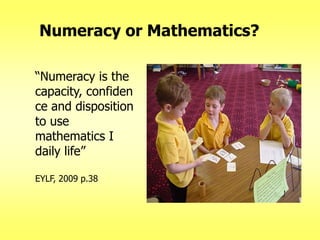
Numeracy or Mathematics?
―Numeracy is the
capacity, confiden
ce and disposition
to use
mathematics I
daily life‖
EYLF, 2009 p.38
Five proficiencies
1. Conceptual understanding
2. Procedural fluency
3. Strategic competence- idea of choosing
what is going to be an appropriate
method to solve problems.
4. Adaptive reasoning - reason to other
contexts
5. Productive disposition- most important
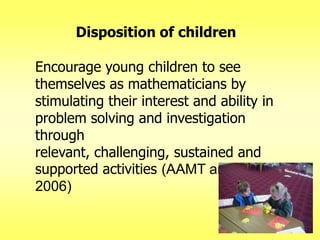
Disposition of children
Encourage young children to see
themselves as mathematicians by
stimulating their interest and ability in
problem solving and investigation
through
relevant, challenging, sustained and
supported activities (AAMT and ECA
2006)
Low mathematical skills in the earliest years
are associated with a slower growth rate –
children without adequate experiences in
mathematics start behind and lose ground
every year thereafter.
(Clements and Sarama, 2009, p. 263)

Interventions must start in pre K and
Kindergarten (Gersten et al 2005). Without
such interventions, children in special need
are often relegated to a path of failure
(Baroody, 1999)
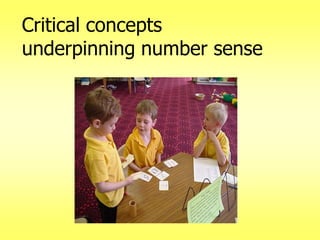
Critical concepts
underpinning number sense
More – less
Counting
Subitising
Part part whole
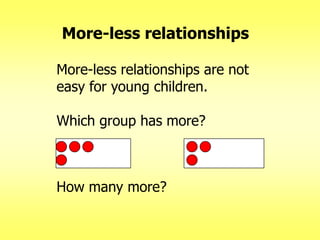
More-less relationships
More-less relationships are not
easy for young children.
Which group has more?

How many more?
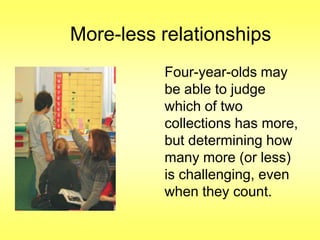
More-less relationships
Four-year-olds may
be able to judge
which of two
collections has more,
but determining how
many more (or less)
is challenging, even
when they count.
More-less relationships
• Young children must arrive at the
important insight that a quantity (the
less) must be contained inside the
other (the more) instead of viewing
both quantities as mutually exclusive.
The concept requires them to think of
the difference between the two
quantities as a third quantity, which is
the notion of parts-whole.
More – less relationships
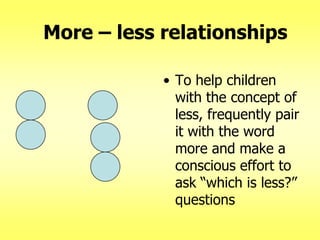
• To help children
with the concept of
less, frequently pair
it with the word
more and make a
conscious effort to
ask ―which is less?‖
questions
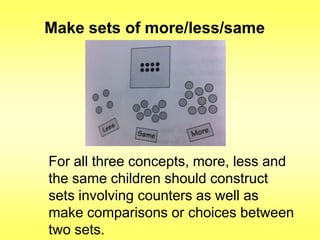
Make sets of more/less/same

For all three concepts, more, less and
the same children should construct
sets involving counters as well as
make comparisons or choices between
two sets.
Diffy Towers
• Organise students into pairs and provide each
pair with a die and a supply of Unifix blocks. The
first student rolls a die, takes a corresponding
numberof Unifix blocks from a central pile and
builds a tower with them. The second student rolls
the die and repeats the process. They then
compare the two towers to see who has the most
blocks and determine the differencebetween the
two towers. The player with the larger number of
blocks keeps the difference and all other blocks
are returned to the central pile.
• The activity continues until one student
accumulates a total of ten blocks
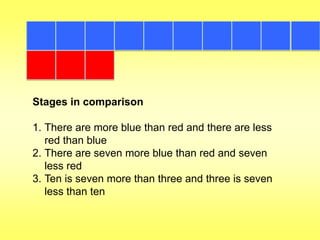
Stages in comparison
1. There are more blue than red and there are less
red than blue
2. There are seven more blue than red and seven
less red
3. Ten is seven more than three and three is seven
less than ten
One and two
more, one and two
less
The two more and two less
relationship involve more than just the
ability to count on two or count back
two. Children should know for
example that 7 is 1 more than 6 and
also 2 less than 9.
When Harry was at the circus, he saw 8 clowns
come out in a little car. Then 2 more clowns came
out on bicycles. How many clowns did Harry see
altogether?

Ask different students to explain how they got
their answer of ten. Some will count on from 8.
Some may need to count 8 and 2 and then
count all. Others will say they knew that 2 more
than 8 is 10.
The last response gives you an opportunity to
talk about the 2 more than idea.
Early counting
The meaning attached to
counting is the key conceptual
idea on which all other number
concepts are developed
Principles of Counting
• Each object to be counted must be touched or „included‟
exactly once as the numbers are said.

• The numbers must be said once and always in the
conventional order.
• The objects can be touched in any order and the starting
point and order in which the objects are counted doesn‟t
affect how many there are.
• The arrangement of the objects doesn‟t affect how many
there are.
• The last number said tells „how many‟ in the whole
collection, it does not describe the last object touched.
Principles of Counting

• Which of the principles of counting
does Charlotte understand?
Principles of Counting
• Each object to be counted must be touched or „included‟
exactly once as the numbers are said.

• The numbers must be said once and always in the
conventional order.
• The objects can be touched in any order and the starting
point and order in which the objects are counted doesn‟t
affect how many there are.
• The arrangement of the objects doesn‟t affect how many
there are.
• The last number said tells „how many‟ in the whole
collection, it does not describe the last object touched.
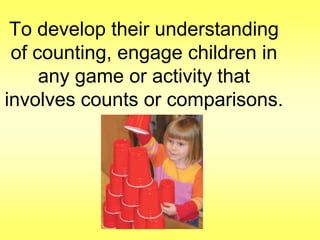
To develop their understanding
of counting, engage children in
any game or activity that
involves counts or comparisons.
Trusting Counting
There are many children who know the
number string well enough to respond
correctly to „how many‟ questions without
really understanding that this is telling
them the quantity of the set.
1, 2, 3, 4, 5, 6, 7,…
2, 4, 6, 8, 10, …
Intentional opportunities for
counting
• Model counting experiences in meaningful
contexts, for example, counting girls, boys as
they arrive at school, counting out pencils at the
art table.
• Involving all children in acting out finger plays
and rhymes and reading literature, which models
the conventional counting order.
• Seize upon teachable moments as they arise
incidentally. “Do we have enough pairs of
scissors for everyone at this table?”
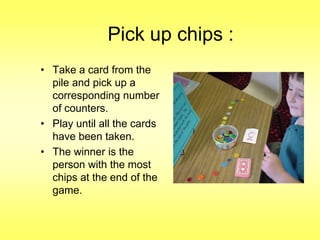
Pick up chips :
• Take a card from the
pile and pick up a
corresponding number
of counters.
• Play until all the cards
have been taken.
• The winner is the
person with the most
chips at the end of the
game.
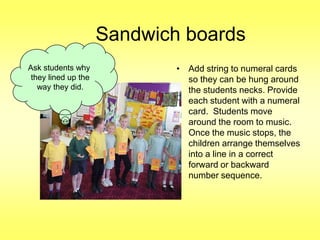
Sandwich boards
Ask students why
they lined up the
way they did.

• Add string to numeral cards
so they can be hung around
the students necks. Provide
each student with a numeral
card. Students move
around the room to music.
Once the music stops, the
children arrange themselves
into a line in a correct
forward or backward
number sequence.
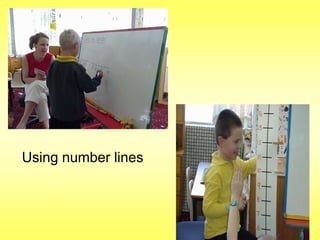
Using number lines
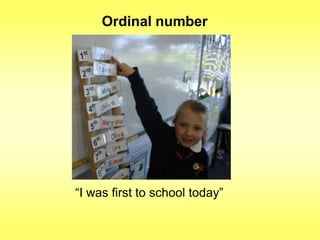
Ordinal number

“I was first to school today”
Counting on and back
• The ability to count on is a
“landmark” in the development of
number sense.
Fosnot and Dolk (2001)
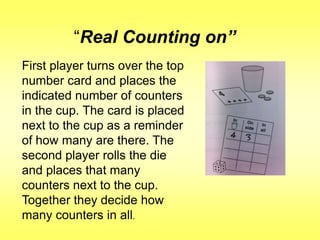
“Real Counting on”
First player turns over the top
number card and places the
indicated number of counters
in the cup. The card is placed
next to the cup as a reminder
of how many are there. The
second player rolls the die
and places that many
counters next to the cup.
Together they decide how
many counters in all.
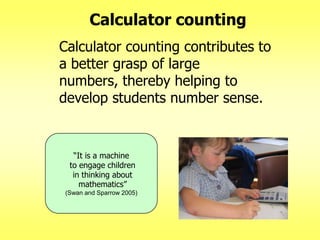
Calculator counting
Calculator counting contributes to
a better grasp of large
numbers, thereby helping to
develop students number sense.

―It is a machine
to engage children
in thinking about
mathematics‖
(Swan and Sparrow 2005)
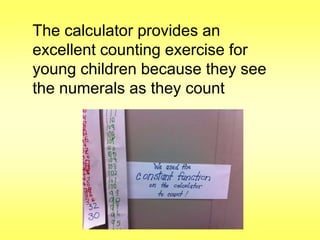
The calculator provides an
excellent counting exercise for
young children because they see
the numerals as they count
Anchors or
‘benchmarks’ of 5 and
10
Since 10 plays such a large role in our
numeration system and because two
fives make ten, it is very useful to
develop the relationships for the
numbers 1 to 10 to the important
factors of 5 and 10.
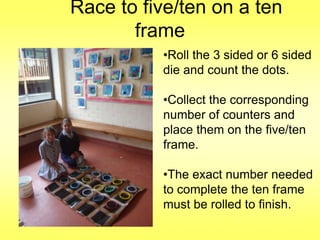
Race to five/ten on a ten
frame
•Roll the 3 sided or 6 sided
die and count the dots.
•Collect the corresponding
number of counters and
place them on the five/ten
frame.
•The exact number needed
to complete the ten frame
must be rolled to finish.
These early number ideas are basic
aspects of number. Unfortunately, too
may traditional programs move
directly from these beginning ideas to
addition and subtraction, leaving
students with a very limited collection
of ideas about number to bring to
these topics. The result is often that
children continue to count by ones to
solve simple story problems and have
difficulty mastering basic facts.
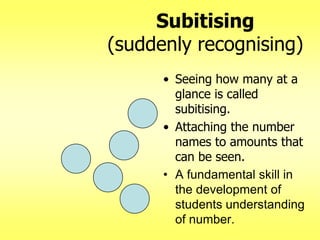
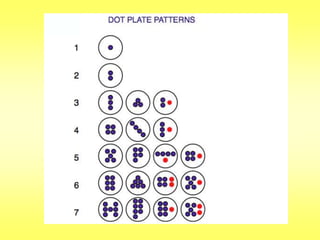
Subitising
(suddenly recognising)
• Seeing how many at a
glance is called
subitising.
• Attaching the number
names to amounts that
can be seen.
• A fundamental skill in
the development of
students understanding
of number.
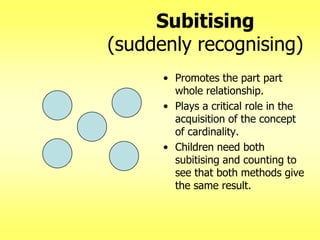
Subitising
(suddenly recognising)
• Promotes the part part
whole relationship.
• Plays a critical role in the
acquisition of the concept
of cardinality.
• Children need both
subitising and counting to
see that both methods give
the same result.
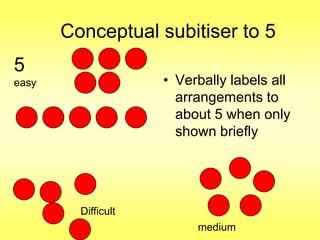
Conceptual subitiser to 5
5

• Verbally labels all
arrangements to
about 5 when only
shown briefly

easy

Difficult
medium
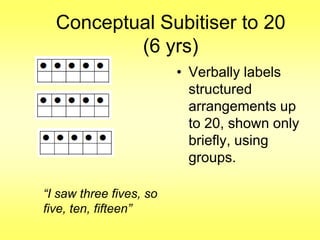
Conceptual Subitiser to 20
(6 yrs)
• Verbally labels
structured
arrangements up
to 20, shown only
briefly, using
groups.
“I saw three fives, so
five, ten, fifteen”
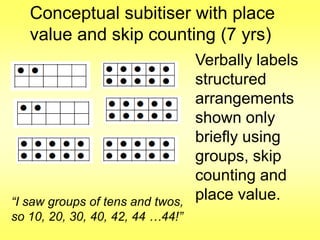
Conceptual subitiser with place
value and skip counting (7 yrs)

“I saw groups of tens and twos,
so 10, 20, 30, 40, 42, 44 …44!”

Verbally labels
structured
arrangements
shown only
briefly using
groups, skip
counting and
place value.
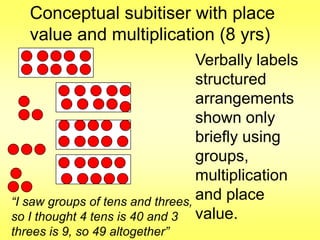
Conceptual subitiser with place
value and multiplication (8 yrs)
Verbally labels
structured
arrangements
shown only
briefly using
groups,
multiplication
“I saw groups of tens and threes, and place
so I thought 4 tens is 40 and 3 value.
threes is 9, so 49 altogether”
Part whole
relationships
To conceptualise a number as being
made up of two or more parts is the
most important relationship that can
be developed about numbers.
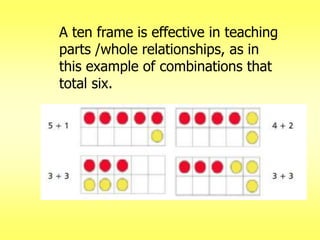
A ten frame is effective in teaching
parts /whole relationships, as in
this example of combinations that
total six.
Missing Cubes
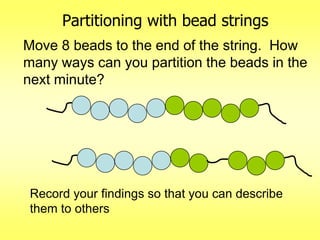
Partitioning with bead strings
Move 8 beads to the end of the string. How
many ways can you partition the beads in the
next minute?

Record your findings so that you can describe
them to others
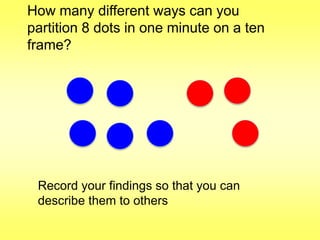
How many different ways can you
partition 8 dots in one minute on a ten
frame?

Record your findings so that you can
describe them to others
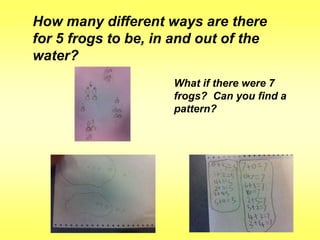
How many different ways are there
for 5 frogs to be, in and out of the
water?
What if there were 7
frogs? Can you find a
pattern?
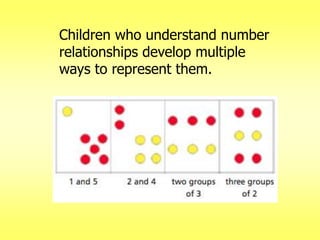
Children who understand number
relationships develop multiple
ways to represent them.
• Understanding part-part-whole
relationships will enhance
children‘s flexibility, enabling them
to represent problems in different
ways, so they can choose the most
helpful.
Relationships for
numbers 10 to 20
A set of ten should play a major role in
children‟s initial understanding of number
between 10 and 20. When children see a
a set of six and a set of ten, they should
know without counting that the total is 16
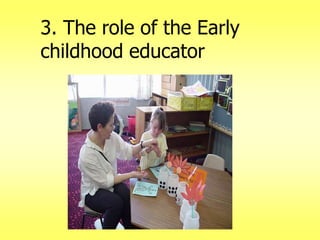
3. The role of the Early
childhood educator
Role of the educator
Model mathematical language.
Ask probing questions.
Build on children‘s interests and natural
curiosity.
Provide meaningful experiences.
Scaffold opportunities for learning &
model strategies.
Monitor children‘s progress and plan for
learning.
Probing Questions
A crucial part of a teacher‟s role is to develop students‟
ability to think about mathematics. To develop thinking
processes teachers need to ask higher-order questions
that require students to interpret, apply, analyse and
evaluate information.
Encourage students to ask questions of each other so
that they begin to develop maturity of thought.
The pedagogy
• … less teacher talk, with the learning coming as
a result of the experience with the task and
children sharing their insights.
• A culture of “not telling”
Listening to children
Encourage persistence
Probing questions
• Learning involves struggle. They are not
learning if it‟s not a struggle
Long „wait‟ time
Time to reflect on their actions
“We use the word struggle to mean that
students expend effort to make sense of
mathematics, to figure something out that is
not immediately apparent. We do not use
struggle to mean needless frustration... The
struggle we have in mind comes from solving
problems that are within reach and grappling
with key mathematical ideas that are
comprehendible but not yet well formed”
Hiebert and Grouws, 2007
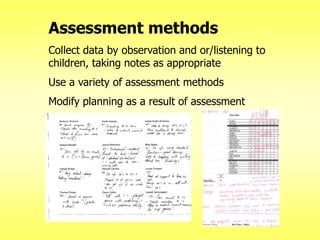
Assessment methods
Collect data by observation and or/listening to
children, taking notes as appropriate
Use a variety of assessment methods
Modify planning as a result of assessment
References

AAMT & ECA. (2006). Position paper on Early Childhood Mathematics.
www.aamt.edu.au
www.earlychildhoodaustralia.org.au

DEEWR. (2009). Belonging, Being & Becoming: The Early Years Learning Framework
for Australia.
http://www.deewr.gov.au/earlychildhood/policy_agenda/quality/pages/earlyyearslearningf
ramework.aspx
Hiebert, J., &Grouws, D. A. (2007). The effects of classroom mathematics teaching on
students‟ learning. Second handbook of research on mathematics teaching and learning,
1, 371-404.
Sarama, J., & Clements, D. H. (2009). Early childhood mathematics education research:
Learning trajectories for young children. Routledge.

Debunking misconceptions about mathematics in the early years

  • 1.
  • 2.
    Overview 1. Common misconceptions 2.Critical mathematical ideas underpinning number sense 3. The role of the early childhood educator
  • 3.
    Common misconceptions Young childrenare not ready for mathematics education. Mathematics is for some bright kids with mathematics genes. Simple numbers and shapes are enough. Language and literacy are more important than mathematics. Teachers should provide an enriched physical environment, step back, and let the children play.
  • 4.
    Common misconceptions Mathematics shouldnot be taught as stand-alone subject matter. Assessment in mathematics is irrelevant when it comes to young children. Children learn mathematics only by interacting with concrete objects. Computers are inappropriate for the teaching and learning of mathematics. Retrieved from http://www.earlychildhoodaustralia.org.au/australian_journal_of_early_childhood/ajec_index_abstracts/early_childhood _teachers_misconceptions_about_mathematics_education_for_young_children_in_the_united_states.html
  • 5.
    Intentional teaching andthe Early Years Learning Framework About ‗intentional teaching‘ •Intentional teaching is one of the 8 key pedagogical practices described in the Early Years Learning Framework (EYLF). •The EYLF defines intentional teaching as ‗educators being deliberate purposeful and thoughtful in their decisions and actions‘. Intentional teaching is thoughtful, informed and deliberate.
  • 6.
    Intentional teaching andthe Early Years Learning Framework Intentional educators: •create a learning environment that is rich in materials and interactions •create opportunities for inquiry •model thinking and problem solving, and challenge children's existing ideas about how things work.
  • 7.
    Intentional teaching andthe Early Years Learning Framework Intentional educators: •know the content—concepts, vocabulary, skills and processes—and the teaching strategies that support important early learning in mathematics •carefully observe children so that they can thoughtfully plan for children‘s next-stage learning and emerging abilities •take advantage of spontaneous, unexpected teaching and learning opportunities.
  • 8.
    Numeracy or Mathematics? ―Numeracyis the capacity, confiden ce and disposition to use mathematics I daily life‖ EYLF, 2009 p.38
  • 9.
    Five proficiencies 1. Conceptualunderstanding 2. Procedural fluency 3. Strategic competence- idea of choosing what is going to be an appropriate method to solve problems. 4. Adaptive reasoning - reason to other contexts 5. Productive disposition- most important
  • 10.
    Disposition of children Encourageyoung children to see themselves as mathematicians by stimulating their interest and ability in problem solving and investigation through relevant, challenging, sustained and supported activities (AAMT and ECA 2006)
  • 11.
    Low mathematical skillsin the earliest years are associated with a slower growth rate – children without adequate experiences in mathematics start behind and lose ground every year thereafter. (Clements and Sarama, 2009, p. 263) Interventions must start in pre K and Kindergarten (Gersten et al 2005). Without such interventions, children in special need are often relegated to a path of failure (Baroody, 1999)
  • 12.
  • 13.
  • 14.
    More-less relationships More-less relationshipsare not easy for young children. Which group has more? How many more?
  • 15.
    More-less relationships Four-year-olds may beable to judge which of two collections has more, but determining how many more (or less) is challenging, even when they count.
  • 16.
    More-less relationships • Youngchildren must arrive at the important insight that a quantity (the less) must be contained inside the other (the more) instead of viewing both quantities as mutually exclusive. The concept requires them to think of the difference between the two quantities as a third quantity, which is the notion of parts-whole.
  • 17.
    More – lessrelationships • To help children with the concept of less, frequently pair it with the word more and make a conscious effort to ask ―which is less?‖ questions
  • 18.
    Make sets ofmore/less/same For all three concepts, more, less and the same children should construct sets involving counters as well as make comparisons or choices between two sets.
  • 19.
    Diffy Towers • Organisestudents into pairs and provide each pair with a die and a supply of Unifix blocks. The first student rolls a die, takes a corresponding numberof Unifix blocks from a central pile and builds a tower with them. The second student rolls the die and repeats the process. They then compare the two towers to see who has the most blocks and determine the differencebetween the two towers. The player with the larger number of blocks keeps the difference and all other blocks are returned to the central pile. • The activity continues until one student accumulates a total of ten blocks
  • 20.
    Stages in comparison 1.There are more blue than red and there are less red than blue 2. There are seven more blue than red and seven less red 3. Ten is seven more than three and three is seven less than ten
  • 21.
    One and two more,one and two less The two more and two less relationship involve more than just the ability to count on two or count back two. Children should know for example that 7 is 1 more than 6 and also 2 less than 9.
  • 22.
    When Harry wasat the circus, he saw 8 clowns come out in a little car. Then 2 more clowns came out on bicycles. How many clowns did Harry see altogether? Ask different students to explain how they got their answer of ten. Some will count on from 8. Some may need to count 8 and 2 and then count all. Others will say they knew that 2 more than 8 is 10. The last response gives you an opportunity to talk about the 2 more than idea.
  • 23.
    Early counting The meaningattached to counting is the key conceptual idea on which all other number concepts are developed
  • 24.
    Principles of Counting •Each object to be counted must be touched or „included‟ exactly once as the numbers are said. • The numbers must be said once and always in the conventional order. • The objects can be touched in any order and the starting point and order in which the objects are counted doesn‟t affect how many there are. • The arrangement of the objects doesn‟t affect how many there are. • The last number said tells „how many‟ in the whole collection, it does not describe the last object touched.
  • 25.
    Principles of Counting •Which of the principles of counting does Charlotte understand?
  • 26.
    Principles of Counting •Each object to be counted must be touched or „included‟ exactly once as the numbers are said. • The numbers must be said once and always in the conventional order. • The objects can be touched in any order and the starting point and order in which the objects are counted doesn‟t affect how many there are. • The arrangement of the objects doesn‟t affect how many there are. • The last number said tells „how many‟ in the whole collection, it does not describe the last object touched.
  • 27.
    To develop theirunderstanding of counting, engage children in any game or activity that involves counts or comparisons.
  • 28.
    Trusting Counting There aremany children who know the number string well enough to respond correctly to „how many‟ questions without really understanding that this is telling them the quantity of the set. 1, 2, 3, 4, 5, 6, 7,… 2, 4, 6, 8, 10, …
  • 29.
    Intentional opportunities for counting •Model counting experiences in meaningful contexts, for example, counting girls, boys as they arrive at school, counting out pencils at the art table. • Involving all children in acting out finger plays and rhymes and reading literature, which models the conventional counting order. • Seize upon teachable moments as they arise incidentally. “Do we have enough pairs of scissors for everyone at this table?”
  • 31.
    Pick up chips: • Take a card from the pile and pick up a corresponding number of counters. • Play until all the cards have been taken. • The winner is the person with the most chips at the end of the game.
  • 32.
    Sandwich boards Ask studentswhy they lined up the way they did. • Add string to numeral cards so they can be hung around the students necks. Provide each student with a numeral card. Students move around the room to music. Once the music stops, the children arrange themselves into a line in a correct forward or backward number sequence.
  • 33.
  • 34.
    Ordinal number “I wasfirst to school today”
  • 35.
    Counting on andback • The ability to count on is a “landmark” in the development of number sense. Fosnot and Dolk (2001)
  • 36.
    “Real Counting on” Firstplayer turns over the top number card and places the indicated number of counters in the cup. The card is placed next to the cup as a reminder of how many are there. The second player rolls the die and places that many counters next to the cup. Together they decide how many counters in all.
  • 37.
    Calculator counting Calculator countingcontributes to a better grasp of large numbers, thereby helping to develop students number sense. ―It is a machine to engage children in thinking about mathematics‖ (Swan and Sparrow 2005)
  • 38.
    The calculator providesan excellent counting exercise for young children because they see the numerals as they count
  • 39.
    Anchors or ‘benchmarks’ of5 and 10 Since 10 plays such a large role in our numeration system and because two fives make ten, it is very useful to develop the relationships for the numbers 1 to 10 to the important factors of 5 and 10.
  • 40.
    Race to five/tenon a ten frame •Roll the 3 sided or 6 sided die and count the dots. •Collect the corresponding number of counters and place them on the five/ten frame. •The exact number needed to complete the ten frame must be rolled to finish.
  • 41.
    These early numberideas are basic aspects of number. Unfortunately, too may traditional programs move directly from these beginning ideas to addition and subtraction, leaving students with a very limited collection of ideas about number to bring to these topics. The result is often that children continue to count by ones to solve simple story problems and have difficulty mastering basic facts.
  • 42.
    Subitising (suddenly recognising) • Seeinghow many at a glance is called subitising. • Attaching the number names to amounts that can be seen. • A fundamental skill in the development of students understanding of number.
  • 43.
    Subitising (suddenly recognising) • Promotesthe part part whole relationship. • Plays a critical role in the acquisition of the concept of cardinality. • Children need both subitising and counting to see that both methods give the same result.
  • 45.
    Conceptual subitiser to5 5 • Verbally labels all arrangements to about 5 when only shown briefly easy Difficult medium
  • 46.
    Conceptual Subitiser to20 (6 yrs) • Verbally labels structured arrangements up to 20, shown only briefly, using groups. “I saw three fives, so five, ten, fifteen”
  • 47.
    Conceptual subitiser withplace value and skip counting (7 yrs) “I saw groups of tens and twos, so 10, 20, 30, 40, 42, 44 …44!” Verbally labels structured arrangements shown only briefly using groups, skip counting and place value.
  • 48.
    Conceptual subitiser withplace value and multiplication (8 yrs) Verbally labels structured arrangements shown only briefly using groups, multiplication “I saw groups of tens and threes, and place so I thought 4 tens is 40 and 3 value. threes is 9, so 49 altogether”
  • 49.
    Part whole relationships To conceptualisea number as being made up of two or more parts is the most important relationship that can be developed about numbers.
  • 50.
    A ten frameis effective in teaching parts /whole relationships, as in this example of combinations that total six.
  • 51.
  • 52.
    Partitioning with beadstrings Move 8 beads to the end of the string. How many ways can you partition the beads in the next minute? Record your findings so that you can describe them to others
  • 53.
    How many differentways can you partition 8 dots in one minute on a ten frame? Record your findings so that you can describe them to others
  • 54.
    How many differentways are there for 5 frogs to be, in and out of the water? What if there were 7 frogs? Can you find a pattern?
  • 55.
    Children who understandnumber relationships develop multiple ways to represent them.
  • 56.
    • Understanding part-part-whole relationshipswill enhance children‘s flexibility, enabling them to represent problems in different ways, so they can choose the most helpful.
  • 57.
    Relationships for numbers 10to 20 A set of ten should play a major role in children‟s initial understanding of number between 10 and 20. When children see a a set of six and a set of ten, they should know without counting that the total is 16
  • 58.
    3. The roleof the Early childhood educator
  • 59.
    Role of theeducator Model mathematical language. Ask probing questions. Build on children‘s interests and natural curiosity. Provide meaningful experiences. Scaffold opportunities for learning & model strategies. Monitor children‘s progress and plan for learning.
  • 60.
    Probing Questions A crucialpart of a teacher‟s role is to develop students‟ ability to think about mathematics. To develop thinking processes teachers need to ask higher-order questions that require students to interpret, apply, analyse and evaluate information. Encourage students to ask questions of each other so that they begin to develop maturity of thought.
  • 61.
    The pedagogy • …less teacher talk, with the learning coming as a result of the experience with the task and children sharing their insights. • A culture of “not telling” Listening to children Encourage persistence Probing questions • Learning involves struggle. They are not learning if it‟s not a struggle Long „wait‟ time Time to reflect on their actions
  • 62.
    “We use theword struggle to mean that students expend effort to make sense of mathematics, to figure something out that is not immediately apparent. We do not use struggle to mean needless frustration... The struggle we have in mind comes from solving problems that are within reach and grappling with key mathematical ideas that are comprehendible but not yet well formed” Hiebert and Grouws, 2007
  • 63.
    Assessment methods Collect databy observation and or/listening to children, taking notes as appropriate Use a variety of assessment methods Modify planning as a result of assessment
  • 64.
    References AAMT & ECA.(2006). Position paper on Early Childhood Mathematics. www.aamt.edu.au www.earlychildhoodaustralia.org.au DEEWR. (2009). Belonging, Being & Becoming: The Early Years Learning Framework for Australia. http://www.deewr.gov.au/earlychildhood/policy_agenda/quality/pages/earlyyearslearningf ramework.aspx Hiebert, J., &Grouws, D. A. (2007). The effects of classroom mathematics teaching on students‟ learning. Second handbook of research on mathematics teaching and learning, 1, 371-404. Sarama, J., & Clements, D. H. (2009). Early childhood mathematics education research: Learning trajectories for young children. Routledge.

Editor's Notes

  • #5 nine common misconceptions about learning and teaching mathematics for young children that are widespread among prospective and practicing early childhood teachers in the United States.
  • #8 Builds on early years learning framework
  • #10 Comes down to trs relationship with kids and trs relationship with kids and maths.
  • #14 Critical in ece and connected and need to be taught concurrently
  • #19 Find cards that are less or more or the same amount.
  • #20 Diffy Towers
  • #21 3. Statement is abstractTrs need to make a conscious effort to use “less than” as much as more thanequivalence
  • #32 One minute count and grab
  • #36 Counting On with CountersGive each child a collection of 10 or 12 small counters that the children line up left to right on their desks. Tell them to count four counters and push them under their left hands. Then say, “Point to your hand. “How many are there?” (Four.) “So let’s count like this: f-o-u-r (pointing to their hand), five, six, . . . . “ Repeat with other numbers under the hand.
  • #37 This “game” for two children requires a deck of cards with numbers 1 to 7, a die, a paper cup, and some counters. The first player turns over the top number card and places the indicated number of counters in the cup. The card is placed next to the cup as a reminder of how many are there. The second child rolls the die and places that many counters next to the cup. Together they decide how many counters in all. A record sheet with columns for “In the Cup,” “On the Side,” and “In All” is an option. The largest number in the card deck can be adjusted if needed.
  • #41 Look make draw
  • #42 Need to sepnd more time developing number sense
  • #45 Encourages reflective thinking. Seeing patterms
  • #47 Use five frames and ten frames to help children visualise addition combinations and move to mental strategies
  • #50 Partitioning numbers into part-part-whole forms the basis for children coming to understand the meaning of addition and subtraction.
  • #51 Breaking cubes