1
A Quantum-Sail for Propulsion and Environmental-Energy Conversion
W. Scott Smith
Spokane, Washington, USA
scott712@hotmail.com
+509 981 5556
According to Quantum Electrodynamics, QED, a hidden source of great momentum and energy, called the EM
Quantum Vacuum, fills the Universe. A Quantum light-sail will use refraction to make the radiation pressure of the Quantum
Vacuum push harder on one side of a light-sail than on its opposite side. This is a new class of macroscopic prime-movers, a kind
of massless propulsion; a new environmental-energy conversion device. Even though the forces are small, many Quantum Sails
can be stacked to achieve arbitrarily large forces. Such compound Quantum Sails could replace car motors, jet engines, rockets
and electrical- generator engines.
Keywords:
Propellant-less propulsion, Zero-Point Energy, ZPE, Casimir, Quantum Vacuum, Quantum Flux, BPPP, Breakthrough Physics, Solar Sails, Light
Sails, Interstellar Propulsion, Space Drive, Reactionless Propulsion, Quantum Optics, Environmental Energy Conversion, massless propulsion
1. Introduction: A new prime-mover
According to Quantum Electrodynamics, QED, the EM Quantum Vacuum fills the Universe.1
If it
could be seen, it would look like the tiny flashes of static-snow that are seen on televisions in-
between channels. It is believed to consist of photons that momentarily manifest then promptly
disappear. This is called Zero-Point Energy because this is the energy that would fill space, even at
Absolute Zero degrees, after all heat and matter has been removed. This EM field is far more
energetic than any amount of heat energy.
One author of NASA's Breakthrough Physics Propulsion Program report, Marc Millis, says that
it might be possible to induce powerful propulsive forces by developing new means of causing the EM
radiation pressure of the Quantum Flux to push harder on one side of a sail than on its opposite side.
A practical approach to accomplishing that is explored in this paper. Another author, Jordan Maclay
disputes this. 2
The proposed experiment may resolve this issue.
These sails could be very small, yet still very powerful. If you held one in your hands, it would
pull away from you like a magnet that is being pulled upon by a second magnet; but, no second
magnet would be needed. They could be used to turn electrical generators. Like Solar Energy, this
environmental energy would itself be free of cost. As with Solar Energy, everyone would only have to
pay for their own equipment.
Such a sail might eventually propel and levitate a vehicle. Spacecraft would continuously
accelerate or decelerate at one g, thus providing a kind of onboard gravity. One could travel between
Earth and Mars in a week to ten days, depending on the relative position of the two planets.
Based on combinations of published experiments, it is certain that one can cause a uniform EM
field to push harder on one side of an object, than on its opposite side by using refraction. The only
2
remaining issue is to experimentally confirm that it is possible to refract the EM Quantum Flux in the
same way as one might refract ordinary light.
2. The Defining Problem
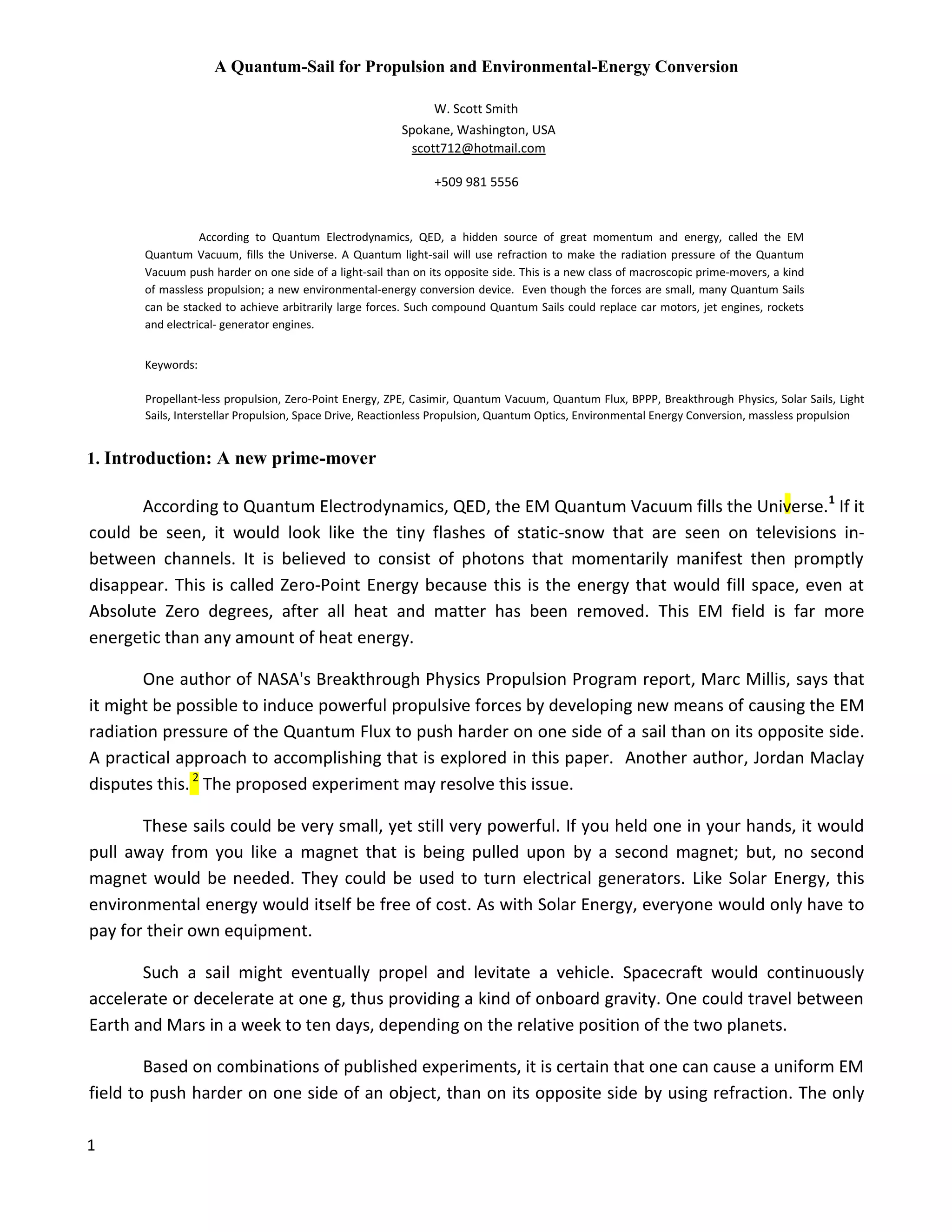
This paper proposes a realistic, simple
solution to a profoundly difficult problem: The EM
Quantum Flux Radiation-Pressure is equally
energetic in every direction. Put another way, this
radiation-pressure normally pushes equally hard on
opposite sides of most objects. All of these forces
would normally be totally used-up, just
counteracting each-other. Since these forces are
normally equal and opposite among themselves, a
single, isolated two-sided mirror floating in Space
would normally remain stationary. See Fig. 1.
3. A Simple Solution
The problem in Fig. 1 is not merely that the rays of light are equally-intense. Rather, the
difficulty lies in the fact that they are equally-intense and opposite.
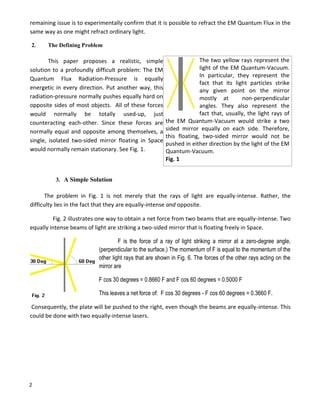
Fig. 2 illustrates one way to obtain a net force from two beams that are equally-intense. Two
equally intense beams of light are striking a two-sided mirror that is floating freely in Space.
F is the force of a ray of light striking a mirror at a zero-degree angle,
(perpendicular to the surface.) The momentum of F is equal to the momentum of the
other light rays that are shown in Fig. 6. The forces of the other rays acting on the
mirror are
F cos 30 degrees = 0.8660 F and F cos 60 degrees = 0.5000 F
This leaves a net force of: F cos 30 degrees - F cos 60 degrees = 0.3660 F.
Consequently, the plate will be pushed to the right, even though the beams are equally-intense. This
could be done with two equally-intense lasers.
The two yellow rays represent the
light of the EM Quantum-Vacuum.
In particular, they represent the
fact that its light particles strike
any given point on the mirror
mostly at non-perpendicular
angles. They also represent the
fact that, usually, the light rays of
the EM Quantum-Vacuum would strike a two
sided mirror equally on each side. Therefore,
this floating, two-sided mirror would not be
pushed in either direction by the light of the EM
Quantum-Vacuum.
Fig. 1
3
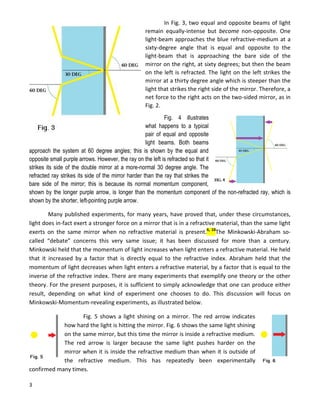
In Fig. 3, two equal and opposite beams of light
remain equally-intense but become non-opposite. One
light-beam approaches the blue refractive-medium at a
sixty-degree angle that is equal and opposite to the
light-beam that is approaching the bare side of the
mirror on the right, at sixty degrees; but then the beam
on the left is refracted. The light on the left strikes the
mirror at a thirty degree angle which is steeper than the
light that strikes the right side of the mirror. Therefore, a
net force to the right acts on the two-sided mirror, as in
Fig. 2.
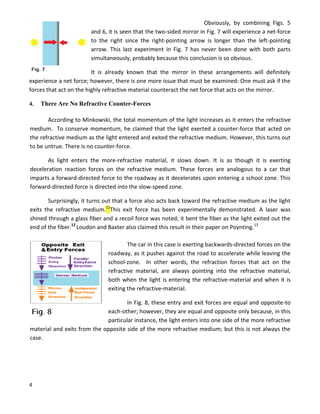
Fig. 4 illustrates
what happens to a typical
pair of equal and opposite
light beams. Both beams
approach the system at 60 degree angles; this is shown by the equal and
opposite small purple arrows. However, the ray on the left is refracted so that it
strikes its side of the double mirror at a more-normal 30 degree angle. The
refracted ray strikes its side of the mirror harder than the ray that strikes the
bare side of the mirror; this is because its normal momentum component,
shown by the longer purple arrow, is longer than the momentum component of the non-refracted ray, which is
shown by the shorter, left-pointing purple arrow.
Many published experiments, for many years, have proved that, under these circumstances,
light does in-fact exert a stronger force on a mirror that is in a refractive material, than the same light
exerts on the same mirror when no refractive material is present.6, 10
The Minkowski-Abraham so-
called “debate” concerns this very same issue; it has been discussed for more than a century.
Minkowski held that the momentum of light increases when light enters a refractive material. He held
that it increased by a factor that is directly equal to the refractive index. Abraham held that the
momentum of light decreases when light enters a refractive material, by a factor that is equal to the
inverse of the refractive index. There are many experiments that exemplify one theory or the other
theory. For the present purposes, it is sufficient to simply acknowledge that one can produce either
result, depending on what kind of experiment one chooses to do. This discussion will focus on
Minkowski-Momentum-revealing experiments, as illustrated below.
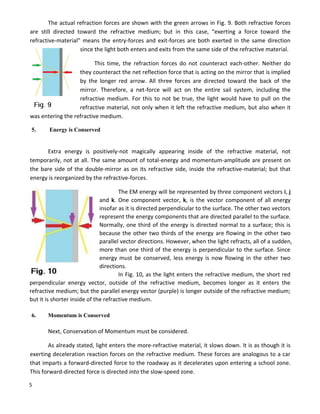
Fig. 5 shows a light shining on a mirror. The red arrow indicates
how hard the light is hitting the mirror. Fig. 6 shows the same light shining
on the same mirror, but this time the mirror is inside a refractive medium.
The red arrow is larger because the same light pushes harder on the
mirror when it is inside the refractive medium than when it is outside of
the refractive medium. This has repeatedly been experimentally
confirmed many times.
4
Obviously, by combining Figs. 5
and 6, it is seen that the two-sided mirror in Fig. 7 will experience a net-force
to the right since the right-pointing arrow is longer than the left-pointing
arrow. This last experiment in Fig. 7 has never been done with both parts
simultaneously, probably because this conclusion is so obvious.
It is already known that the mirror in these arrangements will definitely
experience a net force; however, there is one more issue that must be examined: One must ask if the
forces that act on the highly refractive material counteract the net force that acts on the mirror.
4. There Are No Refractive Counter-Forces
According to Minkowski, the total momentum of the light increases as it enters the refractive
medium. To conserve momentum, he claimed that the light exerted a counter-force that acted on
the refractive medium as the light entered and exited the refractive medium. However, this turns out
to be untrue. There is no counter-force.
As light enters the more-refractive material, it slows down. It is as though it is exerting
deceleration reaction forces on the refractive medium. These forces are analogous to a car that
imparts a forward-directed force to the roadway as it decelerates upon entering a school zone. This
forward-directed force is directed into the slow-speed zone.
Surprisingly, it turns out that a force also acts back toward the refractive medium as the light
exits the refractive medium.11
This exit force has been experimentally demonstrated. A laser was
shined through a glass fiber and a recoil force was noted; it bent the fiber as the light exited out the
end of the fiber.12
Loudon and Baxter also claimed this result in their paper on Poynting.13
The car in this case is exerting backwards-directed forces on the
roadway, as it pushes against the road to accelerate while leaving the
school-zone. In other words, the refraction forces that act on the
refractive material, are always pointing into the refractive material,
both when the light is entering the refractive-material and when it is
exiting the refractive-material.
In Fig. 8, these entry and exit forces are equal and opposite-to
each-other; however, they are equal and opposite only because, in this
particular instance, the light enters into one side of the more refractive
material and exits from the opposite side of the more refractive medium; but this is not always the
case.
5
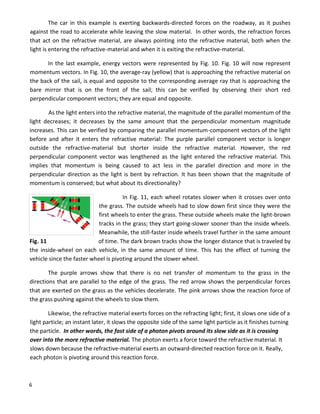
The actual refraction forces are shown with the green arrows in Fig. 9. Both refractive forces
are still directed toward the refractive medium; but in this case, “exerting a force toward the
refractive-material” means the entry-forces and exit-forces are both exerted in the same direction
since the light both enters and exits from the same side of the refractive material.
This time, the refraction forces do not counteract each-other. Neither do
they counteract the net reflection force that is acting on the mirror that is implied
by the longer red arrow. All three forces are directed toward the back of the
mirror. Therefore, a net-force will act on the entire sail system, including the
refractive medium. For this to not be true, the light would have to pull on the
refractive material, not only when it left the refractive medium, but also when it
was entering the refractive medium.
5. Energy is Conserved
Extra energy is positively-not magically appearing inside of the refractive material, not
temporarily, not at all. The same amount of total-energy and momentum-amplitude are present on
the bare side of the double-mirror as on its refractive side, inside the refractive-material; but that
energy is reorganized by the refractive-forces.
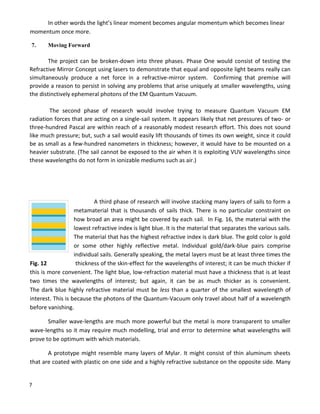
The EM energy will be represented by three component vectors i, j
and k. One component vector, k, is the vector component of all energy
insofar as it is directed perpendicular to the surface. The other two vectors
represent the energy components that are directed parallel to the surface.
Normally, one third of the energy is directed normal to a surface; this is
because the other two thirds of the energy are flowing in the other two
parallel vector directions. However, when the light refracts, all of a sudden,
more than one third of the energy is perpendicular to the surface. Since
energy must be conserved, less energy is now flowing in the other two
directions.
In Fig. 10, as the light enters the refractive medium, the short red
perpendicular energy vector, outside of the refractive medium, becomes longer as it enters the
refractive medium; but the parallel energy vector (purple) is longer outside of the refractive medium;
but it is shorter inside of the refractive medium.
6. Momentum is Conserved
Next, Conservation of Momentum must be considered.
As already stated, light enters the more-refractive material, it slows down. It is as though it is
exerting deceleration reaction forces on the refractive medium. These forces are analogous to a car
that imparts a forward-directed force to the roadway as it decelerates upon entering a school zone.
This forward-directed force is directed into the slow-speed zone.
6
The car in this example is exerting backwards-directed forces on the roadway, as it pushes
against the road to accelerate while leaving the slow material. In other words, the refraction forces
that act on the refractive material, are always pointing into the refractive material, both when the
light is entering the refractive-material and when it is exiting the refractive-material.
In the last example, energy vectors were represented by Fig. 10. Fig. 10 will now represent
momentum vectors. In Fig. 10, the average-ray (yellow) that is approaching the refractive material on
the back of the sail, is equal and opposite to the corresponding average ray that is approaching the
bare mirror that is on the front of the sail; this can be verified by observing their short red
perpendicular component vectors; they are equal and opposite.
As the light enters into the refractive material, the magnitude of the parallel momentum of the
light decreases; it decreases by the same amount that the perpendicular momentum magnitude
increases. This can be verified by comparing the parallel momentum-component vectors of the light
before and after it enters the refractive material: The purple parallel component vector is longer
outside the refractive-material but shorter inside the refractive material. However, the red
perpendicular component vector was lengthened as the light entered the refractive material. This
implies that momentum is being caused to act less in the parallel direction and more in the
perpendicular direction as the light is bent by refraction. It has been shown that the magnitude of
momentum is conserved; but what about its directionality?
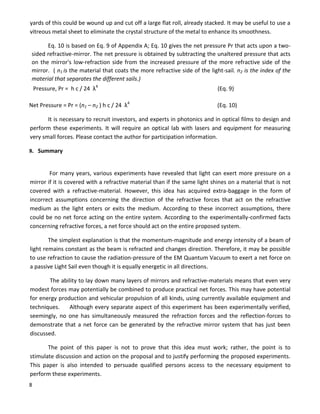
In Fig. 11, each wheel rotates slower when it crosses over onto
the grass. The outside wheels had to slow down first since they were the
first wheels to enter the grass. These outside wheels make the light-brown
tracks in the grass; they start going-slower sooner than the inside wheels.
Meanwhile, the still-faster inside wheels travel further in the same amount
Fig. 11 of time. The dark brown tracks show the longer distance that is traveled by
the inside-wheel on each vehicle, in the same amount of time. This has the effect of turning the
vehicle since the faster wheel is pivoting around the slower wheel.
The purple arrows show that there is no net transfer of momentum to the grass in the
directions that are parallel to the edge of the grass. The red arrow shows the perpendicular forces
that are exerted on the grass as the vehicles decelerate. The pink arrows show the reaction force of
the grass pushing against the wheels to slow them.
Likewise, the refractive material exerts forces on the refracting light; first, it slows one side of a
light particle; an instant later, it slows the opposite side of the same light particle as it finishes turning
the particle. In other words, the fast side of a photon pivots around its slow side as it is crossing
over into the more refractive material. The photon exerts a force toward the refractive material. It
slows down because the refractive-material exerts an outward-directed reaction force on it. Really,
each photon is pivoting around this reaction force.
7
In other words the light’s linear moment becomes angular momentum which becomes linear
momentum once more.
7. Moving Forward
The project can be broken-down into three phases. Phase One would consist of testing the
Refractive Mirror Concept using lasers to demonstrate that equal and opposite light beams really can
simultaneously produce a net force in a refractive-mirror system. Confirming that premise will
provide a reason to persist in solving any problems that arise uniquely at smaller wavelengths, using
the distinctively ephemeral photons of the EM Quantum Vacuum.
The second phase of research would involve trying to measure Quantum Vacuum EM
radiation forces that are acting on a single-sail system. It appears likely that net pressures of two- or
three-hundred Pascal are within reach of a reasonably modest research effort. This does not sound
like much pressure; but, such a sail would easily lift thousands of times its own weight, since it could
be as small as a few-hundred nanometers in thickness; however, it would have to be mounted on a
heavier substrate. (The sail cannot be exposed to the air when it is exploiting VUV wavelengths since
these wavelengths do not form in ionizable mediums such as air.)
A third phase of research will involve stacking many layers of sails to form a
metamaterial that is thousands of sails thick. There is no particular constraint on
how broad an area might be covered by each sail. In Fig. 16, the material with the
lowest refractive index is light blue. It is the material that separates the various sails.
The material that has the highest refractive index is dark blue. The gold color is gold
or some other highly reflective metal. Individual gold/dark-blue pairs comprise
individual sails. Generally speaking, the metal layers must be at least three times the
Fig. 12 thickness of the skin-effect for the wavelengths of interest; it can be much thicker if
this is more convenient. The light blue, low-refraction material must have a thickness that is at least
two times the wavelengths of interest; but again, it can be as much thicker as is convenient.
The dark blue highly refractive material must be less than a quarter of the smallest wavelength of
interest. This is because the photons of the Quantum-Vacuum only travel about half of a wavelength
before vanishing.
Smaller wave-lengths are much more powerful but the metal is more transparent to smaller
wave-lengths so it may require much modelling, trial and error to determine what wavelengths will
prove to be optimum with which materials.
A prototype might resemble many layers of Mylar. It might consist of thin aluminum sheets
that are coated with plastic on one side and a highly refractive substance on the opposite side. Many
8
yards of this could be wound up and cut off a large flat roll, already stacked. It may be useful to use a
vitreous metal sheet to eliminate the crystal structure of the metal to enhance its smoothness.
Eq. 10 is based on Eq. 9 of Appendix A; Eq. 10 gives the net pressure Pr that acts upon a two-
sided refractive-mirror. The net pressure is obtained by subtracting the unaltered pressure that acts
on the mirror's low-refraction side from the increased pressure of the more refractive side of the
mirror. ( n1 is the material that coats the more refractive side of the light-sail. n2 is the index of the
material that separates the different sails.)
Pressure, Pr = h c / 24 λ4
(Eq. 9)
Net Pressure = Pr = (n1 – n2 ) h c / 24 λ4
(Eq. 10)
It is necessary to recruit investors, and experts in photonics and in optical films to design and
perform these experiments. It will require an optical lab with lasers and equipment for measuring
very small forces. Please contact the author for participation information.
8. Summary
For many years, various experiments have revealed that light can exert more pressure on a
mirror if it is covered with a refractive material than if the same light shines on a material that is not
covered with a refractive-material. However, this idea has acquired extra-baggage in the form of
incorrect assumptions concerning the direction of the refractive forces that act on the refractive
medium as the light enters or exits the medium. According to these incorrect assumptions, there
could be no net force acting on the entire system. According to the experimentally-confirmed facts
concerning refractive forces, a net force should act on the entire proposed system.
The simplest explanation is that the momentum-magnitude and energy intensity of a beam of
light remains constant as the beam is refracted and changes direction. Therefore, it may be possible
to use refraction to cause the radiation-pressure of the EM Quantum Vacuum to exert a net force on
a passive Light Sail even though it is equally energetic in all directions.
The ability to lay down many layers of mirrors and refractive-materials means that even very
modest forces may potentially be combined to produce practical net forces. This may have potential
for energy production and vehicular propulsion of all kinds, using currently available equipment and
techniques. Although every separate aspect of this experiment has been experimentally verified,
seemingly, no one has simultaneously measured the refraction forces and the reflection-forces to
demonstrate that a net force can be generated by the refractive mirror system that has just been
discussed.
The point of this paper is not to prove that this idea must work; rather, the point is to
stimulate discussion and action on the proposal and to justify performing the proposed experiments.
This paper is also intended to persuade qualified persons access to the necessary equipment to
perform these experiments.
9
Further questions and answers are addressed in the Apendixes.
References
1. A Radiation pressure from the vacuum: Physical interpretation of the Casimir Force; Physical
Review A; Volume 38, Number 3; August 1, 1988, pg.1621; PW. Milonni, Theoretical Division, M.E.
Goggin, Los Alamos National Laboratory, Los Alamos, New Mexico; J. Cook, Rank J. Seiler, Research
Laboratory, United States Air Force Academy, Colorado Springs, Colorado.
2. Frontiers of Propulsion Science; Progress in Astronautics and Aeronautics, Vol. 227,pgs. 153-156,
Reston Virginia; Marc G. Millis, NASA Glen Research Center, Cleveland, Ohio; Eric W, Davis,
Institute for advanced Studies at Austin, Texas.
3. H.B.G. Casimir, Proc. Kon. Ned. Akad. Wetensch. B51, 793 (1948)
4. S. Lamoreaux, Phys. Rev. Lett.78, 5 (1996)
5. US Patent Number 8,317,137
6. R. V. Jones and J. C. S. Richards, Proc. Roy. Soc. A 221, 480 (1954).
7. Pfeifer, R. N. C.; Nieminen, T. A; Heckenberg, N. R.; Rubinsztein-Dunlop, H. (2007). "Colloquium:
Momentum of an electromagnetic wave in dielectric media". Reviews of Modern Physics 79 (4):
1197.
arXiv:0710.0461. Bibcode:2007RvMP...79.1197P. doi:10.1103/RevModPhys.79.1197.
8. Minkowski, H. (1908). "Die Grundgleichungen für die elektromagnetischen Vorgänge in bewegten
Körpern". Nachrichten von der Gesellschaft der Wissenschaften zu Göttingen, Mathematisch-
Physikalische Klasse: 53– 111.
9. Abraham, M. (1909). "Zur Elektrodynamik bewegter Körper". Rendiconti del Circolo Matematico di
Palermo 28: 1–28. doi:10.1007/bf03018208.
10. R. V. Jones and B. Leslie, Proc. R. Soc. Lond. A 360, 347 (1978).
11. Cambell] et al. (2008) Campbell, G. K., Leanhardt, A. E., Mun, J., Boyd, M., Streed, E. W., Ketterle,
W. & Pritchard, D. E., 2005; Photon recoil momentum in dispersive media. Phys. Rev. Lett. 94,
170403.
12. Weilong She, Jianhui Yu, and Raohui Feng, Weilong She, Jianhui Yu, and Raohui Feng State Key
Laboratory of Optoelectronic Materials and Technologies, Sun Yat-Sen University, Guangzhou
510275, China.
13. Contributions of John Henry Poynting to the understanding of radiation pressure; R. Loudon and C.
Baxter; Proc. R. Soc. A 2012 468, doi: 10.1098/rspa.2011.0573; first published online 28 March
2012.
Appendixes
A. Deriving the Radiation-Pressure of the EM Quantum Vacuum
According to Quantum Electrodynamics, the Quantum-Vacuum Zero-Point Energy field is what
is left in space even if all matter and heat were removed. It is believed to consist of particle-pairs that
pop into existence then vanish a short time later. Some of these particles are photons. Its photons
continuously appear in every possible wavelength. Then they vanish after traveling about half of a
wave-length.
10
The EM Quantum Vacuum Radiation Pressure can be derived from energy values that can be
experimentally detected. These values and their relationships are described by Planck's Black Body
Radiation Spectrum Formula. Each energy value is represented by u. Planck's Constant is ħ.
u = ħω (n + 1/2); { n = 0, 1, 2, 3 . . . n, n+1} (Eq. 1)
The existence of the Zero Point Energy Field is most clearly seen in the instance where n = 0;
this leaves Eq. 2.
uzpe = ħω / 2 (Eq. 2)
The radiation that is attributable to emissions from atoms is given by n, which is always a
whole number.
However, actual readings of Black Body Radiation reveals the extra term: 1 / 2. So in addition
to the part of the Black Body Radiation field which originates in orbital transitions inside of atoms,
another field is present. It would be detected by itself when n equals Zero. Zero-Point Energy, uzpe, is
the energy that comprises the EM Quantum Vacuum.
Planck's constant is represented by the symbol ħ or h; ω is light frequency in radians per
second; f is frequency in cycles per second.
(Eq. 2) = ħ ω / 2 = [(h / 2π) (2π f / 2)] = uzpe = h f /2 (Eq. 3)
A single photon is one wavelength long; 1 / λ3
gives the total number of photons of one
wavelength that can fit into one cubic meter. (Eq. 4) gives the total energy of quanta of that one
wavelength that fit into a cubic meter of space.
(h / 2) * (1 / λ3
) = uzpe ( λ ) d λ = h / 2 λ3
(Eq. 4)
c = f λ (Eq. 5)
h / 2 λ3
d λ = (h f 3
/ 2 c3
) df (Eq. 6)
Integrating uzpe ( f ) df sums the energies of all photons of every frequency that can
simultaneously occupy one cubic meter in a given range of frequencies.
Uzpe (f) =  (f 3
/ 2 c3
)df = Uzpe (f) = h f 4
/ 8 c3
(Eq. 7)
(h f 4
/ 8 c3
) * (c / c)= (h c f 4
/ 8 c3
) = Uzpe (λ) = h c / 8 λ4
(Eq. 8)
Ludwig Boltzmann proved that the isotropic radiation-pressure Pr, that is acting uniformly on
a surface is equal to the energy-density above the surface, divided by three.
Uzpe (λ) / 3 = Pr = h c / 24 λ4
(Eq. 9)
11
In practice, one can justify not counting wavelengths that are larger than λ specified since one
only needs to specify wavelengths that significantly impact the material that has been chosen. The
energy density of progressively longer wavelengths quickly becomes insignificant. This is because
every two-fold increase in wavelength is accompanied by a sixteen-fold decrease in energy-density.
This is due to the λ-4
term. Likewise, consideration of ever-smaller wavelengths also converges rapidly
on irrelevance for the present purposes; this is because matter rapidly becomes ever-more
transparent as ever-smaller wavelengths are considered.
B. Using the EM Quantum-Vacuum to Push, a First Quantum Sail Experiment
Henrik Casimir is credited with being the first person to propose
using the Radiation Pressure of the EM Quantum Flux to move a physical
object.3
He described what would occur if EM Zero-Point Energy really
exists. In 1948, he proposed a thought experiment. He described two
electrically-neutral, electrically-conducting, parallel plates. At least one
plate could move freely. They would be separated from each other by a
Fig. 12 very small distance. He pointed out that these plates would prevent the
EM Quantum Flux from forming photons with wavelengths that were too long to form between the
plates.
In Fig. 12, the smaller, purple waves represent all of the wavelengths that can form both
inside-of and outside-of the space between the plates. Since the smaller waves are equal and
opposite to each other, they exert no net forces on the plates; however, the longer red wavelengths
can only form outside of the space between the two plates since they are too long to fit between the
plates. The inward-directed Radiation Pressure, outside of the plates, consists of all possible
wavelengths. This is because all-possible wavelengths can form outside of the confines of the space
between the Plates. The longer (red) wavelengths move the plates inward since there are no long, red
wavelengths inside the cavity to counteract them by pushing outwardly.
In 1996, Steve Lamoreaux4
, then at the University of Washington in Seattle, experimentally
confirmed a version of this gedanken. Many additional independent experiments have consistently
verified this phenomenon. The force that moves the “plates” together is called the Casimir Force.
These plates are a kind of quantum sail if they are driven by an induced asymmetry in the radiation
pressure of the EM Quantum Vacuum.
There is another possible explanation for the Casimir Force. Some argue that the two
electrically neutral plates somehow exert Van der Waal-like electrical forces on each other. Resolving
this issue is another good reason for doing the proposed experiment. This is because a sail doesn’t
have a “second plate” to attract or repel it; so if the sail still moves without a second plate, then the
Radiation Pressure Interpretation is the only viable explanation.
12
C. A Patented, Potentially-Practical Casimir Device
The Casimir Effect is very real; it currently presents severe problems in Microscopic
Electromechanical Machines, MEMs. It causes sticktion which means that the small clearances that
are between small parts form unintended Casimir Cavities. In other words, Casimir Forces tend to jam
very-small parts together so that they cannot function properly. So already, the Casimir Effect is a
force to be reckoned-with. However, one man has found a potentially-practical method of utilizing
the effect.
Fabrizio Pinto has obtained a patent for reciprocating Casimir Plates.5
Semiconductor plates
would alternate between a conducting and non-conducting state to turn the Casimir Effect off and on.
Unfortunately such an approach may only produce small forces, and motions that are less than a
micrometer in length. It may very well prove to be useful for microscopic machines; but it may be
impossible to use it to create useful macroscopic forces. This is due to the difficulty of maintaining
large parallel surfaces at nano-scale separations. It also would not be useful for propellantless
propulsion.
D. The Quantum-Flux Has Already Done Work
Suppose Casimir's original Radiation Pressure Theory correctly models a real physical process.
This means that the plates are not exerting any significant forces on each other. Instead, the plates
are effortlessly altering the EM Quantum Vacuum Density by simply being there. They are then
moved because of the radiation pressure differences on opposite sides of each plate. They are moved
by the energy and momentum of the Radiation Pressure of the EM Quantum Flux. In other words, no
human is providing this energy. This is energy that would have been there, in the environment,
whether or not anyone chose to use it. Harold Puthoff, Director of the Institute for Advanced Studies
at Austin, Texas, has pointed out that this energy is left behind as heat if the plates collide. In other
words, perhaps Zero-Point energy has already been used to propel real objects. Again, these plates
constitute a kind of Quantum Sail if they are in fact moved by induced asymmetries in the radiation
pressures in the EM Quantum Vacuum.
E. Casimir Plate Movement & the Four Laws
If Casimir Plates did not move, that would violate the Zeroeth Law. This is because the freely-
moveable Plate is located directly between a high energy-density radiation-pressure region and a low-
energy radiation-pressure region; therefore, it would have to move.
The First Law is not violated. This is because the energy that is entering the system as a high-
energy flux of photons is equal to the work and low-energy photon flux that is leaving system as heat.
The Second Law is not violated. This is because an already-existing high energy-density, low
entropy photon flux is crossing the system boundary, performing work and shedding high-entropy,
13
low energy-density heat which then exits across the System Boundary. Therefore Entropy is increasing
and energy density is decreasing, just as they should do.
The Third Law concerns the usual inability of energy to transfer in the absence of two differing
Thermal Reservoirs. It is not the machine that is exceptional in this case. Rather, the Quantum Flux
itself is defined as the energy that remains in otherwise empty space, when all heat energy has been
removed. This is one reason why it is called Zero-Point Energy (ZPE.) Of course it is also still present at
all non-zero temperatures.
ZPE literally has no thermal potential because differences in energy potential cannot flow
together. This is because each generation of particles vanishes before they can redistribute
themselves. Each generation of particles is replaced by a new generation of particles that appears in
the same general distribution as the previous generation of particles appeared. Casimir's Plates move
because they store multiple generations of energy that is collected as the photons collide more with
one side of each plate than with the opposite side.
Though the Quantum Flux is non-thermal, its spectrum is, highly energetic, especially at
wavelengths below 50 nm. In other words, being at Zero-Temperature does not mean that its energy
potential is Zero. Again, one is using the low-entropy, high-energy density Radiation Pressure of very-
intense, very-small wavelengths to do work. That work is dissipated as low-energy, high-entropy
wavelengths of infrared radiation.
Basically, the Third Law comes into play more abstractly: High and low frequencies always exist
in the ZPE Spectrum at all temperatures. Even at Absolute Zero Degrees, the high energy, low-entropy
wavelengths function as the high-energy reservoir and the cool heat-sink of space still serves as the
low-energy heat-reservoir when the work is dissipated as heat. So a high energy reservoir and a low
energy reservoir are both still present. So, in principle, the Third Law is still being observed. This
adaptation of the Third Law is no more extraordinary than when the Third Law is adapted to cover
systems that require non-thermal differences in electrical potential or hydraulic pressure.
Many object that using some of this energy before it winked-out would change the amount of
energy remaining in the Universe. This depends entirely on where one draws the system-boundaries
of the Universe. On the one hand, if one defines the Quantum Flux mechanism as part of the Universe
then, perhaps, energy is not really being created and destroyed. Instead, it might be alternating
between a hidden state and a manifest state. This is the essence of Paul Dirac's Theory of a vast Sea of
Particles that alternate between a positive energy level and a negative energy level. Any energy that
left the Quantum-Flux would then have begun in the Universe and then remained in the Universe.
On the other hand, if one posits that the Quantum Flux is not part of the Universe, then he is
admitting that energy can enter and leave the Universe. Therefore, one would have no basis for
assuming that matter and energy could not temporarily accumulate in one Universe while another
Universe is temporarily depleted. Perhaps this energy would be passed back and forth more or less
equally over time. These musings are no more- or less- fanciful than insisting that one even can know
14
if the energy-balance of the universe has to match our small-minded, pathetically-uninformed
expectations. In other words a quantum sail is not required to return an equal amount of energy to
the Quantum field any more than one would require a coal-fired steam plant to return an equal
quantity of coal to the ground.
F. Conclusions of NASA's Breakthrough Physics Propulsion Program (BPPP)
Can the two sides of a single plate interact asymmetrically with the radiation pressure of the
EM Quantum Vacuum and experience a net force? Propellant-less Propulsion is the sort of concept
that will cause many readers to quickly put this paper down. That is because, on its face, it seems like
a hopelessly absurd thing to attempt. NASA's Breakthrough Physics Propulsion Program2
(BPPP)
evaluated possible avenues of novel research. It hoped to identify new insights and methods that
might enable science to surpass current expectations of what is considered possible. The BPPP
authors examined many proposals; electric rockets, nuclear rockets, laser powered sails; interstellar
ramjets. No mass-based propulsion methods appear adequate to take anyone, even just to the
second-nearest Star, in a single lifetime. Therefore, the BPPP was particularly interested in identifying
avenues of research that might lead to Propellant-less propulsion. Propellant-less Propulsion would
not need on-board reaction mass. This is important because the reaction-mass requirement of
rockets is the major part of what makes them fuel-hungry, large, expensive and slow.
NASA's Breakthrough Physics Propulsion Program final report mentioned the possibility of
developing a Quantum light-diode sail;2
it would let more EM Quantum Vacuum radiation pass
through the diode from one side than from the opposite side. This would cause the isotropic EM
Quantum-Vacuum radiation-pressure to exert a net force toward the less-transparent, more-
reflective side of the Quantum-Diode. In other words, instead of using Newton's Third Law which
requires reaction-mass, one would use the radiation-pressure of the Quantum-Vacuum as an outside-
force, in accordance with Newton's First Law.
G. Asymmetric Boundary Conditions on Two Sides of a Single Plate
Instead of using a pair of plates, a single isolated plate will impose asymmetric boundary
conditions with the EM Quantum Vacuum on its two sides. These asymmetric conditions will cause a
single plate to experience different radiation pressures on its two sides; this will cause a net force to
act on the plate.
It sounds theoretically impossible to derive a net force from equal and opposite influxes. It is
tempting to dismiss this entire notion by simply invoking Conservation of Momentum; however, this
general objection is easily refuted by a simple example, a mechanical diode for rubber balls: Two
teams of astronauts throw equal and opposite numbers of rubber balls at a wall that is floating in
Space between them. At this point, most people insist that one should already know that the wall will
not be moved in either direction. They will argue that all of the forces that are applied to the balls are
15
equal and opposite; therefore, they say that whatever one side of the system accomplishes, the
opposite side of the system must undo it. In other words, they are saying, since the applied
momentum sums to zero, then so must the final momentum sum to zero. This much is true, but it still
does not mean that the wall is not moved.
What if the wall itself responds differently to the two influxes of balls? What if the wall itself
introduces asymmetric reaction-forces? If the wall is made of little doors that only open in one
direction, then half of the balls will impart a full-measure of momentum to the wall as they bounce off
of the one side where the doors stay closed; but the remaining balls will only impart a small amount
of their momentum to the wall, in the opposite direction, as they push the doors open and continue
onward. In other words, a door experiences a stronger collision-force from a rubber ball if that door
remains closed than from a rubber ball that pushes through the door. This happens because the
collision-force that a given rubber ball exerts on a door must equal the reaction force that door
applies to the rubber ball. On one side, that reaction-force is limited to whatever small amount of
force it takes to push a door open. In effect, the balls on the other side encounter a solid wall.
It is quite remarkable that two equal and opposite influxes can indeed impact the same wall
asymmetrically. This does not prove that one could in-practice make a light-diode; but it does prove
that this sort of thing is not impossible from the standpoint of Momentum Conservation. In this
example, the doors experienced different reaction forces on their two sides. Similarly, in the proposed
experiment, a two-sided mirror is approached by equal and opposite influxes of EM Quantum-
Vacuum radiation-pressure. Again, the reaction forces are different on each of the two sides. In this
case, a difference in pressure arises on opposite sides of the two-sided mirror because one side is
covered with a highly-refractive material and the opposite side is bare or is covered with a low-
refraction material.

2RQThruster

  • 1.
    1 A Quantum-Sail forPropulsion and Environmental-Energy Conversion W. Scott Smith Spokane, Washington, USA scott712@hotmail.com +509 981 5556 According to Quantum Electrodynamics, QED, a hidden source of great momentum and energy, called the EM Quantum Vacuum, fills the Universe. A Quantum light-sail will use refraction to make the radiation pressure of the Quantum Vacuum push harder on one side of a light-sail than on its opposite side. This is a new class of macroscopic prime-movers, a kind of massless propulsion; a new environmental-energy conversion device. Even though the forces are small, many Quantum Sails can be stacked to achieve arbitrarily large forces. Such compound Quantum Sails could replace car motors, jet engines, rockets and electrical- generator engines. Keywords: Propellant-less propulsion, Zero-Point Energy, ZPE, Casimir, Quantum Vacuum, Quantum Flux, BPPP, Breakthrough Physics, Solar Sails, Light Sails, Interstellar Propulsion, Space Drive, Reactionless Propulsion, Quantum Optics, Environmental Energy Conversion, massless propulsion 1. Introduction: A new prime-mover According to Quantum Electrodynamics, QED, the EM Quantum Vacuum fills the Universe.1 If it could be seen, it would look like the tiny flashes of static-snow that are seen on televisions in- between channels. It is believed to consist of photons that momentarily manifest then promptly disappear. This is called Zero-Point Energy because this is the energy that would fill space, even at Absolute Zero degrees, after all heat and matter has been removed. This EM field is far more energetic than any amount of heat energy. One author of NASA's Breakthrough Physics Propulsion Program report, Marc Millis, says that it might be possible to induce powerful propulsive forces by developing new means of causing the EM radiation pressure of the Quantum Flux to push harder on one side of a sail than on its opposite side. A practical approach to accomplishing that is explored in this paper. Another author, Jordan Maclay disputes this. 2 The proposed experiment may resolve this issue. These sails could be very small, yet still very powerful. If you held one in your hands, it would pull away from you like a magnet that is being pulled upon by a second magnet; but, no second magnet would be needed. They could be used to turn electrical generators. Like Solar Energy, this environmental energy would itself be free of cost. As with Solar Energy, everyone would only have to pay for their own equipment. Such a sail might eventually propel and levitate a vehicle. Spacecraft would continuously accelerate or decelerate at one g, thus providing a kind of onboard gravity. One could travel between Earth and Mars in a week to ten days, depending on the relative position of the two planets. Based on combinations of published experiments, it is certain that one can cause a uniform EM field to push harder on one side of an object, than on its opposite side by using refraction. The only
  • 2.
    2 remaining issue isto experimentally confirm that it is possible to refract the EM Quantum Flux in the same way as one might refract ordinary light. 2. The Defining Problem This paper proposes a realistic, simple solution to a profoundly difficult problem: The EM Quantum Flux Radiation-Pressure is equally energetic in every direction. Put another way, this radiation-pressure normally pushes equally hard on opposite sides of most objects. All of these forces would normally be totally used-up, just counteracting each-other. Since these forces are normally equal and opposite among themselves, a single, isolated two-sided mirror floating in Space would normally remain stationary. See Fig. 1. 3. A Simple Solution The problem in Fig. 1 is not merely that the rays of light are equally-intense. Rather, the difficulty lies in the fact that they are equally-intense and opposite. Fig. 2 illustrates one way to obtain a net force from two beams that are equally-intense. Two equally intense beams of light are striking a two-sided mirror that is floating freely in Space. F is the force of a ray of light striking a mirror at a zero-degree angle, (perpendicular to the surface.) The momentum of F is equal to the momentum of the other light rays that are shown in Fig. 6. The forces of the other rays acting on the mirror are F cos 30 degrees = 0.8660 F and F cos 60 degrees = 0.5000 F This leaves a net force of: F cos 30 degrees - F cos 60 degrees = 0.3660 F. Consequently, the plate will be pushed to the right, even though the beams are equally-intense. This could be done with two equally-intense lasers. The two yellow rays represent the light of the EM Quantum-Vacuum. In particular, they represent the fact that its light particles strike any given point on the mirror mostly at non-perpendicular angles. They also represent the fact that, usually, the light rays of the EM Quantum-Vacuum would strike a two sided mirror equally on each side. Therefore, this floating, two-sided mirror would not be pushed in either direction by the light of the EM Quantum-Vacuum. Fig. 1
  • 3.
    3 In Fig. 3,two equal and opposite beams of light remain equally-intense but become non-opposite. One light-beam approaches the blue refractive-medium at a sixty-degree angle that is equal and opposite to the light-beam that is approaching the bare side of the mirror on the right, at sixty degrees; but then the beam on the left is refracted. The light on the left strikes the mirror at a thirty degree angle which is steeper than the light that strikes the right side of the mirror. Therefore, a net force to the right acts on the two-sided mirror, as in Fig. 2. Fig. 4 illustrates what happens to a typical pair of equal and opposite light beams. Both beams approach the system at 60 degree angles; this is shown by the equal and opposite small purple arrows. However, the ray on the left is refracted so that it strikes its side of the double mirror at a more-normal 30 degree angle. The refracted ray strikes its side of the mirror harder than the ray that strikes the bare side of the mirror; this is because its normal momentum component, shown by the longer purple arrow, is longer than the momentum component of the non-refracted ray, which is shown by the shorter, left-pointing purple arrow. Many published experiments, for many years, have proved that, under these circumstances, light does in-fact exert a stronger force on a mirror that is in a refractive material, than the same light exerts on the same mirror when no refractive material is present.6, 10 The Minkowski-Abraham so- called “debate” concerns this very same issue; it has been discussed for more than a century. Minkowski held that the momentum of light increases when light enters a refractive material. He held that it increased by a factor that is directly equal to the refractive index. Abraham held that the momentum of light decreases when light enters a refractive material, by a factor that is equal to the inverse of the refractive index. There are many experiments that exemplify one theory or the other theory. For the present purposes, it is sufficient to simply acknowledge that one can produce either result, depending on what kind of experiment one chooses to do. This discussion will focus on Minkowski-Momentum-revealing experiments, as illustrated below. Fig. 5 shows a light shining on a mirror. The red arrow indicates how hard the light is hitting the mirror. Fig. 6 shows the same light shining on the same mirror, but this time the mirror is inside a refractive medium. The red arrow is larger because the same light pushes harder on the mirror when it is inside the refractive medium than when it is outside of the refractive medium. This has repeatedly been experimentally confirmed many times.
  • 4.
    4 Obviously, by combiningFigs. 5 and 6, it is seen that the two-sided mirror in Fig. 7 will experience a net-force to the right since the right-pointing arrow is longer than the left-pointing arrow. This last experiment in Fig. 7 has never been done with both parts simultaneously, probably because this conclusion is so obvious. It is already known that the mirror in these arrangements will definitely experience a net force; however, there is one more issue that must be examined: One must ask if the forces that act on the highly refractive material counteract the net force that acts on the mirror. 4. There Are No Refractive Counter-Forces According to Minkowski, the total momentum of the light increases as it enters the refractive medium. To conserve momentum, he claimed that the light exerted a counter-force that acted on the refractive medium as the light entered and exited the refractive medium. However, this turns out to be untrue. There is no counter-force. As light enters the more-refractive material, it slows down. It is as though it is exerting deceleration reaction forces on the refractive medium. These forces are analogous to a car that imparts a forward-directed force to the roadway as it decelerates upon entering a school zone. This forward-directed force is directed into the slow-speed zone. Surprisingly, it turns out that a force also acts back toward the refractive medium as the light exits the refractive medium.11 This exit force has been experimentally demonstrated. A laser was shined through a glass fiber and a recoil force was noted; it bent the fiber as the light exited out the end of the fiber.12 Loudon and Baxter also claimed this result in their paper on Poynting.13 The car in this case is exerting backwards-directed forces on the roadway, as it pushes against the road to accelerate while leaving the school-zone. In other words, the refraction forces that act on the refractive material, are always pointing into the refractive material, both when the light is entering the refractive-material and when it is exiting the refractive-material. In Fig. 8, these entry and exit forces are equal and opposite-to each-other; however, they are equal and opposite only because, in this particular instance, the light enters into one side of the more refractive material and exits from the opposite side of the more refractive medium; but this is not always the case.
  • 5.
    5 The actual refractionforces are shown with the green arrows in Fig. 9. Both refractive forces are still directed toward the refractive medium; but in this case, “exerting a force toward the refractive-material” means the entry-forces and exit-forces are both exerted in the same direction since the light both enters and exits from the same side of the refractive material. This time, the refraction forces do not counteract each-other. Neither do they counteract the net reflection force that is acting on the mirror that is implied by the longer red arrow. All three forces are directed toward the back of the mirror. Therefore, a net-force will act on the entire sail system, including the refractive medium. For this to not be true, the light would have to pull on the refractive material, not only when it left the refractive medium, but also when it was entering the refractive medium. 5. Energy is Conserved Extra energy is positively-not magically appearing inside of the refractive material, not temporarily, not at all. The same amount of total-energy and momentum-amplitude are present on the bare side of the double-mirror as on its refractive side, inside the refractive-material; but that energy is reorganized by the refractive-forces. The EM energy will be represented by three component vectors i, j and k. One component vector, k, is the vector component of all energy insofar as it is directed perpendicular to the surface. The other two vectors represent the energy components that are directed parallel to the surface. Normally, one third of the energy is directed normal to a surface; this is because the other two thirds of the energy are flowing in the other two parallel vector directions. However, when the light refracts, all of a sudden, more than one third of the energy is perpendicular to the surface. Since energy must be conserved, less energy is now flowing in the other two directions. In Fig. 10, as the light enters the refractive medium, the short red perpendicular energy vector, outside of the refractive medium, becomes longer as it enters the refractive medium; but the parallel energy vector (purple) is longer outside of the refractive medium; but it is shorter inside of the refractive medium. 6. Momentum is Conserved Next, Conservation of Momentum must be considered. As already stated, light enters the more-refractive material, it slows down. It is as though it is exerting deceleration reaction forces on the refractive medium. These forces are analogous to a car that imparts a forward-directed force to the roadway as it decelerates upon entering a school zone. This forward-directed force is directed into the slow-speed zone.
  • 6.
    6 The car inthis example is exerting backwards-directed forces on the roadway, as it pushes against the road to accelerate while leaving the slow material. In other words, the refraction forces that act on the refractive material, are always pointing into the refractive material, both when the light is entering the refractive-material and when it is exiting the refractive-material. In the last example, energy vectors were represented by Fig. 10. Fig. 10 will now represent momentum vectors. In Fig. 10, the average-ray (yellow) that is approaching the refractive material on the back of the sail, is equal and opposite to the corresponding average ray that is approaching the bare mirror that is on the front of the sail; this can be verified by observing their short red perpendicular component vectors; they are equal and opposite. As the light enters into the refractive material, the magnitude of the parallel momentum of the light decreases; it decreases by the same amount that the perpendicular momentum magnitude increases. This can be verified by comparing the parallel momentum-component vectors of the light before and after it enters the refractive material: The purple parallel component vector is longer outside the refractive-material but shorter inside the refractive material. However, the red perpendicular component vector was lengthened as the light entered the refractive material. This implies that momentum is being caused to act less in the parallel direction and more in the perpendicular direction as the light is bent by refraction. It has been shown that the magnitude of momentum is conserved; but what about its directionality? In Fig. 11, each wheel rotates slower when it crosses over onto the grass. The outside wheels had to slow down first since they were the first wheels to enter the grass. These outside wheels make the light-brown tracks in the grass; they start going-slower sooner than the inside wheels. Meanwhile, the still-faster inside wheels travel further in the same amount Fig. 11 of time. The dark brown tracks show the longer distance that is traveled by the inside-wheel on each vehicle, in the same amount of time. This has the effect of turning the vehicle since the faster wheel is pivoting around the slower wheel. The purple arrows show that there is no net transfer of momentum to the grass in the directions that are parallel to the edge of the grass. The red arrow shows the perpendicular forces that are exerted on the grass as the vehicles decelerate. The pink arrows show the reaction force of the grass pushing against the wheels to slow them. Likewise, the refractive material exerts forces on the refracting light; first, it slows one side of a light particle; an instant later, it slows the opposite side of the same light particle as it finishes turning the particle. In other words, the fast side of a photon pivots around its slow side as it is crossing over into the more refractive material. The photon exerts a force toward the refractive material. It slows down because the refractive-material exerts an outward-directed reaction force on it. Really, each photon is pivoting around this reaction force.
  • 7.
    7 In other wordsthe light’s linear moment becomes angular momentum which becomes linear momentum once more. 7. Moving Forward The project can be broken-down into three phases. Phase One would consist of testing the Refractive Mirror Concept using lasers to demonstrate that equal and opposite light beams really can simultaneously produce a net force in a refractive-mirror system. Confirming that premise will provide a reason to persist in solving any problems that arise uniquely at smaller wavelengths, using the distinctively ephemeral photons of the EM Quantum Vacuum. The second phase of research would involve trying to measure Quantum Vacuum EM radiation forces that are acting on a single-sail system. It appears likely that net pressures of two- or three-hundred Pascal are within reach of a reasonably modest research effort. This does not sound like much pressure; but, such a sail would easily lift thousands of times its own weight, since it could be as small as a few-hundred nanometers in thickness; however, it would have to be mounted on a heavier substrate. (The sail cannot be exposed to the air when it is exploiting VUV wavelengths since these wavelengths do not form in ionizable mediums such as air.) A third phase of research will involve stacking many layers of sails to form a metamaterial that is thousands of sails thick. There is no particular constraint on how broad an area might be covered by each sail. In Fig. 16, the material with the lowest refractive index is light blue. It is the material that separates the various sails. The material that has the highest refractive index is dark blue. The gold color is gold or some other highly reflective metal. Individual gold/dark-blue pairs comprise individual sails. Generally speaking, the metal layers must be at least three times the Fig. 12 thickness of the skin-effect for the wavelengths of interest; it can be much thicker if this is more convenient. The light blue, low-refraction material must have a thickness that is at least two times the wavelengths of interest; but again, it can be as much thicker as is convenient. The dark blue highly refractive material must be less than a quarter of the smallest wavelength of interest. This is because the photons of the Quantum-Vacuum only travel about half of a wavelength before vanishing. Smaller wave-lengths are much more powerful but the metal is more transparent to smaller wave-lengths so it may require much modelling, trial and error to determine what wavelengths will prove to be optimum with which materials. A prototype might resemble many layers of Mylar. It might consist of thin aluminum sheets that are coated with plastic on one side and a highly refractive substance on the opposite side. Many
  • 8.
    8 yards of thiscould be wound up and cut off a large flat roll, already stacked. It may be useful to use a vitreous metal sheet to eliminate the crystal structure of the metal to enhance its smoothness. Eq. 10 is based on Eq. 9 of Appendix A; Eq. 10 gives the net pressure Pr that acts upon a two- sided refractive-mirror. The net pressure is obtained by subtracting the unaltered pressure that acts on the mirror's low-refraction side from the increased pressure of the more refractive side of the mirror. ( n1 is the material that coats the more refractive side of the light-sail. n2 is the index of the material that separates the different sails.) Pressure, Pr = h c / 24 λ4 (Eq. 9) Net Pressure = Pr = (n1 – n2 ) h c / 24 λ4 (Eq. 10) It is necessary to recruit investors, and experts in photonics and in optical films to design and perform these experiments. It will require an optical lab with lasers and equipment for measuring very small forces. Please contact the author for participation information. 8. Summary For many years, various experiments have revealed that light can exert more pressure on a mirror if it is covered with a refractive material than if the same light shines on a material that is not covered with a refractive-material. However, this idea has acquired extra-baggage in the form of incorrect assumptions concerning the direction of the refractive forces that act on the refractive medium as the light enters or exits the medium. According to these incorrect assumptions, there could be no net force acting on the entire system. According to the experimentally-confirmed facts concerning refractive forces, a net force should act on the entire proposed system. The simplest explanation is that the momentum-magnitude and energy intensity of a beam of light remains constant as the beam is refracted and changes direction. Therefore, it may be possible to use refraction to cause the radiation-pressure of the EM Quantum Vacuum to exert a net force on a passive Light Sail even though it is equally energetic in all directions. The ability to lay down many layers of mirrors and refractive-materials means that even very modest forces may potentially be combined to produce practical net forces. This may have potential for energy production and vehicular propulsion of all kinds, using currently available equipment and techniques. Although every separate aspect of this experiment has been experimentally verified, seemingly, no one has simultaneously measured the refraction forces and the reflection-forces to demonstrate that a net force can be generated by the refractive mirror system that has just been discussed. The point of this paper is not to prove that this idea must work; rather, the point is to stimulate discussion and action on the proposal and to justify performing the proposed experiments. This paper is also intended to persuade qualified persons access to the necessary equipment to perform these experiments.
  • 9.
    9 Further questions andanswers are addressed in the Apendixes. References 1. A Radiation pressure from the vacuum: Physical interpretation of the Casimir Force; Physical Review A; Volume 38, Number 3; August 1, 1988, pg.1621; PW. Milonni, Theoretical Division, M.E. Goggin, Los Alamos National Laboratory, Los Alamos, New Mexico; J. Cook, Rank J. Seiler, Research Laboratory, United States Air Force Academy, Colorado Springs, Colorado. 2. Frontiers of Propulsion Science; Progress in Astronautics and Aeronautics, Vol. 227,pgs. 153-156, Reston Virginia; Marc G. Millis, NASA Glen Research Center, Cleveland, Ohio; Eric W, Davis, Institute for advanced Studies at Austin, Texas. 3. H.B.G. Casimir, Proc. Kon. Ned. Akad. Wetensch. B51, 793 (1948) 4. S. Lamoreaux, Phys. Rev. Lett.78, 5 (1996) 5. US Patent Number 8,317,137 6. R. V. Jones and J. C. S. Richards, Proc. Roy. Soc. A 221, 480 (1954). 7. Pfeifer, R. N. C.; Nieminen, T. A; Heckenberg, N. R.; Rubinsztein-Dunlop, H. (2007). "Colloquium: Momentum of an electromagnetic wave in dielectric media". Reviews of Modern Physics 79 (4): 1197. arXiv:0710.0461. Bibcode:2007RvMP...79.1197P. doi:10.1103/RevModPhys.79.1197. 8. Minkowski, H. (1908). "Die Grundgleichungen für die elektromagnetischen Vorgänge in bewegten Körpern". Nachrichten von der Gesellschaft der Wissenschaften zu Göttingen, Mathematisch- Physikalische Klasse: 53– 111. 9. Abraham, M. (1909). "Zur Elektrodynamik bewegter Körper". Rendiconti del Circolo Matematico di Palermo 28: 1–28. doi:10.1007/bf03018208. 10. R. V. Jones and B. Leslie, Proc. R. Soc. Lond. A 360, 347 (1978). 11. Cambell] et al. (2008) Campbell, G. K., Leanhardt, A. E., Mun, J., Boyd, M., Streed, E. W., Ketterle, W. & Pritchard, D. E., 2005; Photon recoil momentum in dispersive media. Phys. Rev. Lett. 94, 170403. 12. Weilong She, Jianhui Yu, and Raohui Feng, Weilong She, Jianhui Yu, and Raohui Feng State Key Laboratory of Optoelectronic Materials and Technologies, Sun Yat-Sen University, Guangzhou 510275, China. 13. Contributions of John Henry Poynting to the understanding of radiation pressure; R. Loudon and C. Baxter; Proc. R. Soc. A 2012 468, doi: 10.1098/rspa.2011.0573; first published online 28 March 2012. Appendixes A. Deriving the Radiation-Pressure of the EM Quantum Vacuum According to Quantum Electrodynamics, the Quantum-Vacuum Zero-Point Energy field is what is left in space even if all matter and heat were removed. It is believed to consist of particle-pairs that pop into existence then vanish a short time later. Some of these particles are photons. Its photons continuously appear in every possible wavelength. Then they vanish after traveling about half of a wave-length.
  • 10.
    10 The EM QuantumVacuum Radiation Pressure can be derived from energy values that can be experimentally detected. These values and their relationships are described by Planck's Black Body Radiation Spectrum Formula. Each energy value is represented by u. Planck's Constant is ħ. u = ħω (n + 1/2); { n = 0, 1, 2, 3 . . . n, n+1} (Eq. 1) The existence of the Zero Point Energy Field is most clearly seen in the instance where n = 0; this leaves Eq. 2. uzpe = ħω / 2 (Eq. 2) The radiation that is attributable to emissions from atoms is given by n, which is always a whole number. However, actual readings of Black Body Radiation reveals the extra term: 1 / 2. So in addition to the part of the Black Body Radiation field which originates in orbital transitions inside of atoms, another field is present. It would be detected by itself when n equals Zero. Zero-Point Energy, uzpe, is the energy that comprises the EM Quantum Vacuum. Planck's constant is represented by the symbol ħ or h; ω is light frequency in radians per second; f is frequency in cycles per second. (Eq. 2) = ħ ω / 2 = [(h / 2π) (2π f / 2)] = uzpe = h f /2 (Eq. 3) A single photon is one wavelength long; 1 / λ3 gives the total number of photons of one wavelength that can fit into one cubic meter. (Eq. 4) gives the total energy of quanta of that one wavelength that fit into a cubic meter of space. (h / 2) * (1 / λ3 ) = uzpe ( λ ) d λ = h / 2 λ3 (Eq. 4) c = f λ (Eq. 5) h / 2 λ3 d λ = (h f 3 / 2 c3 ) df (Eq. 6) Integrating uzpe ( f ) df sums the energies of all photons of every frequency that can simultaneously occupy one cubic meter in a given range of frequencies. Uzpe (f) =  (f 3 / 2 c3 )df = Uzpe (f) = h f 4 / 8 c3 (Eq. 7) (h f 4 / 8 c3 ) * (c / c)= (h c f 4 / 8 c3 ) = Uzpe (λ) = h c / 8 λ4 (Eq. 8) Ludwig Boltzmann proved that the isotropic radiation-pressure Pr, that is acting uniformly on a surface is equal to the energy-density above the surface, divided by three. Uzpe (λ) / 3 = Pr = h c / 24 λ4 (Eq. 9)
  • 11.
    11 In practice, onecan justify not counting wavelengths that are larger than λ specified since one only needs to specify wavelengths that significantly impact the material that has been chosen. The energy density of progressively longer wavelengths quickly becomes insignificant. This is because every two-fold increase in wavelength is accompanied by a sixteen-fold decrease in energy-density. This is due to the λ-4 term. Likewise, consideration of ever-smaller wavelengths also converges rapidly on irrelevance for the present purposes; this is because matter rapidly becomes ever-more transparent as ever-smaller wavelengths are considered. B. Using the EM Quantum-Vacuum to Push, a First Quantum Sail Experiment Henrik Casimir is credited with being the first person to propose using the Radiation Pressure of the EM Quantum Flux to move a physical object.3 He described what would occur if EM Zero-Point Energy really exists. In 1948, he proposed a thought experiment. He described two electrically-neutral, electrically-conducting, parallel plates. At least one plate could move freely. They would be separated from each other by a Fig. 12 very small distance. He pointed out that these plates would prevent the EM Quantum Flux from forming photons with wavelengths that were too long to form between the plates. In Fig. 12, the smaller, purple waves represent all of the wavelengths that can form both inside-of and outside-of the space between the plates. Since the smaller waves are equal and opposite to each other, they exert no net forces on the plates; however, the longer red wavelengths can only form outside of the space between the two plates since they are too long to fit between the plates. The inward-directed Radiation Pressure, outside of the plates, consists of all possible wavelengths. This is because all-possible wavelengths can form outside of the confines of the space between the Plates. The longer (red) wavelengths move the plates inward since there are no long, red wavelengths inside the cavity to counteract them by pushing outwardly. In 1996, Steve Lamoreaux4 , then at the University of Washington in Seattle, experimentally confirmed a version of this gedanken. Many additional independent experiments have consistently verified this phenomenon. The force that moves the “plates” together is called the Casimir Force. These plates are a kind of quantum sail if they are driven by an induced asymmetry in the radiation pressure of the EM Quantum Vacuum. There is another possible explanation for the Casimir Force. Some argue that the two electrically neutral plates somehow exert Van der Waal-like electrical forces on each other. Resolving this issue is another good reason for doing the proposed experiment. This is because a sail doesn’t have a “second plate” to attract or repel it; so if the sail still moves without a second plate, then the Radiation Pressure Interpretation is the only viable explanation.
  • 12.
    12 C. A Patented,Potentially-Practical Casimir Device The Casimir Effect is very real; it currently presents severe problems in Microscopic Electromechanical Machines, MEMs. It causes sticktion which means that the small clearances that are between small parts form unintended Casimir Cavities. In other words, Casimir Forces tend to jam very-small parts together so that they cannot function properly. So already, the Casimir Effect is a force to be reckoned-with. However, one man has found a potentially-practical method of utilizing the effect. Fabrizio Pinto has obtained a patent for reciprocating Casimir Plates.5 Semiconductor plates would alternate between a conducting and non-conducting state to turn the Casimir Effect off and on. Unfortunately such an approach may only produce small forces, and motions that are less than a micrometer in length. It may very well prove to be useful for microscopic machines; but it may be impossible to use it to create useful macroscopic forces. This is due to the difficulty of maintaining large parallel surfaces at nano-scale separations. It also would not be useful for propellantless propulsion. D. The Quantum-Flux Has Already Done Work Suppose Casimir's original Radiation Pressure Theory correctly models a real physical process. This means that the plates are not exerting any significant forces on each other. Instead, the plates are effortlessly altering the EM Quantum Vacuum Density by simply being there. They are then moved because of the radiation pressure differences on opposite sides of each plate. They are moved by the energy and momentum of the Radiation Pressure of the EM Quantum Flux. In other words, no human is providing this energy. This is energy that would have been there, in the environment, whether or not anyone chose to use it. Harold Puthoff, Director of the Institute for Advanced Studies at Austin, Texas, has pointed out that this energy is left behind as heat if the plates collide. In other words, perhaps Zero-Point energy has already been used to propel real objects. Again, these plates constitute a kind of Quantum Sail if they are in fact moved by induced asymmetries in the radiation pressures in the EM Quantum Vacuum. E. Casimir Plate Movement & the Four Laws If Casimir Plates did not move, that would violate the Zeroeth Law. This is because the freely- moveable Plate is located directly between a high energy-density radiation-pressure region and a low- energy radiation-pressure region; therefore, it would have to move. The First Law is not violated. This is because the energy that is entering the system as a high- energy flux of photons is equal to the work and low-energy photon flux that is leaving system as heat. The Second Law is not violated. This is because an already-existing high energy-density, low entropy photon flux is crossing the system boundary, performing work and shedding high-entropy,
  • 13.
    13 low energy-density heatwhich then exits across the System Boundary. Therefore Entropy is increasing and energy density is decreasing, just as they should do. The Third Law concerns the usual inability of energy to transfer in the absence of two differing Thermal Reservoirs. It is not the machine that is exceptional in this case. Rather, the Quantum Flux itself is defined as the energy that remains in otherwise empty space, when all heat energy has been removed. This is one reason why it is called Zero-Point Energy (ZPE.) Of course it is also still present at all non-zero temperatures. ZPE literally has no thermal potential because differences in energy potential cannot flow together. This is because each generation of particles vanishes before they can redistribute themselves. Each generation of particles is replaced by a new generation of particles that appears in the same general distribution as the previous generation of particles appeared. Casimir's Plates move because they store multiple generations of energy that is collected as the photons collide more with one side of each plate than with the opposite side. Though the Quantum Flux is non-thermal, its spectrum is, highly energetic, especially at wavelengths below 50 nm. In other words, being at Zero-Temperature does not mean that its energy potential is Zero. Again, one is using the low-entropy, high-energy density Radiation Pressure of very- intense, very-small wavelengths to do work. That work is dissipated as low-energy, high-entropy wavelengths of infrared radiation. Basically, the Third Law comes into play more abstractly: High and low frequencies always exist in the ZPE Spectrum at all temperatures. Even at Absolute Zero Degrees, the high energy, low-entropy wavelengths function as the high-energy reservoir and the cool heat-sink of space still serves as the low-energy heat-reservoir when the work is dissipated as heat. So a high energy reservoir and a low energy reservoir are both still present. So, in principle, the Third Law is still being observed. This adaptation of the Third Law is no more extraordinary than when the Third Law is adapted to cover systems that require non-thermal differences in electrical potential or hydraulic pressure. Many object that using some of this energy before it winked-out would change the amount of energy remaining in the Universe. This depends entirely on where one draws the system-boundaries of the Universe. On the one hand, if one defines the Quantum Flux mechanism as part of the Universe then, perhaps, energy is not really being created and destroyed. Instead, it might be alternating between a hidden state and a manifest state. This is the essence of Paul Dirac's Theory of a vast Sea of Particles that alternate between a positive energy level and a negative energy level. Any energy that left the Quantum-Flux would then have begun in the Universe and then remained in the Universe. On the other hand, if one posits that the Quantum Flux is not part of the Universe, then he is admitting that energy can enter and leave the Universe. Therefore, one would have no basis for assuming that matter and energy could not temporarily accumulate in one Universe while another Universe is temporarily depleted. Perhaps this energy would be passed back and forth more or less equally over time. These musings are no more- or less- fanciful than insisting that one even can know
  • 14.
    14 if the energy-balanceof the universe has to match our small-minded, pathetically-uninformed expectations. In other words a quantum sail is not required to return an equal amount of energy to the Quantum field any more than one would require a coal-fired steam plant to return an equal quantity of coal to the ground. F. Conclusions of NASA's Breakthrough Physics Propulsion Program (BPPP) Can the two sides of a single plate interact asymmetrically with the radiation pressure of the EM Quantum Vacuum and experience a net force? Propellant-less Propulsion is the sort of concept that will cause many readers to quickly put this paper down. That is because, on its face, it seems like a hopelessly absurd thing to attempt. NASA's Breakthrough Physics Propulsion Program2 (BPPP) evaluated possible avenues of novel research. It hoped to identify new insights and methods that might enable science to surpass current expectations of what is considered possible. The BPPP authors examined many proposals; electric rockets, nuclear rockets, laser powered sails; interstellar ramjets. No mass-based propulsion methods appear adequate to take anyone, even just to the second-nearest Star, in a single lifetime. Therefore, the BPPP was particularly interested in identifying avenues of research that might lead to Propellant-less propulsion. Propellant-less Propulsion would not need on-board reaction mass. This is important because the reaction-mass requirement of rockets is the major part of what makes them fuel-hungry, large, expensive and slow. NASA's Breakthrough Physics Propulsion Program final report mentioned the possibility of developing a Quantum light-diode sail;2 it would let more EM Quantum Vacuum radiation pass through the diode from one side than from the opposite side. This would cause the isotropic EM Quantum-Vacuum radiation-pressure to exert a net force toward the less-transparent, more- reflective side of the Quantum-Diode. In other words, instead of using Newton's Third Law which requires reaction-mass, one would use the radiation-pressure of the Quantum-Vacuum as an outside- force, in accordance with Newton's First Law. G. Asymmetric Boundary Conditions on Two Sides of a Single Plate Instead of using a pair of plates, a single isolated plate will impose asymmetric boundary conditions with the EM Quantum Vacuum on its two sides. These asymmetric conditions will cause a single plate to experience different radiation pressures on its two sides; this will cause a net force to act on the plate. It sounds theoretically impossible to derive a net force from equal and opposite influxes. It is tempting to dismiss this entire notion by simply invoking Conservation of Momentum; however, this general objection is easily refuted by a simple example, a mechanical diode for rubber balls: Two teams of astronauts throw equal and opposite numbers of rubber balls at a wall that is floating in Space between them. At this point, most people insist that one should already know that the wall will not be moved in either direction. They will argue that all of the forces that are applied to the balls are
  • 15.
    15 equal and opposite;therefore, they say that whatever one side of the system accomplishes, the opposite side of the system must undo it. In other words, they are saying, since the applied momentum sums to zero, then so must the final momentum sum to zero. This much is true, but it still does not mean that the wall is not moved. What if the wall itself responds differently to the two influxes of balls? What if the wall itself introduces asymmetric reaction-forces? If the wall is made of little doors that only open in one direction, then half of the balls will impart a full-measure of momentum to the wall as they bounce off of the one side where the doors stay closed; but the remaining balls will only impart a small amount of their momentum to the wall, in the opposite direction, as they push the doors open and continue onward. In other words, a door experiences a stronger collision-force from a rubber ball if that door remains closed than from a rubber ball that pushes through the door. This happens because the collision-force that a given rubber ball exerts on a door must equal the reaction force that door applies to the rubber ball. On one side, that reaction-force is limited to whatever small amount of force it takes to push a door open. In effect, the balls on the other side encounter a solid wall. It is quite remarkable that two equal and opposite influxes can indeed impact the same wall asymmetrically. This does not prove that one could in-practice make a light-diode; but it does prove that this sort of thing is not impossible from the standpoint of Momentum Conservation. In this example, the doors experienced different reaction forces on their two sides. Similarly, in the proposed experiment, a two-sided mirror is approached by equal and opposite influxes of EM Quantum- Vacuum radiation-pressure. Again, the reaction forces are different on each of the two sides. In this case, a difference in pressure arises on opposite sides of the two-sided mirror because one side is covered with a highly-refractive material and the opposite side is bare or is covered with a low- refraction material.