Concrete StructuresConcrete Structures
! Introduction to design methods in reinforced
concrete
! Sustainable construction – is concrete “green”?
! Possibilities in concrete structure
! Technical concepts:
– Bending moment diagrams
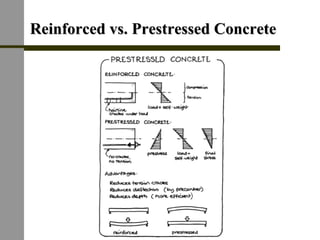
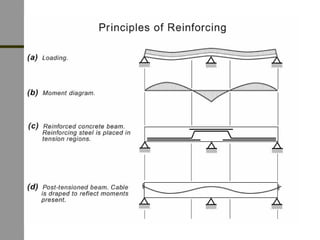
– Reinforced vs. prestressed concrete
– Strut and tie method of design
OutlineOutline
! Introduction to concrete as a material
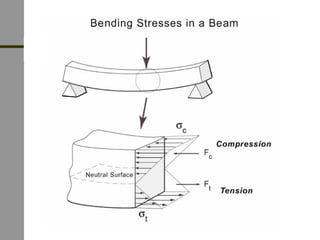
! Stresses in bending
! Reinforced concrete vs. prestressed
concrete
! Design methods
! Environmental issues
! Design possibilities
! Conclusions
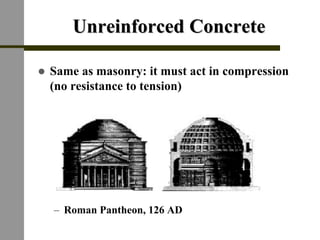
UnreinforcedUnreinforced ConcreteConcrete
! Same as masonry: it must act in compression
(no resistance to tension)
– Roman Pantheon, 126 AD
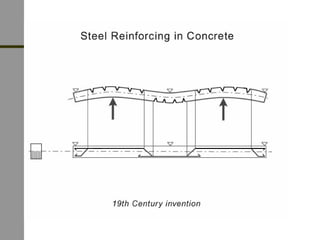
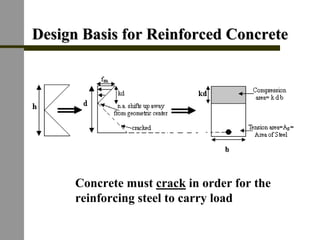
Design Basis for Reinforced ConcreteDesign Basis for Reinforced Concrete
Concrete must crack in order for the
reinforcing steel to carry load
Reinforced vs.Reinforced vs. PrestressedPrestressed ConcreteConcrete
Two design methods for concreteTwo design methods for concrete
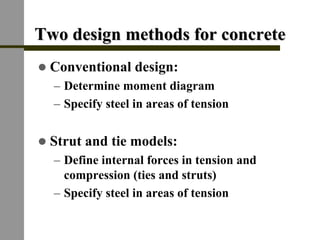
! Conventional design:
– Determine moment diagram
– Specify steel in areas of tension
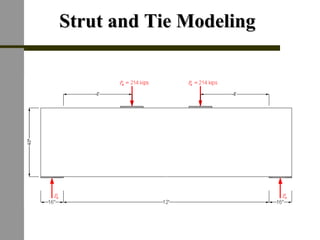
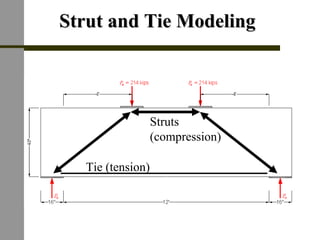
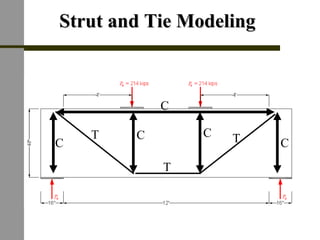
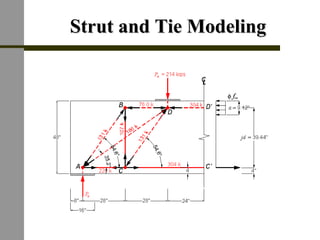
! Strut and tie models:
– Define internal forces in tension and
compression (ties and struts)
– Specify steel in areas of tension
Strut and Tie ModelingStrut and Tie Modeling
Tie (tension)
Struts
(compression)
Strut and Tie ModelingStrut and Tie Modeling
T T
T
C C
C
C C
Strut and Tie ModelingStrut and Tie Modeling
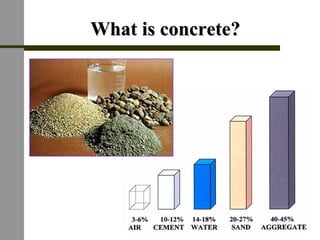
What is concrete?What is concrete?
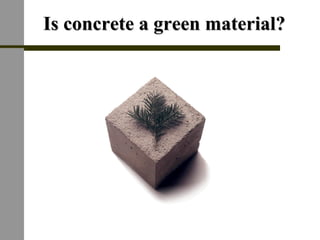
Is concrete a green material?Is concrete a green material?
Construction and the EnvironmentConstruction and the Environment
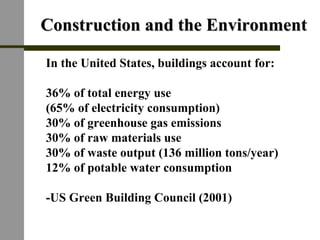
In the United States, buildings account for:
36% of total energy use
(65% of electricity consumption)
30% of greenhouse gas emissions
30% of raw materials use
30% of waste output (136 million tons/year)
12% of potable water consumption
-US Green Building Council (2001)
Construction WasteConstruction Waste
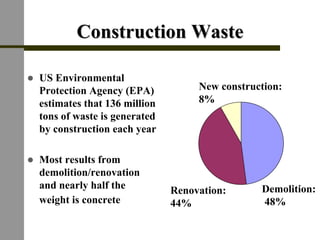
! US Environmental
Protection Agency (EPA)
estimates that 136 million
tons of waste is generated
by construction each year
! Most results from
demolition/renovation
and nearly half the
weight is concrete
New construction:
8%
Demolition:
48%
Renovation:
44%
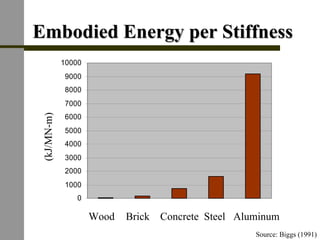
Embodied Energy per StiffnessEmbodied Energy per Stiffness
Wood Brick Concrete Steel Aluminum
(kJ/MN-m)
0
1000
2000
3000
4000
5000
6000
7000
8000
9000
10000
Source: Biggs (1991)
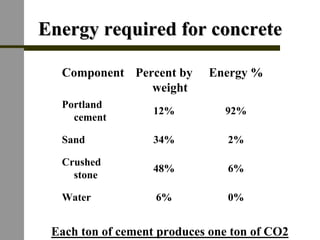
Energy required for concreteEnergy required for concrete
0%
6%
2%
92%
Energy %
6%Water
48%
Crushed
stone
34%Sand
12%
Portland
cement
Percent by
weight
Component
Each ton of cement produces one ton of CO2
! Concrete is in tune with the environment. From an environmental
standpoint, concrete has a lot to offer.
! The ingredients of concrete (water, aggregate, and cement) are abundant.
Concrete can be made from local resources and processed near a jobsite.
! Concrete is an ideal medium for recycling waste or industrial byproducts.
Many materials that would end up in landfills can be used instead to make
concrete.
! Concrete is modest in its energy needs and generous in its payback. The
only energy intensive demand is in the manufacture of portland cement,
typically a 10-15% component of concrete.
! Concrete offers significant energy savings over the lifetime of a building
or pavement. Concrete’s high thermal mass moderates temperature
swings by storing and releasing energy needed for heating and cooling.
And concrete is a durable material that conserves resources by reducing
maintenance and the need for reconstruction.
! A reliable and versatile product for centuries, concrete paves the way
toward an environmentally secure future for successive generations.
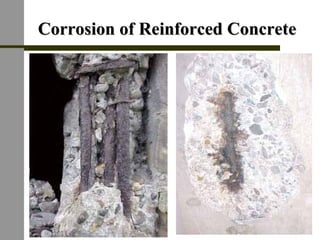
Corrosion of Reinforced ConcreteCorrosion of Reinforced Concrete
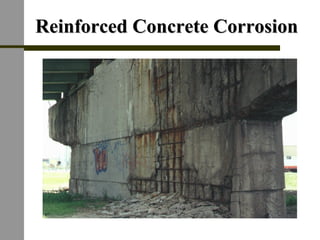
Reinforced Concrete CorrosionReinforced Concrete Corrosion
Corrosion of RCCorrosion of RC
! In the United States, the overall costs
of reinforcing steel corrosion have
been estimated at more than $150
billion per year.
! A particular problem for highway
bridges due to de-icing salts
Corrosion Prevention of RCCorrosion Prevention of RC
! Simplest method: Maintain concrete in
compression and provide greater cover of
concrete over rebar
! More complicated and more expensive:
– Protect steel (with epoxy coating) or by using
stainless steel rebar
– Use non-metallic reinforcing, such as carbon
or kevlar, but these materials are expensive
and energy-intensive
Structural Design in RCStructural Design in RC
! Maintain concrete in compression as much as
possible
! Follow moment diagram to minimize material use
! Detailed design
– Prevent water infiltration
– Protect steel
– Specify use of fly ash
– Recycle old concrete
““Fly Ash” in ConcreteFly Ash” in Concrete
! Fly ash is a byproduct of coal burning:
600 million tons are produced per year
and over 80% goes to the landfill
! Up to 50% of cement (by volume) can be
replaced with fly ash (15-35% is typical)
! Today only about 10% of available fly ash
is used in concrete
Why use fly ash in concrete?Why use fly ash in concrete?
! Reduce environmental impact
! Improve workability (better finish)
! Increase corrosion resistance
! Improve long term concrete strength
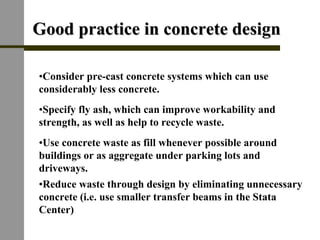
Good practice in concrete designGood practice in concrete design
•Reduce waste through design by eliminating unnecessary
concrete (i.e. use smaller transfer beams in the Stata
Center)
•Use concrete waste as fill whenever possible around
buildings or as aggregate under parking lots and
driveways.
•Specify fly ash, which can improve workability and
strength, as well as help to recycle waste.
•Consider pre-cast concrete systems which can use
considerably less concrete.
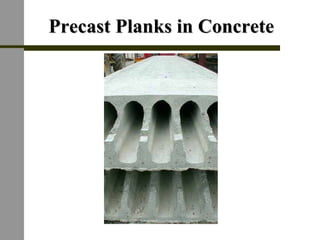
PrecastPrecast Planks in ConcretePlanks in Concrete
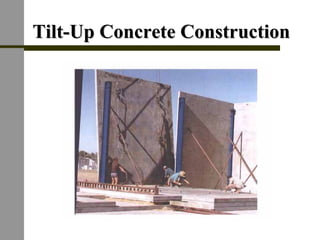
TiltTilt--Up Concrete ConstructionUp Concrete Construction
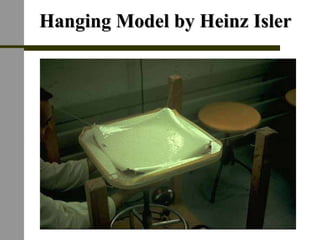
Hanging Model by HeinzHanging Model by Heinz IslerIsler
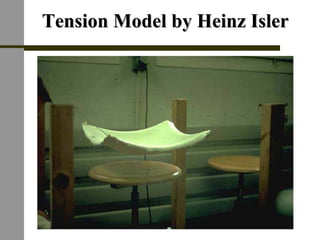
Tension Model by HeinzTension Model by Heinz IslerIsler
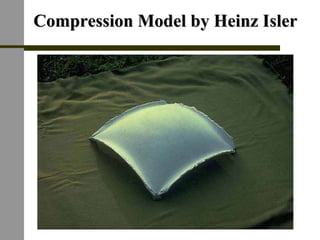
Compression Model by HeinzCompression Model by Heinz IslerIsler
ConclusionsConclusions
! Concrete will continue to be a dominant
construction material
! Reinforced concrete must crack in order for
reinforcing to work " lower durability because
steel can corrode
! Prestressed concrete prevents cracking
! Two powerful design methods: moment
diagrams or strut and tie models
! Environmental impact can be reduced through
design
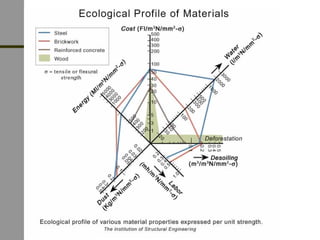
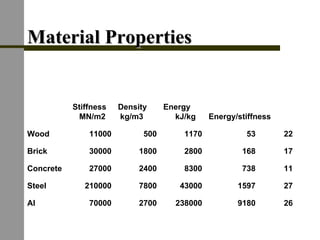
Material PropertiesMaterial Properties
269180238000270070000Al
271597430007800210000Steel
117388300240027000Concrete
171682800180030000Brick
2253117050011000Wood
Energy/stiffness
Energy
kJ/kg
Density
kg/m3
Stiffness
MN/m2
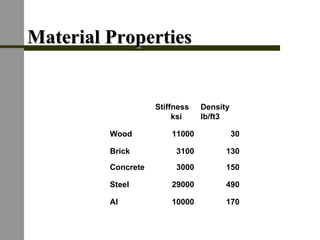
17010000Al
49029000Steel
1503000Concrete
1303100Brick
3011000Wood
Density
lb/ft3
Stiffness
ksi
Material PropertiesMaterial Properties

2concrete

  • 1.
    Concrete StructuresConcrete Structures !Introduction to design methods in reinforced concrete ! Sustainable construction – is concrete “green”? ! Possibilities in concrete structure ! Technical concepts: – Bending moment diagrams – Reinforced vs. prestressed concrete – Strut and tie method of design
  • 2.
    OutlineOutline ! Introduction toconcrete as a material ! Stresses in bending ! Reinforced concrete vs. prestressed concrete ! Design methods ! Environmental issues ! Design possibilities ! Conclusions
  • 3.
    UnreinforcedUnreinforced ConcreteConcrete ! Sameas masonry: it must act in compression (no resistance to tension) – Roman Pantheon, 126 AD
  • 7.
    Design Basis forReinforced ConcreteDesign Basis for Reinforced Concrete Concrete must crack in order for the reinforcing steel to carry load
  • 8.
    Reinforced vs.Reinforced vs.PrestressedPrestressed ConcreteConcrete
  • 10.
    Two design methodsfor concreteTwo design methods for concrete ! Conventional design: – Determine moment diagram – Specify steel in areas of tension ! Strut and tie models: – Define internal forces in tension and compression (ties and struts) – Specify steel in areas of tension
  • 11.
    Strut and TieModelingStrut and Tie Modeling
  • 12.
    Strut and TieModelingStrut and Tie Modeling Tie (tension) Struts (compression)
  • 13.
    Strut and TieModelingStrut and Tie Modeling T T T C C C C C
  • 14.
    Strut and TieModelingStrut and Tie Modeling
  • 15.
  • 16.
    Is concrete agreen material?Is concrete a green material?
  • 17.
    Construction and theEnvironmentConstruction and the Environment In the United States, buildings account for: 36% of total energy use (65% of electricity consumption) 30% of greenhouse gas emissions 30% of raw materials use 30% of waste output (136 million tons/year) 12% of potable water consumption -US Green Building Council (2001)
  • 18.
    Construction WasteConstruction Waste !US Environmental Protection Agency (EPA) estimates that 136 million tons of waste is generated by construction each year ! Most results from demolition/renovation and nearly half the weight is concrete New construction: 8% Demolition: 48% Renovation: 44%
  • 19.
    Embodied Energy perStiffnessEmbodied Energy per Stiffness Wood Brick Concrete Steel Aluminum (kJ/MN-m) 0 1000 2000 3000 4000 5000 6000 7000 8000 9000 10000 Source: Biggs (1991)
  • 20.
    Energy required forconcreteEnergy required for concrete 0% 6% 2% 92% Energy % 6%Water 48% Crushed stone 34%Sand 12% Portland cement Percent by weight Component Each ton of cement produces one ton of CO2
  • 21.
    ! Concrete isin tune with the environment. From an environmental standpoint, concrete has a lot to offer. ! The ingredients of concrete (water, aggregate, and cement) are abundant. Concrete can be made from local resources and processed near a jobsite. ! Concrete is an ideal medium for recycling waste or industrial byproducts. Many materials that would end up in landfills can be used instead to make concrete. ! Concrete is modest in its energy needs and generous in its payback. The only energy intensive demand is in the manufacture of portland cement, typically a 10-15% component of concrete. ! Concrete offers significant energy savings over the lifetime of a building or pavement. Concrete’s high thermal mass moderates temperature swings by storing and releasing energy needed for heating and cooling. And concrete is a durable material that conserves resources by reducing maintenance and the need for reconstruction. ! A reliable and versatile product for centuries, concrete paves the way toward an environmentally secure future for successive generations.
  • 22.
    Corrosion of ReinforcedConcreteCorrosion of Reinforced Concrete
  • 23.
  • 24.
    Corrosion of RCCorrosionof RC ! In the United States, the overall costs of reinforcing steel corrosion have been estimated at more than $150 billion per year. ! A particular problem for highway bridges due to de-icing salts
  • 25.
    Corrosion Prevention ofRCCorrosion Prevention of RC ! Simplest method: Maintain concrete in compression and provide greater cover of concrete over rebar ! More complicated and more expensive: – Protect steel (with epoxy coating) or by using stainless steel rebar – Use non-metallic reinforcing, such as carbon or kevlar, but these materials are expensive and energy-intensive
  • 26.
    Structural Design inRCStructural Design in RC ! Maintain concrete in compression as much as possible ! Follow moment diagram to minimize material use ! Detailed design – Prevent water infiltration – Protect steel – Specify use of fly ash – Recycle old concrete
  • 27.
    ““Fly Ash” inConcreteFly Ash” in Concrete ! Fly ash is a byproduct of coal burning: 600 million tons are produced per year and over 80% goes to the landfill ! Up to 50% of cement (by volume) can be replaced with fly ash (15-35% is typical) ! Today only about 10% of available fly ash is used in concrete
  • 28.
    Why use flyash in concrete?Why use fly ash in concrete? ! Reduce environmental impact ! Improve workability (better finish) ! Increase corrosion resistance ! Improve long term concrete strength
  • 29.
    Good practice inconcrete designGood practice in concrete design •Reduce waste through design by eliminating unnecessary concrete (i.e. use smaller transfer beams in the Stata Center) •Use concrete waste as fill whenever possible around buildings or as aggregate under parking lots and driveways. •Specify fly ash, which can improve workability and strength, as well as help to recycle waste. •Consider pre-cast concrete systems which can use considerably less concrete.
  • 30.
    PrecastPrecast Planks inConcretePlanks in Concrete
  • 31.
  • 32.
    Hanging Model byHeinzHanging Model by Heinz IslerIsler
  • 33.
    Tension Model byHeinzTension Model by Heinz IslerIsler
  • 34.
    Compression Model byHeinzCompression Model by Heinz IslerIsler
  • 37.
    ConclusionsConclusions ! Concrete willcontinue to be a dominant construction material ! Reinforced concrete must crack in order for reinforcing to work " lower durability because steel can corrode ! Prestressed concrete prevents cracking ! Two powerful design methods: moment diagrams or strut and tie models ! Environmental impact can be reduced through design
  • 40.
  • 41.