Green concRete
Under the Guidance of
Mr. SATYA RANJAN SAMAL
Assistant Professor
Submitted by
Amrendra Kumar
1301147
CV-2
1. What is Green Concrete ?
2. Where does the Carbon Dioxide come from in concrete ?
3. Features of Green Concrete
4. Materials for Green Concrete
5. Cementitious materials - Fly Ash
6. Advantage Of Green Concrete
7. SUITABILITY OF GREEN CONCRETE IN STRUCTURES
8. SCOPE IN INDIA
What is Green Concrete ?
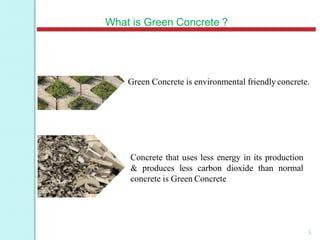
Green Concrete is environmental friendly concrete.
Concrete that uses less energy in its production
& produces less carbon dioxide than normal
concrete is Green Concrete
3
Where does the Carbon Dioxide come from in
concrete ?
i) Cement:
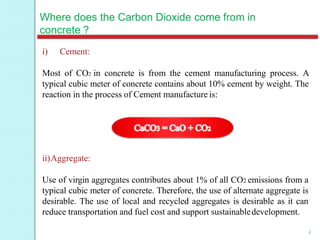
Most of CO2 in concrete is from the cement manufacturing process. A
typical cubic meter of concrete contains about 10% cement by weight. The
reaction in the process of Cement manufacture is:
ii)Aggregate:
Use of virgin aggregates contributes about 1% of all CO2 emissions from a
typical cubic meter of concrete. Therefore, the use of alternate aggregate is
desirable. The use of local and recycled aggregates is desirable as it can
reduce transportation and fuel cost and support sustainabledevelopment.
4
Features of Green Concrete
5
The concrete which can fall in the category of green must have the
following characteristics.
 Optimizes use of available materials
 Better Performance
 Enhanced cohesion workability / consistency
 Reduced shrinkage / creep.
 Durability - Better service life of concrete
 Reduced carbon footprint
 No increase in cost
 LEED India Certification
Green concrete mix is designed with the principle of "Particle-Packing
Optimization" to meet requirements of plastic and hardenedproperties.
Materials for Green Concrete
6
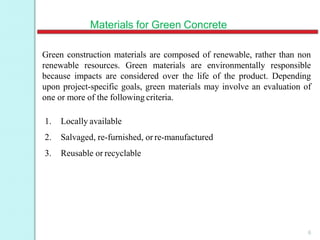
Green construction materials are composed of renewable, rather than non
renewable resources. Green materials are environmentally responsible
because impacts are considered over the life of the product. Depending
upon project-specific goals, green materials may involve an evaluation of
one or more of the following criteria.
1. Locally available
2. Salvaged, re-furnished, or re-manufactured
3. Reusable or recyclable
Materials for Green Concrete
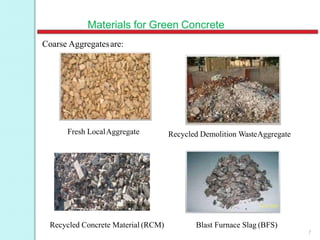
Coarse Aggregatesare:
Fresh LocalAggregate Recycled Demolition WasteAggregate
Blast Furnace Slag (BFS)Recycled Concrete Material (RCM)
7
Materials for Green Concrete
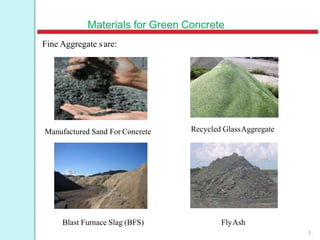
Fine Aggregate sare:
Manufactured Sand For Concrete
8
Recycled GlassAggregate
Blast Furnace Slag (BFS) FlyAsh
Cementitious materials - Fly Ash
Fly ash is a by-product produced during the operation of coal-fired power
plants. The finely divided particles from the exhaust gases are collected in
electrostatic precipitators. These particles are called Flyash.
Advantages Of Using Fly Ash inConcrete:
1. Utilization of fly ash as a part replacement of cement or as a mineral
admixture in concrete saves on cement and hence the emission of
CO2.
2. Use of good quality fly ash in concrete has shown remarkable
improvement in durability of concrete, especially in aggressive
environment.
3. Some of the technical benefits of the use of fly ash in Green Concrete
are:
a) Higher ultimate strength
b) Increased durability
c) Improved workability
d) Reduced bleeding
e) Increased resistance to alkali-silica reactivity.
f) Reduced shrinkage.
9
Advantage Of Green Concrete
1. Optimized mix designs mean easier handling, better consistency and
easier finishing.
2. Reduction in shrinkage & creep.
3. Green Concrete uses local and recycled materials in concrete.
4. The heat of hydration of green concrete is significantly lowerthan
traditional concrete.
5. This result in a lower temperature rise in large concrete pourswhich
is a distinct advantage for greenconcrete.
10
SUITABILITY OF GREEN CONCRETE IN
STRUCTURES
11
enhances the suitability of green concrete inSeveral factors which
structures include:
1. Reduce the dead weight of a structure and reduce crane age load; allow
handling, lifting flexibility with lighterweight.
2. Good thermal and fire resistance, sound insulation than the traditional
granite rock.
3. Improve damping resistance of building.
4. Reduction of the concrete industry's CO2-emission by 30 %.
5. Increased concrete industry's use of waste products by 20%.
6. No environmental pollution and sustainabledevelopment.
7. Green concrete requires less maintenance and repairs.
8. Compressive strength behaviour of concrete with water cement ratio is
more than that of conventional concrete.
9. Flexural strength of green concrete is almost equal to that of
conventional concrete.
SCOPE IN INDIA
Green concrete is a revolutionary topic in the history of concrete industry.
As green concrete is made with concrete wastes it does take more time to
come in India because of industries having problem to dispose wastes and
it also reduces environmental impact with reduction in CO2 emission. Use
of green concrete can help us reduce a lot of wastage of several products.
Various non-biodegradable products can also be used and thus avoiding the
issues of their disposal.
12
14

Green Concrete

  • 1.
    Green concRete Under theGuidance of Mr. SATYA RANJAN SAMAL Assistant Professor Submitted by Amrendra Kumar 1301147 CV-2
  • 2.
    1. What isGreen Concrete ? 2. Where does the Carbon Dioxide come from in concrete ? 3. Features of Green Concrete 4. Materials for Green Concrete 5. Cementitious materials - Fly Ash 6. Advantage Of Green Concrete 7. SUITABILITY OF GREEN CONCRETE IN STRUCTURES 8. SCOPE IN INDIA
  • 3.
    What is GreenConcrete ? Green Concrete is environmental friendly concrete. Concrete that uses less energy in its production & produces less carbon dioxide than normal concrete is Green Concrete 3
  • 4.
    Where does theCarbon Dioxide come from in concrete ? i) Cement: Most of CO2 in concrete is from the cement manufacturing process. A typical cubic meter of concrete contains about 10% cement by weight. The reaction in the process of Cement manufacture is: ii)Aggregate: Use of virgin aggregates contributes about 1% of all CO2 emissions from a typical cubic meter of concrete. Therefore, the use of alternate aggregate is desirable. The use of local and recycled aggregates is desirable as it can reduce transportation and fuel cost and support sustainabledevelopment. 4
  • 5.
    Features of GreenConcrete 5 The concrete which can fall in the category of green must have the following characteristics.  Optimizes use of available materials  Better Performance  Enhanced cohesion workability / consistency  Reduced shrinkage / creep.  Durability - Better service life of concrete  Reduced carbon footprint  No increase in cost  LEED India Certification Green concrete mix is designed with the principle of "Particle-Packing Optimization" to meet requirements of plastic and hardenedproperties.
  • 6.
    Materials for GreenConcrete 6 Green construction materials are composed of renewable, rather than non renewable resources. Green materials are environmentally responsible because impacts are considered over the life of the product. Depending upon project-specific goals, green materials may involve an evaluation of one or more of the following criteria. 1. Locally available 2. Salvaged, re-furnished, or re-manufactured 3. Reusable or recyclable
  • 7.
    Materials for GreenConcrete Coarse Aggregatesare: Fresh LocalAggregate Recycled Demolition WasteAggregate Blast Furnace Slag (BFS)Recycled Concrete Material (RCM) 7
  • 8.
    Materials for GreenConcrete Fine Aggregate sare: Manufactured Sand For Concrete 8 Recycled GlassAggregate Blast Furnace Slag (BFS) FlyAsh
  • 9.
    Cementitious materials -Fly Ash Fly ash is a by-product produced during the operation of coal-fired power plants. The finely divided particles from the exhaust gases are collected in electrostatic precipitators. These particles are called Flyash. Advantages Of Using Fly Ash inConcrete: 1. Utilization of fly ash as a part replacement of cement or as a mineral admixture in concrete saves on cement and hence the emission of CO2. 2. Use of good quality fly ash in concrete has shown remarkable improvement in durability of concrete, especially in aggressive environment. 3. Some of the technical benefits of the use of fly ash in Green Concrete are: a) Higher ultimate strength b) Increased durability c) Improved workability d) Reduced bleeding e) Increased resistance to alkali-silica reactivity. f) Reduced shrinkage. 9
  • 10.
    Advantage Of GreenConcrete 1. Optimized mix designs mean easier handling, better consistency and easier finishing. 2. Reduction in shrinkage & creep. 3. Green Concrete uses local and recycled materials in concrete. 4. The heat of hydration of green concrete is significantly lowerthan traditional concrete. 5. This result in a lower temperature rise in large concrete pourswhich is a distinct advantage for greenconcrete. 10
  • 11.
    SUITABILITY OF GREENCONCRETE IN STRUCTURES 11 enhances the suitability of green concrete inSeveral factors which structures include: 1. Reduce the dead weight of a structure and reduce crane age load; allow handling, lifting flexibility with lighterweight. 2. Good thermal and fire resistance, sound insulation than the traditional granite rock. 3. Improve damping resistance of building. 4. Reduction of the concrete industry's CO2-emission by 30 %. 5. Increased concrete industry's use of waste products by 20%. 6. No environmental pollution and sustainabledevelopment. 7. Green concrete requires less maintenance and repairs. 8. Compressive strength behaviour of concrete with water cement ratio is more than that of conventional concrete. 9. Flexural strength of green concrete is almost equal to that of conventional concrete.
  • 12.
    SCOPE IN INDIA Greenconcrete is a revolutionary topic in the history of concrete industry. As green concrete is made with concrete wastes it does take more time to come in India because of industries having problem to dispose wastes and it also reduces environmental impact with reduction in CO2 emission. Use of green concrete can help us reduce a lot of wastage of several products. Various non-biodegradable products can also be used and thus avoiding the issues of their disposal. 12
  • 13.