   Condition 1- The property should consist of any building or
    lands appurtenant.
   Condition 2- The assessee should be owner of the property.
   Condition 3- The property should not be used by the owner
    for the purpose of any business or profession carried on by
    him, the profits of which are chargeable to income-tax.
   Building
   Land appurteant thereto
   Income from subletting is not taxable under
    section 22.
   Deemed Owner
    ◦ Transfer to spouse or minor child.
    ◦ Holder of impartible estate.
    ◦ Property held by a member of Co-Operative
      Society/Company/AOP.
    ◦ A person who has acquired a property under a
      power of Attorney transaction.
    ◦ A person who has acquired a right in a building
      under section 269UA.
   The owner of the property utilizes the
    property for the purpose of carrying on his
    business or profession.
   Income of the above business or profession is
    chargeable to tax.
   House property in a foreign country.
   Disputed ownership.
   Property held as stock-in-trade.
   Treatment of composite rent.
   When a house property is owned by co-
    owners.
   Principle of mutuality.
   Income from farm house
   Annual value of any one place of an ex-ruler.
   Property income of a local authority.
   Property income of an approved scientific research
    association.
   Property income of an educational institution and hospital.
   Property income of trade union.
   House property held for charitable purposes.
   Property income of a political party.
   Property used for own business or profession.
   One self-occupied property.
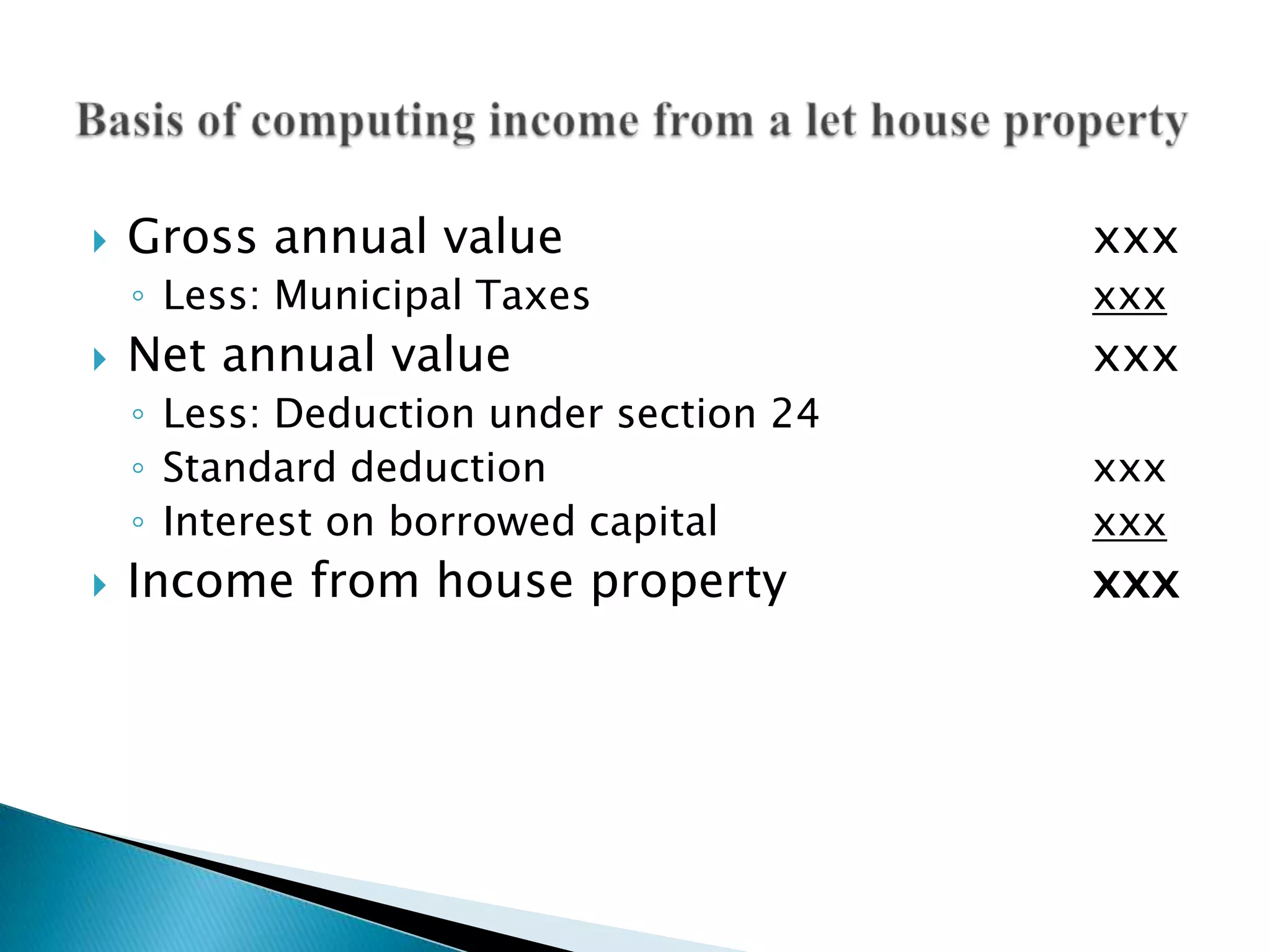
   Gross annual value                   xxx
    ◦ Less: Municipal Taxes              xxx
   Net annual value                     xxx
    ◦ Less: Deduction under section 24
    ◦ Standard deduction                 xxx
    ◦ Interest on borrowed capital       xxx
   Income from house property           xxx
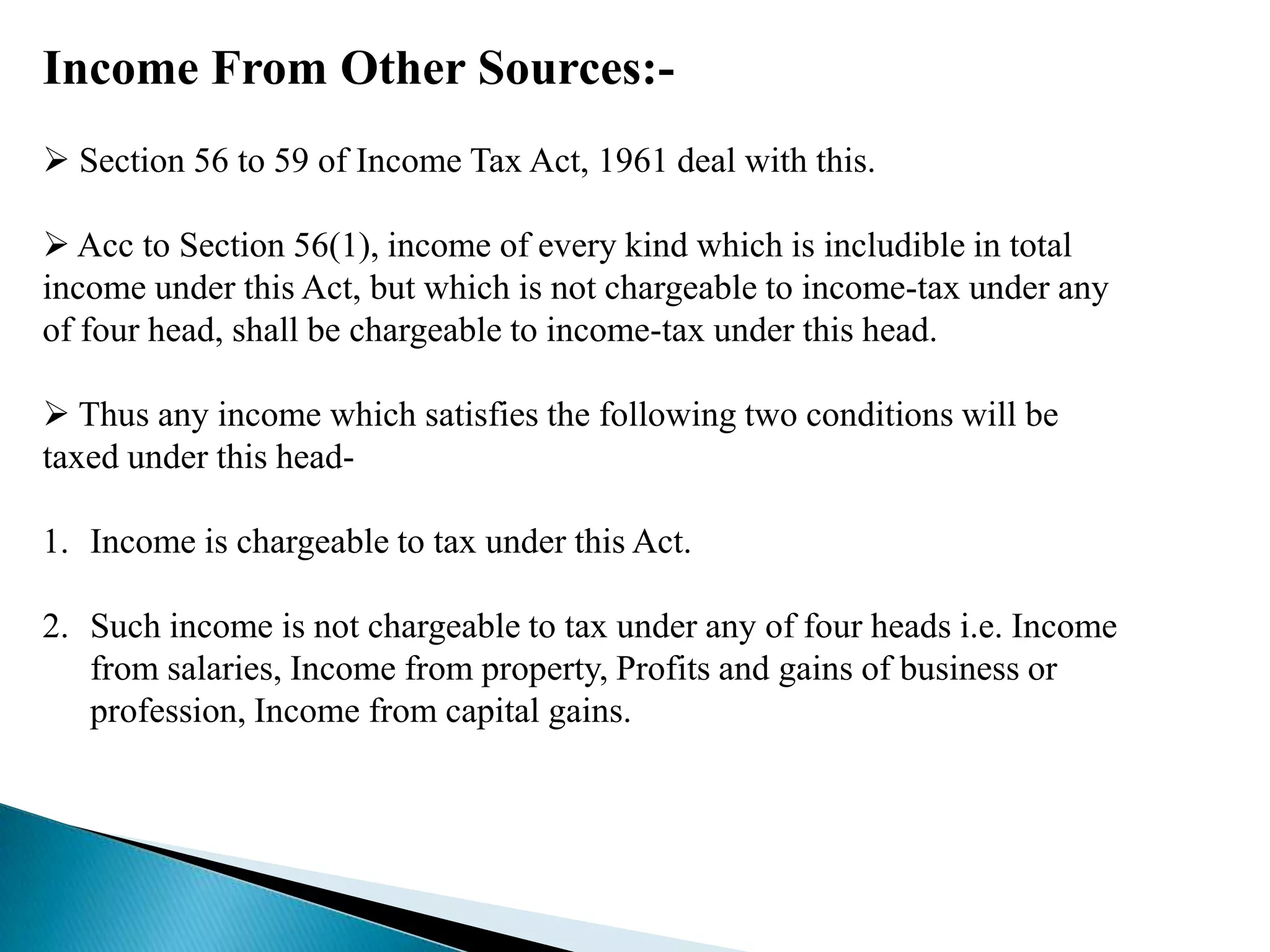
Income From Other Sources:-
 Section 56 to 59 of Income Tax Act, 1961 deal with this.

 Acc to Section 56(1), income of every kind which is includible in total
income under this Act, but which is not chargeable to income-tax under any
of four head, shall be chargeable to income-tax under this head.

 Thus any income which satisfies the following two conditions will be
taxed under this head-

1. Income is chargeable to tax under this Act.

2. Such income is not chargeable to tax under any of four heads i.e. Income
   from salaries, Income from property, Profits and gains of business or
   profession, Income from capital gains.
CHARGEABILITY
1. DIVIDEND:-

     under section 2(22), the following payments or distributions made by a company to its
     shareholders are deemed as dividend:-

1) Any distribution of accumulated profits

2) Any distribution of debentures, debentures stock or deposit certificate, whether with or
   without interest

3) Any distribution of bonus shares made by a company to its preference shareholders.

4) Any distribution made by a company to its shareholders on its liquidation

5)   any payment by way of loan or advance, to following:-

a) A shareholder who is the beneficial owner of at least 10% equity shares of company

b) Any concern(HUF, firm, company), in which such shareholder is a member or partner or
   has substantial interest (beneficial owner of at least 20% profits of the concern)
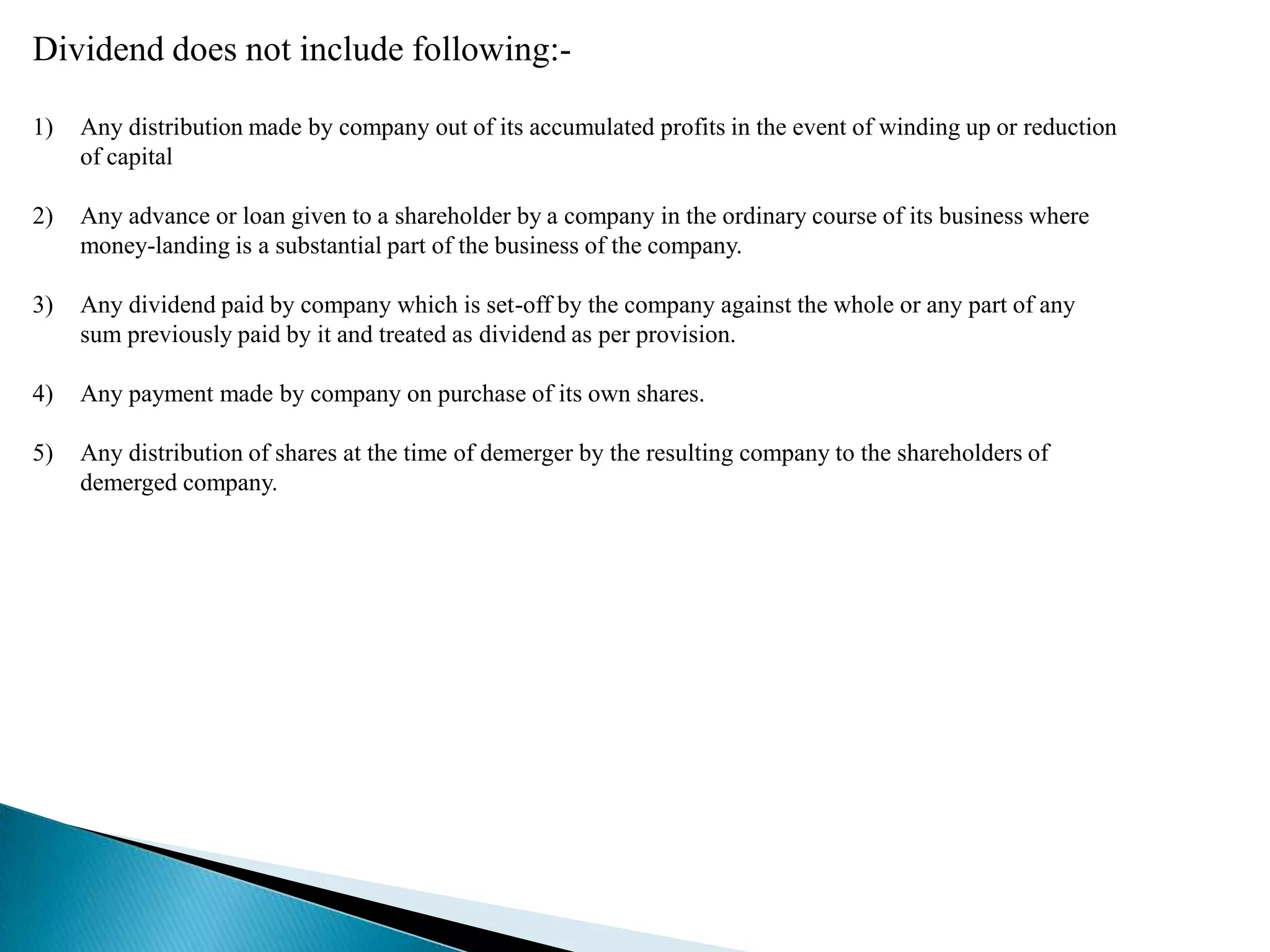
Dividend does not include following:-

1)   Any distribution made by company out of its accumulated profits in the event of winding up or reduction
     of capital

2)   Any advance or loan given to a shareholder by a company in the ordinary course of its business where
     money-landing is a substantial part of the business of the company.

3)   Any dividend paid by company which is set-off by the company against the whole or any part of any
     sum previously paid by it and treated as dividend as per provision.

4)   Any payment made by company on purchase of its own shares.

5)   Any distribution of shares at the time of demerger by the resulting company to the shareholders of
     demerged company.
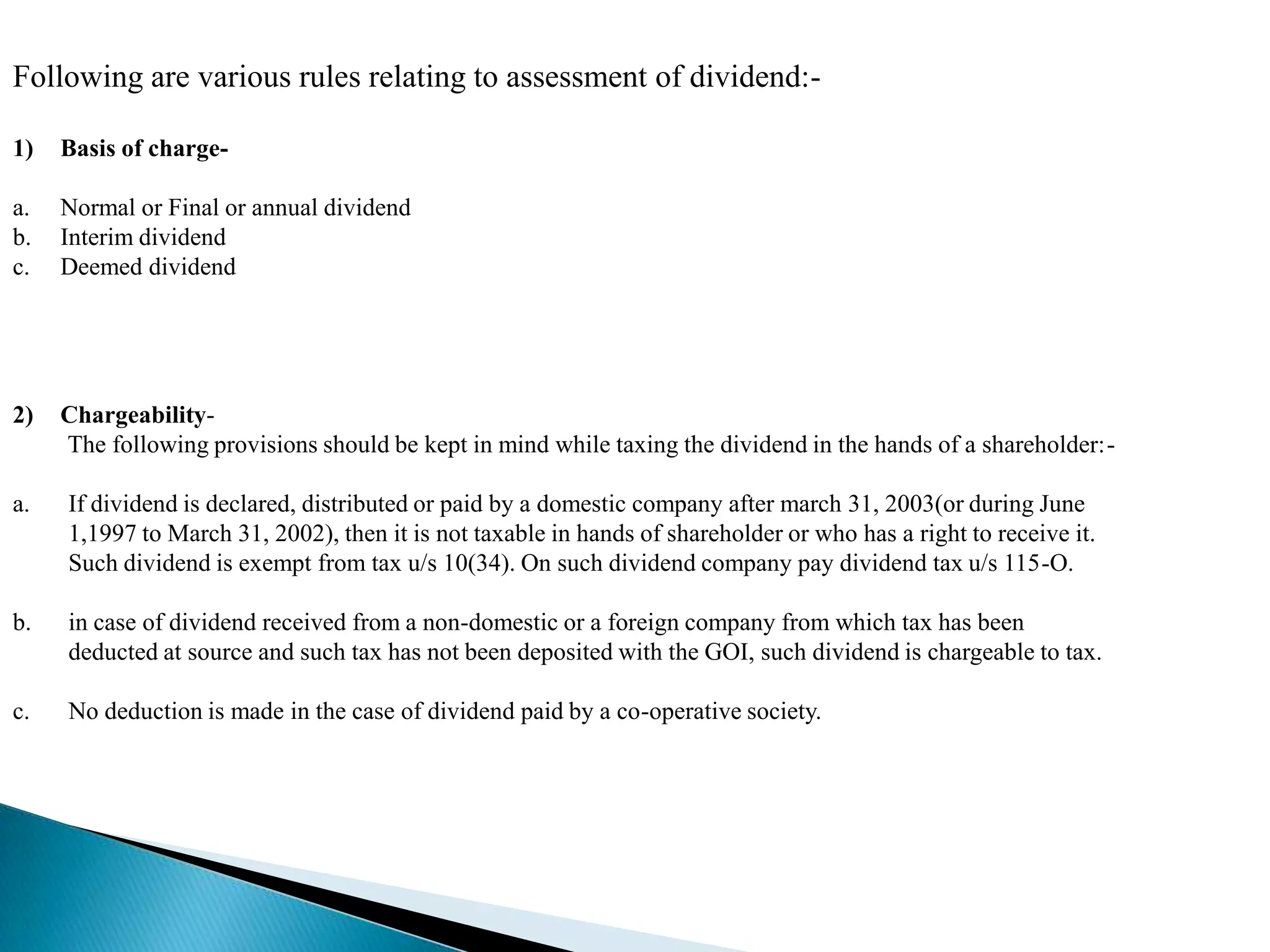
Following are various rules relating to assessment of dividend:-

1)   Basis of charge-

a.   Normal or Final or annual dividend
b.   Interim dividend
c.   Deemed dividend


2)   Chargeability-
     The following provisions should be kept in mind while taxing the dividend in the hands of a shareholder:-

a.   If dividend is declared, distributed or paid by a domestic company after march 31, 2003(or during June
     1,1997 to March 31, 2002), then it is not taxable in hands of shareholder or who has a right to receive it.
     Such dividend is exempt from tax u/s 10(34). On such dividend company pay dividend tax u/s 115-O.

b.   in case of dividend received from a non-domestic or a foreign company from which tax has been
     deducted at source and such tax has not been deposited with the GOI, such dividend is chargeable to tax.

c.   No deduction is made in the case of dividend paid by a co-operative society.
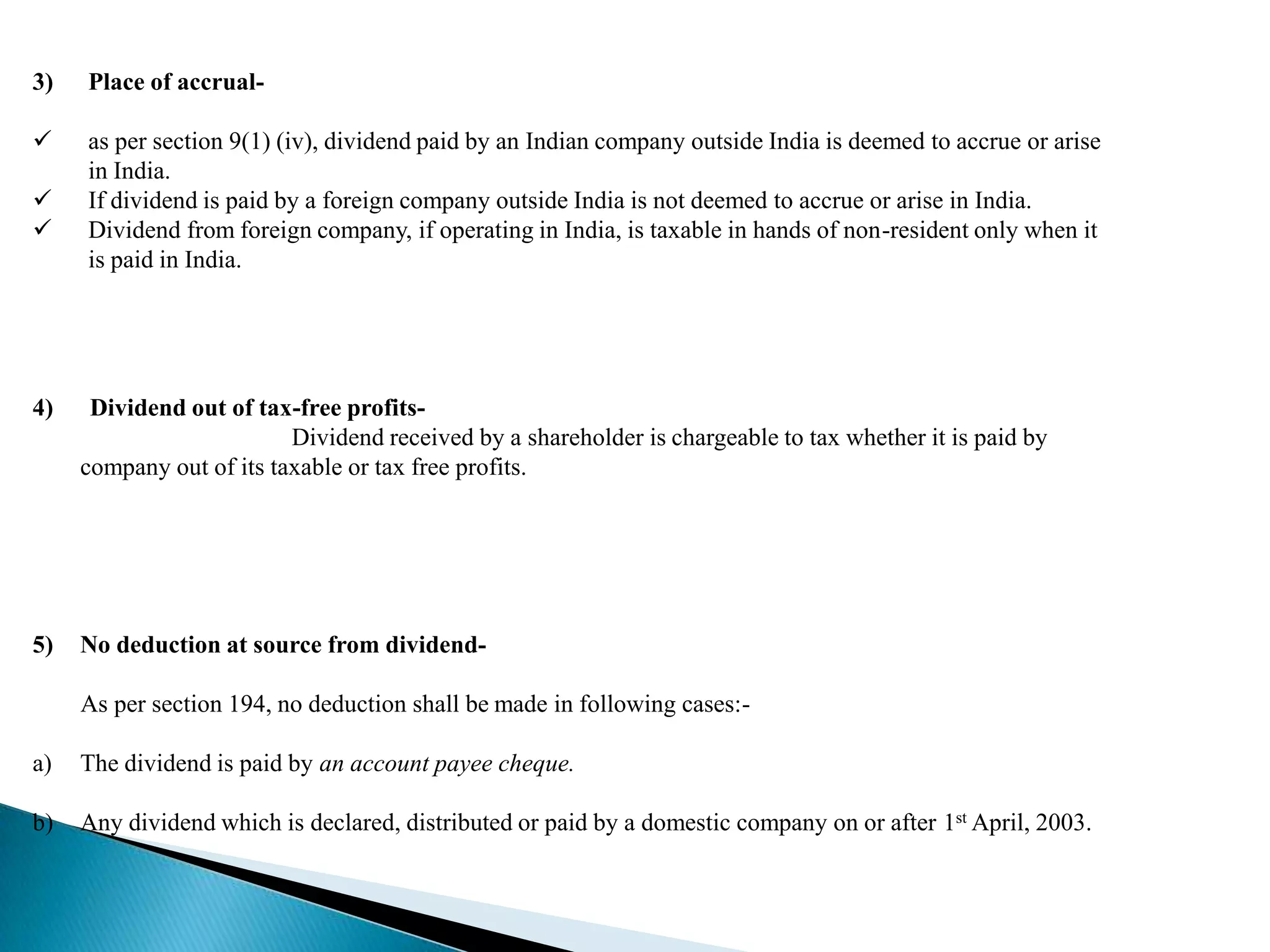
3)   Place of accrual-

    as per section 9(1) (iv), dividend paid by an Indian company outside India is deemed to accrue or arise
     in India.
    If dividend is paid by a foreign company outside India is not deemed to accrue or arise in India.
    Dividend from foreign company, if operating in India, is taxable in hands of non-resident only when it
     is paid in India.


4)    Dividend out of tax-free profits-
                          Dividend received by a shareholder is chargeable to tax whether it is paid by
     company out of its taxable or tax free profits.


5)   No deduction at source from dividend-

     As per section 194, no deduction shall be made in following cases:-

a)   The dividend is paid by an account payee cheque.

b)   Any dividend which is declared, distributed or paid by a domestic company on or after 1st April, 2003.
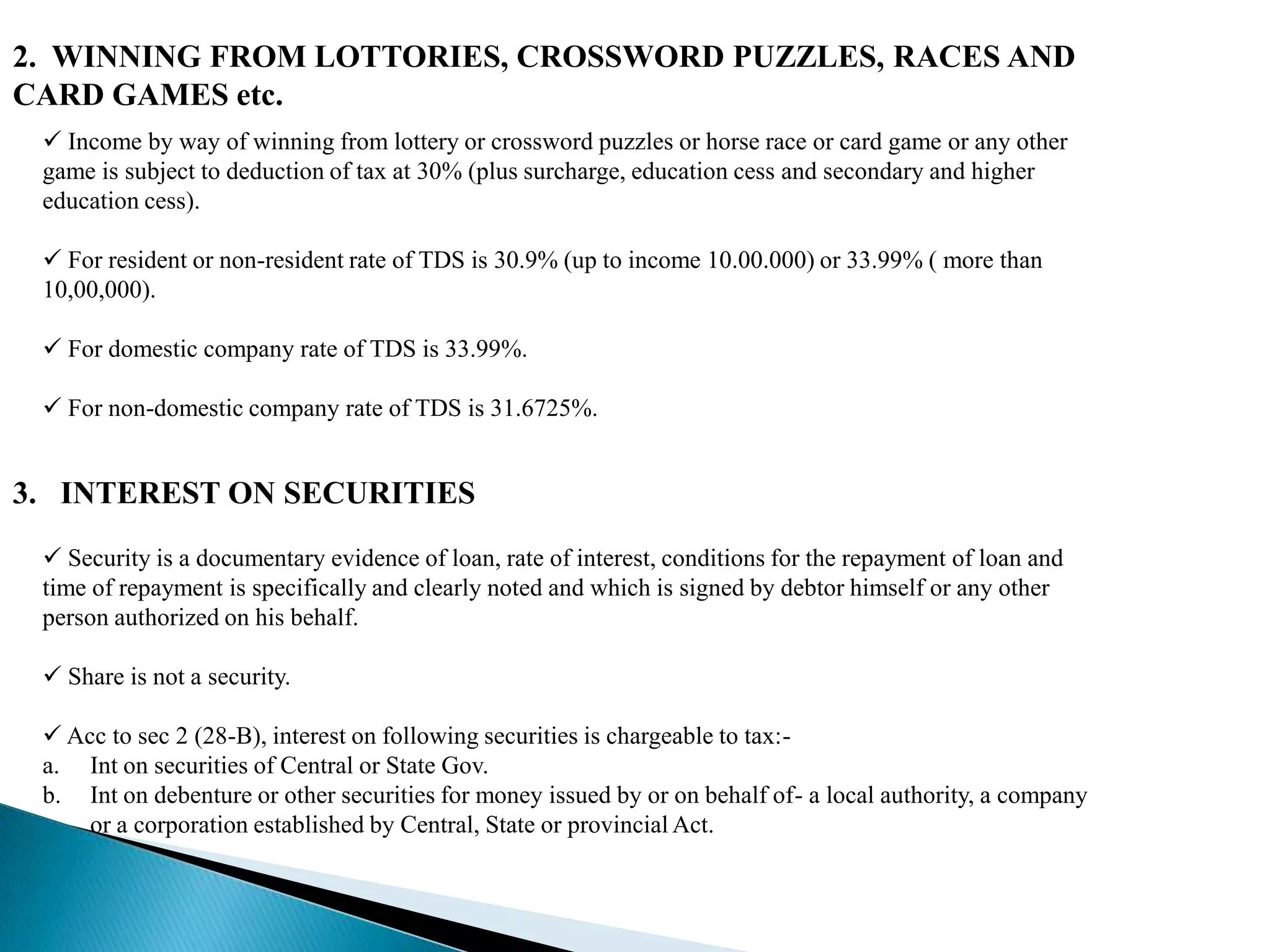
2. WINNING FROM LOTTORIES, CROSSWORD PUZZLES, RACES AND
CARD GAMES etc.
  Income by way of winning from lottery or crossword puzzles or horse race or card game or any other
 game is subject to deduction of tax at 30% (plus surcharge, education cess and secondary and higher
 education cess).

  For resident or non-resident rate of TDS is 30.9% (up to income 10.00.000) or 33.99% ( more than
 10,00,000).

  For domestic company rate of TDS is 33.99%.

  For non-domestic company rate of TDS is 31.6725%.


3. INTEREST ON SECURITIES
  Security is a documentary evidence of loan, rate of interest, conditions for the repayment of loan and
 time of repayment is specifically and clearly noted and which is signed by debtor himself or any other
 person authorized on his behalf.

  Share is not a security.

  Acc to sec 2 (28-B), interest on following securities is chargeable to tax:-
 a. Int on securities of Central or State Gov.
 b. Int on debenture or other securities for money issued by or on behalf of- a local authority, a company
     or a corporation established by Central, State or provincial Act.
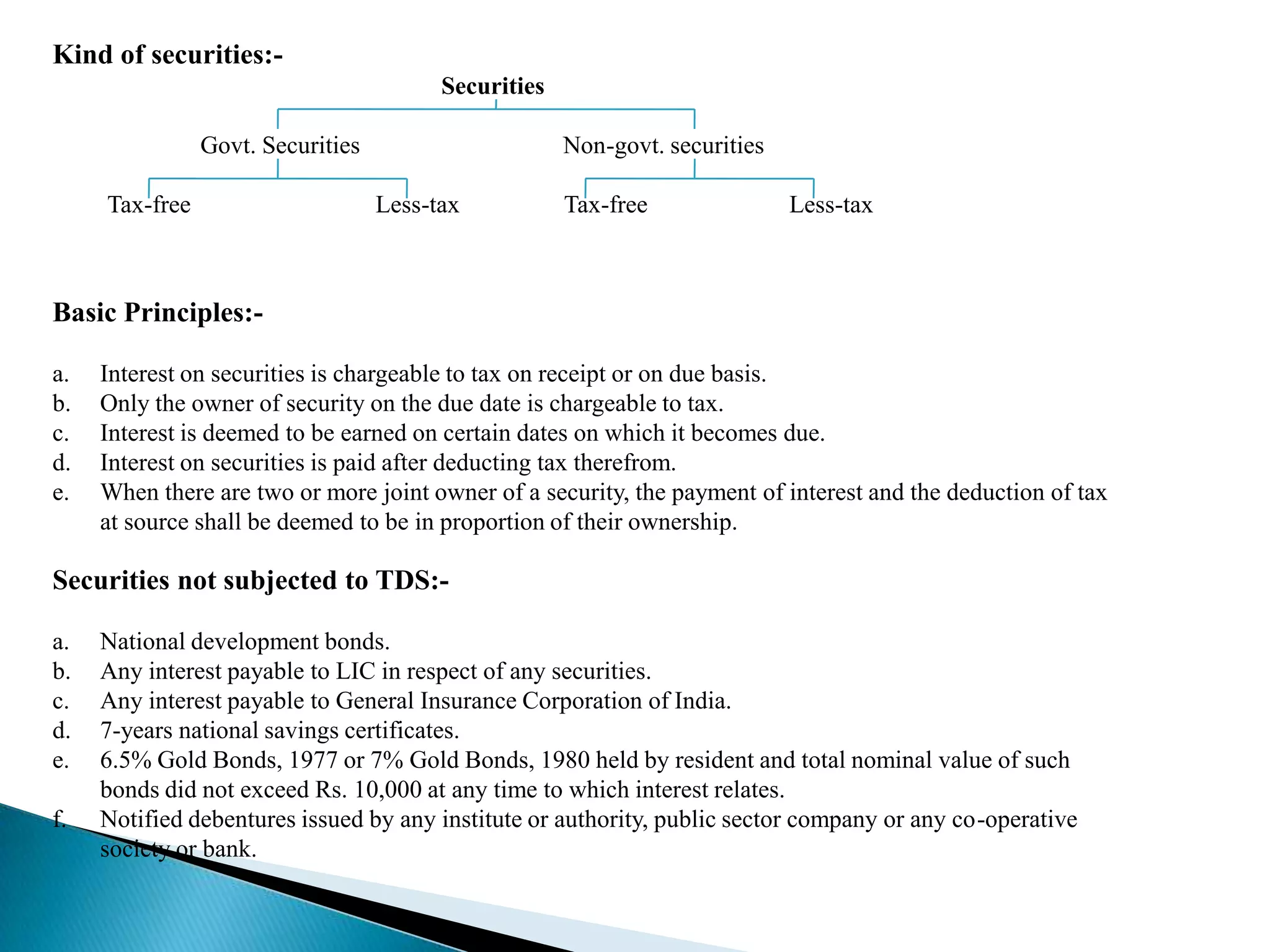
Kind of securities:-
                                         Securities

                Govt. Securities                      Non-govt. securities

     Tax-free                      Less-tax           Tax-free               Less-tax


Basic Principles:-

a.   Interest on securities is chargeable to tax on receipt or on due basis.
b.   Only the owner of security on the due date is chargeable to tax.
c.   Interest is deemed to be earned on certain dates on which it becomes due.
d.   Interest on securities is paid after deducting tax therefrom.
e.   When there are two or more joint owner of a security, the payment of interest and the deduction of tax
     at source shall be deemed to be in proportion of their ownership.

Securities not subjected to TDS:-

a.   National development bonds.
b.   Any interest payable to LIC in respect of any securities.
c.   Any interest payable to General Insurance Corporation of India.
d.   7-years national savings certificates.
e.   6.5% Gold Bonds, 1977 or 7% Gold Bonds, 1980 held by resident and total nominal value of such
     bonds did not exceed Rs. 10,000 at any time to which interest relates.
f.   Notified debentures issued by any institute or authority, public sector company or any co-operative
     society or bank.
4. CONTRIBUTION RECEIVED FROM EMPLOYEES
Acc to section 2(24)(x), if an assesses receives any of following amounts from his employees, he is
chargeable to tax:-
a. Contribution to an provident fund
b. Contribution to superannuation fund
c. Contribution to any fund set up under Employees’ State Insurance Act, 1948
d. Contribution to any other fund for welfare of employees.

5. INCOME FROM MACHINERY, PLANT OR FURNITURE LET ON HIRE

6. INCOME FROM COMPOSITE LETTING OF
BUILDINGS, MACHINERY, PLANT OR FURNITURE

7. RECEIPT WITHOUT COONSIDERATION
                  As per section 56 (2) (vi), if any sum of money exceeds Rs. 50,000 is received without any
consideration by an individual or a HUF, in any previous year from any person or persons on or after April
1, 2006, then the whole of such sum shall be taxable.

Exceptions-
a. Any sum of money received from any relative
b. Any sum of money received on occasion of marriage of individual
c. Any sum of money received under a will or inheritance
d. Any sum of money received in contemplation of death of payer
e. Any sum of money received from any fund or foundation of university or other educational institutions
    or hospital or other medical institution.
f. Any sum of money received from any trust or institution.
8. INTEREST ON KISAN VIKAS PATRA


9. INTEREST ON INDIRA VIKAS PATRA


10. INTEREST ON NATIONAL SAVINGS CERTIFICATES


11. INTEREST ON SOCIAL SECURITY CERTIFICATE
Besides these income, the following income are also chargeable to income-tax
under ‘Income from other sources’:-
1)    Agricultural income received from outside India
2)    Interest on securities of foreign Government or authority
3)    Salaries due to a member of Parliament
4)    Compensation received for use of business assets
5)    Any fee, commission, reward or other remuneration received by an employee from a person other than
      his employer, e.g., examination remuneration received by teacher, tips received by a waiter etc.
6)    Income from sub-letting of property
7)    Royalties or rent of mines received or receivable by owner of a coal mine
8)    Income from fisheries
9)    Amount received for loss of income from land
10)   Interest other than interest on securities such as int. on loan, on bank deposit and on provident fund etc
11)   Int. on employee’s contribution to unrecognized provident fund
12)   Gratuity received by director, who is not employee of company
13)   Income of cricket players who have been selected to play for India. Following rules are applicable:-

a.    25% of income received from cricket Control Board of India for test matches played in India
b.    50% of income received for matches played outside India
c.    Income from other matches played in India is tax-free if income is received from Cricket Control Board
      of India.

14)   Interest earned by a company on deposits during pre-production period
15)   Director’s fee or salary to a director employee
16)   Rent received from leasing out the trademark
17)   Income from buster lands
18)   Income from units of Unit Trust of India.
19)   Int. on securities issued by a private body, institution or authority.
27448938 income-from-other-sources-1

27448938 income-from-other-sources-1

  • 2.
    Condition 1- The property should consist of any building or lands appurtenant.  Condition 2- The assessee should be owner of the property.  Condition 3- The property should not be used by the owner for the purpose of any business or profession carried on by him, the profits of which are chargeable to income-tax.
  • 3.
    Building  Land appurteant thereto
  • 4.
    Income from subletting is not taxable under section 22.  Deemed Owner ◦ Transfer to spouse or minor child. ◦ Holder of impartible estate. ◦ Property held by a member of Co-Operative Society/Company/AOP. ◦ A person who has acquired a property under a power of Attorney transaction. ◦ A person who has acquired a right in a building under section 269UA.
  • 5.
    The owner of the property utilizes the property for the purpose of carrying on his business or profession.  Income of the above business or profession is chargeable to tax.
  • 6.
    House property in a foreign country.  Disputed ownership.  Property held as stock-in-trade.  Treatment of composite rent.  When a house property is owned by co- owners.  Principle of mutuality.
  • 7.
    Income from farm house  Annual value of any one place of an ex-ruler.  Property income of a local authority.  Property income of an approved scientific research association.  Property income of an educational institution and hospital.  Property income of trade union.  House property held for charitable purposes.  Property income of a political party.  Property used for own business or profession.  One self-occupied property.
  • 8.
    Gross annual value xxx ◦ Less: Municipal Taxes xxx  Net annual value xxx ◦ Less: Deduction under section 24 ◦ Standard deduction xxx ◦ Interest on borrowed capital xxx  Income from house property xxx
  • 10.
    Income From OtherSources:-  Section 56 to 59 of Income Tax Act, 1961 deal with this.  Acc to Section 56(1), income of every kind which is includible in total income under this Act, but which is not chargeable to income-tax under any of four head, shall be chargeable to income-tax under this head.  Thus any income which satisfies the following two conditions will be taxed under this head- 1. Income is chargeable to tax under this Act. 2. Such income is not chargeable to tax under any of four heads i.e. Income from salaries, Income from property, Profits and gains of business or profession, Income from capital gains.
  • 11.
    CHARGEABILITY 1. DIVIDEND:- under section 2(22), the following payments or distributions made by a company to its shareholders are deemed as dividend:- 1) Any distribution of accumulated profits 2) Any distribution of debentures, debentures stock or deposit certificate, whether with or without interest 3) Any distribution of bonus shares made by a company to its preference shareholders. 4) Any distribution made by a company to its shareholders on its liquidation 5) any payment by way of loan or advance, to following:- a) A shareholder who is the beneficial owner of at least 10% equity shares of company b) Any concern(HUF, firm, company), in which such shareholder is a member or partner or has substantial interest (beneficial owner of at least 20% profits of the concern)
  • 12.
    Dividend does notinclude following:- 1) Any distribution made by company out of its accumulated profits in the event of winding up or reduction of capital 2) Any advance or loan given to a shareholder by a company in the ordinary course of its business where money-landing is a substantial part of the business of the company. 3) Any dividend paid by company which is set-off by the company against the whole or any part of any sum previously paid by it and treated as dividend as per provision. 4) Any payment made by company on purchase of its own shares. 5) Any distribution of shares at the time of demerger by the resulting company to the shareholders of demerged company.
  • 13.
    Following are variousrules relating to assessment of dividend:- 1) Basis of charge- a. Normal or Final or annual dividend b. Interim dividend c. Deemed dividend 2) Chargeability- The following provisions should be kept in mind while taxing the dividend in the hands of a shareholder:- a. If dividend is declared, distributed or paid by a domestic company after march 31, 2003(or during June 1,1997 to March 31, 2002), then it is not taxable in hands of shareholder or who has a right to receive it. Such dividend is exempt from tax u/s 10(34). On such dividend company pay dividend tax u/s 115-O. b. in case of dividend received from a non-domestic or a foreign company from which tax has been deducted at source and such tax has not been deposited with the GOI, such dividend is chargeable to tax. c. No deduction is made in the case of dividend paid by a co-operative society.
  • 14.
    3) Place of accrual-  as per section 9(1) (iv), dividend paid by an Indian company outside India is deemed to accrue or arise in India.  If dividend is paid by a foreign company outside India is not deemed to accrue or arise in India.  Dividend from foreign company, if operating in India, is taxable in hands of non-resident only when it is paid in India. 4) Dividend out of tax-free profits- Dividend received by a shareholder is chargeable to tax whether it is paid by company out of its taxable or tax free profits. 5) No deduction at source from dividend- As per section 194, no deduction shall be made in following cases:- a) The dividend is paid by an account payee cheque. b) Any dividend which is declared, distributed or paid by a domestic company on or after 1st April, 2003.
  • 15.
    2. WINNING FROMLOTTORIES, CROSSWORD PUZZLES, RACES AND CARD GAMES etc.  Income by way of winning from lottery or crossword puzzles or horse race or card game or any other game is subject to deduction of tax at 30% (plus surcharge, education cess and secondary and higher education cess).  For resident or non-resident rate of TDS is 30.9% (up to income 10.00.000) or 33.99% ( more than 10,00,000).  For domestic company rate of TDS is 33.99%.  For non-domestic company rate of TDS is 31.6725%. 3. INTEREST ON SECURITIES  Security is a documentary evidence of loan, rate of interest, conditions for the repayment of loan and time of repayment is specifically and clearly noted and which is signed by debtor himself or any other person authorized on his behalf.  Share is not a security.  Acc to sec 2 (28-B), interest on following securities is chargeable to tax:- a. Int on securities of Central or State Gov. b. Int on debenture or other securities for money issued by or on behalf of- a local authority, a company or a corporation established by Central, State or provincial Act.
  • 16.
    Kind of securities:- Securities Govt. Securities Non-govt. securities Tax-free Less-tax Tax-free Less-tax Basic Principles:- a. Interest on securities is chargeable to tax on receipt or on due basis. b. Only the owner of security on the due date is chargeable to tax. c. Interest is deemed to be earned on certain dates on which it becomes due. d. Interest on securities is paid after deducting tax therefrom. e. When there are two or more joint owner of a security, the payment of interest and the deduction of tax at source shall be deemed to be in proportion of their ownership. Securities not subjected to TDS:- a. National development bonds. b. Any interest payable to LIC in respect of any securities. c. Any interest payable to General Insurance Corporation of India. d. 7-years national savings certificates. e. 6.5% Gold Bonds, 1977 or 7% Gold Bonds, 1980 held by resident and total nominal value of such bonds did not exceed Rs. 10,000 at any time to which interest relates. f. Notified debentures issued by any institute or authority, public sector company or any co-operative society or bank.
  • 17.
    4. CONTRIBUTION RECEIVEDFROM EMPLOYEES Acc to section 2(24)(x), if an assesses receives any of following amounts from his employees, he is chargeable to tax:- a. Contribution to an provident fund b. Contribution to superannuation fund c. Contribution to any fund set up under Employees’ State Insurance Act, 1948 d. Contribution to any other fund for welfare of employees. 5. INCOME FROM MACHINERY, PLANT OR FURNITURE LET ON HIRE 6. INCOME FROM COMPOSITE LETTING OF BUILDINGS, MACHINERY, PLANT OR FURNITURE 7. RECEIPT WITHOUT COONSIDERATION As per section 56 (2) (vi), if any sum of money exceeds Rs. 50,000 is received without any consideration by an individual or a HUF, in any previous year from any person or persons on or after April 1, 2006, then the whole of such sum shall be taxable. Exceptions- a. Any sum of money received from any relative b. Any sum of money received on occasion of marriage of individual c. Any sum of money received under a will or inheritance d. Any sum of money received in contemplation of death of payer e. Any sum of money received from any fund or foundation of university or other educational institutions or hospital or other medical institution. f. Any sum of money received from any trust or institution.
  • 18.
    8. INTEREST ONKISAN VIKAS PATRA 9. INTEREST ON INDIRA VIKAS PATRA 10. INTEREST ON NATIONAL SAVINGS CERTIFICATES 11. INTEREST ON SOCIAL SECURITY CERTIFICATE
  • 19.
    Besides these income,the following income are also chargeable to income-tax under ‘Income from other sources’:- 1) Agricultural income received from outside India 2) Interest on securities of foreign Government or authority 3) Salaries due to a member of Parliament 4) Compensation received for use of business assets 5) Any fee, commission, reward or other remuneration received by an employee from a person other than his employer, e.g., examination remuneration received by teacher, tips received by a waiter etc. 6) Income from sub-letting of property 7) Royalties or rent of mines received or receivable by owner of a coal mine 8) Income from fisheries 9) Amount received for loss of income from land 10) Interest other than interest on securities such as int. on loan, on bank deposit and on provident fund etc 11) Int. on employee’s contribution to unrecognized provident fund 12) Gratuity received by director, who is not employee of company 13) Income of cricket players who have been selected to play for India. Following rules are applicable:- a. 25% of income received from cricket Control Board of India for test matches played in India b. 50% of income received for matches played outside India c. Income from other matches played in India is tax-free if income is received from Cricket Control Board of India. 14) Interest earned by a company on deposits during pre-production period 15) Director’s fee or salary to a director employee 16) Rent received from leasing out the trademark 17) Income from buster lands 18) Income from units of Unit Trust of India. 19) Int. on securities issued by a private body, institution or authority.