INCOME FROM OTHER SOURCES COVERS INCOME THAT DOES NOT
FALL UNDER ANY OF THE OTHER HEADS OF INCOME.
According to section 56 of the Income Tax (IT) Act, 1961, ‘Income from Other Sources’ is
the means of earnings which can not be declared under any other income heads. This
section also comprises a list of different incomes which are to be declared under this head
when computing the tax dues by using an income tax calculator.
A related section of the IT Act, 1961, is section 57. This section and its several other
subsections mention expenditures which are permitted as deductions for incomes which
are earned as ‘Income from Other Sources’.
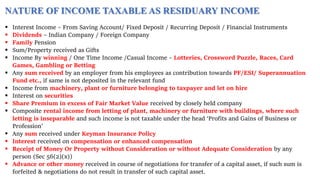
NATURE OF INCOME TAXABLE AS RESIDUARY INCOME
 Interest Income – From Saving Account/ Fixed Deposit / Recurring Deposit / Financial Instruments
 Dividends – Indian Company / Foreign Company
 Family Pension
 Sum/Property received as Gifts
 Income By winning / One Time Income /Casual Income – Lotteries, Crossword Puzzle, Races, Card
Games, Gambling or Betting
 Any sum received by an employer from his employees as contribution towards PF/ESI/ Superannuation
Fund etc., if same is not deposited in the relevant fund
 Income from machinery, plant or furniture belonging to taxpayer and let on hire
 Interest on securities
 Share Premium in excess of Fair Market Value received by closely held company
 Composite rental income from letting of plant, machinery or furniture with buildings, where such
letting is inseparable and such income is not taxable under the head ‘Profits and Gains of Business or
Profession’
 Any sum received under Keyman Insurance Policy
 Interest received on compensation or enhanced compensation
 Receipt of Money Or Property without Consideration or without Adequate Consideration by any
person (Sec 56(2)(x))
 Advance or other money received in course of negotiations for transfer of a capital asset, if such sum is
forfeited & negotiations do not result in transfer of such capital asset.
DEDUCTIONS [SEC. 57]:
The following expenditures are allowed as deductions from income chargeable to tax under the head ‘Income from Other Sources’:
S.No. Section Nature of Income Deductions allowed
1 57(i) Dividend or Interest on securities
Any reasonable sum paid by way of commission or remuneration
to banker or any other person for purpose of realizing dividend or
interest on securities
2 57(ia)
Employee’s contribution towards Provident Fund,
Superannuation Fund, ESI Fund or any other fund
setup for the welfare of such employees
If employees’ contribution is credited to their account in
relevant fund on or before the due date
3 57(ii)
Rental income letting of plant, machinery, furniture
or building
Rent, rates, taxes, repairs, insurance and depreciation etc.
4 57(iia) Family Pension 1/3rd of family pension subject to maximum of Rs. 15,000.
5 57(iii) Any other income
Any other expenditure (not being capital expenditure) expended
wholly and exclusively for earning such income
6 57 (iv) Interest on compensation or enhanced compensation 50% of such interest (subject to certain conditions)
7 58(4) Proviso
Income from activity of owning and maintaining race
horses.
All expenditure relating to such activity.
Expenses not deductible [Section 58]:
S.N. Section Nature of Income
1 58(1)(a)(i) Personal expenses
2 58(1)(a)(ii)
Interest chargeable to tax which is payable outside
India on which tax has not been paid or deducted at
source
3 58(1)(a)(iii)
‘Salaries’ payable outside India on which no tax is paid
or deducted at source
4 58(1A) Wealth-tax
5 58(2) Expenditure of the nature specified in section 40A
6 58(4)
Expenditure in connection with winnings from
lotteries, crossword puzzles, races, games, gambling
or betting
INTEREST INCOME
SAVINGS BANK ACCOUNT –
 The interest received by a taxpayer during a financial year is taxable under the head income from other sources
 Interest earned up to Rs. 10,000 in a FY is exempt from tax and Senior Citizens Rs. 50,000 including Other deposits
 The deduction is allowed for Savings account with a bank/ post office/ cooperative society carrying on the business of
banking
FIXED DEPOSIT / RECURRING DEPOSIT –
 The interest on fixed deposits received by an assessee has classified under the head of other sources and is taxed at the
rates applicable to the assessee
 The TDS on interest is deducted at the time when it is earned and not when it is paid.
 There is no deduction for interest earned from fixed deposits.
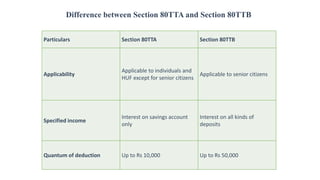
Particulars Section 80TTA Section 80TTB
Applicability
Applicable to individuals and
HUF except for senior citizens
Applicable to senior citizens
Specified income
Interest on savings account
only
Interest on all kinds of
deposits
Quantum of deduction Up to Rs 10,000 Up to Rs 50,000
Difference between Section 80TTA and Section 80TTB
DIVIDENDINCOME
 Dividend usually refers to the distribution of profits by a company to its shareholders.
 Dividend income is chargeable under IFOS as per the slab rates.
 Dividends received from cooperative societies or foreign companies will be completely taxable as per the slab rates.
 The normal rate of TDS is 10% (SECTION 194) on dividend income paid in excess of Rs 5,000 from a company or
mutual fund
Dividend includes:
(a) Distribution of accumulated profits to shareholders entailing release of the company's assets;
(b) Distribution of debentures or deposit certificates to shareholders out of the accumulated profits of the company and
issue of bonus shares to preference shareholders out of accumulated profits;
(c) Distribution made to shareholders of the company on its liquidation out of accumulated profits;
(d) Distribution to shareholders out of accumulated profits on the reduction of capital by the company; and
(e) Loan or advance made by a closely held company to its shareholder out of accumulated profits.
BASIS OF CHARGE OF DIVIDEND (SECTION 8)
Dividend Declared: Dividend declared by the company at its annual general meeting (AGM) is deemed to be the income Of
the shareholder in the PY in which it is so declared
Deemed Dividend u/s 2(22)(a)/(b)/(c)/(d)- Distribution by a company which is deemed as dividend u/s 2(22)(a)/(b)/(c)/(d)
would be the income of the PY in which it is distributed
Deemed Dividend u/s 2(22)(e) – Payment of advance or loan to a shareholder or a concern, as the case may be, which is
deemed as dividend u/s 2(22)(e) will be the income of the PY in which it is so paid
Interim Dividend- Interim dividend would be deemed to be the income of the PY in which such dividend is unconditionally
made available by the company to the members who is entitled to it.
TAX RATE ON DIVIDEND INCOME- Any Income by way of dividends received by a resident from a company, whether domestic or
foreign, is taxable in the hands of a resident shareholder at normal rates of tax
CASUAL INCOME
Casual income means income in the nature of winning from lotteries, crossword puzzles, races including horse races, card
games and other games of any sort, gambling, betting etc. Such winnings are chargeable to tax at a flat rate of 30% under
section 115BB.
 Any expense related to a casual income is not deductible. Eg: Buying Lottery Ticket
 TDS is deducted under Sec 194B/ 194BB and if the amount exceeds Rs.10,000/- and TDS rate is 31.2% including
Surcharge & Cess
 Losses cannot be set off
 If the prize money is received in both cash and kind, then the total tax will be calculated according to the money received in
cash and on the market value of the prize given in kind.
 No deduction under the Section 80C or Section 80D of the Income Tax Act is allowed from such income.
 The benefit of basic exemption limit cannot be availed on this type of income.
FAMILY PENSION INCOME
If you are receiving any pension income on behalf of a deceased family member Then it’ll become taxable under this head.
Though you can claim a deduction of Rs. 15,000 or 1/3rd of the amount received, whichever is lower.
EXCEPTIONS IN RESPECT OF FAMILY PENSION:
1. The family pension received by the widow or children or nomiated heirs, of a member of the armed forces (including para-
military forces) of the union, where the death of such member has occurred in the course of operational duties, in specified
circumstances would, however, be exempt under section 10(19)
2. The family pension received by any member of the family of an individual who had been in the service of Central
Government and has bad been awarded “Param Vir Chakra” or “Maha Vir Chakra” or “Vir Chakra” or other notified
gallantry awards would be exempt under section10(18)(ii)
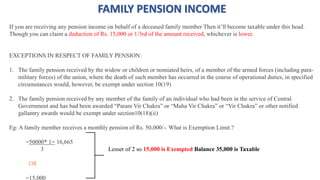
Eg: A family member receives a monthly pension of Rs. 50,000/-. What is Exemption Limit.?
=50000* 1= 16,665
3 Lesser of 2 so 15,000 is Exempted Balance 35,000 is Taxable
OR
=15,000
EMPLOYEES’ CONTRIBUTIONS TO PROVIDENT FUND ETC,
[Sec. 56(2)(IC)]
It has to be remembered that any sum received by the assessee from his employees as contributions to any provident fund or
superannuation fund or any fund set up under the provisions of the Employees 'State Insurance Act, 1948 or any other fund for
the welfare of such employees is income in the hands of the assessee and is chargeable as Income from Other Sources if not
chargeable as Profits and Gains on Business or Profession [Sec. 2(24)(x)]
However, the tax payer is entitled to deduction of the sum of such contributions received from his employees if such sum is
credited by the taxpayer to the employee’s account in the relevant fund on or before the due date. Here, the due date means the
date by which the assessee is required as an employer to credit an employees’ contribution to the employees’ account in the
relevant fund under an Act, rule, etc. issued in that behalf [Sec. 36(1)(va)].
Therefore, any sum received by the assessee from his employees as contributions to any fund as aforesaid and is not deposited
or deposited belatedly to the employee’s account, it becomes income of the assessee.
INTEREST ON SECURITIES
Interest on securities is chargeable as Income from Other Sources if it is not chargeable as Profits and
Gains of Business or Profession, i.e. when the securities are held as investment.
BASIS OF CHARGE: If Books are maintained
a. Cash Basis- Interest on securities will be chargeable on receipt basis
b. Mercantile Basis - Interest on securities will be chargeable on accrual basis
c. No Method OF accounting -Interest on securities will be chargeable on accrual basis
Accrual Basis means the income of the Previous Year in which such interest is due to the assessee – Second Proviso to Sec.
145(1)
INTEREST ON SECURITIES EXEMPT
 Interest on notified securities, bonds or certificates issued by the Central Govt. Interest on Post Office Savings Bank
Account will be exempted only to the extent of ` 3,500 in case of an individual and ` 7,000 in case of joint account w.e.f.
AY 2012-13
 Taxpayer is entitled to the deduction of any reasonable sum paid as commission or remuneration to a banker or any other
person for the purpose of realizing interest on securities. Similarly, he will also be entitled to the deduction of interest on
capital borrowed for investing in securities.
INCOME FROM INSEPARABLE LETTING OF MACHINERY,
PLANT OR FURNITURE WITH BUILDING
If an assessee lets on hire machinery, plant or furniture and also buildings and the letting of building is inseparable from the
letting of machinery, plant or furniture, the income from such letting would be chargeable to tax under the residuary head
where it is not chargeable under the ‘Profits and Gains of Business or Profession”
Example : Mr. A let out his building along with air conditioning plant, tube-wells, refrigerators, etc. Though separate rent is
fixed in the lease deed refers to them collectively as “demised premise”, it will be a case of inseparable letting and the entire
rental income will be assessable as Income from Other Sources.
BUILDING &
MACHINARY
CANNOT BE
SEPERATED
RENT RECEIVED
WILL FALL UNDER
OTHER INCOME
PROPERTY ACQUIRED WITHOUT CONSIDERATION OR FOR AN
INADEQUATE CONSIDERATION
Section 56(2)(vi) provides that any ‘sum of money’ (in excess of the prescribed limit of `50,000) received without
consideration by an individual or HUF will be chargeable to Income Tax in the hands of the recipient under the head ‘Income
from Other Sources’ Exception on Relatives, on Marriage, Will / Inheritance
The value of any property received without consideration or for inadequate consideration will also be included in the
computation of total income of the recipient. Such properties will include:
(i) immovable property being land or building or both,
(ii) shares and securities,
(iii) jewellery,
(iv) archaeological collections,
(v) drawings,
(vi) paintings,
(vii)sculptures
(viii) any work of art
GIFT
RECEIVED
Monetory
Movable property with /
without consideration
Immovable property
with / without
consideration
GIFT RECEIVED
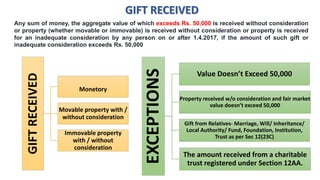
Any sum of money, the aggregate value of which exceeds Rs. 50,000 is received without consideration
or property (whether movable or immovable) is received without consideration or property is received
for an inadequate consideration by any person on or after 1.4.2017, if the amount of such gift or
inadequate consideration exceeds Rs. 50,000
EXCEPTIONS
Value Doesn’t Exceed 50,000
Property received w/o consideration and fair market
value doesn’t exceed 50,000
Gift from Relatives- Marriage, Will/ Inheritance/
Local Authority/ Fund, Foundation, Institution,
Trust as per Sec 12(23C)
The amount received from a charitable
trust registered under Section 12AA.
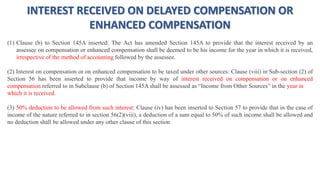
INTEREST RECEIVED ON DELAYED COMPENSATION OR
ENHANCED COMPENSATION
(1) Clause (b) to Section 145A inserted: The Act has amended Section 145A to provide that the interest received by an
assessee on compensation or enhanced compensation shall be deemed to be his income for the year in which it is received,
irrespective of the method of accounting followed by the assessee.
(2) Interest on compensation or on enhanced compensation to be taxed under other sources: Clause (viii) in Sub-section (2) of
Section 56 has been inserted to provide that income by way of interest received on compensation or on enhanced
compensation referred to in Subclause (b) of Section 145A shall be assessed as “Income from Other Sources” in the year in
which it is received.
(3) 50% deduction to be allowed from such interest: Clause (iv) has been inserted to Section 57 to provide that in the case of
income of the nature referred to in section 56(2)(viii), a deduction of a sum equal to 50% of such income shall be allowed and
no deduction shall be allowed under any other clause of this section
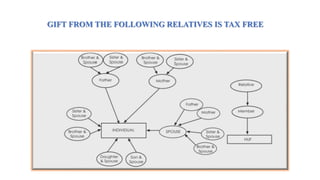
GIFT FROM THE FOLLOWING RELATIVES IS TAX FREE
OTHER INCOMES INCLUDIBLE UNDER THE HEAD
Apart from the incomes specified in Sec. 56(2) of the Act, as mentioned above, courts have held that incomes of the following
nature will be chargeable as Income from Other Sources:
 Income of company in winding-up.
 Gratuity received by a director who is not an employee of the company
 Interest is assessed under the head ‘Income from Other Sources’, if it not taxed as business or
 professional income
 Interest on tax refunds
 Interest earned prior to commencement of business - CIT vs. Modi Rubber Ltd. / Goa Carbon Ltd.
 Interest earned on short-term investment of funds borrowed for setting up of factory during construction of factory before
commencement of business has to be assessed as Income from Other Sources and it cannot be held to be non-taxable on
ground that it would go to reduce interest on borrowed amount which would be capitalized - Tuticorin Alkali Chemicals &
Fertilizers
 Tax on salary of assessee borne by payer, for whom assessee was working under a contrac
 Sale receipts prior to commencement of business
 If the business as a whole is let out the income i.e. the rent, would not be liable to be assessed as income from business. If
only the commercial assets are leased out the income would continue to be income from business
 Reimbursement of taxes on salary
 Interest on employee’s contribution to unrecognised provident fund
 Income from undisclosed sources
 Examinorship fee received by a teacher.
 Income received after discontinuance of business

INCOME FROM OTHER SOURCES Base.pptx

  • 1.
    INCOME FROM OTHERSOURCES COVERS INCOME THAT DOES NOT FALL UNDER ANY OF THE OTHER HEADS OF INCOME. According to section 56 of the Income Tax (IT) Act, 1961, ‘Income from Other Sources’ is the means of earnings which can not be declared under any other income heads. This section also comprises a list of different incomes which are to be declared under this head when computing the tax dues by using an income tax calculator. A related section of the IT Act, 1961, is section 57. This section and its several other subsections mention expenditures which are permitted as deductions for incomes which are earned as ‘Income from Other Sources’.
  • 2.
    NATURE OF INCOMETAXABLE AS RESIDUARY INCOME  Interest Income – From Saving Account/ Fixed Deposit / Recurring Deposit / Financial Instruments  Dividends – Indian Company / Foreign Company  Family Pension  Sum/Property received as Gifts  Income By winning / One Time Income /Casual Income – Lotteries, Crossword Puzzle, Races, Card Games, Gambling or Betting  Any sum received by an employer from his employees as contribution towards PF/ESI/ Superannuation Fund etc., if same is not deposited in the relevant fund  Income from machinery, plant or furniture belonging to taxpayer and let on hire  Interest on securities  Share Premium in excess of Fair Market Value received by closely held company  Composite rental income from letting of plant, machinery or furniture with buildings, where such letting is inseparable and such income is not taxable under the head ‘Profits and Gains of Business or Profession’  Any sum received under Keyman Insurance Policy  Interest received on compensation or enhanced compensation  Receipt of Money Or Property without Consideration or without Adequate Consideration by any person (Sec 56(2)(x))  Advance or other money received in course of negotiations for transfer of a capital asset, if such sum is forfeited & negotiations do not result in transfer of such capital asset.
  • 3.
    DEDUCTIONS [SEC. 57]: Thefollowing expenditures are allowed as deductions from income chargeable to tax under the head ‘Income from Other Sources’: S.No. Section Nature of Income Deductions allowed 1 57(i) Dividend or Interest on securities Any reasonable sum paid by way of commission or remuneration to banker or any other person for purpose of realizing dividend or interest on securities 2 57(ia) Employee’s contribution towards Provident Fund, Superannuation Fund, ESI Fund or any other fund setup for the welfare of such employees If employees’ contribution is credited to their account in relevant fund on or before the due date 3 57(ii) Rental income letting of plant, machinery, furniture or building Rent, rates, taxes, repairs, insurance and depreciation etc. 4 57(iia) Family Pension 1/3rd of family pension subject to maximum of Rs. 15,000. 5 57(iii) Any other income Any other expenditure (not being capital expenditure) expended wholly and exclusively for earning such income 6 57 (iv) Interest on compensation or enhanced compensation 50% of such interest (subject to certain conditions) 7 58(4) Proviso Income from activity of owning and maintaining race horses. All expenditure relating to such activity.
  • 4.
    Expenses not deductible[Section 58]: S.N. Section Nature of Income 1 58(1)(a)(i) Personal expenses 2 58(1)(a)(ii) Interest chargeable to tax which is payable outside India on which tax has not been paid or deducted at source 3 58(1)(a)(iii) ‘Salaries’ payable outside India on which no tax is paid or deducted at source 4 58(1A) Wealth-tax 5 58(2) Expenditure of the nature specified in section 40A 6 58(4) Expenditure in connection with winnings from lotteries, crossword puzzles, races, games, gambling or betting
  • 5.
    INTEREST INCOME SAVINGS BANKACCOUNT –  The interest received by a taxpayer during a financial year is taxable under the head income from other sources  Interest earned up to Rs. 10,000 in a FY is exempt from tax and Senior Citizens Rs. 50,000 including Other deposits  The deduction is allowed for Savings account with a bank/ post office/ cooperative society carrying on the business of banking FIXED DEPOSIT / RECURRING DEPOSIT –  The interest on fixed deposits received by an assessee has classified under the head of other sources and is taxed at the rates applicable to the assessee  The TDS on interest is deducted at the time when it is earned and not when it is paid.  There is no deduction for interest earned from fixed deposits.
  • 6.
    Particulars Section 80TTASection 80TTB Applicability Applicable to individuals and HUF except for senior citizens Applicable to senior citizens Specified income Interest on savings account only Interest on all kinds of deposits Quantum of deduction Up to Rs 10,000 Up to Rs 50,000 Difference between Section 80TTA and Section 80TTB
  • 7.
    DIVIDENDINCOME  Dividend usuallyrefers to the distribution of profits by a company to its shareholders.  Dividend income is chargeable under IFOS as per the slab rates.  Dividends received from cooperative societies or foreign companies will be completely taxable as per the slab rates.  The normal rate of TDS is 10% (SECTION 194) on dividend income paid in excess of Rs 5,000 from a company or mutual fund Dividend includes: (a) Distribution of accumulated profits to shareholders entailing release of the company's assets; (b) Distribution of debentures or deposit certificates to shareholders out of the accumulated profits of the company and issue of bonus shares to preference shareholders out of accumulated profits; (c) Distribution made to shareholders of the company on its liquidation out of accumulated profits; (d) Distribution to shareholders out of accumulated profits on the reduction of capital by the company; and (e) Loan or advance made by a closely held company to its shareholder out of accumulated profits.
  • 8.
    BASIS OF CHARGEOF DIVIDEND (SECTION 8) Dividend Declared: Dividend declared by the company at its annual general meeting (AGM) is deemed to be the income Of the shareholder in the PY in which it is so declared Deemed Dividend u/s 2(22)(a)/(b)/(c)/(d)- Distribution by a company which is deemed as dividend u/s 2(22)(a)/(b)/(c)/(d) would be the income of the PY in which it is distributed Deemed Dividend u/s 2(22)(e) – Payment of advance or loan to a shareholder or a concern, as the case may be, which is deemed as dividend u/s 2(22)(e) will be the income of the PY in which it is so paid Interim Dividend- Interim dividend would be deemed to be the income of the PY in which such dividend is unconditionally made available by the company to the members who is entitled to it. TAX RATE ON DIVIDEND INCOME- Any Income by way of dividends received by a resident from a company, whether domestic or foreign, is taxable in the hands of a resident shareholder at normal rates of tax
  • 9.
    CASUAL INCOME Casual incomemeans income in the nature of winning from lotteries, crossword puzzles, races including horse races, card games and other games of any sort, gambling, betting etc. Such winnings are chargeable to tax at a flat rate of 30% under section 115BB.  Any expense related to a casual income is not deductible. Eg: Buying Lottery Ticket  TDS is deducted under Sec 194B/ 194BB and if the amount exceeds Rs.10,000/- and TDS rate is 31.2% including Surcharge & Cess  Losses cannot be set off  If the prize money is received in both cash and kind, then the total tax will be calculated according to the money received in cash and on the market value of the prize given in kind.  No deduction under the Section 80C or Section 80D of the Income Tax Act is allowed from such income.  The benefit of basic exemption limit cannot be availed on this type of income.
  • 10.
    FAMILY PENSION INCOME Ifyou are receiving any pension income on behalf of a deceased family member Then it’ll become taxable under this head. Though you can claim a deduction of Rs. 15,000 or 1/3rd of the amount received, whichever is lower. EXCEPTIONS IN RESPECT OF FAMILY PENSION: 1. The family pension received by the widow or children or nomiated heirs, of a member of the armed forces (including para- military forces) of the union, where the death of such member has occurred in the course of operational duties, in specified circumstances would, however, be exempt under section 10(19) 2. The family pension received by any member of the family of an individual who had been in the service of Central Government and has bad been awarded “Param Vir Chakra” or “Maha Vir Chakra” or “Vir Chakra” or other notified gallantry awards would be exempt under section10(18)(ii) Eg: A family member receives a monthly pension of Rs. 50,000/-. What is Exemption Limit.? =50000* 1= 16,665 3 Lesser of 2 so 15,000 is Exempted Balance 35,000 is Taxable OR =15,000
  • 11.
    EMPLOYEES’ CONTRIBUTIONS TOPROVIDENT FUND ETC, [Sec. 56(2)(IC)] It has to be remembered that any sum received by the assessee from his employees as contributions to any provident fund or superannuation fund or any fund set up under the provisions of the Employees 'State Insurance Act, 1948 or any other fund for the welfare of such employees is income in the hands of the assessee and is chargeable as Income from Other Sources if not chargeable as Profits and Gains on Business or Profession [Sec. 2(24)(x)] However, the tax payer is entitled to deduction of the sum of such contributions received from his employees if such sum is credited by the taxpayer to the employee’s account in the relevant fund on or before the due date. Here, the due date means the date by which the assessee is required as an employer to credit an employees’ contribution to the employees’ account in the relevant fund under an Act, rule, etc. issued in that behalf [Sec. 36(1)(va)]. Therefore, any sum received by the assessee from his employees as contributions to any fund as aforesaid and is not deposited or deposited belatedly to the employee’s account, it becomes income of the assessee.
  • 12.
    INTEREST ON SECURITIES Intereston securities is chargeable as Income from Other Sources if it is not chargeable as Profits and Gains of Business or Profession, i.e. when the securities are held as investment. BASIS OF CHARGE: If Books are maintained a. Cash Basis- Interest on securities will be chargeable on receipt basis b. Mercantile Basis - Interest on securities will be chargeable on accrual basis c. No Method OF accounting -Interest on securities will be chargeable on accrual basis Accrual Basis means the income of the Previous Year in which such interest is due to the assessee – Second Proviso to Sec. 145(1) INTEREST ON SECURITIES EXEMPT  Interest on notified securities, bonds or certificates issued by the Central Govt. Interest on Post Office Savings Bank Account will be exempted only to the extent of ` 3,500 in case of an individual and ` 7,000 in case of joint account w.e.f. AY 2012-13  Taxpayer is entitled to the deduction of any reasonable sum paid as commission or remuneration to a banker or any other person for the purpose of realizing interest on securities. Similarly, he will also be entitled to the deduction of interest on capital borrowed for investing in securities.
  • 13.
    INCOME FROM INSEPARABLELETTING OF MACHINERY, PLANT OR FURNITURE WITH BUILDING If an assessee lets on hire machinery, plant or furniture and also buildings and the letting of building is inseparable from the letting of machinery, plant or furniture, the income from such letting would be chargeable to tax under the residuary head where it is not chargeable under the ‘Profits and Gains of Business or Profession” Example : Mr. A let out his building along with air conditioning plant, tube-wells, refrigerators, etc. Though separate rent is fixed in the lease deed refers to them collectively as “demised premise”, it will be a case of inseparable letting and the entire rental income will be assessable as Income from Other Sources. BUILDING & MACHINARY CANNOT BE SEPERATED RENT RECEIVED WILL FALL UNDER OTHER INCOME
  • 14.
    PROPERTY ACQUIRED WITHOUTCONSIDERATION OR FOR AN INADEQUATE CONSIDERATION Section 56(2)(vi) provides that any ‘sum of money’ (in excess of the prescribed limit of `50,000) received without consideration by an individual or HUF will be chargeable to Income Tax in the hands of the recipient under the head ‘Income from Other Sources’ Exception on Relatives, on Marriage, Will / Inheritance The value of any property received without consideration or for inadequate consideration will also be included in the computation of total income of the recipient. Such properties will include: (i) immovable property being land or building or both, (ii) shares and securities, (iii) jewellery, (iv) archaeological collections, (v) drawings, (vi) paintings, (vii)sculptures (viii) any work of art
  • 15.
    GIFT RECEIVED Monetory Movable property with/ without consideration Immovable property with / without consideration GIFT RECEIVED Any sum of money, the aggregate value of which exceeds Rs. 50,000 is received without consideration or property (whether movable or immovable) is received without consideration or property is received for an inadequate consideration by any person on or after 1.4.2017, if the amount of such gift or inadequate consideration exceeds Rs. 50,000 EXCEPTIONS Value Doesn’t Exceed 50,000 Property received w/o consideration and fair market value doesn’t exceed 50,000 Gift from Relatives- Marriage, Will/ Inheritance/ Local Authority/ Fund, Foundation, Institution, Trust as per Sec 12(23C) The amount received from a charitable trust registered under Section 12AA.
  • 16.
    INTEREST RECEIVED ONDELAYED COMPENSATION OR ENHANCED COMPENSATION (1) Clause (b) to Section 145A inserted: The Act has amended Section 145A to provide that the interest received by an assessee on compensation or enhanced compensation shall be deemed to be his income for the year in which it is received, irrespective of the method of accounting followed by the assessee. (2) Interest on compensation or on enhanced compensation to be taxed under other sources: Clause (viii) in Sub-section (2) of Section 56 has been inserted to provide that income by way of interest received on compensation or on enhanced compensation referred to in Subclause (b) of Section 145A shall be assessed as “Income from Other Sources” in the year in which it is received. (3) 50% deduction to be allowed from such interest: Clause (iv) has been inserted to Section 57 to provide that in the case of income of the nature referred to in section 56(2)(viii), a deduction of a sum equal to 50% of such income shall be allowed and no deduction shall be allowed under any other clause of this section
  • 17.
    GIFT FROM THEFOLLOWING RELATIVES IS TAX FREE
  • 18.
    OTHER INCOMES INCLUDIBLEUNDER THE HEAD Apart from the incomes specified in Sec. 56(2) of the Act, as mentioned above, courts have held that incomes of the following nature will be chargeable as Income from Other Sources:  Income of company in winding-up.  Gratuity received by a director who is not an employee of the company  Interest is assessed under the head ‘Income from Other Sources’, if it not taxed as business or  professional income  Interest on tax refunds  Interest earned prior to commencement of business - CIT vs. Modi Rubber Ltd. / Goa Carbon Ltd.  Interest earned on short-term investment of funds borrowed for setting up of factory during construction of factory before commencement of business has to be assessed as Income from Other Sources and it cannot be held to be non-taxable on ground that it would go to reduce interest on borrowed amount which would be capitalized - Tuticorin Alkali Chemicals & Fertilizers  Tax on salary of assessee borne by payer, for whom assessee was working under a contrac  Sale receipts prior to commencement of business  If the business as a whole is let out the income i.e. the rent, would not be liable to be assessed as income from business. If only the commercial assets are leased out the income would continue to be income from business  Reimbursement of taxes on salary  Interest on employee’s contribution to unrecognised provident fund  Income from undisclosed sources  Examinorship fee received by a teacher.  Income received after discontinuance of business