PRESENTATION ON

PROFIT AND GAIN OF
BUSINESS OR PROFESSION


Presented By :- GROUP-6
RAJAN PATEL       (104143)
BRIJESH PATEL (104106)
SOHAN LASKARI (104153)
BASIS OF CHARGE [SECTION 28]
   profits and gains of any business or profession
   any compensation or other payments due to or received by any person
    specified in section 28(ii)
    income derived by a trade, professional or similar association from specific
    services performed for its members
   the value of any benefit or perquisite, whether convertible into money or
    not, arising from business or the exercise of profession
   any profit on transfer of the Duty Entitlement Pass Book Scheme
   any profit on transfer of duty free replenishment certificate
   export incentive available to exporters
   any interest, salary, bonus, commission or remuneration received by a
    partner from firm
   any sum received for not carrying out any activity in relation to any
    business or not to share any know how , patent, copyright, trademark , etc.
   profit and gains of managing agency and
   income from speculative transactions
BUSINESS [SECTION 2(13)]

   It includes any trade, commerce, manufacture or
    any adventure or concern in nature of
    trade, commerce or manufacture
       A person who purchases goods with a view to sell them as
        profit is trade

       Whereas if such transactions are repeated on a large scale
        it is called commerce

       Manufacture is a process which results in alteration or
        change in goods which are subjected to such manufacture.
BASIC PRINCIPLES FOR ARRIVING AT
    BUSINESS INCOME
   Business or profession carried on by the assessee
   Business or profession should be carried on during the previous year
   Income of previous year is taxable during the following assessment year
   Tax incidence arises in respect of all business or profession
   Legal ownership V/S Beneficial Ownership
   Real profit V/S Anticipated profit
   Real profit V/S Notional profit
   Mode of book entries not relevant
   Illegal business
   Losses incidental to trade
METHOD OF ACCOUNTING
   2 main methods
     Mercantile system
     Cash system


    Mercantile system:- Net profit/loss is calculated after
    taking consideration all income and expenditure of a
    particular accounting year irrespective of the fact
    whether income is not received or expenditure is not
    actually paid during the accounting period

   Cash system:- a record is kept of actual receipts and
    actual payments of a particular year. Hence income
    actually collected during the previous year is taxable
    and expenditure actually paid during the previous year is
    deductable irrespective of fact whether it related to the
    previous year or some other years.
TWO CONCEPTS
 Block of assets method of providing depreciation on
  fixed assets
 Calculation of taxable business/ profession income.
BLOCK OF ASSETS
 In income tax for calculating depreciation a unique
  method is used.
 Here all assets are classified in to different blocks
  on the basis of its nature and rate of depreciation.
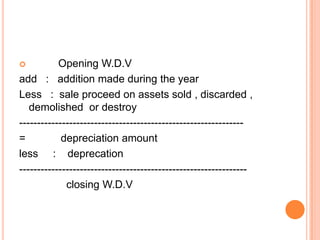
 Here following format will show how to calculate on
  depreciation value is derived as follow:-
          Opening W.D.V
add : addition made during the year
Less : sale proceed on assets sold , discarded ,
   demolished or destroy
---------------------------------------------------------------
=           depreciation amount
less : deprecation
----------------------------------------------------------------
             closing W.D.V
RULES
 Depreciation on asset used in business is allowed
  as deduction in computing the taxable
  income/profits but subject to following conditions:-
1) Assets should be owned by the assessee.

2) Asset should be used for the purpose of business
  or profession.
3) If any asset is used for less than 180 days than
  depreciation will be allowed @ ½ the prescribed rate.
      up to 2nd October full depreciation (even on 2nd
  October)

4) The depreciation is to be allowed on the basis of concept
  of block of assets
 Block of assets means a group of assets following with
  same class of assets and subject to same depreciation
  rate.
5) All expenses incur to acquire assets are to be
  considered as a part of total cost.
   like:-
          carriage inward
          installation charges
          technical fees
          interest on loan etc

However subsidy is received it would be deducted from
 total cost.
6)   No depreciation will be considered in following cases :-

 If all assets of block are sold out. It may result short term
  capital gain or short term capital loss.
 When sales proceed is more than opening W.D.V and
  addition made during the year. In that situation sale
  proceed less ( o/p W.D.V + addition during the year)=
  short term capital gain .
 For depreciation selling date is not concern but
  purchasing date must considered , it is calculated not
  from date of purchase but from date of use.
EXAMPLE

 Sohan Pvt. Ltd. is having 5 Mac book subject to rate of
  depreciation 20 % ( W.D.V as on 1/4/2011)
 Rs 8 laces already with Unjha ltd.

 On 19 June 2011 company purchased Mac book
  costing 180000 with installation charges for Rs 120000.
 However one Mac book was sold on 26 December 2011
  for Rs 400000
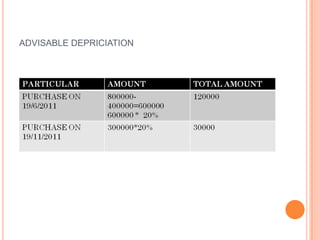
Compute advisable depreciation for year 2011-12
  ???????????????
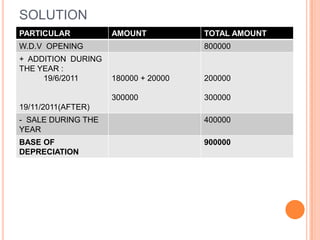
SOLUTION
PARTICULAR          AMOUNT           TOTAL AMOUNT
W.D.V OPENING                        800000
+ ADDITION DURING
THE YEAR :
     19/6/2011      180000 + 20000   200000

                    300000           300000
19/11/2011(AFTER)
- SALE DURING THE                    400000
YEAR
BASE OF                              900000
DEPRECIATION
ADVISABLE DEPRICIATION
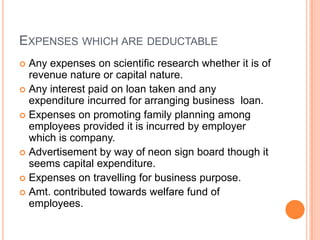
EXPENSES WHICH ARE DEDUCTABLE
 Any expenses on scientific research whether it is of
  revenue nature or capital nature.
 Any interest paid on loan taken and any
  expenditure incurred for arranging business loan.
 Expenses on promoting family planning among
  employees provided it is incurred by employer
  which is company.
 Advertisement by way of neon sign board though it
  seems capital expenditure.
 Expenses on travelling for business purpose.
 Amt. contributed towards welfare fund of
  employees.
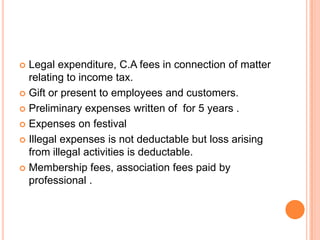
 Legal expenditure, C.A fees in connection of matter
  relating to income tax.
 Gift or present to employees and customers.

 Preliminary expenses written of for 5 years .

 Expenses on festival

 Illegal expenses is not deductable but loss arising
  from illegal activities is deductable.
 Membership fees, association fees paid by
  professional .
EXPENSES WHICH ARE NOT DEDUCTABLE

 Any expenses which are related to income
  chargeable under any other head other than
  business and profession.
 Any payment to owner of business or any personal
  expenses of owner
 Any expenses not being business expenses.
 Any capital expenditure like purchase of fixed
  assets as well as expenses on shifting of factory.
 Income from speculative transaction is taxable here
  and speculative loss is deductable only from it.
 Income which is taxable as business income.
 Any expenditure which is disallowed by act.
Thank you………

Group 6

  • 1.
    PRESENTATION ON PROFIT ANDGAIN OF BUSINESS OR PROFESSION Presented By :- GROUP-6 RAJAN PATEL (104143) BRIJESH PATEL (104106) SOHAN LASKARI (104153)
  • 2.
    BASIS OF CHARGE[SECTION 28]  profits and gains of any business or profession  any compensation or other payments due to or received by any person specified in section 28(ii)  income derived by a trade, professional or similar association from specific services performed for its members  the value of any benefit or perquisite, whether convertible into money or not, arising from business or the exercise of profession  any profit on transfer of the Duty Entitlement Pass Book Scheme  any profit on transfer of duty free replenishment certificate  export incentive available to exporters  any interest, salary, bonus, commission or remuneration received by a partner from firm  any sum received for not carrying out any activity in relation to any business or not to share any know how , patent, copyright, trademark , etc.  profit and gains of managing agency and  income from speculative transactions
  • 3.
    BUSINESS [SECTION 2(13)]  It includes any trade, commerce, manufacture or any adventure or concern in nature of trade, commerce or manufacture  A person who purchases goods with a view to sell them as profit is trade  Whereas if such transactions are repeated on a large scale it is called commerce  Manufacture is a process which results in alteration or change in goods which are subjected to such manufacture.
  • 4.
    BASIC PRINCIPLES FORARRIVING AT BUSINESS INCOME  Business or profession carried on by the assessee  Business or profession should be carried on during the previous year  Income of previous year is taxable during the following assessment year  Tax incidence arises in respect of all business or profession  Legal ownership V/S Beneficial Ownership  Real profit V/S Anticipated profit  Real profit V/S Notional profit  Mode of book entries not relevant  Illegal business  Losses incidental to trade
  • 5.
    METHOD OF ACCOUNTING  2 main methods  Mercantile system  Cash system  Mercantile system:- Net profit/loss is calculated after taking consideration all income and expenditure of a particular accounting year irrespective of the fact whether income is not received or expenditure is not actually paid during the accounting period  Cash system:- a record is kept of actual receipts and actual payments of a particular year. Hence income actually collected during the previous year is taxable and expenditure actually paid during the previous year is deductable irrespective of fact whether it related to the previous year or some other years.
  • 6.
    TWO CONCEPTS  Blockof assets method of providing depreciation on fixed assets  Calculation of taxable business/ profession income.
  • 7.
    BLOCK OF ASSETS In income tax for calculating depreciation a unique method is used.  Here all assets are classified in to different blocks on the basis of its nature and rate of depreciation.  Here following format will show how to calculate on depreciation value is derived as follow:-
  • 8.
    Opening W.D.V add : addition made during the year Less : sale proceed on assets sold , discarded , demolished or destroy --------------------------------------------------------------- = depreciation amount less : deprecation ---------------------------------------------------------------- closing W.D.V
  • 9.
    RULES  Depreciation onasset used in business is allowed as deduction in computing the taxable income/profits but subject to following conditions:- 1) Assets should be owned by the assessee. 2) Asset should be used for the purpose of business or profession.
  • 10.
    3) If anyasset is used for less than 180 days than depreciation will be allowed @ ½ the prescribed rate.  up to 2nd October full depreciation (even on 2nd October) 4) The depreciation is to be allowed on the basis of concept of block of assets  Block of assets means a group of assets following with same class of assets and subject to same depreciation rate.
  • 11.
    5) All expensesincur to acquire assets are to be considered as a part of total cost. like:-  carriage inward  installation charges  technical fees  interest on loan etc However subsidy is received it would be deducted from total cost.
  • 12.
    6) No depreciation will be considered in following cases :-  If all assets of block are sold out. It may result short term capital gain or short term capital loss.  When sales proceed is more than opening W.D.V and addition made during the year. In that situation sale proceed less ( o/p W.D.V + addition during the year)= short term capital gain .  For depreciation selling date is not concern but purchasing date must considered , it is calculated not from date of purchase but from date of use.
  • 13.
    EXAMPLE  Sohan Pvt.Ltd. is having 5 Mac book subject to rate of depreciation 20 % ( W.D.V as on 1/4/2011)  Rs 8 laces already with Unjha ltd.  On 19 June 2011 company purchased Mac book costing 180000 with installation charges for Rs 120000.  However one Mac book was sold on 26 December 2011 for Rs 400000 Compute advisable depreciation for year 2011-12 ???????????????
  • 14.
    SOLUTION PARTICULAR AMOUNT TOTAL AMOUNT W.D.V OPENING 800000 + ADDITION DURING THE YEAR : 19/6/2011 180000 + 20000 200000 300000 300000 19/11/2011(AFTER) - SALE DURING THE 400000 YEAR BASE OF 900000 DEPRECIATION
  • 15.
  • 16.
    EXPENSES WHICH AREDEDUCTABLE  Any expenses on scientific research whether it is of revenue nature or capital nature.  Any interest paid on loan taken and any expenditure incurred for arranging business loan.  Expenses on promoting family planning among employees provided it is incurred by employer which is company.  Advertisement by way of neon sign board though it seems capital expenditure.  Expenses on travelling for business purpose.  Amt. contributed towards welfare fund of employees.
  • 17.
     Legal expenditure,C.A fees in connection of matter relating to income tax.  Gift or present to employees and customers.  Preliminary expenses written of for 5 years .  Expenses on festival  Illegal expenses is not deductable but loss arising from illegal activities is deductable.  Membership fees, association fees paid by professional .
  • 18.
    EXPENSES WHICH ARENOT DEDUCTABLE  Any expenses which are related to income chargeable under any other head other than business and profession.  Any payment to owner of business or any personal expenses of owner  Any expenses not being business expenses.  Any capital expenditure like purchase of fixed assets as well as expenses on shifting of factory.  Income from speculative transaction is taxable here and speculative loss is deductable only from it.  Income which is taxable as business income.  Any expenditure which is disallowed by act.
  • 19.