27:2 Human Traits
• Objectives:
• Compare recessive and dominant traits with
  incomplete dominance
• Describe different ways human traits can be
  inherited
Review
• One dominant gene is needed for a trait to
  show up
• Two recessive genes are needed for a
  recessive trait to show up
• Examples of recessive traits are: straight
  hair, short eyelashes
• Examples of dominant traits are: curly hair,
  the ability to roll your tongue, dimples
•                    Free earlobes
•        dominant    dimples
•                    curly hair
• Human
• Traits
•                    attached earlobes
•        recessive   no dimples
•                    straight hair
Incomplete Dominance
• Incomplete dominance is when a new trait
  is formed. Neither gene is dominant over
  the other.
• The gene is heterozygous, but the dominant
  trait is not seen. A new trait is formed that
  is a blend of the dominant and recessive
  trait
• When a pure dominant red snapdragon
  flower is mated with a pure recessive white
  snapdragon the results is that the offspring
  is a heterozygous pink flower
• The genes them selves do not change, just
  the resulting traits change.
• If the genes are separated then we see the
  red and white genes again.
• If two pink flowers
 are mated then
they produce red,
white and pink
offspring
Sickle-Cell Anemia
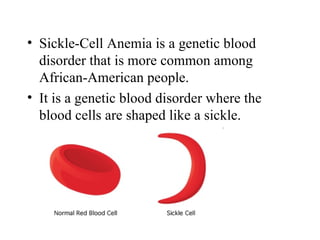
• Most people have blood cells that are round
• Some people have cells that are shaped like
  a sickle that is used to cut grass. These cells
  are called sickle cells.
• Some people have both shape blood cells
• Sickle-Cell Anemia is a genetic blood
  disorder that is more common among
  African-American people.
• It is a genetic blood disorder where the
  blood cells are shaped like a sickle.
• This shape cell does not move through the
  capillaries very well because their shape causes
  the capillaries to become clogged
• They also cannot carry enough oxygen to the body
  tissue
As a result a
person with
sickle-cell
anemia can
suffer serious
health problems.
If both parents carry the sickle-cell then one out of four
offspring would have round cells, two out of four would have
both round and sickle cells and one out of four would have all
sickle-cells. This child would have Sickle-Cell Anemia.
Blood Types in Humans
• There are four blood types in humans
• A, B, AB, O
• Three genes control blood type but people
  only have two of them
• A and B are dominant to O
The A or B gene is dominant to the O
             gene type
Genes on the X Chromosome
• Sex chromosomes carry genes
• Because females have two X chromosomes,
  they have two genes for some traits
• Males only have one gene for these traits
  because they have only have one X
  chromosome. These genes are not on the Y
  chromosome
• When the XY chromosomes are together
  the genes on the X chromosome control the
  trait
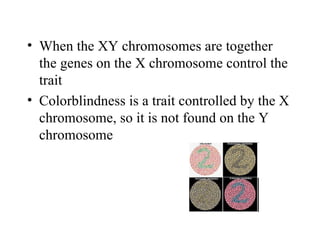
• Colorblindness is a trait controlled by the X
  chromosome, so it is not found on the Y
  chromosome
• Being color blind means not being able to
  see red and green as two separate colors
• Not being able to red and green is a
  recessive trait.
C - dominant
Able to see red
and green
c- recessive

27: 2 Human Traits

  • 1.
    27:2 Human Traits •Objectives: • Compare recessive and dominant traits with incomplete dominance • Describe different ways human traits can be inherited
  • 2.
    Review • One dominantgene is needed for a trait to show up • Two recessive genes are needed for a recessive trait to show up • Examples of recessive traits are: straight hair, short eyelashes • Examples of dominant traits are: curly hair, the ability to roll your tongue, dimples
  • 3.
    Free earlobes • dominant dimples • curly hair • Human • Traits • attached earlobes • recessive no dimples • straight hair
  • 4.
    Incomplete Dominance • Incompletedominance is when a new trait is formed. Neither gene is dominant over the other. • The gene is heterozygous, but the dominant trait is not seen. A new trait is formed that is a blend of the dominant and recessive trait
  • 5.
    • When apure dominant red snapdragon flower is mated with a pure recessive white snapdragon the results is that the offspring is a heterozygous pink flower
  • 6.
    • The genesthem selves do not change, just the resulting traits change. • If the genes are separated then we see the red and white genes again. • If two pink flowers are mated then they produce red, white and pink offspring
  • 7.
    Sickle-Cell Anemia • Mostpeople have blood cells that are round • Some people have cells that are shaped like a sickle that is used to cut grass. These cells are called sickle cells. • Some people have both shape blood cells
  • 8.
    • Sickle-Cell Anemiais a genetic blood disorder that is more common among African-American people. • It is a genetic blood disorder where the blood cells are shaped like a sickle.
  • 9.
    • This shapecell does not move through the capillaries very well because their shape causes the capillaries to become clogged • They also cannot carry enough oxygen to the body tissue As a result a person with sickle-cell anemia can suffer serious health problems.
  • 10.
    If both parentscarry the sickle-cell then one out of four offspring would have round cells, two out of four would have both round and sickle cells and one out of four would have all sickle-cells. This child would have Sickle-Cell Anemia.
  • 11.
    Blood Types inHumans • There are four blood types in humans • A, B, AB, O • Three genes control blood type but people only have two of them • A and B are dominant to O
  • 12.
    The A orB gene is dominant to the O gene type
  • 13.
    Genes on theX Chromosome • Sex chromosomes carry genes • Because females have two X chromosomes, they have two genes for some traits • Males only have one gene for these traits because they have only have one X chromosome. These genes are not on the Y chromosome
  • 14.
    • When theXY chromosomes are together the genes on the X chromosome control the trait • Colorblindness is a trait controlled by the X chromosome, so it is not found on the Y chromosome
  • 15.
    • Being colorblind means not being able to see red and green as two separate colors • Not being able to red and green is a recessive trait. C - dominant Able to see red and green c- recessive