Objectives


•   Discuss why Mendel’s principles cannot be applied to all
    situations.

•   Compare and contrast different types of complex
    inheritance.
It’s complicated

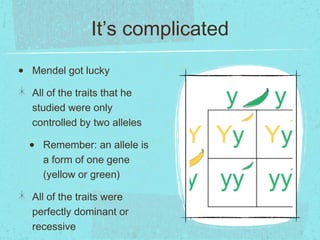
•   Mendel got lucky

    All of the traits that he
    studied were only
    controlled by two alleles

    •   Remember: an allele is
        a form of one gene
        (yellow or green)

    All of the traits were
    perfectly dominant or
    recessive
It’s complicated


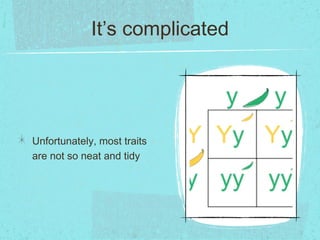
Unfortunately, most traits
are not so neat and tidy
It’s complicated

•   There are 4 forms of
    complex inheritance you
    need to know

        Incomplete dominance

    •   Co-dominance

    •   Multiple Alleles

    •   Polygenic inheritance
Incomplete Dominance
•   Remember, a gene is the
    instruction for a protein

    Because there are two
    alleles for a trait, two
    proteins are being
    produced

•   In Mendel’s studies, one
    protein dominated the
    other

    The dominant protein was
    shown
Incomplete Dominance


•   Incomplete Dominance:
    One gene does not
    clearly dominate the other

•   The phenotype of the
    offspring is a blend of the
    two parent phenotypes
Incomplete Dominance

•   Example: A white flower is
    mixed with a red flower

    In incomplete dominance a
    white flower mixed with a
    red flower produces PINK
    offspring

•   The offspring are a blend of
    the two parents

    Neither parent is seen in
    the offspring
Co-dominance


Co-dominance: Neither
phenotype dominates and
BOTH are shown
Co-dominance


•   Example: A red flower is
    mixed with a white flower

•   In co-dominance a red
    parent flower and a white
    parent flower produce
    offspring with BOTH red
    AND white petals
Compare


•   Incomplete dominance:

      Red + White = Pink

•   Co-dominance:

      Red + White = Both red
      and white on the same
      flower
Multiple Alleles


With all of the variety in the
world it would make sense
that some traits have more
than two forms
Multiple Alleles


Multiple Alleles: A trait for
which there are more than
2 forms of a gene
Multiple Alleles


•   Example: Blood Type

    There are three alleles for
    blood type

        IA

        IB

    •   i
Multiple Alleles

•   Genotypes for type A blood are

    •   IA IA or IAi

    Genotypes for type B blood are

        IB IB or IBi

•   Genotype for AB blood is

    •   IA IB

    Genotype for type O blood is

    •   ii
Polygenic Inheritance


•   If you have noticed, most
    kids are a blend of their
    parents traits

•   To this point all of the traits
    we have talked about have
    been controlled by different
    forms of ONE gene
Polygenic Inheritance


•   Polygenic Inheritence

    Remember your words

    •   Poly = many

    What do you think
    POLYgenic inheritance
    means?
Polygenic Inheritance


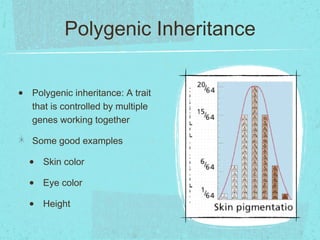
•   Polygenic inheritance: A trait
    that is controlled by multiple
    genes working together

    Some good examples

    •   Skin color

    •   Eye color

    •   Height
Polygenic Inheritance


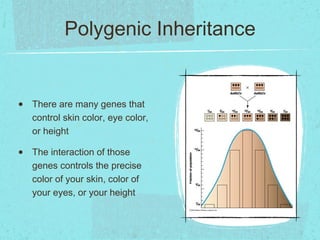
•   There are many genes that
    control skin color, eye color,
    or height

•   The interaction of those
    genes controls the precise
    color of your skin, color of
    your eyes, or your height

Complex Inheritance

  • 1.
    Objectives • Discuss why Mendel’s principles cannot be applied to all situations. • Compare and contrast different types of complex inheritance.
  • 2.
    It’s complicated • Mendel got lucky All of the traits that he studied were only controlled by two alleles • Remember: an allele is a form of one gene (yellow or green) All of the traits were perfectly dominant or recessive
  • 3.
    It’s complicated Unfortunately, mosttraits are not so neat and tidy
  • 4.
    It’s complicated • There are 4 forms of complex inheritance you need to know Incomplete dominance • Co-dominance • Multiple Alleles • Polygenic inheritance
  • 5.
    Incomplete Dominance • Remember, a gene is the instruction for a protein Because there are two alleles for a trait, two proteins are being produced • In Mendel’s studies, one protein dominated the other The dominant protein was shown
  • 6.
    Incomplete Dominance • Incomplete Dominance: One gene does not clearly dominate the other • The phenotype of the offspring is a blend of the two parent phenotypes
  • 7.
    Incomplete Dominance • Example: A white flower is mixed with a red flower In incomplete dominance a white flower mixed with a red flower produces PINK offspring • The offspring are a blend of the two parents Neither parent is seen in the offspring
  • 8.
  • 9.
    Co-dominance • Example: A red flower is mixed with a white flower • In co-dominance a red parent flower and a white parent flower produce offspring with BOTH red AND white petals
  • 10.
    Compare • Incomplete dominance: Red + White = Pink • Co-dominance: Red + White = Both red and white on the same flower
  • 11.
    Multiple Alleles With allof the variety in the world it would make sense that some traits have more than two forms
  • 12.
    Multiple Alleles Multiple Alleles:A trait for which there are more than 2 forms of a gene
  • 13.
    Multiple Alleles • Example: Blood Type There are three alleles for blood type IA IB • i
  • 14.
    Multiple Alleles • Genotypes for type A blood are • IA IA or IAi Genotypes for type B blood are IB IB or IBi • Genotype for AB blood is • IA IB Genotype for type O blood is • ii
  • 15.
    Polygenic Inheritance • If you have noticed, most kids are a blend of their parents traits • To this point all of the traits we have talked about have been controlled by different forms of ONE gene
  • 16.
    Polygenic Inheritance • Polygenic Inheritence Remember your words • Poly = many What do you think POLYgenic inheritance means?
  • 17.
    Polygenic Inheritance • Polygenic inheritance: A trait that is controlled by multiple genes working together Some good examples • Skin color • Eye color • Height
  • 18.
    Polygenic Inheritance • There are many genes that control skin color, eye color, or height • The interaction of those genes controls the precise color of your skin, color of your eyes, or your height