A Difficult Past- How the Americas Change Lisa Daleiden
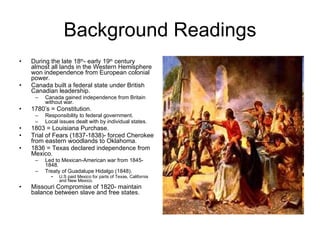
Background Readings During the late 18 th - early 19 th  century almost all lands in the Western Hemisphere won independence from European colonial power. Canada built a federal state under British Canadian leadership. Canada gained independence from Britain without war. 1780’s = Constitution. Responsibility to federal government. Local issues dealt with by individual states. 1803 = Louisiana Purchase. Trial of Fears (1837-1838)- forced Cherokee from eastern woodlands to Oklahoma. 1836 = Texas declared independence from Mexico. Led to Mexican-American war from 1845- 1848. Treaty of Guadalupe Hidalgo (1848). U.S paid Mexico for parts of Texas, California and New Mexico. Missouri Compromise of 1820- maintain balance between slave and free states.
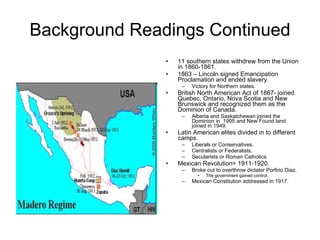
Background Readings Continued 11 southern states withdrew from the Union in 1860-1861. 1863 – Lincoln signed Emancipation Proclamation and ended slavery. Victory for Northern states. British North American Act of 1867- joined Quebec, Ontario, Nova Scotia and New Brunswick and recognized them as the Dominion of Canada. Alberta and Saskatchewan joined the Dominion in  1905 and New Found land joined in 1949. Latin American elites divided in to different camps. Liberals or Conservatives. Centralists or Federalists. Secularists or Roman Catholics. Mexican Revolution= 1911-1920.  Broke out to overthrow dictator Porfirio Diaz. The government gained control. Mexican Constitution addressed in 1917.
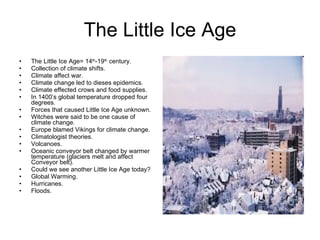
The Little Ice Age The Little Ice Age= 14 th -19 th  century. Collection of climate shifts. Climate affect war. Climate change led to dieses epidemics. Climate effected crows and food supplies. In 1400’s global temperature dropped four degrees. Forces that caused Little Ice Age unknown. Witches were said to be one cause of climate change. Europe blamed Vikings for climate change. Climatologist theories. Volcanoes. Oceanic conveyor belt changed by warmer temperature (glaciers melt and affect Conveyor belt). Could we see another Little Ice Age today? Global Warming. Hurricanes. Floods.
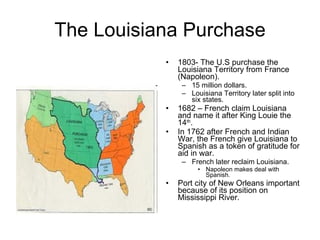
The Louisiana Purchase 1803- The U.S purchase the Louisiana Territory from France (Napoleon). 15 million dollars. Louisiana Territory later split into six states. 1682 – French claim Louisiana and name it after King Louie the 14 th . In 1762 after French and Indian War, the French give Louisiana to Spanish as a token of gratitude for aid in war. French later reclaim Louisiana. Napoleon makes deal with Spanish. Port city of New Orleans important because of its position on Mississippi River.
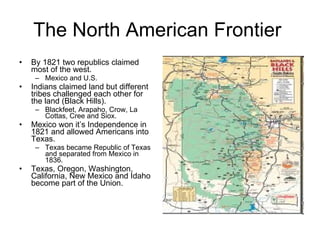
The North American Frontier  By 1821 two republics claimed most of the west. Mexico and U.S. Indians claimed land but different tribes challenged each other for the land (Black Hills). Blackfeet, Arapaho, Crow, La Cottas, Cree and Siox. Mexico won it’s Independence in 1821 and allowed Americans into Texas. Texas became Republic of Texas and separated from Mexico in 1836. Texas, Oregon, Washington, California, New Mexico and Idaho become part of the Union.
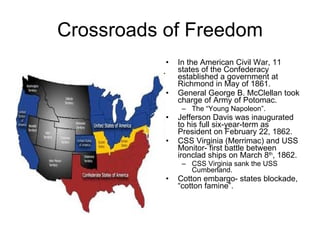
Crossroads of Freedom In the American Civil War, 11 states of the Confederacy established a government at Richmond in May of 1861. General George B. McClellan took charge of Army of Potomac. The “Young Napoleon”. Jefferson Davis was inaugurated to his full six-year-term as President on February 22, 1862. CSS Virginia (Merrimac) and USS Monitor- first battle between ironclad ships on March 8 th , 1862. CSS Virginia sank the USS Cumberland. Cotton embargo- states blockade, “cotton famine”.
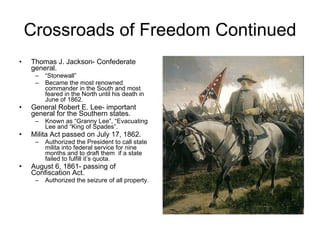
Crossroads of Freedom Continued Thomas J. Jackson- Confederate general. “ Stonewall” Became the most renowned commander in the South and most feared in the North until his death in June of 1862. General Robert E. Lee- important general for the Southern states. Known as “Granny Lee”, “Evacuating Lee and “King of Spades”. Milita Act passed on July 17, 1862. Authorized the President to call state milita into federal service for nine months and to draft them  if a state failed to fulfill it’s quota. August 6, 1861- passing of Confiscation Act. Authorized the seizure of all property.
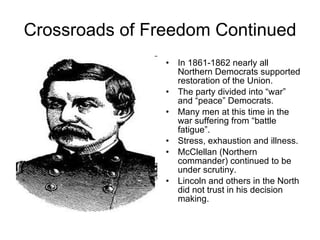
Crossroads of Freedom Continued In 1861-1862 nearly all Northern Democrats supported restoration of the Union. The party divided into “war” and “peace” Democrats. Many men at this time in the war suffering from “battle fatigue”. Stress, exhaustion and illness. McClellan (Northern commander) continued to be under scrutiny. Lincoln and others in the North did not trust in his decision making.
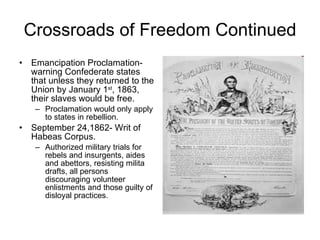
Crossroads of Freedom Continued Emancipation Proclamation- warning Confederate states that unless they returned to the Union by January 1 st , 1863, their slaves would be free. Proclamation would only apply to states in rebellion. September 24,1862- Writ of Habeas Corpus. Authorized military trials for rebels and insurgents, aides and abettors, resisting milita drafts, all persons discouraging volunteer enlistments and those guilty of disloyal practices.

How the americas change

  • 1.
    A Difficult Past-How the Americas Change Lisa Daleiden
  • 2.
    Background Readings Duringthe late 18 th - early 19 th century almost all lands in the Western Hemisphere won independence from European colonial power. Canada built a federal state under British Canadian leadership. Canada gained independence from Britain without war. 1780’s = Constitution. Responsibility to federal government. Local issues dealt with by individual states. 1803 = Louisiana Purchase. Trial of Fears (1837-1838)- forced Cherokee from eastern woodlands to Oklahoma. 1836 = Texas declared independence from Mexico. Led to Mexican-American war from 1845- 1848. Treaty of Guadalupe Hidalgo (1848). U.S paid Mexico for parts of Texas, California and New Mexico. Missouri Compromise of 1820- maintain balance between slave and free states.
  • 3.
    Background Readings Continued11 southern states withdrew from the Union in 1860-1861. 1863 – Lincoln signed Emancipation Proclamation and ended slavery. Victory for Northern states. British North American Act of 1867- joined Quebec, Ontario, Nova Scotia and New Brunswick and recognized them as the Dominion of Canada. Alberta and Saskatchewan joined the Dominion in 1905 and New Found land joined in 1949. Latin American elites divided in to different camps. Liberals or Conservatives. Centralists or Federalists. Secularists or Roman Catholics. Mexican Revolution= 1911-1920. Broke out to overthrow dictator Porfirio Diaz. The government gained control. Mexican Constitution addressed in 1917.
  • 4.
    The Little IceAge The Little Ice Age= 14 th -19 th century. Collection of climate shifts. Climate affect war. Climate change led to dieses epidemics. Climate effected crows and food supplies. In 1400’s global temperature dropped four degrees. Forces that caused Little Ice Age unknown. Witches were said to be one cause of climate change. Europe blamed Vikings for climate change. Climatologist theories. Volcanoes. Oceanic conveyor belt changed by warmer temperature (glaciers melt and affect Conveyor belt). Could we see another Little Ice Age today? Global Warming. Hurricanes. Floods.
  • 5.
    The Louisiana Purchase1803- The U.S purchase the Louisiana Territory from France (Napoleon). 15 million dollars. Louisiana Territory later split into six states. 1682 – French claim Louisiana and name it after King Louie the 14 th . In 1762 after French and Indian War, the French give Louisiana to Spanish as a token of gratitude for aid in war. French later reclaim Louisiana. Napoleon makes deal with Spanish. Port city of New Orleans important because of its position on Mississippi River.
  • 6.
    The North AmericanFrontier By 1821 two republics claimed most of the west. Mexico and U.S. Indians claimed land but different tribes challenged each other for the land (Black Hills). Blackfeet, Arapaho, Crow, La Cottas, Cree and Siox. Mexico won it’s Independence in 1821 and allowed Americans into Texas. Texas became Republic of Texas and separated from Mexico in 1836. Texas, Oregon, Washington, California, New Mexico and Idaho become part of the Union.
  • 7.
    Crossroads of FreedomIn the American Civil War, 11 states of the Confederacy established a government at Richmond in May of 1861. General George B. McClellan took charge of Army of Potomac. The “Young Napoleon”. Jefferson Davis was inaugurated to his full six-year-term as President on February 22, 1862. CSS Virginia (Merrimac) and USS Monitor- first battle between ironclad ships on March 8 th , 1862. CSS Virginia sank the USS Cumberland. Cotton embargo- states blockade, “cotton famine”.
  • 8.
    Crossroads of FreedomContinued Thomas J. Jackson- Confederate general. “ Stonewall” Became the most renowned commander in the South and most feared in the North until his death in June of 1862. General Robert E. Lee- important general for the Southern states. Known as “Granny Lee”, “Evacuating Lee and “King of Spades”. Milita Act passed on July 17, 1862. Authorized the President to call state milita into federal service for nine months and to draft them if a state failed to fulfill it’s quota. August 6, 1861- passing of Confiscation Act. Authorized the seizure of all property.
  • 9.
    Crossroads of FreedomContinued In 1861-1862 nearly all Northern Democrats supported restoration of the Union. The party divided into “war” and “peace” Democrats. Many men at this time in the war suffering from “battle fatigue”. Stress, exhaustion and illness. McClellan (Northern commander) continued to be under scrutiny. Lincoln and others in the North did not trust in his decision making.
  • 10.
    Crossroads of FreedomContinued Emancipation Proclamation- warning Confederate states that unless they returned to the Union by January 1 st , 1863, their slaves would be free. Proclamation would only apply to states in rebellion. September 24,1862- Writ of Habeas Corpus. Authorized military trials for rebels and insurgents, aides and abettors, resisting milita drafts, all persons discouraging volunteer enlistments and those guilty of disloyal practices.