P. Herold – 08/2016
US/D Workshop
Washington, USA, Sept. 7-9, 2016
1
Impact of retrieval requirements on
repository design
− Results of R&D project funded by BMWi (PTKA) −
Philipp Herold, Sabine Dörr, Eric Kuate Simo,
Wilhelm Bollingerfehr, Wolfgang Filbert
DBE TECHNOLOGY GmbH
Washington, DC
September 7-9, 2016
P. Herold – 08/2016
US/D Workshop
Washington, USA, Sept. 7-9, 2016
2
1. Final Disposal in Germany – HLW program
2. Regulatory requirements related to retrievability
3. Retrieval strategy
4. Retrievability in drift disposal concept
5. Retrievability in borehole disposal concept
6. Summary
Contents
P. Herold – 08/2016
US/D Workshop
Washington, USA, Sept. 7-9, 2016
3
Final Disposal in Germany
• Disposal in deep rock salt formations was the preferred
option for the last decades
• Summer 2013: German parliament (Bundestag) passed
new law for restart of site selection process for HLW
repository and implemented commission “Storage of
HLW”
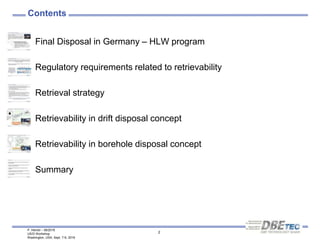
Exploration Mine Gorleben (DBE, 2016)
Final report commission “Storage of HLW”:
• Recommends disposal of HLW in deep geologic
formations with the possibility of retrieving waste
packages as preferred option in Germany
• Determined site selection criteria, considering salt, clay,
crystalline rock as potential host rocks
• Prepared a roadmap for site selection process, which
will start in 2017
P. Herold – 08/2016
US/D Workshop
Washington, USA, Sept. 7-9, 2016
4
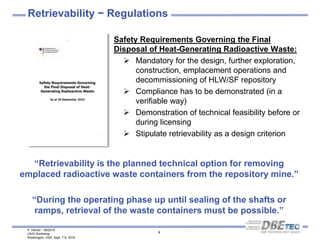
Retrievability − Regulations
Safety Requirements Governing the Final
Disposal of Heat-Generating Radioactive Waste:
 Mandatory for the design, further exploration,
construction, emplacement operations and
decommissioning of HLW/SF repository
 Compliance has to be demonstrated (in a
verifiable way)
 Demonstration of technical feasibility before or
during licensing
 Stipulate retrievability as a design criterion
“Retrievability is the planned technical option for removing
emplaced radioactive waste containers from the repository mine.”
“During the operating phase up until sealing of the shafts or
ramps, retrieval of the waste containers must be possible.”
P. Herold – 08/2016
US/D Workshop
Washington, USA, Sept. 7-9, 2016
5
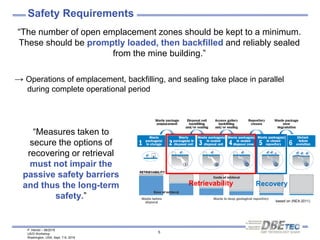
Safety Requirements
“Measures taken to
secure the options of
recovering or retrieval
must not impair the
passive safety barriers
and thus the long-term
safety.” based on (NEA 2011)
Retrievability Recovery
“The number of open emplacement zones should be kept to a minimum.
These should be promptly loaded, then backfilled and reliably sealed
from the mine building.”
→ Operations of emplacement, backfilling, and sealing take place in parallel
during complete operational period
P. Herold – 08/2016
US/D Workshop
Washington, USA, Sept. 7-9, 2016
6
Retrieval Strategy
• In the framework of R&D projects (funded by German Federal Ministry for
Economic Affairs and Energy), DBE TECHNOLOGY GmbH developed a
suitable strategy and technical solutions to retrieve waste packages
• Focus on underground operations
• Waste package management plan after retrieval does not exist
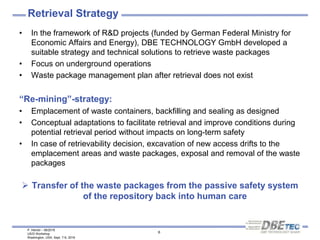
“Re-mining”-strategy:
• Emplacement of waste containers, backfilling and sealing as designed
• Conceptual adaptations to facilitate retrieval and improve conditions during
potential retrieval period without impacts on long-term safety
• In case of retrievability decision, excavation of new access drifts to the
emplacement areas and waste packages, exposal and removal of the waste
packages
 Transfer of the waste packages from the passive safety system
of the repository back into human care
P. Herold – 08/2016
US/D Workshop
Washington, USA, Sept. 7-9, 2016
7
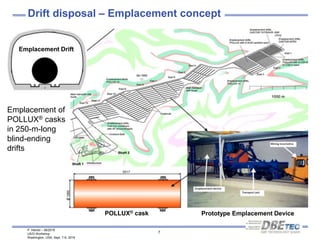
Drift disposal – Emplacement concept
Emplacement Drift
Prototype Emplacement DevicePOLLUX® cask
Emplacement of
POLLUX® casks
in 250-m-long
blind-ending
drifts
P. Herold – 08/2016
US/D Workshop
Washington, USA, Sept. 7-9, 2016
8
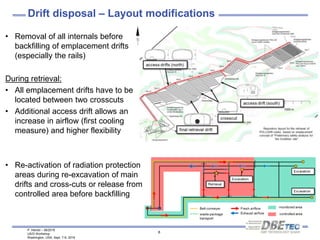
• Removal of all internals before
backfilling of emplacement drifts
(especially the rails)
During retrieval:
• All emplacement drifts have to be
located between two crosscuts
• Additional access drift allows an
increase in airflow (first cooling
measure) and higher flexibility
• Re-activation of radiation protection
areas during re-excavation of main
drifts and cross-cuts or release from
controlled area before backfilling
Drift disposal – Layout modifications
P. Herold – 08/2016
US/D Workshop
Washington, USA, Sept. 7-9, 2016
9
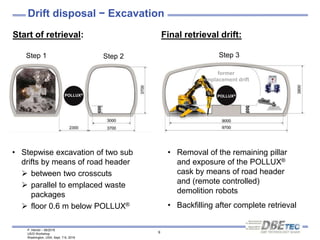
• Removal of the remaining pillar
and exposure of the POLLUX®
cask by means of road header
and (remote controlled)
demolition robots
• Backfilling after complete retrieval
Drift disposal − Excavation
• Stepwise excavation of two sub
drifts by means of road header
 between two crosscuts
 parallel to emplaced waste
packages
 floor 0.6 m below POLLUX®
Final retrieval drift:Start of retrieval:
Step 2Step 1 Step 3
POLLUX®POLLUX®
600
600
former
emplacement drift
P. Herold – 08/2016
US/D Workshop
Washington, USA, Sept. 7-9, 2016
10
Prototype Emplacement Device
Drift disposal − Equipment modifications
• Retrieval without rebuilding of rails
 automotive drive necessary
• Usability of trunnions after emplacement not
guaranteed
 alternative bearing structure necessary
• POLLUX® casks lie on a salt base/socket
 reduces lifting height
Feasibility Study for Modified Emplacement Device
P. Herold – 08/2016
US/D Workshop
Washington, USA, Sept. 7-9, 2016
11
Drift disposal − Thermal input
40 Years after start of
emplacement (corresponds
with start of retrieval)
• 200°C design temperature at waste package surface, optimized to densest
disposal of waste packages
• Barely manageable conditions inside the access drifts, cross cuts
• Retrieval operation coincides with thermal maximum inside the emplacement
fields
• Excavation inside the emplacement fields hardly manageable because of
very high technical cooling effort, necessary cooling breaks and geo-
mechanics
1 year after emplacement 2 years after emplacement
11 years after emplacement6 years after emplacement
Temperature [°C]
P. Herold – 08/2016
US/D Workshop
Washington, USA, Sept. 7-9, 2016
12
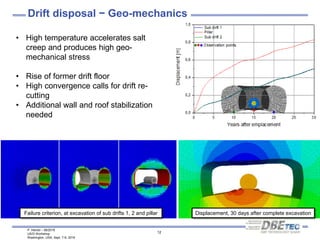
Drift disposal − Geo-mechanics
• High temperature accelerates salt
creep and produces high geo-
mechanical stress
• Rise of former drift floor
• High convergence calls for drift re-
cutting
• Additional wall and roof stabilization
needed
Displacement, 30 days after complete excavationFailure criterion, at excavation of sub drifts 1, 2 and pillar
P. Herold – 08/2016
US/D Workshop
Washington, USA, Sept. 7-9, 2016
13
Drift disposal − Conclusions
• Retrieval process is designed for total exposure of the POLLUX®-10
casks
• Modified emplacement device with rail-less drive and with new
bearing structure
• Thermal input due to densest packaging of the POLLUX®-10 casks
produces high rock temperatures and high geo-mechanical stress
• Optimization of thermal repository design would improve conditions
during potential retrieval period but increase repository footprint
• Requirement of retrievability changes repository design significantly
P. Herold – 08/2016
US/D Workshop
Washington, USA, Sept. 7-9, 2016
14
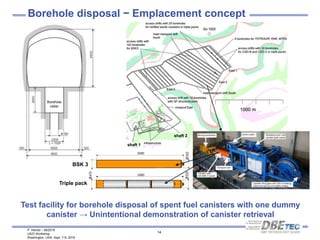
Borehole disposal − Emplacement concept
BSK 3
Triple pack
Borehole
cellar
Test facility for borehole disposal of spent fuel canisters with one dummy
canister → Unintentional demonstration of canister retrieval
P. Herold – 08/2016
US/D Workshop
Washington, USA, Sept. 7-9, 2016
15
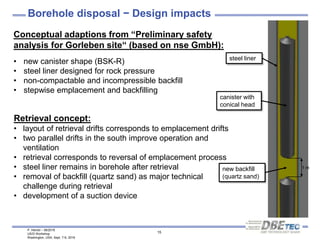
Conceptual adaptions from “Preliminary safety
analysis for Gorleben site“ (based on nse GmbH):
Borehole disposal − Design impacts
canister with
conical head
new backfill
(quartz sand)
steel liner
Retrieval concept:
• layout of retrieval drifts corresponds to emplacement drifts
• two parallel drifts in the south improve operation and
ventilation
• retrieval corresponds to reversal of emplacement process
• steel liner remains in borehole after retrieval
• removal of backfill (quartz sand) as major technical
challenge during retrieval
• development of a suction device
1 m
• new canister shape (BSK-R)
• steel liner designed for rock pressure
• non-compactable and incompressible backfill
• stepwise emplacement and backfilling
P. Herold – 08/2016
US/D Workshop
Washington, USA, Sept. 7-9, 2016
16
Borehole disposal − Design impacts
Feasibility study on suction device:
• Remove backfill to free head of the BSK-R
• Suction device with same outer dimensions as
BSK
• Integrated drive, fan and storage space
• Two suctions steps per BSK-R
• First pilot tests for air intake design
Grip
Drive
Fan
Deflection
dome
Transport
pipe clamp
Storage
space
Transport
pipe
Borehole liner
Air intake
Canister head
Cladding
P. Herold – 08/2016
US/D Workshop
Washington, USA, Sept. 7-9, 2016
17
Borehole disposal − Thermal input
Thermal conditions:
• Heat sources below mine level
• Temperatures above 100°C just next to the boreholes
• Steady increase of rock temperature during retrieval period
• Moderate total heat input inside the mine openings expected
• Third main drift improves ventilation conditions and allows higher flexibility
• Additional cooling equipment during excavation necessary
Drifts at emplacement field East 2
Drifts at emplacement field East 3
Time [a]
Temperature[°C]
P. Herold – 08/2016
US/D Workshop
Washington, USA, Sept. 7-9, 2016
18
Borehole disposal − Conclusions
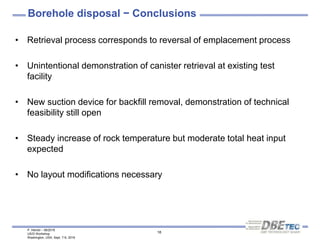
• Retrieval process corresponds to reversal of emplacement process
• Unintentional demonstration of canister retrieval at existing test
facility
• New suction device for backfill removal, demonstration of technical
feasibility still open
• Steady increase of rock temperature but moderate total heat input
expected
• No layout modifications necessary
P. Herold – 08/2016
US/D Workshop
Washington, USA, Sept. 7-9, 2016
19
Summary
• Retrievability is required during complete operational period as
licensing permission
• Thermal input of the waste will influence retrieval concept and to a
certain extent repository design
• Requirement of retrievability could change repository design
significantly
• Retrievability is compatible to German safety concept for high-level
radioactive waste repository in salt formations
• Technical feasibility of all retrieval concepts and techniques has still
to be demonstrated
P. Herold – 08/2016
US/D Workshop
Washington, USA, Sept. 7-9, 2016
20
Thank you
for your attention.

25 herold 20160830 retrieval final

  • 1.
    P. Herold –08/2016 US/D Workshop Washington, USA, Sept. 7-9, 2016 1 Impact of retrieval requirements on repository design − Results of R&D project funded by BMWi (PTKA) − Philipp Herold, Sabine Dörr, Eric Kuate Simo, Wilhelm Bollingerfehr, Wolfgang Filbert DBE TECHNOLOGY GmbH Washington, DC September 7-9, 2016
  • 2.
    P. Herold –08/2016 US/D Workshop Washington, USA, Sept. 7-9, 2016 2 1. Final Disposal in Germany – HLW program 2. Regulatory requirements related to retrievability 3. Retrieval strategy 4. Retrievability in drift disposal concept 5. Retrievability in borehole disposal concept 6. Summary Contents
  • 3.
    P. Herold –08/2016 US/D Workshop Washington, USA, Sept. 7-9, 2016 3 Final Disposal in Germany • Disposal in deep rock salt formations was the preferred option for the last decades • Summer 2013: German parliament (Bundestag) passed new law for restart of site selection process for HLW repository and implemented commission “Storage of HLW” Exploration Mine Gorleben (DBE, 2016) Final report commission “Storage of HLW”: • Recommends disposal of HLW in deep geologic formations with the possibility of retrieving waste packages as preferred option in Germany • Determined site selection criteria, considering salt, clay, crystalline rock as potential host rocks • Prepared a roadmap for site selection process, which will start in 2017
  • 4.
    P. Herold –08/2016 US/D Workshop Washington, USA, Sept. 7-9, 2016 4 Retrievability − Regulations Safety Requirements Governing the Final Disposal of Heat-Generating Radioactive Waste:  Mandatory for the design, further exploration, construction, emplacement operations and decommissioning of HLW/SF repository  Compliance has to be demonstrated (in a verifiable way)  Demonstration of technical feasibility before or during licensing  Stipulate retrievability as a design criterion “Retrievability is the planned technical option for removing emplaced radioactive waste containers from the repository mine.” “During the operating phase up until sealing of the shafts or ramps, retrieval of the waste containers must be possible.”
  • 5.
    P. Herold –08/2016 US/D Workshop Washington, USA, Sept. 7-9, 2016 5 Safety Requirements “Measures taken to secure the options of recovering or retrieval must not impair the passive safety barriers and thus the long-term safety.” based on (NEA 2011) Retrievability Recovery “The number of open emplacement zones should be kept to a minimum. These should be promptly loaded, then backfilled and reliably sealed from the mine building.” → Operations of emplacement, backfilling, and sealing take place in parallel during complete operational period
  • 6.
    P. Herold –08/2016 US/D Workshop Washington, USA, Sept. 7-9, 2016 6 Retrieval Strategy • In the framework of R&D projects (funded by German Federal Ministry for Economic Affairs and Energy), DBE TECHNOLOGY GmbH developed a suitable strategy and technical solutions to retrieve waste packages • Focus on underground operations • Waste package management plan after retrieval does not exist “Re-mining”-strategy: • Emplacement of waste containers, backfilling and sealing as designed • Conceptual adaptations to facilitate retrieval and improve conditions during potential retrieval period without impacts on long-term safety • In case of retrievability decision, excavation of new access drifts to the emplacement areas and waste packages, exposal and removal of the waste packages  Transfer of the waste packages from the passive safety system of the repository back into human care
  • 7.
    P. Herold –08/2016 US/D Workshop Washington, USA, Sept. 7-9, 2016 7 Drift disposal – Emplacement concept Emplacement Drift Prototype Emplacement DevicePOLLUX® cask Emplacement of POLLUX® casks in 250-m-long blind-ending drifts
  • 8.
    P. Herold –08/2016 US/D Workshop Washington, USA, Sept. 7-9, 2016 8 • Removal of all internals before backfilling of emplacement drifts (especially the rails) During retrieval: • All emplacement drifts have to be located between two crosscuts • Additional access drift allows an increase in airflow (first cooling measure) and higher flexibility • Re-activation of radiation protection areas during re-excavation of main drifts and cross-cuts or release from controlled area before backfilling Drift disposal – Layout modifications
  • 9.
    P. Herold –08/2016 US/D Workshop Washington, USA, Sept. 7-9, 2016 9 • Removal of the remaining pillar and exposure of the POLLUX® cask by means of road header and (remote controlled) demolition robots • Backfilling after complete retrieval Drift disposal − Excavation • Stepwise excavation of two sub drifts by means of road header  between two crosscuts  parallel to emplaced waste packages  floor 0.6 m below POLLUX® Final retrieval drift:Start of retrieval: Step 2Step 1 Step 3 POLLUX®POLLUX® 600 600 former emplacement drift
  • 10.
    P. Herold –08/2016 US/D Workshop Washington, USA, Sept. 7-9, 2016 10 Prototype Emplacement Device Drift disposal − Equipment modifications • Retrieval without rebuilding of rails  automotive drive necessary • Usability of trunnions after emplacement not guaranteed  alternative bearing structure necessary • POLLUX® casks lie on a salt base/socket  reduces lifting height Feasibility Study for Modified Emplacement Device
  • 11.
    P. Herold –08/2016 US/D Workshop Washington, USA, Sept. 7-9, 2016 11 Drift disposal − Thermal input 40 Years after start of emplacement (corresponds with start of retrieval) • 200°C design temperature at waste package surface, optimized to densest disposal of waste packages • Barely manageable conditions inside the access drifts, cross cuts • Retrieval operation coincides with thermal maximum inside the emplacement fields • Excavation inside the emplacement fields hardly manageable because of very high technical cooling effort, necessary cooling breaks and geo- mechanics 1 year after emplacement 2 years after emplacement 11 years after emplacement6 years after emplacement Temperature [°C]
  • 12.
    P. Herold –08/2016 US/D Workshop Washington, USA, Sept. 7-9, 2016 12 Drift disposal − Geo-mechanics • High temperature accelerates salt creep and produces high geo- mechanical stress • Rise of former drift floor • High convergence calls for drift re- cutting • Additional wall and roof stabilization needed Displacement, 30 days after complete excavationFailure criterion, at excavation of sub drifts 1, 2 and pillar
  • 13.
    P. Herold –08/2016 US/D Workshop Washington, USA, Sept. 7-9, 2016 13 Drift disposal − Conclusions • Retrieval process is designed for total exposure of the POLLUX®-10 casks • Modified emplacement device with rail-less drive and with new bearing structure • Thermal input due to densest packaging of the POLLUX®-10 casks produces high rock temperatures and high geo-mechanical stress • Optimization of thermal repository design would improve conditions during potential retrieval period but increase repository footprint • Requirement of retrievability changes repository design significantly
  • 14.
    P. Herold –08/2016 US/D Workshop Washington, USA, Sept. 7-9, 2016 14 Borehole disposal − Emplacement concept BSK 3 Triple pack Borehole cellar Test facility for borehole disposal of spent fuel canisters with one dummy canister → Unintentional demonstration of canister retrieval
  • 15.
    P. Herold –08/2016 US/D Workshop Washington, USA, Sept. 7-9, 2016 15 Conceptual adaptions from “Preliminary safety analysis for Gorleben site“ (based on nse GmbH): Borehole disposal − Design impacts canister with conical head new backfill (quartz sand) steel liner Retrieval concept: • layout of retrieval drifts corresponds to emplacement drifts • two parallel drifts in the south improve operation and ventilation • retrieval corresponds to reversal of emplacement process • steel liner remains in borehole after retrieval • removal of backfill (quartz sand) as major technical challenge during retrieval • development of a suction device 1 m • new canister shape (BSK-R) • steel liner designed for rock pressure • non-compactable and incompressible backfill • stepwise emplacement and backfilling
  • 16.
    P. Herold –08/2016 US/D Workshop Washington, USA, Sept. 7-9, 2016 16 Borehole disposal − Design impacts Feasibility study on suction device: • Remove backfill to free head of the BSK-R • Suction device with same outer dimensions as BSK • Integrated drive, fan and storage space • Two suctions steps per BSK-R • First pilot tests for air intake design Grip Drive Fan Deflection dome Transport pipe clamp Storage space Transport pipe Borehole liner Air intake Canister head Cladding
  • 17.
    P. Herold –08/2016 US/D Workshop Washington, USA, Sept. 7-9, 2016 17 Borehole disposal − Thermal input Thermal conditions: • Heat sources below mine level • Temperatures above 100°C just next to the boreholes • Steady increase of rock temperature during retrieval period • Moderate total heat input inside the mine openings expected • Third main drift improves ventilation conditions and allows higher flexibility • Additional cooling equipment during excavation necessary Drifts at emplacement field East 2 Drifts at emplacement field East 3 Time [a] Temperature[°C]
  • 18.
    P. Herold –08/2016 US/D Workshop Washington, USA, Sept. 7-9, 2016 18 Borehole disposal − Conclusions • Retrieval process corresponds to reversal of emplacement process • Unintentional demonstration of canister retrieval at existing test facility • New suction device for backfill removal, demonstration of technical feasibility still open • Steady increase of rock temperature but moderate total heat input expected • No layout modifications necessary
  • 19.
    P. Herold –08/2016 US/D Workshop Washington, USA, Sept. 7-9, 2016 19 Summary • Retrievability is required during complete operational period as licensing permission • Thermal input of the waste will influence retrieval concept and to a certain extent repository design • Requirement of retrievability could change repository design significantly • Retrievability is compatible to German safety concept for high-level radioactive waste repository in salt formations • Technical feasibility of all retrieval concepts and techniques has still to be demonstrated
  • 20.
    P. Herold –08/2016 US/D Workshop Washington, USA, Sept. 7-9, 2016 20 Thank you for your attention.