Sandia National Laboratories is a multi-program laboratory managed and operated by Sandia
Corporation, a wholly owned subsidiary of Lockheed Martin Corporation, for the U.S. Department
of Energy’s National Nuclear Security Administration under contract DE-AC04-94AL85000..
Capillary controls on brine percolation
in rock salt
Marc Hesse and Maša Prodanović
(Soheil Ghanbarzadeh)
University of Texas at Austin
Washington, DC
September 7-9, 2016
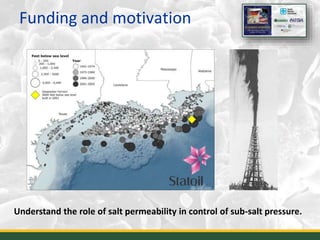
Funding and motivation
2
Understand the role of salt permeability in control of sub-salt pressure.
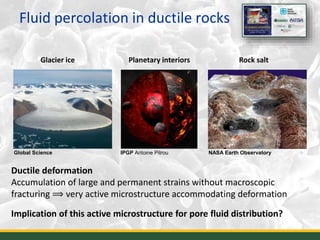
Fluid percolation in ductile rocks
3
Glacier ice Planetary interiors Rock salt
Ductile deformation
Accumulation of large and permanent strains without macroscopic
fracturing ⟹ very active microstructure accommodating deformation
Implication of this active microstructure for pore fluid distribution?
NASA Earth ObservatoryIPGP Antoine PitrouGlobal Science
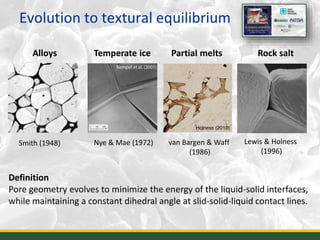
Evolution to textural equilibrium
4
Alloys Temperate ice Rock salt
Definition
Pore geometry evolves to minimize the energy of the liquid-solid interfaces,
while maintaining a constant dihedral angle at slid-solid-liquid contact lines.
Partial melts
Smith (1948) Nye & Mae (1972) van Bargen & Waff
(1986)
Lewis & Holness
(1996)
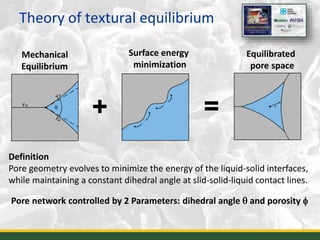
Theory of textural equilibrium
5
Mechanical
Equilibrium
Surface energy
minimization
Equilibrated
pore space
Definition
Pore geometry evolves to minimize the energy of the liquid-solid interfaces,
while maintaining a constant dihedral angle at slid-solid-liquid contact lines.
+ =
Pore network controlled by 2 Parameters: dihedral angle q and porosity f
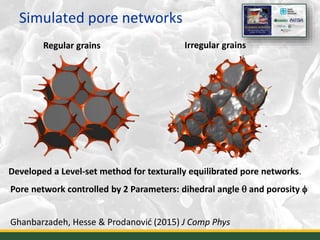
Simulated pore networks
Developed a Level-set method for texturally equilibrated pore networks.
Pore network controlled by 2 Parameters: dihedral angle q and porosity f
Regular grains Irregular grains
Ghanbarzadeh, Hesse & Prodanović (2015) J Comp Phys
Percolation threshold
Ghanbarzadeh, Hesse & Prodanović (2016) in review for Nat Geosci
q=10°q=7𝟎°q=9𝟎°
f = 2% f = 5% f = 10%
0 155 2010 3025
porosity: f [%]
120
80
60
20
40
100
0
dihedralangle:q[°]
Percolation threshold (real grains
)
Percolation threshold
Ghanbarzadeh, Prodanović & Hesse (2014) Phys Rev Lett
Ghanbarzadeh, Hesse & Prodanović (2016) in review for Nat Geosci
0 155 2010 3025
porosity: f [%]
120
80
60
20
40
100
0
dihedralangle:q[°]
Percolation threshold (real grains
)
Ideal grains Real grains
Percol
ation
th
reshold(idealgrains)
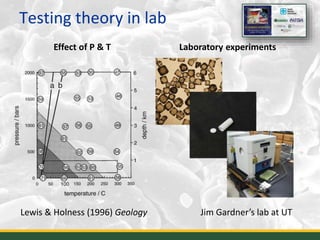
Testing theory in lab
9
Laboratory experimentsEffect of P & T
Lewis & Holness (1996) Geology Jim Gardner’s lab at UT
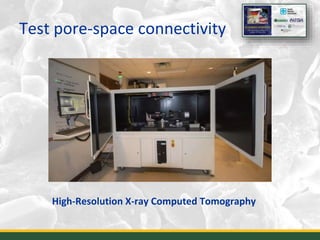
Test pore-space connectivity
High-Resolution X-ray Computed Tomography
10
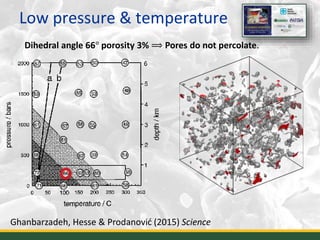
Low pressure & temperature
11
Dihedral angle 66° porosity 3% ⟹ Pores do not percolate.
Ghanbarzadeh, Hesse & Prodanović (2015) Science
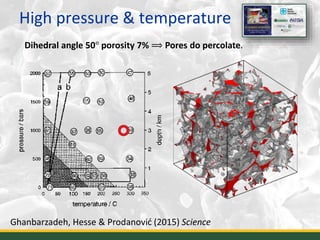
High pressure & temperature
12
Ghanbarzadeh, Hesse & Prodanović (2015) Science
Dihedral angle 50° porosity 7% ⟹ Pores do percolate.
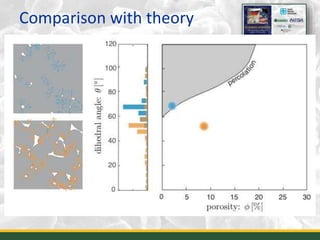
Comparison with theory
13
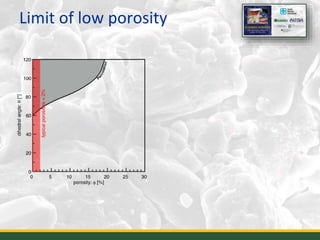
Limit of low porosity
14
Limit of low porosity
15
57
50 150 200
50
100
150
200
P[MPa]
T [°C]
0
1000
55 53 50-2
0
0 200
5355
56
56 55
59
57
61
61
61
62
6266
6063
6671
68
72
Depth[km]
7
4
3
2
1
0
8
6
5
Lewis & Holness (1996)
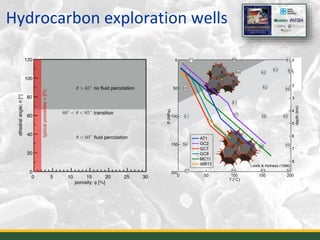
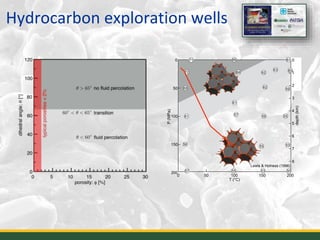
Hydrocarbon exploration wells
16
57
50 150 200
50
100
150
200
P(MPa)
T (°C)
0
1000
55 53 50-2
0
0 200
5355
56
56 55
59
57
61
61
61
62
6266
6063
6671
68
72
depth(km)
7
4
3
2
1
0
8
6
5
Lewis & Holness (1996)
AT1
GC2
GC7
GC8
MC11
WR13
Hydrocarbon exploration wells
17
57
50 150 200
50
100
150
200
P(MPa)
T (°C)
0
1000
55 53 50-2
0
0 200
5355
56
56 55
59
57
61
61
61
62
6266
6063
6671
68
72
depth(km)
7
4
3
2
1
0
8
6
5
Lewis & Holness (1996)
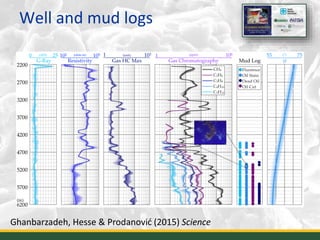
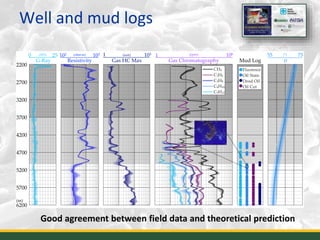
Well and mud logs
0 25(API)
G-Ray
102 105(ohm.m)
Resistivity
1 103(unit)
Gas HC Max
1 106(ppm)
Gas Chromatography
(m)
55 75(°)
θ
Fluoresce
Oil Stain
Dead Oil
Oil Cut
2200
2700
3200
3700
4200
4700
5200
5700
6200
Mud Log
CH4
C2H6
C3H8
C4H10
C5H12
18
Ghanbarzadeh, Hesse & Prodanović (2015) Science
Well and mud logs
0 25(API)
G-Ray
102 105(ohm.m)
Resistivity
1 103(unit)
Gas HC Max
1 106(ppm)
Gas Chromatography
(m)
55 75(°)
θ
Fluoresce
Oil Stain
Dead Oil
Oil Cut
2200
2700
3200
3700
4200
4700
5200
5700
6200
Mud Log
CH4
C2H6
C3H8
C4H10
C5H12
19Good agreement between field data and theoretical prediction
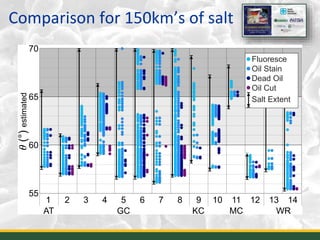
Comparison for 150km’s of salt
1 2 3 4 5 96 87 10 1412 1311
AT MCGC KC WR
(°)estimated
70
65
55
60
Fluoresce
Oil Stain
Dead Oil
Oil Cut
Salt Extent
20
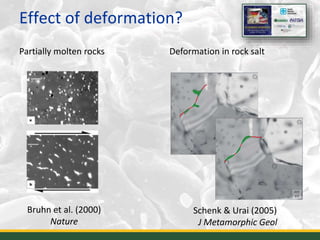
Effect of deformation?
21
Bruhn et al. (2000)
Nature
Partially molten rocks
Schenk & Urai (2005)
J Metamorphic Geol
Deformation in rock salt
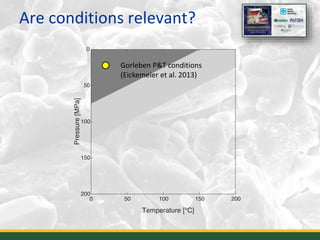
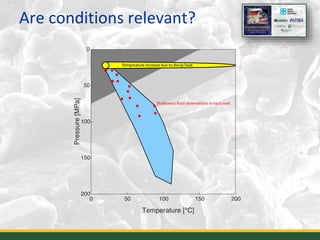
Are conditions relevant?
22
Gorleben P&T conditions
(Eickemeier et al. 2013)
Are conditions relevant?
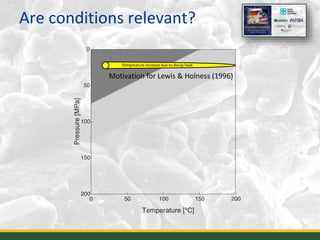
23
Motivation for Lewis & Holness (1996)
Are conditions relevant?
24
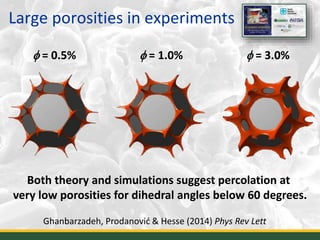
Large porosities in experiments
25
f = 0.5% f = 1.0% f = 3.0%
Both theory and simulations suggest percolation at
very low porosities for dihedral angles below 60 degrees.
Ghanbarzadeh, Prodanović & Hesse (2014) Phys Rev Lett
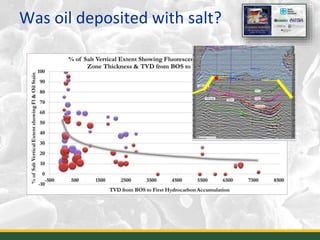
Was oil deposited with salt?
26

22 hesse capillary controls

  • 1.
    Sandia National Laboratoriesis a multi-program laboratory managed and operated by Sandia Corporation, a wholly owned subsidiary of Lockheed Martin Corporation, for the U.S. Department of Energy’s National Nuclear Security Administration under contract DE-AC04-94AL85000.. Capillary controls on brine percolation in rock salt Marc Hesse and Maša Prodanović (Soheil Ghanbarzadeh) University of Texas at Austin Washington, DC September 7-9, 2016
  • 2.
    Funding and motivation 2 Understandthe role of salt permeability in control of sub-salt pressure.
  • 3.
    Fluid percolation inductile rocks 3 Glacier ice Planetary interiors Rock salt Ductile deformation Accumulation of large and permanent strains without macroscopic fracturing ⟹ very active microstructure accommodating deformation Implication of this active microstructure for pore fluid distribution? NASA Earth ObservatoryIPGP Antoine PitrouGlobal Science
  • 4.
    Evolution to texturalequilibrium 4 Alloys Temperate ice Rock salt Definition Pore geometry evolves to minimize the energy of the liquid-solid interfaces, while maintaining a constant dihedral angle at slid-solid-liquid contact lines. Partial melts Smith (1948) Nye & Mae (1972) van Bargen & Waff (1986) Lewis & Holness (1996)
  • 5.
    Theory of texturalequilibrium 5 Mechanical Equilibrium Surface energy minimization Equilibrated pore space Definition Pore geometry evolves to minimize the energy of the liquid-solid interfaces, while maintaining a constant dihedral angle at slid-solid-liquid contact lines. + = Pore network controlled by 2 Parameters: dihedral angle q and porosity f
  • 6.
    Simulated pore networks Developeda Level-set method for texturally equilibrated pore networks. Pore network controlled by 2 Parameters: dihedral angle q and porosity f Regular grains Irregular grains Ghanbarzadeh, Hesse & Prodanović (2015) J Comp Phys
  • 7.
    Percolation threshold Ghanbarzadeh, Hesse& Prodanović (2016) in review for Nat Geosci q=10°q=7𝟎°q=9𝟎° f = 2% f = 5% f = 10% 0 155 2010 3025 porosity: f [%] 120 80 60 20 40 100 0 dihedralangle:q[°] Percolation threshold (real grains )
  • 8.
    Percolation threshold Ghanbarzadeh, Prodanović& Hesse (2014) Phys Rev Lett Ghanbarzadeh, Hesse & Prodanović (2016) in review for Nat Geosci 0 155 2010 3025 porosity: f [%] 120 80 60 20 40 100 0 dihedralangle:q[°] Percolation threshold (real grains ) Ideal grains Real grains Percol ation th reshold(idealgrains)
  • 9.
    Testing theory inlab 9 Laboratory experimentsEffect of P & T Lewis & Holness (1996) Geology Jim Gardner’s lab at UT
  • 10.
  • 11.
    Low pressure &temperature 11 Dihedral angle 66° porosity 3% ⟹ Pores do not percolate. Ghanbarzadeh, Hesse & Prodanović (2015) Science
  • 12.
    High pressure &temperature 12 Ghanbarzadeh, Hesse & Prodanović (2015) Science Dihedral angle 50° porosity 7% ⟹ Pores do percolate.
  • 13.
  • 14.
    Limit of lowporosity 14
  • 15.
    Limit of lowporosity 15 57 50 150 200 50 100 150 200 P[MPa] T [°C] 0 1000 55 53 50-2 0 0 200 5355 56 56 55 59 57 61 61 61 62 6266 6063 6671 68 72 Depth[km] 7 4 3 2 1 0 8 6 5 Lewis & Holness (1996)
  • 16.
    Hydrocarbon exploration wells 16 57 50150 200 50 100 150 200 P(MPa) T (°C) 0 1000 55 53 50-2 0 0 200 5355 56 56 55 59 57 61 61 61 62 6266 6063 6671 68 72 depth(km) 7 4 3 2 1 0 8 6 5 Lewis & Holness (1996) AT1 GC2 GC7 GC8 MC11 WR13
  • 17.
    Hydrocarbon exploration wells 17 57 50150 200 50 100 150 200 P(MPa) T (°C) 0 1000 55 53 50-2 0 0 200 5355 56 56 55 59 57 61 61 61 62 6266 6063 6671 68 72 depth(km) 7 4 3 2 1 0 8 6 5 Lewis & Holness (1996)
  • 18.
    Well and mudlogs 0 25(API) G-Ray 102 105(ohm.m) Resistivity 1 103(unit) Gas HC Max 1 106(ppm) Gas Chromatography (m) 55 75(°) θ Fluoresce Oil Stain Dead Oil Oil Cut 2200 2700 3200 3700 4200 4700 5200 5700 6200 Mud Log CH4 C2H6 C3H8 C4H10 C5H12 18 Ghanbarzadeh, Hesse & Prodanović (2015) Science
  • 19.
    Well and mudlogs 0 25(API) G-Ray 102 105(ohm.m) Resistivity 1 103(unit) Gas HC Max 1 106(ppm) Gas Chromatography (m) 55 75(°) θ Fluoresce Oil Stain Dead Oil Oil Cut 2200 2700 3200 3700 4200 4700 5200 5700 6200 Mud Log CH4 C2H6 C3H8 C4H10 C5H12 19Good agreement between field data and theoretical prediction
  • 20.
    Comparison for 150km’sof salt 1 2 3 4 5 96 87 10 1412 1311 AT MCGC KC WR (°)estimated 70 65 55 60 Fluoresce Oil Stain Dead Oil Oil Cut Salt Extent 20
  • 21.
    Effect of deformation? 21 Bruhnet al. (2000) Nature Partially molten rocks Schenk & Urai (2005) J Metamorphic Geol Deformation in rock salt
  • 22.
    Are conditions relevant? 22 GorlebenP&T conditions (Eickemeier et al. 2013)
  • 23.
    Are conditions relevant? 23 Motivationfor Lewis & Holness (1996)
  • 24.
  • 25.
    Large porosities inexperiments 25 f = 0.5% f = 1.0% f = 3.0% Both theory and simulations suggest percolation at very low porosities for dihedral angles below 60 degrees. Ghanbarzadeh, Prodanović & Hesse (2014) Phys Rev Lett
  • 26.
    Was oil depositedwith salt? 26