German Waste Management Strategy, September 5th, 2017
German Waste Management Strategy
US / German Workshop on
Salt Repository Research, Design, an Operation
Dr. Thilo v. Berlepsch
DBE TECHNOLOGY GmbH
September 5th, 2017
1
German Waste Management Strategy, September 5th, 2017
Content
2
 Introduction
 Overview on Radioactive Waste Streams in Germany
 Political Background
 Commissions and Acts
 Site Selection for a HLW repository
 Involved Organisations
German Waste Management Strategy, September 5th, 2017
Introduction
German Waste Management Strategy, September 5th, 2017
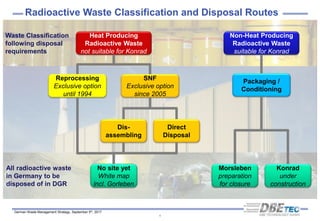
Waste Classification
following disposal
requirements
All radioactive waste
in Germany to be
disposed of in DGR
Radioactive Waste Classification and Disposal Routes
Heat Producing
Radioactive Waste
not suitable for Konrad
Non-Heat Producing
Radioactive Waste
suitable for Konrad
Reprocessing
Exclusive option
until 1994
SNF
Exclusive option
since 2005
Dis-
assembling
Direct
Disposal
Packaging /
Conditioning
No site yet
White map
incl. Gorleben
Morsleben
preparation
for closure
Konrad
under
construction
4
German Waste Management Strategy, September 5th, 2017
History of Radwaste Programme
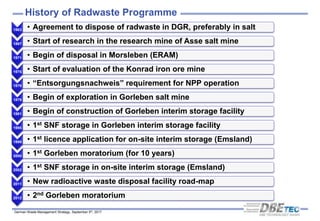
1963 • Agreement to dispose of radwaste in DGR, preferably in salt
1967 • Start of research in the research mine of Asse salt mine
1971 • Begin of disposal in Morsleben (ERAM)
1975 • Start of evaluation of the Konrad iron ore mine
1979 • “Entsorgungsnachweis” requirement for NPP operation
1979 • Begin of exploration in Gorleben salt mine
1981 • Begin of construction of Gorleben interim storage facility
1995 • 1st SNF storage in Gorleben interim storage facility
1999 • 1st licence application for on-site interim storage (Emsland)
2000 • 1st Gorleben moratorium (for 10 years)
2002 • 1st SNF storage in on-site interim storage (Emsland)
2011 • New radioactive waste disposal facility road-map
2012 • 2nd Gorleben moratorium
German Waste Management Strategy, September 5th, 2017
Overview on German Disposal Projects
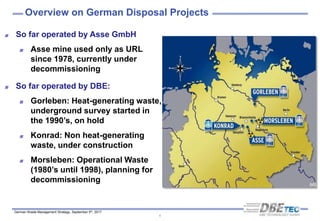
So far operated by Asse GmbH
Asse mine used only as URL
since 1978, currently under
decommissioning
So far operated by DBE:
Gorleben: Heat-generating waste,
underground survey started in
the 1990’s, on hold
Konrad: Non heat-generating
waste, under construction
Morsleben: Operational Waste
(1980’s until 1998), planning for
decommissioning BfS
6
German Waste Management Strategy, September 5th, 2017
Political
Background
§
German Waste Management Strategy, September 5th, 2017
8
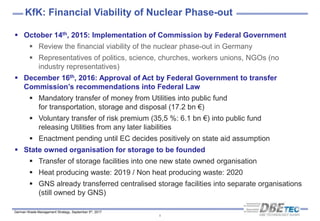
 October 14th, 2015: Implementation of Commission by Federal Government
 Review the financial viability of the nuclear phase-out in Germany
 Representatives of politics, science, churches, workers unions, NGOs (no
industry representatives)
 December 16th, 2016: Approval of Act by Federal Government to transfer
Commission’s recommendations into Federal Law
 Mandatory transfer of money from Utilities into public fund
for transportation, storage and disposal (17.2 bn €)
 Voluntary transfer of risk premium (35,5 %: 6.1 bn €) into public fund
releasing Utilities from any later liabilities
 Enactment pending until EC decides positively on state aid assumption
 State owned organisation for storage to be founded
 Transfer of storage facilities into one new state owned organisation
 Heat producing waste: 2019 / Non heat producing waste: 2020
 GNS already transferred centralised storage facilities into separate organisations
(still owned by GNS)
KfK: Financial Viability of Nuclear Phase-out
German Waste Management Strategy, September 5th, 2017
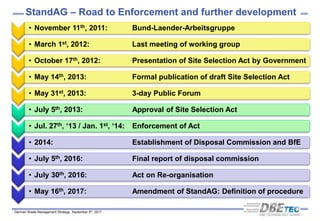
StandAG – Road to Enforcement and further development
• November 11th, 2011: Bund-Laender-Arbeitsgruppe
• March 1st, 2012: Last meeting of working group
• October 17th, 2012: Presentation of Site Selection Act by Government
• May 14th, 2013: Formal publication of draft Site Selection Act
• May 31st, 2013: 3-day Public Forum
• July 5th, 2013: Approval of Site Selection Act
• Jul. 27th, ‘13 / Jan. 1st, ‘14: Enforcement of Act
• 2014: Establishment of Disposal Commission and BfE
• July 5th, 2016: Final report of disposal commission
• July 30th, 2016: Act on Re-organisation
• May 16th, 2017: Amendment of StandAG: Definition of procedure
German Waste Management Strategy, September 5th, 2017
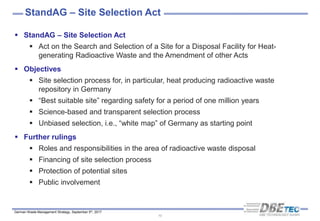
StandAG – Site Selection Act
10
 StandAG – Site Selection Act
 Act on the Search and Selection of a Site for a Disposal Facility for Heat-
generating Radioactive Waste and the Amendment of other Acts
 Objectives
 Site selection process for, in particular, heat producing radioactive waste
repository in Germany
 “Best suitable site” regarding safety for a period of one million years
 Science-based and transparent selection process
 Unbiased selection, i.e., “white map” of Germany as starting point
 Further rulings
 Roles and responsibilities in the area of radioactive waste disposal
 Financing of site selection process
 Protection of potential sites
 Public involvement
German Waste Management Strategy, September 5th, 2017
Site Selection

German Waste Management Strategy, September 5th, 2017
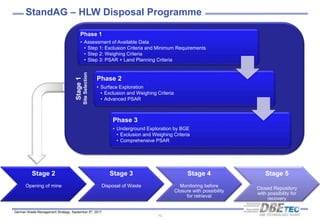
Stage1
SiteSelection
StandAG – HLW Disposal Programme
Phase 1
• Assessment of Available Data
• Step 1: Exclusion Criteria and Minimum Requirements
• Step 2: Weighing Criteria
• Step 3: PSAR + Land Planning Criteria
Phase 2
• Surface Exploration
• Exclusion and Weighing Criteria
• Advanced PSAR
Phase 3
• Underground Exploration by BGE
• Exclusion and Weighing Criteria
• Comprehensive PSAR
Stage 2
Opening of mine
Stage 3
Disposal of Waste
Stage 4
Monitoring before
Closure with possibility
for retrieval
Stage 5
Closed Repository
with possibility for
recovery
12
German Waste Management Strategy, September 5th, 2017
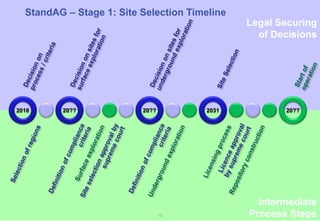
Intermediate
Process Steps
Legal Securing
of Decisions
2016 20?? 20?? 2031 20??
13
StandAG – Stage 1: Site Selection Timeline
German Waste Management Strategy, September 5th, 2017
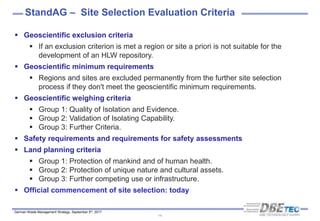
StandAG – Site Selection Evaluation Criteria
14
 Geoscientific exclusion criteria
 If an exclusion criterion is met a region or site a priori is not suitable for the
development of an HLW repository.
 Geoscientific minimum requirements
 Regions and sites are excluded permanently from the further site selection
process if they don't meet the geoscientific minimum requirements.
 Geoscientific weighing criteria
 Group 1: Quality of Isolation and Evidence.
 Group 2: Validation of Isolating Capability.
 Group 3: Further Criteria.
 Safety requirements and requirements for safety assessments
 Land planning criteria
 Group 1: Protection of mankind and of human health.
 Group 2: Protection of unique nature and cultural assets.
 Group 3: Further competing use or infrastructure.
 Official commencement of site selection: today
German Waste Management Strategy, September 5th, 2017
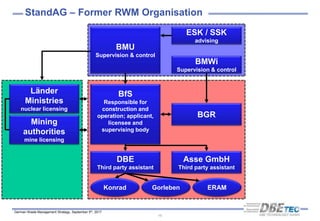
StandAG – Former RWM Organisation
BMU
Supervision & control
ESK / SSK
advising
BMWi
Supervision & control
BfS
Responsible for
construction and
operation; applicant,
licensee and
supervising body
DBE
Third party assistant
BGR
Länder
Ministries
nuclear licensing
Mining
authorities
mine licensing
Konrad Gorleben ERAM
Asse GmbH
Third party assistant
15
German Waste Management Strategy, September 5th, 2017
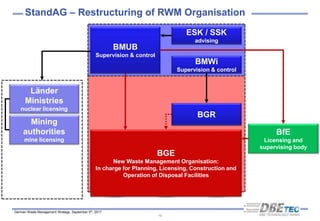
StandAG – Restructuring of RWM Organisation
BMUB
Supervision & control
ESK / SSK
advising
BMWi
Supervision & control
DBE
Third party assistant
BGR
Länder
Ministries
nuclear licensing
Mining
authorities
mine licensing
Konrad Gorleben ERAM
Asse GmbH
Third party assistant
BfE
Licensing and
supervising body
for LILW
BGE
New Waste Management Organisation:
In charge for Planning, Licensing, Construction and
Operation of Disposal Facilities
16
German Waste Management Strategy, September 5th, 2017
Regional
Conferences
Regional
Conferences
Regional
Conferences
Regional
Conferences
Regional
Conferences
StandAG – Involved Bodies in Site Selection
Federal Assembly
Federal Diet
Federal
Government
BMUB
BfE
Federal Office for the Safety
of Nuclear Waste Management
Representative
for Participation
Scientific
Advisory Board
BGE
(Federal WMO)
General Public
Local Affected
Public
Regional
Conferences
Symposia
‘Subregions‘ and
‘Council of Regions‘
National
Accompanying
Body
Societal Support
for Site Selection
Technical Support
for Site Selection
17
[Disposal Commission]
German Waste Management Strategy, September 5th, 2017
StandAG – Implementation of new organisations: BfE
18
BfE: Bundesamt für Entsorgungssicherheit
Federal Office for the Safety of Nuclear Waste Management
 Foundation date: September 1st, 2014
 Tasks
 Regulation of site selection and the co-ordination of public participation,
 Nuclear licences for interim storage facilities and transports of nuclear fuels,
 Procedures under mining, water and nuclear law relating to disposal,
 Issues related to the safety of nuclear waste management, and
 Task-related research in these areas.
 Staffing:
 Transfer of relevant staff from BfS (mainly the former „EÜ“ –
Endlagerüberwachung: disposal supervision) into BfE in April 2016
German Waste Management Strategy, September 5th, 2017
StandAG – Implementation of new organisations: BGE
19
BGE: Bundesgesellschaft für Endlagerung
Federal Organisation for Disposal
 July, 2016: Foundation date
 Tasks
 Planning, construction and operation of radioactive waste repositories,
 Implementation of the site selection procedure for a HLW repository:
 development and implementation of exploration programmes,
 development of safety assessments,
 proposals for regions and sites
 April 25th, 2017: Transfer of operational tasks for Asse, Gorleben, Konrad and
Morsleben to BGE
 Staffing
 April 25th, 2017: Transfer of relevant staff from BfS
 June: Transfer of DBE’s shares to the State
 End 2017: Merger of Asse GmbH and DBE to BGE
German Waste Management Strategy, September 5th, 2017
20
Thank you!

04 German Waste Management Strategy

  • 1.
    German Waste ManagementStrategy, September 5th, 2017 German Waste Management Strategy US / German Workshop on Salt Repository Research, Design, an Operation Dr. Thilo v. Berlepsch DBE TECHNOLOGY GmbH September 5th, 2017 1
  • 2.
    German Waste ManagementStrategy, September 5th, 2017 Content 2  Introduction  Overview on Radioactive Waste Streams in Germany  Political Background  Commissions and Acts  Site Selection for a HLW repository  Involved Organisations
  • 3.
    German Waste ManagementStrategy, September 5th, 2017 Introduction
  • 4.
    German Waste ManagementStrategy, September 5th, 2017 Waste Classification following disposal requirements All radioactive waste in Germany to be disposed of in DGR Radioactive Waste Classification and Disposal Routes Heat Producing Radioactive Waste not suitable for Konrad Non-Heat Producing Radioactive Waste suitable for Konrad Reprocessing Exclusive option until 1994 SNF Exclusive option since 2005 Dis- assembling Direct Disposal Packaging / Conditioning No site yet White map incl. Gorleben Morsleben preparation for closure Konrad under construction 4
  • 5.
    German Waste ManagementStrategy, September 5th, 2017 History of Radwaste Programme 1963 • Agreement to dispose of radwaste in DGR, preferably in salt 1967 • Start of research in the research mine of Asse salt mine 1971 • Begin of disposal in Morsleben (ERAM) 1975 • Start of evaluation of the Konrad iron ore mine 1979 • “Entsorgungsnachweis” requirement for NPP operation 1979 • Begin of exploration in Gorleben salt mine 1981 • Begin of construction of Gorleben interim storage facility 1995 • 1st SNF storage in Gorleben interim storage facility 1999 • 1st licence application for on-site interim storage (Emsland) 2000 • 1st Gorleben moratorium (for 10 years) 2002 • 1st SNF storage in on-site interim storage (Emsland) 2011 • New radioactive waste disposal facility road-map 2012 • 2nd Gorleben moratorium
  • 6.
    German Waste ManagementStrategy, September 5th, 2017 Overview on German Disposal Projects So far operated by Asse GmbH Asse mine used only as URL since 1978, currently under decommissioning So far operated by DBE: Gorleben: Heat-generating waste, underground survey started in the 1990’s, on hold Konrad: Non heat-generating waste, under construction Morsleben: Operational Waste (1980’s until 1998), planning for decommissioning BfS 6
  • 7.
    German Waste ManagementStrategy, September 5th, 2017 Political Background §
  • 8.
    German Waste ManagementStrategy, September 5th, 2017 8  October 14th, 2015: Implementation of Commission by Federal Government  Review the financial viability of the nuclear phase-out in Germany  Representatives of politics, science, churches, workers unions, NGOs (no industry representatives)  December 16th, 2016: Approval of Act by Federal Government to transfer Commission’s recommendations into Federal Law  Mandatory transfer of money from Utilities into public fund for transportation, storage and disposal (17.2 bn €)  Voluntary transfer of risk premium (35,5 %: 6.1 bn €) into public fund releasing Utilities from any later liabilities  Enactment pending until EC decides positively on state aid assumption  State owned organisation for storage to be founded  Transfer of storage facilities into one new state owned organisation  Heat producing waste: 2019 / Non heat producing waste: 2020  GNS already transferred centralised storage facilities into separate organisations (still owned by GNS) KfK: Financial Viability of Nuclear Phase-out
  • 9.
    German Waste ManagementStrategy, September 5th, 2017 StandAG – Road to Enforcement and further development • November 11th, 2011: Bund-Laender-Arbeitsgruppe • March 1st, 2012: Last meeting of working group • October 17th, 2012: Presentation of Site Selection Act by Government • May 14th, 2013: Formal publication of draft Site Selection Act • May 31st, 2013: 3-day Public Forum • July 5th, 2013: Approval of Site Selection Act • Jul. 27th, ‘13 / Jan. 1st, ‘14: Enforcement of Act • 2014: Establishment of Disposal Commission and BfE • July 5th, 2016: Final report of disposal commission • July 30th, 2016: Act on Re-organisation • May 16th, 2017: Amendment of StandAG: Definition of procedure
  • 10.
    German Waste ManagementStrategy, September 5th, 2017 StandAG – Site Selection Act 10  StandAG – Site Selection Act  Act on the Search and Selection of a Site for a Disposal Facility for Heat- generating Radioactive Waste and the Amendment of other Acts  Objectives  Site selection process for, in particular, heat producing radioactive waste repository in Germany  “Best suitable site” regarding safety for a period of one million years  Science-based and transparent selection process  Unbiased selection, i.e., “white map” of Germany as starting point  Further rulings  Roles and responsibilities in the area of radioactive waste disposal  Financing of site selection process  Protection of potential sites  Public involvement
  • 11.
    German Waste ManagementStrategy, September 5th, 2017 Site Selection 
  • 12.
    German Waste ManagementStrategy, September 5th, 2017 Stage1 SiteSelection StandAG – HLW Disposal Programme Phase 1 • Assessment of Available Data • Step 1: Exclusion Criteria and Minimum Requirements • Step 2: Weighing Criteria • Step 3: PSAR + Land Planning Criteria Phase 2 • Surface Exploration • Exclusion and Weighing Criteria • Advanced PSAR Phase 3 • Underground Exploration by BGE • Exclusion and Weighing Criteria • Comprehensive PSAR Stage 2 Opening of mine Stage 3 Disposal of Waste Stage 4 Monitoring before Closure with possibility for retrieval Stage 5 Closed Repository with possibility for recovery 12
  • 13.
    German Waste ManagementStrategy, September 5th, 2017 Intermediate Process Steps Legal Securing of Decisions 2016 20?? 20?? 2031 20?? 13 StandAG – Stage 1: Site Selection Timeline
  • 14.
    German Waste ManagementStrategy, September 5th, 2017 StandAG – Site Selection Evaluation Criteria 14  Geoscientific exclusion criteria  If an exclusion criterion is met a region or site a priori is not suitable for the development of an HLW repository.  Geoscientific minimum requirements  Regions and sites are excluded permanently from the further site selection process if they don't meet the geoscientific minimum requirements.  Geoscientific weighing criteria  Group 1: Quality of Isolation and Evidence.  Group 2: Validation of Isolating Capability.  Group 3: Further Criteria.  Safety requirements and requirements for safety assessments  Land planning criteria  Group 1: Protection of mankind and of human health.  Group 2: Protection of unique nature and cultural assets.  Group 3: Further competing use or infrastructure.  Official commencement of site selection: today
  • 15.
    German Waste ManagementStrategy, September 5th, 2017 StandAG – Former RWM Organisation BMU Supervision & control ESK / SSK advising BMWi Supervision & control BfS Responsible for construction and operation; applicant, licensee and supervising body DBE Third party assistant BGR Länder Ministries nuclear licensing Mining authorities mine licensing Konrad Gorleben ERAM Asse GmbH Third party assistant 15
  • 16.
    German Waste ManagementStrategy, September 5th, 2017 StandAG – Restructuring of RWM Organisation BMUB Supervision & control ESK / SSK advising BMWi Supervision & control DBE Third party assistant BGR Länder Ministries nuclear licensing Mining authorities mine licensing Konrad Gorleben ERAM Asse GmbH Third party assistant BfE Licensing and supervising body for LILW BGE New Waste Management Organisation: In charge for Planning, Licensing, Construction and Operation of Disposal Facilities 16
  • 17.
    German Waste ManagementStrategy, September 5th, 2017 Regional Conferences Regional Conferences Regional Conferences Regional Conferences Regional Conferences StandAG – Involved Bodies in Site Selection Federal Assembly Federal Diet Federal Government BMUB BfE Federal Office for the Safety of Nuclear Waste Management Representative for Participation Scientific Advisory Board BGE (Federal WMO) General Public Local Affected Public Regional Conferences Symposia ‘Subregions‘ and ‘Council of Regions‘ National Accompanying Body Societal Support for Site Selection Technical Support for Site Selection 17 [Disposal Commission]
  • 18.
    German Waste ManagementStrategy, September 5th, 2017 StandAG – Implementation of new organisations: BfE 18 BfE: Bundesamt für Entsorgungssicherheit Federal Office for the Safety of Nuclear Waste Management  Foundation date: September 1st, 2014  Tasks  Regulation of site selection and the co-ordination of public participation,  Nuclear licences for interim storage facilities and transports of nuclear fuels,  Procedures under mining, water and nuclear law relating to disposal,  Issues related to the safety of nuclear waste management, and  Task-related research in these areas.  Staffing:  Transfer of relevant staff from BfS (mainly the former „EÜ“ – Endlagerüberwachung: disposal supervision) into BfE in April 2016
  • 19.
    German Waste ManagementStrategy, September 5th, 2017 StandAG – Implementation of new organisations: BGE 19 BGE: Bundesgesellschaft für Endlagerung Federal Organisation for Disposal  July, 2016: Foundation date  Tasks  Planning, construction and operation of radioactive waste repositories,  Implementation of the site selection procedure for a HLW repository:  development and implementation of exploration programmes,  development of safety assessments,  proposals for regions and sites  April 25th, 2017: Transfer of operational tasks for Asse, Gorleben, Konrad and Morsleben to BGE  Staffing  April 25th, 2017: Transfer of relevant staff from BfS  June: Transfer of DBE’s shares to the State  End 2017: Merger of Asse GmbH and DBE to BGE
  • 20.
    German Waste ManagementStrategy, September 5th, 2017 20 Thank you!