7th US/German Workshop on Salt Repository
Research, Design, and Operation
WIPP Recovery and Lessons Learned
Tammy Reynolds – Deputy Project Manager
Nuclear Waste Partnership LLC
Washington, DC
September 7-9, 2016
WIPP Recovery and Lessons Learned
Background
 The Waste Isolation Pilot Plant (WIPP), located in New Mexico began construction in the
early 1980’s
 Receipt and disposal of Contact Handled (CH) waste began in March 1999
 Receipt and disposal of Remote Handled (RH) waste began in January 2007
 Between March 1999 and February 2014, WIPP safely and compliantly:
Received 11, 894 shipments and disposed the waste in the u/g,
90,627 cubic meters of CH TRU waste,
357 cubic meters of RH TRU waste
 In February 2014, WIPP operations were paused when a fire and a radiological event
occurred in the underground
 Recovery from the events is in progress and planned to be complete by the end of calendar
year 2016. Commencement of waste emplacement activities will begin as soon as it is safe
to do so.
2
WIPP Recovery and Lessons Learned
Fire Event
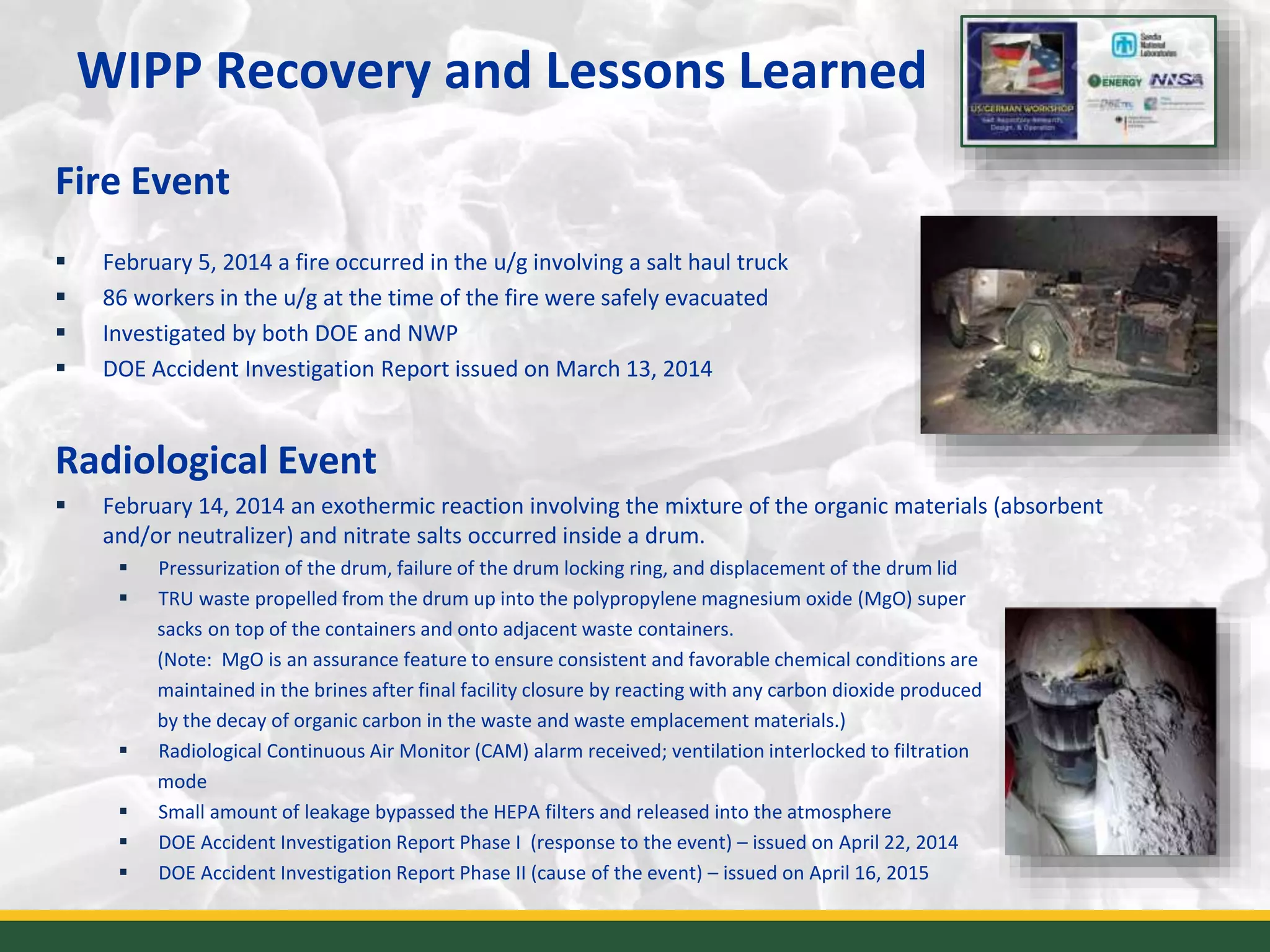
 February 5, 2014 a fire occurred in the u/g involving a salt haul truck
 86 workers in the u/g at the time of the fire were safely evacuated
 Investigated by both DOE and NWP
 DOE Accident Investigation Report issued on March 13, 2014
Radiological Event
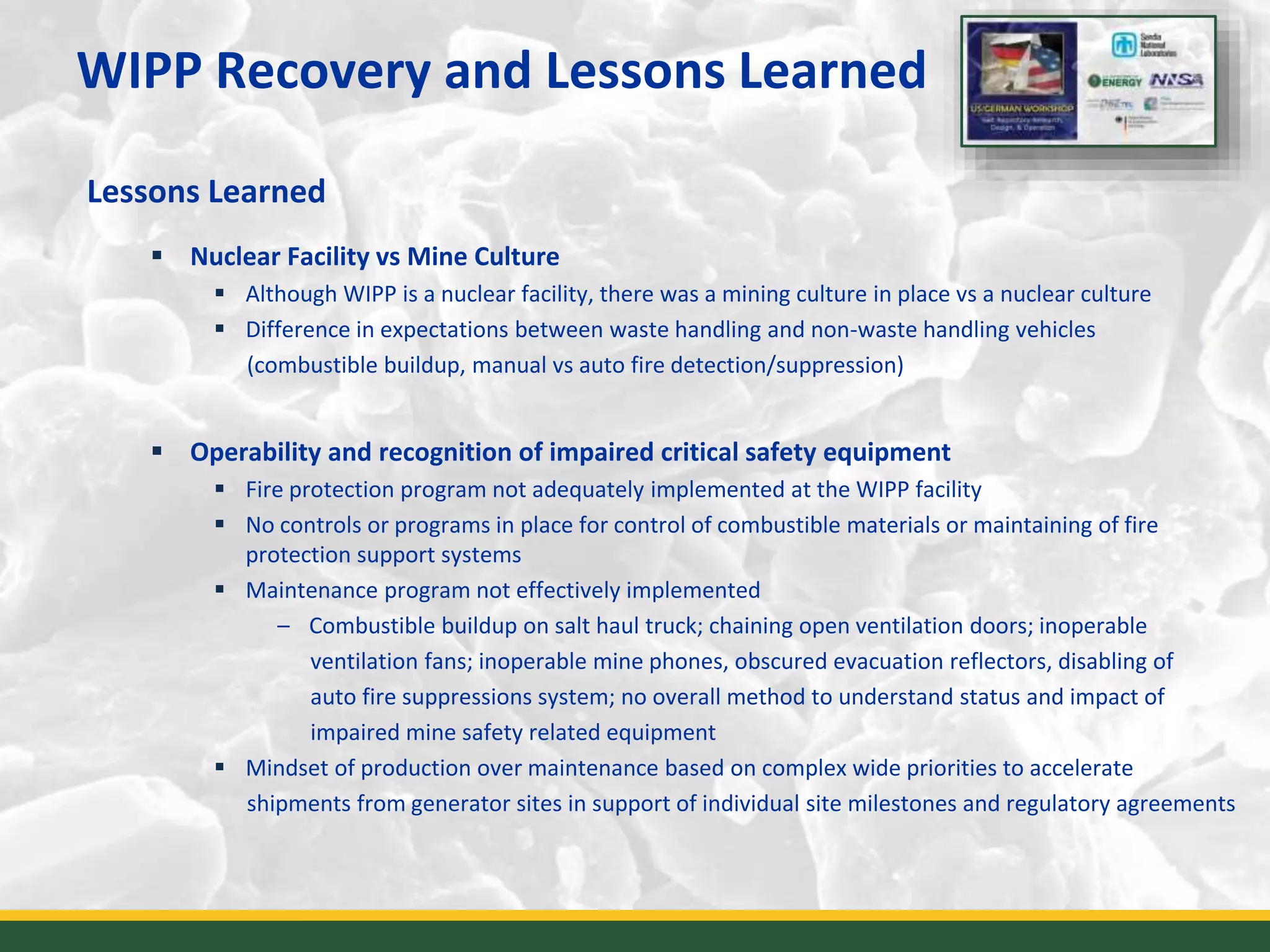
 February 14, 2014 an exothermic reaction involving the mixture of the organic materials (absorbent
and/or neutralizer) and nitrate salts occurred inside a drum.
 Pressurization of the drum, failure of the drum locking ring, and displacement of the drum lid
 TRU waste propelled from the drum up into the polypropylene magnesium oxide (MgO) super
sacks on top of the containers and onto adjacent waste containers.
(Note: MgO is an assurance feature to ensure consistent and favorable chemical conditions are
maintained in the brines after final facility closure by reacting with any carbon dioxide produced
by the decay of organic carbon in the waste and waste emplacement materials.)
 Radiological Continuous Air Monitor (CAM) alarm received; ventilation interlocked to filtration
mode
 Small amount of leakage bypassed the HEPA filters and released into the atmosphere
 DOE Accident Investigation Report Phase I (response to the event) – issued on April 22, 2014
 DOE Accident Investigation Report Phase II (cause of the event) – issued on April 16, 2015 3
WIPP Recovery and Lessons Learned
Lessons Learned
 Nuclear Facility vs Mine Culture
 Although WIPP is a nuclear facility, there was a mining culture in place vs a nuclear culture
 Difference in expectations between waste handling and non-waste handling vehicles
(combustible buildup, manual vs auto fire detection/suppression)
 Operability and recognition of impaired critical safety equipment
 Fire protection program not adequately implemented at the WIPP facility
 No controls or programs in place for control of combustible materials or maintaining of fire
protection support systems
 Maintenance program not effectively implemented
– Combustible buildup on salt haul truck; chaining open ventilation doors; inoperable
ventilation fans; inoperable mine phones, obscured evacuation reflectors, disabling of
auto fire suppressions system; no overall method to understand status and impact of
impaired mine safety related equipment
 Mindset of production over maintenance based on complex wide priorities to accelerate
shipments from generator sites in support of individual site milestones and regulatory agreements
4
WIPP Recovery and Lessons Learned
Lessons Learned
 Training and drill programs
 Emergency management/preparedness and response programs not effectively implemented
 Limited drills, inadequate donning of self-rescuers or SCSRs during training or drills,
or hands on training with portable fire extinguishers
 Inconsistencies between u/g fire response procedures and drills/training
(shifting ventilation during evacuation)
 Expectations and capabilities of the Facility Shift Manager to manage all aspects of an
emergency or abnormal event
 CMR response (evaluation and protective actions) was less than adequate
 Identified problems with communications and alarms during the fire/evacuation
delaying egress
 National TRU Program not robust enough to identify incompatible waste
 Communications to the community and regulatory stakeholders was not timely
 Ensures trust is maintained rather than rebuilding that trust
5
WIPP Recovery and Lessons Learned
6
WIPP Recovery Managed as a Project
• Baseline established
• Scope, schedule, cost and risks reflected in the recovery baseline
• Primavera detailed schedule developed
• Progress tracked in Plan of the Day and Plan of the Week meetings
• Critical Path calculated on weekly basis
WIPP Recovery and Lessons Learned
7
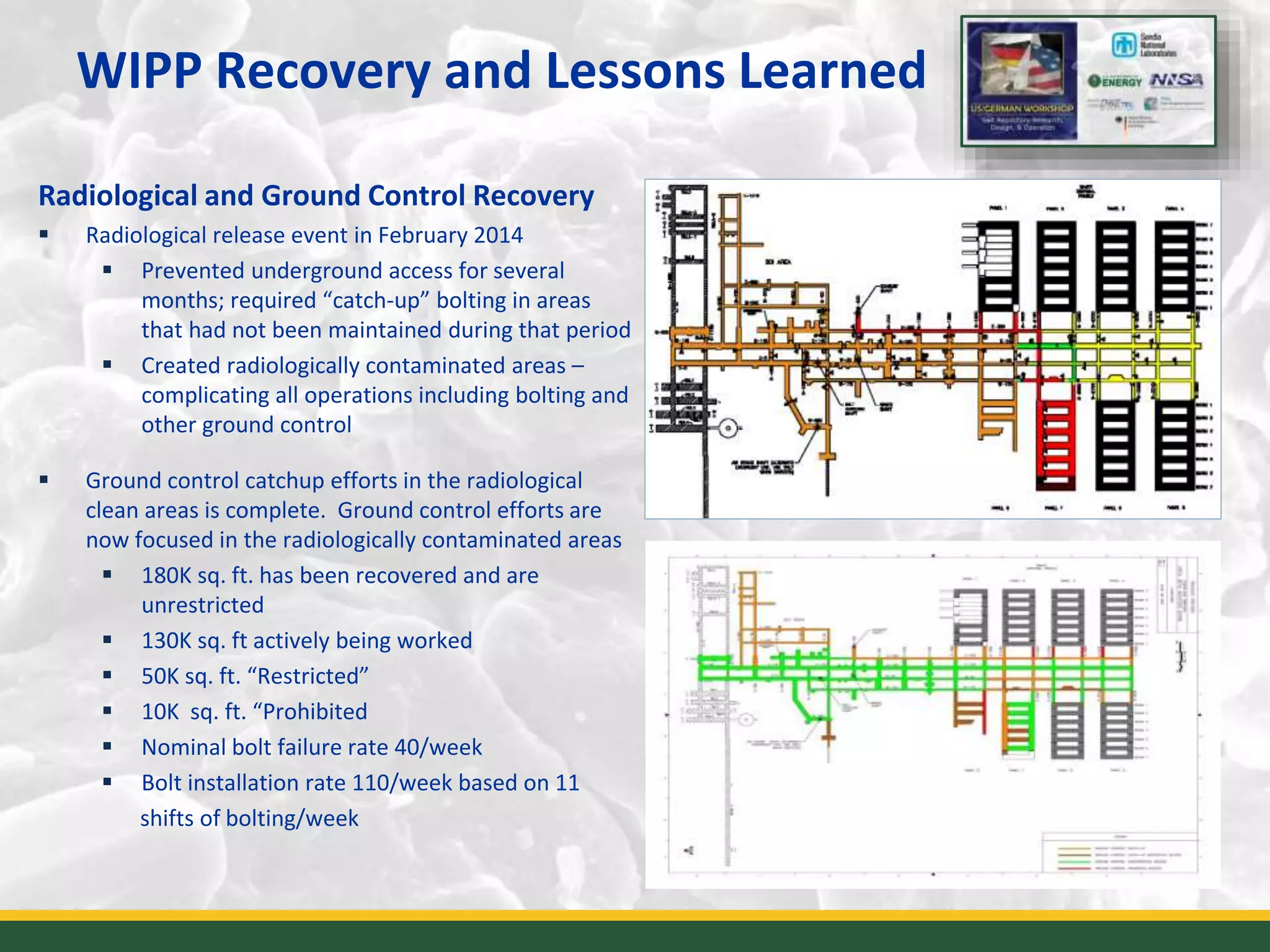
Radiological and Ground Control Recovery
 Radiological release event in February 2014
 Prevented underground access for several
months; required “catch-up” bolting in areas
that had not been maintained during that period
 Created radiologically contaminated areas –
complicating all operations including bolting and
other ground control
 Ground control catchup efforts in the radiological
clean areas is complete. Ground control efforts are
now focused in the radiologically contaminated areas
 180K sq. ft. has been recovered and are
unrestricted
 130K sq. ft actively being worked
 50K sq. ft. “Restricted”
 10K sq. ft. “Prohibited
 Nominal bolt failure rate 40/week
 Bolt installation rate 110/week based on 11
shifts of bolting/week
WIPP Recovery and Lessons Learned
8
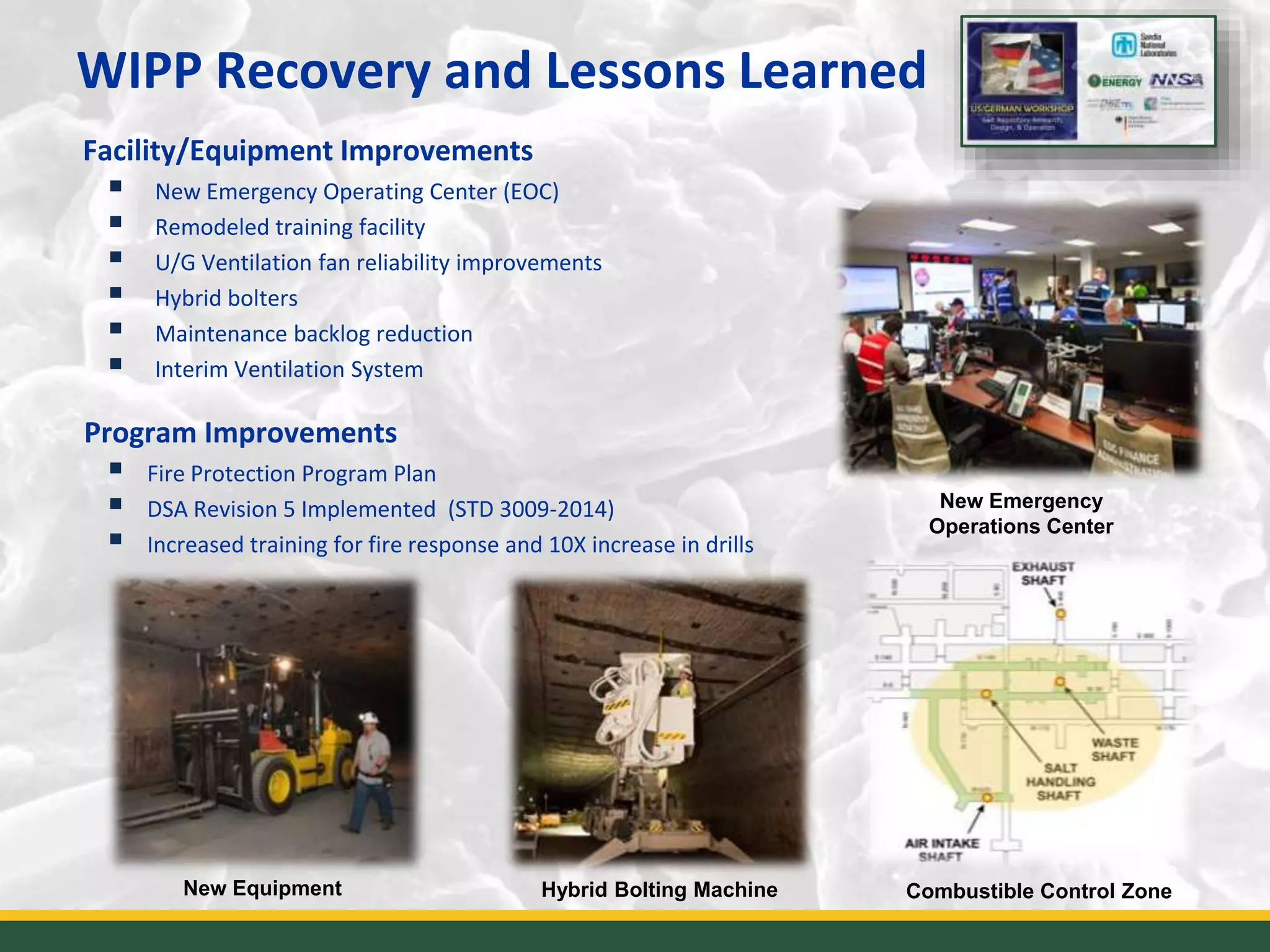
Facility/Equipment Improvements
 New Emergency Operating Center (EOC)
 Remodeled training facility
 U/G Ventilation fan reliability improvements
 Hybrid bolters
 Maintenance backlog reduction
 Interim Ventilation System
Program Improvements
 Fire Protection Program Plan
 DSA Revision 5 Implemented (STD 3009-2014)
 Increased training for fire response and 10X increase in drills
New Emergency
Operations Center
Hybrid Bolting Machine Combustible Control ZoneNew Equipment
WIPP Recovery and Lessons Learned
9
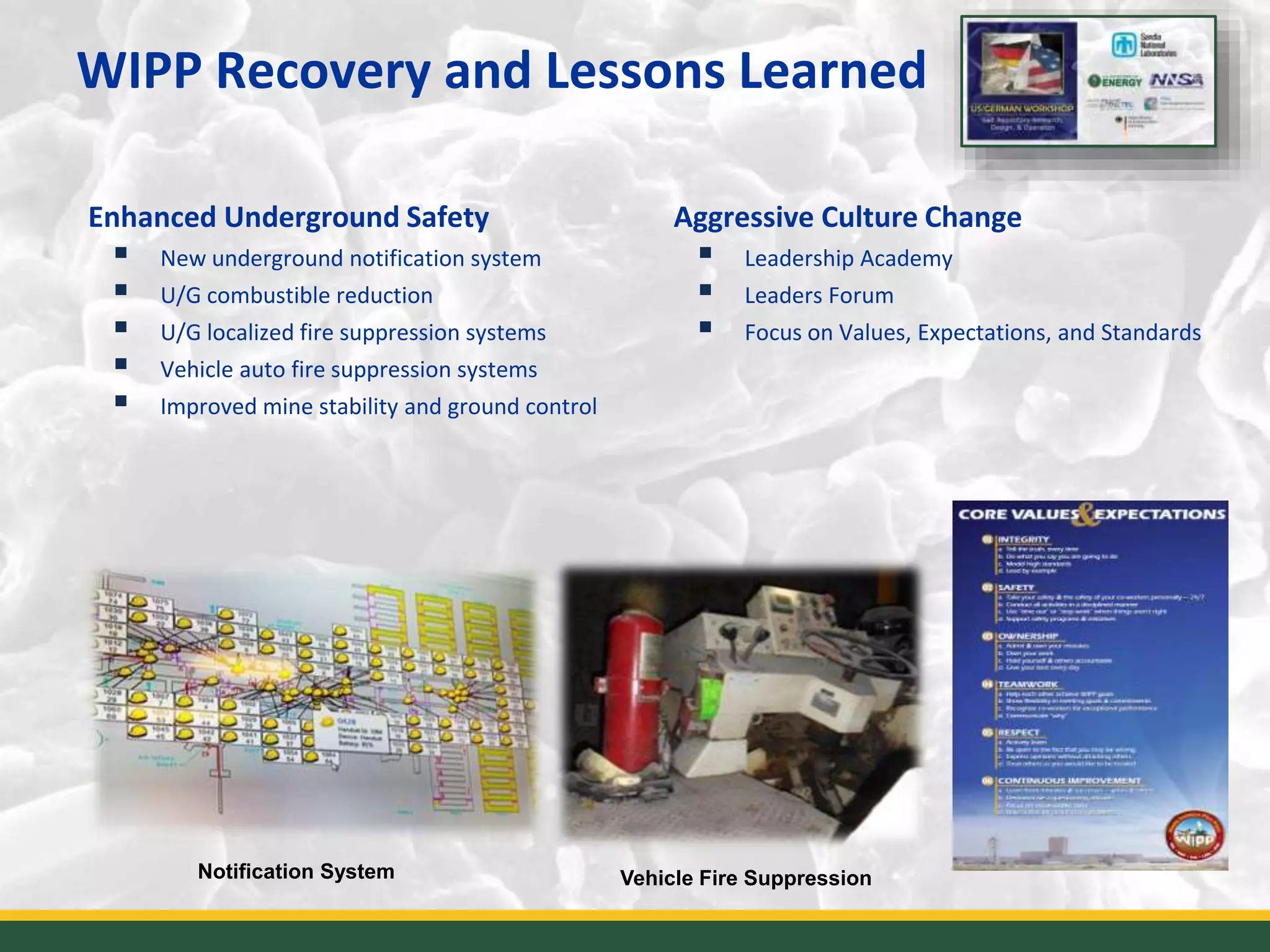
Enhanced Underground Safety
 New underground notification system
 U/G combustible reduction
 U/G localized fire suppression systems
 Vehicle auto fire suppression systems
 Improved mine stability and ground control
Aggressive Culture Change
 Leadership Academy
 Leaders Forum
 Focus on Values, Expectations, and Standards
Notification System Vehicle Fire Suppression
WIPP Recovery and Lessons Learned
10
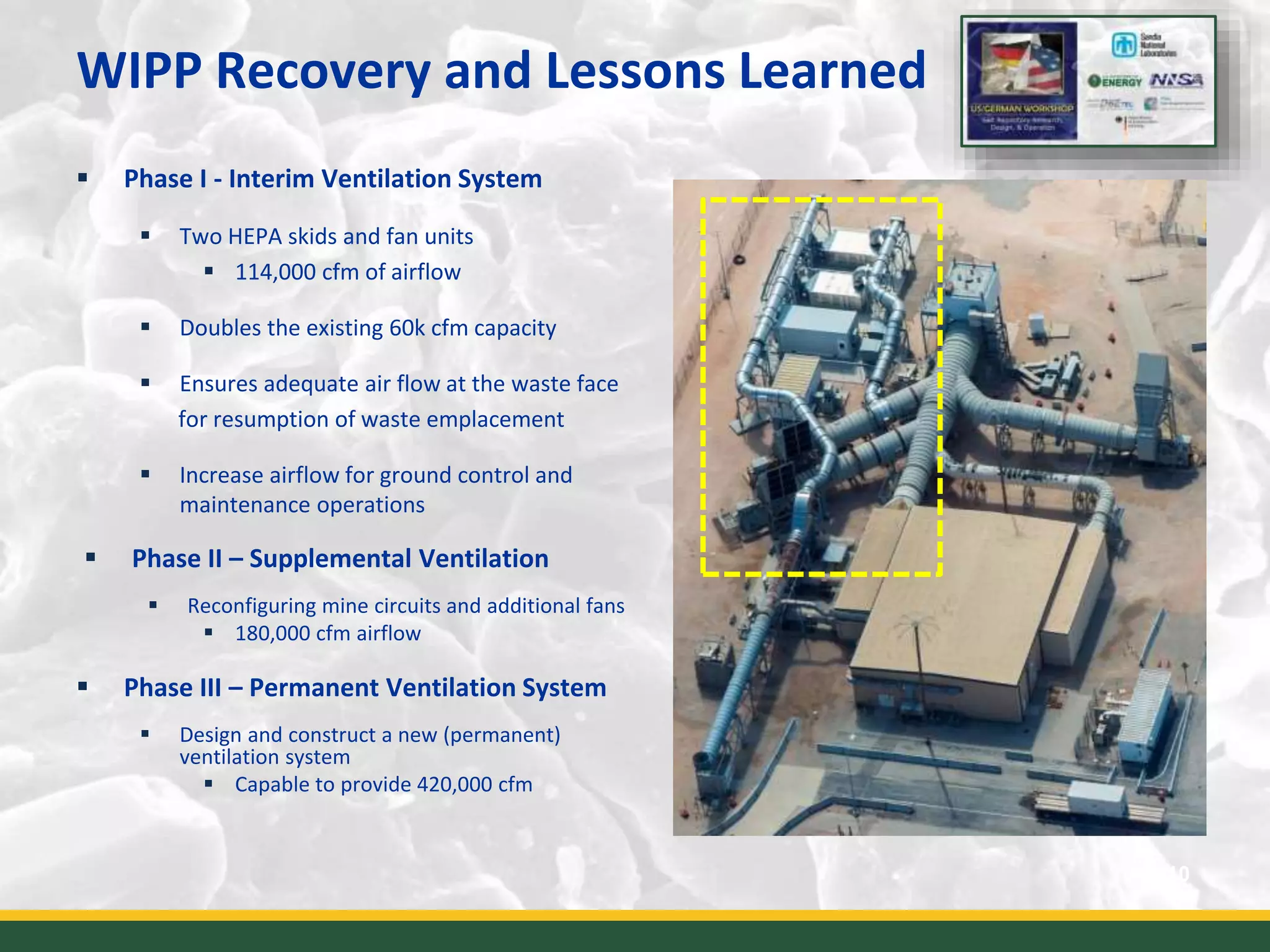
 Phase I - Interim Ventilation System
 Two HEPA skids and fan units
 114,000 cfm of airflow
 Doubles the existing 60k cfm capacity
 Ensures adequate air flow at the waste face
for resumption of waste emplacement
 Increase airflow for ground control and
maintenance operations
 Phase II – Supplemental Ventilation
 Reconfiguring mine circuits and additional fans
 180,000 cfm airflow
 Phase III – Permanent Ventilation System
 Design and construct a new (permanent)
ventilation system
 Capable to provide 420,000 cfm
WIPP Recovery and Lessons Learned
11
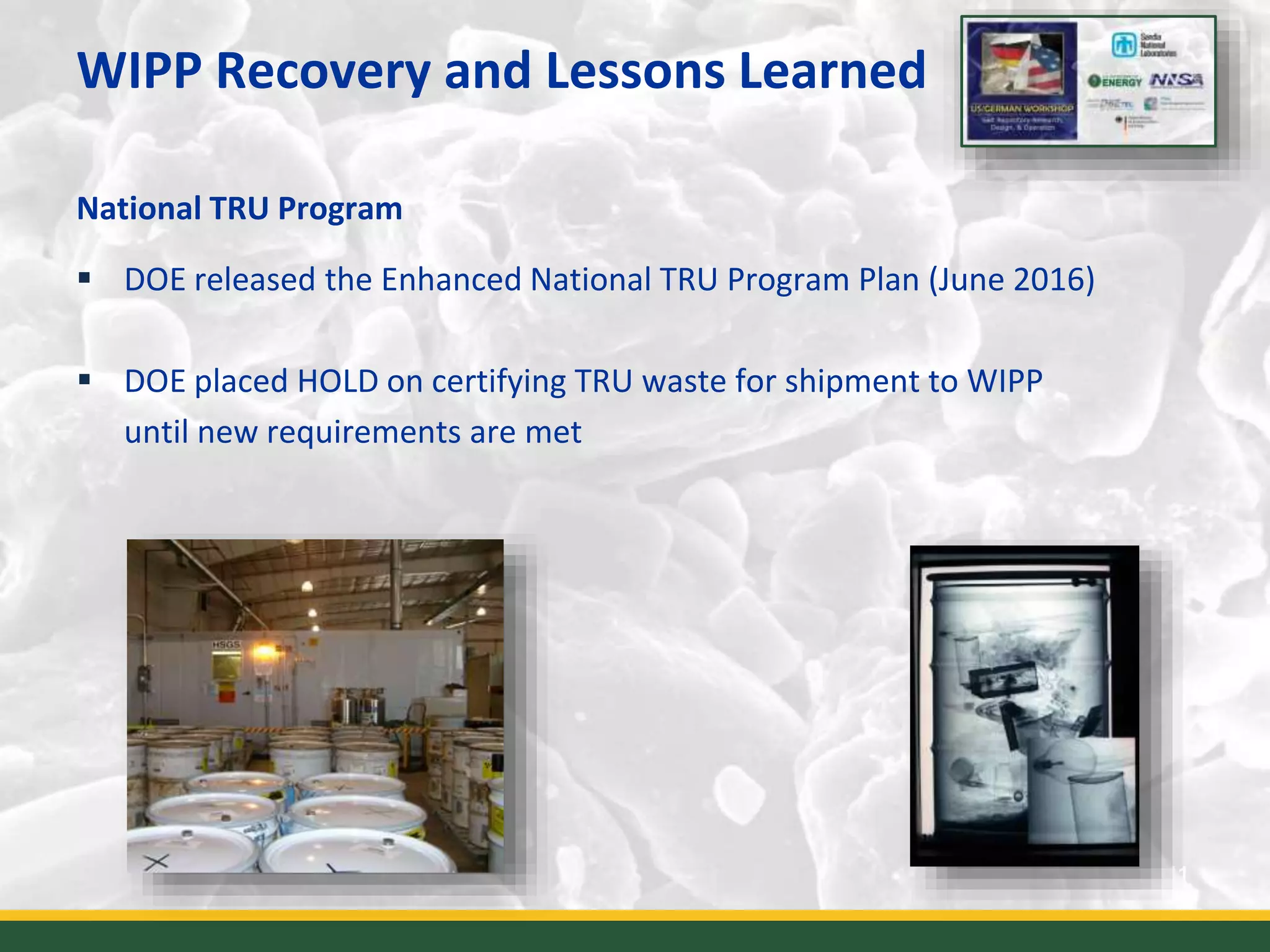
National TRU Program
 DOE released the Enhanced National TRU Program Plan (June 2016)
 DOE placed HOLD on certifying TRU waste for shipment to WIPP
until new requirements are met
WIPP Recovery and Lessons Learned
12
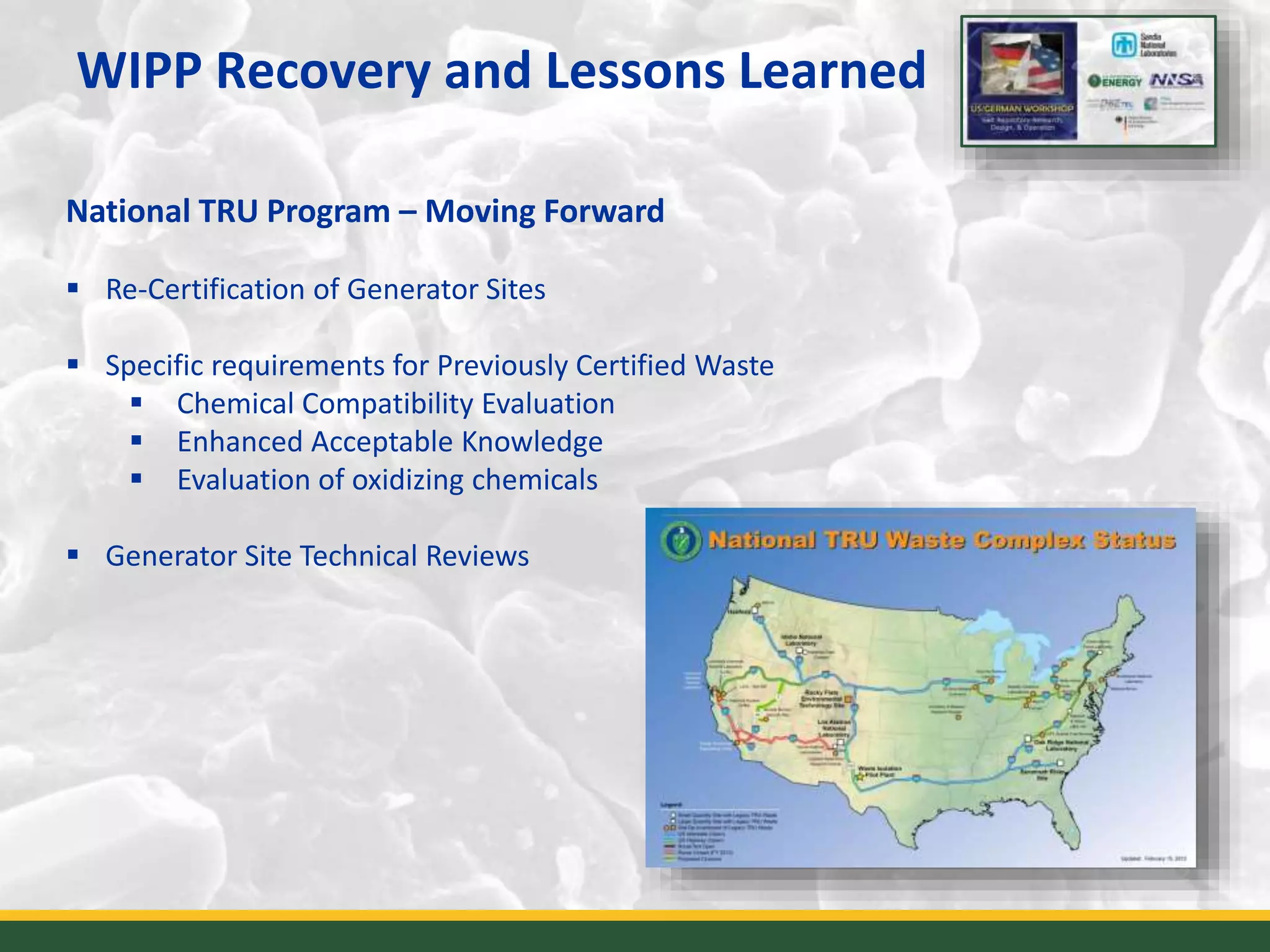
National TRU Program – Moving Forward
 Re-Certification of Generator Sites
 Specific requirements for Previously Certified Waste
 Chemical Compatibility Evaluation
 Enhanced Acceptable Knowledge
 Evaluation of oxidizing chemicals
 Generator Site Technical Reviews
WIPP Recovery and Lessons Learned
13
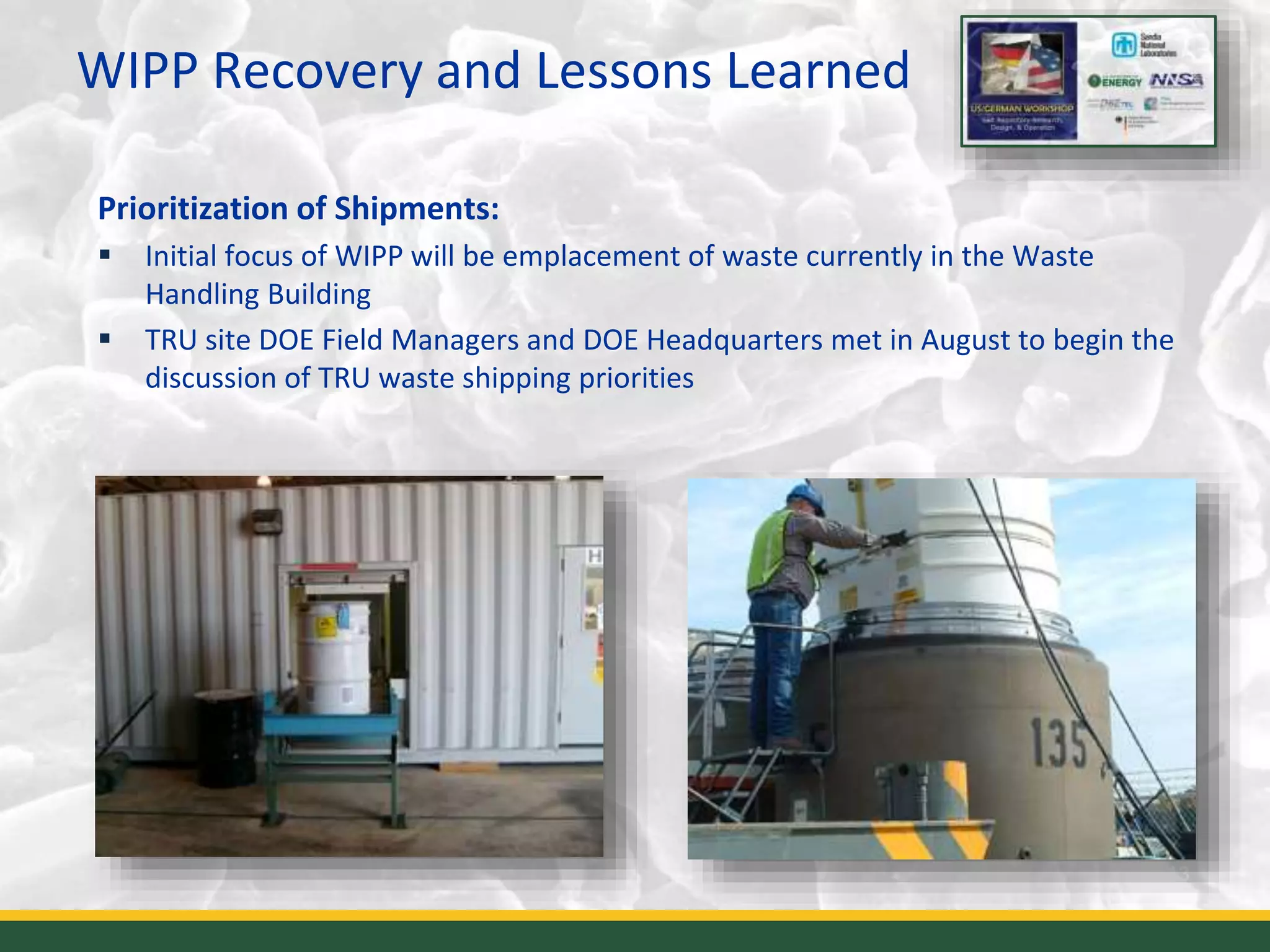
Prioritization of Shipments:
 Initial focus of WIPP will be emplacement of waste currently in the Waste
Handling Building
 TRU site DOE Field Managers and DOE Headquarters met in August to begin the
discussion of TRU waste shipping priorities
WIPP Recovery and Lessons Learned
14
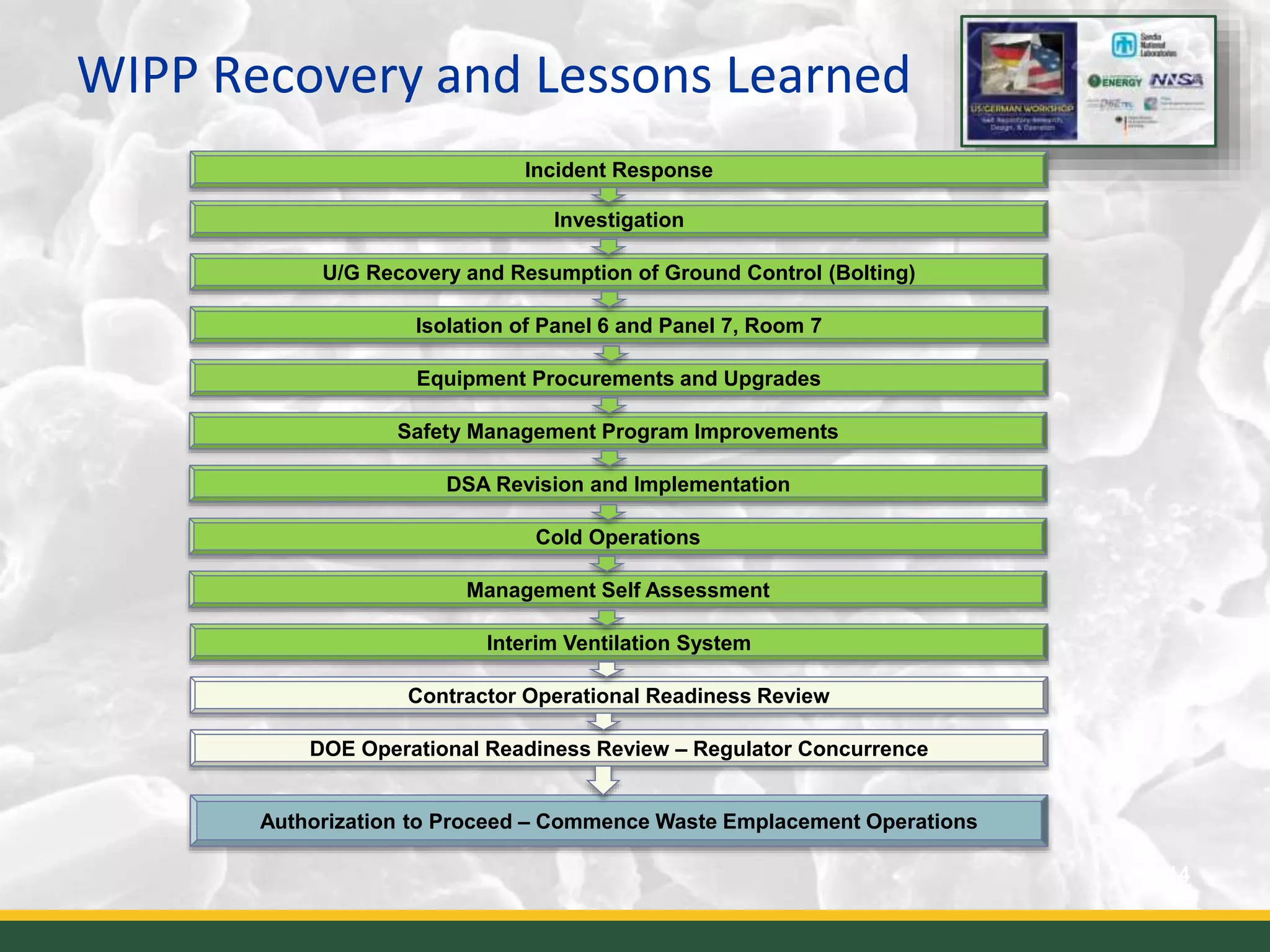
Incident Response
Investigation
U/G Recovery and Resumption of Ground Control (Bolting)
Isolation of Panel 6 and Panel 7, Room 7
Equipment Procurements and Upgrades
Interim Ventilation System
Authorization to Proceed – Commence Waste Emplacement Operations
DSA Revision and Implementation
Cold Operations
Management Self Assessment
Safety Management Program Improvements
Contractor Operational Readiness Review
DOE Operational Readiness Review – Regulator Concurrence

09 reynolds 7th salt workshop (trr)

  • 1.
    7th US/German Workshopon Salt Repository Research, Design, and Operation WIPP Recovery and Lessons Learned Tammy Reynolds – Deputy Project Manager Nuclear Waste Partnership LLC Washington, DC September 7-9, 2016
  • 2.
    WIPP Recovery andLessons Learned Background  The Waste Isolation Pilot Plant (WIPP), located in New Mexico began construction in the early 1980’s  Receipt and disposal of Contact Handled (CH) waste began in March 1999  Receipt and disposal of Remote Handled (RH) waste began in January 2007  Between March 1999 and February 2014, WIPP safely and compliantly: Received 11, 894 shipments and disposed the waste in the u/g, 90,627 cubic meters of CH TRU waste, 357 cubic meters of RH TRU waste  In February 2014, WIPP operations were paused when a fire and a radiological event occurred in the underground  Recovery from the events is in progress and planned to be complete by the end of calendar year 2016. Commencement of waste emplacement activities will begin as soon as it is safe to do so. 2
  • 3.
    WIPP Recovery andLessons Learned Fire Event  February 5, 2014 a fire occurred in the u/g involving a salt haul truck  86 workers in the u/g at the time of the fire were safely evacuated  Investigated by both DOE and NWP  DOE Accident Investigation Report issued on March 13, 2014 Radiological Event  February 14, 2014 an exothermic reaction involving the mixture of the organic materials (absorbent and/or neutralizer) and nitrate salts occurred inside a drum.  Pressurization of the drum, failure of the drum locking ring, and displacement of the drum lid  TRU waste propelled from the drum up into the polypropylene magnesium oxide (MgO) super sacks on top of the containers and onto adjacent waste containers. (Note: MgO is an assurance feature to ensure consistent and favorable chemical conditions are maintained in the brines after final facility closure by reacting with any carbon dioxide produced by the decay of organic carbon in the waste and waste emplacement materials.)  Radiological Continuous Air Monitor (CAM) alarm received; ventilation interlocked to filtration mode  Small amount of leakage bypassed the HEPA filters and released into the atmosphere  DOE Accident Investigation Report Phase I (response to the event) – issued on April 22, 2014  DOE Accident Investigation Report Phase II (cause of the event) – issued on April 16, 2015 3
  • 4.
    WIPP Recovery andLessons Learned Lessons Learned  Nuclear Facility vs Mine Culture  Although WIPP is a nuclear facility, there was a mining culture in place vs a nuclear culture  Difference in expectations between waste handling and non-waste handling vehicles (combustible buildup, manual vs auto fire detection/suppression)  Operability and recognition of impaired critical safety equipment  Fire protection program not adequately implemented at the WIPP facility  No controls or programs in place for control of combustible materials or maintaining of fire protection support systems  Maintenance program not effectively implemented – Combustible buildup on salt haul truck; chaining open ventilation doors; inoperable ventilation fans; inoperable mine phones, obscured evacuation reflectors, disabling of auto fire suppressions system; no overall method to understand status and impact of impaired mine safety related equipment  Mindset of production over maintenance based on complex wide priorities to accelerate shipments from generator sites in support of individual site milestones and regulatory agreements 4
  • 5.
    WIPP Recovery andLessons Learned Lessons Learned  Training and drill programs  Emergency management/preparedness and response programs not effectively implemented  Limited drills, inadequate donning of self-rescuers or SCSRs during training or drills, or hands on training with portable fire extinguishers  Inconsistencies between u/g fire response procedures and drills/training (shifting ventilation during evacuation)  Expectations and capabilities of the Facility Shift Manager to manage all aspects of an emergency or abnormal event  CMR response (evaluation and protective actions) was less than adequate  Identified problems with communications and alarms during the fire/evacuation delaying egress  National TRU Program not robust enough to identify incompatible waste  Communications to the community and regulatory stakeholders was not timely  Ensures trust is maintained rather than rebuilding that trust 5
  • 6.
    WIPP Recovery andLessons Learned 6 WIPP Recovery Managed as a Project • Baseline established • Scope, schedule, cost and risks reflected in the recovery baseline • Primavera detailed schedule developed • Progress tracked in Plan of the Day and Plan of the Week meetings • Critical Path calculated on weekly basis
  • 7.
    WIPP Recovery andLessons Learned 7 Radiological and Ground Control Recovery  Radiological release event in February 2014  Prevented underground access for several months; required “catch-up” bolting in areas that had not been maintained during that period  Created radiologically contaminated areas – complicating all operations including bolting and other ground control  Ground control catchup efforts in the radiological clean areas is complete. Ground control efforts are now focused in the radiologically contaminated areas  180K sq. ft. has been recovered and are unrestricted  130K sq. ft actively being worked  50K sq. ft. “Restricted”  10K sq. ft. “Prohibited  Nominal bolt failure rate 40/week  Bolt installation rate 110/week based on 11 shifts of bolting/week
  • 8.
    WIPP Recovery andLessons Learned 8 Facility/Equipment Improvements  New Emergency Operating Center (EOC)  Remodeled training facility  U/G Ventilation fan reliability improvements  Hybrid bolters  Maintenance backlog reduction  Interim Ventilation System Program Improvements  Fire Protection Program Plan  DSA Revision 5 Implemented (STD 3009-2014)  Increased training for fire response and 10X increase in drills New Emergency Operations Center Hybrid Bolting Machine Combustible Control ZoneNew Equipment
  • 9.
    WIPP Recovery andLessons Learned 9 Enhanced Underground Safety  New underground notification system  U/G combustible reduction  U/G localized fire suppression systems  Vehicle auto fire suppression systems  Improved mine stability and ground control Aggressive Culture Change  Leadership Academy  Leaders Forum  Focus on Values, Expectations, and Standards Notification System Vehicle Fire Suppression
  • 10.
    WIPP Recovery andLessons Learned 10  Phase I - Interim Ventilation System  Two HEPA skids and fan units  114,000 cfm of airflow  Doubles the existing 60k cfm capacity  Ensures adequate air flow at the waste face for resumption of waste emplacement  Increase airflow for ground control and maintenance operations  Phase II – Supplemental Ventilation  Reconfiguring mine circuits and additional fans  180,000 cfm airflow  Phase III – Permanent Ventilation System  Design and construct a new (permanent) ventilation system  Capable to provide 420,000 cfm
  • 11.
    WIPP Recovery andLessons Learned 11 National TRU Program  DOE released the Enhanced National TRU Program Plan (June 2016)  DOE placed HOLD on certifying TRU waste for shipment to WIPP until new requirements are met
  • 12.
    WIPP Recovery andLessons Learned 12 National TRU Program – Moving Forward  Re-Certification of Generator Sites  Specific requirements for Previously Certified Waste  Chemical Compatibility Evaluation  Enhanced Acceptable Knowledge  Evaluation of oxidizing chemicals  Generator Site Technical Reviews
  • 13.
    WIPP Recovery andLessons Learned 13 Prioritization of Shipments:  Initial focus of WIPP will be emplacement of waste currently in the Waste Handling Building  TRU site DOE Field Managers and DOE Headquarters met in August to begin the discussion of TRU waste shipping priorities
  • 14.
    WIPP Recovery andLessons Learned 14 Incident Response Investigation U/G Recovery and Resumption of Ground Control (Bolting) Isolation of Panel 6 and Panel 7, Room 7 Equipment Procurements and Upgrades Interim Ventilation System Authorization to Proceed – Commence Waste Emplacement Operations DSA Revision and Implementation Cold Operations Management Self Assessment Safety Management Program Improvements Contractor Operational Readiness Review DOE Operational Readiness Review – Regulator Concurrence