Dr Sadia Fatima
Associate Professor
Biochemistry
Measuring food consumption at
individual levels:
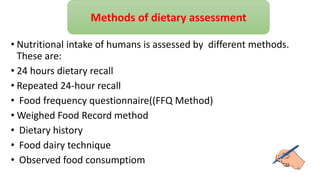
• Nutritional intake of humans is assessed by different methods.
These are:
• 24 hours dietary recall
• Repeated 24-hour recall
• Food frequency questionnaire((FFQ Method)
• Weighed Food Record method
• Dietary history
• Food dairy technique
• Observed food consumptiom
Methods of dietary assessment
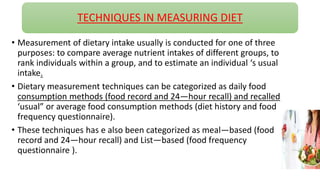
• Measurement of dietary intake usually is conducted for one of three
purposes: to compare average nutrient intakes of different groups, to
rank individuals within a group, and to estimate an individual ‘s usual
intake.
• Dietary measurement techniques can be categorized as daily food
consumption methods (food record and 24—hour recall) and recalled
‘usual” or average food consumption methods (diet history and food
frequency questionnaire).
• These techniques has e also been categorized as meal—based (food
record and 24—hour recall) and List—based (food frequency
questionnaire ).
TECHNIQUES IN MEASURING DIET
• This is the most widely used method where subjects are
interviewed by trained professionals to recall the kinds and
the amount of food consumed during the last 24 hours.
• Food intake per person or per consumption unit is calculated
taking into account the age , sex and the number of family
members.
24 Hour Dietary Recall Method
• In the dietary recall method, a trained interviewer asks the
respondent to recall in detail all the food and drink consumed during
a period of time in the recent past.
• The interviewer then records this information for later coding and
analysis. (In coding. a number is assigned to each kind of food,
allowing it to be identified easily for computer analysis.) In most
instances, the time period is the previous 24 hours. Thus, the method
is most commonly known as the 24—hour recall.
• In dietary recall assessments, extending beyond 24 hours to periods
like 48 hours, 7 days, or a month risks compromising accuracy due to
rapid memory decay, outweighing gains in representativeness."
24 hours dietary procedure
24 hours dietary procedure conti…
• Interviewers aid participants in recalling all consumed food and drink,
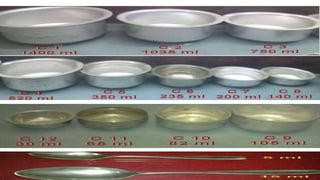
estimating portion sizes.
• Recalls begin from waking up, progressing through the day, and
tracing back exactly 24 hours.
• Inquiries about recent activities prompt memory recall, aiding in
comprehensive intake assessment.
• Post-interview, checks are conducted for omissions or errors, with
follow-up for clarification if needed.
• Details on preparation methods and serving sizes are recorded for
analysis.
• Multiple non-consecutive recalls are necessary for capturing daily
variability and achieving accuracy.
• Each food item is assigned a unique code for identification,
distinguishing variations for analysis.
Uses
.
• Useful for assessing average usual intakes of a large
population, provided that the sample is truly representative
and that the days of the week are adequately represented.
• • Used for international comparisons of relationship of
nutrient intakes to health and susceptibility to chronic
disease. Inexpensive, easy, quick, with low respondent
burden so that compliance is high.
• • Large coverage possible; can be used with illiterate
individuals. Element of surprise so less likely to modify eating
pattern.
• Use in clinic set up
Components of Dietary Recall Assessment
.
• method of preparation; (boiled/baked/fried);
• brand name (commercial/ready to eat/parts eaten (whole
item/half);
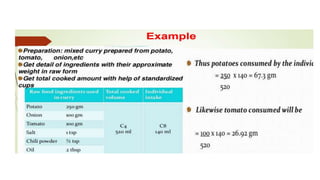
• ingredients(if mixed dish, what ingredients used and
amounts;
• addition to foods ( was anything added to food during
preparation or at the table; was any dressing added, cream
or sugar)
Components of Dietary Recall Assessment
.
• Get an accurate and complete listing of all food/drink
individual consumed within last 24 hrs.
• Questions asked: – What food/drink was consumed? – How
much was consumed? –
• Time it was consumed?
• How was it prepared?
• How was it served?
• Details of food (e.g low fat, 1%, whole, milk powder,
preparation,
Components of Dietary Recall Assessment
.
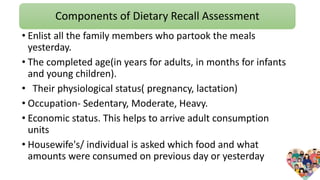
• Enlist all the family members who partook the meals
yesterday.
• The completed age(in years for adults, in months for infants
and young children).
• Their physiological status( pregnancy, lactation)
• Occupation- Sedentary, Moderate, Heavy.
• Economic status. This helps to arrive adult consumption
units
• Housewife's/ individual is asked which food and what
amounts were consumed on previous day or yesterday
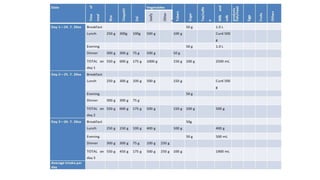
Example of 24 hr recall method
.
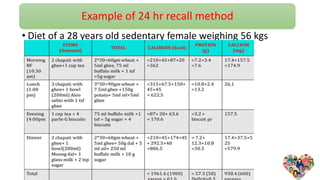
• Diet of a 28 years old sedentary female weighing 56 kgs
Advantages/Strengths
.
• Inexpensive method
• Recalls intakes over the last 24-hours, therefore there is less
burden on the respondents’ memory, leading to better accuracy
and response rates.
• Captures detail information on eating patterns, preparation
methods, place of consumption, etc
• Easy in administration(Requires less than 20 minutes to
administer) .
• Interview-based 24-hour recall does not rely on the literacy and
numeracy skills of the respondent.
• Useful in clinical settings
• Open-ended format used is appropriate for all eating patterns
Limitations/Weakness
.
• Relies on memory and hence it is unsatisfactory for the elderly and
young children.
• Multiple replicate 24h recalls used to estimate usual intakes of
individuals.
• Requires well-trained interviewers with knowledge of cultural
practices, eating habits, local recipes and preparation methods.
• Recall bias may be present, as respondents can be selective with the
foods they choose to report during the recall
• Underreporting/overreporting occurs.
• May be a tendency to overreport intake at low levels and overreport
intake at high levels of consumption .
• Data entry can be very labor intensive
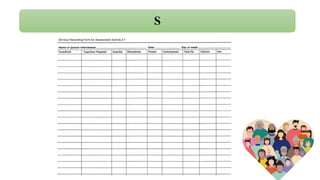
Assessment Activity
.
• Collecting a 24-Hour Recall The 24-hour recall is probably the most
commonly used technique for measuring diet. Consequently, it is
important that health professionals involved in nutritional assessment
understand, practice, and master this technique. In this assessment
activity, you will collect a 24-hour recall from a classmate and
calculate that person’s intake of kilocalories, protein, carbohydrate,
total fat, calcium, and iron from a food composition table. Be sure to
have a classmate collect a 24-hour recall from you, too. This will
provide you with additional experience with recalls
S
• What is the most widely used indicator of nutritional status of
children in a community?
• What is the best indicator of Nutritional status in an infant?
• What is the best indicator of Nutritional Status of underweight
pregnant females?
• Which surveys are conducted in Pakistan for the Assessment of
Nutritional Status of Community?
• Tell us some important finding of NNS 2018 Survey?
Quiz
24 hours dietary Assessment methods.pptx

24 hours dietary Assessment methods.pptx

  • 1.
    Dr Sadia Fatima AssociateProfessor Biochemistry Measuring food consumption at individual levels:
  • 2.
    • Nutritional intakeof humans is assessed by different methods. These are: • 24 hours dietary recall • Repeated 24-hour recall • Food frequency questionnaire((FFQ Method) • Weighed Food Record method • Dietary history • Food dairy technique • Observed food consumptiom Methods of dietary assessment
  • 3.
    • Measurement ofdietary intake usually is conducted for one of three purposes: to compare average nutrient intakes of different groups, to rank individuals within a group, and to estimate an individual ‘s usual intake. • Dietary measurement techniques can be categorized as daily food consumption methods (food record and 24—hour recall) and recalled ‘usual” or average food consumption methods (diet history and food frequency questionnaire). • These techniques has e also been categorized as meal—based (food record and 24—hour recall) and List—based (food frequency questionnaire ). TECHNIQUES IN MEASURING DIET
  • 4.
    • This isthe most widely used method where subjects are interviewed by trained professionals to recall the kinds and the amount of food consumed during the last 24 hours. • Food intake per person or per consumption unit is calculated taking into account the age , sex and the number of family members. 24 Hour Dietary Recall Method
  • 5.
    • In thedietary recall method, a trained interviewer asks the respondent to recall in detail all the food and drink consumed during a period of time in the recent past. • The interviewer then records this information for later coding and analysis. (In coding. a number is assigned to each kind of food, allowing it to be identified easily for computer analysis.) In most instances, the time period is the previous 24 hours. Thus, the method is most commonly known as the 24—hour recall. • In dietary recall assessments, extending beyond 24 hours to periods like 48 hours, 7 days, or a month risks compromising accuracy due to rapid memory decay, outweighing gains in representativeness." 24 hours dietary procedure
  • 6.
    24 hours dietaryprocedure conti… • Interviewers aid participants in recalling all consumed food and drink, estimating portion sizes. • Recalls begin from waking up, progressing through the day, and tracing back exactly 24 hours. • Inquiries about recent activities prompt memory recall, aiding in comprehensive intake assessment. • Post-interview, checks are conducted for omissions or errors, with follow-up for clarification if needed. • Details on preparation methods and serving sizes are recorded for analysis. • Multiple non-consecutive recalls are necessary for capturing daily variability and achieving accuracy. • Each food item is assigned a unique code for identification, distinguishing variations for analysis.
  • 7.
    Uses . • Useful forassessing average usual intakes of a large population, provided that the sample is truly representative and that the days of the week are adequately represented. • • Used for international comparisons of relationship of nutrient intakes to health and susceptibility to chronic disease. Inexpensive, easy, quick, with low respondent burden so that compliance is high. • • Large coverage possible; can be used with illiterate individuals. Element of surprise so less likely to modify eating pattern. • Use in clinic set up
  • 8.
    Components of DietaryRecall Assessment . • method of preparation; (boiled/baked/fried); • brand name (commercial/ready to eat/parts eaten (whole item/half); • ingredients(if mixed dish, what ingredients used and amounts; • addition to foods ( was anything added to food during preparation or at the table; was any dressing added, cream or sugar)
  • 9.
    Components of DietaryRecall Assessment . • Get an accurate and complete listing of all food/drink individual consumed within last 24 hrs. • Questions asked: – What food/drink was consumed? – How much was consumed? – • Time it was consumed? • How was it prepared? • How was it served? • Details of food (e.g low fat, 1%, whole, milk powder, preparation,
  • 10.
    Components of DietaryRecall Assessment . • Enlist all the family members who partook the meals yesterday. • The completed age(in years for adults, in months for infants and young children). • Their physiological status( pregnancy, lactation) • Occupation- Sedentary, Moderate, Heavy. • Economic status. This helps to arrive adult consumption units • Housewife's/ individual is asked which food and what amounts were consumed on previous day or yesterday
  • 14.
    Example of 24hr recall method . • Diet of a 28 years old sedentary female weighing 56 kgs
  • 17.
    Advantages/Strengths . • Inexpensive method •Recalls intakes over the last 24-hours, therefore there is less burden on the respondents’ memory, leading to better accuracy and response rates. • Captures detail information on eating patterns, preparation methods, place of consumption, etc • Easy in administration(Requires less than 20 minutes to administer) . • Interview-based 24-hour recall does not rely on the literacy and numeracy skills of the respondent. • Useful in clinical settings • Open-ended format used is appropriate for all eating patterns
  • 18.
    Limitations/Weakness . • Relies onmemory and hence it is unsatisfactory for the elderly and young children. • Multiple replicate 24h recalls used to estimate usual intakes of individuals. • Requires well-trained interviewers with knowledge of cultural practices, eating habits, local recipes and preparation methods. • Recall bias may be present, as respondents can be selective with the foods they choose to report during the recall • Underreporting/overreporting occurs. • May be a tendency to overreport intake at low levels and overreport intake at high levels of consumption . • Data entry can be very labor intensive
  • 19.
    Assessment Activity . • Collectinga 24-Hour Recall The 24-hour recall is probably the most commonly used technique for measuring diet. Consequently, it is important that health professionals involved in nutritional assessment understand, practice, and master this technique. In this assessment activity, you will collect a 24-hour recall from a classmate and calculate that person’s intake of kilocalories, protein, carbohydrate, total fat, calcium, and iron from a food composition table. Be sure to have a classmate collect a 24-hour recall from you, too. This will provide you with additional experience with recalls
  • 20.
  • 21.
    • What isthe most widely used indicator of nutritional status of children in a community? • What is the best indicator of Nutritional status in an infant? • What is the best indicator of Nutritional Status of underweight pregnant females? • Which surveys are conducted in Pakistan for the Assessment of Nutritional Status of Community? • Tell us some important finding of NNS 2018 Survey? Quiz