Proposition and Hypothesis
Dr Ankit Srivastava
Proposition and Hypothesis
• Proposition is a statement that predicts a relationship between two
or more variables.
• A hypothesis is used to describe a proposition that will be tested in
the study.
Proposition
• Propositions form the basis for scientific research.
• The validity of a research study is, to a large extent, evaluated
on the criteria of its propositions.
• For internal validity, study propositions provide information
regarding precision of definitions, measurements, associations,
confounding factors etc.
Proposition : Example
The dynamic nature of today’s global market-places a premium on an
organization's ability to anticipate and to respond to customer needs as well as
changing pressures. By using the product life cycle within this environment, a
marketing strategy can be developed, and marketing decisions can be taken.
As highlighted in the literature review the application of the product life cycle
concept was empirically tested in mainly large manufacturing organizations
(Agarwal: 1997, 571-585 and Magnan et al, 1999: 239-253).
Proposition 1
There is a difference in the application of the product life cycle concept theory
assumptions of small organizations in South Africa compared to Kotler’s
theory.
Marketing managers of small organizations know the different
characteristics in each of the four product life cycle phases as identified
by Kotler (2000: 316).
Proposition 2
Marketing managers of small organizations in Gauteng, South Africa
use the product life cycle concept to strategically plan and manage
their products through the various phases of the product life cycle.
Proposition : Example
Marketing managers of small organizations set different marketing
objectives during the four phases of the product life cycle as identified
by Kotler (2000: 316).
Proposition 3
Small manufacturing organizations in Gauteng apply and use the
product life cycle concept for marketing decision-making purposes.
Hypothesis
• A hypothesis is a statement which predicts what you expect to observe in
your empirical data.
• The scientific method requires that hypothesis be falsifiable.
• For this reason, hypothesis predicting a relationship between 2 variables is
accompanied by a null hypothesis which predicts no relationship between
the variables
• The hypothesis only state an association not any causal relationship or
effect.
• Once tested , retested and further tested , a supported hypothesis may
become a well accepted part of a theory or occasionally may grow to
become a theory itself.
Hypothesis : Falsifiability
• As by their very nature hypothesis cannot be proven to be true .
• A hypothesis is statistically falsified.
• All if-then statements are not hypothesis.
Hypothesis : Falsifiability
• Falsifiability is relatively simple test. But it’s a critically important
one.
• If a statement, theory, or idea is falsifiable, then the possibility
exists for proving it false.
• If there is no possible way to prove it false, it is non-falsifiable.
Hypothesis : Falsifiability
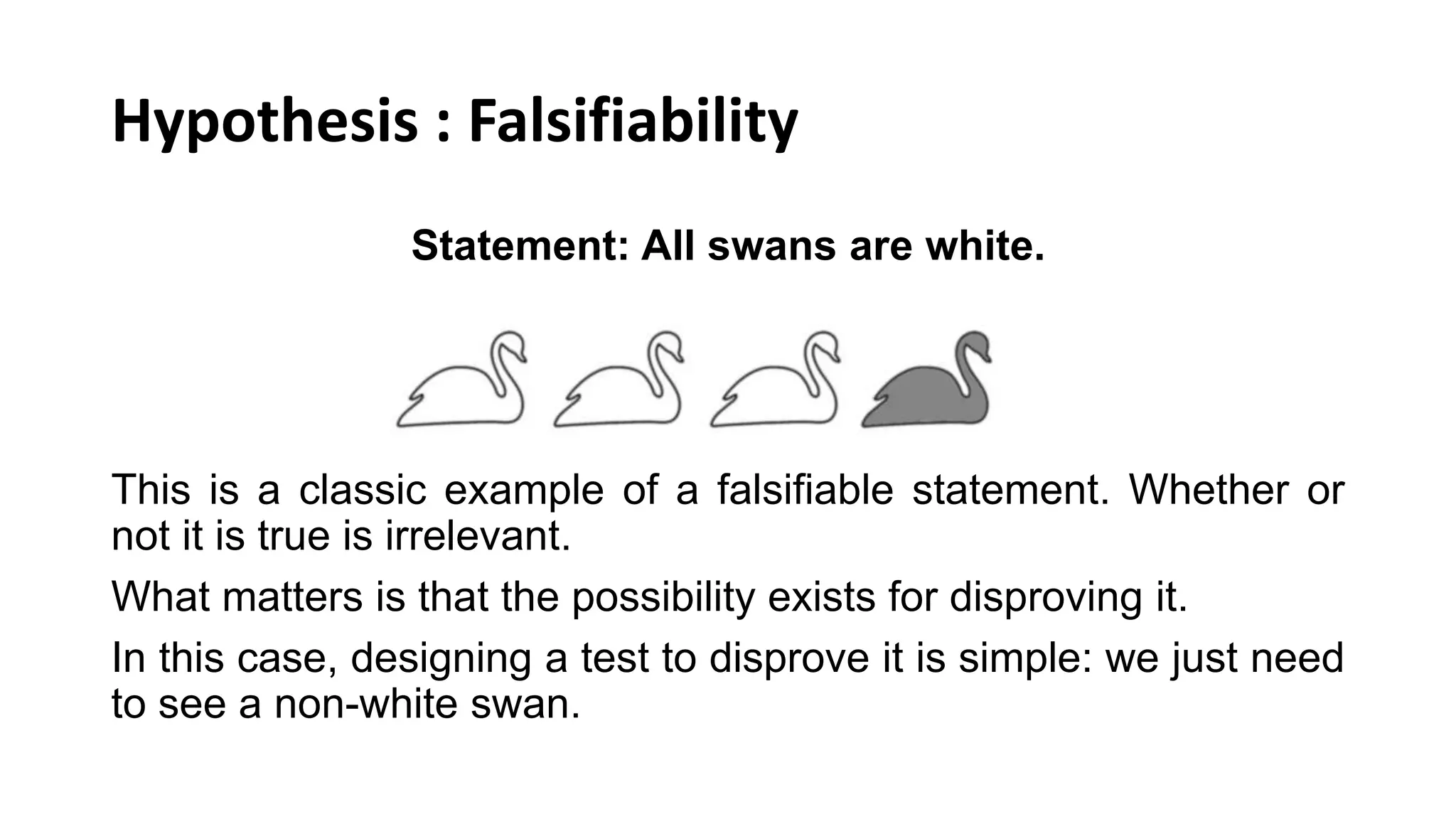
Statement: All swans are white.
This is a classic example of a falsifiable statement. Whether or
not it is true is irrelevant.
What matters is that the possibility exists for disproving it.
In this case, designing a test to disprove it is simple: we just need
to see a non-white swan.
Hypothesis : Falsifiability
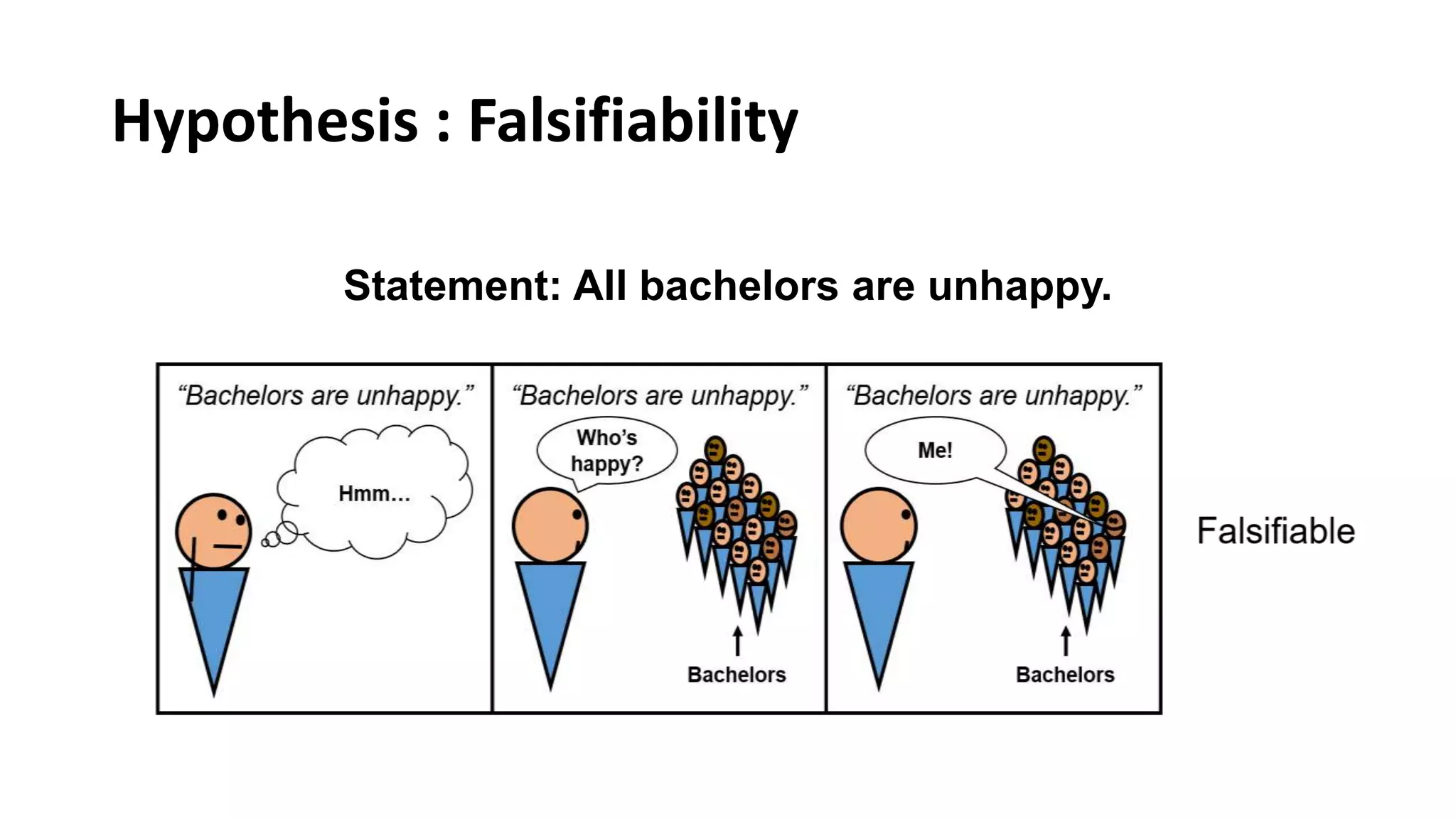
Statement: All bachelors are unhappy.
Hypothesis : Falsifiability
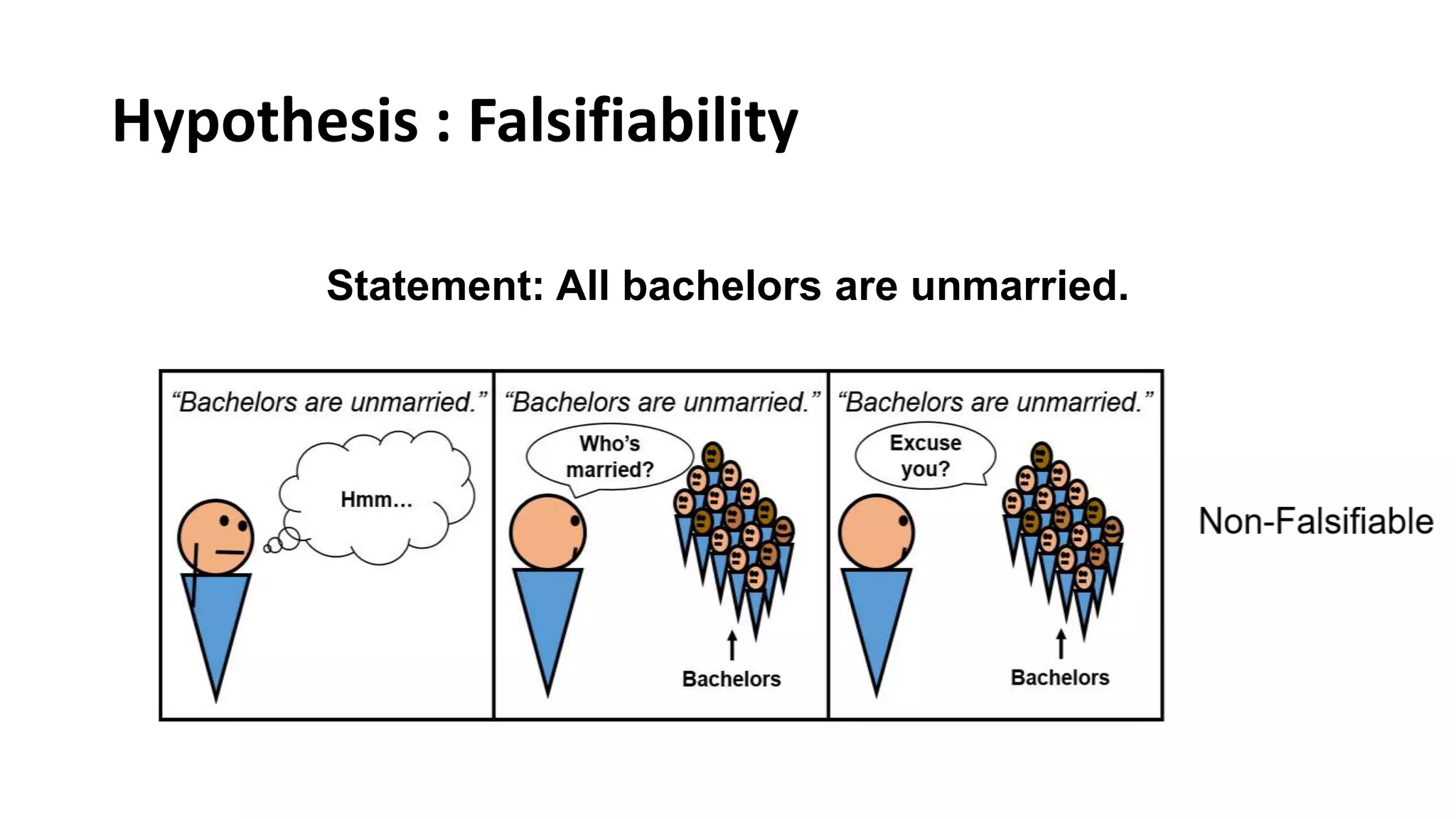
Statement: All bachelors are unmarried.

2.2 Proposition & Hypothesis.pptx

  • 1.
  • 2.
    Proposition and Hypothesis •Proposition is a statement that predicts a relationship between two or more variables. • A hypothesis is used to describe a proposition that will be tested in the study.
  • 3.
    Proposition • Propositions formthe basis for scientific research. • The validity of a research study is, to a large extent, evaluated on the criteria of its propositions. • For internal validity, study propositions provide information regarding precision of definitions, measurements, associations, confounding factors etc.
  • 4.
    Proposition : Example Thedynamic nature of today’s global market-places a premium on an organization's ability to anticipate and to respond to customer needs as well as changing pressures. By using the product life cycle within this environment, a marketing strategy can be developed, and marketing decisions can be taken. As highlighted in the literature review the application of the product life cycle concept was empirically tested in mainly large manufacturing organizations (Agarwal: 1997, 571-585 and Magnan et al, 1999: 239-253). Proposition 1 There is a difference in the application of the product life cycle concept theory assumptions of small organizations in South Africa compared to Kotler’s theory.
  • 5.
    Marketing managers ofsmall organizations know the different characteristics in each of the four product life cycle phases as identified by Kotler (2000: 316). Proposition 2 Marketing managers of small organizations in Gauteng, South Africa use the product life cycle concept to strategically plan and manage their products through the various phases of the product life cycle. Proposition : Example
  • 6.
    Proposition : Example Marketingmanagers of small organizations set different marketing objectives during the four phases of the product life cycle as identified by Kotler (2000: 316). Proposition 3 Small manufacturing organizations in Gauteng apply and use the product life cycle concept for marketing decision-making purposes.
  • 7.
    Hypothesis • A hypothesisis a statement which predicts what you expect to observe in your empirical data. • The scientific method requires that hypothesis be falsifiable. • For this reason, hypothesis predicting a relationship between 2 variables is accompanied by a null hypothesis which predicts no relationship between the variables • The hypothesis only state an association not any causal relationship or effect. • Once tested , retested and further tested , a supported hypothesis may become a well accepted part of a theory or occasionally may grow to become a theory itself.
  • 8.
    Hypothesis : Falsifiability •As by their very nature hypothesis cannot be proven to be true . • A hypothesis is statistically falsified. • All if-then statements are not hypothesis.
  • 9.
    Hypothesis : Falsifiability •Falsifiability is relatively simple test. But it’s a critically important one. • If a statement, theory, or idea is falsifiable, then the possibility exists for proving it false. • If there is no possible way to prove it false, it is non-falsifiable.
  • 10.
    Hypothesis : Falsifiability Statement:All swans are white. This is a classic example of a falsifiable statement. Whether or not it is true is irrelevant. What matters is that the possibility exists for disproving it. In this case, designing a test to disprove it is simple: we just need to see a non-white swan.
  • 11.
    Hypothesis : Falsifiability Statement:All bachelors are unhappy.
  • 12.
    Hypothesis : Falsifiability Statement:All bachelors are unmarried.