21 st  Century Learning Skills
The Growing Gap There is a growing gap between the knowledge and skills students learn in school and the knowledge and skills they need in typical 21 st  century communities and workplaces. Specifically, our students will spend their adult lives in a multitasking, multifaceted, technology-driven, diverse vibrant world.
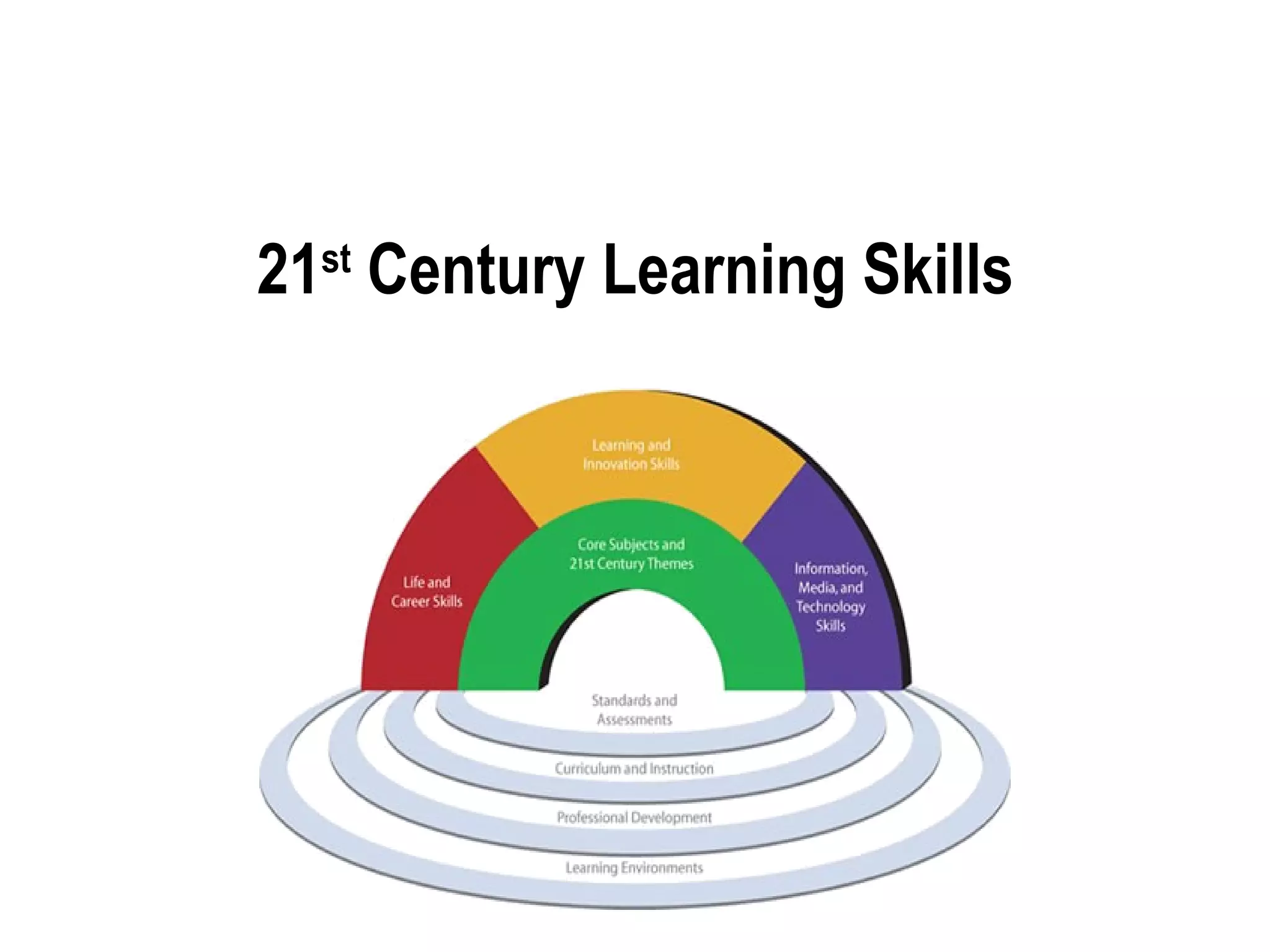
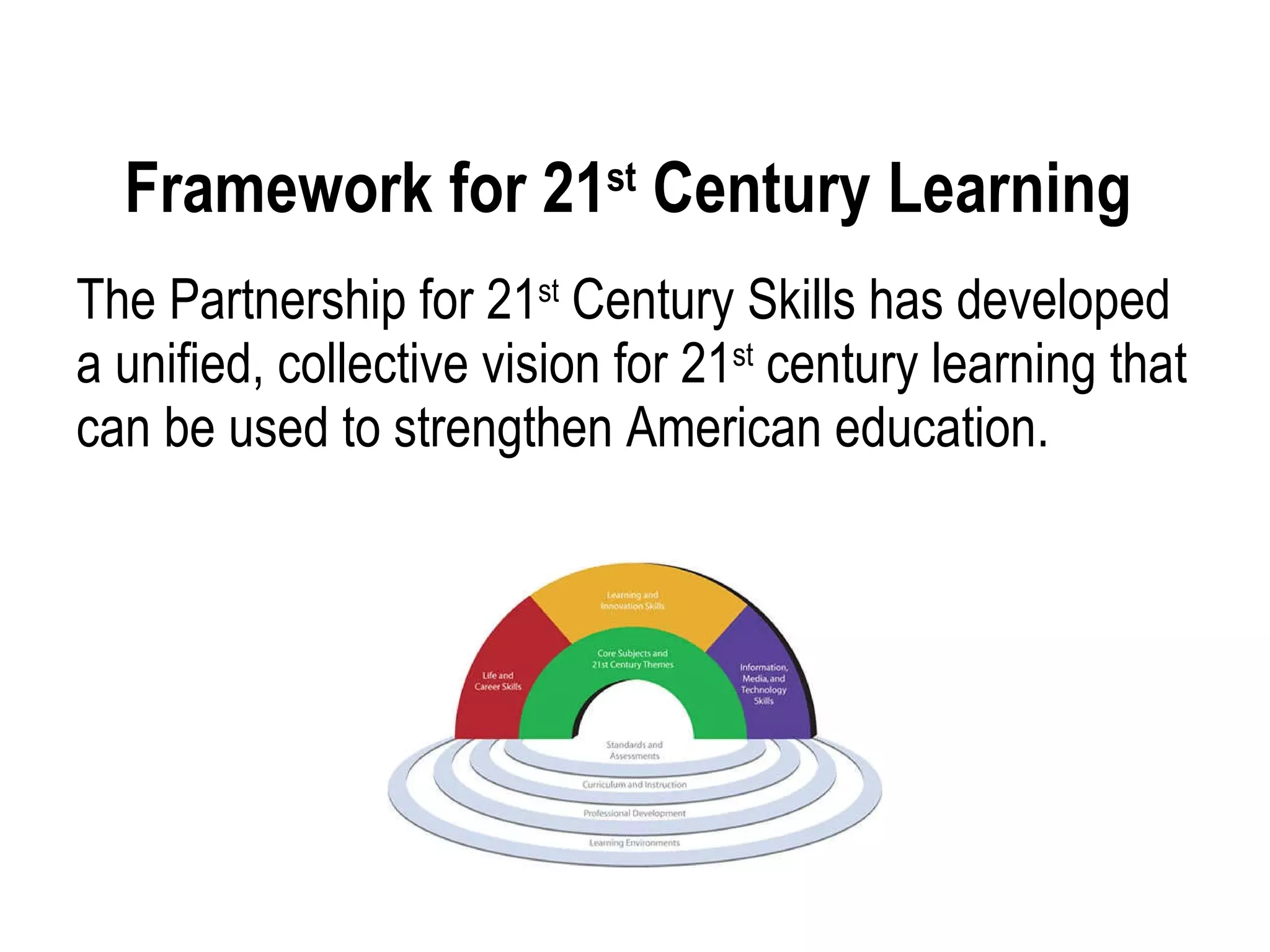
Framework for 21 st  Century Learning   The Partnership for 21 st  Century Skills has developed a unified, collective vision for 21 st  century learning that can be used to strengthen American education.
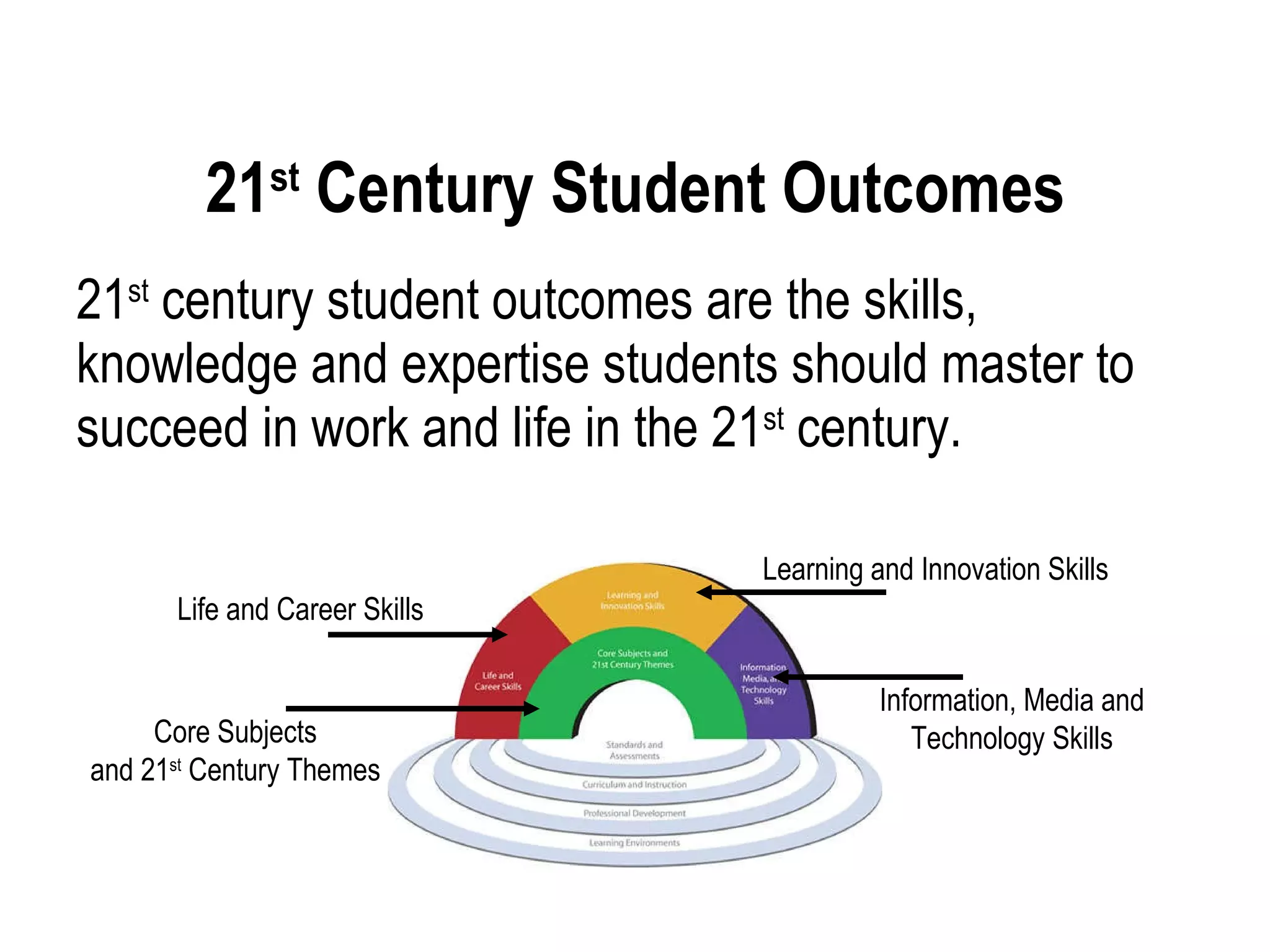
21 st  Century Student Outcomes 21 st  century student outcomes are the skills, knowledge and expertise students should master to succeed in work and life in the 21 st  century.  Core Subjects  and 21 st  Century Themes  Learning and Innovation Skills  Information, Media and  Technology Skills  Life and Career Skills
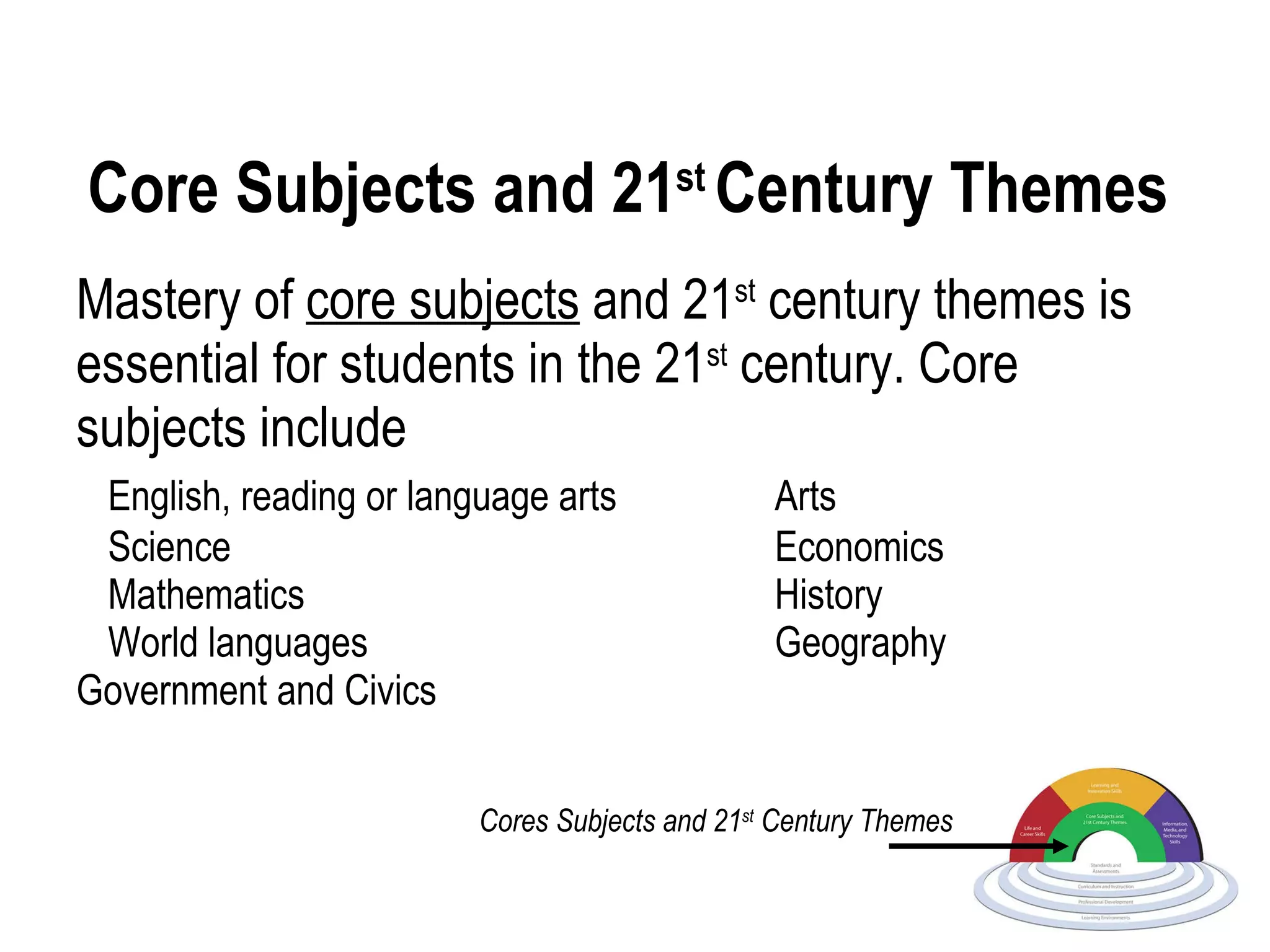
Core Subjects and 21 st  Century Themes   Mastery of  core subjects  and 21 st  century themes is essential for students in the 21 st  century. Core subjects include English, reading or language arts  Arts Science  Economics  Mathematics  History  World languages  Geography  Government and Civics Cores Subjects and 21 st  Century Themes
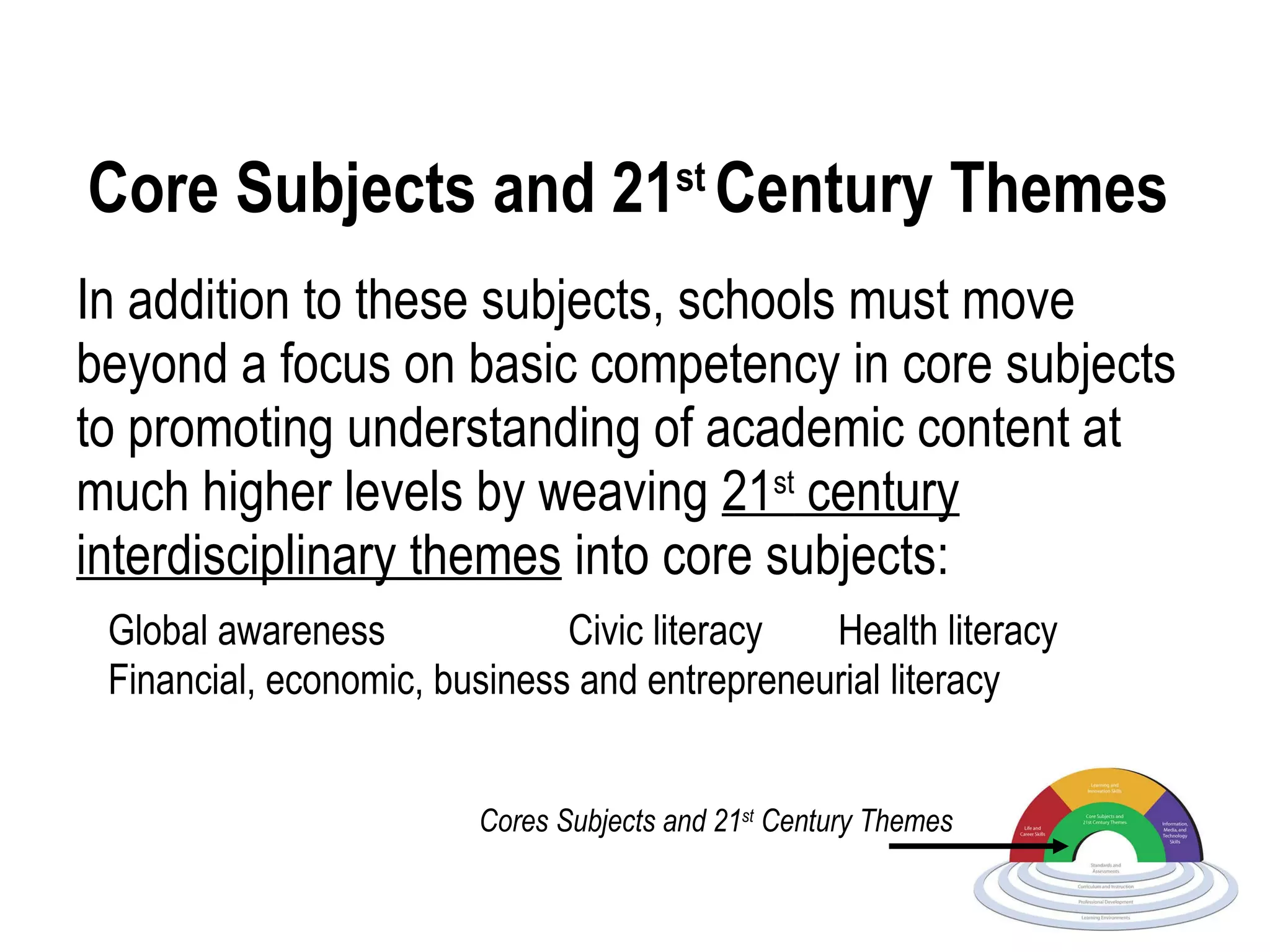
Core Subjects and 21 st  Century Themes   In addition to these subjects, schools must move beyond a focus on basic competency in core subjects to promoting understanding of academic content at much higher levels by weaving  21 st  century interdisciplinary themes  into core subjects:  Global awareness  Civic literacy  Health literacy Financial, economic, business and entrepreneurial literacy Cores Subjects and 21 st  Century Themes
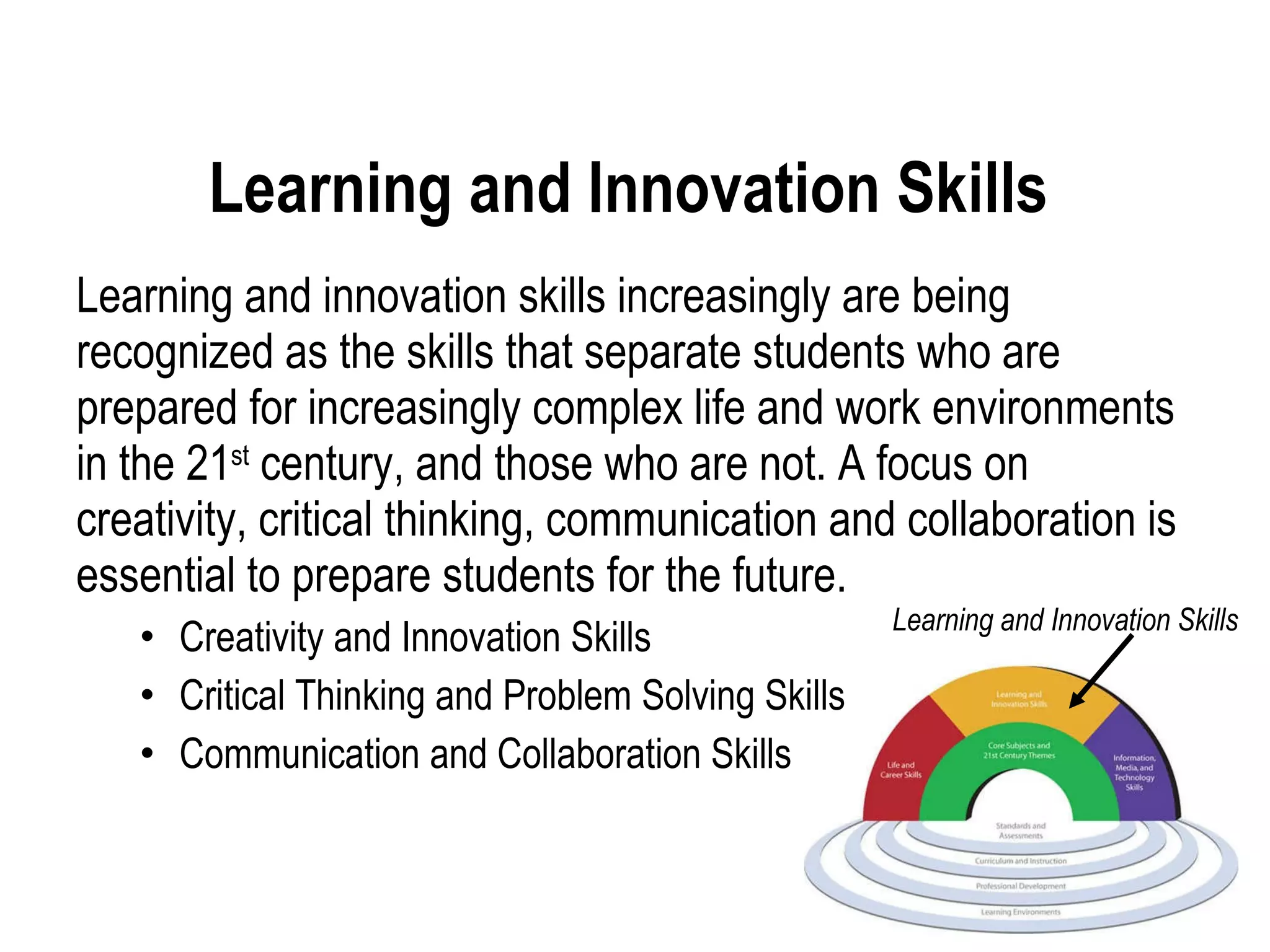
Learning and Innovation Skills   Learning and innovation skills increasingly are being recognized as the skills that separate students who are prepared for increasingly complex life and work environments in the 21 st  century, and those who are not. A focus on creativity, critical thinking, communication and collaboration is essential to prepare students for the future.  Creativity and Innovation Skills  Critical Thinking and Problem Solving Skills  Communication and Collaboration Skills  Learning and Innovation Skills
Learning and Innovation Skills: Creativity and Innovation Skills   Demonstrate originality and inventiveness in work  Develop, implement and communicate new ideas to others  Be open and responsive to new and diverse perspectives  Act on creative ideas to make a tangible and useful contribution to the domain in which the innovation occurs
Learning and Innovation Skills: Critical Thinking & Problem Solving Skills Exercise sound reasoning in understanding  Make complex choices and decisions  Understand the interconnections among systems  Identify and ask significant questions that clarify various points of view and lead to better solutions  Frame, analyze and synthesize information in order to solve problems and answer questions
Learning and Innovation Skills: Communication and Collaboration Skills Articulate thoughts and ideas clearly and effectively through speaking and writing  Demonstrate ability to work effectively with diverse teams  Exercise flexibility and willingness to be helpful in making necessary compromises to accomplish a common goal  Assume shared responsibility for collaborative work
Information, Media & Technology Skills   People in the 21 st  century live in a technology and media-suffused environment, marked by access to an abundance of information, rapid changes in technology tools, and the ability to collaborate and make individual contributions on an unprecedented scale. To be effective in the 21 st  century, citizens and workers must be able to exhibit a range of functional and critical thinking skills related to information, media and technology.  Information Literacy  Media Literacy  ICT Literacy (Information, Communications & Technology) Information, Media & Technology Skills
Information, Media and Technology Skills Information Literacy Access information efficiently and effectively, evaluate information critically and competently and use information accurately and creatively for the issue or problem at hand  Possess a fundamental understanding of the ethical/legal issues surrounding the access and use of information
Information, Media and Technology Skills Media Literacy  Understand how media messages are constructed, for what purposes and using which tools, characteristics and conventions. Examine how individuals interpret messages differently, how values and points of view are included or excluded and how media can influence beliefs and behaviors.  Possess a fundamental understanding of the ethical/legal issues surrounding the access and use of information
Information, Media and Technology Skills ICT Literacy  Use digital technology, communication tools and/or networks appropriately to access, manage, integrate, evaluate, and create information in order to function in a knowledge economy  Use technology as a tool to research, organize, evaluate and communicate information, and the possession of a fundamental understanding of the ethical/legal issues surrounding the access and use of information
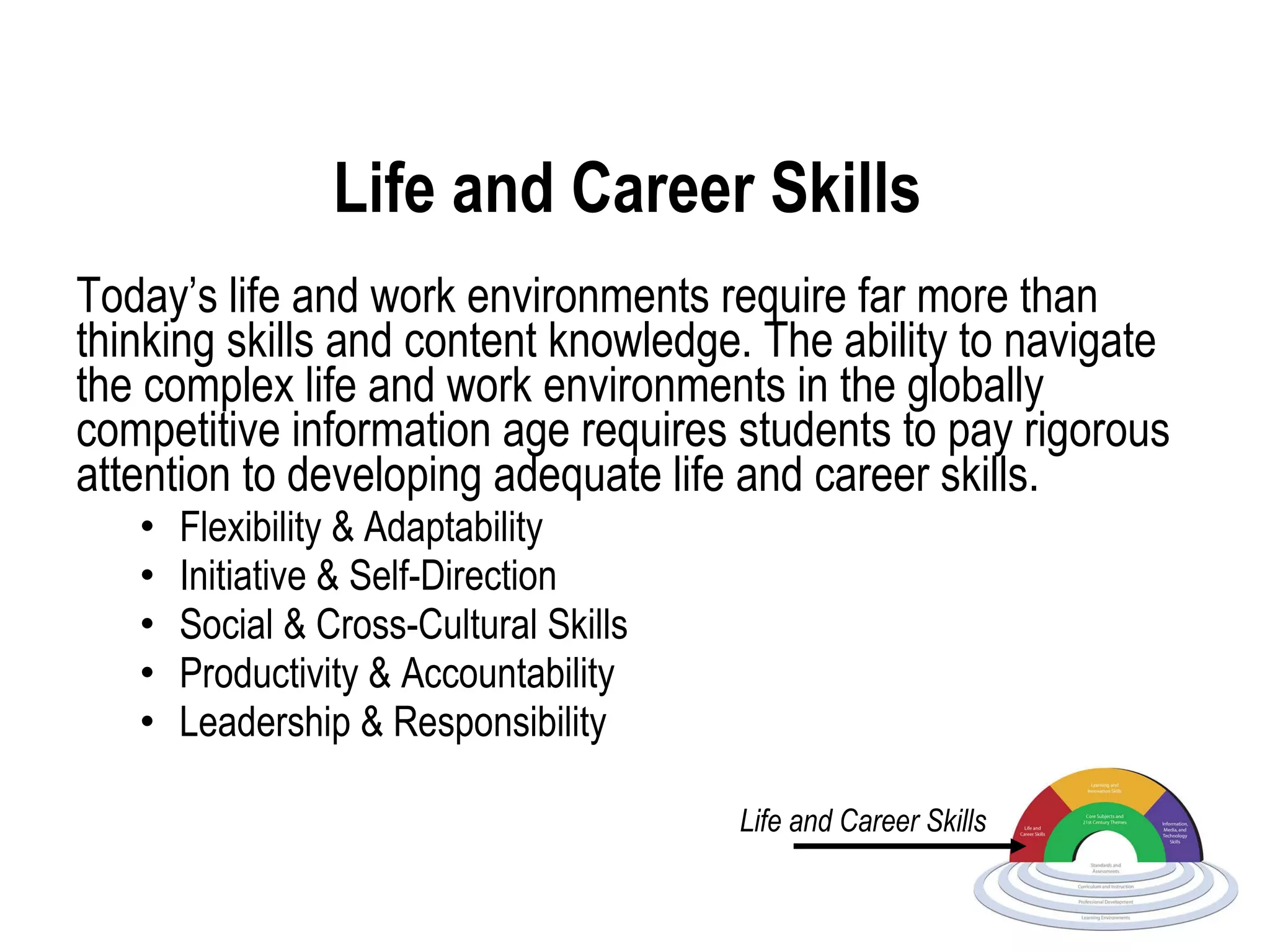
Life and Career Skills   Today’s life and work environments require far more than thinking skills and content knowledge. The ability to navigate the complex life and work environments in the globally competitive information age requires students to pay rigorous attention to developing adequate life and career skills.  Flexibility & Adaptability  Initiative & Self-Direction  Social & Cross-Cultural Skills  Productivity & Accountability  Leadership & Responsibility  Life and Career Skills
Life and Career Skills Flexibility & Adaptability  Adapt to varied roles and responsibilities  Worki effectively in a climate of ambiguity and changing priorities
Life and Career Skills Initiative & Self-Direction Monitor one’s own understanding and learning needs  Go beyond basic mastery of skills and/or curriculum to explore and expand one’s own learning and opportunities to gain expertise Demonstrate initiative to advance skill levels towards a professional level  Define, prioritize and complete tasks without direct oversight  Utilize time efficiently and managing workload  Demonstrate commitment to learning as a lifelong process
Life and Career Skills Social & Cross-Cultural Skills  Work appropriately and productively with others  Leverage the collective intelligence of groups when appropriate  Bridge cultural differences and using differing perspectives to increase innovation and the quality of work
Life and Career Skills  Productivity & Accountability  Set and meet high standards and goals for delivering quality work on time Demonstrate diligence and a positive work ethic  (e.g., being punctual and reliable)
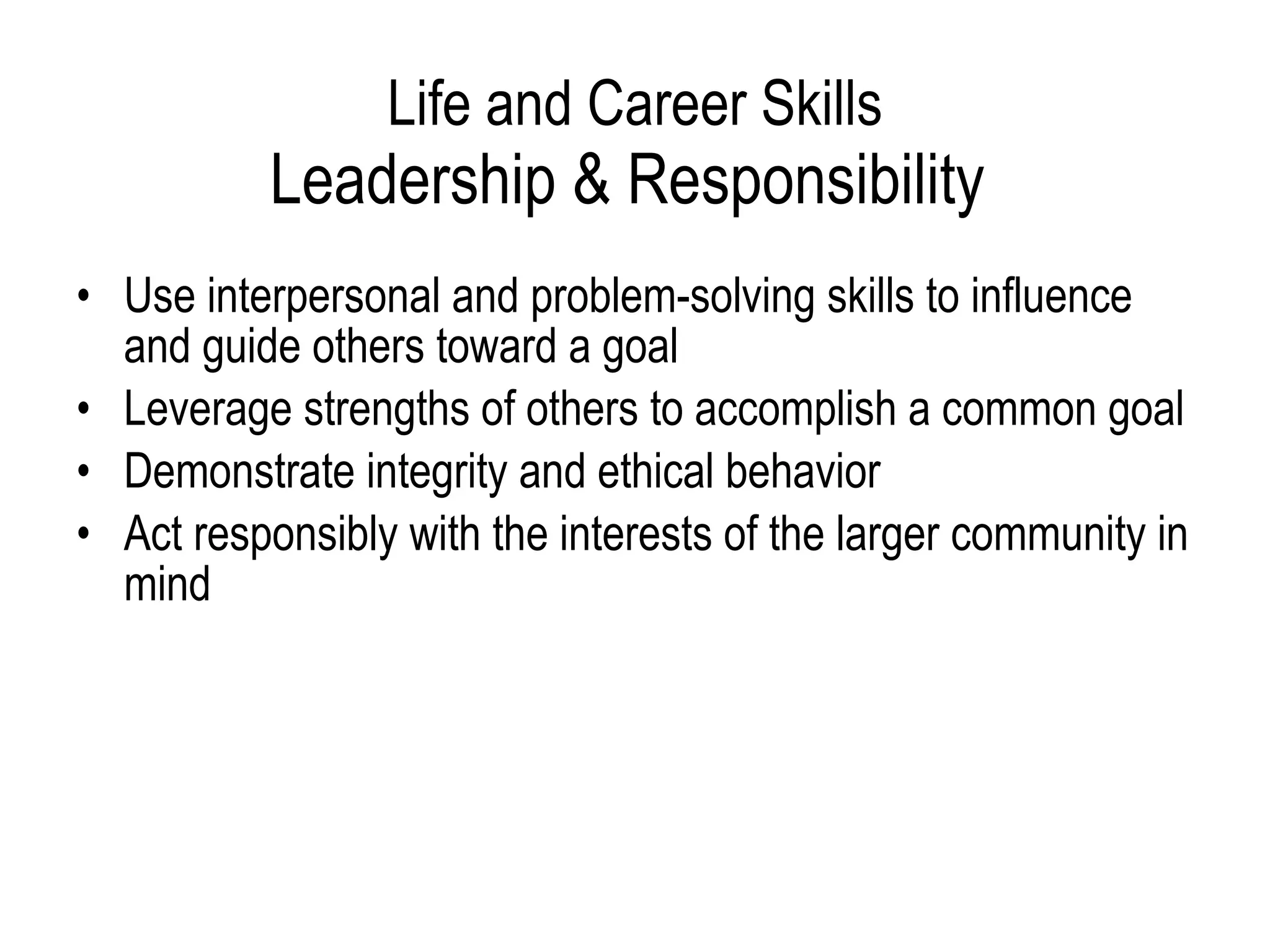
Life and Career Skills Leadership & Responsibility  Use interpersonal and problem-solving skills to influence and guide others toward a goal  Leverage strengths of others to accomplish a common goal  Demonstrate integrity and ethical behavior  Act responsibly with the interests of the larger community in mind

21st century skills

  • 1.
    21 st Century Learning Skills
  • 2.
    The Growing GapThere is a growing gap between the knowledge and skills students learn in school and the knowledge and skills they need in typical 21 st century communities and workplaces. Specifically, our students will spend their adult lives in a multitasking, multifaceted, technology-driven, diverse vibrant world.
  • 3.
    Framework for 21st Century Learning The Partnership for 21 st Century Skills has developed a unified, collective vision for 21 st century learning that can be used to strengthen American education.
  • 4.
    21 st Century Student Outcomes 21 st century student outcomes are the skills, knowledge and expertise students should master to succeed in work and life in the 21 st century. Core Subjects and 21 st Century Themes Learning and Innovation Skills Information, Media and Technology Skills Life and Career Skills
  • 5.
    Core Subjects and21 st Century Themes Mastery of core subjects and 21 st century themes is essential for students in the 21 st century. Core subjects include English, reading or language arts Arts Science Economics Mathematics History World languages Geography Government and Civics Cores Subjects and 21 st Century Themes
  • 6.
    Core Subjects and21 st Century Themes In addition to these subjects, schools must move beyond a focus on basic competency in core subjects to promoting understanding of academic content at much higher levels by weaving 21 st century interdisciplinary themes into core subjects: Global awareness Civic literacy Health literacy Financial, economic, business and entrepreneurial literacy Cores Subjects and 21 st Century Themes
  • 7.
    Learning and InnovationSkills Learning and innovation skills increasingly are being recognized as the skills that separate students who are prepared for increasingly complex life and work environments in the 21 st century, and those who are not. A focus on creativity, critical thinking, communication and collaboration is essential to prepare students for the future.  Creativity and Innovation Skills Critical Thinking and Problem Solving Skills Communication and Collaboration Skills Learning and Innovation Skills
  • 8.
    Learning and InnovationSkills: Creativity and Innovation Skills Demonstrate originality and inventiveness in work Develop, implement and communicate new ideas to others Be open and responsive to new and diverse perspectives Act on creative ideas to make a tangible and useful contribution to the domain in which the innovation occurs
  • 9.
    Learning and InnovationSkills: Critical Thinking & Problem Solving Skills Exercise sound reasoning in understanding Make complex choices and decisions Understand the interconnections among systems Identify and ask significant questions that clarify various points of view and lead to better solutions Frame, analyze and synthesize information in order to solve problems and answer questions
  • 10.
    Learning and InnovationSkills: Communication and Collaboration Skills Articulate thoughts and ideas clearly and effectively through speaking and writing Demonstrate ability to work effectively with diverse teams Exercise flexibility and willingness to be helpful in making necessary compromises to accomplish a common goal Assume shared responsibility for collaborative work
  • 11.
    Information, Media &Technology Skills People in the 21 st century live in a technology and media-suffused environment, marked by access to an abundance of information, rapid changes in technology tools, and the ability to collaborate and make individual contributions on an unprecedented scale. To be effective in the 21 st century, citizens and workers must be able to exhibit a range of functional and critical thinking skills related to information, media and technology. Information Literacy Media Literacy ICT Literacy (Information, Communications & Technology) Information, Media & Technology Skills
  • 12.
    Information, Media andTechnology Skills Information Literacy Access information efficiently and effectively, evaluate information critically and competently and use information accurately and creatively for the issue or problem at hand Possess a fundamental understanding of the ethical/legal issues surrounding the access and use of information
  • 13.
    Information, Media andTechnology Skills Media Literacy Understand how media messages are constructed, for what purposes and using which tools, characteristics and conventions. Examine how individuals interpret messages differently, how values and points of view are included or excluded and how media can influence beliefs and behaviors. Possess a fundamental understanding of the ethical/legal issues surrounding the access and use of information
  • 14.
    Information, Media andTechnology Skills ICT Literacy Use digital technology, communication tools and/or networks appropriately to access, manage, integrate, evaluate, and create information in order to function in a knowledge economy Use technology as a tool to research, organize, evaluate and communicate information, and the possession of a fundamental understanding of the ethical/legal issues surrounding the access and use of information
  • 15.
    Life and CareerSkills Today’s life and work environments require far more than thinking skills and content knowledge. The ability to navigate the complex life and work environments in the globally competitive information age requires students to pay rigorous attention to developing adequate life and career skills. Flexibility & Adaptability Initiative & Self-Direction Social & Cross-Cultural Skills Productivity & Accountability Leadership & Responsibility Life and Career Skills
  • 16.
    Life and CareerSkills Flexibility & Adaptability Adapt to varied roles and responsibilities Worki effectively in a climate of ambiguity and changing priorities
  • 17.
    Life and CareerSkills Initiative & Self-Direction Monitor one’s own understanding and learning needs Go beyond basic mastery of skills and/or curriculum to explore and expand one’s own learning and opportunities to gain expertise Demonstrate initiative to advance skill levels towards a professional level Define, prioritize and complete tasks without direct oversight Utilize time efficiently and managing workload Demonstrate commitment to learning as a lifelong process
  • 18.
    Life and CareerSkills Social & Cross-Cultural Skills Work appropriately and productively with others Leverage the collective intelligence of groups when appropriate Bridge cultural differences and using differing perspectives to increase innovation and the quality of work
  • 19.
    Life and CareerSkills Productivity & Accountability Set and meet high standards and goals for delivering quality work on time Demonstrate diligence and a positive work ethic (e.g., being punctual and reliable)
  • 20.
    Life and CareerSkills Leadership & Responsibility Use interpersonal and problem-solving skills to influence and guide others toward a goal Leverage strengths of others to accomplish a common goal Demonstrate integrity and ethical behavior Act responsibly with the interests of the larger community in mind

Editor's Notes

  • #2 21st Century Learning Skills District 30 03/02/09