VIVEKANANDA COLLEGE
College with Potential for Excellence
Reaccredited With ‘A’ Grade (CGPA 3.59 out of 4) by
NAAC
Residential &Autonomous - A Gurukula Institute of Life
Training
Affiliated to Madurai Kamaraj University
Tiruvedakam West, Madurai-625 214
Tamil Nadu
PG& Research Department of Commerce
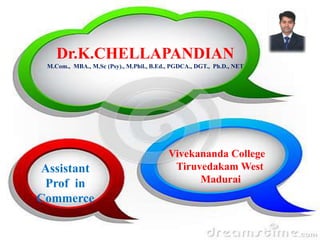
Dr.K.CHELLAPANDIAN
M.Com., MBA., M.Sc (Psy)., M.Phil., B.Ed., PGDCA., DGT., Ph.D., NET
Vivekananda College
Tiruvedakam West
Madurai
Assistant
Prof in
Commerce
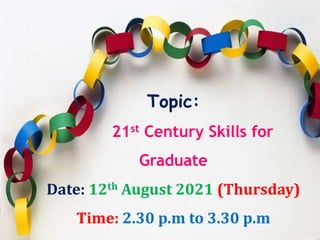
Topic:
21st Century Skills for
Graduate
Date: 12th August 2021 (Thursday)
Time: 2.30 p.m to 3.30 p.m
Topic: 21st Century Skills for
Graduate
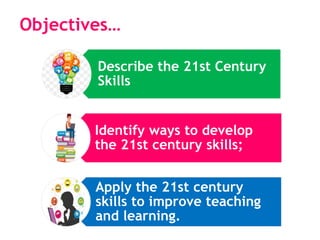
Describe the 21st Century
Skills
Identify ways to develop
the 21st century skills;
Apply the 21st century
skills to improve teaching
and learning.
Objectives…
The 21st-Century Skills Gap
 (ASK) Attitude, Skills and Knowledge are the driving forces of
economic growth and social development for any country.
 Presently, the country faces a demand – supply mismatch, as the
economy needs more ‘skilled’ workforce than that is available.
 In this globally and digitally interconnected world, all learners,
from cradle to career, need new skills and knowledge to succeed.
 If we want to prepare our students for success in college, work
and life, opportunities to learn 21st-century skills are essential.
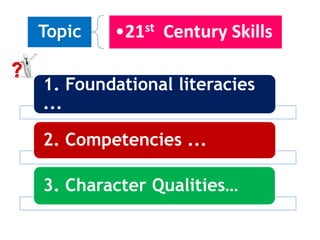
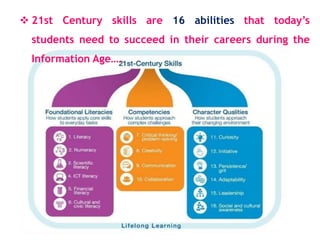
1. Foundational literacies
...
2. Competencies ...
3. Character Qualities…
Topic •21st Century Skills
 21st Century skills are 16 abilities that today’s
students need to succeed in their careers during the
Information Age….
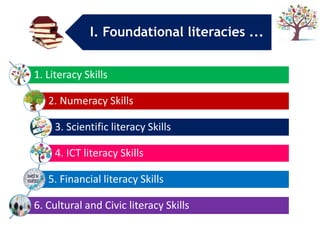
1. Literacy Skills
2. Numeracy Skills
3. Scientific literacy Skills
4. ICT literacy Skills
5. Financial literacy Skills
6. Cultural and Civic literacy Skills
I. Foundational literacies ...
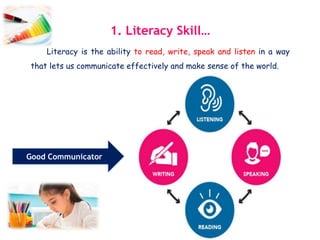
1. Literacy Skill…
Literacy is the ability to read, write, speak and listen in a way
that lets us communicate effectively and make sense of the world.
Good Communicator
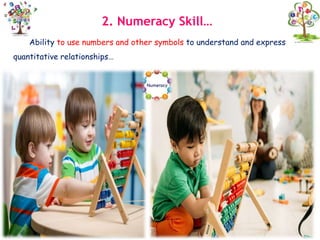
2. Numeracy Skill…
Ability to use numbers and other symbols to understand and express
quantitative relationships…
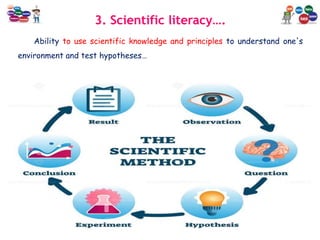
3. Scientific literacy….
Ability to use scientific knowledge and principles to understand one's
environment and test hypotheses…
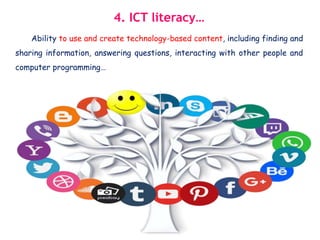
4. ICT literacy…
Ability to use and create technology-based content, including finding and
sharing information, answering questions, interacting with other people and
computer programming…
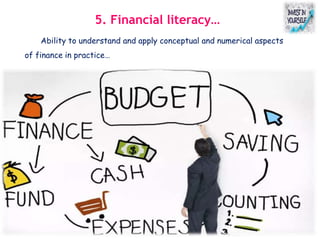
5. Financial literacy…
Ability to understand and apply conceptual and numerical aspects
of finance in practice…
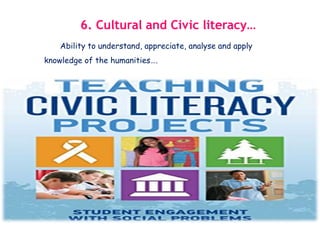
6. Cultural and Civic literacy…
Ability to understand, appreciate, analyse and apply
knowledge of the humanities….
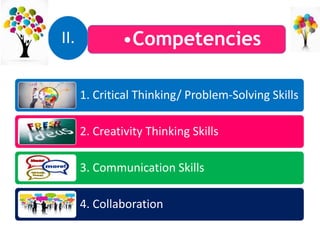
1. Critical Thinking/ Problem-Solving Skills
2. Creativity Thinking Skills
3. Communication Skills
4. Collaboration
II. •Competencies
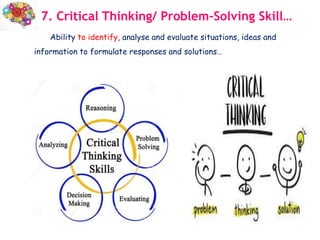
7. Critical Thinking/ Problem-Solving Skill…
Ability to identify, analyse and evaluate situations, ideas and
information to formulate responses and solutions…
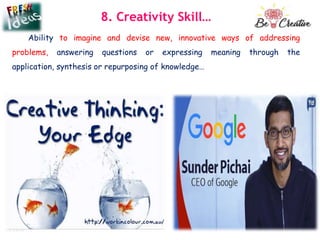
8. Creativity Skill…
Ability to imagine and devise new, innovative ways of addressing
problems, answering questions or expressing meaning through the
application, synthesis or repurposing of knowledge…
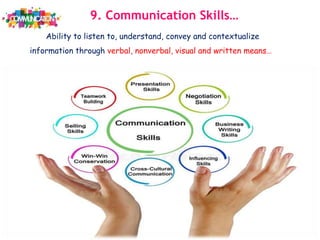
9. Communication Skills…
Ability to listen to, understand, convey and contextualize
information through verbal, nonverbal, visual and written means…
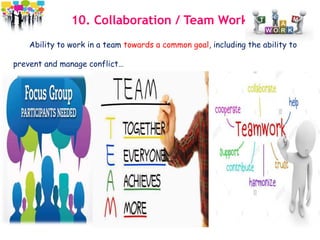
10. Collaboration / Team Work
Ability to work in a team towards a common goal, including the ability to
prevent and manage conflict…
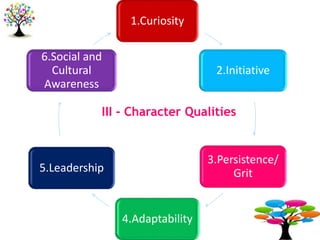
1.Curiosity
2.Initiative
3.Persistence/
Grit
4.Adaptability
5.Leadership
6.Social and
Cultural
Awareness
III - Character Qualities
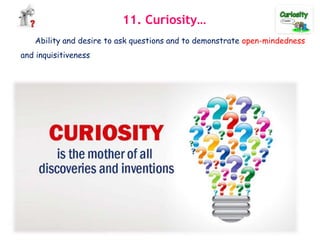
11. Curiosity…
Ability and desire to ask questions and to demonstrate open-mindedness
and inquisitiveness
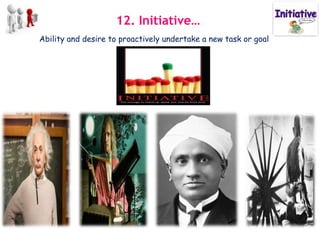
12. Initiative…
Ability and desire to proactively undertake a new task or goal
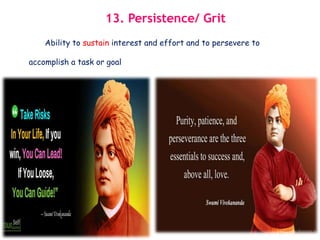
13. Persistence/ Grit
Ability to sustain interest and effort and to persevere to
accomplish a task or goal
14. Adaptability / Flexibility …
 Ability to change plans, methods, opinions or goals in light of new
information…
 Having adaptability and flexibility skills means you are open and
willing to learn new things, take on new challenges and make adjustments
to suit transitions in the workplace.
Flexibility
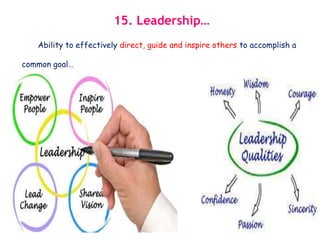
15. Leadership…
Ability to effectively direct, guide and inspire others to accomplish a
common goal…
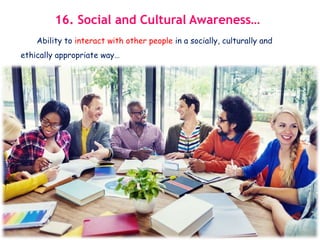
16. Social and Cultural Awareness…
Ability to interact with other people in a socially, culturally and
ethically appropriate way…
 Have you experienced awareness when interacting with a colleague who is
culturally different from you?
 Have you realized that certain words and gestures can be offensive or insensitive
in some cultures?
 As workplaces become diverse globally, it is important for each one of us to have
a high level of cultural and social awareness.
 Employability skills in today’s rapidly changing work environment requires cultural
sensitivity skills to be an important part of our experience and knowledge.
What are these Skills?
Your social and cultural skills will determine your ability to understand and
respect cultural and social differences. Depending on nationality, ethnicity, religion
and other factors, the attitudes, viewpoints and customs of people will differ. Being
aware of this is crucial to help you accept, respect and embrace these differences.
16. Social and Cultural Awareness…
Thank You
By
Dr.K.CHELLAPANDIAN
Assistant Professor of Commerce
Vivekananda College
Tiruvedakam West
Madurai – 625 234
Tamil Nadu
21st Century Skills - PPT

21st Century Skills - PPT

  • 2.
    VIVEKANANDA COLLEGE College withPotential for Excellence Reaccredited With ‘A’ Grade (CGPA 3.59 out of 4) by NAAC Residential &Autonomous - A Gurukula Institute of Life Training Affiliated to Madurai Kamaraj University Tiruvedakam West, Madurai-625 214 Tamil Nadu PG& Research Department of Commerce
  • 3.
    Dr.K.CHELLAPANDIAN M.Com., MBA., M.Sc(Psy)., M.Phil., B.Ed., PGDCA., DGT., Ph.D., NET Vivekananda College Tiruvedakam West Madurai Assistant Prof in Commerce
  • 4.
    Topic: 21st Century Skillsfor Graduate Date: 12th August 2021 (Thursday) Time: 2.30 p.m to 3.30 p.m
  • 5.
    Topic: 21st CenturySkills for Graduate
  • 6.
    Describe the 21stCentury Skills Identify ways to develop the 21st century skills; Apply the 21st century skills to improve teaching and learning. Objectives…
  • 7.
    The 21st-Century SkillsGap  (ASK) Attitude, Skills and Knowledge are the driving forces of economic growth and social development for any country.  Presently, the country faces a demand – supply mismatch, as the economy needs more ‘skilled’ workforce than that is available.  In this globally and digitally interconnected world, all learners, from cradle to career, need new skills and knowledge to succeed.  If we want to prepare our students for success in college, work and life, opportunities to learn 21st-century skills are essential.
  • 8.
    1. Foundational literacies ... 2.Competencies ... 3. Character Qualities… Topic •21st Century Skills
  • 9.
     21st Centuryskills are 16 abilities that today’s students need to succeed in their careers during the Information Age….
  • 10.
    1. Literacy Skills 2.Numeracy Skills 3. Scientific literacy Skills 4. ICT literacy Skills 5. Financial literacy Skills 6. Cultural and Civic literacy Skills I. Foundational literacies ...
  • 11.
    1. Literacy Skill… Literacyis the ability to read, write, speak and listen in a way that lets us communicate effectively and make sense of the world. Good Communicator
  • 12.
    2. Numeracy Skill… Abilityto use numbers and other symbols to understand and express quantitative relationships…
  • 13.
    3. Scientific literacy…. Abilityto use scientific knowledge and principles to understand one's environment and test hypotheses…
  • 14.
    4. ICT literacy… Abilityto use and create technology-based content, including finding and sharing information, answering questions, interacting with other people and computer programming…
  • 15.
    5. Financial literacy… Abilityto understand and apply conceptual and numerical aspects of finance in practice…
  • 16.
    6. Cultural andCivic literacy… Ability to understand, appreciate, analyse and apply knowledge of the humanities….
  • 17.
    1. Critical Thinking/Problem-Solving Skills 2. Creativity Thinking Skills 3. Communication Skills 4. Collaboration II. •Competencies
  • 18.
    7. Critical Thinking/Problem-Solving Skill… Ability to identify, analyse and evaluate situations, ideas and information to formulate responses and solutions…
  • 19.
    8. Creativity Skill… Abilityto imagine and devise new, innovative ways of addressing problems, answering questions or expressing meaning through the application, synthesis or repurposing of knowledge…
  • 20.
    9. Communication Skills… Abilityto listen to, understand, convey and contextualize information through verbal, nonverbal, visual and written means…
  • 21.
    10. Collaboration /Team Work Ability to work in a team towards a common goal, including the ability to prevent and manage conflict…
  • 22.
  • 23.
    11. Curiosity… Ability anddesire to ask questions and to demonstrate open-mindedness and inquisitiveness
  • 24.
    12. Initiative… Ability anddesire to proactively undertake a new task or goal
  • 25.
    13. Persistence/ Grit Abilityto sustain interest and effort and to persevere to accomplish a task or goal
  • 26.
    14. Adaptability /Flexibility …  Ability to change plans, methods, opinions or goals in light of new information…  Having adaptability and flexibility skills means you are open and willing to learn new things, take on new challenges and make adjustments to suit transitions in the workplace. Flexibility
  • 27.
    15. Leadership… Ability toeffectively direct, guide and inspire others to accomplish a common goal…
  • 28.
    16. Social andCultural Awareness… Ability to interact with other people in a socially, culturally and ethically appropriate way…
  • 29.
     Have youexperienced awareness when interacting with a colleague who is culturally different from you?  Have you realized that certain words and gestures can be offensive or insensitive in some cultures?  As workplaces become diverse globally, it is important for each one of us to have a high level of cultural and social awareness.  Employability skills in today’s rapidly changing work environment requires cultural sensitivity skills to be an important part of our experience and knowledge. What are these Skills? Your social and cultural skills will determine your ability to understand and respect cultural and social differences. Depending on nationality, ethnicity, religion and other factors, the attitudes, viewpoints and customs of people will differ. Being aware of this is crucial to help you accept, respect and embrace these differences. 16. Social and Cultural Awareness…
  • 31.
    Thank You By Dr.K.CHELLAPANDIAN Assistant Professorof Commerce Vivekananda College Tiruvedakam West Madurai – 625 234 Tamil Nadu