21st Century Education
Globalizing curriculum and
Instruction
“One can’t believe impossible things.”
“I dare say you haven’t had much practice,”
said the Queen. “When I was your age I
always did it for half-an-hour a day. Why,
sometimes I’ve believed as many as six
impossible things before breakfast.”
( Lewis Carroll, Alice’s Adventures in
Wonderland)
Should You Choose to Accept It . . .
• Like Alice, many educators, policy makers
and even the general public respond
resoundingly with "That's impossible!"
when challenged to adopt a new paradigm
of education for the 21st century. Most
people today adhere to a paradigm of
education that is strictly 19th century. But,
like the Queen, a growing number of
educators are believing in and
accomplishing "the impossible".
what is 21st century education?
• It is flexible, creative, challenging, and
complex. It addresses a rapidly changing
world filled with fantastic new problems as
well as exciting new possibilities.
Fortunately, there is a growing body of
research supporting an increasing number
of 21st century schools.
The 21st Century
• ushered in by a dramatic technological
revolution
• an increasingly diverse, globalized, and
complex, media-saturated society
• According to Dr. Douglas Kellner at UCLA
this technological revolution will have a
greater impact on society than the
transition from an oral to a print culture.1
• Emerging technologies and resulting
globalization also provide unlimited
possibilities for exciting new discoveries
and developments such as new forms of
energy, medical advances, restoration of
environmentally ravaged areas,
communications, and exploration into space
and into the depths of the oceans. The
possibilities are unlimited.
21st Century Skills
• “whole child”, the “whole person”,
and does not limit our professional
development and curriculum
design to workplace readiness.
Survival Skills
( advocated by Tony Wagner )
• Critical Thinking and Problem Solving
• Collaboration across Networks and Leading
by Influence
• Agility and Adaptability
• Initiative and Entrepreneurialism
• Effective Oral and Written Communication
• Accessing and Analyzing Information
• Curiosity and Imagination
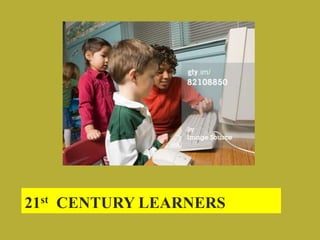
21st CENTURY LEARNERS
 Generation Y ====== Eric Chester
( they are skeptical and ask WHY )
 Net Generation/ Net Gener === Barnes
( net savvy ) Marateo
Ferris
Digital Natives ======= Marc Prensky
( native speakers of the digital language
of computers, video games and internet )
21st CENTURY LEARNERS
use information they have learned and
demonstrate their mastery of the content
in the projects they work on
 they learn how to ask the right question,
how to conduct an appropriate
investigation, how to find answers, and
how to use information
 grown up in a media saturated
environment and have become
desensitized and critical
 they find it easy to multi-task and want
to be a part of the experience that new
emerging technology brings while
craving the limelight for the effort
 students move beyond the student role
to learn through real world experiences
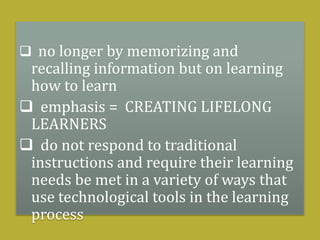
 no longer by memorizing and
recalling information but on learning
how to learn
 emphasis = CREATING LIFELONG
LEARNERS
 do not respond to traditional
instructions and require their learning
needs be met in a variety of ways that
use technological tools in the learning
process
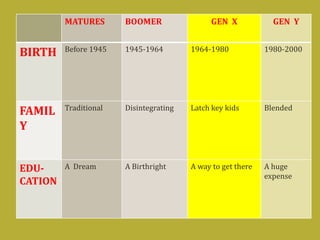
MATURES BOOMER GEN X GEN Y
BIRTH Before 1945 1945-1964 1964-1980 1980-2000
FAMIL
Y
Traditional Disintegrating Latch key kids Blended
EDU-
CATION
A Dream A Birthright A way to get there A huge
expense
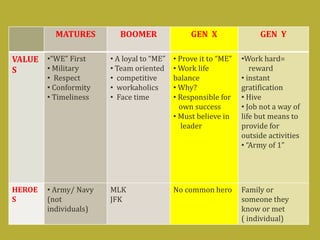
MATURES BOOMER GEN X GEN Y
VALUE
S
•“WE” First
• Military
• Respect
• Conformity
• Timeliness
• A loyal to “ME”
• Team oriented
• competitive
• workaholics
• Face time
• Prove it to “ME”
• Work life
balance
• Why?
• Responsible for
own success
• Must believe in
leader
•Work hard=
reward
• instant
gratification
• Hive
• Job not a way of
life but means to
provide for
outside activities
• “Army of 1”
HEROE
S
• Army/ Navy
(not
individuals)
MLK
JFK
No common hero Family or
someone they
know or met
( individual)
GENERATION X
vs.
GENERATION Y
Generation X
• Members of Generation X are largely in
their 30’s and early 40’s
• , they are more ethnically diverse and
better educated than the Baby Boomers
• Over 60% of Generation X attended
college.
Characteristics of Generation X
1. Individualistic
2. Technologically Adept
3. Flexible
4. Value Work/Life Balance
Generation Y
• Born in the mid-1980's and later,
Generation Y legal professionals are in
their 20s and are just entering the
workforce. With numbers estimated as
high as 70 million, Generation Y (also
known as the Millennials) is the fastest
growing segment of today’s workforce.
As law firms compete for available talent,
employers cannot ignore the needs,
desires and attitudes of this vast
Traits that define Generation Y
1. Tech-Savvy
2. Family-Centric
3. Achievement-Oriented
4. Team-Oriented
5. Attention-Craving
21 Characteristics of 21st Century
Learners (Generation Y )
1. Want to have a say in their education.
They’ll respond better when their voices
are heard.
2. Often have higher levels of digital
literacy than their parents or teachers.
They don’t know a world without
computers.
3. Expect transparency in their parents,
teachers and mentors. They’ll see right
through you.
4. Want you to tell them when you have
messed up, apologize for it, and move
on. Everyone messes up. No big deal. Just
don’t try to hide it. If you do, they are likely
to post it on Facebook.
5. Don’t care as much about having a job as
they do about making a difference. The
very concept of a “job” has changed so
much in the past decade, the future is
about making a difference.
6. Demand the freedom to show their wild
creativity. 21st century learners balk at
rote learning and memorizing. They’ll do
it if you make them, but be prepared to let
them loose to be creative, too.
7. Want to connect with others in real
time on their own terms. They want their
social media, their phones and their mobile
technology. They want to be connected. All
the time. In a way that makes sense to them
(not necessarily to you).
8. Collaborate amazingly well.
They love teamwork and figuring
things out with their friends.
9. Really can multi-task.
10. Appreciate a “trial and error”
approach to learning new skills.
11. Learn by doing. Just try making them sit
down and learn from you by watching. See
what happens.
12. Have a “can do” attitude. There is
nothing to be afraid of.
13. Thrive in an atmosphere of controlled
challenge. They must be challenged or they
zone out, but they need structure, too.
14. Have multicultural awareness and
appreciation. This generation is more
aware of a variety cultures, countries and
ways of life than any generation before
them.
15. Open to change. Really, what’s the big
deal?
16. Are equal parts “consumer” and
“creator”.
17. Increasingly aware of the world
around them. From the environment to
politics, today’s learners are asking
questions and demanding answers.
18. Know where to go to find
information. Google was first
incorporated in 1998. 21st century
learners have never known a world
without Google.
19. Are better educated than any
generation before them. 21st
century learners really do know more
than their parents (but that doesn’t
necessarily make them wiser!)
20. Expect inter-disciplinarity. It is we,
the older generation, who organize topics
into “subjects”. The 21st century learner
understands that subjects are inherently
interconnected.
21. Know that they are the future. They
look at their parents and their peers and
understand that the world’s future rests
in their hands.
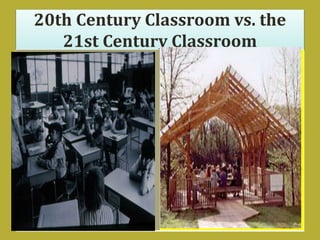
20th Century Classroom vs. the
21st Century Classroom
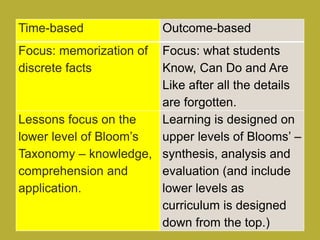
Time-based Outcome-based
Focus: memorization of
discrete facts
Focus: what students
Know, Can Do and Are
Like after all the details
are forgotten.
Lessons focus on the
lower level of Bloom’s
Taxonomy – knowledge,
comprehension and
application.
Learning is designed on
upper levels of Blooms’ –
synthesis, analysis and
evaluation (and include
lower levels as
curriculum is designed
down from the top.)
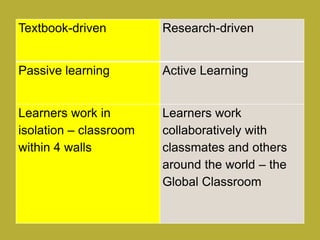
Textbook-driven Research-driven
Passive learning Active Learning
Learners work in
isolation – classroom
within 4 walls
Learners work
collaboratively with
classmates and others
around the world – the
Global Classroom
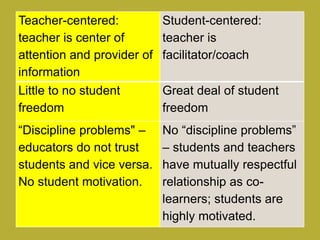
Teacher-centered:
teacher is center of
attention and provider of
information
Student-centered:
teacher is
facilitator/coach
Little to no student
freedom
Great deal of student
freedom
“Discipline problems" –
educators do not trust
students and vice versa.
No student motivation.
No “discipline problems”
– students and teachers
have mutually respectful
relationship as co-
learners; students are
highly motivated.
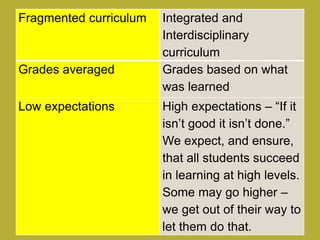
Fragmented curriculum Integrated and
Interdisciplinary
curriculum
Grades averaged Grades based on what
was learned
Low expectations High expectations – “If it
isn’t good it isn’t done.”
We expect, and ensure,
that all students succeed
in learning at high levels.
Some may go higher –
we get out of their way to
let them do that.
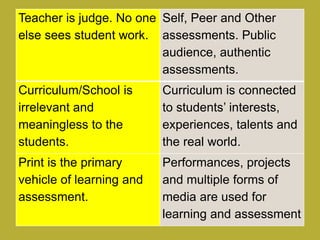
Teacher is judge. No one
else sees student work.
Self, Peer and Other
assessments. Public
audience, authentic
assessments.
Curriculum/School is
irrelevant and
meaningless to the
students.
Curriculum is connected
to students’ interests,
experiences, talents and
the real world.
Print is the primary
vehicle of learning and
assessment.
Performances, projects
and multiple forms of
media are used for
learning and assessment
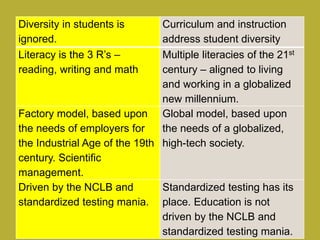
Diversity in students is
ignored.
Curriculum and instruction
address student diversity
Literacy is the 3 R’s –
reading, writing and math
Multiple literacies of the 21st
century – aligned to living
and working in a globalized
new millennium.
Factory model, based upon
the needs of employers for
the Industrial Age of the 19th
century. Scientific
management.
Global model, based upon
the needs of a globalized,
high-tech society.
Driven by the NCLB and
standardized testing mania.
Standardized testing has its
place. Education is not
driven by the NCLB and
standardized testing mania.
THANK YOU….

Arnie report.. foundation

  • 1.
    21st Century Education Globalizingcurriculum and Instruction
  • 2.
    “One can’t believeimpossible things.” “I dare say you haven’t had much practice,” said the Queen. “When I was your age I always did it for half-an-hour a day. Why, sometimes I’ve believed as many as six impossible things before breakfast.” ( Lewis Carroll, Alice’s Adventures in Wonderland)
  • 3.
    Should You Chooseto Accept It . . . • Like Alice, many educators, policy makers and even the general public respond resoundingly with "That's impossible!" when challenged to adopt a new paradigm of education for the 21st century. Most people today adhere to a paradigm of education that is strictly 19th century. But, like the Queen, a growing number of educators are believing in and accomplishing "the impossible".
  • 4.
    what is 21stcentury education? • It is flexible, creative, challenging, and complex. It addresses a rapidly changing world filled with fantastic new problems as well as exciting new possibilities. Fortunately, there is a growing body of research supporting an increasing number of 21st century schools.
  • 5.
    The 21st Century •ushered in by a dramatic technological revolution • an increasingly diverse, globalized, and complex, media-saturated society • According to Dr. Douglas Kellner at UCLA this technological revolution will have a greater impact on society than the transition from an oral to a print culture.1
  • 6.
    • Emerging technologiesand resulting globalization also provide unlimited possibilities for exciting new discoveries and developments such as new forms of energy, medical advances, restoration of environmentally ravaged areas, communications, and exploration into space and into the depths of the oceans. The possibilities are unlimited.
  • 7.
    21st Century Skills •“whole child”, the “whole person”, and does not limit our professional development and curriculum design to workplace readiness.
  • 8.
    Survival Skills ( advocatedby Tony Wagner ) • Critical Thinking and Problem Solving • Collaboration across Networks and Leading by Influence • Agility and Adaptability • Initiative and Entrepreneurialism • Effective Oral and Written Communication • Accessing and Analyzing Information • Curiosity and Imagination
  • 9.
  • 10.
     Generation Y====== Eric Chester ( they are skeptical and ask WHY )  Net Generation/ Net Gener === Barnes ( net savvy ) Marateo Ferris Digital Natives ======= Marc Prensky ( native speakers of the digital language of computers, video games and internet )
  • 11.
    21st CENTURY LEARNERS useinformation they have learned and demonstrate their mastery of the content in the projects they work on  they learn how to ask the right question, how to conduct an appropriate investigation, how to find answers, and how to use information
  • 12.
     grown upin a media saturated environment and have become desensitized and critical  they find it easy to multi-task and want to be a part of the experience that new emerging technology brings while craving the limelight for the effort  students move beyond the student role to learn through real world experiences
  • 13.
     no longerby memorizing and recalling information but on learning how to learn  emphasis = CREATING LIFELONG LEARNERS  do not respond to traditional instructions and require their learning needs be met in a variety of ways that use technological tools in the learning process
  • 14.
    MATURES BOOMER GENX GEN Y BIRTH Before 1945 1945-1964 1964-1980 1980-2000 FAMIL Y Traditional Disintegrating Latch key kids Blended EDU- CATION A Dream A Birthright A way to get there A huge expense
  • 15.
    MATURES BOOMER GENX GEN Y VALUE S •“WE” First • Military • Respect • Conformity • Timeliness • A loyal to “ME” • Team oriented • competitive • workaholics • Face time • Prove it to “ME” • Work life balance • Why? • Responsible for own success • Must believe in leader •Work hard= reward • instant gratification • Hive • Job not a way of life but means to provide for outside activities • “Army of 1” HEROE S • Army/ Navy (not individuals) MLK JFK No common hero Family or someone they know or met ( individual)
  • 16.
  • 17.
    Generation X • Membersof Generation X are largely in their 30’s and early 40’s • , they are more ethnically diverse and better educated than the Baby Boomers • Over 60% of Generation X attended college.
  • 18.
    Characteristics of GenerationX 1. Individualistic 2. Technologically Adept 3. Flexible 4. Value Work/Life Balance
  • 19.
    Generation Y • Bornin the mid-1980's and later, Generation Y legal professionals are in their 20s and are just entering the workforce. With numbers estimated as high as 70 million, Generation Y (also known as the Millennials) is the fastest growing segment of today’s workforce. As law firms compete for available talent, employers cannot ignore the needs, desires and attitudes of this vast
  • 20.
    Traits that defineGeneration Y 1. Tech-Savvy 2. Family-Centric 3. Achievement-Oriented 4. Team-Oriented 5. Attention-Craving
  • 21.
    21 Characteristics of21st Century Learners (Generation Y ) 1. Want to have a say in their education. They’ll respond better when their voices are heard. 2. Often have higher levels of digital literacy than their parents or teachers. They don’t know a world without computers. 3. Expect transparency in their parents, teachers and mentors. They’ll see right through you.
  • 22.
    4. Want youto tell them when you have messed up, apologize for it, and move on. Everyone messes up. No big deal. Just don’t try to hide it. If you do, they are likely to post it on Facebook. 5. Don’t care as much about having a job as they do about making a difference. The very concept of a “job” has changed so much in the past decade, the future is about making a difference.
  • 23.
    6. Demand thefreedom to show their wild creativity. 21st century learners balk at rote learning and memorizing. They’ll do it if you make them, but be prepared to let them loose to be creative, too. 7. Want to connect with others in real time on their own terms. They want their social media, their phones and their mobile technology. They want to be connected. All the time. In a way that makes sense to them (not necessarily to you).
  • 24.
    8. Collaborate amazinglywell. They love teamwork and figuring things out with their friends. 9. Really can multi-task. 10. Appreciate a “trial and error” approach to learning new skills.
  • 25.
    11. Learn bydoing. Just try making them sit down and learn from you by watching. See what happens. 12. Have a “can do” attitude. There is nothing to be afraid of. 13. Thrive in an atmosphere of controlled challenge. They must be challenged or they zone out, but they need structure, too. 14. Have multicultural awareness and appreciation. This generation is more aware of a variety cultures, countries and ways of life than any generation before them.
  • 26.
    15. Open tochange. Really, what’s the big deal? 16. Are equal parts “consumer” and “creator”. 17. Increasingly aware of the world around them. From the environment to politics, today’s learners are asking questions and demanding answers.
  • 27.
    18. Know whereto go to find information. Google was first incorporated in 1998. 21st century learners have never known a world without Google. 19. Are better educated than any generation before them. 21st century learners really do know more than their parents (but that doesn’t necessarily make them wiser!)
  • 28.
    20. Expect inter-disciplinarity.It is we, the older generation, who organize topics into “subjects”. The 21st century learner understands that subjects are inherently interconnected. 21. Know that they are the future. They look at their parents and their peers and understand that the world’s future rests in their hands.
  • 29.
    20th Century Classroomvs. the 21st Century Classroom
  • 30.
    Time-based Outcome-based Focus: memorizationof discrete facts Focus: what students Know, Can Do and Are Like after all the details are forgotten. Lessons focus on the lower level of Bloom’s Taxonomy – knowledge, comprehension and application. Learning is designed on upper levels of Blooms’ – synthesis, analysis and evaluation (and include lower levels as curriculum is designed down from the top.)
  • 31.
    Textbook-driven Research-driven Passive learningActive Learning Learners work in isolation – classroom within 4 walls Learners work collaboratively with classmates and others around the world – the Global Classroom
  • 32.
    Teacher-centered: teacher is centerof attention and provider of information Student-centered: teacher is facilitator/coach Little to no student freedom Great deal of student freedom “Discipline problems" – educators do not trust students and vice versa. No student motivation. No “discipline problems” – students and teachers have mutually respectful relationship as co- learners; students are highly motivated.
  • 33.
    Fragmented curriculum Integratedand Interdisciplinary curriculum Grades averaged Grades based on what was learned Low expectations High expectations – “If it isn’t good it isn’t done.” We expect, and ensure, that all students succeed in learning at high levels. Some may go higher – we get out of their way to let them do that.
  • 34.
    Teacher is judge.No one else sees student work. Self, Peer and Other assessments. Public audience, authentic assessments. Curriculum/School is irrelevant and meaningless to the students. Curriculum is connected to students’ interests, experiences, talents and the real world. Print is the primary vehicle of learning and assessment. Performances, projects and multiple forms of media are used for learning and assessment
  • 35.
    Diversity in studentsis ignored. Curriculum and instruction address student diversity Literacy is the 3 R’s – reading, writing and math Multiple literacies of the 21st century – aligned to living and working in a globalized new millennium. Factory model, based upon the needs of employers for the Industrial Age of the 19th century. Scientific management. Global model, based upon the needs of a globalized, high-tech society. Driven by the NCLB and standardized testing mania. Standardized testing has its place. Education is not driven by the NCLB and standardized testing mania.
  • 36.