21st Century LiteraciesRe-defining basic educational goals for a globalized world.Paul Treadwell, March 2011
“Acquiring literacy does not involve memorising sentences, words or syllables … but rather an attitude of creation and re-creation, a self-transformation producing a stance of intervention in one's context."  Paulo Freire, Education: The Practice of Freedom (1973)Why Talk About Literacy?
New literacies for a new world:Technology is becoming increasingly pervasiveWebs of interconnection are being woven around the worldWhat happens in Egypt affects what happens hereDistance is contracting, and expanding, at the same timeExpanding Literacies
If we accept the definition of literacy as:“(involving) a continuum of learning … enabling individuals to achieve their goals, to develop their knowledge and potential, and to participate fully in their community and wider society.” (UNESCO 2003)Fluency in multiple literacies becomes an essential need for survival in the 21st century.Being Literate
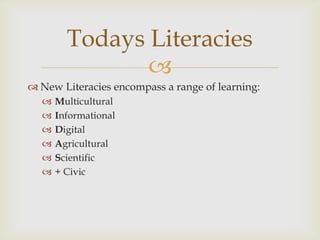
New Literacies encompass a range of learning:MulticulturalInformationalDigitalAgriculturalScientific+ CivicTodays Literacies
Currently in New York State 24% of adults fall below basic (traditional) literacy achievement.Given that, how do we embrace all the other literacies as important?Are literacies stacked, or overlapping?Literate Necessities
Providing educational programming to support the development of these literacies is “golden” Pardon me, couldn’t resist….It is also a challenge – who among us is MIDAS+ literate?The MIDAS+ Touch
If we accept the challenge of a redefined suite of literacies, what does that imply?Integration of these elements into existing programsExploring new programming to fill in gapsPartnering in new ways Making skillful use of technologyStart where people are
Not to get too philosophical but:Some literacies are “meta” literaciesSupporting the development of other literaciesWe can’t teach what we don’t knowThe Meta Level
Technology can be a meta literacyIt can support efforts to educateIt, in itself, demands a literacy of it’s usersInterlocks with and is dependent upon “traditional” literacyRole of Technology
If technology is used as a method to increase literacies, we need to expand our view of technology.Revive audio as a delivery formExplore games as learningUnite what is learned online with what is enacted locallyCreatively engage in a variety of bandwidthsNot just desktop or videoconferencingText messaging, audiocasting for mobile phonesA Broad View of Tech
While technologies may “collapse distance”, we still live in a particular place at a specific timeBalancing literacy educations to respect both the interconnectedness, and locality, of life is the challenge facing us today.Near and Far
New literacies bridge local and global knowledge and concernsWe already participate in some facets of this workIs new literacy education consistent with our mission?Challenges for Extension
Paul Treadwellpt36@cornell.edu@ptreadwellhttp://pt36.posterous.com/Contact

21st century literacies

  • 1.
    21st Century LiteraciesRe-definingbasic educational goals for a globalized world.Paul Treadwell, March 2011
  • 2.
    “Acquiring literacy doesnot involve memorising sentences, words or syllables … but rather an attitude of creation and re-creation, a self-transformation producing a stance of intervention in one's context."  Paulo Freire, Education: The Practice of Freedom (1973)Why Talk About Literacy?
  • 3.
    New literacies fora new world:Technology is becoming increasingly pervasiveWebs of interconnection are being woven around the worldWhat happens in Egypt affects what happens hereDistance is contracting, and expanding, at the same timeExpanding Literacies
  • 4.
    If we acceptthe definition of literacy as:“(involving) a continuum of learning … enabling individuals to achieve their goals, to develop their knowledge and potential, and to participate fully in their community and wider society.” (UNESCO 2003)Fluency in multiple literacies becomes an essential need for survival in the 21st century.Being Literate
  • 5.
    New Literacies encompassa range of learning:MulticulturalInformationalDigitalAgriculturalScientific+ CivicTodays Literacies
  • 6.
    Currently in NewYork State 24% of adults fall below basic (traditional) literacy achievement.Given that, how do we embrace all the other literacies as important?Are literacies stacked, or overlapping?Literate Necessities
  • 7.
    Providing educational programmingto support the development of these literacies is “golden” Pardon me, couldn’t resist….It is also a challenge – who among us is MIDAS+ literate?The MIDAS+ Touch
  • 8.
    If we acceptthe challenge of a redefined suite of literacies, what does that imply?Integration of these elements into existing programsExploring new programming to fill in gapsPartnering in new ways Making skillful use of technologyStart where people are
  • 9.
    Not to gettoo philosophical but:Some literacies are “meta” literaciesSupporting the development of other literaciesWe can’t teach what we don’t knowThe Meta Level
  • 10.
    Technology can bea meta literacyIt can support efforts to educateIt, in itself, demands a literacy of it’s usersInterlocks with and is dependent upon “traditional” literacyRole of Technology
  • 11.
    If technology isused as a method to increase literacies, we need to expand our view of technology.Revive audio as a delivery formExplore games as learningUnite what is learned online with what is enacted locallyCreatively engage in a variety of bandwidthsNot just desktop or videoconferencingText messaging, audiocasting for mobile phonesA Broad View of Tech
  • 12.
    While technologies may“collapse distance”, we still live in a particular place at a specific timeBalancing literacy educations to respect both the interconnectedness, and locality, of life is the challenge facing us today.Near and Far
  • 13.
    New literacies bridgelocal and global knowledge and concernsWe already participate in some facets of this workIs new literacy education consistent with our mission?Challenges for Extension
  • 14.

Editor's Notes

  • #3 Paulo Freire, 'Education:The Practice of Freedom' (1973) "To acquire literacy is more than to psychologically and mechanically dominate reading and writing techniques. It is to dominate those techniques in terms of consciousness; to understand what one reads and to write what one understands: it is to communicate graphically. Acquiring literacy does not involve memorising sentences, words or syllables - lifeless objects unconnected to an existential universe - but rather an attitude of creation and re-creation, a self-transformation producing a stance of intervention in one's context."