21st Century Learning Strategy Group: What, Why, How?
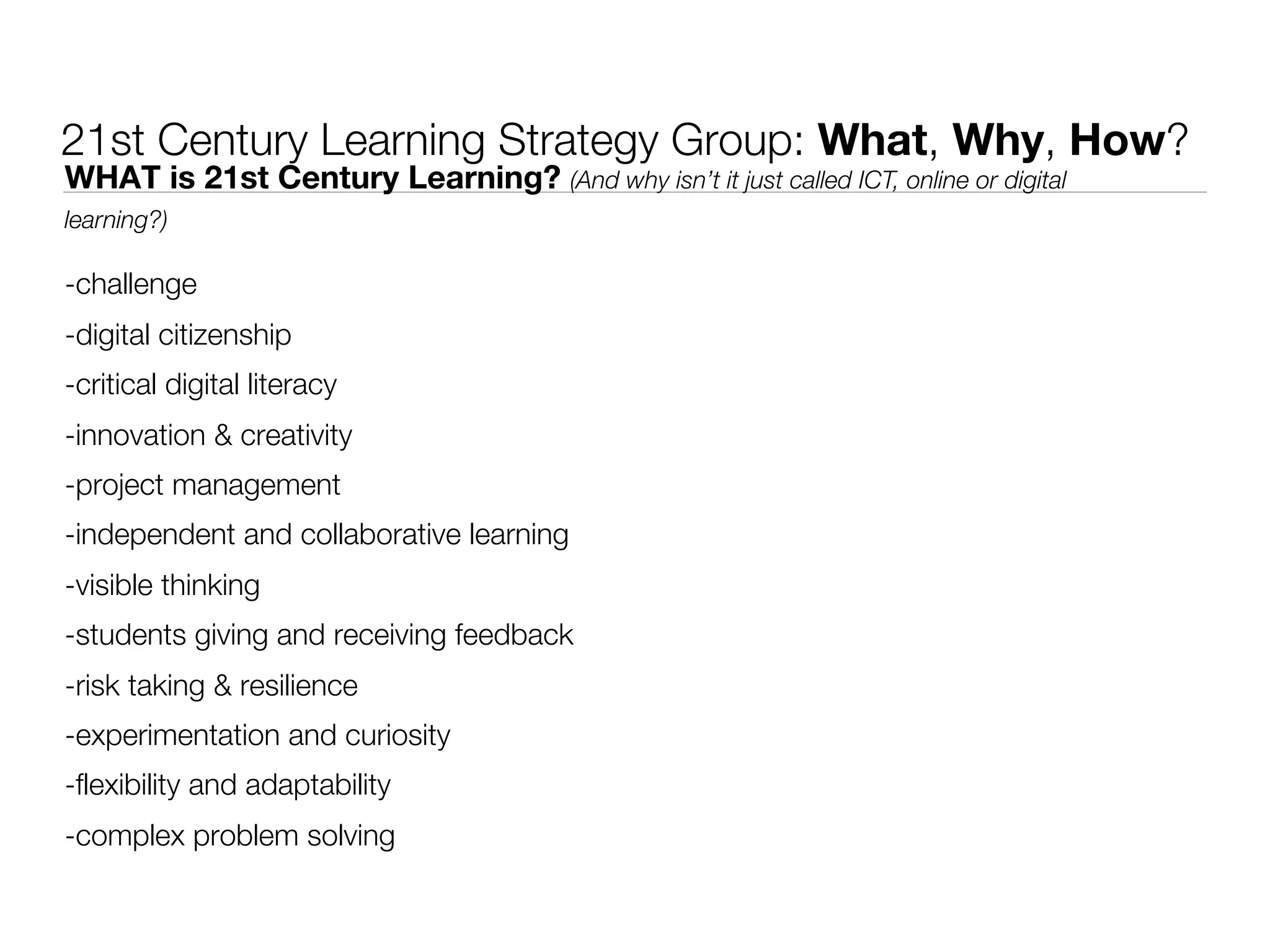
WHAT is 21st Century Learning? (And why isn’t it just called ICT, online or digital
learning?)

-challenge
-digital citizenship
-critical digital literacy
-innovation & creativity
-project management
-independent and collaborative learning
-visible thinking
-students giving and receiving feedback
-risk taking & resilience
-experimentation and curiosity
-flexibility and adaptability
-complex problem solving
Why is it important?

• Cultivating skills for tomorrow, rather than the world we grew up in. We can be
  thought of as digital immigrants. Our students are digital natives.
Why is it important?

• Cultivating skills for tomorrow, rather than the world we grew up in. We can be
  thought of as digital immigrants. Our students are digital natives.


• “Information and communication technology (ICT) is transforming the nature of
  how work is conducted and the meaning of social relationships.
Why is it important?

• Cultivating skills for tomorrow, rather than the world we grew up in. We can be
  thought of as digital immigrants. Our students are digital natives.


• “Information and communication technology (ICT) is transforming the nature of
  how work is conducted and the meaning of social relationships.


• Decentralized decision-making, information sharing, teamwork and innovation
  are key in today’s enterprises.
Why is it important?

• Cultivating skills for tomorrow, rather than the world we grew up in. We can be
  thought of as digital immigrants. Our students are digital natives.


• “Information and communication technology (ICT) is transforming the nature of
  how work is conducted and the meaning of social relationships.


• Decentralized decision-making, information sharing, teamwork and innovation
  are key in today’s enterprises.


• Rather, whether a technician or a professional person, success lies in being able
  to communicate, share and use information to solve complex problems, in
  being able to adapt and innovate in response to new demands and changing
  circumstances, in being able to marshal and expand the power of technology to
  create new knowledge and expand human capacity and productivity.” -UNIVERSITY
 OF MELBOURNE: ASSESSMENT & TEACHING OF 21ST CENTURY, Draft White Paper 1: Defining 21st Century Skills 2010
Why is it important?

• Cultivating skills for tomorrow, rather than the world we grew up in. We can be
  thought of as digital immigrants. Our students are digital natives.


• “Information and communication technology (ICT) is transforming the nature of
  how work is conducted and the meaning of social relationships.


• Decentralized decision-making, information sharing, teamwork and innovation
  are key in today’s enterprises.


• Rather, whether a technician or a professional person, success lies in being able
  to communicate, share and use information to solve complex problems, in
  being able to adapt and innovate in response to new demands and changing
  circumstances, in being able to marshal and expand the power of technology to
  create new knowledge and expand human capacity and productivity.” -UNIVERSITY
 OF MELBOURNE: ASSESSMENT & TEACHING OF 21ST CENTURY, Draft White Paper 1: Defining 21st Century Skills 2010
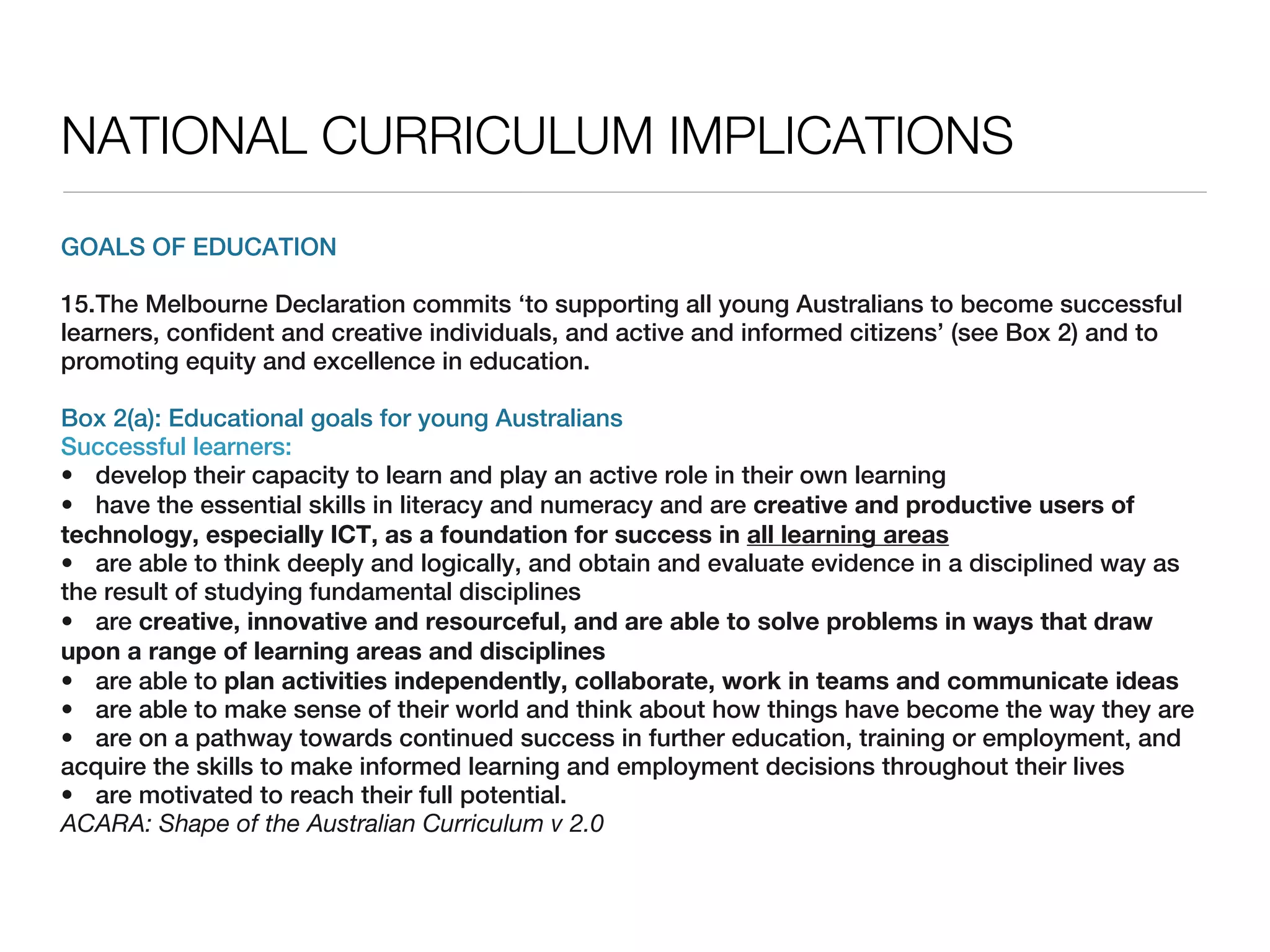
NATIONAL CURRICULUM IMPLICATIONS
GOALS OF EDUCATION

15.The Melbourne Declaration commits ‘to supporting all young Australians to become successful
learners, confident and creative individuals, and active and informed citizens’ (see Box 2) and to
promoting equity and excellence in education.

Box 2(a): Educational goals for young Australians
Successful learners:
• develop their capacity to learn and play an active role in their own learning
• have the essential skills in literacy and numeracy and are creative and productive users of
technology, especially ICT, as a foundation for success in all learning areas
• are able to think deeply and logically, and obtain and evaluate evidence in a disciplined way as
the result of studying fundamental disciplines
• are creative, innovative and resourceful, and are able to solve problems in ways that draw
upon a range of learning areas and disciplines
• are able to plan activities independently, collaborate, work in teams and communicate ideas
• are able to make sense of their world and think about how things have become the way they are
• are on a pathway towards continued success in further education, training or employment, and
acquire the skills to make informed learning and employment decisions throughout their lives
• are motivated to reach their full potential.
ACARA: Shape of the Australian Curriculum v 2.0
How?

• 21st Century Learning Strategy Group is the next step in the excellent work
  Tranby has been doing.


  • develop a vision statement based on a shared understanding of our
    position and priorities


  • What do we want a 21st Century Learner at Tranby to look like?


     • What skills do we want them to have?


     • How do we embed these into our practice?


     • How do we support each other as educators?
• Remember:


• It’s not about how well we as teachers use the tools it’s how well we
  design the LEARNING! :)

21st Century Learning Session 1

  • 2.
    21st Century LearningStrategy Group: What, Why, How? WHAT is 21st Century Learning? (And why isn’t it just called ICT, online or digital learning?) -challenge -digital citizenship -critical digital literacy -innovation & creativity -project management -independent and collaborative learning -visible thinking -students giving and receiving feedback -risk taking & resilience -experimentation and curiosity -flexibility and adaptability -complex problem solving
  • 3.
    Why is itimportant?
  • 4.
    Why is itimportant? • Cultivating skills for tomorrow, rather than the world we grew up in. We can be thought of as digital immigrants. Our students are digital natives.
  • 5.
    Why is itimportant? • Cultivating skills for tomorrow, rather than the world we grew up in. We can be thought of as digital immigrants. Our students are digital natives. • “Information and communication technology (ICT) is transforming the nature of how work is conducted and the meaning of social relationships.
  • 6.
    Why is itimportant? • Cultivating skills for tomorrow, rather than the world we grew up in. We can be thought of as digital immigrants. Our students are digital natives. • “Information and communication technology (ICT) is transforming the nature of how work is conducted and the meaning of social relationships. • Decentralized decision-making, information sharing, teamwork and innovation are key in today’s enterprises.
  • 7.
    Why is itimportant? • Cultivating skills for tomorrow, rather than the world we grew up in. We can be thought of as digital immigrants. Our students are digital natives. • “Information and communication technology (ICT) is transforming the nature of how work is conducted and the meaning of social relationships. • Decentralized decision-making, information sharing, teamwork and innovation are key in today’s enterprises. • Rather, whether a technician or a professional person, success lies in being able to communicate, share and use information to solve complex problems, in being able to adapt and innovate in response to new demands and changing circumstances, in being able to marshal and expand the power of technology to create new knowledge and expand human capacity and productivity.” -UNIVERSITY OF MELBOURNE: ASSESSMENT & TEACHING OF 21ST CENTURY, Draft White Paper 1: Defining 21st Century Skills 2010
  • 8.
    Why is itimportant? • Cultivating skills for tomorrow, rather than the world we grew up in. We can be thought of as digital immigrants. Our students are digital natives. • “Information and communication technology (ICT) is transforming the nature of how work is conducted and the meaning of social relationships. • Decentralized decision-making, information sharing, teamwork and innovation are key in today’s enterprises. • Rather, whether a technician or a professional person, success lies in being able to communicate, share and use information to solve complex problems, in being able to adapt and innovate in response to new demands and changing circumstances, in being able to marshal and expand the power of technology to create new knowledge and expand human capacity and productivity.” -UNIVERSITY OF MELBOURNE: ASSESSMENT & TEACHING OF 21ST CENTURY, Draft White Paper 1: Defining 21st Century Skills 2010
  • 9.
    NATIONAL CURRICULUM IMPLICATIONS GOALSOF EDUCATION 15.The Melbourne Declaration commits ‘to supporting all young Australians to become successful learners, confident and creative individuals, and active and informed citizens’ (see Box 2) and to promoting equity and excellence in education. Box 2(a): Educational goals for young Australians Successful learners: • develop their capacity to learn and play an active role in their own learning • have the essential skills in literacy and numeracy and are creative and productive users of technology, especially ICT, as a foundation for success in all learning areas • are able to think deeply and logically, and obtain and evaluate evidence in a disciplined way as the result of studying fundamental disciplines • are creative, innovative and resourceful, and are able to solve problems in ways that draw upon a range of learning areas and disciplines • are able to plan activities independently, collaborate, work in teams and communicate ideas • are able to make sense of their world and think about how things have become the way they are • are on a pathway towards continued success in further education, training or employment, and acquire the skills to make informed learning and employment decisions throughout their lives • are motivated to reach their full potential. ACARA: Shape of the Australian Curriculum v 2.0
  • 10.
    How? • 21st CenturyLearning Strategy Group is the next step in the excellent work Tranby has been doing. • develop a vision statement based on a shared understanding of our position and priorities • What do we want a 21st Century Learner at Tranby to look like? • What skills do we want them to have? • How do we embed these into our practice? • How do we support each other as educators?
  • 11.
    • Remember: • It’snot about how well we as teachers use the tools it’s how well we design the LEARNING! :)

Editor's Notes