





McGraw-Hill/Irwin Copyright © 2009 by The McGraw-Hill Companies, Inc.  All rights reserved.
Learning Objectives L01: Summarize major challenges of managing in the new competitive landscape L02: Describe the drivers of competitive advantage for a company L03: Explain how the functions of management are evolving in today’s business environment 1-
Learning Objectives L04: Compare how the nature of management varies at different levels of an organization L05: Define the skills you need to be an effective manager L06: Discuss the principles that will help you manage your career 1-
Managing in the New Competitive Landscape Globalization Technological change The importance of knowledge and ideas Collaboration across organizational “boundaries” 1-
What is Globalization? Consumer demands transcend national borders Organizations recruit talent from all over the world Internet use is increasing consumer demands and changing the way people work 1-
“ The best thing business schools can do to prepare their students is to encourage them to look beyond their own backyards.  Globalization has opened the world for many opportunities, and schools should encourage their students to take advantage of them.” -Jim Goodnight, CEO SAS Institute 1-
Why is the Internet important? Fulfills many business functions:  Marketplace Manufacturing goods and services Distribution channel An information service 1-
Why is the Internet important? Drives down costs Speeds up globalization Provides access to information, allows better-informed decisions, and improves efficiency of decision making Facilitates design of new products 1-
Importance of Knowledge Knowledge workers -  Workers whose primary contributions are ideas and problem-solving expertise Knowledge management –  Practices aimed at discovering and harnessing an organization’s intellectual resources 1-
Challenges of managing knowledge workers Job performance evaluation is difficult because of the lack of quantitative measures of output Motivated by interesting jobs not rewards 1-
Knowledge Management involves Finding, unlocking, sharing and altogether capitalizing on employees’ expertise, skills, wisdom, and relationships. Relies on software to allow employees to contribute and readily share knowledge with one another 1-
Collaborating for success Knowledge management ensures communication across boundaries to facilitate collaboration. Collaboration occurs inside the organization (across levels, functions, departments) as well as outside (with customers, competitors, investors) 1-
Managing for Competitive Advantage Fundamental success drivers: Innovation Quality Service Speed Cost Competitiveness 1-
Innovation Introduction of new goods and services “ Today’s holy grail.” 1-
Quality The excellence of goods or services Historically:  pertained to the physical goods that customers bought and the attractiveness, lack of defects, reliability, and long-term dependability More recently:  preventing defects before they occur, achieving zero defects in manufacturing, designing products for quality, meets consumer wishes,  1-
Service The speed and dependability with which an organization delivers what customers want 1-
Speed Fast and timely execution, response and delivery of results 1-
Cost Competitiveness Keeping costs low to achieve profits and be able to offer prices that are attractive to consumers 1-
Management success is … Delivering them all: Innovation Quality Service Speed Cost Competitiveness 1-
The Functions of Management Management is the process of working with people and resources to accomplish organizational goals 1-
Management is… Effective – to achieve organizational goals Efficient – to achieve goals with minimal waste of resources  1-
Four Management Functions Planning Organizing Leading Controlling 1-
Planning Specifying the goals to be achieved and deciding in advance the appropriate actions needed to achieve those goals. 1-
Organizing Assembling and coordinating the human, financial, physical, informational, and other resources needed to achieve goals. 1-
Leading Stimulating people to be high performers 1-
Controlling Monitoring performance and implements necessary changes. 1-
Management Levels Top Level Middle level Frontline 1-
Top managers Senior executives Responsible for overall management Concerned with organization’s interactions with the external environment Strategic managers (set overall direction by formulating strategy and controlling resources) focus on long-term issues Emphasize the survival, growth, and overall effectiveness of the organization 1-
Middle Managers Located below top-level managers and above front-line managers Tactical managers Responsible for translating the general goals and plans developed by strategic managers into specific objectives and activities 1-
Frontline Managers Lower level managers Operational managers Supervise the operations of the organization Directly involved with nonmanagement employees Implementing the specific plans developed by middle managers 1-
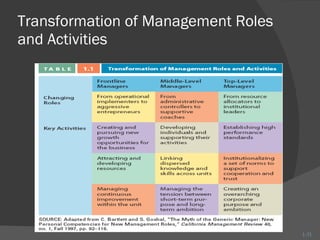
Transformation of Management Roles and Activities 1-
Management Roles Interpersonal Leader Liaison Figurehead Informational Monitor Disseminator Spokesperson Decisional Entrepreneur Disturbance handler Resource allocator Negotiation 1-
Skills YOU need to be a successful manager Technical skills Ability to perform a specialized task that involves a certain method or process Interpersonal and communication skills Ability to work well with people Conceptual and decision skills Ability to identify and resolve problems for the benefit of the organization and everyone concerned 1-
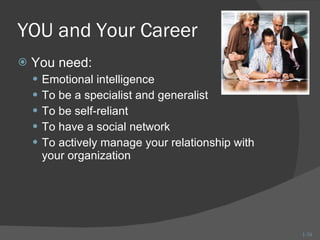
YOU and Your Career You need: Emotional intelligence To be a specialist and generalist To be self-reliant To have a social network To actively manage your relationship with your organization  1-
What’s your EQ? How well do you understand your strengths and limitations? How well do you manage your emotions, make good decisions, seek and use feedback, and exercise self-control? How well do you effectively listen, show empathy, motivate and lead others? 1-
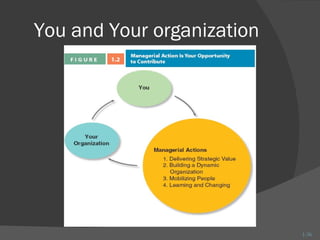
You and Your organization 1-
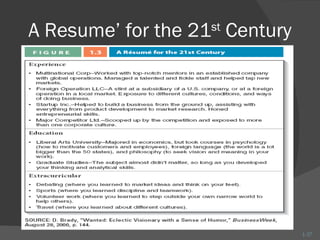
A Resume’ for the 21 st  Century 1-
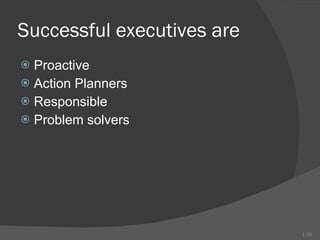
Successful executives are Proactive  Action Planners Responsible  Problem solvers 1-
 
Review of Learning Objectives L01: Summarize major challenges of managing in the new competitive landscape L02: Describe the drivers of competitive advantage for a company L03: Explain how the functions of management are evolving in today’s business environment 1-
Review of Learning Objectives L04: Compare how the nature of management varies at different levels of an organization L05: Define the skills you need to be an effective manager L06: Discuss the principles that will help you manage your career 1-
Test your Knowledge How does the nature of management vary at different levels of an organization? 1-
Test Your Skills Glass Slipper Project Describe how the four functions of management apply to the Glass Slipper Project, its founders and participants Describe some of the specific skills you think Jim Nutini must have to get the dresses cleaned, packaged, and delivered in time for shopping days. 1-
Test your knowledge Summarize the major challenges in the new competitive landscape 1-
Test Your Knowledge Describe the drivers of competitive advantage for a company 1-
1-

BUS137 Chapter 1

  • 1.
    McGraw-Hill/Irwin Copyright ©2009 by The McGraw-Hill Companies, Inc. All rights reserved.
  • 2.
    Learning Objectives L01:Summarize major challenges of managing in the new competitive landscape L02: Describe the drivers of competitive advantage for a company L03: Explain how the functions of management are evolving in today’s business environment 1-
  • 3.
    Learning Objectives L04:Compare how the nature of management varies at different levels of an organization L05: Define the skills you need to be an effective manager L06: Discuss the principles that will help you manage your career 1-
  • 4.
    Managing in theNew Competitive Landscape Globalization Technological change The importance of knowledge and ideas Collaboration across organizational “boundaries” 1-
  • 5.
    What is Globalization?Consumer demands transcend national borders Organizations recruit talent from all over the world Internet use is increasing consumer demands and changing the way people work 1-
  • 6.
    “ The bestthing business schools can do to prepare their students is to encourage them to look beyond their own backyards. Globalization has opened the world for many opportunities, and schools should encourage their students to take advantage of them.” -Jim Goodnight, CEO SAS Institute 1-
  • 7.
    Why is theInternet important? Fulfills many business functions: Marketplace Manufacturing goods and services Distribution channel An information service 1-
  • 8.
    Why is theInternet important? Drives down costs Speeds up globalization Provides access to information, allows better-informed decisions, and improves efficiency of decision making Facilitates design of new products 1-
  • 9.
    Importance of KnowledgeKnowledge workers - Workers whose primary contributions are ideas and problem-solving expertise Knowledge management – Practices aimed at discovering and harnessing an organization’s intellectual resources 1-
  • 10.
    Challenges of managingknowledge workers Job performance evaluation is difficult because of the lack of quantitative measures of output Motivated by interesting jobs not rewards 1-
  • 11.
    Knowledge Management involvesFinding, unlocking, sharing and altogether capitalizing on employees’ expertise, skills, wisdom, and relationships. Relies on software to allow employees to contribute and readily share knowledge with one another 1-
  • 12.
    Collaborating for successKnowledge management ensures communication across boundaries to facilitate collaboration. Collaboration occurs inside the organization (across levels, functions, departments) as well as outside (with customers, competitors, investors) 1-
  • 13.
    Managing for CompetitiveAdvantage Fundamental success drivers: Innovation Quality Service Speed Cost Competitiveness 1-
  • 14.
    Innovation Introduction ofnew goods and services “ Today’s holy grail.” 1-
  • 15.
    Quality The excellenceof goods or services Historically: pertained to the physical goods that customers bought and the attractiveness, lack of defects, reliability, and long-term dependability More recently: preventing defects before they occur, achieving zero defects in manufacturing, designing products for quality, meets consumer wishes, 1-
  • 16.
    Service The speedand dependability with which an organization delivers what customers want 1-
  • 17.
    Speed Fast andtimely execution, response and delivery of results 1-
  • 18.
    Cost Competitiveness Keepingcosts low to achieve profits and be able to offer prices that are attractive to consumers 1-
  • 19.
    Management success is… Delivering them all: Innovation Quality Service Speed Cost Competitiveness 1-
  • 20.
    The Functions ofManagement Management is the process of working with people and resources to accomplish organizational goals 1-
  • 21.
    Management is… Effective– to achieve organizational goals Efficient – to achieve goals with minimal waste of resources 1-
  • 22.
    Four Management FunctionsPlanning Organizing Leading Controlling 1-
  • 23.
    Planning Specifying thegoals to be achieved and deciding in advance the appropriate actions needed to achieve those goals. 1-
  • 24.
    Organizing Assembling andcoordinating the human, financial, physical, informational, and other resources needed to achieve goals. 1-
  • 25.
    Leading Stimulating peopleto be high performers 1-
  • 26.
    Controlling Monitoring performanceand implements necessary changes. 1-
  • 27.
    Management Levels TopLevel Middle level Frontline 1-
  • 28.
    Top managers Seniorexecutives Responsible for overall management Concerned with organization’s interactions with the external environment Strategic managers (set overall direction by formulating strategy and controlling resources) focus on long-term issues Emphasize the survival, growth, and overall effectiveness of the organization 1-
  • 29.
    Middle Managers Locatedbelow top-level managers and above front-line managers Tactical managers Responsible for translating the general goals and plans developed by strategic managers into specific objectives and activities 1-
  • 30.
    Frontline Managers Lowerlevel managers Operational managers Supervise the operations of the organization Directly involved with nonmanagement employees Implementing the specific plans developed by middle managers 1-
  • 31.
    Transformation of ManagementRoles and Activities 1-
  • 32.
    Management Roles InterpersonalLeader Liaison Figurehead Informational Monitor Disseminator Spokesperson Decisional Entrepreneur Disturbance handler Resource allocator Negotiation 1-
  • 33.
    Skills YOU needto be a successful manager Technical skills Ability to perform a specialized task that involves a certain method or process Interpersonal and communication skills Ability to work well with people Conceptual and decision skills Ability to identify and resolve problems for the benefit of the organization and everyone concerned 1-
  • 34.
    YOU and YourCareer You need: Emotional intelligence To be a specialist and generalist To be self-reliant To have a social network To actively manage your relationship with your organization 1-
  • 35.
    What’s your EQ?How well do you understand your strengths and limitations? How well do you manage your emotions, make good decisions, seek and use feedback, and exercise self-control? How well do you effectively listen, show empathy, motivate and lead others? 1-
  • 36.
    You and Yourorganization 1-
  • 37.
    A Resume’ forthe 21 st Century 1-
  • 38.
    Successful executives areProactive Action Planners Responsible Problem solvers 1-
  • 39.
  • 40.
    Review of LearningObjectives L01: Summarize major challenges of managing in the new competitive landscape L02: Describe the drivers of competitive advantage for a company L03: Explain how the functions of management are evolving in today’s business environment 1-
  • 41.
    Review of LearningObjectives L04: Compare how the nature of management varies at different levels of an organization L05: Define the skills you need to be an effective manager L06: Discuss the principles that will help you manage your career 1-
  • 42.
    Test your KnowledgeHow does the nature of management vary at different levels of an organization? 1-
  • 43.
    Test Your SkillsGlass Slipper Project Describe how the four functions of management apply to the Glass Slipper Project, its founders and participants Describe some of the specific skills you think Jim Nutini must have to get the dresses cleaned, packaged, and delivered in time for shopping days. 1-
  • 44.
    Test your knowledgeSummarize the major challenges in the new competitive landscape 1-
  • 45.
    Test Your KnowledgeDescribe the drivers of competitive advantage for a company 1-
  • 46.