Vocabulary about
Photography
Gisselle Riveros
English teacher
~ June 2014
Types of Photography
Landscape
photography
Photography that shows different spaces within the
world, often including urban, industrial, macro and
nature photography.
Portraiture Photography of a person or group of people that
displays the expression, personality, and mood of the
subject.
Monochrome Photographs that are in grey scale (only black and
white) or sepia (different shades of brown, like old
photographs).
Types of Photography
Macrophotography Photos of very small subjects. In modern use it refers to
a finished photograph of a subject at greater than life
size.
Aerial photography The taking of photographs of the ground from an
elevated position.
Stock photography The supply of photographs licensed for specific uses.
Equipment
Darkroom A room that can be made completely dark to allow the
processing of light sensitive photographic materials.
SLR camera
(Single-lens reflex)
Typically uses a mirror and prism system that allows the
photographer to view through the lens and therefore see
exactly what will be captured.
A point and shoot Also called a compact camera, there are no additional
manual settings or options. The camera focus, flash and
all settings are automatically set by the camera allowing
users to simply point the camera at the subject and
Press the shutter button.
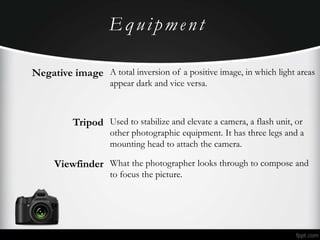
Equipment
Negative image A total inversion of a positive image, in which light areas
appear dark and vice versa.
Tripod Used to stabilize and elevate a camera, a flash unit, or
other photographic equipment. It has three legs and a
mounting head to attach the camera.
Viewfinder What the photographer looks through to compose and
to focus the picture.
Photographic Terms
Exposure The total amount of light allowed to fall on the
photographic medium (photographic film or image
sensor) during the process of taking a photograph.
Shutter speed The effective length of time a camera's shutter is
open i.e. The exposure time.
Aperture A hole or an opening through which light travels, which
determines the angle of the rays that come to a
focus on the image plane
Photographic Terms
Rule of thirds Guideline which proposes that an image should be
imagined as divided into nine equal parts by two equally-
spaced horizontal and vertical lines, and that important
compositional elements should be placed along these
lines or their intersections
Time-lapse
photography
A technique whereby the frequency at which film
frames are captured is much lower than that used to
view the sequence. When played at normal speed, time
appears to be moving faster e.g. An image of a scene
may be captured once every second, then played back at
30 frames per second
Verbs
To take a photo We don't normally say 'make' a photo, we say 'take' a
photo!
To develop a photo Creating a 'real' touch and feel photo onto
photographic paper from the negative.
To frame the shot To carefully compose the photo with your viewfinder.
To crop it To cut the photo to the required size and
composition (normally electronically).
To capture it To catch it in everlasting form.
From:
http://www.englishisapieceofcake.com/support-files/photography-
vocabulary.pdf

Photography vocabulary

  • 1.
  • 2.
    Types of Photography Landscape photography Photographythat shows different spaces within the world, often including urban, industrial, macro and nature photography. Portraiture Photography of a person or group of people that displays the expression, personality, and mood of the subject. Monochrome Photographs that are in grey scale (only black and white) or sepia (different shades of brown, like old photographs).
  • 3.
    Types of Photography MacrophotographyPhotos of very small subjects. In modern use it refers to a finished photograph of a subject at greater than life size. Aerial photography The taking of photographs of the ground from an elevated position. Stock photography The supply of photographs licensed for specific uses.
  • 4.
    Equipment Darkroom A roomthat can be made completely dark to allow the processing of light sensitive photographic materials. SLR camera (Single-lens reflex) Typically uses a mirror and prism system that allows the photographer to view through the lens and therefore see exactly what will be captured. A point and shoot Also called a compact camera, there are no additional manual settings or options. The camera focus, flash and all settings are automatically set by the camera allowing users to simply point the camera at the subject and Press the shutter button.
  • 5.
    Equipment Negative image Atotal inversion of a positive image, in which light areas appear dark and vice versa. Tripod Used to stabilize and elevate a camera, a flash unit, or other photographic equipment. It has three legs and a mounting head to attach the camera. Viewfinder What the photographer looks through to compose and to focus the picture.
  • 6.
    Photographic Terms Exposure Thetotal amount of light allowed to fall on the photographic medium (photographic film or image sensor) during the process of taking a photograph. Shutter speed The effective length of time a camera's shutter is open i.e. The exposure time. Aperture A hole or an opening through which light travels, which determines the angle of the rays that come to a focus on the image plane
  • 7.
    Photographic Terms Rule ofthirds Guideline which proposes that an image should be imagined as divided into nine equal parts by two equally- spaced horizontal and vertical lines, and that important compositional elements should be placed along these lines or their intersections Time-lapse photography A technique whereby the frequency at which film frames are captured is much lower than that used to view the sequence. When played at normal speed, time appears to be moving faster e.g. An image of a scene may be captured once every second, then played back at 30 frames per second
  • 8.
    Verbs To take aphoto We don't normally say 'make' a photo, we say 'take' a photo! To develop a photo Creating a 'real' touch and feel photo onto photographic paper from the negative. To frame the shot To carefully compose the photo with your viewfinder. To crop it To cut the photo to the required size and composition (normally electronically). To capture it To catch it in everlasting form.
  • 9.