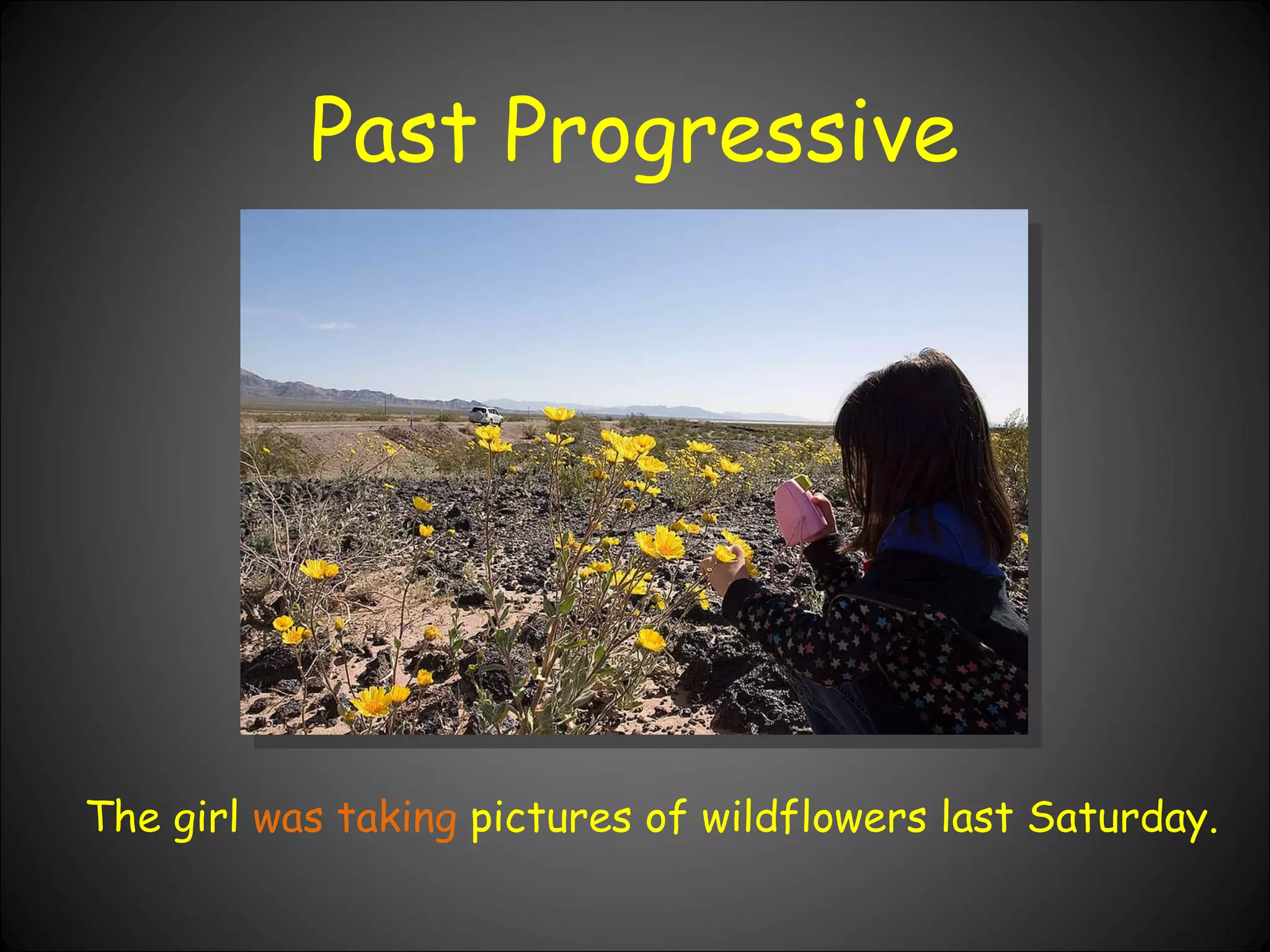
Past Progressive The girl  was taking  pictures of wildflowers last Saturday.
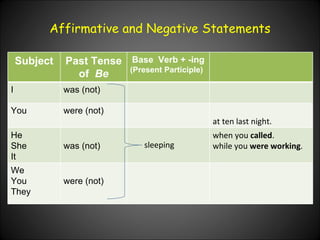
Affirmative and Negative Statements Subject Past Tense of  Be Base  Verb + -ing (Present Participle) I was (not) You were (not) at ten last night. He She It was (not) sleeping when you  called . while you  were working . We You They were (not)
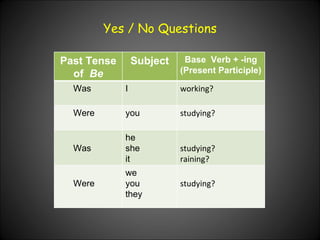
Yes / No Questions Past Tense of  Be Subject Base  Verb + -ing (Present Participle) Was I working? Were  you studying? Was  he she it studying? raining? Were we you they studying?
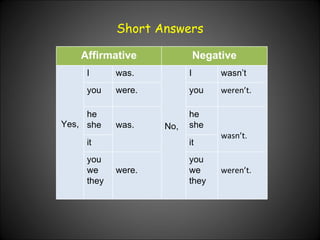
Short Answers Affirmative Negative Yes, I was. No, I wasn’t you were. you weren’t. he she was. he she wasn’t. it it you we they were. you we they weren’t.
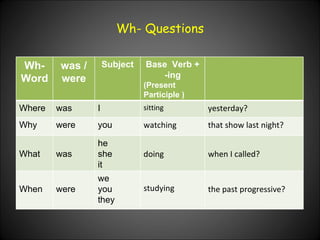
Wh- Questions Wh- Word was / were Subject Base  Verb + -ing (Present Participle ) Where was I sitting yesterday? Why were you watching that show last night? What was he she it doing when I called? When were we you they studying the past progressive?
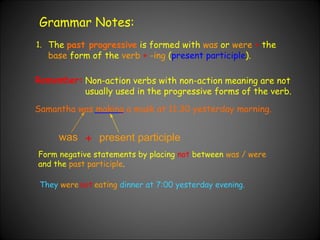
Grammar Notes: 1. The  past progressive  is formed with  was  or  were   +  the  base  form of the  verb   +   -ing  ( present participle ). Non-action verbs with non-action meaning are not usually used in the progressive forms of the verb. Samantha was making a mask at 11:30 yesterday morning. Remember: was + present participle Form negative statements by placing  not  between  was / were  and the  past participle . They   were eating   dinner at 7:00 yesterday evening. not
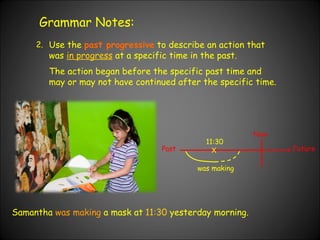
Grammar Notes: 2. Use the  past progressive  to describe an action that was  in progress  at a specific time in the past. The action began before the specific past time and may or may not have continued after the specific time. Samantha  was making  a mask at  11:30  yesterday morning. Past Now Future X was making 11:30
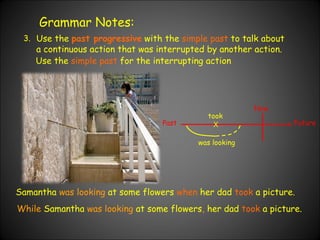
Grammar Notes: 3. Use the  past progressive  with the  simple past  to talk about a continuous action that was interrupted by another action.  Use the  simple past  for the interrupting action Samantha  was looking  at some flowers  when  her dad  took  a picture. Past Now Future X was looking took While  Samantha  was looking  at some flowers ,  her dad  took  a picture.
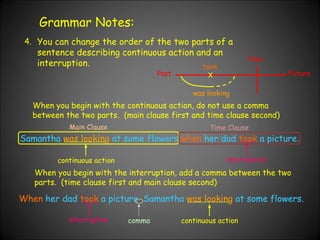
Grammar Notes: 4. You can change the order of the two parts of a sentence describing continuous action and an interruption.  When you begin with the continuous action, do not use a comma between the two parts.  (main clause first and time clause second) Samantha   was looking   at some flowers   when   her dad   took   a picture. Past Now Future X was looking took When   her dad   took   a picture ,  Samantha   was looking   at some flowers. continuous action interruption When you begin with the interruption, add a comma between the two parts.  (time clause first and main clause second) interruption continuous action comma Main Clause Time Clause
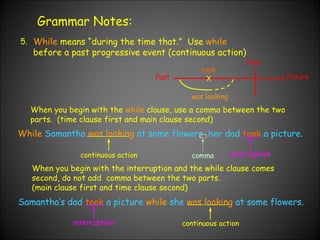
Grammar Notes: 5. While  means “during the time that.”  Use  while  before a past progressive event (continuous action)  When you begin with the  while  clause, use a comma between the two parts.  (time clause first and main clause second) Samantha’s dad   took   a picture  while  she   was looking   at some flowers. Past Now Future X was looking took While   Samantha   was looking   at some flowers ,  her dad   took   a picture. When you begin with the interruption and the while clause comes second, do not add  comma between the two parts.  (main clause first and time clause second) interruption continuous action comma continuous action interruption
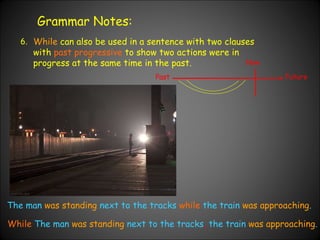
Grammar Notes: 6. While  can also be used in a sentence with two clauses with  past progressive  to show two actions were in progress at the same time in the past.  Past Now Future The man  was standing  next to the tracks  while  the train  was approaching . While  The man  was standing  next to the tracks ,  the train  was approaching .
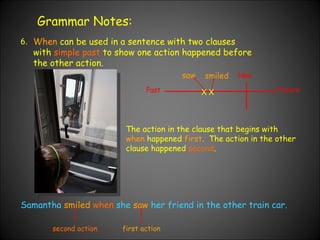
Grammar Notes: 6. When  can be used in a sentence with two clauses with  simple past  to show one action happened before the other action.  Past Now Future Samantha  smiled  when  she  saw  her friend in the other train car. X X saw smiled The action in the clause that begins with  when  happened  first .  The action in the other clause happened  second . first action second action
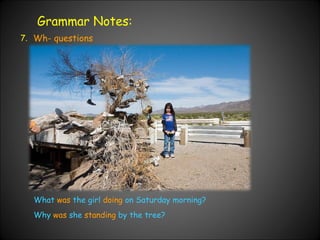
Grammar Notes: 7. Wh- questions What  was  the girl  doing  on Saturday morning? Why  was  she  standing  by the tree?
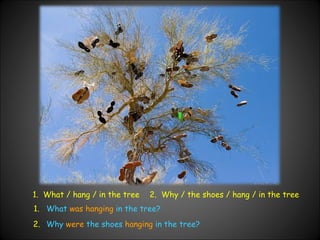
1.  What / hang / in the tree 2.  Why / the shoes / hang / in the tree 1. What  was   hanging  in the tree? 2. Why  were  the shoes  hanging  in the tree?
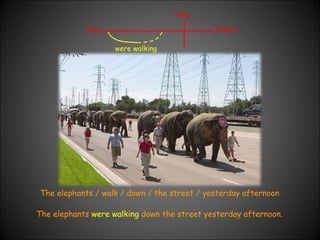
Past Now Future were walking The elephants / walk / down / the street / yesterday afternoon The elephants  were walking  down the street yesterday afternoon.
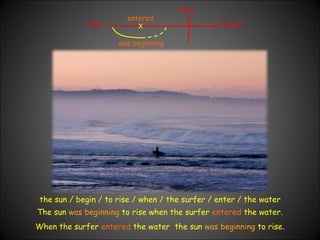
Past Now Future X was beginning entered the sun / begin / to rise / when / the surfer / enter / the water The sun  was beginning  to rise when the surfer  entered  the water . When the surfer  entered  the water  the sun  was beginning  to rise . ,
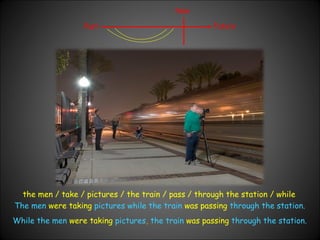
Past Now Future the men / take / pictures / the train / pass / through the station / while The men  were taking  pictures while the train  was passing  through the station. While the men  were taking  pictures ,  the train  was passing  through the station.
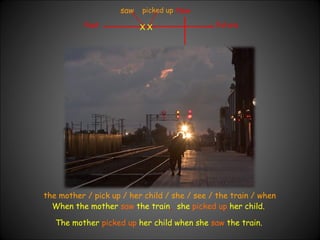
Past Now Future X X saw picked up the mother / pick up / her child / she / see / the train / when When the mother  saw  the train ,   she  picked up  her child.   The mother  picked up  her child when she  saw  the train.

Past Progressive

  • 1.
    Past Progressive Thegirl was taking pictures of wildflowers last Saturday.
  • 2.
    Affirmative and NegativeStatements Subject Past Tense of Be Base Verb + -ing (Present Participle) I was (not) You were (not) at ten last night. He She It was (not) sleeping when you called . while you were working . We You They were (not)
  • 3.
    Yes / NoQuestions Past Tense of Be Subject Base Verb + -ing (Present Participle) Was I working? Were you studying? Was he she it studying? raining? Were we you they studying?
  • 4.
    Short Answers AffirmativeNegative Yes, I was. No, I wasn’t you were. you weren’t. he she was. he she wasn’t. it it you we they were. you we they weren’t.
  • 5.
    Wh- Questions Wh-Word was / were Subject Base Verb + -ing (Present Participle ) Where was I sitting yesterday? Why were you watching that show last night? What was he she it doing when I called? When were we you they studying the past progressive?
  • 6.
    Grammar Notes: 1.The past progressive is formed with was or were + the base form of the verb + -ing ( present participle ). Non-action verbs with non-action meaning are not usually used in the progressive forms of the verb. Samantha was making a mask at 11:30 yesterday morning. Remember: was + present participle Form negative statements by placing not between was / were and the past participle . They were eating dinner at 7:00 yesterday evening. not
  • 7.
    Grammar Notes: 2.Use the past progressive to describe an action that was in progress at a specific time in the past. The action began before the specific past time and may or may not have continued after the specific time. Samantha was making a mask at 11:30 yesterday morning. Past Now Future X was making 11:30
  • 8.
    Grammar Notes: 3.Use the past progressive with the simple past to talk about a continuous action that was interrupted by another action. Use the simple past for the interrupting action Samantha was looking at some flowers when her dad took a picture. Past Now Future X was looking took While Samantha was looking at some flowers , her dad took a picture.
  • 9.
    Grammar Notes: 4.You can change the order of the two parts of a sentence describing continuous action and an interruption. When you begin with the continuous action, do not use a comma between the two parts. (main clause first and time clause second) Samantha was looking at some flowers when her dad took a picture. Past Now Future X was looking took When her dad took a picture , Samantha was looking at some flowers. continuous action interruption When you begin with the interruption, add a comma between the two parts. (time clause first and main clause second) interruption continuous action comma Main Clause Time Clause
  • 10.
    Grammar Notes: 5.While means “during the time that.” Use while before a past progressive event (continuous action) When you begin with the while clause, use a comma between the two parts. (time clause first and main clause second) Samantha’s dad took a picture while she was looking at some flowers. Past Now Future X was looking took While Samantha was looking at some flowers , her dad took a picture. When you begin with the interruption and the while clause comes second, do not add comma between the two parts. (main clause first and time clause second) interruption continuous action comma continuous action interruption
  • 11.
    Grammar Notes: 6.While can also be used in a sentence with two clauses with past progressive to show two actions were in progress at the same time in the past. Past Now Future The man was standing next to the tracks while the train was approaching . While The man was standing next to the tracks , the train was approaching .
  • 12.
    Grammar Notes: 6.When can be used in a sentence with two clauses with simple past to show one action happened before the other action. Past Now Future Samantha smiled when she saw her friend in the other train car. X X saw smiled The action in the clause that begins with when happened first . The action in the other clause happened second . first action second action
  • 13.
    Grammar Notes: 7.Wh- questions What was the girl doing on Saturday morning? Why was she standing by the tree?
  • 14.
    1. What/ hang / in the tree 2. Why / the shoes / hang / in the tree 1. What was hanging in the tree? 2. Why were the shoes hanging in the tree?
  • 15.
    Past Now Futurewere walking The elephants / walk / down / the street / yesterday afternoon The elephants were walking down the street yesterday afternoon.
  • 16.
    Past Now FutureX was beginning entered the sun / begin / to rise / when / the surfer / enter / the water The sun was beginning to rise when the surfer entered the water . When the surfer entered the water the sun was beginning to rise . ,
  • 17.
    Past Now Futurethe men / take / pictures / the train / pass / through the station / while The men were taking pictures while the train was passing through the station. While the men were taking pictures , the train was passing through the station.
  • 18.
    Past Now FutureX X saw picked up the mother / pick up / her child / she / see / the train / when When the mother saw the train , she picked up her child. The mother picked up her child when she saw the train.