1
Cathode Rays and CRO
Cathode rays and CRO
Charge and mass of electrons
JJ Thomson and Millikan-Experiment
Dr. Pius Augustine, SH College, Kochi
Is electron a Fundamental Particle?
600 BC – Kannad – matter consists of indiviscible particle
“paramanu”
Present study tells that electrons and leptons are the
fundamental particles
1998 Nobel prize winners said “electrons in a powerful magnetic
field condense to form a kind of fluid” – quasi particles –
having charge equal to a fraction of electronic charge.
Superconductivity – even after 100 yrs- unable to explain high
temperature superconductivity – may be a fractional electron
concept is required.
Dr. Pius Augustine, SH College, Kochi
Why gases are generally poor conductors of
electricity?
Do not have free charge particles in large
numbers to respond to electric field.
Even if there is ionization due to cosmic rays or
so, recombination nullifies.
One way to make gas conducting is apply a large
p.d across a gas column at very low pressure.
Another pass X-ray through gases
Dr. Pius Augustine, SH College, Kochi
Explanation of Discharge Phenomenon
Due to cosmic rays etc, some ions are always
present in a gas.
Under high E – accelerated charged ions collide
and ionize (+vely) more molecules.
(cummulative)
Detached electrons can move large distance
without getting attached to –ve ions, if pressure
is low.
Dr. Pius Augustine, SH College, Kochi
What is sparking potential?
If the p.d between the electrodes is gradually
increased, sparking occurs in the gas at certain
stage and the minimum potential difference
needed for it is called sparking potential
Sparking potential depends on
i. Pressure (P) of the gas
ii. Separation (d) between the electrodes.
It is a function of the product f(Pd)
Known as Paschen’s law.Dr. Pius Augustine, SH College, Kochi
The mean free path of electrons in the gas in a
discharge tube is inversely proportional to the
pressure inside it. The Crookes dark space
occupies half the length of the discharge tube
when the pressure is 0.02 mm of Hg. Estimate
the pressure at which the dark space will fill the
whole tube?
Hint
L α 1/P
Length will be doubled, if P is reduced to half
Full length of the tube, when P = 0.01 mm of Hg.
Two discharge tubes have identical material
structures and the same gas is filled in them.
The length of one tube is 10 cm and that of the
other tube is 20 cm. Sparking starts in both the
tubes when the potential difference between the
cathode and the anode is 100 V. If the pressure
is the shorter tube is 1.0 mm of Hg, what is the
pressure in the long tube?
Hint
Sparking potential is f(Pd)
V1 = K P1d1 V2 = K P2d2 Take ratio - will give P2 = 0.5 mm of Hg
Requirement for electrical conduction in gases
i. By applying very high voltage
ii. By reducing pressure to very low
value
Note: At normal atm pressure: 30,000 V/cm
is required to produce electrical
discharge in gas.
Dr. Pius Augustine, SH College, Kochi
Discharge tube
Pyrex glass tube, about 40cm long and
4cm diameter
Connected to vacuum pump
Two circular electrodes are fixed at two
ends
10,000 V to 15,000 V can be applied
Dr. Pius Augustine, SH College, Kochi
Response under various
pressures
Dr. Pius Augustine, SH College, Kochi
i. Pressure of about 10 cm of Hg.
Irregular streaks of light with
crackling sound
Dr. Pius Augustine, SH College, Kochi
At 1cm of Hg
Streaks widen out in to a luminous
column called positive column
extends from cathode to anode.
Buzzing sound.
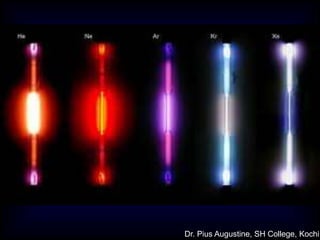
Colour depends on nature of gas inside
Red- neon bluish – CO2
Dr. Pius Augustine, SH College, Kochi
Positive column
With fewer ions, as the electric field increases,
electrons with energy of about 2 eV, excite
atoms and produce light.
Dr. Pius Augustine, SH College, Kochi
At 0.3 cm of Hg
+ve column is detached from
cathode and another glow appears
in the cathode called negative
glow
Faraday’s Dark Space between two
columns Dr. Pius Augustine, SH College, Kochi
At 0.01cm of Hg
Cathode glow appears on cathode
Crooke’s dark space between
+ve column is divided into equally
spaced striations
Dr. Pius Augustine, SH College, Kochi
0.001 cm of Hg
Striations disappear
-ve and cathode glow vanishes
Whole tube is filled with crookes dark space
Walls of tube begins to glow called
fluorescence
Invisible rays are called cathode rays
Dr. Pius Augustine, SH College, Kochi
Reasons for various phenomena seen
High speed atomic particles can
cause ionization by collision
Atoms and molecules emit
radiations when they are in excited
states
Dr. Pius Augustine, SH College, Kochi
Cathode rays
Invisible rays emerging normally from
the cathode of a discharge tube, kept
at a pressure of 0.001cm of Hg and
under a very high p.d .of the order of
ten thousand volts across the
electrodes.
Dr. Pius Augustine, SH College, Kochi
Properties of cathode rays
i. Travel in straight line
ii. Emitted normally from cathode
iii. Possess high momentum and K.E.
iv. Emit from cathode, -vely charged
v. Deflected by E and B (establish –ve charge)
vi. Produce heat when falling on matter
Dr. Pius Augustine, SH College, Kochi
Properties of cathode rays
vii. Ionise gas through which they pass.
viii. Affect photographic plate
ix. Produce fluorescence
x. Velocity = 1/10th velocity of light (c)
xi. If suddenly stopped – X-rays are produced.
xii. Will exert mechanical pressure
Dr. Pius Augustine, SH College, Kochi
Are cathode rays electromagnetic? Comment
No.
Emitted only in one direction from cathode
Had they been em waves, would have
been emitted in all directions
Velocity of em waves constant but cathode
rays have different velocity depending
upon the p.d between anode and cathode.
Dr. Pius Augustine, SH College, Kochi
The electric discharge stops at very low pressure.
Why?
If gas is too rarefied, sufficient
positive ions are not available to
ejects electrons from the cathode
and hence the discharge current
stops.
Dr. Pius Augustine, SH College, Kochi
A discharge tube contains helium at a low pressure. A
large potential difference is applied across the tube.
Consider a helium atom that has just been ionized due
to the detachment of an atomic electron. Find the ratio
of the distance travelled by the free electron to that by
the positive ion in a short time dt after the ionization.
Hint
Charge of particles (equal) = q
me, mp are known, Electric field = E F = qE
Electron ae = qE/me. Se = ½ at2.
Positive ion aion = qE/4mp. Sion = ½ at2.
Se/Sion = 7340
Dr. Pius Augustine, SH College, Kochi
A molecule of a gas, filled in a discharge tube,
gets ionized when an electron is detached from
it. An electric field of 5.0 kV/m exists in the
vicinity of the event. Find the distance traveled
by the free electron in 1 μs assuming no
collision.
Hint
E = 5000 V/m t = 1 x 10⁻⁶ s
F = eE a = eE/me.
S = ½ at2 = 439.56 m = 440 m
Dr. Pius Augustine, SH College, Kochi
A molecule of a gas, filled in a discharge tube,
gets ionized when an electron is detached from
it. An electric field of 5.0 kV/m exists in the
vicinity of the event. If the mean free path of the
electron is 1.0 mm, estimate the time of transit
of the free electron between successive
collisions.
Hint
E = 5000 V/m d = 1 x 10⁻³ m
F = eE a = eE/me.
d = ½ at2 t = 1.508 x 10⁻⁹ s = 1.508 ns
Dr. Pius Augustine, SH College, Kochi
Motion of electron in electric field
Horizontal - Electrons move with constant velocity
Vertical – within the region of electric field ectrons will
be accelerated upward.
Combined motion is parabolic.
When electron comes out of electric field, what ever is
the resultant velocity (magnitude and direction) would
continue
Dr. Pius Augustine, SH College, Kochi
Vertical accn (a) = F/m = eE/m
towards +ve plate
Vertical distance moved during the time (t =
x/v) electron travels within electric field (y)
y = ½ at2 = ½ (eE/m)(x/v)2 = (a const) x2.
y proportional to x2.
So path is parabolic
Motion of electron in electric field
Dr. Pius Augustine, SH College, Kochi
A beam of electron each of mass m
and charge e and velocity 3 x 109 cm/s
is 2mm deflected by 10 cm traversing a
distance of 18 V/cm through an
electrostatic field perpendicular to their
path. e/m ?
Hint: x = 0.1 m, y = 0.02 m, E = 1800 V/m,
y = ½ (eE/m) (x/y)2 Solve for e/m
. Dr. Pius Augustine, SH College, Kochi
Motion of electron in magnetic field
Recollect cyclotron studies
In a transverse uniform magnetic field the
electron traces a circular path.
Radius of circular path r = mv/qB
Note: If field is in the direction of motion of
charge, no force
Dr. Pius Augustine, SH College, Kochi
In an experiment to find the specific charge
of an electron, the cathode ray beam was
accelerated under a p.d of 2000V. When
the beam was subjected to a magnetic field
of 5 x 10⁻⁶ T, the radius of the circualr path
traced by the beam was 30.7 cm. Find e/m?
Hint: mv2/r = Bev, v = Ber/m
eV = ½ mv2 = ½ m (Ber/m)2
e/m – can be found out
Dr. Pius Augustine, SH College, Kochi
Joseph John Thomson
(1856 – 1940)
Specific charge (e/m) of electrons
JJ Thomson’s experiment
Joseph John Thomson
Proved that cathode rays are electrons
Electron is a fundamental particle
Negatively charged : -1.6019 x 10⁻¹⁹ C
Mass = 9.102 x 10⁻³¹ kg.
Dr. Pius Augustine, SH College, Kochi
Specific charge (e/m) of electrons
JJ Thomson’s experiment
Principle: cathode rays (electrons) are
negatively charged particles and are
deflected by E and B
Knowing the strengths of E and B for
balancing the deflection, e/m can be
calculated. Dr. Pius Augustine, SH College, Kochi
J J Thomson’s Apparatus
Dr. Pius Augustine, SH College, Kochi
P1 and P2
Dr. Pius Augustine, SH College, Kochi
Apparatus :
Cathode C and anode A enclosed in an
evacuated discharge tube.
Electrons, emitted from cathode under
high p.d .between anode and
cathode are accelerated towards A.
Dr. Pius Augustine, SH College, Kochi
Apparatus :
Electrons emerge as a narrow beam
through a hole in the anode A
Heated filament may also be used as
source of electrons (thermionic)
P1 and P2 are for applying E
Dr. Pius Augustine, SH College, Kochi
Working – Ist part – E and B applied
On applying E, electron beam is deflected
towards +ve plate
Force on electron = eE (along +ve Y axis)
B applied in –ve Z direction
Mag force = Bev (along –ve Y-direction)
Adjust field strength, so that no deflection.
eE = Bev, v = E/BDr. Pius Augustine, SH College, Kochi
Working
v = E/B
Kinetic energy of elctron on reaching anode
= W.done by the source on accelerating e
½ mv2 = eV
e/m = v2/2V = E2/ 2VB2
= 1.76 x 10¹¹ C/kg
Dr. Pius Augustine, SH College, Kochi
Note: there is an alternate way in which
circular motion of electro in magnetic field is
analyzed
e/m = V/B2rd
E = V/d V – p.d between the plates
d – separation between plates
B-magnetic field strength
r- radius of circular path
Dr. Pius Augustine, SH College, Kochi
1. Define the term work function of a
metal.
2. Name the unit in which work
function of a metal is generally
expressed.
3. How is it related to the SI unit
Joule ? Dr. Pius Augustine, SH College, Kochi
Work funciton
Electrons in outermost shell – valence electrons.
Metals have free electrons (valence electrons
which are loosely bound to nucleus and free to
move within the metal)
Free electrons experience a surface barrier which
prevents from leaving the metal.
The energy required to overcome this
potential barrier is called work function
Dr. Pius Augustine, SH College, Kochi
Electron Emission
Thermionic emission - by heating metals
Photo electric emission - by light
Field emission – pulling electrons under strong
electric field
Cold emission – cathode rays in discharge tube
under low pressure and high p.d.
Secondary emission – high speed electrons
knocking out electrons from surface of metals.
Thermionic emission
Electron emission by heating metals.
Emitted electrons are called thermions.
Metal used for electron emission –
cathode.
Dr. Pius Augustine, SH College, Kochi
Thermionic emission
Qualities of good thermionic emitter are
i. Low work function
ii. High melting point
iii. High mechanical strength
iv. Low vapor pressure at high
temperature.
Dr. Pius Augustine, SH College, Kochi
Common thermionic emitters
Tungsten : M.P – 3665K
Starts thermionic emission at 2500 K
Work function is quite high 4.52 eV
Thoriated W : W + 2% Thorium oxide + C
Work Function: 2.6 eV at 2000 K
Dr. Pius Augustine, SH College, Kochi
Common thermionic emitters
Alkali metal oxide coating on W :
Barium oxide or cesium oxide or
strontium oxide on W
Work fn.- less than 1eV at 1000K
Dr. Pius Augustine, SH College, Kochi
Number of thermions emitted by a hot
metal in one second
Factors affecting rate of emission
i. Nature of surface:
inversely proportional to φ
ii. Directly proportional to temperature
iii. Directly proportional to surface area
Rate of emission of thermions
Dr. Pius Augustine, SH College, Kochi
Work function of some metals
Pt – 6.2eV W – 4.52eV
Cr – 4.37 eV Zn – 4.24 eV
Na – 2.3 eV K – 2.26 eV
Barium coated W – 1.6 eV
Ceasium coated W – 1.4 eV
Dr. Pius Augustine, SH College, Kochi
Richardson-Dushman Equation
At high temperature, average KE of electrons will be
increased, will come out of the metal if it overcomes
work function
Thermionic current (n-thermions ejected/unit time)
I = ne = AST2e-φ/kT
S – surface area, T – absolute temperature
φ – workfunction of the metal
k-Boltzmann constant
A- constant which depends on nature of the metal
Dr. Pius Augustine, SH College, Kochi
The work function of a thermionic emitter is 4.5
eV. By what factor does the thermionic current
increase if its temperature is raised from 1500 K
to 2000 K?
T1 = 1500 K T2 = 2000 K φ = 4.5 eV
k= 1.38 × 10⁻²³ m2 kg s-2 K-1
I1= AST1
2e-φ/kT
1
I2= AST2
2e-φ/kT
2
Take ratio and solve I2/I1 = 10625
Dr. Pius Augustine, SH College, Kochi
Calculate n(T)/n(1000K) for tungsten emitter at T
= 300 K and 2000 K, where n(T) represents the
number of thermions emitted per second by the
surface at temperature T. Work function of
tungsten is 4.52 eV
φ = 4.52 eV k =1.38 × 10⁻²³ J/K
n(T)e = AST2e-φ/kT
Prepare equations for n(1000) n(300) and n (2000) and
solve
Dr. Pius Augustine, SH College, Kochi
Explain the term thermionic
emission. Mention its use
Cathode Ray Oscilloscope
Dr. Pius Augustine, SH College, Kochi
Cathode Ray Oscilloscope
An electronic device – used in labs
Converts electrical signal to visual signal
Principle:
Cathode rays – deflected in E and B fields and
produce fluorescence
Dr. Pius Augustine, SH College, Kochi
Cathode ray tube - uses
Visualise time variation of voltages
(oscilloscope)
TV, computer monitors
To determine frequency of a.c
Study the waveform of electrical signal
Measuring short time interval
Dr. Pius Augustine, SH College, Kochi
Principle
i. Thermionic emission
ii. Deflection of electron beam by E
and B
iii. Fluorescence produced by
electron beam on fluorescent
screen Dr. Pius Augustine, SH College, Kochi
Electron gun:
Electrons are emitted by indirectly heated cathode
(L.T = 6V) are accelerated by a high voltage (1000V)
applied to cylindrical anodes
-ve pot is given to grid G – controls no. of electrons
Electrons come out of anode as a narrow beam
Dr. Pius Augustine, SH College, Kochi
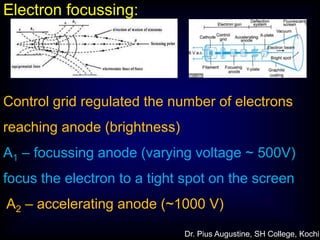
Electron focussing:
Control grid regulated the number of electrons
reaching anode (brightness)
A1 – focussing anode (varying voltage ~ 500V)
focus the electron to a tight spot on the screen
A2 – accelerating anode (~1000 V)
Dr. Pius Augustine, SH College, Kochi
Electron focussing:
A2 is higher positive potential w. r. to A1 and
create electric field (equipotentials) as shown.
Equipotential formed by A1 and A2 together act
as electrostatic lens for electron signal.
Note: electric field is perpendicular to
equipotential.
Charge will move in the direction or opposite to
field Dr. Pius Augustine, SH College, Kochi
Deflecting plates
Electron beam is deflected vertically
(Y plates) and horizontally (X plates)
due to E, provided by metal plates
Combined motion – parabolic
Dr. Pius Augustine, SH College, Kochi
Deflection sensitivity
The shift of the spot of light on the
screen per unit change in voltage
across the deflection plates is called
deflection sensitivity.
Spot deflection = deflection sensitivity x
applied voltage
Dr. Pius Augustine, SH College, Kochi
The deflection sensitivity of a cathode
ray tube is 0.01 mm/V. Calculate the
shift produced in the spot when 250 V
is applied to the vertical plates.
Use previous slide
Dr. Pius Augustine, SH College, Kochi
Fluorescent screen
Glow when struck by electrons get spot of
focussed electron beam.
Coated with zinc orthosilicate, zinc oxide
etc.
Color depend on fluorescent material.
Zinc orthosilicate – green, calcium tungstate
– blue. Dr. Pius Augustine, SH College, Kochi
Inner surface of tube between electron gun and
screen is given conducting material called
aquadag and is electrically connected to
accelerating anode. (eg: graphite coating and is
earthed)
(which prevents electrostatic interference from outside.
Also if any electron strikes the wall accidently, they are
returned to the anode and prevents from getting
charged to high negative potential)
Dr. Pius Augustine, SH College, Kochi
Spot of light can be brought to any
point on screen by adjusting
electric fields
In TV about 525 lines sweep
complete screen once in 1/25 s.
(High definition – more than double)
Dr. Pius Augustine, SH College, Kochi
Brightness of spot on the screen varies
with intensity of electron beam striking
on the screen which in turn depends
on the signal
Rapidity of scanning and persistence of
vision gives the illusion of moving
picture
Dr. Pius Augustine, SH College, Kochi
Colour TV – screen contains array
of tiny phosphor dots each
contain three colours red, green
and blue.
When different colored spots are
excited, mixing of various colors
give color picture. Dr. Pius Augustine, SH College, Kochi
In TV magnetic field is preferred over E
for deflection. Comment
Same value (magnitude) of E
and B, B exerts large force on
electron beam
If E is used, length of CRT
should be more. Dr. Pius Augustine, SH College, Kochi
Time base or sweep circuit – sawtooth voltage??
Imagine a sinusoidal voltage is applied to Y plate
Spot of light will go up and down along a vertical line as
the Y-plates are getting alternate polarity.
In order to trace sinsusoidal signal on the screen
spot of light should also be given a
synchronized horizontal movemet for which a
voltage is applied in the X plate which is known
as time base voltage (saw tooth voltage)
Dr. Pius Augustine, SH College, Kochi
Various knobs of CRO?
i. Intensity control knob: vary brightness of the spot, by
adjusting the grid voltage.
ii. Focus controll knob: regulate the beam to narrow
pinpoint spot, by adjusting anode pot.
iii. Horizontal position control knob: regulate amplitude
of dc potential on X to control the horizontal
movement of the spot
iv. Vertical position control knob: regulate amplitude of
d.c potential on Y plates to control the vertical
movement of the spot. Dr. Pius Augustine, SH College, Kochi
Applications of CRO
i. Examine different waveforms.
ii. To measure voltage
iii. Radio engg and radar
iv. Electrocardiography
v. Study the PV diagram of heat engines
vi. Study the effect of inductance in ac circuit
vii. Study the effect of conductance in ac circuit
viii. To measure frequency
Dr. Pius Augustine, SH College, Kochi
“Donot take a magnet close to
CRT monitor”.Comment.
Dr. Pius Augustine, SH College, Kochi
Robert Andrews Millikan
(1868 –1953)
Millikan’s oil drop experiment –
Measurement of charge of electron
Dr. Pius Augustine, SH College, Kochi
Description of apparatus
Two optically plane parallel circular metal plates
A and B (seperated by glass or quartz ) given
p.d. such that A is +ve and B is earthed.
Upper plate has a tiny hole at the centre.
Plates in bigger chamber containing purified
dryair
Surrounded by constant temperature oil bath.
Dr. Pius Augustine, SH College, Kochi
Description of apparatus
Using atomizer heavy non volatile oil is sprayed
into the chamber
Few drops enter into the space AB through the
hole is illuminated by arc lamp and seen
through a microscope T having millimeter scale
in its eyepiece
Through friction droplets gets charge. X-ray
ionise air which provide additional charge
Dr. Pius Augustine, SH College, Kochi
Procedure
Effective wt of drop = mg = Fg – Fb
Under balanced condition
mg = 6πηav ….(1)
Under applied electric field –vely charged
drop moves upwards and attains
terminal vel.
n1eE – mg = 6πηav1 …..(2)
Dr. Pius Augustine, SH College, Kochi
Procedure
mg = 6πηav ….(1)
n1eE – mg = 6πηav1 …..(2)
(2)/(1) n1e = (v1 + v ) mg/Ev …..(3)
Air is ionised by passing X-ray and droplet
gets new charge n2e and new terminal
velocity v2.
n2e = (v2 + v ) mg/Ev ……(4)
(4) – (3) (n2 – n1)e =mg/Ev (v2-v1)
Dr. Pius Augustine, SH College, Kochi
Procedure
mg = 6πηav …………………(1)
n1eE – mg = 6πηav1 ………..(2)
(2) / (1) n1e = (v1 + v ) mg/Ev ………..(3)
n2e = (v2 + v ) mg/Ev ………(4)
(4) – (3) (n2 – n1)e =mg/Ev (v2-v1)
Dr. Pius Augustine, SH College, Kochi
(n2 – n1)e = mg/Ev (v2-v1)
v2>v1 (n2-n1) e is +ve
v2<v1 (n2-n1) e is -ve
If E is kept constant, (v2-v1) α (n2-n1)
Millikan made large no. of observations on single
drop and there was a minimum value for
(v2-v1) and all other values are integral
multiple of minimum value.
Minimum value corresponds to (n2-n1) = ±1
Dr. Pius Augustine, SH College, Kochi
To find the mass of the drop
When the drop is falling under gravity with terminal
velocity
mg = 6πηav
m- effective mass
mg = 4/3 πa3 (ρ-σ) g = 6πηav
a = [9ηv / 2 (ρ-σ) g]1/2.
Effective mass of the drop
m = 4/3 π [9ηv / 2 (ρ-σ) g]3/2 (ρ-σ)
Dr. Pius Augustine, SH College, Kochi
• Use this
Effective mass of the drop
m = 4/3 π [9ηv / 2 (ρ-σ) g]3/2 (ρ-σ)
±e = mg/Ev (v2-v1)
e – can be calculated.
Millikan watched one drop continuously for 18 hrs
and arrived at best value
e=1.6020892 ± 0.0000046 x 10⁻¹⁹ C
Importance of Millikan’s experiment
i. Proved that electricity is atomic in character
ii. Proved quantization of charge
iii. Can determine Avogadro’s number (F = Ne)
iv. No direct method to find mass of electron. So
clubbed with e/m result, mass of electron is
also made available. 9.1 x 10⁻³¹ kg.
Dr. Pius Augustine, SH College, Kochi
Stoke’s formula fro viscous drag is not really valid
for oil drops of extreme minute size. Why not?
Stoke’s law can be applied if medium is
homogenous and the size of the drops is
greater than the inter-molecular distance.
When the size is small for the drop, the medium
will appear to be in homogeneous.
Dr. Pius Augustine, SH College, Kochi
Can we do Millikan’s experiment with bigger
drops?
With increase in size of the drop, the electric field
(E) and hence voltage V (E = V/d) would be
very large.
Almost impossible.
Dr. Pius Augustine, SH College, Kochi
Two parallel plates 5 cm apart are connected to a
500 V supply. Assuming that an electron starts
from rest and moves towards the positive plate,
calculate it’s velocity after 6.6 x 10⁻¹⁹ s.
Hint
E = V/d = 104 V/m
F = eE = 1.6 x 10⁻¹⁵ N = ma
a = F/m
v = u + at = 1.16 x 10⁷ m/s
Dr. Pius Augustine, SH College, Kochi
Q. A charged drop falls under gravity with a
terminal speed v. The drop is held
stationary by applying suitable electric field
in a Millikan’s set up, and is found to carry 2
excess electrons. Suddenly the drop is
observed to move upward with speed v.
Guess what has happened.
Dr. Pius Augustine, SH College, Kochi
falls under gravity with a terminal speed v.
mg = 6πηav
The drop is held stationary by applying
suitable electric field
qE = mg = 6πηav
Found to carry 2 excess electrons. Suddenly the
drop is observed to move upward with speed v.
New charge on the drop is q’
q’E-mg = 6πηav Dr. Pius Augustine, SH College, Kochi
falls under gravity with a terminal speed v.
mg = 6πηav
The drop is held stationary by applying suitable
electric field
qE = mg = 6πηav
Found to carry 2 excess electrons. Suddenly the
drop is observed to move upward with speed v.
New charge on the drop is q’
q’E-mg = 6πηav
Dr. Pius Augustine, SH College, Kochi
What is CRO?
May be used to measure electrical
parameters in time and amplitude form.
Give waveform when the different input
signals are given.
From waveform, amplitude, frequency, rise
time, distortion, time interval etc can be
determined
Dr. Pius Augustine, SH College, Kochi
CRO Front panel
Dr. Pius Augustine, SH College, Kochi
Start using CRO
• Power on/off –turns power on. See the
LED.
• INTENS – intensity of the display can be
varied
• FOCUS – for keep the beam sharply
defined – reading can be taken more
accurately
Dr. Pius Augustine, SH College, Kochi
Start using CRO-vertical deflection
Y-Position controls the vertical shifting of the trace
VOLTS/DIV enlarges the signal in vertical direction.
Knob can be set in the range from 2mV/div to 10 V/div
ON/OFF – turn the channel on or off.
AC/DC/GND – selects the mode.
AC mode: DC component of the signal input is blocked
by a blocking capacitor.
DC mode: signal is directly coupled to CRO input.
Ground mode: no signal is diplayed.Dr. Pius Augustine, SH College, Kochi
Start using Time-base and horizontal deflection
X-Position controls the horizontal shifting of the trace
LEVEL – Helps the trace to remain still
s/ms In combination with TIME/DIV switch selects the
time coefficients
MAGN x N Allows magnification of the horizontal
direction by a factor of n.
TIME/DIV Varies length of signal in X direction
Dr. Pius Augustine, SH College, Kochi
Start using Time-base and horizontal deflection
X via A
Input to X-X plate of CRT is fed through channel A
CAL knob – turn to CAL position to take readings
INT/EXT Toggle switch selects either internal or external
triggering signal
NORM/TV In NORM position, normal triggering is
obtained. In TV position, TV line or TV frame
synchronization is obtained.
Dr. Pius Augustine, SH College, Kochi
Examination of waveform
• To observe the wave shapes of voltages in
various types of electronic circuits CRO is used.
• Signal is applied to vertical input
• The sweep circuit –internal saw tooth wave is
applied to the horizontal input
• Then various controls are adjusted to obtain
sharp and well defined signal wave form on the
screen.
Dr. Pius Augustine, SH College, Kochi
Voltage measurement
Adjust INTENS and FOCUS knobs and get a sharply defined
horizontal line.
Adjust Y position knob to coincide the horizontal line exactly on
the central line (AC-DC switch in GND Position)
Connect function generator to CRO to give test signal using test
probe (having BNC connected at both ends) BNC – British
Naval Connector.
Count the number of divisions spanned by the signal from peak to
peak and multiply by scale factor (VOLT/DIV knob) – will give
peak to peak.
Half gives maximum voltage. (try different setting of Volt/Div knob)
Voltage measurement
• signal is applied to the vertical deflection
plates only, a vertical line appears on the
screen
• The height of the line is proportional to
peak to peak voltage of the applied signal.
Dr. Pius Augustine, SH College, Kochi
Voltage measurement
• Shut off the internal horizontal sweep and get
vertical line on the screen
• Attach a transparent plastic screen to the face
of oscilloscope. Mark screen with vertical and
horizontal lines in the form of graph
• Calibrate the oscilloscope against a known
voltage. (Apply, say 10V to the vertical input
terminals of the oscilloscope)
Dr. Pius Augustine, SH College, Kochi
Voltage measurement
• Adjust the vertical gain till a good deflection is
obtained
• Note the deflection sensitivity - V volts /mm
• Keeping the vertical gain unchanged, apply the
unknown voltage to the vertical input terminals
• Measure the length of the vertical line obtained
• Let it be L mm. Unknown voltage = L x V volts.
Dr. Pius Augustine, SH College, Kochi
Frequency measurement
• A known frequency is applied to horizontal
input and unknown frequency to the vertical
input.
• Adjust various controls
• Get pattern with loops cut by horizontal line
which will give frequency on the vertical plate
• Get pattern with loops cut by vertical line which
will give frequency on the horizontal plate
Dr. Pius Augustine, SH College, Kochi
To measure frequency of a signal
Adjust INTENS and FOCUS knobs and get a sharply
defined horizontal line.
Feed the signal to either of the chnnels
Adjust TIME/DIV – to see 2 or 3 cycles of the waveform.
Count the number of div in one cycle of the waveform
and multiply with time-base setting – gives T
Frequency = 1/T
Repeat for various settings of TIME/DIV.
Dr. Pius Augustine, SH College, Kochi
A sinusoidal waveform is displayed on
CRO screen with on e full cycle on 2
divisions. If the time base knob is in 0.5
ms position, what is the frequency of
the waveform?
T = 2 x 0.5 ms = 1ms
f = 1/T = 1 kHz
Dr. Pius Augustine, SH College, Kochi
If a sine wave of frequency 500 Hz is
fed to a CRO and the time base knob is
set as 1 ms position, how many
horizontal divisions are needed to
display one cycle of the wave?
T = 2 ms
ie. one cycle will take two divisions.
Dr. Pius Augustine, SH College, Kochi
How is the intensity of electron beam
varied?
By turning INTEN knob.
Grid voltage of CRT varies and in turn
varies the amount of electrons reach the
fluorescent screen
Dr. Pius Augustine, SH College, Kochi
How is the focussing of the electron beam
obtained?
Using electrostatic lens having
three electrodes inside CRT.
Dr. Pius Augustine, SH College, Kochi
What is the input impedance of CRO?
Typically 1 MΩ, shunted with 40 pF
capacitance
Dr. Pius Augustine, SH College, Kochi
Difference between dual beam CRO and
dual trace CRO?
Dual beam CRO: produce 2 independent beams.
Two electron guns and two sets of vertical and
horizontal deflection plates
Dual trace CRO: single electron beam with a
facility of display two vertical input signals
simultaneously. (use time sharing on one
electron beam to display two waveforms)
Dr. Pius Augustine, SH College, Kochi
What is Digital Storage Oscilloscope (DSO)?
CRO with storage facility for waveform in a
RAM and recall according to the
requirement
Dr. Pius Augustine, SH College, Kochi
For my youtube videos: please visit -
SH vision youtube channel
or
xray diffraction series
SH Vision
Dr. Pius Augustine, SH College, Kochi
125
Appeal: Please Contribute to Prime Minister’s or Chief
Minister’s fund in the fight against COVID-19
Dr. Pius Augustine, Dept of Physics, Sacred Heart College, Thevara
we will
overcome
Thank You
http://piusaugustine.shcollege.ac.in
https://www.facebook.com/piustine
Please share
Dr. Pius Augustine, Asst. Professor, Sacred Heart College, Thevara, Kochi.

21 pius augustine cathode rays cro

  • 1.
  • 2.
    Cathode rays andCRO Charge and mass of electrons JJ Thomson and Millikan-Experiment Dr. Pius Augustine, SH College, Kochi
  • 3.
    Is electron aFundamental Particle? 600 BC – Kannad – matter consists of indiviscible particle “paramanu” Present study tells that electrons and leptons are the fundamental particles 1998 Nobel prize winners said “electrons in a powerful magnetic field condense to form a kind of fluid” – quasi particles – having charge equal to a fraction of electronic charge. Superconductivity – even after 100 yrs- unable to explain high temperature superconductivity – may be a fractional electron concept is required. Dr. Pius Augustine, SH College, Kochi
  • 4.
    Why gases aregenerally poor conductors of electricity? Do not have free charge particles in large numbers to respond to electric field. Even if there is ionization due to cosmic rays or so, recombination nullifies. One way to make gas conducting is apply a large p.d across a gas column at very low pressure. Another pass X-ray through gases Dr. Pius Augustine, SH College, Kochi
  • 5.
    Explanation of DischargePhenomenon Due to cosmic rays etc, some ions are always present in a gas. Under high E – accelerated charged ions collide and ionize (+vely) more molecules. (cummulative) Detached electrons can move large distance without getting attached to –ve ions, if pressure is low. Dr. Pius Augustine, SH College, Kochi
  • 6.
    What is sparkingpotential? If the p.d between the electrodes is gradually increased, sparking occurs in the gas at certain stage and the minimum potential difference needed for it is called sparking potential Sparking potential depends on i. Pressure (P) of the gas ii. Separation (d) between the electrodes. It is a function of the product f(Pd) Known as Paschen’s law.Dr. Pius Augustine, SH College, Kochi
  • 7.
    The mean freepath of electrons in the gas in a discharge tube is inversely proportional to the pressure inside it. The Crookes dark space occupies half the length of the discharge tube when the pressure is 0.02 mm of Hg. Estimate the pressure at which the dark space will fill the whole tube? Hint L α 1/P Length will be doubled, if P is reduced to half Full length of the tube, when P = 0.01 mm of Hg.
  • 8.
    Two discharge tubeshave identical material structures and the same gas is filled in them. The length of one tube is 10 cm and that of the other tube is 20 cm. Sparking starts in both the tubes when the potential difference between the cathode and the anode is 100 V. If the pressure is the shorter tube is 1.0 mm of Hg, what is the pressure in the long tube? Hint Sparking potential is f(Pd) V1 = K P1d1 V2 = K P2d2 Take ratio - will give P2 = 0.5 mm of Hg
  • 9.
    Requirement for electricalconduction in gases i. By applying very high voltage ii. By reducing pressure to very low value Note: At normal atm pressure: 30,000 V/cm is required to produce electrical discharge in gas. Dr. Pius Augustine, SH College, Kochi
  • 10.
    Dr. Pius Augustine,SH College, Kochi
  • 11.
    Discharge tube Pyrex glasstube, about 40cm long and 4cm diameter Connected to vacuum pump Two circular electrodes are fixed at two ends 10,000 V to 15,000 V can be applied Dr. Pius Augustine, SH College, Kochi
  • 12.
    Dr. Pius Augustine,SH College, Kochi
  • 13.
    Response under various pressures Dr.Pius Augustine, SH College, Kochi
  • 14.
    i. Pressure ofabout 10 cm of Hg. Irregular streaks of light with crackling sound Dr. Pius Augustine, SH College, Kochi
  • 15.
    At 1cm ofHg Streaks widen out in to a luminous column called positive column extends from cathode to anode. Buzzing sound. Colour depends on nature of gas inside Red- neon bluish – CO2 Dr. Pius Augustine, SH College, Kochi
  • 16.
    Positive column With fewerions, as the electric field increases, electrons with energy of about 2 eV, excite atoms and produce light. Dr. Pius Augustine, SH College, Kochi
  • 17.
    Dr. Pius Augustine,SH College, Kochi
  • 18.
    Dr. Pius Augustine,SH College, Kochi
  • 19.
    At 0.3 cmof Hg +ve column is detached from cathode and another glow appears in the cathode called negative glow Faraday’s Dark Space between two columns Dr. Pius Augustine, SH College, Kochi
  • 20.
    At 0.01cm ofHg Cathode glow appears on cathode Crooke’s dark space between +ve column is divided into equally spaced striations Dr. Pius Augustine, SH College, Kochi
  • 21.
    0.001 cm ofHg Striations disappear -ve and cathode glow vanishes Whole tube is filled with crookes dark space Walls of tube begins to glow called fluorescence Invisible rays are called cathode rays Dr. Pius Augustine, SH College, Kochi
  • 22.
    Reasons for variousphenomena seen High speed atomic particles can cause ionization by collision Atoms and molecules emit radiations when they are in excited states Dr. Pius Augustine, SH College, Kochi
  • 23.
    Dr. Pius Augustine,SH College, Kochi
  • 24.
    Dr. Pius Augustine,SH College, Kochi
  • 25.
    Dr. Pius Augustine,SH College, Kochi
  • 26.
    Cathode rays Invisible raysemerging normally from the cathode of a discharge tube, kept at a pressure of 0.001cm of Hg and under a very high p.d .of the order of ten thousand volts across the electrodes. Dr. Pius Augustine, SH College, Kochi
  • 27.
    Properties of cathoderays i. Travel in straight line ii. Emitted normally from cathode iii. Possess high momentum and K.E. iv. Emit from cathode, -vely charged v. Deflected by E and B (establish –ve charge) vi. Produce heat when falling on matter Dr. Pius Augustine, SH College, Kochi
  • 28.
    Properties of cathoderays vii. Ionise gas through which they pass. viii. Affect photographic plate ix. Produce fluorescence x. Velocity = 1/10th velocity of light (c) xi. If suddenly stopped – X-rays are produced. xii. Will exert mechanical pressure Dr. Pius Augustine, SH College, Kochi
  • 29.
    Dr. Pius Augustine,SH College, Kochi
  • 30.
    Are cathode rayselectromagnetic? Comment No. Emitted only in one direction from cathode Had they been em waves, would have been emitted in all directions Velocity of em waves constant but cathode rays have different velocity depending upon the p.d between anode and cathode. Dr. Pius Augustine, SH College, Kochi
  • 31.
    The electric dischargestops at very low pressure. Why? If gas is too rarefied, sufficient positive ions are not available to ejects electrons from the cathode and hence the discharge current stops. Dr. Pius Augustine, SH College, Kochi
  • 32.
    A discharge tubecontains helium at a low pressure. A large potential difference is applied across the tube. Consider a helium atom that has just been ionized due to the detachment of an atomic electron. Find the ratio of the distance travelled by the free electron to that by the positive ion in a short time dt after the ionization. Hint Charge of particles (equal) = q me, mp are known, Electric field = E F = qE Electron ae = qE/me. Se = ½ at2. Positive ion aion = qE/4mp. Sion = ½ at2. Se/Sion = 7340 Dr. Pius Augustine, SH College, Kochi
  • 33.
    A molecule ofa gas, filled in a discharge tube, gets ionized when an electron is detached from it. An electric field of 5.0 kV/m exists in the vicinity of the event. Find the distance traveled by the free electron in 1 μs assuming no collision. Hint E = 5000 V/m t = 1 x 10⁻⁶ s F = eE a = eE/me. S = ½ at2 = 439.56 m = 440 m Dr. Pius Augustine, SH College, Kochi
  • 34.
    A molecule ofa gas, filled in a discharge tube, gets ionized when an electron is detached from it. An electric field of 5.0 kV/m exists in the vicinity of the event. If the mean free path of the electron is 1.0 mm, estimate the time of transit of the free electron between successive collisions. Hint E = 5000 V/m d = 1 x 10⁻³ m F = eE a = eE/me. d = ½ at2 t = 1.508 x 10⁻⁹ s = 1.508 ns Dr. Pius Augustine, SH College, Kochi
  • 35.
    Motion of electronin electric field Horizontal - Electrons move with constant velocity Vertical – within the region of electric field ectrons will be accelerated upward. Combined motion is parabolic. When electron comes out of electric field, what ever is the resultant velocity (magnitude and direction) would continue Dr. Pius Augustine, SH College, Kochi
  • 36.
    Vertical accn (a)= F/m = eE/m towards +ve plate Vertical distance moved during the time (t = x/v) electron travels within electric field (y) y = ½ at2 = ½ (eE/m)(x/v)2 = (a const) x2. y proportional to x2. So path is parabolic Motion of electron in electric field Dr. Pius Augustine, SH College, Kochi
  • 37.
    A beam ofelectron each of mass m and charge e and velocity 3 x 109 cm/s is 2mm deflected by 10 cm traversing a distance of 18 V/cm through an electrostatic field perpendicular to their path. e/m ? Hint: x = 0.1 m, y = 0.02 m, E = 1800 V/m, y = ½ (eE/m) (x/y)2 Solve for e/m . Dr. Pius Augustine, SH College, Kochi
  • 38.
    Motion of electronin magnetic field Recollect cyclotron studies In a transverse uniform magnetic field the electron traces a circular path. Radius of circular path r = mv/qB Note: If field is in the direction of motion of charge, no force Dr. Pius Augustine, SH College, Kochi
  • 39.
    In an experimentto find the specific charge of an electron, the cathode ray beam was accelerated under a p.d of 2000V. When the beam was subjected to a magnetic field of 5 x 10⁻⁶ T, the radius of the circualr path traced by the beam was 30.7 cm. Find e/m? Hint: mv2/r = Bev, v = Ber/m eV = ½ mv2 = ½ m (Ber/m)2 e/m – can be found out Dr. Pius Augustine, SH College, Kochi
  • 40.
  • 41.
    Specific charge (e/m)of electrons JJ Thomson’s experiment Joseph John Thomson Proved that cathode rays are electrons Electron is a fundamental particle Negatively charged : -1.6019 x 10⁻¹⁹ C Mass = 9.102 x 10⁻³¹ kg. Dr. Pius Augustine, SH College, Kochi
  • 42.
    Specific charge (e/m)of electrons JJ Thomson’s experiment Principle: cathode rays (electrons) are negatively charged particles and are deflected by E and B Knowing the strengths of E and B for balancing the deflection, e/m can be calculated. Dr. Pius Augustine, SH College, Kochi
  • 43.
    J J Thomson’sApparatus Dr. Pius Augustine, SH College, Kochi
  • 44.
    P1 and P2 Dr.Pius Augustine, SH College, Kochi
  • 45.
    Apparatus : Cathode Cand anode A enclosed in an evacuated discharge tube. Electrons, emitted from cathode under high p.d .between anode and cathode are accelerated towards A. Dr. Pius Augustine, SH College, Kochi
  • 46.
    Apparatus : Electrons emergeas a narrow beam through a hole in the anode A Heated filament may also be used as source of electrons (thermionic) P1 and P2 are for applying E Dr. Pius Augustine, SH College, Kochi
  • 47.
    Working – Istpart – E and B applied On applying E, electron beam is deflected towards +ve plate Force on electron = eE (along +ve Y axis) B applied in –ve Z direction Mag force = Bev (along –ve Y-direction) Adjust field strength, so that no deflection. eE = Bev, v = E/BDr. Pius Augustine, SH College, Kochi
  • 48.
    Working v = E/B Kineticenergy of elctron on reaching anode = W.done by the source on accelerating e ½ mv2 = eV e/m = v2/2V = E2/ 2VB2 = 1.76 x 10¹¹ C/kg Dr. Pius Augustine, SH College, Kochi
  • 49.
    Dr. Pius Augustine,SH College, Kochi
  • 50.
    Note: there isan alternate way in which circular motion of electro in magnetic field is analyzed e/m = V/B2rd E = V/d V – p.d between the plates d – separation between plates B-magnetic field strength r- radius of circular path Dr. Pius Augustine, SH College, Kochi
  • 51.
    1. Define theterm work function of a metal. 2. Name the unit in which work function of a metal is generally expressed. 3. How is it related to the SI unit Joule ? Dr. Pius Augustine, SH College, Kochi
  • 52.
    Work funciton Electrons inoutermost shell – valence electrons. Metals have free electrons (valence electrons which are loosely bound to nucleus and free to move within the metal) Free electrons experience a surface barrier which prevents from leaving the metal. The energy required to overcome this potential barrier is called work function Dr. Pius Augustine, SH College, Kochi
  • 53.
    Electron Emission Thermionic emission- by heating metals Photo electric emission - by light Field emission – pulling electrons under strong electric field Cold emission – cathode rays in discharge tube under low pressure and high p.d. Secondary emission – high speed electrons knocking out electrons from surface of metals.
  • 54.
    Thermionic emission Electron emissionby heating metals. Emitted electrons are called thermions. Metal used for electron emission – cathode. Dr. Pius Augustine, SH College, Kochi
  • 55.
    Thermionic emission Qualities ofgood thermionic emitter are i. Low work function ii. High melting point iii. High mechanical strength iv. Low vapor pressure at high temperature. Dr. Pius Augustine, SH College, Kochi
  • 56.
    Common thermionic emitters Tungsten: M.P – 3665K Starts thermionic emission at 2500 K Work function is quite high 4.52 eV Thoriated W : W + 2% Thorium oxide + C Work Function: 2.6 eV at 2000 K Dr. Pius Augustine, SH College, Kochi
  • 57.
    Common thermionic emitters Alkalimetal oxide coating on W : Barium oxide or cesium oxide or strontium oxide on W Work fn.- less than 1eV at 1000K Dr. Pius Augustine, SH College, Kochi
  • 58.
    Number of thermionsemitted by a hot metal in one second Factors affecting rate of emission i. Nature of surface: inversely proportional to φ ii. Directly proportional to temperature iii. Directly proportional to surface area Rate of emission of thermions Dr. Pius Augustine, SH College, Kochi
  • 59.
    Work function ofsome metals Pt – 6.2eV W – 4.52eV Cr – 4.37 eV Zn – 4.24 eV Na – 2.3 eV K – 2.26 eV Barium coated W – 1.6 eV Ceasium coated W – 1.4 eV Dr. Pius Augustine, SH College, Kochi
  • 60.
    Richardson-Dushman Equation At hightemperature, average KE of electrons will be increased, will come out of the metal if it overcomes work function Thermionic current (n-thermions ejected/unit time) I = ne = AST2e-φ/kT S – surface area, T – absolute temperature φ – workfunction of the metal k-Boltzmann constant A- constant which depends on nature of the metal Dr. Pius Augustine, SH College, Kochi
  • 61.
    The work functionof a thermionic emitter is 4.5 eV. By what factor does the thermionic current increase if its temperature is raised from 1500 K to 2000 K? T1 = 1500 K T2 = 2000 K φ = 4.5 eV k= 1.38 × 10⁻²³ m2 kg s-2 K-1 I1= AST1 2e-φ/kT 1 I2= AST2 2e-φ/kT 2 Take ratio and solve I2/I1 = 10625 Dr. Pius Augustine, SH College, Kochi
  • 62.
    Calculate n(T)/n(1000K) fortungsten emitter at T = 300 K and 2000 K, where n(T) represents the number of thermions emitted per second by the surface at temperature T. Work function of tungsten is 4.52 eV φ = 4.52 eV k =1.38 × 10⁻²³ J/K n(T)e = AST2e-φ/kT Prepare equations for n(1000) n(300) and n (2000) and solve Dr. Pius Augustine, SH College, Kochi
  • 63.
    Explain the termthermionic emission. Mention its use Cathode Ray Oscilloscope Dr. Pius Augustine, SH College, Kochi
  • 64.
    Cathode Ray Oscilloscope Anelectronic device – used in labs Converts electrical signal to visual signal Principle: Cathode rays – deflected in E and B fields and produce fluorescence Dr. Pius Augustine, SH College, Kochi
  • 65.
    Cathode ray tube- uses Visualise time variation of voltages (oscilloscope) TV, computer monitors To determine frequency of a.c Study the waveform of electrical signal Measuring short time interval Dr. Pius Augustine, SH College, Kochi
  • 66.
    Principle i. Thermionic emission ii.Deflection of electron beam by E and B iii. Fluorescence produced by electron beam on fluorescent screen Dr. Pius Augustine, SH College, Kochi
  • 67.
    Electron gun: Electrons areemitted by indirectly heated cathode (L.T = 6V) are accelerated by a high voltage (1000V) applied to cylindrical anodes -ve pot is given to grid G – controls no. of electrons Electrons come out of anode as a narrow beam Dr. Pius Augustine, SH College, Kochi
  • 68.
    Electron focussing: Control gridregulated the number of electrons reaching anode (brightness) A1 – focussing anode (varying voltage ~ 500V) focus the electron to a tight spot on the screen A2 – accelerating anode (~1000 V) Dr. Pius Augustine, SH College, Kochi
  • 69.
    Electron focussing: A2 ishigher positive potential w. r. to A1 and create electric field (equipotentials) as shown. Equipotential formed by A1 and A2 together act as electrostatic lens for electron signal. Note: electric field is perpendicular to equipotential. Charge will move in the direction or opposite to field Dr. Pius Augustine, SH College, Kochi
  • 70.
    Deflecting plates Electron beamis deflected vertically (Y plates) and horizontally (X plates) due to E, provided by metal plates Combined motion – parabolic Dr. Pius Augustine, SH College, Kochi
  • 71.
    Deflection sensitivity The shiftof the spot of light on the screen per unit change in voltage across the deflection plates is called deflection sensitivity. Spot deflection = deflection sensitivity x applied voltage Dr. Pius Augustine, SH College, Kochi
  • 72.
    The deflection sensitivityof a cathode ray tube is 0.01 mm/V. Calculate the shift produced in the spot when 250 V is applied to the vertical plates. Use previous slide Dr. Pius Augustine, SH College, Kochi
  • 73.
    Fluorescent screen Glow whenstruck by electrons get spot of focussed electron beam. Coated with zinc orthosilicate, zinc oxide etc. Color depend on fluorescent material. Zinc orthosilicate – green, calcium tungstate – blue. Dr. Pius Augustine, SH College, Kochi
  • 74.
    Inner surface oftube between electron gun and screen is given conducting material called aquadag and is electrically connected to accelerating anode. (eg: graphite coating and is earthed) (which prevents electrostatic interference from outside. Also if any electron strikes the wall accidently, they are returned to the anode and prevents from getting charged to high negative potential) Dr. Pius Augustine, SH College, Kochi
  • 75.
    Spot of lightcan be brought to any point on screen by adjusting electric fields In TV about 525 lines sweep complete screen once in 1/25 s. (High definition – more than double) Dr. Pius Augustine, SH College, Kochi
  • 76.
    Brightness of spoton the screen varies with intensity of electron beam striking on the screen which in turn depends on the signal Rapidity of scanning and persistence of vision gives the illusion of moving picture Dr. Pius Augustine, SH College, Kochi
  • 77.
    Colour TV –screen contains array of tiny phosphor dots each contain three colours red, green and blue. When different colored spots are excited, mixing of various colors give color picture. Dr. Pius Augustine, SH College, Kochi
  • 78.
    In TV magneticfield is preferred over E for deflection. Comment Same value (magnitude) of E and B, B exerts large force on electron beam If E is used, length of CRT should be more. Dr. Pius Augustine, SH College, Kochi
  • 79.
    Time base orsweep circuit – sawtooth voltage?? Imagine a sinusoidal voltage is applied to Y plate Spot of light will go up and down along a vertical line as the Y-plates are getting alternate polarity. In order to trace sinsusoidal signal on the screen spot of light should also be given a synchronized horizontal movemet for which a voltage is applied in the X plate which is known as time base voltage (saw tooth voltage) Dr. Pius Augustine, SH College, Kochi
  • 80.
    Various knobs ofCRO? i. Intensity control knob: vary brightness of the spot, by adjusting the grid voltage. ii. Focus controll knob: regulate the beam to narrow pinpoint spot, by adjusting anode pot. iii. Horizontal position control knob: regulate amplitude of dc potential on X to control the horizontal movement of the spot iv. Vertical position control knob: regulate amplitude of d.c potential on Y plates to control the vertical movement of the spot. Dr. Pius Augustine, SH College, Kochi
  • 81.
    Applications of CRO i.Examine different waveforms. ii. To measure voltage iii. Radio engg and radar iv. Electrocardiography v. Study the PV diagram of heat engines vi. Study the effect of inductance in ac circuit vii. Study the effect of conductance in ac circuit viii. To measure frequency Dr. Pius Augustine, SH College, Kochi
  • 82.
    “Donot take amagnet close to CRT monitor”.Comment. Dr. Pius Augustine, SH College, Kochi
  • 83.
  • 84.
    Millikan’s oil dropexperiment – Measurement of charge of electron Dr. Pius Augustine, SH College, Kochi
  • 85.
    Dr. Pius Augustine,SH College, Kochi
  • 86.
    Dr. Pius Augustine,SH College, Kochi
  • 87.
    Dr. Pius Augustine,SH College, Kochi
  • 88.
    Description of apparatus Twooptically plane parallel circular metal plates A and B (seperated by glass or quartz ) given p.d. such that A is +ve and B is earthed. Upper plate has a tiny hole at the centre. Plates in bigger chamber containing purified dryair Surrounded by constant temperature oil bath. Dr. Pius Augustine, SH College, Kochi
  • 89.
    Description of apparatus Usingatomizer heavy non volatile oil is sprayed into the chamber Few drops enter into the space AB through the hole is illuminated by arc lamp and seen through a microscope T having millimeter scale in its eyepiece Through friction droplets gets charge. X-ray ionise air which provide additional charge Dr. Pius Augustine, SH College, Kochi
  • 90.
    Procedure Effective wt ofdrop = mg = Fg – Fb Under balanced condition mg = 6πηav ….(1) Under applied electric field –vely charged drop moves upwards and attains terminal vel. n1eE – mg = 6πηav1 …..(2) Dr. Pius Augustine, SH College, Kochi
  • 91.
    Procedure mg = 6πηav….(1) n1eE – mg = 6πηav1 …..(2) (2)/(1) n1e = (v1 + v ) mg/Ev …..(3) Air is ionised by passing X-ray and droplet gets new charge n2e and new terminal velocity v2. n2e = (v2 + v ) mg/Ev ……(4) (4) – (3) (n2 – n1)e =mg/Ev (v2-v1) Dr. Pius Augustine, SH College, Kochi
  • 92.
    Procedure mg = 6πηav…………………(1) n1eE – mg = 6πηav1 ………..(2) (2) / (1) n1e = (v1 + v ) mg/Ev ………..(3) n2e = (v2 + v ) mg/Ev ………(4) (4) – (3) (n2 – n1)e =mg/Ev (v2-v1) Dr. Pius Augustine, SH College, Kochi
  • 93.
    (n2 – n1)e= mg/Ev (v2-v1) v2>v1 (n2-n1) e is +ve v2<v1 (n2-n1) e is -ve If E is kept constant, (v2-v1) α (n2-n1) Millikan made large no. of observations on single drop and there was a minimum value for (v2-v1) and all other values are integral multiple of minimum value. Minimum value corresponds to (n2-n1) = ±1 Dr. Pius Augustine, SH College, Kochi
  • 94.
    Dr. Pius Augustine,SH College, Kochi
  • 95.
    To find themass of the drop When the drop is falling under gravity with terminal velocity mg = 6πηav m- effective mass mg = 4/3 πa3 (ρ-σ) g = 6πηav a = [9ηv / 2 (ρ-σ) g]1/2. Effective mass of the drop m = 4/3 π [9ηv / 2 (ρ-σ) g]3/2 (ρ-σ) Dr. Pius Augustine, SH College, Kochi
  • 96.
    • Use this Effectivemass of the drop m = 4/3 π [9ηv / 2 (ρ-σ) g]3/2 (ρ-σ) ±e = mg/Ev (v2-v1) e – can be calculated. Millikan watched one drop continuously for 18 hrs and arrived at best value e=1.6020892 ± 0.0000046 x 10⁻¹⁹ C
  • 97.
    Importance of Millikan’sexperiment i. Proved that electricity is atomic in character ii. Proved quantization of charge iii. Can determine Avogadro’s number (F = Ne) iv. No direct method to find mass of electron. So clubbed with e/m result, mass of electron is also made available. 9.1 x 10⁻³¹ kg. Dr. Pius Augustine, SH College, Kochi
  • 98.
    Stoke’s formula froviscous drag is not really valid for oil drops of extreme minute size. Why not? Stoke’s law can be applied if medium is homogenous and the size of the drops is greater than the inter-molecular distance. When the size is small for the drop, the medium will appear to be in homogeneous. Dr. Pius Augustine, SH College, Kochi
  • 99.
    Can we doMillikan’s experiment with bigger drops? With increase in size of the drop, the electric field (E) and hence voltage V (E = V/d) would be very large. Almost impossible. Dr. Pius Augustine, SH College, Kochi
  • 100.
    Two parallel plates5 cm apart are connected to a 500 V supply. Assuming that an electron starts from rest and moves towards the positive plate, calculate it’s velocity after 6.6 x 10⁻¹⁹ s. Hint E = V/d = 104 V/m F = eE = 1.6 x 10⁻¹⁵ N = ma a = F/m v = u + at = 1.16 x 10⁷ m/s Dr. Pius Augustine, SH College, Kochi
  • 101.
    Q. A chargeddrop falls under gravity with a terminal speed v. The drop is held stationary by applying suitable electric field in a Millikan’s set up, and is found to carry 2 excess electrons. Suddenly the drop is observed to move upward with speed v. Guess what has happened. Dr. Pius Augustine, SH College, Kochi
  • 102.
    falls under gravitywith a terminal speed v. mg = 6πηav The drop is held stationary by applying suitable electric field qE = mg = 6πηav Found to carry 2 excess electrons. Suddenly the drop is observed to move upward with speed v. New charge on the drop is q’ q’E-mg = 6πηav Dr. Pius Augustine, SH College, Kochi
  • 103.
    falls under gravitywith a terminal speed v. mg = 6πηav The drop is held stationary by applying suitable electric field qE = mg = 6πηav Found to carry 2 excess electrons. Suddenly the drop is observed to move upward with speed v. New charge on the drop is q’ q’E-mg = 6πηav Dr. Pius Augustine, SH College, Kochi
  • 104.
    What is CRO? Maybe used to measure electrical parameters in time and amplitude form. Give waveform when the different input signals are given. From waveform, amplitude, frequency, rise time, distortion, time interval etc can be determined Dr. Pius Augustine, SH College, Kochi
  • 105.
    CRO Front panel Dr.Pius Augustine, SH College, Kochi
  • 106.
    Start using CRO •Power on/off –turns power on. See the LED. • INTENS – intensity of the display can be varied • FOCUS – for keep the beam sharply defined – reading can be taken more accurately Dr. Pius Augustine, SH College, Kochi
  • 107.
    Start using CRO-verticaldeflection Y-Position controls the vertical shifting of the trace VOLTS/DIV enlarges the signal in vertical direction. Knob can be set in the range from 2mV/div to 10 V/div ON/OFF – turn the channel on or off. AC/DC/GND – selects the mode. AC mode: DC component of the signal input is blocked by a blocking capacitor. DC mode: signal is directly coupled to CRO input. Ground mode: no signal is diplayed.Dr. Pius Augustine, SH College, Kochi
  • 108.
    Start using Time-baseand horizontal deflection X-Position controls the horizontal shifting of the trace LEVEL – Helps the trace to remain still s/ms In combination with TIME/DIV switch selects the time coefficients MAGN x N Allows magnification of the horizontal direction by a factor of n. TIME/DIV Varies length of signal in X direction Dr. Pius Augustine, SH College, Kochi
  • 109.
    Start using Time-baseand horizontal deflection X via A Input to X-X plate of CRT is fed through channel A CAL knob – turn to CAL position to take readings INT/EXT Toggle switch selects either internal or external triggering signal NORM/TV In NORM position, normal triggering is obtained. In TV position, TV line or TV frame synchronization is obtained. Dr. Pius Augustine, SH College, Kochi
  • 110.
    Examination of waveform •To observe the wave shapes of voltages in various types of electronic circuits CRO is used. • Signal is applied to vertical input • The sweep circuit –internal saw tooth wave is applied to the horizontal input • Then various controls are adjusted to obtain sharp and well defined signal wave form on the screen. Dr. Pius Augustine, SH College, Kochi
  • 111.
    Voltage measurement Adjust INTENSand FOCUS knobs and get a sharply defined horizontal line. Adjust Y position knob to coincide the horizontal line exactly on the central line (AC-DC switch in GND Position) Connect function generator to CRO to give test signal using test probe (having BNC connected at both ends) BNC – British Naval Connector. Count the number of divisions spanned by the signal from peak to peak and multiply by scale factor (VOLT/DIV knob) – will give peak to peak. Half gives maximum voltage. (try different setting of Volt/Div knob)
  • 112.
    Voltage measurement • signalis applied to the vertical deflection plates only, a vertical line appears on the screen • The height of the line is proportional to peak to peak voltage of the applied signal. Dr. Pius Augustine, SH College, Kochi
  • 113.
    Voltage measurement • Shutoff the internal horizontal sweep and get vertical line on the screen • Attach a transparent plastic screen to the face of oscilloscope. Mark screen with vertical and horizontal lines in the form of graph • Calibrate the oscilloscope against a known voltage. (Apply, say 10V to the vertical input terminals of the oscilloscope) Dr. Pius Augustine, SH College, Kochi
  • 114.
    Voltage measurement • Adjustthe vertical gain till a good deflection is obtained • Note the deflection sensitivity - V volts /mm • Keeping the vertical gain unchanged, apply the unknown voltage to the vertical input terminals • Measure the length of the vertical line obtained • Let it be L mm. Unknown voltage = L x V volts. Dr. Pius Augustine, SH College, Kochi
  • 115.
    Frequency measurement • Aknown frequency is applied to horizontal input and unknown frequency to the vertical input. • Adjust various controls • Get pattern with loops cut by horizontal line which will give frequency on the vertical plate • Get pattern with loops cut by vertical line which will give frequency on the horizontal plate Dr. Pius Augustine, SH College, Kochi
  • 116.
    To measure frequencyof a signal Adjust INTENS and FOCUS knobs and get a sharply defined horizontal line. Feed the signal to either of the chnnels Adjust TIME/DIV – to see 2 or 3 cycles of the waveform. Count the number of div in one cycle of the waveform and multiply with time-base setting – gives T Frequency = 1/T Repeat for various settings of TIME/DIV. Dr. Pius Augustine, SH College, Kochi
  • 117.
    A sinusoidal waveformis displayed on CRO screen with on e full cycle on 2 divisions. If the time base knob is in 0.5 ms position, what is the frequency of the waveform? T = 2 x 0.5 ms = 1ms f = 1/T = 1 kHz Dr. Pius Augustine, SH College, Kochi
  • 118.
    If a sinewave of frequency 500 Hz is fed to a CRO and the time base knob is set as 1 ms position, how many horizontal divisions are needed to display one cycle of the wave? T = 2 ms ie. one cycle will take two divisions. Dr. Pius Augustine, SH College, Kochi
  • 119.
    How is theintensity of electron beam varied? By turning INTEN knob. Grid voltage of CRT varies and in turn varies the amount of electrons reach the fluorescent screen Dr. Pius Augustine, SH College, Kochi
  • 120.
    How is thefocussing of the electron beam obtained? Using electrostatic lens having three electrodes inside CRT. Dr. Pius Augustine, SH College, Kochi
  • 121.
    What is theinput impedance of CRO? Typically 1 MΩ, shunted with 40 pF capacitance Dr. Pius Augustine, SH College, Kochi
  • 122.
    Difference between dualbeam CRO and dual trace CRO? Dual beam CRO: produce 2 independent beams. Two electron guns and two sets of vertical and horizontal deflection plates Dual trace CRO: single electron beam with a facility of display two vertical input signals simultaneously. (use time sharing on one electron beam to display two waveforms) Dr. Pius Augustine, SH College, Kochi
  • 123.
    What is DigitalStorage Oscilloscope (DSO)? CRO with storage facility for waveform in a RAM and recall according to the requirement Dr. Pius Augustine, SH College, Kochi
  • 124.
    For my youtubevideos: please visit - SH vision youtube channel or xray diffraction series SH Vision Dr. Pius Augustine, SH College, Kochi
  • 125.
    125 Appeal: Please Contributeto Prime Minister’s or Chief Minister’s fund in the fight against COVID-19 Dr. Pius Augustine, Dept of Physics, Sacred Heart College, Thevara we will overcome Thank You http://piusaugustine.shcollege.ac.in https://www.facebook.com/piustine Please share Dr. Pius Augustine, Asst. Professor, Sacred Heart College, Thevara, Kochi.