C. MOHAN
Western Institute in Computer Science:
Transacation Processing Concepts and Techniques
Stanford, August 1999
mohan@almaden.ibm.com
www.almaden.ibm.com/u/mohan/
IBM Almaden Research Center
650 Harry Road, K01/B1
San Jose, CA 95120, USA
Evolution of Groupware for
TP/Business Applications:
Lotus Domino/Notes
Agenda
Introduction
Semi-Structured Data Management
Storage Architecture
Replication
High Availability
Log-based Recovery
Summary
www.lotus.com, www.notes.net, www.iris.com, www.edge.lotus.com
Lotus Domino, WICS, mohan 1-2, 8/99
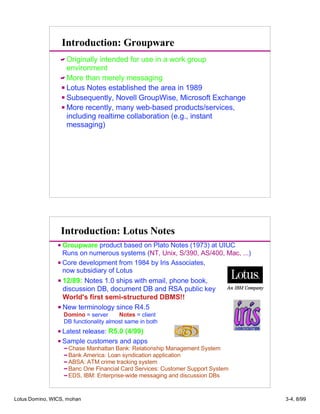
Introduction: Groupware
Originally intended for use in a work group
environment
More than merely messaging
Lotus Notes established the area in 1989
Subsequently, Novell GroupWise, Microsoft Exchange
More recently, many web-based products/services,
including realtime collaboration (e.g., instant
messaging)
Introduction: Lotus Notes
Groupware product based on Plato Notes (1973) at UIUC
Runs on numerous systems (NT, Unix, S/390, AS/400, Mac, ...)
Core development from 1984 by Iris Associates,
now subsidiary of Lotus
12/89: Notes 1.0 ships with email, phone book,
discussion DB, document DB and RSA public key
World's first semi-structured DBMS!!
New terminology since R4.5
Domino = server Notes = client
DB functionality almost same in both
Latest release: R5.0 (4/99)
Sample customers and apps
Chase Manhattan Bank: Relationship Management System
Bank America: Loan syndication application
ABSA: ATM crime tracking system
Banc One Financial Card Services: Customer Support System
EDS, IBM: Enterprise-wide messaging and discussion DBs
Lotus Domino, WICS, mohan 3-4, 8/99
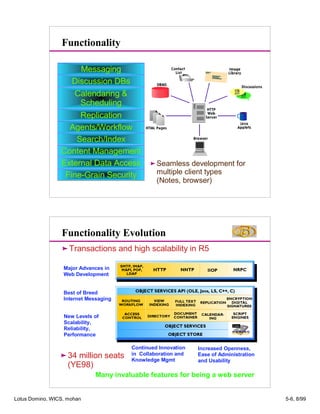
MessagingMessaging
Discussion DBsDiscussion DBs
Calendaring &Calendaring &
SchedulingScheduling
ReplicationReplication
Agents/WorkflowAgents/Workflow
Search/IndexSearch/Index
Content ManagementContent Management
External Data AccessExternal Data Access
Fine-Grain SecurityFine-Grain Security
Functionality
Seamless development for
multiple client types
(Notes, browser)
Functionality Evolution
Major Advances in
Web Development
  ¡ ¢ £ ¤ ¥ ¦
§ ¡   ¨ ©  ¡ §
 ¤  §
¤ ¥    ¤ ¥ ¦
© ¢   £   £
¤ ¥    ¤ ¥ ¦
     ¤   £ ¤ ¡ ¥
 ¥      £ ¤ ¡ ¥
 ¤ ¦ ¤ £  
 ¤ ¦ ¥  £ ¢    
     
 ¡ ¥ £   ¡ 
 ¤     £ ¡   
 ¡  ¢  ¥ £
 ¡ ¥ £  ¤ ¥   
    ¥     !
¤ ¥ ¦
    ¤  £
 ¥ ¦ ¤ ¥  
 # $ %  ' ( % ) 0 1  % (
 # $ %  ' ( '  ) %
 # $ %  ' ( % ) 0 1  % ( 2 3 1 4  5 % 6 $ 7 8 7 6 5 ( 6  9 9 6  @
 £  A ¤   A
  ¤ A  ¡  A
    B
' ' 3 C C ' 3
1 1  3
C ) 3 
Best of Breed
Internet Messaging
New Levels of
Scalability,
Reliability,
Performance
Continued Innovation
in Collaboration and
Knowledge Mgmt
Increased Openness,
Ease of Administration
and Usability
Transactions and high scalability in R5
34 million seats
(YE98)
Many invaluable features for being a web server
Lotus Domino, WICS, mohan 5-6, 8/99
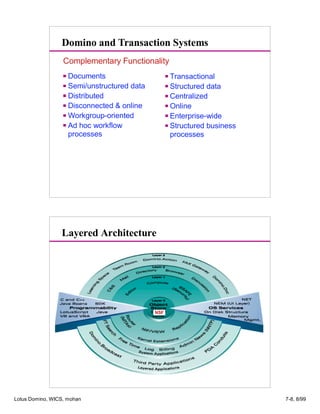
Transactional
Structured data
Centralized
Online
Enterprise-wide
Structured business
processes
Documents
Semi/unstructured data
Distributed
Disconnected  online
Workgroup-oriented
Ad hoc workflow
processes
Complementary Functionality
Domino and Transaction Systems
Layered Architecture
NSF
Lotus Domino, WICS, mohan 7-8, 8/99
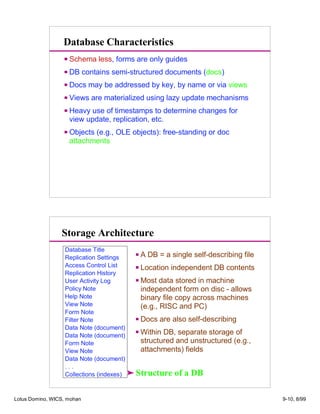
Database Characteristics
Schema less, forms are only guides
DB contains semi-structured documents (docs)
Docs may be addressed by key, by name or via views
Views are materialized using lazy update mechanisms
Heavy use of timestamps to determine changes for
view update, replication, etc.
Objects (e.g., OLE objects): free-standing or doc
attachments
Database Title
Replication Settings
Access Control List
Replication History
User Activity Log
Policy Note
Help Note
View Note
Form Note
Filter Note
Data Note (document)
Form Note
View Note
Data Note (document)
. . .
Collections (indexes)
Storage Architecture
A DB = a single self-describing file
Location independent DB contents
Most data stored in machine
independent form on disc - allows
binary file copy across machines
(e.g., RISC and PC)
Docs are also self-describing
Within DB, separate storage of
structured and unstructured (e.g.,
attachments) fields
Structure of a DB
Lotus Domino, WICS, mohan 9-10, 8/99
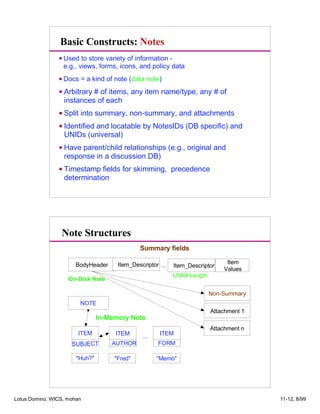
Basic Constructs: Notes
Used to store variety of information -
e.g., views, forms, icons, and policy data
Docs = a kind of note (data note)
Arbitrary # of items, any item name/type, any # of
instances of each
Split into summary, non-summary, and attachments
Identified and locatable by NotesIDs (DB specific) and
UNIDs (universal)
Have parent/child relationships (e.g., original and
response in a discussion DB)
Timestamp fields for skimming, precedence
determination
Note Structures
BodyHeader Item_Descriptor...
Item
Values
UNK#/Length
NOTE
ITEM
SUBJECT
ITEM
FORM
ITEM
AUTHOR
...
Huh? MemoFred
In-Memory Note
On-Disk Note
Item_Descriptor
Non-Summary
Attachment 1
Attachment n
Summary fields
Lotus Domino, WICS, mohan 11-12, 8/99
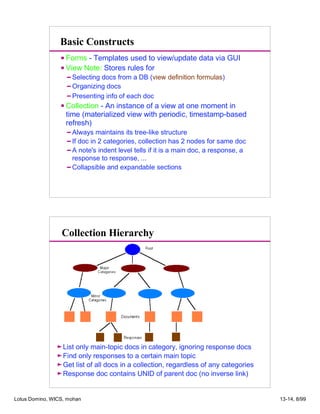
Basic Constructs
Forms - Templates used to view/update data via GUI
View Note: Stores rules for
Selecting docs from a DB (view definition formulas)
Organizing docs
Presenting info of each doc
Collection - An instance of a view at one moment in
time (materialized view with periodic, timestamp-based
refresh)
Always maintains its tree-like structure
If doc in 2 categories, collection has 2 nodes for same doc
A note's indent level tells if it is a main doc, a response, a
response to response, ...
Collapsible and expandable sections
Collection Hierarchy
List only main-topic docs in category, ignoring response docs
Find only responses to a certain main topic
Get list of all docs in a collection, regardless of any categories
Response doc contains UNID of parent doc (no inverse link)
Lotus Domino, WICS, mohan 13-14, 8/99
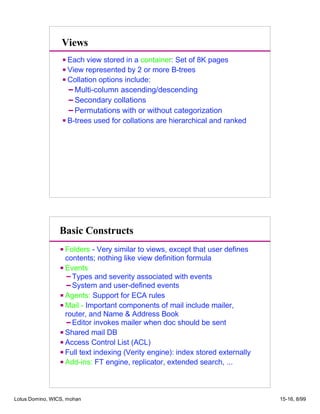
Views
Each view stored in a container: Set of 8K pages
View represented by 2 or more B-trees
Collation options include:
Multi-column ascending/descending
Secondary collations
Permutations with or without categorization
B-trees used for collations are hierarchical and ranked
Basic Constructs
Folders - Very similar to views, except that user defines
contents; nothing like view definition formula
Events
Types and severity associated with events
System and user-defined events
Agents: Support for ECA rules
Mail - Important components of mail include mailer,
router, and Name  Address Book
Editor invokes mailer when doc should be sent
Shared mail DB
Access Control List (ACL)
Full text indexing (Verity engine): index stored externally
Add-ins: FT engine, replicator, extended search, ...
Lotus Domino, WICS, mohan 15-16, 8/99
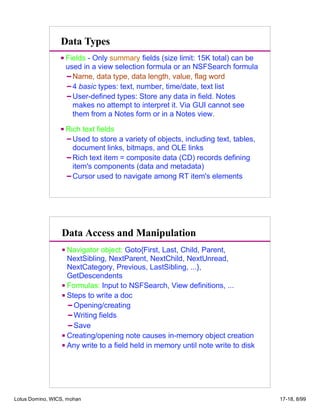
Fields - Only summary fields (size limit: 15K total) can be
used in a view selection formula or an NSFSearch formula
Name, data type, data length, value, flag word
4 basic types: text, number, time/date, text list
User-defined types: Store any data in field. Notes
makes no attempt to interpret it. Via GUI cannot see
them from a Notes form or in a Notes view.
Rich text fields
Used to store a variety of objects, including text, tables,
document links, bitmaps, and OLE links
Rich text item = composite data (CD) records defining
item's components (data and metadata)
Cursor used to navigate among RT item's elements
Data Types
Navigator object: Goto{First, Last, Child, Parent,
NextSibling, NextParent, NextChild, NextUnread,
NextCategory, Previous, LastSibling, ...},
GetDescendents
Formulas: Input to NSFSearch, View definitions, ...
Steps to write a doc
Opening/creating
Writing fields
Save
Creating/opening note causes in-memory object creation
Any write to a field held in memory until note write to disk
Data Access and Manipulation
Lotus Domino, WICS, mohan 17-18, 8/99
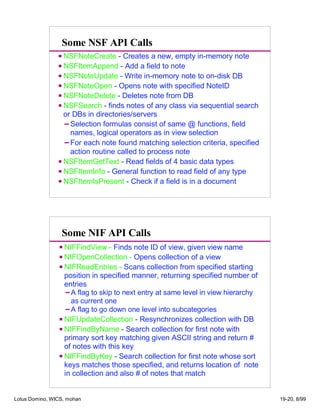
Some NSF API Calls
NSFNoteCreate - Creates a new, empty in-memory note
NSFItemAppend - Add a field to note
NSFNoteUpdate - Write in-memory note to on-disk DB
NSFNoteOpen - Opens note with specified NoteID
NSFNoteDelete - Deletes note from DB
NSFSearch - finds notes of any class via sequential search
or DBs in directories/servers
Selection formulas consist of same @ functions, field
names, logical operators as in view selection
For each note found matching selection criteria, specified
action routine called to process note
NSFItemGetText - Read fields of 4 basic data types
NSFItemInfo - General function to read field of any type
NSFItemIsPresent - Check if a field is in a document
Some NIF API Calls
NIFFindView - Finds note ID of view, given view name
NIFOpenCollection - Opens collection of a view
NIFReadEntries - Scans collection from specified starting
position in specified manner, returning specified number of
entries
A flag to skip to next entry at same level in view hierarchy
as current one
A flag to go down one level into subcategories
NIFUpdateCollection - Resynchronizes collection with DB
NIFFindByName - Search collection for first note with
primary sort key matching given ASCII string and return #
of notes with this key
NIFFindByKey - Search collection for first note whose sort
keys matches those specified, and returns location of note
in collection and also # of notes that match
Lotus Domino, WICS, mohan 19-20, 8/99
Architecture
Like web, based on rich document-oriented DB,
fielded forms and document linking
Original design point: small workgroup
Led to scalability and data recovery problems with
expanded usage and new requirements
Recent work (R5): Far improved scalability allowing
enterprise-wide deployment
Domino = Classic Notes + security and network
management + HTTP and CGI support
(A fully standard, Java-compliant, web server)
HTML, Java, SSL, NNTP, IMAP and LDAP are integrated
URL syntax for addressing Notes objects
DB functionality in Domino (server) and Notes (client)
almost identical
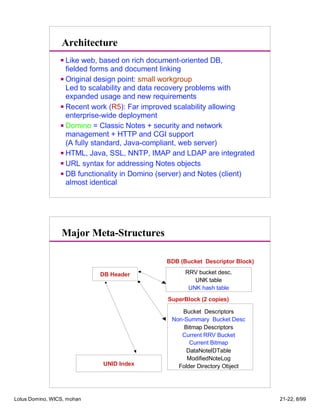
Major Meta-Structures
Bucket Descriptors
Non-Summary Bucket Desc
Bitmap Descriptors
Current RRV Bucket
Current Bitmap
DataNoteIDTable
ModifiedNoteLog
Folder Directory Object
DB Header RRV bucket desc.
UNK table
UNK hash table
SuperBlock (2 copies)
UNID Index
BDB (Bucket Descriptor Block)
Lotus Domino, WICS, mohan 21-22, 8/99
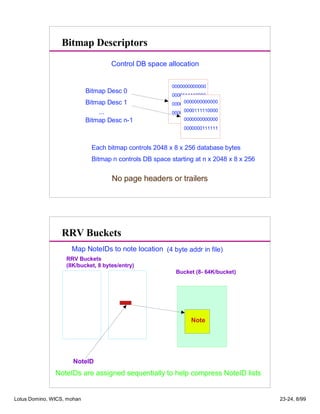
Bitmap Descriptors
0000000000000
00000001111111
0000000000000
0000111110000
Each bitmap controls 2048 x 8 x 256 database bytes
Bitmap n controls DB space starting at n x 2048 x 8 x 256
Bitmap Desc 0
Bitmap Desc 1
Bitmap Desc n-1
...
0000000000000
0000000111111
0000000000000
0000111110000
Control DB space allocation
No page headers or trailers
Bucket (8- 64K/bucket)
RRV Buckets
RRV Buckets
(8K/bucket, 8 bytes/entry)
NoteID
Note
Map NoteIDs to note location (4 byte addr in file)
NoteIDs are assigned sequentially to help compress NoteID lists
Lotus Domino, WICS, mohan 23-24, 8/99
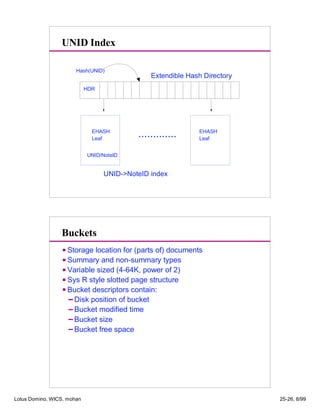
UNID Index
Extendible Hash Directory
HDR
EHASH
Leaf
EHASH
Leaf
.............
Hash(UNID)
UNID-NoteID index
UNID/NoteID
Buckets
Storage location for (parts of) documents
Summary and non-summary types
Variable sized (4-64K, power of 2)
Sys R style slotted page structure
Bucket descriptors contain:
Disk position of bucket
Bucket modified time
Bucket size
Bucket free space
Lotus Domino, WICS, mohan 25-26, 8/99
I/O
Buckets read and written as units
Index pages read and written as units
Bitmaps, other meta-objects read and written as units
Other objects read and written as byte ranges - relies
on OS file buffering
File syncs used to force data to disk - for meta
operations and on request via API
File and container level bits to detect need for fixup
Extension Manager
Allows an executable program library in an app to
register callback routine to be called before, after,
or before and after Domino/Notes performs
selected internal operations
Allows API apps to perform database shadowing
or add additional access controls
By trapping replication conflict notification, can
automatically handle replication conflicts
Extensible Architecture
Lotus Domino, WICS, mohan 27-28, 8/99
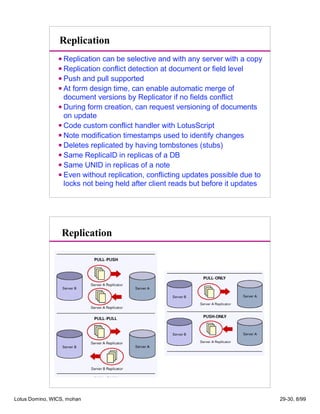
Replication
Replication can be selective and with any server with a copy
Replication conflict detection at document or field level
Push and pull supported
At form design time, can enable automatic merge of
document versions by Replicator if no fields conflict
During form creation, can request versioning of documents
on update
Code custom conflict handler with LotusScript
Note modification timestamps used to identify changes
Deletes replicated by having tombstones (stubs)
Same ReplicaID in replicas of a DB
Same UNID in replicas of a note
Even without replication, conflicting updates possible due to
locks not being held after client reads but before it updates
Replication
Lotus Domino, WICS, mohan 29-30, 8/99
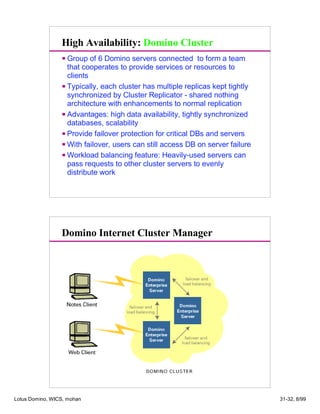
High Availability: Domino Cluster
Group of 6 Domino servers connected to form a team
that cooperates to provide services or resources to
clients
Typically, each cluster has multiple replicas kept tightly
synchronized by Cluster Replicator - shared nothing
architecture with enhancements to normal replication
Advantages: high data availability, tightly synchronized
databases, scalability
Provide failover protection for critical DBs and servers
With failover, users can still access DB on server failure
Workload balancing feature: Heavily-used servers can
pass requests to other cluster servers to evenly
distribute work
Domino Internet Cluster Manager
Lotus Domino, WICS, mohan 31-32, 8/99
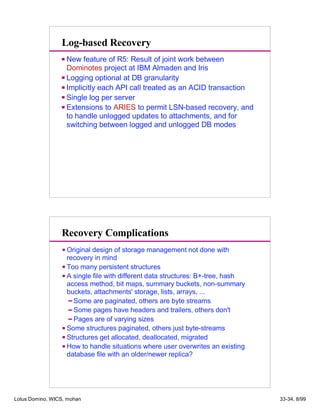
Log-based Recovery
New feature of R5: Result of joint work between
Dominotes project at IBM Almaden and Iris
Logging optional at DB granularity
Implicitly each API call treated as an ACID transaction
Single log per server
Extensions to ARIES to permit LSN-based recovery, and
to handle unlogged updates to attachments, and for
switching between logged and unlogged DB modes
Original design of storage management not done with
recovery in mind
Too many persistent structures
A single file with different data structures: B+-tree, hash
access method, bit maps, summary buckets, non-summary
buckets, attachments' storage, lists, arrays, ...
Some are paginated, others are byte streams
Some pages have headers and trailers, others don't
Pages are of varying sizes
Some structures paginated, others just byte-streams
Structures get allocated, deallocated, migrated
How to handle situations where user overwrites an existing
database file with an older/newer replica?
Recovery Complications
Lotus Domino, WICS, mohan 33-34, 8/99
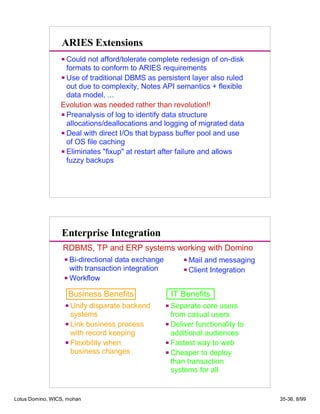
ARIES Extensions
Could not afford/tolerate complete redesign of on-disk
formats to conform to ARIES requirements
Use of traditional DBMS as persistent layer also ruled
out due to complexity, Notes API semantics + flexible
data model, ...
Evolution was needed rather than revolution!!
Preanalysis of log to identify data structure
allocations/deallocations and logging of migrated data
Deal with direct I/Os that bypass buffer pool and use
of OS file caching
Eliminates fixup at restart after failure and allows
fuzzy backups
Bi-directional data exchange
with transaction integration
Workflow
Enterprise Integration
RDBMS, TP and ERP systems working with Domino
Unify disparate backend
systems
Link business process
with record keeping
Flexibility when
business changes
Business Benefits
Separate core users
from casual users
Deliver functionality to
additional audiences
Fastest way to web
Cheaper to deploy
than transaction
systems for all
IT Benefits
Mail and messaging
Client Integration
Lotus Domino, WICS, mohan 35-36, 8/99
Domino
Insurance.nsf
Browser
Connector
Client
TP SYSTEM
Program/
Service
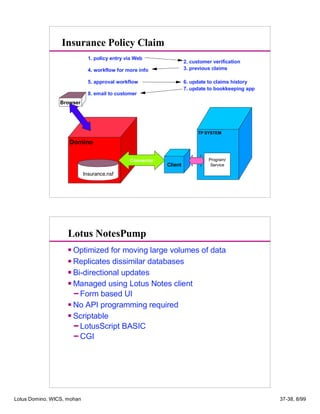
1. policy entry via Web
4. workflow for more info
5. approval workflow
8. email to customer
2. customer verification
3. previous claims
6. update to claims history
7. update to bookkeeping app
Insurance Policy Claim
Optimized for moving large volumes of data
Replicates dissimilar databases
Bi-directional updates
Managed using Lotus Notes client
Form based UI
No API programming required
Scriptable
LotusScript BASIC
CGI
Lotus NotesPump
Lotus Domino, WICS, mohan 37-38, 8/99
D E F G H E I P Q R I H S
T E U R F P H Q Q E Q V P U W G P H Q
X
W G P H Q I P Y R P S Q S
T E U R F P H Q ` I E F
D E F G H E S P I a P I
D b
X c
I P Q I G P a P S
d
H T G H S P I Q S T
d
Q
d
G H Q E T E U R F P H Q
D E F G H E I P Q I G P a P S Q V P
T E U R F P H Q ` I E F Q V P e
c f
Q I G g g P I G H g D b
X c
D b
X c
I P Y R P S Q S
T
d
Q
d
` I E F
P h Q P I H
d
W S P I a P I
U W G U i E H T E U R F P H Q G H
d
a G P p
q r s t u r v w x y w x
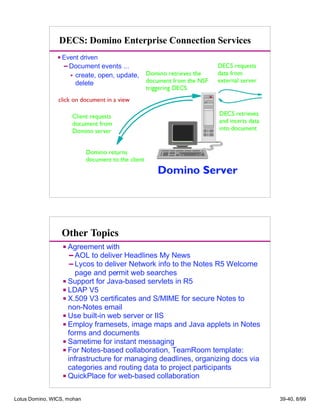
Event driven
Document events ...
create, open, update,
delete
DECS: Domino Enterprise Connection Services
Other Topics
Agreement with
AOL to deliver Headlines My News
Lycos to deliver Network info to the Notes R5 Welcome
page and permit web searches
Support for Java-based servlets in R5
LDAP V5
X.509 V3 certificates and S/MIME for secure Notes to
non-Notes email
Use built-in web server or IIS
Employ framesets, image maps and Java applets in Notes
forms and documents
Sametime for instant messaging
For Notes-based collaboration, TeamRoom template:
infrastructure for managing deadlines, organizing docs via
categories and routing data to project participants
QuickPlace for web-based collaboration
Lotus Domino, WICS, mohan 39-40, 8/99
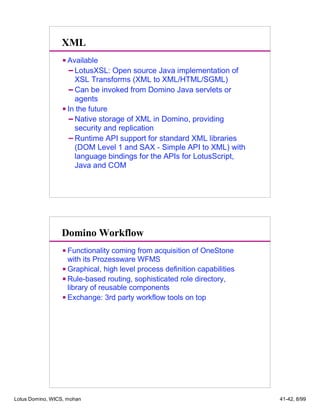
XML
Available
LotusXSL: Open source Java implementation of
XSL Transforms (XML to XML/HTML/SGML)
Can be invoked from Domino Java servlets or
agents
In the future
Native storage of XML in Domino, providing
security and replication
Runtime API support for standard XML libraries
(DOM Level 1 and SAX - Simple API to XML) with
language bindings for the APIs for LotusScript,
Java and COM
Domino Workflow
Functionality coming from acquisition of OneStone
with its Prozessware WFMS
Graphical, high level process definition capabilities
Rule-based routing, sophisticated role directory,
library of reusable components
Exchange: 3rd party workflow tools on top
Lotus Domino, WICS, mohan 41-42, 8/99
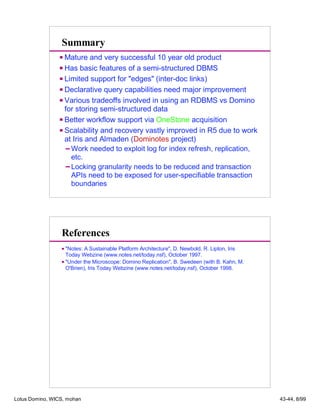
Mature and very successful 10 year old product
Has basic features of a semi-structured DBMS
Limited support for edges (inter-doc links)
Declarative query capabilities need major improvement
Various tradeoffs involved in using an RDBMS vs Domino
for storing semi-structured data
Better workflow support via OneStone acquisition
Scalability and recovery vastly improved in R5 due to work
at Iris and Almaden (Dominotes project)
Work needed to exploit log for index refresh, replication,
etc.
Locking granularity needs to be reduced and transaction
APIs need to be exposed for user-specifiable transaction
boundaries
Summary
References
Notes: A Sustainable Platform Architecture, D. Newbold, R. Lipton, Iris
Today Webzine (www.notes.net/today.nsf), October 1997.
Under the Microscope: Domino Replication, B. Swedeen (with B. Kahn, M.
O'Brien), Iris Today Webzine (www.notes.net/today.nsf), October 1998.
Lotus Domino, WICS, mohan 43-44, 8/99

21 domino mohan-1

  • 1.
    C. MOHAN Western Institutein Computer Science: Transacation Processing Concepts and Techniques Stanford, August 1999 mohan@almaden.ibm.com www.almaden.ibm.com/u/mohan/ IBM Almaden Research Center 650 Harry Road, K01/B1 San Jose, CA 95120, USA Evolution of Groupware for TP/Business Applications: Lotus Domino/Notes Agenda Introduction Semi-Structured Data Management Storage Architecture Replication High Availability Log-based Recovery Summary www.lotus.com, www.notes.net, www.iris.com, www.edge.lotus.com Lotus Domino, WICS, mohan 1-2, 8/99
  • 2.
    Introduction: Groupware Originally intendedfor use in a work group environment More than merely messaging Lotus Notes established the area in 1989 Subsequently, Novell GroupWise, Microsoft Exchange More recently, many web-based products/services, including realtime collaboration (e.g., instant messaging) Introduction: Lotus Notes Groupware product based on Plato Notes (1973) at UIUC Runs on numerous systems (NT, Unix, S/390, AS/400, Mac, ...) Core development from 1984 by Iris Associates, now subsidiary of Lotus 12/89: Notes 1.0 ships with email, phone book, discussion DB, document DB and RSA public key World's first semi-structured DBMS!! New terminology since R4.5 Domino = server Notes = client DB functionality almost same in both Latest release: R5.0 (4/99) Sample customers and apps Chase Manhattan Bank: Relationship Management System Bank America: Loan syndication application ABSA: ATM crime tracking system Banc One Financial Card Services: Customer Support System EDS, IBM: Enterprise-wide messaging and discussion DBs Lotus Domino, WICS, mohan 3-4, 8/99
  • 3.
    MessagingMessaging Discussion DBsDiscussion DBs Calendaring&Calendaring & SchedulingScheduling ReplicationReplication Agents/WorkflowAgents/Workflow Search/IndexSearch/Index Content ManagementContent Management External Data AccessExternal Data Access Fine-Grain SecurityFine-Grain Security Functionality Seamless development for multiple client types (Notes, browser) Functionality Evolution Major Advances in Web Development   ¡ ¢ £ ¤ ¥ ¦ § ¡   ¨ © ¡ § ¤ § ¤ ¥ ¤ ¥ ¦ © ¢ £ £ ¤ ¥ ¤ ¥ ¦   ¤ £ ¤ ¡ ¥ ¥   £ ¤ ¡ ¥ ¤ ¦ ¤ £ ¤ ¦ ¥ £ ¢   ¡ ¥ £   ¡ ¤   £ ¡   ¡ ¢ ¥ £ ¡ ¥ £ ¤ ¥   ¥   ! ¤ ¥ ¦   ¤ £ ¥ ¦ ¤ ¥ # $ % ' ( % ) 0 1 % ( # $ % ' ( ' ) % # $ % ' ( % ) 0 1 % ( 2 3 1 4 5 % 6 $ 7 8 7 6 5 ( 6 9 9 6 @ £ A ¤ A ¤ A ¡ A B ' ' 3 C C ' 3 1 1 3 C ) 3 Best of Breed Internet Messaging New Levels of Scalability, Reliability, Performance Continued Innovation in Collaboration and Knowledge Mgmt Increased Openness, Ease of Administration and Usability Transactions and high scalability in R5 34 million seats (YE98) Many invaluable features for being a web server Lotus Domino, WICS, mohan 5-6, 8/99
  • 4.
    Transactional Structured data Centralized Online Enterprise-wide Structured business processes Documents Semi/unstructureddata Distributed Disconnected online Workgroup-oriented Ad hoc workflow processes Complementary Functionality Domino and Transaction Systems Layered Architecture NSF Lotus Domino, WICS, mohan 7-8, 8/99
  • 5.
    Database Characteristics Schema less,forms are only guides DB contains semi-structured documents (docs) Docs may be addressed by key, by name or via views Views are materialized using lazy update mechanisms Heavy use of timestamps to determine changes for view update, replication, etc. Objects (e.g., OLE objects): free-standing or doc attachments Database Title Replication Settings Access Control List Replication History User Activity Log Policy Note Help Note View Note Form Note Filter Note Data Note (document) Data Note (document) Form Note View Note Data Note (document) . . . Collections (indexes) Storage Architecture A DB = a single self-describing file Location independent DB contents Most data stored in machine independent form on disc - allows binary file copy across machines (e.g., RISC and PC) Docs are also self-describing Within DB, separate storage of structured and unstructured (e.g., attachments) fields Structure of a DB Lotus Domino, WICS, mohan 9-10, 8/99
  • 6.
    Basic Constructs: Notes Usedto store variety of information - e.g., views, forms, icons, and policy data Docs = a kind of note (data note) Arbitrary # of items, any item name/type, any # of instances of each Split into summary, non-summary, and attachments Identified and locatable by NotesIDs (DB specific) and UNIDs (universal) Have parent/child relationships (e.g., original and response in a discussion DB) Timestamp fields for skimming, precedence determination Note Structures BodyHeader Item_Descriptor... Item Values UNK#/Length NOTE ITEM SUBJECT ITEM FORM ITEM AUTHOR ... Huh? MemoFred In-Memory Note On-Disk Note Item_Descriptor Non-Summary Attachment 1 Attachment n Summary fields Lotus Domino, WICS, mohan 11-12, 8/99
  • 7.
    Basic Constructs Forms -Templates used to view/update data via GUI View Note: Stores rules for Selecting docs from a DB (view definition formulas) Organizing docs Presenting info of each doc Collection - An instance of a view at one moment in time (materialized view with periodic, timestamp-based refresh) Always maintains its tree-like structure If doc in 2 categories, collection has 2 nodes for same doc A note's indent level tells if it is a main doc, a response, a response to response, ... Collapsible and expandable sections Collection Hierarchy List only main-topic docs in category, ignoring response docs Find only responses to a certain main topic Get list of all docs in a collection, regardless of any categories Response doc contains UNID of parent doc (no inverse link) Lotus Domino, WICS, mohan 13-14, 8/99
  • 8.
    Views Each view storedin a container: Set of 8K pages View represented by 2 or more B-trees Collation options include: Multi-column ascending/descending Secondary collations Permutations with or without categorization B-trees used for collations are hierarchical and ranked Basic Constructs Folders - Very similar to views, except that user defines contents; nothing like view definition formula Events Types and severity associated with events System and user-defined events Agents: Support for ECA rules Mail - Important components of mail include mailer, router, and Name Address Book Editor invokes mailer when doc should be sent Shared mail DB Access Control List (ACL) Full text indexing (Verity engine): index stored externally Add-ins: FT engine, replicator, extended search, ... Lotus Domino, WICS, mohan 15-16, 8/99
  • 9.
    Fields - Onlysummary fields (size limit: 15K total) can be used in a view selection formula or an NSFSearch formula Name, data type, data length, value, flag word 4 basic types: text, number, time/date, text list User-defined types: Store any data in field. Notes makes no attempt to interpret it. Via GUI cannot see them from a Notes form or in a Notes view. Rich text fields Used to store a variety of objects, including text, tables, document links, bitmaps, and OLE links Rich text item = composite data (CD) records defining item's components (data and metadata) Cursor used to navigate among RT item's elements Data Types Navigator object: Goto{First, Last, Child, Parent, NextSibling, NextParent, NextChild, NextUnread, NextCategory, Previous, LastSibling, ...}, GetDescendents Formulas: Input to NSFSearch, View definitions, ... Steps to write a doc Opening/creating Writing fields Save Creating/opening note causes in-memory object creation Any write to a field held in memory until note write to disk Data Access and Manipulation Lotus Domino, WICS, mohan 17-18, 8/99
  • 10.
    Some NSF APICalls NSFNoteCreate - Creates a new, empty in-memory note NSFItemAppend - Add a field to note NSFNoteUpdate - Write in-memory note to on-disk DB NSFNoteOpen - Opens note with specified NoteID NSFNoteDelete - Deletes note from DB NSFSearch - finds notes of any class via sequential search or DBs in directories/servers Selection formulas consist of same @ functions, field names, logical operators as in view selection For each note found matching selection criteria, specified action routine called to process note NSFItemGetText - Read fields of 4 basic data types NSFItemInfo - General function to read field of any type NSFItemIsPresent - Check if a field is in a document Some NIF API Calls NIFFindView - Finds note ID of view, given view name NIFOpenCollection - Opens collection of a view NIFReadEntries - Scans collection from specified starting position in specified manner, returning specified number of entries A flag to skip to next entry at same level in view hierarchy as current one A flag to go down one level into subcategories NIFUpdateCollection - Resynchronizes collection with DB NIFFindByName - Search collection for first note with primary sort key matching given ASCII string and return # of notes with this key NIFFindByKey - Search collection for first note whose sort keys matches those specified, and returns location of note in collection and also # of notes that match Lotus Domino, WICS, mohan 19-20, 8/99
  • 11.
    Architecture Like web, basedon rich document-oriented DB, fielded forms and document linking Original design point: small workgroup Led to scalability and data recovery problems with expanded usage and new requirements Recent work (R5): Far improved scalability allowing enterprise-wide deployment Domino = Classic Notes + security and network management + HTTP and CGI support (A fully standard, Java-compliant, web server) HTML, Java, SSL, NNTP, IMAP and LDAP are integrated URL syntax for addressing Notes objects DB functionality in Domino (server) and Notes (client) almost identical Major Meta-Structures Bucket Descriptors Non-Summary Bucket Desc Bitmap Descriptors Current RRV Bucket Current Bitmap DataNoteIDTable ModifiedNoteLog Folder Directory Object DB Header RRV bucket desc. UNK table UNK hash table SuperBlock (2 copies) UNID Index BDB (Bucket Descriptor Block) Lotus Domino, WICS, mohan 21-22, 8/99
  • 12.
    Bitmap Descriptors 0000000000000 00000001111111 0000000000000 0000111110000 Each bitmapcontrols 2048 x 8 x 256 database bytes Bitmap n controls DB space starting at n x 2048 x 8 x 256 Bitmap Desc 0 Bitmap Desc 1 Bitmap Desc n-1 ... 0000000000000 0000000111111 0000000000000 0000111110000 Control DB space allocation No page headers or trailers Bucket (8- 64K/bucket) RRV Buckets RRV Buckets (8K/bucket, 8 bytes/entry) NoteID Note Map NoteIDs to note location (4 byte addr in file) NoteIDs are assigned sequentially to help compress NoteID lists Lotus Domino, WICS, mohan 23-24, 8/99
  • 13.
    UNID Index Extendible HashDirectory HDR EHASH Leaf EHASH Leaf ............. Hash(UNID) UNID-NoteID index UNID/NoteID Buckets Storage location for (parts of) documents Summary and non-summary types Variable sized (4-64K, power of 2) Sys R style slotted page structure Bucket descriptors contain: Disk position of bucket Bucket modified time Bucket size Bucket free space Lotus Domino, WICS, mohan 25-26, 8/99
  • 14.
    I/O Buckets read andwritten as units Index pages read and written as units Bitmaps, other meta-objects read and written as units Other objects read and written as byte ranges - relies on OS file buffering File syncs used to force data to disk - for meta operations and on request via API File and container level bits to detect need for fixup Extension Manager Allows an executable program library in an app to register callback routine to be called before, after, or before and after Domino/Notes performs selected internal operations Allows API apps to perform database shadowing or add additional access controls By trapping replication conflict notification, can automatically handle replication conflicts Extensible Architecture Lotus Domino, WICS, mohan 27-28, 8/99
  • 15.
    Replication Replication can beselective and with any server with a copy Replication conflict detection at document or field level Push and pull supported At form design time, can enable automatic merge of document versions by Replicator if no fields conflict During form creation, can request versioning of documents on update Code custom conflict handler with LotusScript Note modification timestamps used to identify changes Deletes replicated by having tombstones (stubs) Same ReplicaID in replicas of a DB Same UNID in replicas of a note Even without replication, conflicting updates possible due to locks not being held after client reads but before it updates Replication Lotus Domino, WICS, mohan 29-30, 8/99
  • 16.
    High Availability: DominoCluster Group of 6 Domino servers connected to form a team that cooperates to provide services or resources to clients Typically, each cluster has multiple replicas kept tightly synchronized by Cluster Replicator - shared nothing architecture with enhancements to normal replication Advantages: high data availability, tightly synchronized databases, scalability Provide failover protection for critical DBs and servers With failover, users can still access DB on server failure Workload balancing feature: Heavily-used servers can pass requests to other cluster servers to evenly distribute work Domino Internet Cluster Manager Lotus Domino, WICS, mohan 31-32, 8/99
  • 17.
    Log-based Recovery New featureof R5: Result of joint work between Dominotes project at IBM Almaden and Iris Logging optional at DB granularity Implicitly each API call treated as an ACID transaction Single log per server Extensions to ARIES to permit LSN-based recovery, and to handle unlogged updates to attachments, and for switching between logged and unlogged DB modes Original design of storage management not done with recovery in mind Too many persistent structures A single file with different data structures: B+-tree, hash access method, bit maps, summary buckets, non-summary buckets, attachments' storage, lists, arrays, ... Some are paginated, others are byte streams Some pages have headers and trailers, others don't Pages are of varying sizes Some structures paginated, others just byte-streams Structures get allocated, deallocated, migrated How to handle situations where user overwrites an existing database file with an older/newer replica? Recovery Complications Lotus Domino, WICS, mohan 33-34, 8/99
  • 18.
    ARIES Extensions Could notafford/tolerate complete redesign of on-disk formats to conform to ARIES requirements Use of traditional DBMS as persistent layer also ruled out due to complexity, Notes API semantics + flexible data model, ... Evolution was needed rather than revolution!! Preanalysis of log to identify data structure allocations/deallocations and logging of migrated data Deal with direct I/Os that bypass buffer pool and use of OS file caching Eliminates fixup at restart after failure and allows fuzzy backups Bi-directional data exchange with transaction integration Workflow Enterprise Integration RDBMS, TP and ERP systems working with Domino Unify disparate backend systems Link business process with record keeping Flexibility when business changes Business Benefits Separate core users from casual users Deliver functionality to additional audiences Fastest way to web Cheaper to deploy than transaction systems for all IT Benefits Mail and messaging Client Integration Lotus Domino, WICS, mohan 35-36, 8/99
  • 19.
    Domino Insurance.nsf Browser Connector Client TP SYSTEM Program/ Service 1. policyentry via Web 4. workflow for more info 5. approval workflow 8. email to customer 2. customer verification 3. previous claims 6. update to claims history 7. update to bookkeeping app Insurance Policy Claim Optimized for moving large volumes of data Replicates dissimilar databases Bi-directional updates Managed using Lotus Notes client Form based UI No API programming required Scriptable LotusScript BASIC CGI Lotus NotesPump Lotus Domino, WICS, mohan 37-38, 8/99
  • 20.
    D E FG H E I P Q R I H S T E U R F P H Q Q E Q V P U W G P H Q X W G P H Q I P Y R P S Q S T E U R F P H Q ` I E F D E F G H E S P I a P I D b X c I P Q I G P a P S d H T G H S P I Q S T d Q d G H Q E T E U R F P H Q D E F G H E I P Q I G P a P S Q V P T E U R F P H Q ` I E F Q V P e c f Q I G g g P I G H g D b X c D b X c I P Y R P S Q S T d Q d ` I E F P h Q P I H d W S P I a P I U W G U i E H T E U R F P H Q G H d a G P p q r s t u r v w x y w x Event driven Document events ... create, open, update, delete DECS: Domino Enterprise Connection Services Other Topics Agreement with AOL to deliver Headlines My News Lycos to deliver Network info to the Notes R5 Welcome page and permit web searches Support for Java-based servlets in R5 LDAP V5 X.509 V3 certificates and S/MIME for secure Notes to non-Notes email Use built-in web server or IIS Employ framesets, image maps and Java applets in Notes forms and documents Sametime for instant messaging For Notes-based collaboration, TeamRoom template: infrastructure for managing deadlines, organizing docs via categories and routing data to project participants QuickPlace for web-based collaboration Lotus Domino, WICS, mohan 39-40, 8/99
  • 21.
    XML Available LotusXSL: Open sourceJava implementation of XSL Transforms (XML to XML/HTML/SGML) Can be invoked from Domino Java servlets or agents In the future Native storage of XML in Domino, providing security and replication Runtime API support for standard XML libraries (DOM Level 1 and SAX - Simple API to XML) with language bindings for the APIs for LotusScript, Java and COM Domino Workflow Functionality coming from acquisition of OneStone with its Prozessware WFMS Graphical, high level process definition capabilities Rule-based routing, sophisticated role directory, library of reusable components Exchange: 3rd party workflow tools on top Lotus Domino, WICS, mohan 41-42, 8/99
  • 22.
    Mature and verysuccessful 10 year old product Has basic features of a semi-structured DBMS Limited support for edges (inter-doc links) Declarative query capabilities need major improvement Various tradeoffs involved in using an RDBMS vs Domino for storing semi-structured data Better workflow support via OneStone acquisition Scalability and recovery vastly improved in R5 due to work at Iris and Almaden (Dominotes project) Work needed to exploit log for index refresh, replication, etc. Locking granularity needs to be reduced and transaction APIs need to be exposed for user-specifiable transaction boundaries Summary References Notes: A Sustainable Platform Architecture, D. Newbold, R. Lipton, Iris Today Webzine (www.notes.net/today.nsf), October 1997. Under the Microscope: Domino Replication, B. Swedeen (with B. Kahn, M. O'Brien), Iris Today Webzine (www.notes.net/today.nsf), October 1998. Lotus Domino, WICS, mohan 43-44, 8/99