
Aug. 2 Aug. 3 Aug. 4 Aug. 5 Aug. 6
9:00 Intro &
terminology
TP mons
& ORBs
Logging &
res. Mgr.
Files &
Buffer Mgr.
Structured
files
11:00 Reliability Locking
theory
Res. Mgr. &
Trans. Mgr.
COM+ Access paths
13:30 Fault
tolerance
Locking
techniques
CICS & TP
& Internet
CORBA/
EJB + TP
Groupware
15:30 Transaction
models
Queueing Advanced
Trans. Mgr.
Replication Performance
& TPC
18:00 Reception Workflow Cyberbricks Party FREE
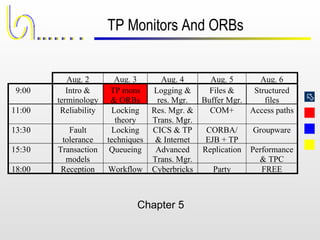
TP Monitors And ORBs
Chapter 5

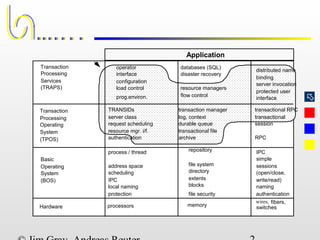
Hardware
Basic
Operating
System
(BOS)
Transaction
Processing
Operating
System
(TPOS)
Transaction
Processing
Services
(TRAPS)
processors
process / thread
address space
scheduling
IPC
local naming
protection
repository
file system
directory
extents
blocks
file security
IPC
simple
sessions
(open/close,
write/read)
naming
authentication
TRANSIDs
server class
request scheduling
resource mgr. i/f.
authentication
transaction manager
log, context
durable queue
transactional file
archive
transactional RPC
transactional
session
RPC
operator
interface
configuration
load control
prog.environ.
databases (SQL)
disaster recovery
resource managers
flow control
distributed name
binding
server invocation
protected user
interface
Application
memory
wires, fibers,
switches

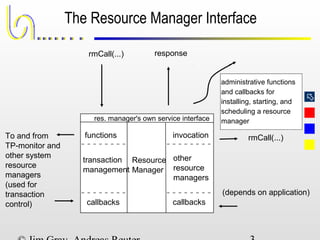
The Resource Manager Interface
Resource
Manager
res. manager's own service interface
rmCall(...)
transaction
management
other
resource
managers
rmCall(...)
administrative functions
and callbacks for
installing, starting, and
scheduling a resource
manager
response
functions
callbacks
invocation
callbacks
(depends on application)
To and from
TP-monitor and
other system
resource
managers
(used for
transaction
control)

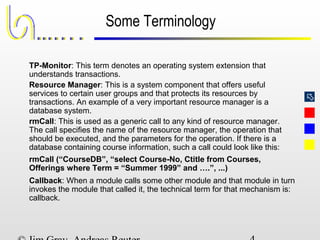
Some Terminology
TP-Monitor: This term denotes an operating system extension that
understands transactions.
Resource Manager: This is a system component that offers useful
services to certain user groups and that protects its resources by
transactions. An example of a very important resource manager is a
database system.
rmCall: This is used as a generic call to any kind of resource manager.
The call specifies the name of the resource manager, the operation that
should be executed, and the parameters for the operation. If there is a
database containing course information, such a call could look like this:
rmCall (“CourseDB”, “select Course-No, Ctitle from Courses,
Offerings where Term = “Summer 1999” and ….”, ...)
Callback: When a module calls some other module and that module in turn
invokes the module that called it, the technical term for that mechanism is:
callback.

Some Interface Definitions
typedef struct /* handle for identifying the specific instantiation */
{ /* of a resource manager */
NODEID nodeid; /* node where process lives */
PID pid; /* process request is bound to */
TIMESTAMP birthdate; /* time of server creation */
} rmInstance; /* identifies a specific server */
typedef struct /* resource manager parameters */
{ Ulong CB_length; /* number of bytes in CB */
char CB_bytes [CB_length]; /* byte string */
} rmParams;
Boolean rmCall(RMNAME, /*inv. of RM named RMNAME */
Bindld* BoundTo, /* expl. with bind mechanism */
rmParams * InParams, /* params to the server */
rmParams * OutResults); /* results from server */

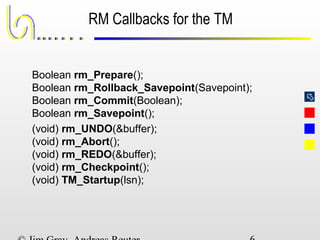
RM Callbacks for the TM
Boolean rm_Prepare();
Boolean rm_Rollback_Savepoint(Savepoint);
Boolean rm_Commit(Boolean);
Boolean rm_Savepoint();
(void) rm_UNDO(&buffer);
(void) rm_Abort();
(void) rm_REDO(&buffer);
(void) rm_Checkpoint();
(void) TM_Startup(lsn);

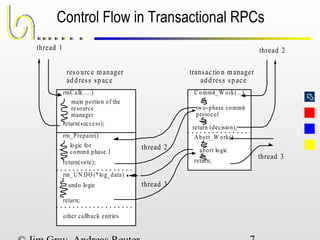
Control Flow in Transactional RPCs
resource manager
address space
rmC all(.....)
main portion of the
resource
manager
return(success);
rm_Prepare()
logic for
commit phase 1
return(vote);
rm_UN DO (*log_data)
undo logic
return;
other callback entries
thread 1
transaction manager
address space
C ommit_W ork(...)
two-phase commit
protocol
return (decision);
Abort_W ork()
abort logic
return;
thread 2
thread 2
thread 3
thread 3

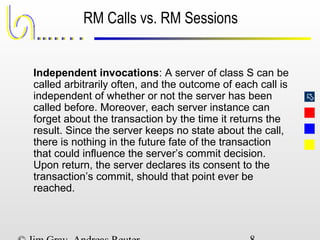
RM Calls vs. RM Sessions
Independent invocations: A server of class S can be
called arbitrarily often, and the outcome of each call is
independent of whether or not the server has been
called before. Moreover, each server instance can
forget about the transaction by the time it returns the
result. Since the server keeps no state about the call,
there is nothing in the future fate of the transaction
that could influence the server’s commit decision.
Upon return, the server declares its consent to the
transaction’s commit, should that point ever be
reached.

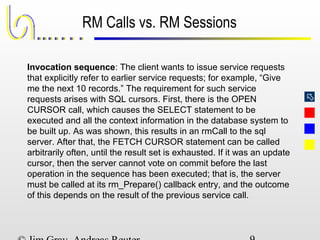
RM Calls vs. RM Sessions
Invocation sequence: The client wants to issue service requests
that explicitly refer to earlier service requests; for example, “Give
me the next 10 records.” The requirement for such service
requests arises with SQL cursors. First, there is the OPEN
CURSOR call, which causes the SELECT statement to be
executed and all the context information in the database system to
be built up. As was shown, this results in an rmCall to the sql
server. After that, the FETCH CURSOR statement can be called
arbitrarily often, until the result set is exhausted. If it was an update
cursor, then the server cannot vote on commit before the last
operation in the sequence has been executed; that is, the server
must be called at its rm_Prepare() callback entry, and the outcome
of this depends on the result of the previous service call.

RM Calls vs. RM Sessions
Complex interaction: The server class must remember the
results of all invocations by client C until commit, because only
then can it be decided whether certain deferred consistency
constraints are fulfilled. Think of a mail server. The server
creates the mail header during the first interaction, the mail body
during the next interaction, and so on. The mail server stores the
various parts of a message in a database. All these interactions
are independent; the client might as well create the body first,
and the header next. However, the mail server maintains a
consistency constraint that says that no mail must be accepted
without at least a header, a body, and a trailer. Since this
constraint cannot be determined until commit, there must be
some way of relating all the updates done on behalf of the client
when the server is called (back) at rm_Prepare.

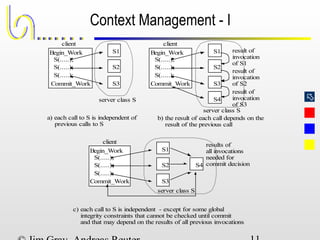
Begin_Work
client
S(.....);
S(.....);
S(.....);
Commit_Work
S1
S2
S3
server class S
Begin_Work
client
S(.....);
S(.....);
S(.....);
Commit_Work
S1
S2
S3
server class S
a) each call to S is independent of
previous calls to S
result of
invocation
of S1
result of
invocation
of S2
b) the result of each call depends on the
result of the previous call
Begin_Work
client
S(.....);
S(.....);
S(.....);
Commit_Work
S1
S2
S3
server class S
S4
result of
invocation
of S3
S4
results of
all invocations
needed for
commit decision
c) each call to S is independent - except for some global
integrity constraints that cannot be checked until commit
and that may depend on the results of all previous invocations
Context Management - I

client
context
server
S1
context
session
context
kept
loc.
client
server
S1
server
S2
context
request
response
request context
contextresponse
client
context
server
S1
server
S2
context
DBread/
write
request
resp.
client
context
server
S1
server
S2
context
request
resp.
request
resp.
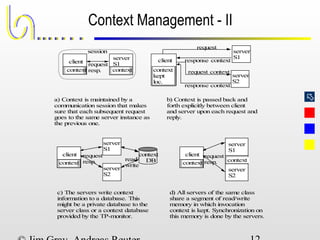
a) Context is maintained by a
communication session that makes
sure that each subsequent request
goes to the same server instance as
the previous one.
b) Context is passed back and
forth explicitly between client
and server upon each request and
reply.
c) The servers write context
information to a database. This
might be a private database to the
server class or a context database
provided by the TP-monitor.
d) All servers of the same class
share a segment of read/write
memory in which invocation
context is kept. Synchronization on
this memory is done by the servers.
Context Management - II

Types of Context Information
Client-oriented context: The solutions presented so far implicitly
assume that this is the type of context to be managed. Typical
examples are cursor positions, authenticated userids, etc.
Transaction-oriented context: Consider the following example:
Client C invokes server S1, which in turn invokes server S3—all
within T. After return from the service call, C invokes S2 (a different
server class), which also invokes S3, but needs the context
established by the earlier call to S3 from S1. The point here is that
the context needed by S3 is not bound to any of the previous
client-server interactions, but it is bound to the transaction as such.
This leads back to the argument about the similarities between
sessions and transactions in terms of context management.
Examples of transaction-oriented context are deferred consistency
constraints and locks.

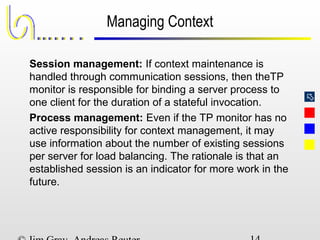
Managing Context
Session management: If context maintenance is
handled through communication sessions, then theTP
monitor is responsible for binding a server process to
one client for the duration of a stateful invocation.
Process management: Even if the TP monitor has no
active responsibility for context management, it may
use information about the number of existing sessions
per server for load balancing. The rationale is that an
established session is an indicator for more work in the
future.

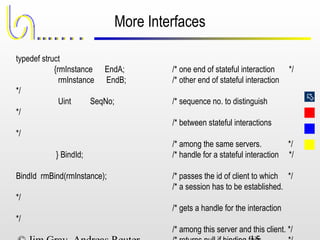
More Interfaces
typedef struct
{rmInstance EndA; /* one end of stateful interaction */
rmInstance EndB; /* other end of stateful interaction
*/
Uint SeqNo; /* sequence no. to distinguish
*/
/* between stateful interactions
*/
/* among the same servers. */
} BindId; /* handle for a stateful interaction */
BindId rmBind(rmInstance); /* passes the id of client to which */
/* a session has to be established.
*/
/* gets a handle for the interaction
*/
/* among this server and this client. */

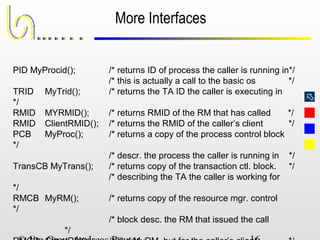
More Interfaces
PID MyProcid(); /* returns ID of process the caller is running in*/
/* this is actually a call to the basic os */
TRID MyTrid(); /* returns the TA ID the caller is executing in
*/
RMID MYRMID(); /* returns RMID of the RM that has called */
RMID ClientRMID(); /* returns the RMID of the caller’s client */
PCB MyProc(); /* returns a copy of the process control block
*/
/* descr. the process the caller is running in */
TransCB MyTrans(); /* returns copy of the transaction ctl. block. */
/* describing the TA the caller is working for
*/
RMCB MyRM(); /* returns copy of the resource mgr. control
*/
/* block desc. the RM that issued the call
*/

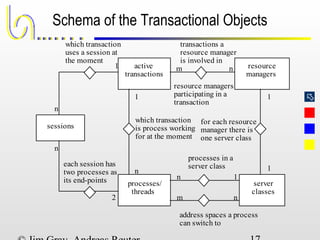
Schema of the Transactional Objects
active
transactions
resource
managers
processes/
threads
sessions
server
classes
m n
1
1
n 1
1
n
n
2
n
1
resource managers
participating in a
transaction
transactions a
resource manager
is involved in
for each resource
manager there is
one server class
processes in a
server classeach session has
two processes as
its end-points
which transaction
is process working
for at the moment
which transaction
uses a session at
the moment
m n
address spaces a process
can switch to

Name Binding for rmCalls
RMNAME address
name server
interface ptype
mailer farnode.mailserver
order entry
order entry
order entry
snode1.prod
snode2.prod
snode3.prod
sqldb database.server
***
***
***
***
***
RMTable
ResMgrName
rmid
RMactive
RMup
...
RMPR_chain
rm_entry[]
...
rm_Savepoint
rm_Prepare
rm_Commit
...
***
***
DebitCredit
DebitCredit
NearNode.1
NearNode.2
cached
part
of name
server
***DebitCredit NearNode.1
***DebitCredit NearNode.2
sqldb database.server ***
ProcessIx
busy
NextProcess
<RMNAME, EntryName>Step 1:
RM locally
available ?
Step 2
(yes):
Bind to
that
RMID
Step 2 (no):
Find a node
in the name
server;
send request
via RPC; do
local
binding at
that node
Step 3:
Find an idle
process
Step 4:
Find entry
point address
RPC to other node;
there it will be local
binding
Step 5: activate process at entry point address

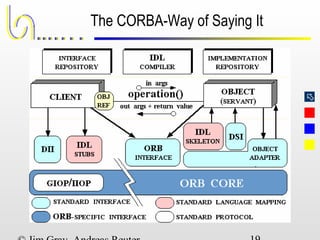
The CORBA-Way of Saying It

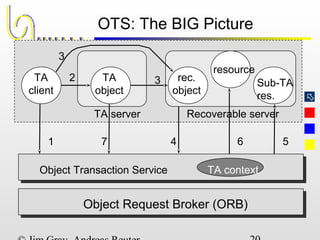
OTS: The BIG Picture
Object Request Broker (ORB)
Object Transaction Service TA context
TA
client
1
2 3
3
4 567
TA
object
rec.
object
resource
Sub-TA
res.
TA server Recoverable server

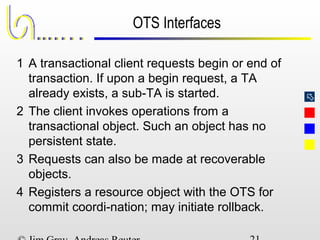
OTS Interfaces
1 A transactional client requests begin or end of
transaction. If upon a begin request, a TA
already exists, a sub-TA is started.
2 The client invokes operations from a
transactional object. Such an object has no
persistent state.
3 Requests can also be made at recoverable
objects.
4 Registers a resource object with the OTS for
commit coordi-nation; may initiate rollback.

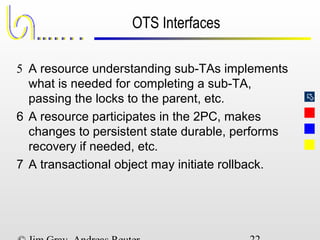
OTS Interfaces
5 A resource understanding sub-TAs implements
what is needed for completing a sub-TA,
passing the locks to the parent, etc.
6 A resource participates in the 2PC, makes
changes to persistent state durable, performs
recovery if needed, etc.
7 A transactional object may initiate rollback.

Transaction Context
OTS maintains a transaction context for each
active TA. It is associated with all transactional
operations.
The TA context is an implicit parameter for all
invocations of TA operations.
The context can also be passed as an explicit
parameter.
This is required in environments where both the
OTS style and the procedural (X/Open DTP)
style of transactions are used in parallel.

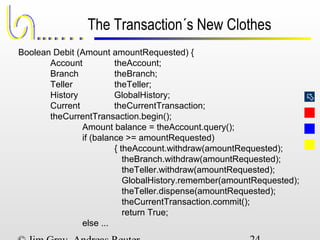
The Transaction´s New Clothes
Boolean Debit (Amount amountRequested) {
Account theAccount;
Branch theBranch;
Teller theTeller;
History GlobalHistory;
Current theCurrentTransaction;
theCurrentTransaction.begin();
Amount balance = theAccount.query();
if (balance >= amountRequested)
{ theAccount.withdraw(amountRequested);
theBranch.withdraw(amountRequested);
theTeller.withdraw(amountRequested);
GlobalHistory.remember(amountRequested);
theTeller.dispense(amountRequested);
theCurrentTransaction.commit();
return True;
else ...

OTS Interfaces
Current denotes a pseudo object, the methods of which
are executed within OTS and ORB.
Invoking begin on an object of class current creates a
transaction context that is managed by the ORB until
the TA either commits or aborts.
As a result of begin, the newly created context is
associated with the client´s “thread of control”, which
typically translates into “process”. Multiple threads (in
different execution environments) can be associated
with the same context at the same time.

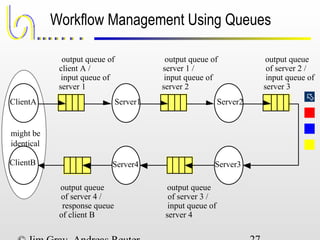
Why Use Queues?
Load control: In case of temporary overload put requests into a
queue for the server class rather than flood the system with new
processes.
End-user control: Queue can maintain the output of
asynchronous transactions for delivery until the user explicitly
acknowledgs receipt.
Recoverable data entry: Requests put on server’s queue. Server
application processes requests as fast as it can.
Multi-transaction requests (Workflow): Requests are processed
by a server which passes results on to another server for further
processing. This can go on for many steps. If none of the steps
interacts with a user, they can all be executed asynchronously.

Workflow Management Using Queues
ClientA Server1 Server2
Server3Server4ClientB
might be
identical
output queue
of server 3 /
input queue of
server 4
output queue
of server 2 /
input queue of
server 3
output queue of
server 1 /
input queue of
server 2
output queue of
client A /
input queue of
server 1
output queue
of server 4 /
response queue
of client B

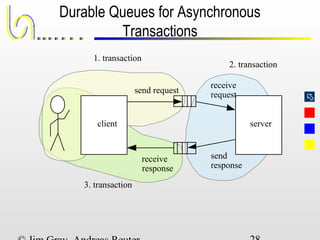
Durable Queues for Asynchronous
Transactions
client server
send request
send
response
receive
request
receive
response
1. transaction
2. transaction
3. transaction

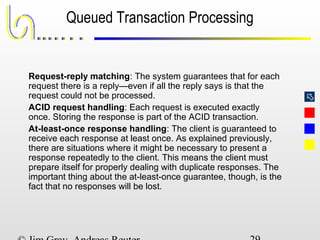
Queued Transaction Processing
Request-reply matching: The system guarantees that for each
request there is a reply—even if all the reply says is that the
request could not be processed.
ACID request handling: Each request is executed exactly
once. Storing the response is part of the ACID transaction.
At-least-once response handling: The client is guaranteed to
receive each response at least once. As explained previously,
there are situations where it might be necessary to present a
response repeatedly to the client. This means the client must
prepare itself for properly dealing with duplicate responses. The
important thing about the at-least-once guarantee, though, is the
fact that no responses will be lost.

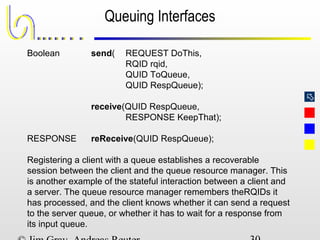
Queuing Interfaces
Boolean send( REQUEST DoThis,
RQID rqid,
QUID ToQueue,
QUID RespQueue);
receive(QUID RespQueue,
RESPONSE KeepThat);
RESPONSE reReceive(QUID RespQueue);
Registering a client with a queue establishes a recoverable
session between the client and the queue resource manager. This
is another example of the stateful interaction between a client and
a server. The queue resource manager remembers theRQIDs it
has processed, and the client knows whether it can send a request
to the server queue, or whether it has to wait for a response from
its input queue.

A Sample Queue Manager
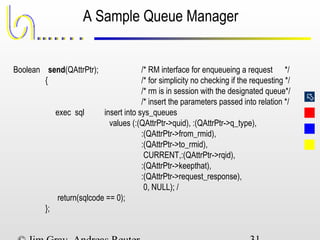
Boolean send(QAttrPtr); /* RM interface for enqueueing a request */
{ /* for simplicity no checking if the requesting */
/* rm is in session with the designated queue*/
/* insert the parameters passed into relation */
exec sql insert into sys_queues
values (:(QAttrPtr->quid), :(QAttrPtr->q_type),
:(QAttrPtr->from_rmid),
:(QAttrPtr->to_rmid),
CURRENT,:(QAttrPtr->rqid),
:(QAttrPtr->keepthat),
:(QAttrPtr->request_response),
0, NULL); /
return(sqlcode == 0);
};

A Sample Queue Manager
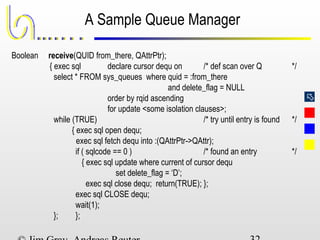
Boolean receive(QUID from_there, QAttrPtr);
{ exec sql declare cursor dequ on /* def scan over Q */
select * FROM sys_queues where quid = :from_there
and delete_flag = NULL
order by rqid ascending
for update <some isolation clauses>;
while (TRUE) /* try until entry is found */
{ exec sql open dequ;
exec sql fetch dequ into :(QAttrPtr->QAttr);
if ( sqlcode == 0 ) /* found an entry */
{ exec sql update where current of cursor dequ
set delete_flag = ‘D’;
exec sql close dequ; return(TRUE); };
exec sql CLOSE dequ;
wait(1);
}; };

Load Balancing
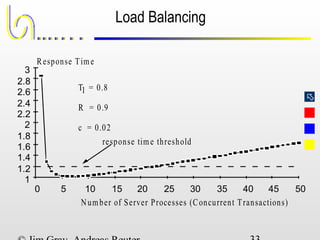
1
1.2
1.4
1.6
1.8
2
2.2
2.4
2.6
2.8
3
0 5 10 15 20 25 30 35 40 45 50
Response Time
Number of Server Processes (Concurrent Transactions)
T = 0.8
R = 0.9
c = 0.02
1
response time threshold

Thrashing
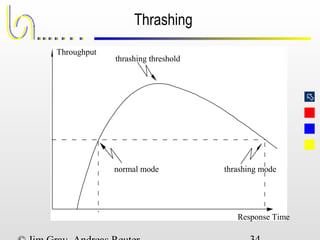
thrashing threshold
Throughput
Response Time
normal mode thrashing mode

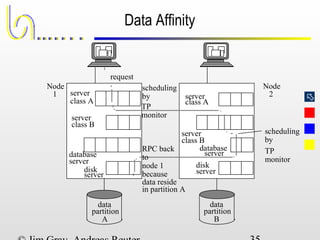
Data Affinity
data
partition
A
data
partition
B
server
class A
server
class A
server
class B
disk
server
disk
server
server
class B
database
server
database
server
Node
1
Node
2
scheduling
by
TP
monitor
scheduling
by
TP
monitor
RPC back
to
node 1
because
data reside
in partition A
request

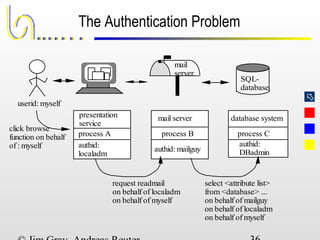
The Authentication Problem
SQL-
database
mail
server
presentation
service
mail server database system
process A process B process C
authid:
localadm
authid: mailguy
authid:
DBadmin
userid: myself
click browse
function on behalf
of : myself
request readmail
on behalf of localadm
on behalf of myself
select <attribute list>
from <database> ...
on behalf of mailguy
on behalf of localadm
on behalf of myself

05 tp mon_orbs

  • 1.
     Aug. 2 Aug.3 Aug. 4 Aug. 5 Aug. 6 9:00 Intro & terminology TP mons & ORBs Logging & res. Mgr. Files & Buffer Mgr. Structured files 11:00 Reliability Locking theory Res. Mgr. & Trans. Mgr. COM+ Access paths 13:30 Fault tolerance Locking techniques CICS & TP & Internet CORBA/ EJB + TP Groupware 15:30 Transaction models Queueing Advanced Trans. Mgr. Replication Performance & TPC 18:00 Reception Workflow Cyberbricks Party FREE TP Monitors And ORBs Chapter 5
  • 2.
     Hardware Basic Operating System (BOS) Transaction Processing Operating System (TPOS) Transaction Processing Services (TRAPS) processors process / thread addressspace scheduling IPC local naming protection repository file system directory extents blocks file security IPC simple sessions (open/close, write/read) naming authentication TRANSIDs server class request scheduling resource mgr. i/f. authentication transaction manager log, context durable queue transactional file archive transactional RPC transactional session RPC operator interface configuration load control prog.environ. databases (SQL) disaster recovery resource managers flow control distributed name binding server invocation protected user interface Application memory wires, fibers, switches
  • 3.
     The Resource ManagerInterface Resource Manager res. manager's own service interface rmCall(...) transaction management other resource managers rmCall(...) administrative functions and callbacks for installing, starting, and scheduling a resource manager response functions callbacks invocation callbacks (depends on application) To and from TP-monitor and other system resource managers (used for transaction control)
  • 4.
     Some Terminology TP-Monitor: Thisterm denotes an operating system extension that understands transactions. Resource Manager: This is a system component that offers useful services to certain user groups and that protects its resources by transactions. An example of a very important resource manager is a database system. rmCall: This is used as a generic call to any kind of resource manager. The call specifies the name of the resource manager, the operation that should be executed, and the parameters for the operation. If there is a database containing course information, such a call could look like this: rmCall (“CourseDB”, “select Course-No, Ctitle from Courses, Offerings where Term = “Summer 1999” and ….”, ...) Callback: When a module calls some other module and that module in turn invokes the module that called it, the technical term for that mechanism is: callback.
  • 5.
     Some Interface Definitions typedefstruct /* handle for identifying the specific instantiation */ { /* of a resource manager */ NODEID nodeid; /* node where process lives */ PID pid; /* process request is bound to */ TIMESTAMP birthdate; /* time of server creation */ } rmInstance; /* identifies a specific server */ typedef struct /* resource manager parameters */ { Ulong CB_length; /* number of bytes in CB */ char CB_bytes [CB_length]; /* byte string */ } rmParams; Boolean rmCall(RMNAME, /*inv. of RM named RMNAME */ Bindld* BoundTo, /* expl. with bind mechanism */ rmParams * InParams, /* params to the server */ rmParams * OutResults); /* results from server */
  • 6.
     RM Callbacks forthe TM Boolean rm_Prepare(); Boolean rm_Rollback_Savepoint(Savepoint); Boolean rm_Commit(Boolean); Boolean rm_Savepoint(); (void) rm_UNDO(&buffer); (void) rm_Abort(); (void) rm_REDO(&buffer); (void) rm_Checkpoint(); (void) TM_Startup(lsn);
  • 7.
     Control Flow inTransactional RPCs resource manager address space rmC all(.....) main portion of the resource manager return(success); rm_Prepare() logic for commit phase 1 return(vote); rm_UN DO (*log_data) undo logic return; other callback entries thread 1 transaction manager address space C ommit_W ork(...) two-phase commit protocol return (decision); Abort_W ork() abort logic return; thread 2 thread 2 thread 3 thread 3
  • 8.
     RM Calls vs.RM Sessions Independent invocations: A server of class S can be called arbitrarily often, and the outcome of each call is independent of whether or not the server has been called before. Moreover, each server instance can forget about the transaction by the time it returns the result. Since the server keeps no state about the call, there is nothing in the future fate of the transaction that could influence the server’s commit decision. Upon return, the server declares its consent to the transaction’s commit, should that point ever be reached.
  • 9.
     RM Calls vs.RM Sessions Invocation sequence: The client wants to issue service requests that explicitly refer to earlier service requests; for example, “Give me the next 10 records.” The requirement for such service requests arises with SQL cursors. First, there is the OPEN CURSOR call, which causes the SELECT statement to be executed and all the context information in the database system to be built up. As was shown, this results in an rmCall to the sql server. After that, the FETCH CURSOR statement can be called arbitrarily often, until the result set is exhausted. If it was an update cursor, then the server cannot vote on commit before the last operation in the sequence has been executed; that is, the server must be called at its rm_Prepare() callback entry, and the outcome of this depends on the result of the previous service call.
  • 10.
     RM Calls vs.RM Sessions Complex interaction: The server class must remember the results of all invocations by client C until commit, because only then can it be decided whether certain deferred consistency constraints are fulfilled. Think of a mail server. The server creates the mail header during the first interaction, the mail body during the next interaction, and so on. The mail server stores the various parts of a message in a database. All these interactions are independent; the client might as well create the body first, and the header next. However, the mail server maintains a consistency constraint that says that no mail must be accepted without at least a header, a body, and a trailer. Since this constraint cannot be determined until commit, there must be some way of relating all the updates done on behalf of the client when the server is called (back) at rm_Prepare.
  • 11.
     Begin_Work client S(.....); S(.....); S(.....); Commit_Work S1 S2 S3 server class S Begin_Work client S(.....); S(.....); S(.....); Commit_Work S1 S2 S3 serverclass S a) each call to S is independent of previous calls to S result of invocation of S1 result of invocation of S2 b) the result of each call depends on the result of the previous call Begin_Work client S(.....); S(.....); S(.....); Commit_Work S1 S2 S3 server class S S4 result of invocation of S3 S4 results of all invocations needed for commit decision c) each call to S is independent - except for some global integrity constraints that cannot be checked until commit and that may depend on the results of all previous invocations Context Management - I
  • 12.
     client context server S1 context session context kept loc. client server S1 server S2 context request response request context contextresponse client context server S1 server S2 context DBread/ write request resp. client context server S1 server S2 context request resp. request resp. a) Contextis maintained by a communication session that makes sure that each subsequent request goes to the same server instance as the previous one. b) Context is passed back and forth explicitly between client and server upon each request and reply. c) The servers write context information to a database. This might be a private database to the server class or a context database provided by the TP-monitor. d) All servers of the same class share a segment of read/write memory in which invocation context is kept. Synchronization on this memory is done by the servers. Context Management - II
  • 13.
     Types of ContextInformation Client-oriented context: The solutions presented so far implicitly assume that this is the type of context to be managed. Typical examples are cursor positions, authenticated userids, etc. Transaction-oriented context: Consider the following example: Client C invokes server S1, which in turn invokes server S3—all within T. After return from the service call, C invokes S2 (a different server class), which also invokes S3, but needs the context established by the earlier call to S3 from S1. The point here is that the context needed by S3 is not bound to any of the previous client-server interactions, but it is bound to the transaction as such. This leads back to the argument about the similarities between sessions and transactions in terms of context management. Examples of transaction-oriented context are deferred consistency constraints and locks.
  • 14.
     Managing Context Session management:If context maintenance is handled through communication sessions, then theTP monitor is responsible for binding a server process to one client for the duration of a stateful invocation. Process management: Even if the TP monitor has no active responsibility for context management, it may use information about the number of existing sessions per server for load balancing. The rationale is that an established session is an indicator for more work in the future.
  • 15.
     More Interfaces typedef struct {rmInstanceEndA; /* one end of stateful interaction */ rmInstance EndB; /* other end of stateful interaction */ Uint SeqNo; /* sequence no. to distinguish */ /* between stateful interactions */ /* among the same servers. */ } BindId; /* handle for a stateful interaction */ BindId rmBind(rmInstance); /* passes the id of client to which */ /* a session has to be established. */ /* gets a handle for the interaction */ /* among this server and this client. */
  • 16.
     More Interfaces PID MyProcid();/* returns ID of process the caller is running in*/ /* this is actually a call to the basic os */ TRID MyTrid(); /* returns the TA ID the caller is executing in */ RMID MYRMID(); /* returns RMID of the RM that has called */ RMID ClientRMID(); /* returns the RMID of the caller’s client */ PCB MyProc(); /* returns a copy of the process control block */ /* descr. the process the caller is running in */ TransCB MyTrans(); /* returns copy of the transaction ctl. block. */ /* describing the TA the caller is working for */ RMCB MyRM(); /* returns copy of the resource mgr. control */ /* block desc. the RM that issued the call */
  • 17.
     Schema of theTransactional Objects active transactions resource managers processes/ threads sessions server classes m n 1 1 n 1 1 n n 2 n 1 resource managers participating in a transaction transactions a resource manager is involved in for each resource manager there is one server class processes in a server classeach session has two processes as its end-points which transaction is process working for at the moment which transaction uses a session at the moment m n address spaces a process can switch to
  • 18.
     Name Binding forrmCalls RMNAME address name server interface ptype mailer farnode.mailserver order entry order entry order entry snode1.prod snode2.prod snode3.prod sqldb database.server *** *** *** *** *** RMTable ResMgrName rmid RMactive RMup ... RMPR_chain rm_entry[] ... rm_Savepoint rm_Prepare rm_Commit ... *** *** DebitCredit DebitCredit NearNode.1 NearNode.2 cached part of name server ***DebitCredit NearNode.1 ***DebitCredit NearNode.2 sqldb database.server *** ProcessIx busy NextProcess <RMNAME, EntryName>Step 1: RM locally available ? Step 2 (yes): Bind to that RMID Step 2 (no): Find a node in the name server; send request via RPC; do local binding at that node Step 3: Find an idle process Step 4: Find entry point address RPC to other node; there it will be local binding Step 5: activate process at entry point address
  • 19.
  • 20.
     OTS: The BIGPicture Object Request Broker (ORB) Object Transaction Service TA context TA client 1 2 3 3 4 567 TA object rec. object resource Sub-TA res. TA server Recoverable server
  • 21.
     OTS Interfaces 1 Atransactional client requests begin or end of transaction. If upon a begin request, a TA already exists, a sub-TA is started. 2 The client invokes operations from a transactional object. Such an object has no persistent state. 3 Requests can also be made at recoverable objects. 4 Registers a resource object with the OTS for commit coordi-nation; may initiate rollback.
  • 22.
     OTS Interfaces 5 Aresource understanding sub-TAs implements what is needed for completing a sub-TA, passing the locks to the parent, etc. 6 A resource participates in the 2PC, makes changes to persistent state durable, performs recovery if needed, etc. 7 A transactional object may initiate rollback.
  • 23.
     Transaction Context OTS maintainsa transaction context for each active TA. It is associated with all transactional operations. The TA context is an implicit parameter for all invocations of TA operations. The context can also be passed as an explicit parameter. This is required in environments where both the OTS style and the procedural (X/Open DTP) style of transactions are used in parallel.
  • 24.
     The Transaction´s NewClothes Boolean Debit (Amount amountRequested) { Account theAccount; Branch theBranch; Teller theTeller; History GlobalHistory; Current theCurrentTransaction; theCurrentTransaction.begin(); Amount balance = theAccount.query(); if (balance >= amountRequested) { theAccount.withdraw(amountRequested); theBranch.withdraw(amountRequested); theTeller.withdraw(amountRequested); GlobalHistory.remember(amountRequested); theTeller.dispense(amountRequested); theCurrentTransaction.commit(); return True; else ...
  • 25.
     OTS Interfaces Current denotesa pseudo object, the methods of which are executed within OTS and ORB. Invoking begin on an object of class current creates a transaction context that is managed by the ORB until the TA either commits or aborts. As a result of begin, the newly created context is associated with the client´s “thread of control”, which typically translates into “process”. Multiple threads (in different execution environments) can be associated with the same context at the same time.
  • 26.
     Why Use Queues? Loadcontrol: In case of temporary overload put requests into a queue for the server class rather than flood the system with new processes. End-user control: Queue can maintain the output of asynchronous transactions for delivery until the user explicitly acknowledgs receipt. Recoverable data entry: Requests put on server’s queue. Server application processes requests as fast as it can. Multi-transaction requests (Workflow): Requests are processed by a server which passes results on to another server for further processing. This can go on for many steps. If none of the steps interacts with a user, they can all be executed asynchronously.
  • 27.
     Workflow Management UsingQueues ClientA Server1 Server2 Server3Server4ClientB might be identical output queue of server 3 / input queue of server 4 output queue of server 2 / input queue of server 3 output queue of server 1 / input queue of server 2 output queue of client A / input queue of server 1 output queue of server 4 / response queue of client B
  • 28.
     Durable Queues forAsynchronous Transactions client server send request send response receive request receive response 1. transaction 2. transaction 3. transaction
  • 29.
     Queued Transaction Processing Request-replymatching: The system guarantees that for each request there is a reply—even if all the reply says is that the request could not be processed. ACID request handling: Each request is executed exactly once. Storing the response is part of the ACID transaction. At-least-once response handling: The client is guaranteed to receive each response at least once. As explained previously, there are situations where it might be necessary to present a response repeatedly to the client. This means the client must prepare itself for properly dealing with duplicate responses. The important thing about the at-least-once guarantee, though, is the fact that no responses will be lost.
  • 30.
     Queuing Interfaces Boolean send(REQUEST DoThis, RQID rqid, QUID ToQueue, QUID RespQueue); receive(QUID RespQueue, RESPONSE KeepThat); RESPONSE reReceive(QUID RespQueue); Registering a client with a queue establishes a recoverable session between the client and the queue resource manager. This is another example of the stateful interaction between a client and a server. The queue resource manager remembers theRQIDs it has processed, and the client knows whether it can send a request to the server queue, or whether it has to wait for a response from its input queue.
  • 31.
     A Sample QueueManager Boolean send(QAttrPtr); /* RM interface for enqueueing a request */ { /* for simplicity no checking if the requesting */ /* rm is in session with the designated queue*/ /* insert the parameters passed into relation */ exec sql insert into sys_queues values (:(QAttrPtr->quid), :(QAttrPtr->q_type), :(QAttrPtr->from_rmid), :(QAttrPtr->to_rmid), CURRENT,:(QAttrPtr->rqid), :(QAttrPtr->keepthat), :(QAttrPtr->request_response), 0, NULL); / return(sqlcode == 0); };
  • 32.
     A Sample QueueManager Boolean receive(QUID from_there, QAttrPtr); { exec sql declare cursor dequ on /* def scan over Q */ select * FROM sys_queues where quid = :from_there and delete_flag = NULL order by rqid ascending for update <some isolation clauses>; while (TRUE) /* try until entry is found */ { exec sql open dequ; exec sql fetch dequ into :(QAttrPtr->QAttr); if ( sqlcode == 0 ) /* found an entry */ { exec sql update where current of cursor dequ set delete_flag = ‘D’; exec sql close dequ; return(TRUE); }; exec sql CLOSE dequ; wait(1); }; };
  • 33.
     Load Balancing 1 1.2 1.4 1.6 1.8 2 2.2 2.4 2.6 2.8 3 0 510 15 20 25 30 35 40 45 50 Response Time Number of Server Processes (Concurrent Transactions) T = 0.8 R = 0.9 c = 0.02 1 response time threshold
  • 34.
  • 35.
     Data Affinity data partition A data partition B server class A server classA server class B disk server disk server server class B database server database server Node 1 Node 2 scheduling by TP monitor scheduling by TP monitor RPC back to node 1 because data reside in partition A request
  • 36.
     The Authentication Problem SQL- database mail server presentation service mailserver database system process A process B process C authid: localadm authid: mailguy authid: DBadmin userid: myself click browse function on behalf of : myself request readmail on behalf of localadm on behalf of myself select <attribute list> from <database> ... on behalf of mailguy on behalf of localadm on behalf of myself

Editor's Notes

  • #9 &amp;lt;number&amp;gt;
  • #21 &amp;lt;number&amp;gt;
  • #22 &amp;lt;number&amp;gt;
  • #23 &amp;lt;number&amp;gt;
  • #24 &amp;lt;number&amp;gt;
  • #25 &amp;lt;number&amp;gt;
  • #26 &amp;lt;number&amp;gt;
  • #27 &amp;lt;number&amp;gt;
  • #30 &amp;lt;number&amp;gt;