The ingestion and absorption of nutritious  food  is essential for life
Digestive system
Food is utilized at a  cellular level .
Defecation
WHICH OF THE FOLLOWING  IS ESSENTIAL  AFTER FOOD IS EATEN? A CHEMICALS IN FOOD TRAVEL THROUGH  SINUSOIDS B MOVEMENT OF FOOD INGREDIENTS  THROUGH PORTAL SYSTEM C ENZYMATIC PROCESSING IN LARGEST  ORGAN IN THE BODY D PASSAGE OF LIPIDS THROUGH DUCT IN  DIAPHRAGM E ALL OF THE ABOVE
The  digestive system  includes the organs that  ingest food, transport food, digest the food into smaller usable components, absorb the nutrients, and expel the waste products from the body.
The  digestive organs  collectively make up the gastrointestinal (GI) tract (alimentary canal).  The GI tract organs include the oral cavity, pharynx, esophagus, stomach, small intestine, and large intestine.
As long as food is  in  the long hose extending from the mouth to the anus, it is  NOT technically in the body .  Only when it is absorbed is it in the body.
An example is when you put your finger in the hole of a doughnut. Your finger is NOT in the doughnut.  If you  image your G.I. tract as an elongated doughnut , then you can see the similarity.
The  accessory digestive organs  do not form the long GI tube, but often develop as outgrowths from and are connected to the GI tract.  These accessory organs include the  teeth, tongue, salivary glands, liver, gallbladder, and pancreas
Ingestion  of food that will cause atherosclerosis.
Food must be  mechanically and chemically reduced  before it can be absorbed across the intestinal wall.
Ingestion and mastication
Swallowing.  Note closure of epiglottis over entrance to larynx
 
Endoscopic view of  intestinal secretions  that aid in digestion
Digestion  and  absorption
Defecation  to eliminate  feces
Mouth  receives food, masticates, and instigates swallowing
Mouth  (oral cavity) is bounded  anteriorly  by the teeth and lips and  posteriorly  by the oropharynx.  The  roof  is the hard and soft palates, while the  floor  contains the tongue and muscles covered with mucosa.
The  oral cavity  has two distinct regions: the  vestibule  (space between the cheeks or lips and the gums) and the  oral cavity proper  (region central to the alveolar processes of the mandible and maxillae  Oral cavity proper
Muscle of  cheeks  is primarily the  buccinator
The  lips  (labia) are formed primarily by the obicularis oris.  The  gingivae  (gums) help support the teeth.  The  superior  and  inferior   labial frenulum  extend from the lips to the gingivae.
The  hard palate  is formed by the palatine processes of the maxillae and the horizontal plates of the palatine bones.  Transverse folds assist the tongue in manipulating food.  The  soft palate  is mostly composed of skeletal muscle.  The  uvula  and soft palate rise superiorly during swallowing to close of the nasopharynx.  The  palatine tonsils  monitor ingested food and drink for harmful antigens.
Tongue , which is composed of skeletal muscle, assists in mastication, in swallowing, has taste buds, and helps with speech.
Lingual frenulum  anchors the tongue to the floor of the mouth.  Note location of  submandibular salivary ducts  that can squirt! Lingual
Saliva  (spit) contains  amylase  which breaks down starch to maltose.  It also contains  lysozyme,  and antibacterial substance.
 
The  parotid salivary glands  are the largest salivary glands and are located near the ear, partially overlying the masseter muscle.  The parotid duct travels parallel to the zygomatic arch and opens into the vestibule near the second upper molar.
Swollen parotid gland  in child with viral  mumps .  This virus can also infect the testes.
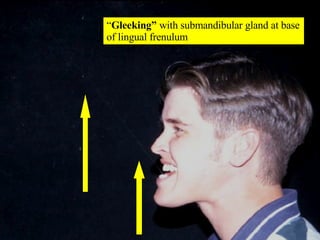
The  submandibular salivary glands  are inferior to the body of the mandible.  A  submandibular duct  opens from each gland in the floor of the mouth on the lateral sides of the lingual frenulum.  These are the squirters used in “gleeking”!
“ Gleeking”  with submandibular gland at base of lingual frenulum
The  sublingual salivary glands  are inferior to the tongue.  Each sublingual gland extends multiple tiny  sublingual ducts  that open onto the inferior surface of the oral cavity.
The  facial nerve  (CN VII) innervates the  submandibular and sublingual glands The  glossopharyngeal nerve  (CN IX) innervates the  parotid glands
Parasympathetic innervation   stimulates  salivary gland secretion (anticipation of tasty food).  Sympathetic stimulation   inhibits  normal secretion, which is why persons who are frightened experience the sensation of a dry mouth.
A  tooth  has an exposed  crown , a constricted  neck , and one or more  roots  that anchor it to the jaw. The roots fit into  dental alveoli  where they are bound to the surrounding bone by the  periodontal ligaments  to form a  gomphosis joint .
 
Permanent teeth
Teeth. The third molar (“wisdom teeth”) are not shown.
Permanent teeth found on  one quadrant of the mouth : 2 incisors, 1 canine, 2 premolars, 3 molars.
Trauma
Dental implant post
Dental implants  are effective, but are very expensive
Tooth being mounted on post.
Pharynx  is the funnel-shaped structure that connects the oral and nasal cavities to the esophagus and trachea.
The  superior, middle, and inferior pharyngeal constrictors , composed of skeletal muscle aid in swallowing.  The vagus nerves (CN X) innervate most of the pharyngeal muscles.
Peritoneal
Within the abdomen,  some organs are completely surrounded by visceral peritoneum  (intraperitoneal organs). And example is the  stomach.
Within the abdomen,  some organs lie behind the parietal peritoneum  (retroperitoneal organs).  An example is the  pancreas .
Mesenteries  are double-layered folds of the peritoneum that support and stabilize intraperitoneal organs.
The  greater omentum  (“fatty apron”) extends from the greater curvature of the stomach and then all the way down to cover most of the small intestine and inferior abdominal organs.
Greater omentum  flipped back over chest to reveal underlying intestines Note  mesentery proper  and  mesocolon
Lesser omentum  (omentum = “apron” in Latin) attaches the stomach and upper duodenum to inferior surface of liver.
The  falciform (“sickle-shaped”) ligament  attaches the liver to the inferior portion of the diaphragm and to the anterior abdominal wall.
The  mucosa  (mucous membrane)  has absorptive and secretory functions. The  submucosa  has lymph vessels, blood vessels, mucin-secreting glands, and nerve plexuses.
The  muscularis  typically contains two layers of smooth muscle, which are responsible for peristalsis.
The outermost tunic may be either an  adventitia  (loose connective tissue) or a  serosa  (visceral peritoneum).
Esophagus  connects the laryngopharynx to the stomach.  It passes through the diaphragm via the  esophageal hiatus .
The wall of the  esophagus  contains both skeletal and smooth muscle
There are  two sphincters  associated with the esophagus:  superior esophageal sphincter  and  inferior esophageal sphincter
Defective lower sphincter Read the  clinical view  in text
Acid damage to esophagus  by acid reflux through defective lower sphincter
The J-shaped  stomach  stores food (the semidigested mass is called chyme), initiates the digestion of proteins, has only minimal absorption, and moves materials on to the small intestine.
Stomach
Close-up of  pyloric sphincter  and  pyloric orifice
Gastric rugae  allow stretching of the stomach  Note  greater and lesser curvatures
Close-up of  gastric rugae
Gastric cells and their secretions
Read about  peptic ulcers  in the  clinical view  in the text
EVERYTHING PAST THIS POINT IS EXTRA OR FOR EXAMS
Figure 26.13a
 
Acid damage to esophagus
 
 
Peristalsis
Gastrointestinal tract  (G.I. tract or alimentary  canal) and some accessory organs of digestion.
The juxtaposition of the anterior portion of two alimentary canals
 
Mouth  also forms words and assists with passage of air
Lips  are fleshy, mobile organs formed by the obicularis oris muscle
This painted rock star has a very loose lingual frenulum!
Close-up of opening of  submandibular salivary glands  at base of lingual frenulum.  They can squirt long distances1
Vallecula  (#6) at base of tongue
Vallecula  between epiglottis and base of tongue
 
Periodontal disease
Stomach  is located in upper left abdominal quadrant just inferior to the diaphragm.
 
Stomach ulcers  are typically triggered by a the bacterium  Helicobacter pylori


Acid reflux damage to esophagus


stomach spleen


Figure 26.co
Figure 26.02
Figure 26.06ab
Figure 26.11
Figure 26.10
Mumps  is usually mild in children, but may be severe and damaging in adults.
Cleft palate
 
The bacterium  Helicobacter pylori  is the most common cause of  stomach ulcers.
A  stomach ulcer  which perforates the wall of the stomach could lead to inflammation of the peritoneal cavity (peritonitis).
 
Endoscopic view looking down through esophagus at lower esophageal sphincter in person with  hiatal hernia .  Note stomach lining protruding up through defective lower esophageal sphincter.


21 Digestive System #1

  • 1.
    The ingestion andabsorption of nutritious food is essential for life
  • 2.
  • 3.
    Food is utilizedat a cellular level .
  • 4.
  • 5.
    WHICH OF THEFOLLOWING IS ESSENTIAL AFTER FOOD IS EATEN? A CHEMICALS IN FOOD TRAVEL THROUGH SINUSOIDS B MOVEMENT OF FOOD INGREDIENTS THROUGH PORTAL SYSTEM C ENZYMATIC PROCESSING IN LARGEST ORGAN IN THE BODY D PASSAGE OF LIPIDS THROUGH DUCT IN DIAPHRAGM E ALL OF THE ABOVE
  • 6.
    The digestivesystem includes the organs that ingest food, transport food, digest the food into smaller usable components, absorb the nutrients, and expel the waste products from the body.
  • 7.
    The digestiveorgans collectively make up the gastrointestinal (GI) tract (alimentary canal). The GI tract organs include the oral cavity, pharynx, esophagus, stomach, small intestine, and large intestine.
  • 8.
    As long asfood is in the long hose extending from the mouth to the anus, it is NOT technically in the body . Only when it is absorbed is it in the body.
  • 9.
    An example iswhen you put your finger in the hole of a doughnut. Your finger is NOT in the doughnut. If you image your G.I. tract as an elongated doughnut , then you can see the similarity.
  • 10.
    The accessorydigestive organs do not form the long GI tube, but often develop as outgrowths from and are connected to the GI tract. These accessory organs include the teeth, tongue, salivary glands, liver, gallbladder, and pancreas
  • 11.
    Ingestion offood that will cause atherosclerosis.
  • 12.
    Food must be mechanically and chemically reduced before it can be absorbed across the intestinal wall.
  • 13.
  • 14.
    Swallowing. Noteclosure of epiglottis over entrance to larynx
  • 15.
  • 16.
    Endoscopic view of intestinal secretions that aid in digestion
  • 17.
    Digestion and absorption
  • 18.
    Defecation toeliminate feces
  • 19.
    Mouth receivesfood, masticates, and instigates swallowing
  • 20.
    Mouth (oralcavity) is bounded anteriorly by the teeth and lips and posteriorly by the oropharynx. The roof is the hard and soft palates, while the floor contains the tongue and muscles covered with mucosa.
  • 21.
    The oralcavity has two distinct regions: the vestibule (space between the cheeks or lips and the gums) and the oral cavity proper (region central to the alveolar processes of the mandible and maxillae Oral cavity proper
  • 22.
    Muscle of cheeks is primarily the buccinator
  • 23.
    The lips (labia) are formed primarily by the obicularis oris. The gingivae (gums) help support the teeth. The superior and inferior labial frenulum extend from the lips to the gingivae.
  • 24.
    The hardpalate is formed by the palatine processes of the maxillae and the horizontal plates of the palatine bones. Transverse folds assist the tongue in manipulating food. The soft palate is mostly composed of skeletal muscle. The uvula and soft palate rise superiorly during swallowing to close of the nasopharynx. The palatine tonsils monitor ingested food and drink for harmful antigens.
  • 25.
    Tongue , whichis composed of skeletal muscle, assists in mastication, in swallowing, has taste buds, and helps with speech.
  • 26.
    Lingual frenulum anchors the tongue to the floor of the mouth. Note location of submandibular salivary ducts that can squirt! Lingual
  • 27.
    Saliva (spit)contains amylase which breaks down starch to maltose. It also contains lysozyme, and antibacterial substance.
  • 28.
  • 29.
    The parotidsalivary glands are the largest salivary glands and are located near the ear, partially overlying the masseter muscle. The parotid duct travels parallel to the zygomatic arch and opens into the vestibule near the second upper molar.
  • 30.
    Swollen parotid gland in child with viral mumps . This virus can also infect the testes.
  • 31.
    The submandibularsalivary glands are inferior to the body of the mandible. A submandibular duct opens from each gland in the floor of the mouth on the lateral sides of the lingual frenulum. These are the squirters used in “gleeking”!
  • 32.
    “ Gleeking” with submandibular gland at base of lingual frenulum
  • 33.
    The sublingualsalivary glands are inferior to the tongue. Each sublingual gland extends multiple tiny sublingual ducts that open onto the inferior surface of the oral cavity.
  • 34.
    The facialnerve (CN VII) innervates the submandibular and sublingual glands The glossopharyngeal nerve (CN IX) innervates the parotid glands
  • 35.
    Parasympathetic innervation stimulates salivary gland secretion (anticipation of tasty food). Sympathetic stimulation inhibits normal secretion, which is why persons who are frightened experience the sensation of a dry mouth.
  • 36.
    A tooth has an exposed crown , a constricted neck , and one or more roots that anchor it to the jaw. The roots fit into dental alveoli where they are bound to the surrounding bone by the periodontal ligaments to form a gomphosis joint .
  • 37.
  • 38.
  • 39.
    Teeth. The thirdmolar (“wisdom teeth”) are not shown.
  • 40.
    Permanent teeth foundon one quadrant of the mouth : 2 incisors, 1 canine, 2 premolars, 3 molars.
  • 41.
  • 42.
  • 43.
    Dental implants are effective, but are very expensive
  • 44.
  • 45.
    Pharynx isthe funnel-shaped structure that connects the oral and nasal cavities to the esophagus and trachea.
  • 46.
    The superior,middle, and inferior pharyngeal constrictors , composed of skeletal muscle aid in swallowing. The vagus nerves (CN X) innervate most of the pharyngeal muscles.
  • 47.
  • 48.
    Within the abdomen, some organs are completely surrounded by visceral peritoneum (intraperitoneal organs). And example is the stomach.
  • 49.
    Within the abdomen, some organs lie behind the parietal peritoneum (retroperitoneal organs). An example is the pancreas .
  • 50.
    Mesenteries aredouble-layered folds of the peritoneum that support and stabilize intraperitoneal organs.
  • 51.
    The greateromentum (“fatty apron”) extends from the greater curvature of the stomach and then all the way down to cover most of the small intestine and inferior abdominal organs.
  • 52.
    Greater omentum flipped back over chest to reveal underlying intestines Note mesentery proper and mesocolon
  • 53.
    Lesser omentum (omentum = “apron” in Latin) attaches the stomach and upper duodenum to inferior surface of liver.
  • 54.
    The falciform(“sickle-shaped”) ligament attaches the liver to the inferior portion of the diaphragm and to the anterior abdominal wall.
  • 55.
    The mucosa (mucous membrane) has absorptive and secretory functions. The submucosa has lymph vessels, blood vessels, mucin-secreting glands, and nerve plexuses.
  • 56.
    The muscularis typically contains two layers of smooth muscle, which are responsible for peristalsis.
  • 57.
    The outermost tunicmay be either an adventitia (loose connective tissue) or a serosa (visceral peritoneum).
  • 58.
    Esophagus connectsthe laryngopharynx to the stomach. It passes through the diaphragm via the esophageal hiatus .
  • 59.
    The wall ofthe esophagus contains both skeletal and smooth muscle
  • 60.
    There are two sphincters associated with the esophagus: superior esophageal sphincter and inferior esophageal sphincter
  • 61.
    Defective lower sphincterRead the clinical view in text
  • 62.
    Acid damage toesophagus by acid reflux through defective lower sphincter
  • 63.
    The J-shaped stomach stores food (the semidigested mass is called chyme), initiates the digestion of proteins, has only minimal absorption, and moves materials on to the small intestine.
  • 64.
  • 65.
    Close-up of pyloric sphincter and pyloric orifice
  • 66.
    Gastric rugae allow stretching of the stomach Note greater and lesser curvatures
  • 67.
    Close-up of gastric rugae
  • 68.
    Gastric cells andtheir secretions
  • 69.
    Read about peptic ulcers in the clinical view in the text
  • 70.
    EVERYTHING PAST THISPOINT IS EXTRA OR FOR EXAMS
  • 71.
  • 72.
  • 73.
    Acid damage toesophagus
  • 74.
  • 75.
  • 76.
  • 77.
    Gastrointestinal tract (G.I. tract or alimentary canal) and some accessory organs of digestion.
  • 78.
    The juxtaposition ofthe anterior portion of two alimentary canals
  • 79.
  • 80.
    Mouth alsoforms words and assists with passage of air
  • 81.
    Lips arefleshy, mobile organs formed by the obicularis oris muscle
  • 82.
    This painted rockstar has a very loose lingual frenulum!
  • 83.
    Close-up of openingof submandibular salivary glands at base of lingual frenulum. They can squirt long distances1
  • 84.
    Vallecula (#6)at base of tongue
  • 85.
    Vallecula betweenepiglottis and base of tongue
  • 86.
  • 87.
  • 88.
    Stomach islocated in upper left abdominal quadrant just inferior to the diaphragm.
  • 89.
  • 90.
    Stomach ulcers are typically triggered by a the bacterium Helicobacter pylori
  • 91.
  • 92.
  • 93.
  • 94.
  • 95.
  • 96.
  • 97.
  • 98.
  • 99.
  • 100.
  • 101.
  • 102.
  • 103.
  • 104.
  • 105.
  • 106.
  • 107.
  • 108.
  • 109.
  • 110.
  • 111.
  • 112.
  • 113.
  • 114.
  • 115.
  • 116.
  • 117.
  • 118.
  • 119.
  • 120.
  • 121.
  • 122.
  • 123.
  • 124.
  • 125.
  • 126.
  • 127.
  • 128.
  • 129.
  • 130.
  • 131.
  • 132.
  • 133.
  • 134.
  • 135.
  • 136.
  • 137.
  • 138.
  • 139.
  • 140.
  • 141.
  • 142.
    Acid reflux damageto esophagus
  • 143.
  • 144.
  • 145.
  • 146.
  • 147.
  • 148.
  • 149.
  • 150.
  • 151.
  • 152.
  • 153.
  • 154.
  • 155.
  • 156.
  • 157.
  • 158.
  • 159.
  • 160.
  • 161.
  • 162.
  • 163.
  • 164.
  • 165.
  • 166.
  • 167.
  • 168.
  • 169.
  • 170.
  • 171.
  • 172.
  • 173.
  • 174.
  • 175.
  • 176.
    Mumps isusually mild in children, but may be severe and damaging in adults.
  • 177.
  • 178.
  • 179.
    The bacterium Helicobacter pylori is the most common cause of stomach ulcers.
  • 180.
    A stomachulcer which perforates the wall of the stomach could lead to inflammation of the peritoneal cavity (peritonitis).
  • 181.
  • 182.
    Endoscopic view lookingdown through esophagus at lower esophageal sphincter in person with hiatal hernia . Note stomach lining protruding up through defective lower esophageal sphincter.
  • 183.
  • 184.
  • 185.