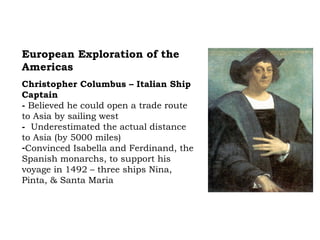
European Exploration of the Americas Christopher Columbus – Italian Ship Captain -  Believed he could open a trade route to Asia by sailing west -  Underestimated the actual distance to Asia (by 5000 miles) Convinced Isabella and Ferdinand, the Spanish monarchs, to support his voyage in 1492 – three ships Nina, Pinta, & Santa Maria
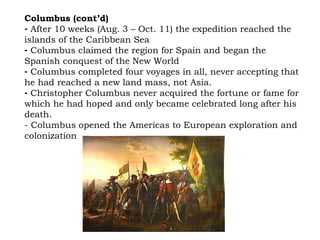
Columbus (cont’d) After 10 weeks (Aug. 3 – Oct. 11) the expedition reached the islands of the Caribbean Sea  Columbus claimed the region for Spain and began the Spanish conquest of the New World Columbus completed four voyages in all, never accepting that he had reached a new land mass, not Asia. Christopher Columbus never acquired the fortune or fame for which he had hoped and only became celebrated long after his death. - Columbus opened the Americas to European exploration and colonization
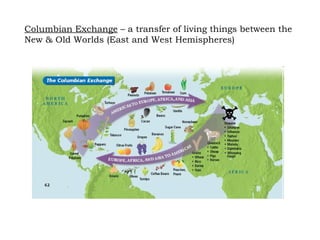
Columbian Exchange  – a transfer of living things between the New & Old Worlds (East and West Hemispheres)
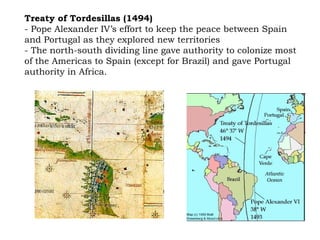
Treaty of Tordesillas (1494) - Pope Alexander IV’s effort to keep the peace between Spain and Portugal as they explored new territories - The north-south dividing line gave authority to colonize most of the Americas to Spain (except for Brazil) and gave Portugal authority in Africa.
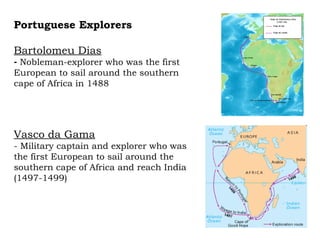
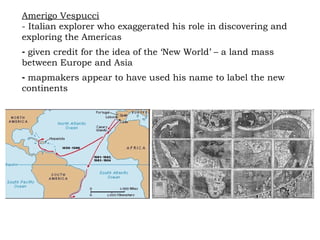
Portuguese Explorers Bartolomeu Dias Nobleman-explorer who was the first European to sail around the southern cape of Africa in 1488 Vasco da Gama - Military captain and explorer who was the first European to sail around the southern cape of Africa and reach India (1497-1499)
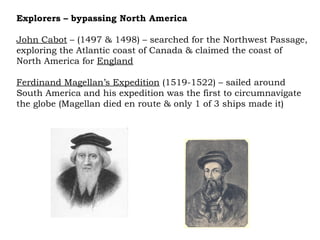
Amerigo Vespucci   - Italian explorer who exaggerated his role in discovering and exploring the Americas given credit for the idea of the ‘New World’ – a land mass between Europe and Asia mapmakers appear to have used his name to label the new continents
Explorers – bypassing North America John Cabot  – (1497 & 1498) – searched for the Northwest Passage, exploring the Atlantic coast of Canada & claimed the coast of North America for  England Ferdinand Magellan’s Expedition  (1519-1522) – sailed around South America and his expedition was the first to circumnavigate the globe (Magellan died en route & only 1 of 3 ships made it)
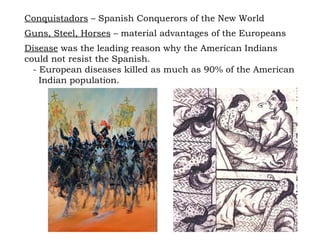
Conquistadors  – Spanish Conquerors of the New World Guns, Steel, Horses  – material advantages of the Europeans Disease  was the leading reason why the American Indians could not resist the Spanish.  - European diseases killed as much as 90% of the American  Indian population.
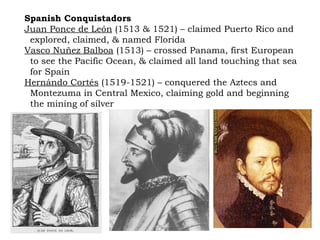
Spanish Conquistadors Juan Ponce de León  (1513 & 1521) – claimed Puerto Rico and  explored, claimed, & named Florida Vasco Nuñez Balboa  (1513) – crossed Panama, first European  to see the Pacific Ocean, & claimed all land touching that sea  for Spain Hernándo Cortés  (1519-1521) – conquered the Aztecs and  Montezuma in Central Mexico, claiming gold and beginning  the mining of silver
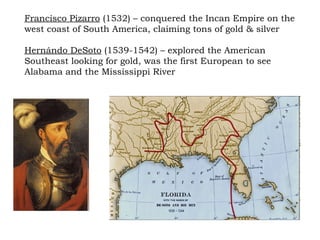
Francisco Pizarro  (1532) – conquered the Incan Empire on the west coast of South America, claiming tons of gold & silver  Hernándo DeSoto  (1539-1542) – explored the American Southeast looking for gold, was the first European to see Alabama and the Mississippi River
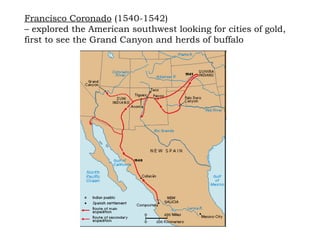
Francisco Coronado  (1540-1542)  –  explored the American southwest looking for cities of gold, first to see the Grand Canyon and herds of buffalo
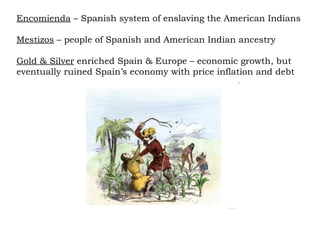
Encomienda  – Spanish system of enslaving the American Indians Mestizos  – people of Spanish and American Indian ancestry Gold & Silver  enriched Spain & Europe – economic growth, but eventually ruined Spain’s economy with price inflation and debt
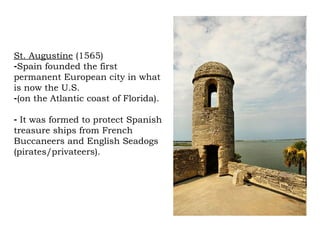
St. Augustine  (1565) Spain founded the first permanent European city in what is now the U.S.  (on the Atlantic coast of Florida).  It was formed to protect Spanish treasure ships from French Buccaneers and English Seadogs (pirates/privateers).

2.1_Columbus_and_Exploration

  • 1.
    European Exploration ofthe Americas Christopher Columbus – Italian Ship Captain - Believed he could open a trade route to Asia by sailing west - Underestimated the actual distance to Asia (by 5000 miles) Convinced Isabella and Ferdinand, the Spanish monarchs, to support his voyage in 1492 – three ships Nina, Pinta, & Santa Maria
  • 2.
    Columbus (cont’d) After10 weeks (Aug. 3 – Oct. 11) the expedition reached the islands of the Caribbean Sea Columbus claimed the region for Spain and began the Spanish conquest of the New World Columbus completed four voyages in all, never accepting that he had reached a new land mass, not Asia. Christopher Columbus never acquired the fortune or fame for which he had hoped and only became celebrated long after his death. - Columbus opened the Americas to European exploration and colonization
  • 3.
    Columbian Exchange – a transfer of living things between the New & Old Worlds (East and West Hemispheres)
  • 4.
    Treaty of Tordesillas(1494) - Pope Alexander IV’s effort to keep the peace between Spain and Portugal as they explored new territories - The north-south dividing line gave authority to colonize most of the Americas to Spain (except for Brazil) and gave Portugal authority in Africa.
  • 5.
    Portuguese Explorers BartolomeuDias Nobleman-explorer who was the first European to sail around the southern cape of Africa in 1488 Vasco da Gama - Military captain and explorer who was the first European to sail around the southern cape of Africa and reach India (1497-1499)
  • 6.
    Amerigo Vespucci - Italian explorer who exaggerated his role in discovering and exploring the Americas given credit for the idea of the ‘New World’ – a land mass between Europe and Asia mapmakers appear to have used his name to label the new continents
  • 7.
    Explorers – bypassingNorth America John Cabot – (1497 & 1498) – searched for the Northwest Passage, exploring the Atlantic coast of Canada & claimed the coast of North America for England Ferdinand Magellan’s Expedition (1519-1522) – sailed around South America and his expedition was the first to circumnavigate the globe (Magellan died en route & only 1 of 3 ships made it)
  • 8.
    Conquistadors –Spanish Conquerors of the New World Guns, Steel, Horses – material advantages of the Europeans Disease was the leading reason why the American Indians could not resist the Spanish. - European diseases killed as much as 90% of the American Indian population.
  • 9.
    Spanish Conquistadors JuanPonce de León (1513 & 1521) – claimed Puerto Rico and explored, claimed, & named Florida Vasco Nuñez Balboa (1513) – crossed Panama, first European to see the Pacific Ocean, & claimed all land touching that sea for Spain Hernándo Cortés (1519-1521) – conquered the Aztecs and Montezuma in Central Mexico, claiming gold and beginning the mining of silver
  • 10.
    Francisco Pizarro (1532) – conquered the Incan Empire on the west coast of South America, claiming tons of gold & silver Hernándo DeSoto (1539-1542) – explored the American Southeast looking for gold, was the first European to see Alabama and the Mississippi River
  • 11.
    Francisco Coronado (1540-1542) – explored the American southwest looking for cities of gold, first to see the Grand Canyon and herds of buffalo
  • 12.
    Encomienda –Spanish system of enslaving the American Indians Mestizos – people of Spanish and American Indian ancestry Gold & Silver enriched Spain & Europe – economic growth, but eventually ruined Spain’s economy with price inflation and debt
  • 13.
    St. Augustine (1565) Spain founded the first permanent European city in what is now the U.S. (on the Atlantic coast of Florida). It was formed to protect Spanish treasure ships from French Buccaneers and English Seadogs (pirates/privateers).