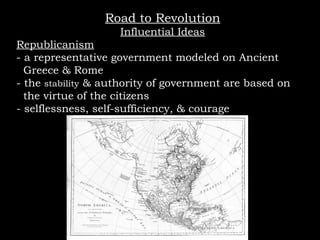
Road to Revolution Influential Ideas Republicanism - a representative government modeled on Ancient  Greece & Rome - the  stability  & authority of government are based on  the virtue of the citizens - selflessness, self-sufficiency, & courage
‘ Country’/‘Radical’ Whig Ideology in England & America - opposed the power of the Monarchy and critical of:  - corruption, patronage & bribes, among the King’s  ministers - the dangers of a standing army - the threat a powerful state posed to personal liberty
A New King George III became King of England in 1760
Parson’s Cause (1758-1763) - British government interfered with Virginia’s limitation  of the pay for Anglican ministers - Colonists, including Patrick Henry, were hostile to  the minister’s claims and British interference
Writs of Assistance  (beginning in 1760) - general search warrants intended to cut down on smuggling - enabled British authorities to search any colonist's business  or home with no advance notice and no probable cause - James Otis, a prominent Boston lawyer, argued against the  writs in an unsuccessful court case
Aftermath of the French & Indian War - Pontiac’s Rebellion (1763-66)  - Proclamation Line of 1763  - Posting of 10,000 on the frontier - Increased enforcement & collection of import duties by  Prime Minister George Grenville - Britain’s national debt doubled as a result of the War
Paxton Boys (1763-4) - After Pontiac’s Rebellion Pennsylvania frontiersmen  attacked and massacred peaceful local American Indians - The colonial government did not support them and instead  threatened prosecution - In response the militia marched on Philadelphia but were  met by British troops & militia - The frontier militia was convinced to back down by  Benjamin Franklin
Sugar Act  (1764) - Reduced import taxes on foreign-made molasses, but  strengthened enforcement of the law - tried smugglers before a Vice-Admiralty Court – a British  judge, instead of a colonial jury - first British tax on the colonies designed to raise revenue  instead of regulate trade - Hurt prosperous colonial merchants
Non-importation movement Many colonial merchants agreed to stop importing British goods in response to the Sugar Act Parliament repealed the Sugar Act at the insistence of British merchants

8.1_Revolutionary_Movement_I

  • 1.
    Road to RevolutionInfluential Ideas Republicanism - a representative government modeled on Ancient Greece & Rome - the stability & authority of government are based on the virtue of the citizens - selflessness, self-sufficiency, & courage
  • 2.
    ‘ Country’/‘Radical’ WhigIdeology in England & America - opposed the power of the Monarchy and critical of: - corruption, patronage & bribes, among the King’s ministers - the dangers of a standing army - the threat a powerful state posed to personal liberty
  • 3.
    A New KingGeorge III became King of England in 1760
  • 4.
    Parson’s Cause (1758-1763)- British government interfered with Virginia’s limitation of the pay for Anglican ministers - Colonists, including Patrick Henry, were hostile to the minister’s claims and British interference
  • 5.
    Writs of Assistance (beginning in 1760) - general search warrants intended to cut down on smuggling - enabled British authorities to search any colonist's business or home with no advance notice and no probable cause - James Otis, a prominent Boston lawyer, argued against the writs in an unsuccessful court case
  • 6.
    Aftermath of theFrench & Indian War - Pontiac’s Rebellion (1763-66) - Proclamation Line of 1763 - Posting of 10,000 on the frontier - Increased enforcement & collection of import duties by Prime Minister George Grenville - Britain’s national debt doubled as a result of the War
  • 7.
    Paxton Boys (1763-4)- After Pontiac’s Rebellion Pennsylvania frontiersmen attacked and massacred peaceful local American Indians - The colonial government did not support them and instead threatened prosecution - In response the militia marched on Philadelphia but were met by British troops & militia - The frontier militia was convinced to back down by Benjamin Franklin
  • 8.
    Sugar Act (1764) - Reduced import taxes on foreign-made molasses, but strengthened enforcement of the law - tried smugglers before a Vice-Admiralty Court – a British judge, instead of a colonial jury - first British tax on the colonies designed to raise revenue instead of regulate trade - Hurt prosperous colonial merchants
  • 9.
    Non-importation movement Manycolonial merchants agreed to stop importing British goods in response to the Sugar Act Parliament repealed the Sugar Act at the insistence of British merchants