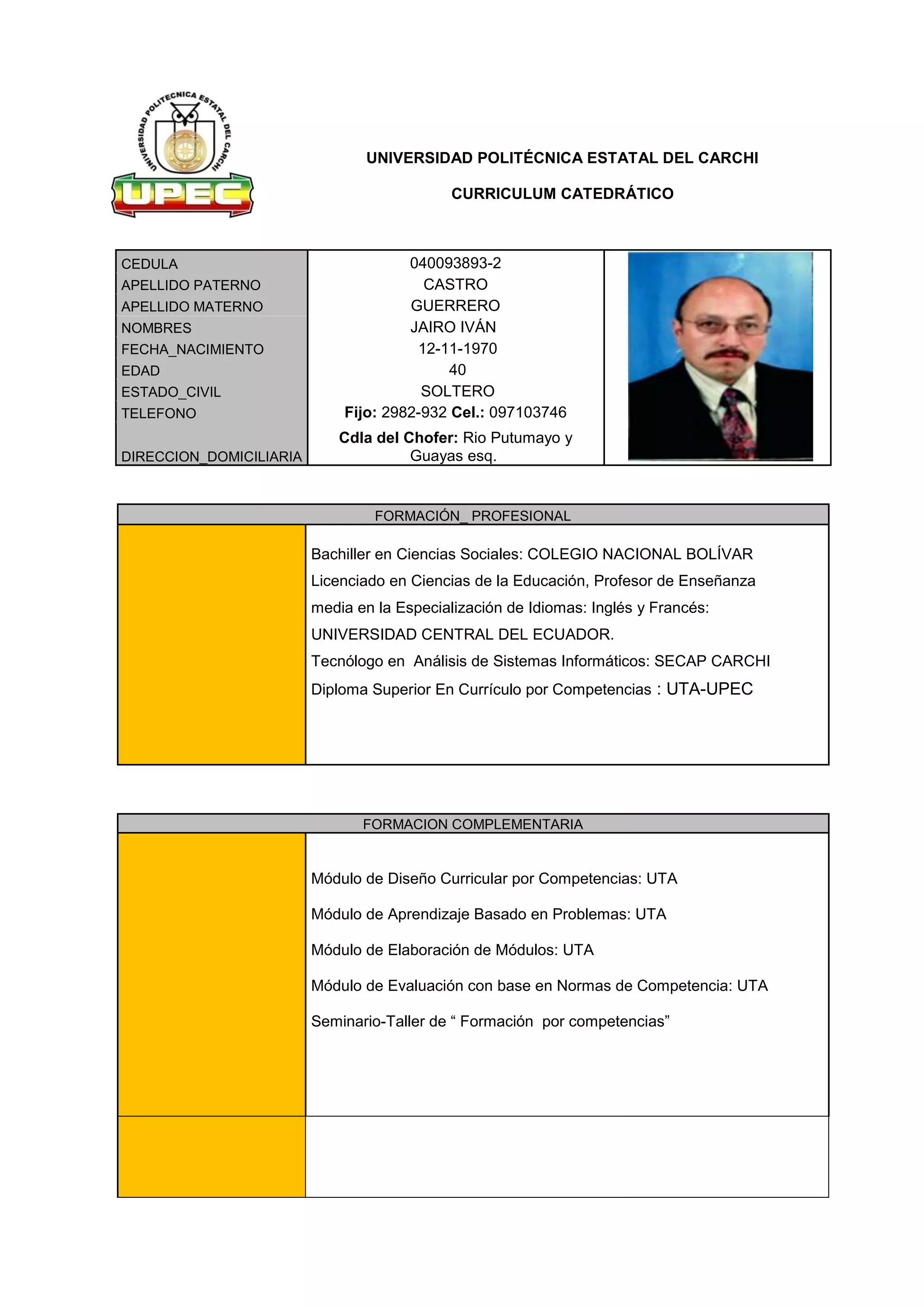
UNIVERSIDAD POLITÉCNICA ESTATAL DEL CARCHI

                                             CURRICULUM CATEDRÁTICO


CEDULA                                040093893-2
APELLIDO PATERNO                        CASTRO
APELLIDO MATERNO                      GUERRERO
NOMBRES                               JAIRO IVÁN
FECHA_NACIMIENTO                       12-11-1970
EDAD                                       40
ESTADO_CIVIL                            SOLTERO
TELEFONO                     Fijo: 2982-932 Cel.: 097103746
                            Cdla del Chofer: Rio Putumayo y
DIRECCION_DOMICILIARIA                Guayas esq.


                                  FORMACIÓN_ PROFESIONAL

                         Bachiller en Ciencias Sociales: COLEGIO NACIONAL BOLÍVAR
                         Licenciado en Ciencias de la Educación, Profesor de Enseñanza
                         media en la Especialización de Idiomas: Inglés y Francés:
                         UNIVERSIDAD CENTRAL DEL ECUADOR.
                         Tecnólogo en Análisis de Sistemas Informáticos: SECAP CARCHI
                         Diploma Superior En Currículo por Competencias : UTA-UPEC


                                FORMACION COMPLEMENTARIA


                         Módulo de Diseño Curricular por Competencias: UTA

                         Módulo de Aprendizaje Basado en Problemas: UTA

                         Módulo de Elaboración de Módulos: UTA

                         Módulo de Evaluación con base en Normas de Competencia: UTA

                         Seminario-Taller de “ Formación por competencias”
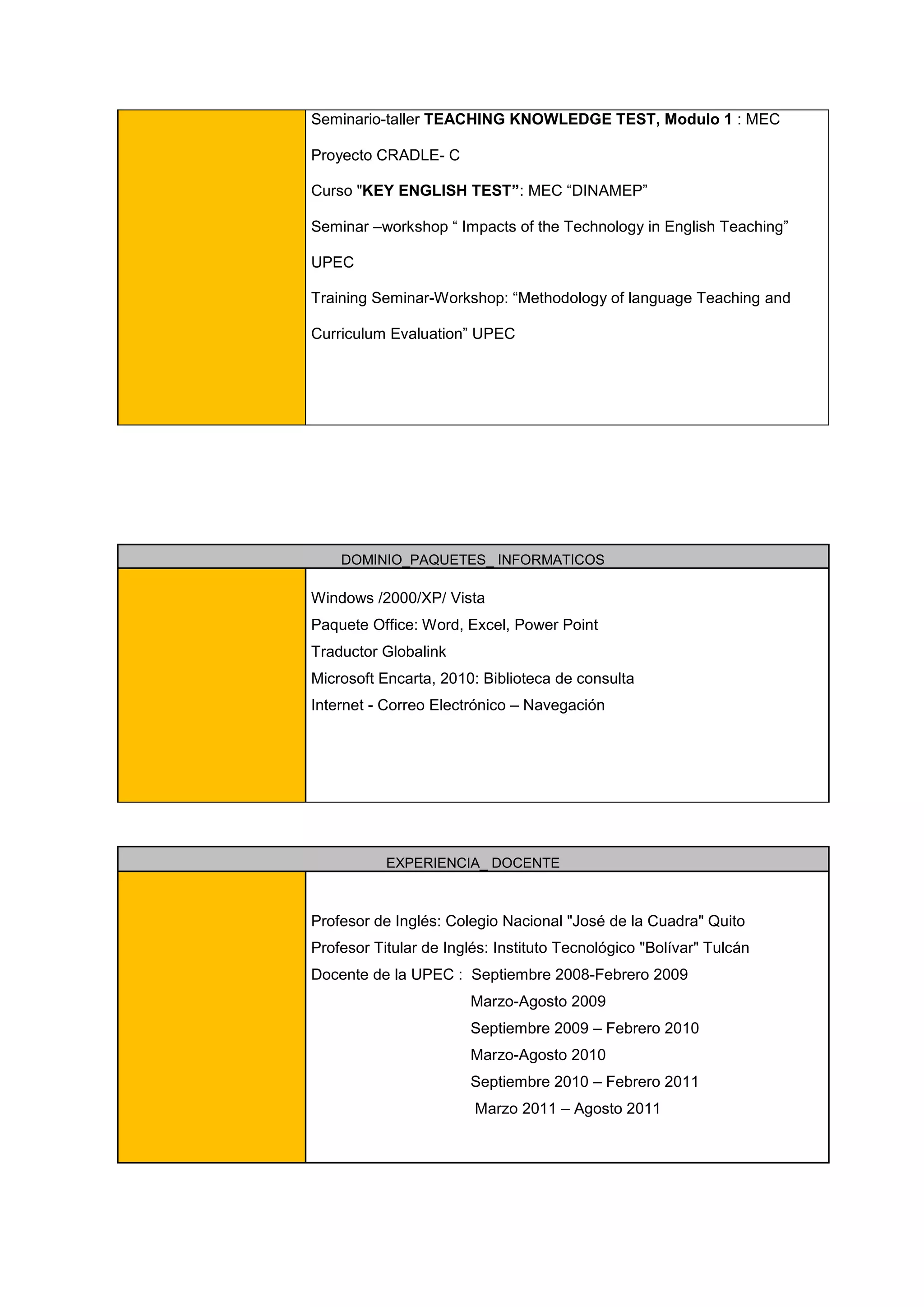
Seminario-taller TEACHING KNOWLEDGE TEST, Modulo 1 : MEC

Proyecto CRADLE- C

Curso "KEY ENGLISH TEST”: MEC “DINAMEP”

Seminar –workshop “ Impacts of the Technology in English Teaching”

UPEC

Training Seminar-Workshop: “Methodology of language Teaching and

Curriculum Evaluation” UPEC


    DOMINIO_PAQUETES_ INFORMATICOS

Windows /2000/XP/ Vista
Paquete Office: Word, Excel, Power Point
Traductor Globalink
Microsoft Encarta, 2010: Biblioteca de consulta
Internet - Correo Electrónico – Navegación


           EXPERIENCIA_ DOCENTE


Profesor de Inglés: Colegio Nacional "José de la Cuadra" Quito
Profesor Titular de Inglés: Instituto Tecnológico "Bolívar" Tulcán
Docente de la UPEC : Septiembre 2008-Febrero 2009
                       Marzo-Agosto 2009
                       Septiembre 2009 – Febrero 2010
                       Marzo-Agosto 2010
                       Septiembre 2010 – Febrero 2011
                        Marzo 2011 – Agosto 2011
3


STATE POLYTECHNIC UNIVERSITY OF CARCHI


    ENGLISH PROFICIENCY PROGRAM


                 Module


           “BEGINNING A1.2”


       PROFESSOR: JAIRO CASTRO G.


  ACADEMIC SEMESTER: MARCH -AUGUST 2011


             LEVEL: SECOND


             Tulcán, April 2011
4


I.   BASIC DATA OF THE MODULE

CODE:EPPUPEC                    REQUIREMENTS:
    KIND OF COMPETENCE:            Have approved English A1.1
GENERIC: ( X )                     Have taken the placement test.
SPECIFIC: ( )                      Basic Knowledge of NTICs.
  CREDITS:        LEVEL            Interest for learning and active
      5          SECOND             performance.
                                   Attitude to work in team.
                                   Attitude to participate in class.


PROFESSOR PROFILE:

NAME:JAIRO IVÁN CASTRO GUERRERO

CONTACT TELEPHONE:      HOUSE 062982932

E-MAIL:                ivancas2004@yahoo.es
5


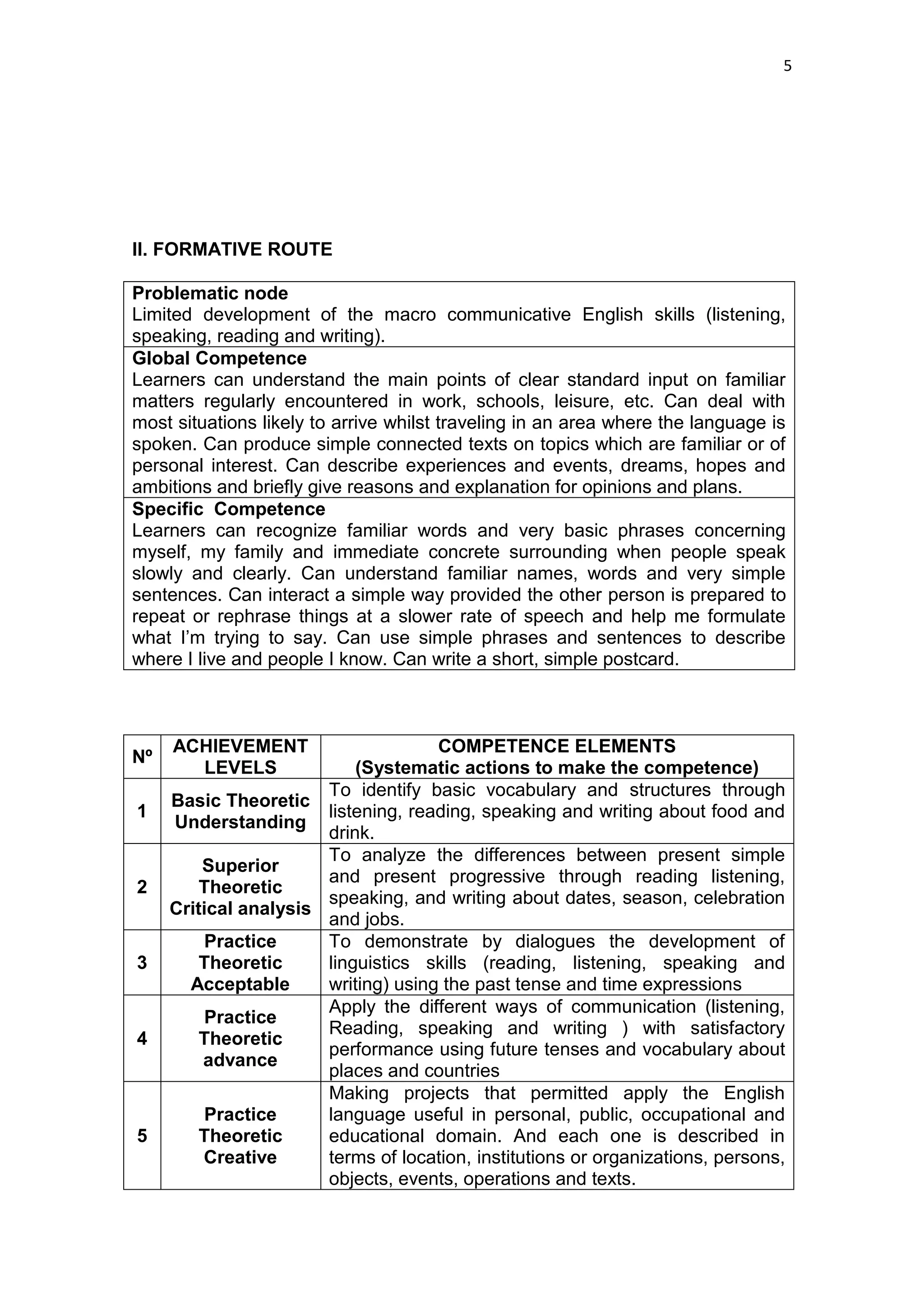
II. FORMATIVE ROUTE

Problematic node
Limited development of the macro communicative English skills (listening,
speaking, reading and writing).
Global Competence
Learners can understand the main points of clear standard input on familiar
matters regularly encountered in work, schools, leisure, etc. Can deal with
most situations likely to arrive whilst traveling in an area where the language is
spoken. Can produce simple connected texts on topics which are familiar or of
personal interest. Can describe experiences and events, dreams, hopes and
ambitions and briefly give reasons and explanation for opinions and plans.
Specific Competence
Learners can recognize familiar words and very basic phrases concerning
myself, my family and immediate concrete surrounding when people speak
slowly and clearly. Can understand familiar names, words and very simple
sentences. Can interact a simple way provided the other person is prepared to
repeat or rephrase things at a slower rate of speech and help me formulate
what I’m trying to say. Can use simple phrases and sentences to describe
where I live and people I know. Can write a short, simple postcard.


     ACHIEVEMENT                     COMPETENCE ELEMENTS
Nº
       LEVELS              (Systematic actions to make the competence)
                       To identify basic vocabulary and structures through
     Basic Theoretic
1                      listening, reading, speaking and writing about food and
     Understanding
                       drink.
                       To analyze the differences between present simple
         Superior
                       and present progressive through reading listening,
2        Theoretic
                       speaking, and writing about dates, season, celebration
     Critical analysis
                       and jobs.
         Practice      To demonstrate by dialogues the development of
3        Theoretic     linguistics skills (reading, listening, speaking and
       Acceptable      writing) using the past tense and time expressions
                       Apply the different ways of communication (listening,
         Practice
                       Reading, speaking and writing ) with satisfactory
4        Theoretic
                       performance using future tenses and vocabulary about
         advance
                       places and countries
                       Making projects that permitted apply the English
         Practice      language useful in personal, public, occupational and
5        Theoretic     educational domain. And each one is described in
         Creative      terms of location, institutions or organizations, persons,
                       objects, events, operations and texts.
6


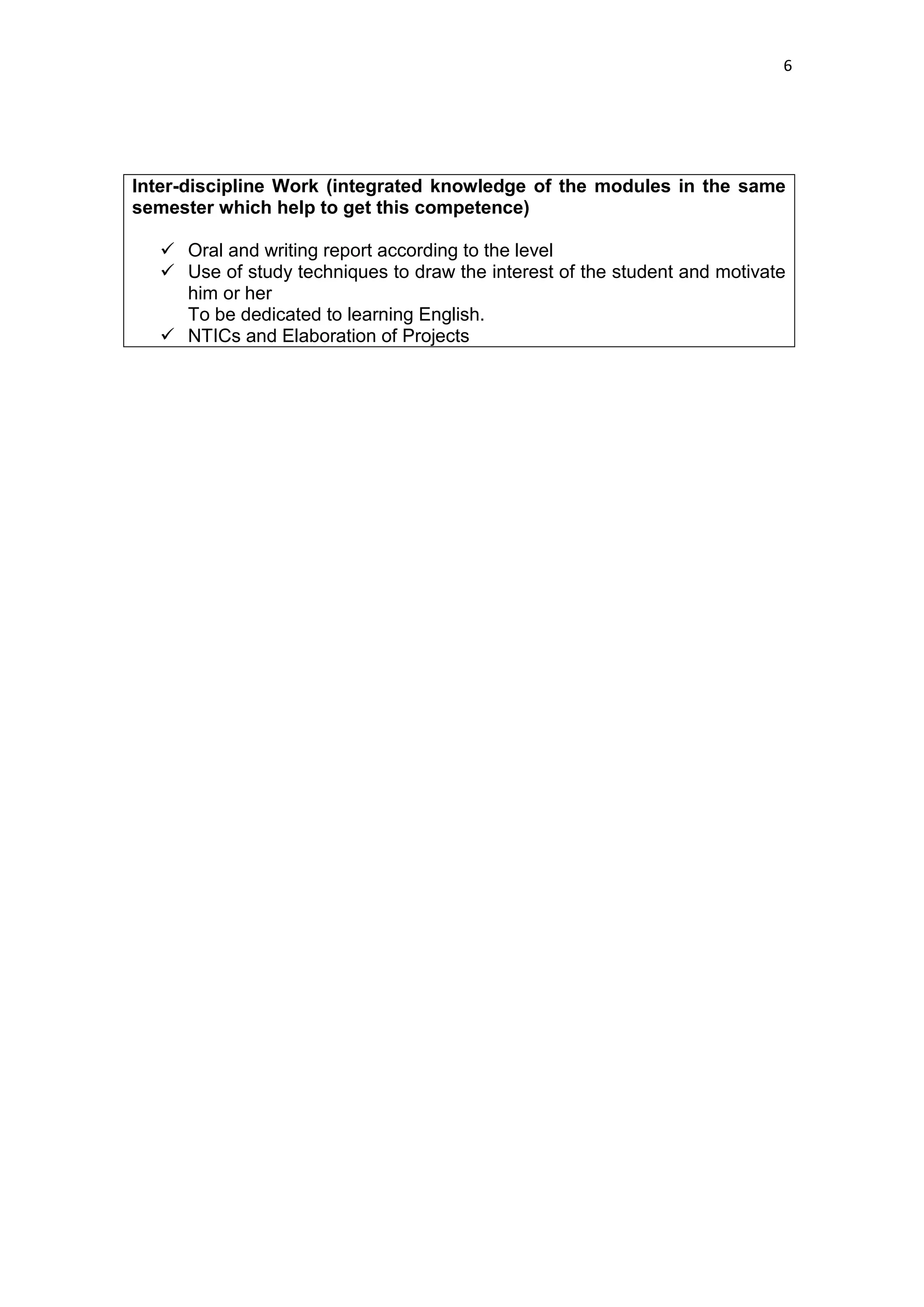
Inter-discipline Work (integrated knowledge of the modules in the same
semester which help to get this competence)

   Oral and writing report according to the level
   Use of study techniques to draw the interest of the student and motivate
    him or her
    To be dedicated to learning English.
   NTICs and Elaboration of Projects
7


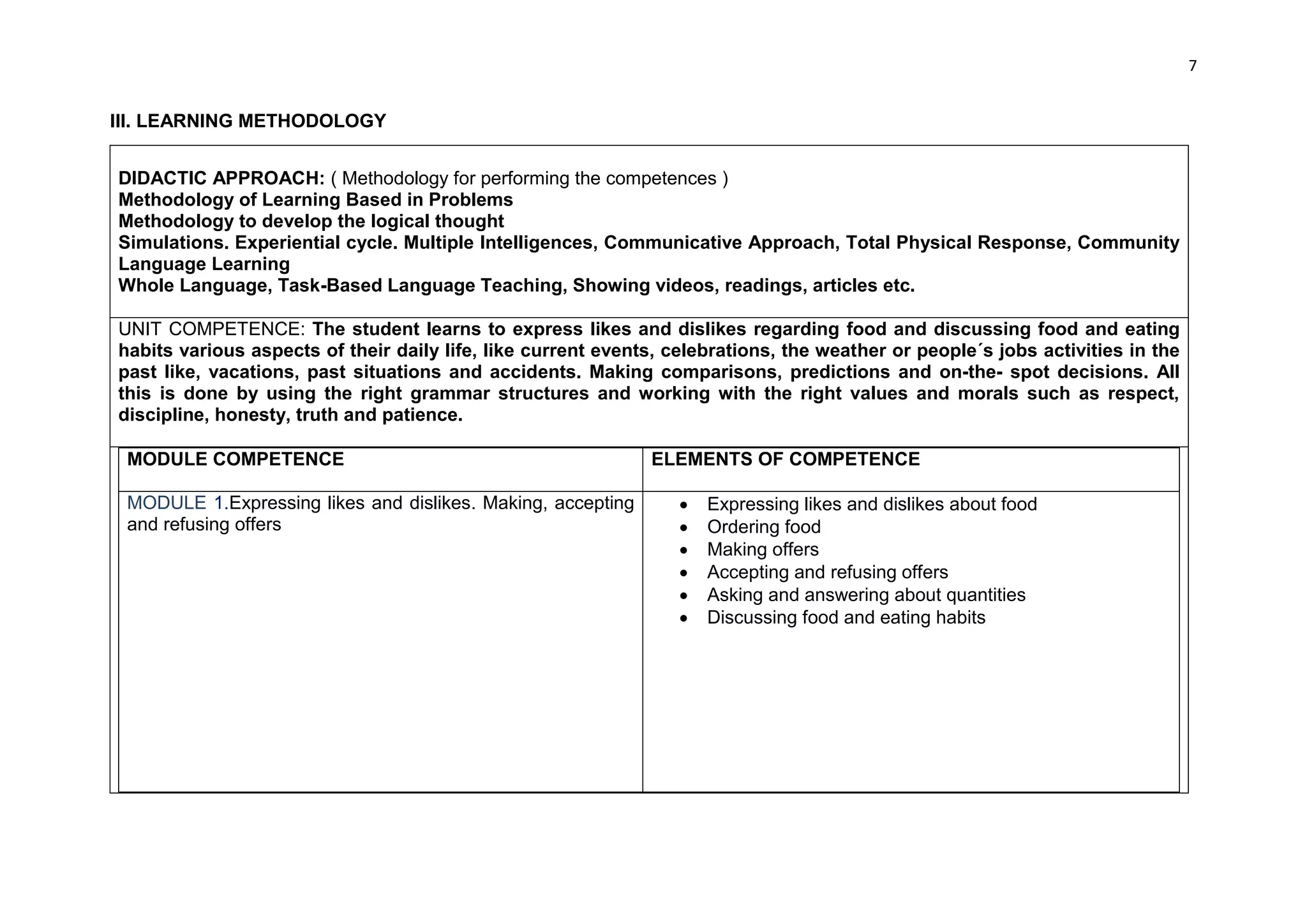
III. LEARNING METHODOLOGY


DIDACTIC APPROACH: ( Methodology for performing the competences )
Methodology of Learning Based in Problems
Methodology to develop the logical thought
Simulations. Experiential cycle. Multiple Intelligences, Communicative Approach, Total Physical Response, Community
Language Learning
Whole Language, Task-Based Language Teaching, Showing videos, readings, articles etc.

UNIT COMPETENCE: The student learns to express likes and dislikes regarding food and discussing food and eating
habits various aspects of their daily life, like current events, celebrations, the weather or people´s jobs activities in the
past like, vacations, past situations and accidents. Making comparisons, predictions and on-the- spot decisions. All
this is done by using the right grammar structures and working with the right values and morals such as respect,
discipline, honesty, truth and patience.

 MODULE COMPETENCE                                            ELEMENTS OF COMPETENCE

 MODULE 1.Expressing likes and dislikes. Making, accepting           Expressing likes and dislikes about food
 and refusing offers                                                 Ordering food
                                                                     Making offers
                                                                     Accepting and refusing offers
                                                                     Asking and answering about quantities
                                                                     Discussing food and eating habits
8


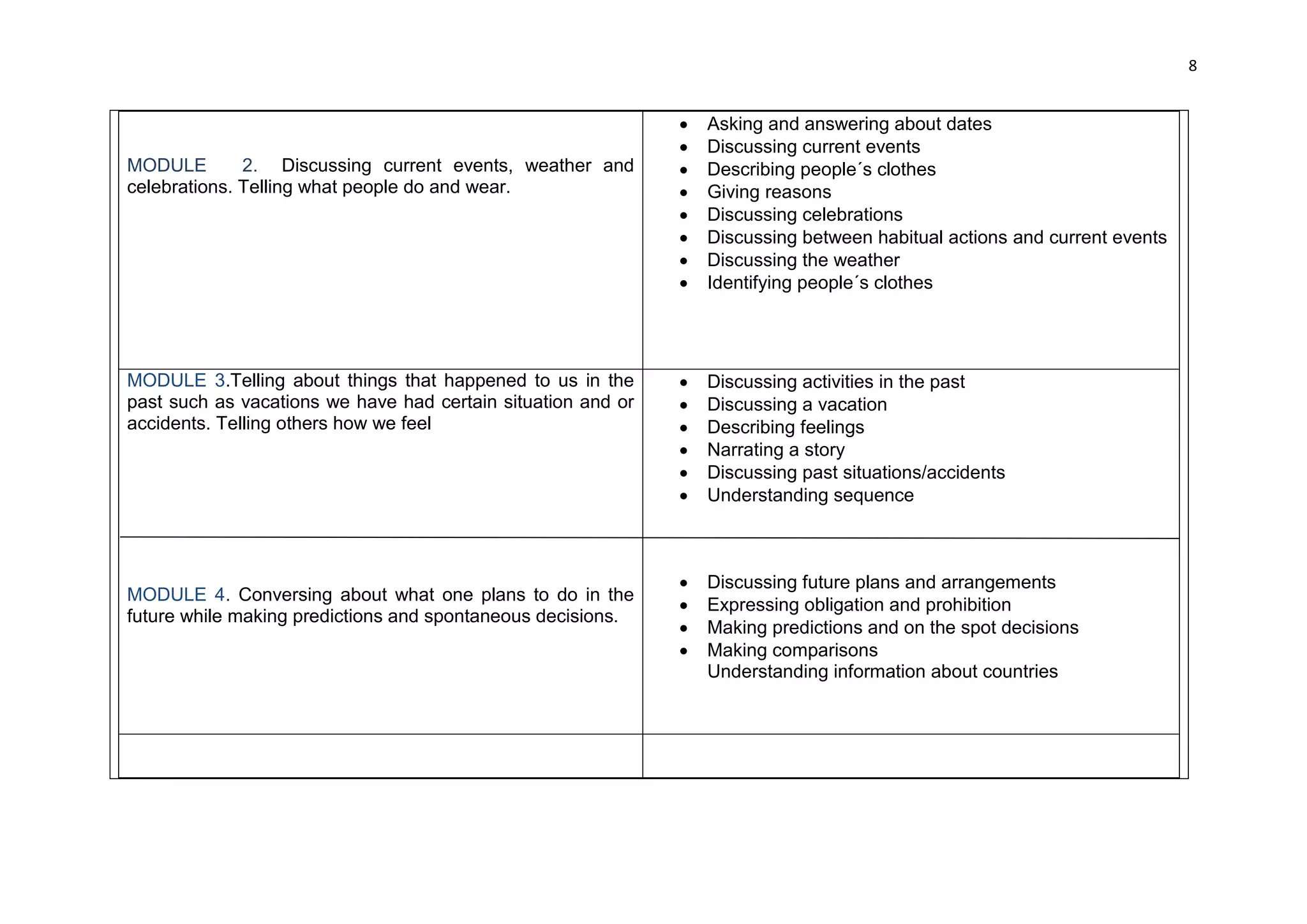
                                                                 Asking and answering about dates
                                                                 Discussing current events
MODULE        2. Discussing current events, weather and          Describing people´s clothes
celebrations. Telling what people do and wear.                   Giving reasons
                                                                 Discussing celebrations
                                                                 Discussing between habitual actions and current events
                                                                 Discussing the weather
                                                                 Identifying people´s clothes


MODULE 3.Telling about things that happened to us in the         Discussing activities in the past
past such as vacations we have had certain situation and or      Discussing a vacation
accidents. Telling others how we feel                            Describing feelings
                                                                 Narrating a story
                                                                 Discussing past situations/accidents
                                                                 Understanding sequence


                                                                 Discussing future plans and arrangements
MODULE 4. Conversing about what one plans to do in the
                                                                 Expressing obligation and prohibition
future while making predictions and spontaneous decisions.
                                                                 Making predictions and on the spot decisions
                                                                 Making comparisons
                                                                  Understanding information about countries
9


                                                                                                          SPECIFIC
                                                                                  MOTIVATIONAL
                                                                                                          DIDACTIC
COMPETENCE                 COGNITIVE                                               AFFECTIVE
                                                 PROCEDURE CONTENTS                                     STRATEGIES
ELEMENTS                   CONTENTS                                                CONTENTS                               TIME
                                                     How to apply?                                       Strategies,
                         What knowledge?                                          Which attitudes
                                                                                                        methods and
                                                                                      with?
                                                                                                         techniques
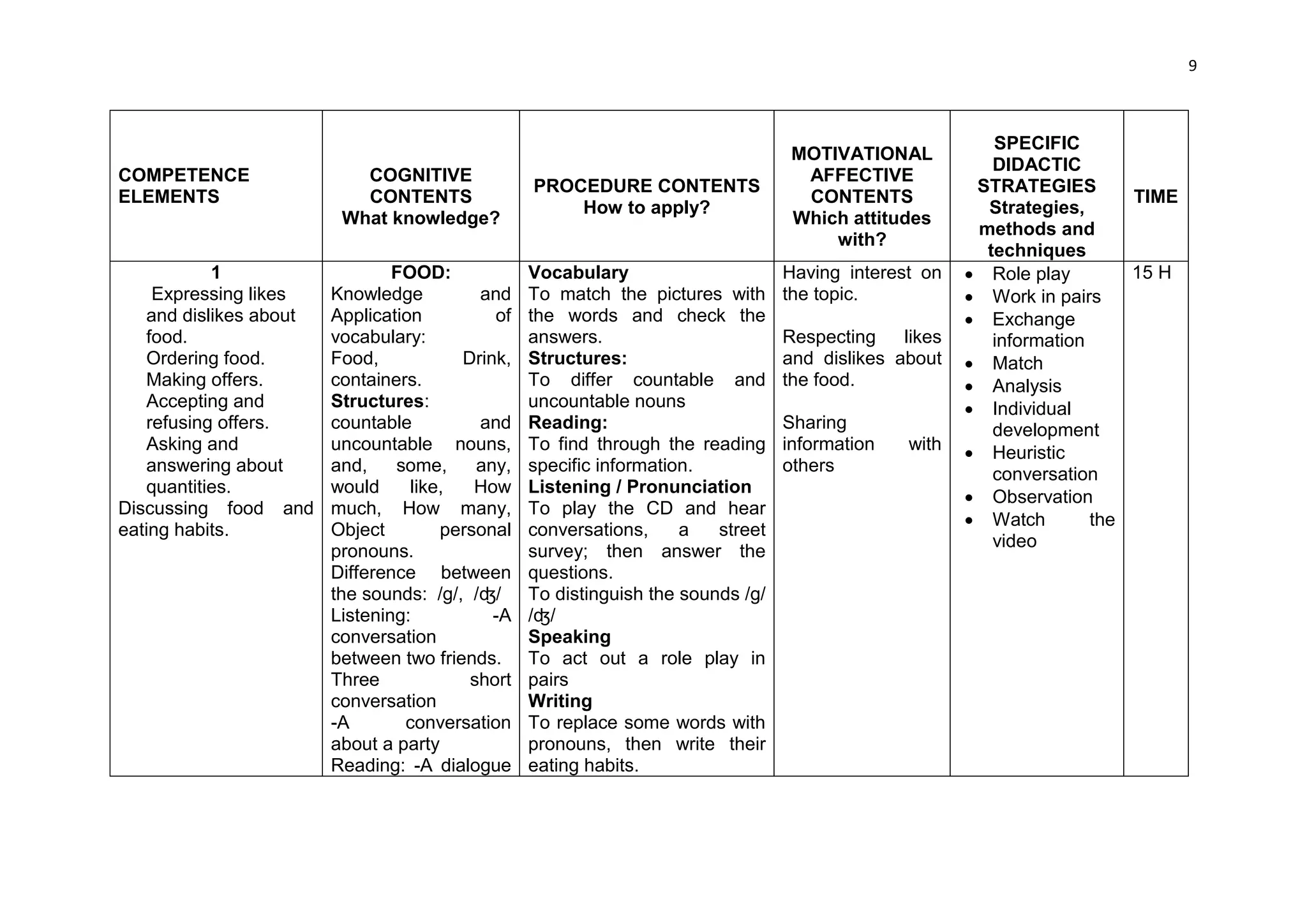
           1                    FOOD:            Vocabulary                      Having interest on     Role play        15 H
    Expressing likes    Knowledge         and    To match the pictures with      the topic.             Work in pairs
   and dislikes about   Application         of   the words and check the                                Exchange
   food.                vocabulary:              answers.                        Respecting    likes      information
   Ordering food.       Food,           Drink,   Structures:                     and dislikes about     Match
   Making offers.       containers.              To differ countable and         the food.              Analysis
   Accepting and        Structures:              uncountable nouns                                      Individual
   refusing offers.     countable         and    Reading:                        Sharing                  development
   Asking and           uncountable nouns,       To find through the reading     information    with    Heuristic
   answering about      and,    some,     any,   specific information.           others                   conversation
   quantities.          would     like,   How    Listening / Pronunciation
                                                                                                        Observation
Discussing food and     much, How many,          To play the CD and hear
                                                                                                        Watch        the
eating habits.          Object        personal   conversations,     a   street
                                                                                                          video
                        pronouns.                survey; then answer the
                        Difference between       questions.
                        the sounds: /g/, /ʤ/     To distinguish the sounds /g/
                        Listening:          -A   /ʤ/
                        conversation             Speaking
                        between two friends.     To act out a role play in
                        Three            short   pairs
                        conversation             Writing
                        -A       conversation    To replace some words with
                        about a party            pronouns, then write their
                        Reading: -A dialogue     eating habits.
10


                        between           two
                        teenagers.
                        -A magazine article
                        about       birthdays,
                        mother´s day and
                        valentine´s day


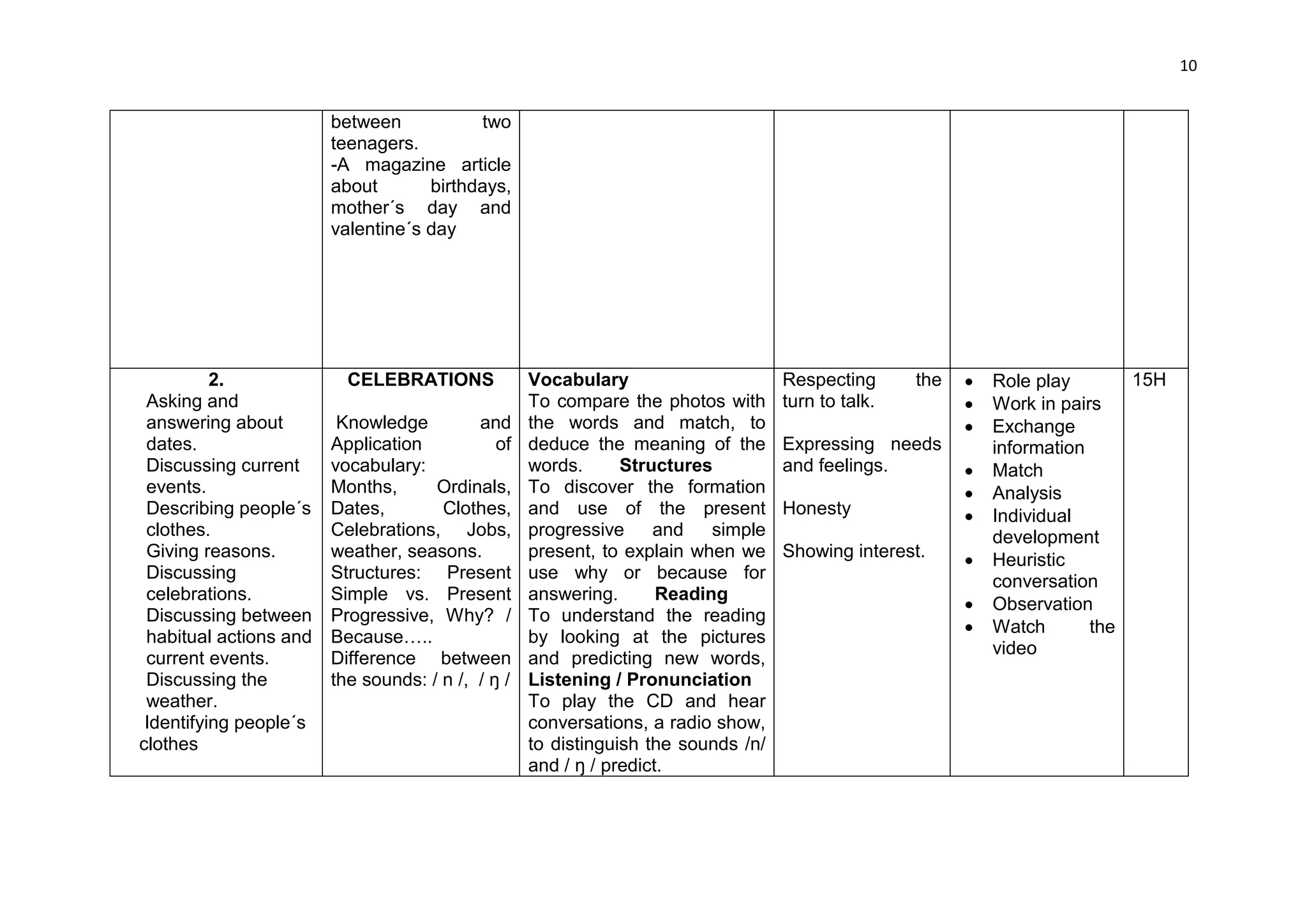
          2.              CELEBRATIONS             Vocabulary                      Respecting      the      Role play       15H
 Asking and                                        To compare the photos with      turn to talk.            Work in pairs
 answering about         Knowledge         and     the words and match, to                                  Exchange
 dates.                 Application           of   deduce the meaning of the       Expressing needs          information
 Discussing current     vocabulary:                words.      Structures          and feelings.            Match
 events.                Months,      Ordinals,     To discover the formation                                Analysis
 Describing people´s    Dates,        Clothes,     and use of the present          Honesty                  Individual
 clothes.               Celebrations, Jobs,        progressive     and    simple                             development
 Giving reasons.        weather, seasons.          present, to explain when we     Showing interest.        Heuristic
 Discussing             Structures: Present        use why or because for                                    conversation
 celebrations.          Simple vs. Present         answering.       Reading
                                                                                                            Observation
 Discussing between     Progressive, Why? /        To understand the reading
                                                                                                            Watch       the
 habitual actions and   Because…..                 by looking at the pictures
                                                                                                             video
 current events.        Difference between         and predicting new words,
 Discussing the         the sounds: / n /, / ŋ /   Listening / Pronunciation
 weather.                                          To play the CD and hear
 Identifying people´s                              conversations, a radio show,
clothes                                            to distinguish the sounds /n/
                                                   and / ŋ / predict.
11


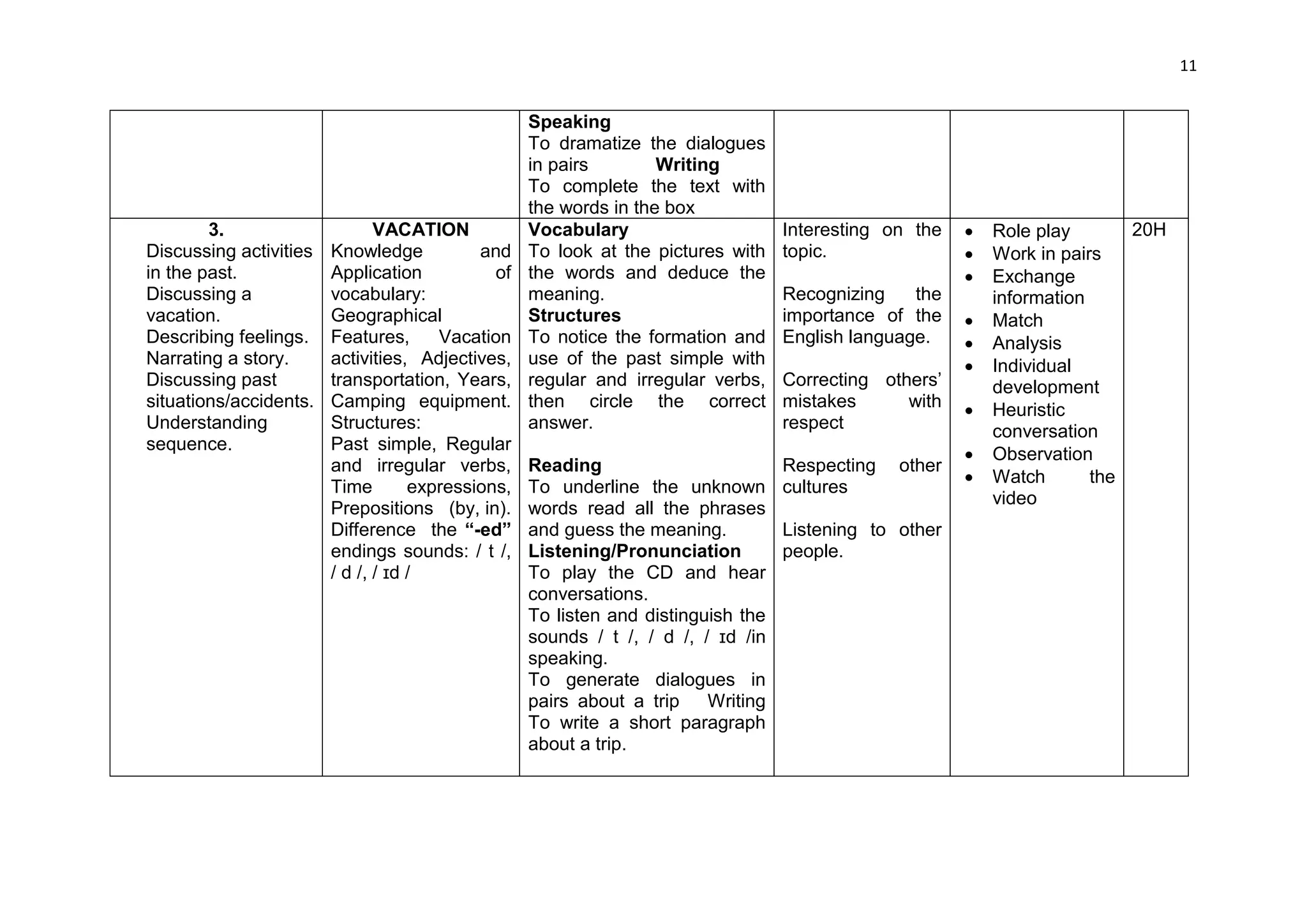
                                                   Speaking
                                                   To dramatize the dialogues
                                                   in pairs        Writing
                                                   To complete the text with
                                                   the words in the box
        3.                     VACATION            Vocabulary                      Interesting on the      Role play       20H
Discussing activities   Knowledge           and    To look at the pictures with    topic.                  Work in pairs
in the past.            Application           of   the words and deduce the                                Exchange
Discussing a            vocabulary:                meaning.                        Recognizing    the       information
vacation.               Geographical               Structures                      importance of the       Match
Describing feelings.    Features,      Vacation    To notice the formation and     English language.       Analysis
Narrating a story.      activities, Adjectives,    use of the past simple with                             Individual
Discussing past         transportation, Years,     regular and irregular verbs,    Correcting others’       development
situations/accidents.   Camping equipment.         then circle the correct         mistakes      with      Heuristic
Understanding           Structures:                answer.                         respect                  conversation
sequence.               Past simple, Regular
                                                                                                           Observation
                        and irregular verbs,       Reading                         Respecting   other
                                                                                                           Watch       the
                        Time        expressions,   To underline the unknown        cultures
                                                                                                            video
                        Prepositions (by, in).     words read all the phrases
                        Difference the “-ed”       and guess the meaning.          Listening to other
                        endings sounds: / t /,     Listening/Pronunciation         people.
                        / d /, / ɪd /              To play the CD and hear
                                                   conversations.
                                                   To listen and distinguish the
                                                   sounds / t /, / d /, / ɪd /in
                                                   speaking.
                                                   To generate dialogues in
                                                   pairs about a trip    Writing
                                                   To write a short paragraph
                                                   about a trip.
12


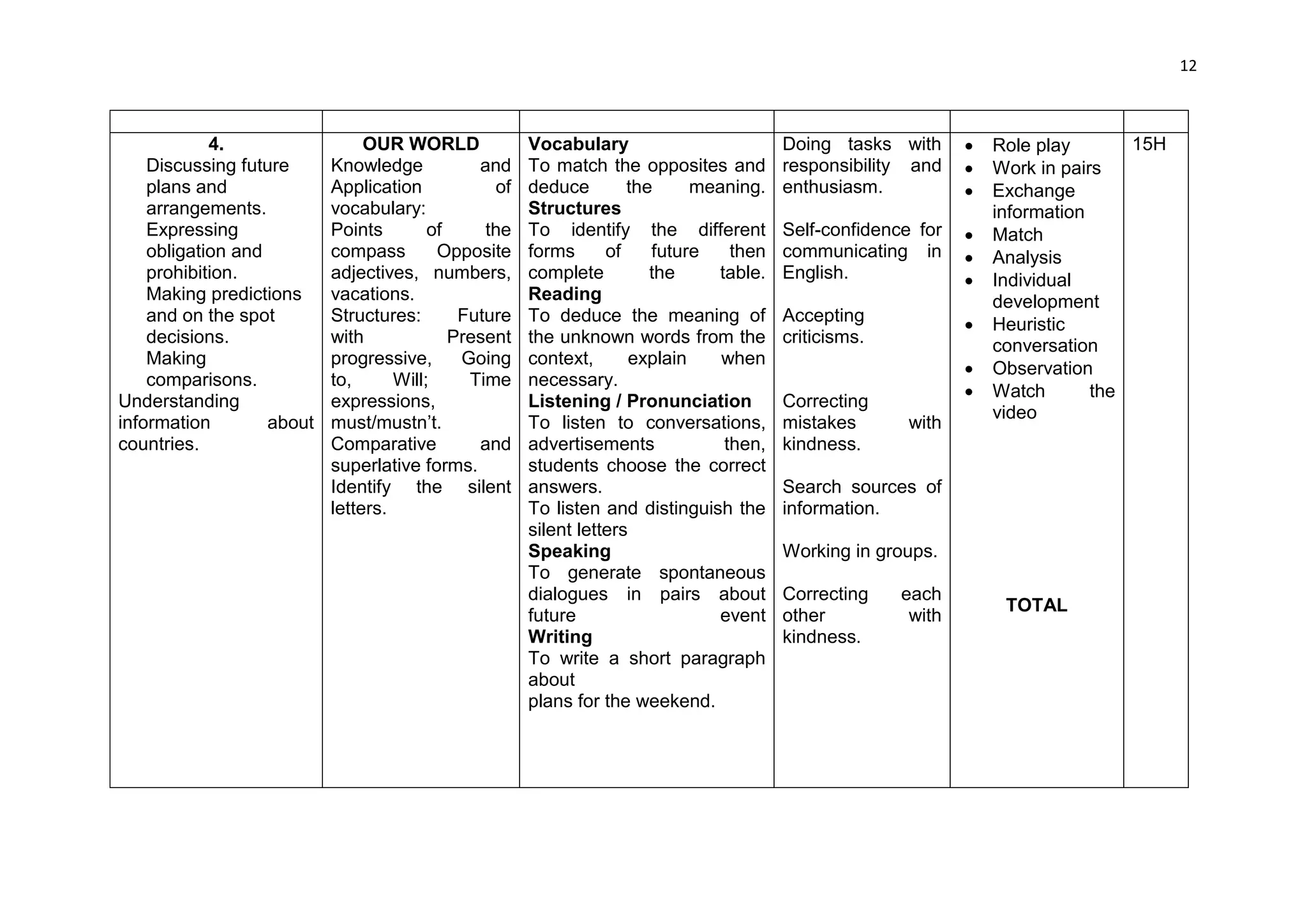
            4.                  OUR WORLD             Vocabulary                         Doing tasks with         Role play       15H
    Discussing future      Knowledge           and    To match the opposites and         responsibility and       Work in pairs
    plans and              Application           of   deduce        the      meaning.    enthusiasm.              Exchange
    arrangements.          vocabulary:                Structures                                                   information
    Expressing             Points        of     the   To identify the different          Self-confidence for      Match
    obligation and         compass        Opposite    forms      of    future     then   communicating in         Analysis
    prohibition.           adjectives, numbers,       complete         the      table.   English.                 Individual
    Making predictions     vacations.                 Reading                                                      development
    and on the spot        Structures:       Future   To deduce the meaning of           Accepting                Heuristic
    decisions.             with             Present   the unknown words from the         criticisms.               conversation
    Making                 progressive,      Going    context,       explain    when
                                                                                                                  Observation
    comparisons.           to,      Will;     Time    necessary.
                                                                                                                  Watch       the
Understanding              expressions,               Listening / Pronunciation          Correcting
                                                                                                                   video
information        about   must/mustn’t.              To listen to conversations,        mistakes       with
countries.                 Comparative         and    advertisements             then,   kindness.
                           superlative forms.         students choose the correct
                           Identify the silent        answers.                           Search sources of
                           letters.                   To listen and distinguish the      information.
                                                      silent letters
                                                      Speaking                           Working in groups.
                                                      To generate spontaneous
                                                      dialogues in pairs about           Correcting    each
                                                                                                                    TOTAL
                                                      future                    event    other          with
                                                      Writing                            kindness.
                                                      To write a short paragraph
                                                      about
                                                      plans for the weekend.
13


                                                                                                                        20H
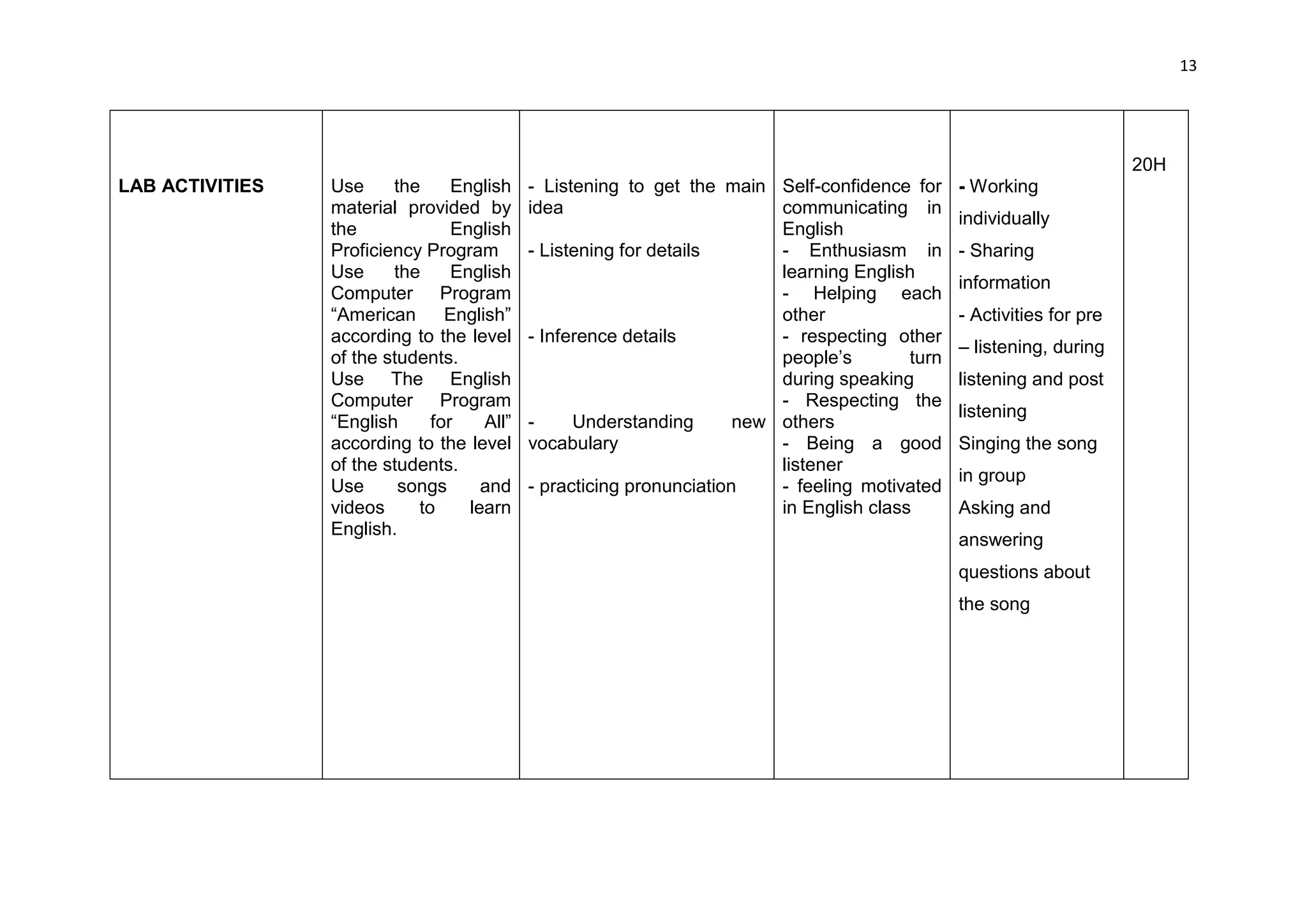
LAB ACTIVITIES   Use     the     English    - Listening to get the main Self-confidence for      - Working
                 material provided by       idea                          communicating in
                                                                                                 individually
                 the             English                                  English
                 Proficiency Program        - Listening for details       - Enthusiasm in        - Sharing
                 Use     the     English                                  learning English
                                                                                                 information
                 Computer Program                                         - Helping each
                 “American      English”                                  other                  - Activities for pre
                 according to the level     - Inference details           - respecting other
                                                                                                 – listening, during
                 of the students.                                         people’s        turn
                 Use The English                                          during speaking        listening and post
                 Computer Program                                         - Respecting the
                                                                                                 listening
                 “English     for    All”   -     Understanding       new others
                 according to the level     vocabulary                    - Being a good         Singing the song
                 of the students.                                         listener
                                                                                                 in group
                 Use      songs      and    - practicing pronunciation    - feeling motivated
                 videos     to     learn                                  in English class       Asking and
                 English.
                                                                                                 answering
                                                                                                 questions about
                                                                                                 the song
14


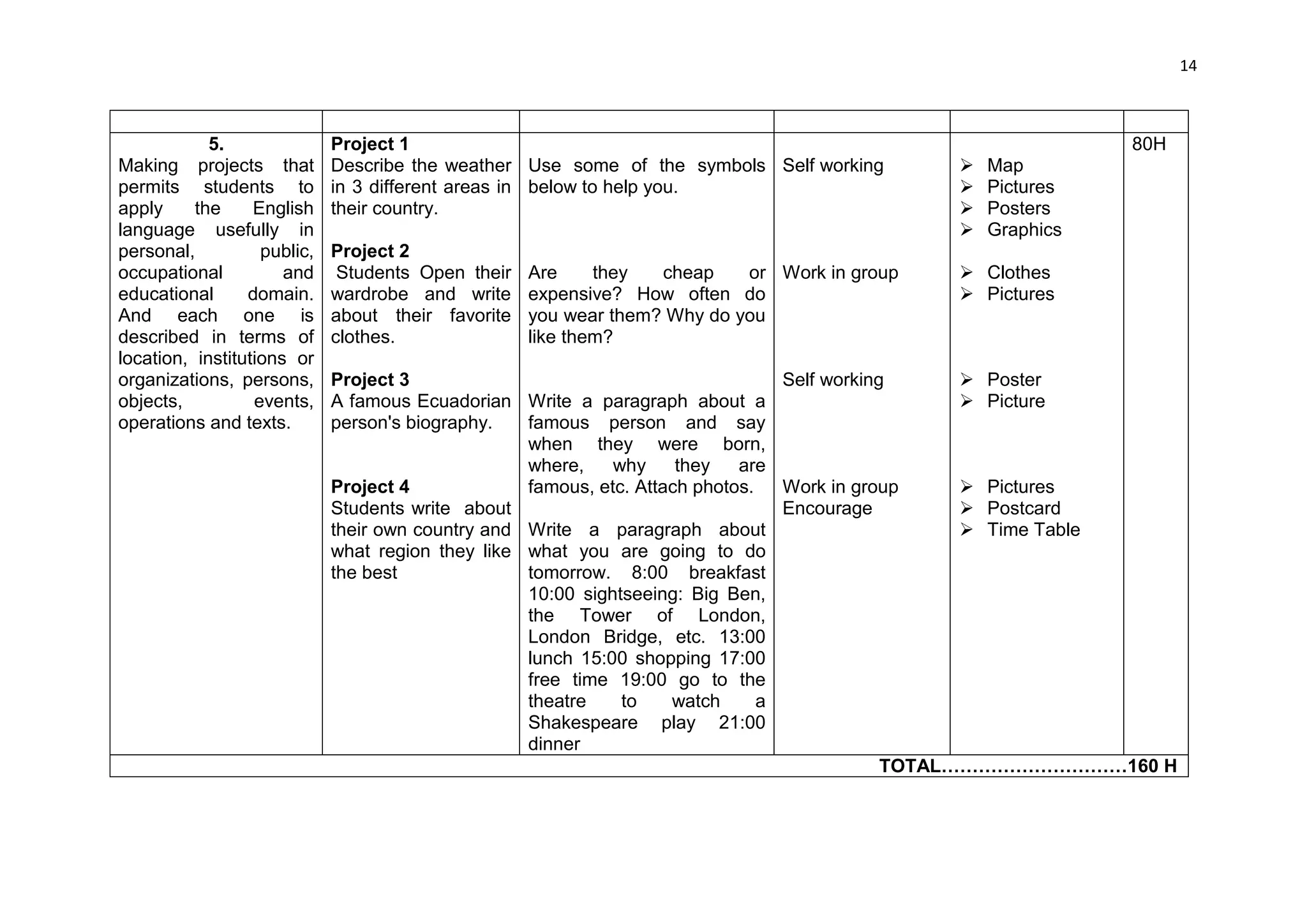
            5.               Project 1                                                                       80H
Making projects that         Describe the weather Use some of the symbols Self working           Map
permits students to          in 3 different areas in below to help you.                          Pictures
apply     the     English    their country.                                                      Posters
language usefully in                                                                             Graphics
personal,          public,   Project 2
occupational          and     Students Open their   Are     they  cheap    or Work in group    Clothes
educational      domain.     wardrobe and write     expensive? How often do                    Pictures
And each one is              about their favorite   you wear them? Why do you
described in terms of        clothes.               like them?
location, institutions or
organizations, persons,      Project 3                                           Self working       Poster
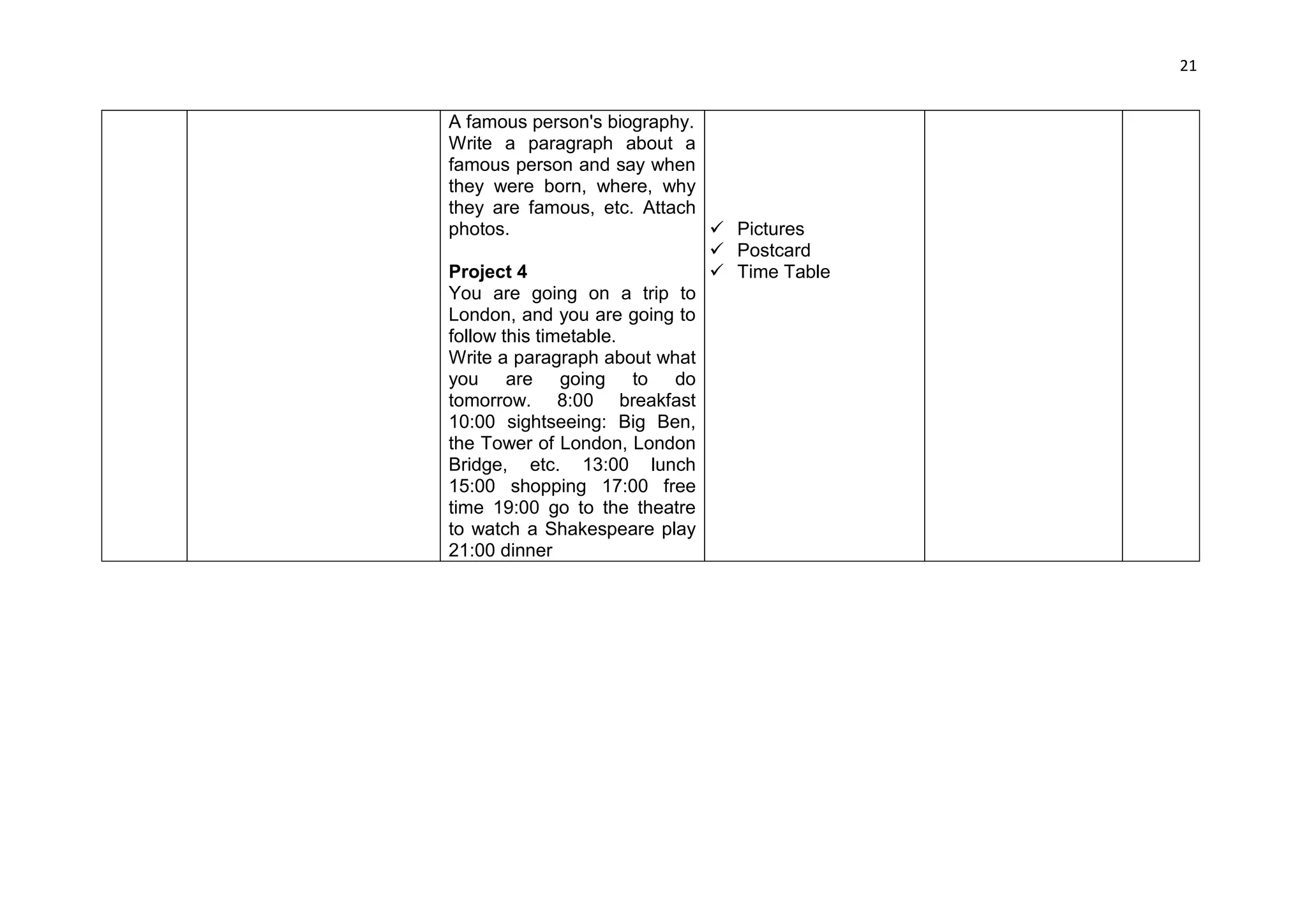
objects,          events,    A famous Ecuadorian Write a paragraph about a                          Picture
operations and texts.        person's biography.   famous person and say
                                                   when they were born,
                                                   where,    why     they   are
                             Project 4             famous, etc. Attach photos.   Work in group      Pictures
                             Students write about                                Encourage          Postcard
                             their own country and Write a paragraph about                          Time Table
                             what region they like what you are going to do
                             the best              tomorrow. 8:00 breakfast
                                                   10:00 sightseeing: Big Ben,
                                                   the Tower of London,
                                                   London Bridge, etc. 13:00
                                                   lunch 15:00 shopping 17:00
                                                   free time 19:00 go to the
                                                   theatre    to    watch      a
                                                   Shakespeare play 21:00
                                                   dinner
                                                                                             TOTAL…………………………160 H
15


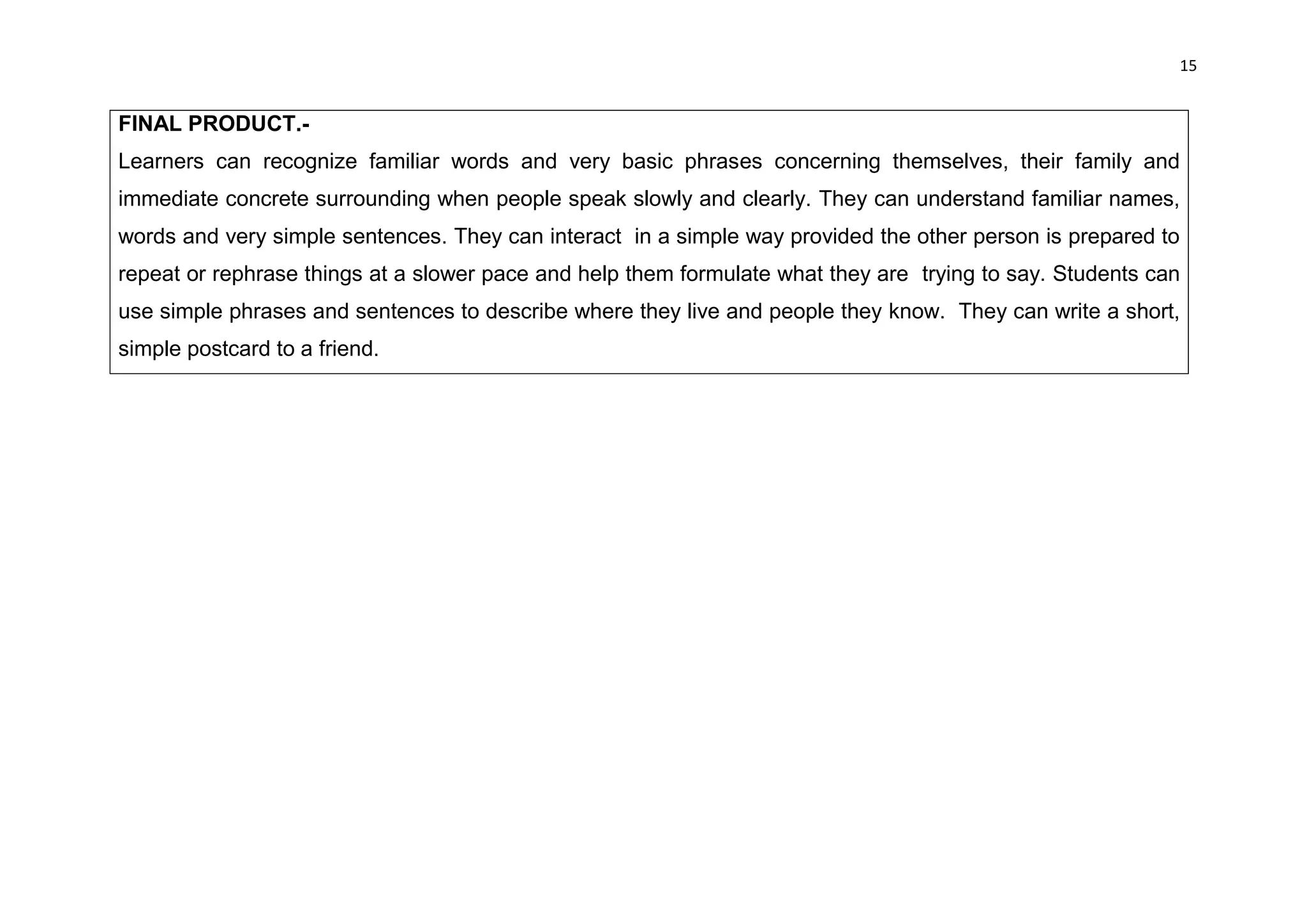
FINAL PRODUCT.-
Learners can recognize familiar words and very basic phrases concerning themselves, their family and
immediate concrete surrounding when people speak slowly and clearly. They can understand familiar names,
words and very simple sentences. They can interact in a simple way provided the other person is prepared to
repeat or rephrase things at a slower pace and help them formulate what they are trying to say. Students can
use simple phrases and sentences to describe where they live and people they know. They can write a short,
simple postcard to a friend.
16


IV. EVALUATION PLAN

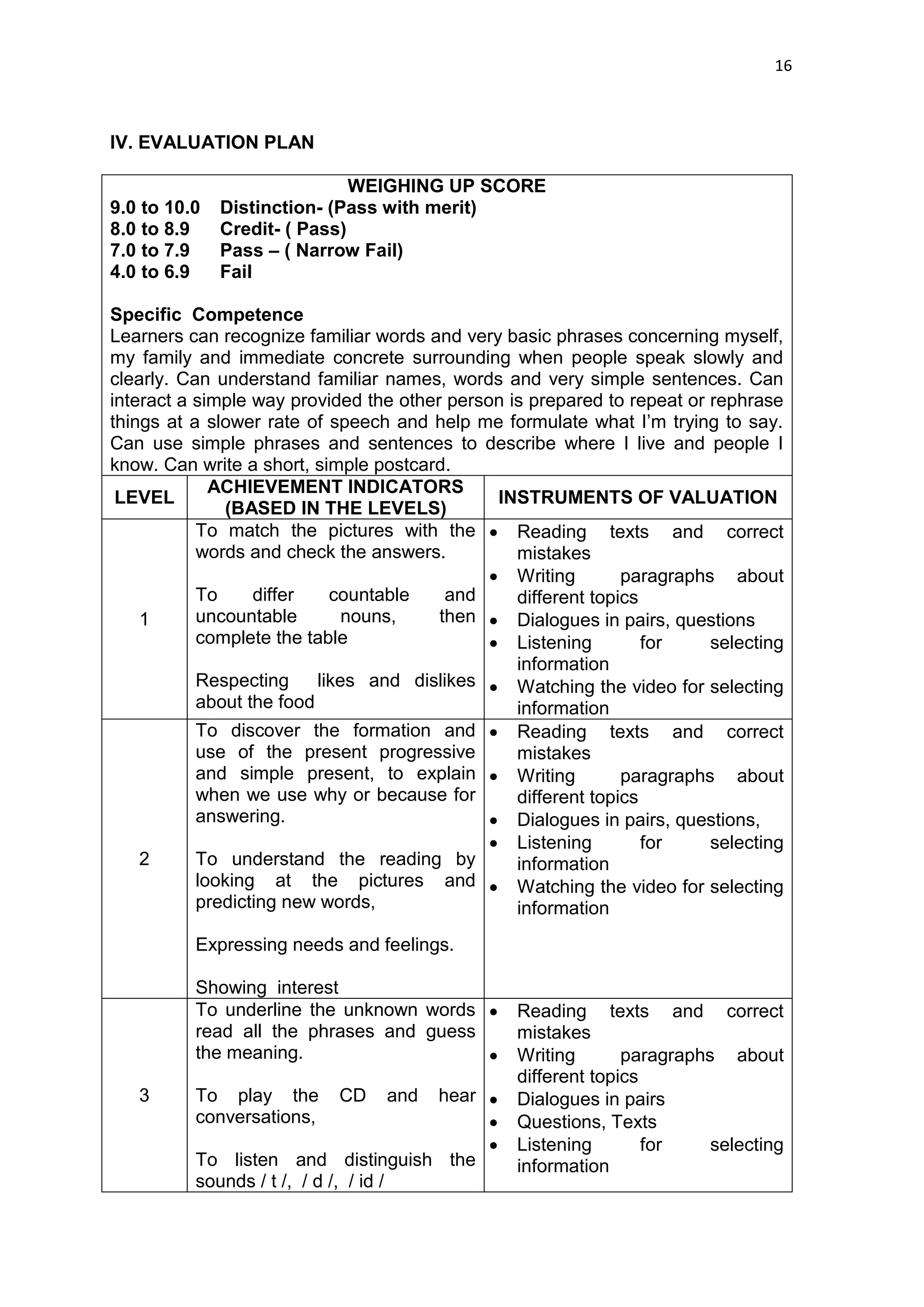
                              WEIGHING UP SCORE
9.0 to 10.0   Distinction- (Pass with merit)
8.0 to 8.9    Credit- ( Pass)
7.0 to 7.9    Pass – ( Narrow Fail)
4.0 to 6.9    Fail

Specific Competence
Learners can recognize familiar words and very basic phrases concerning myself,
my family and immediate concrete surrounding when people speak slowly and
clearly. Can understand familiar names, words and very simple sentences. Can
interact a simple way provided the other person is prepared to repeat or rephrase
things at a slower rate of speech and help me formulate what I’m trying to say.
Can use simple phrases and sentences to describe where I live and people I
know. Can write a short, simple postcard.
             ACHIEVEMENT INDICATORS
 LEVEL                                         INSTRUMENTS OF VALUATION
              (BASED IN THE LEVELS)
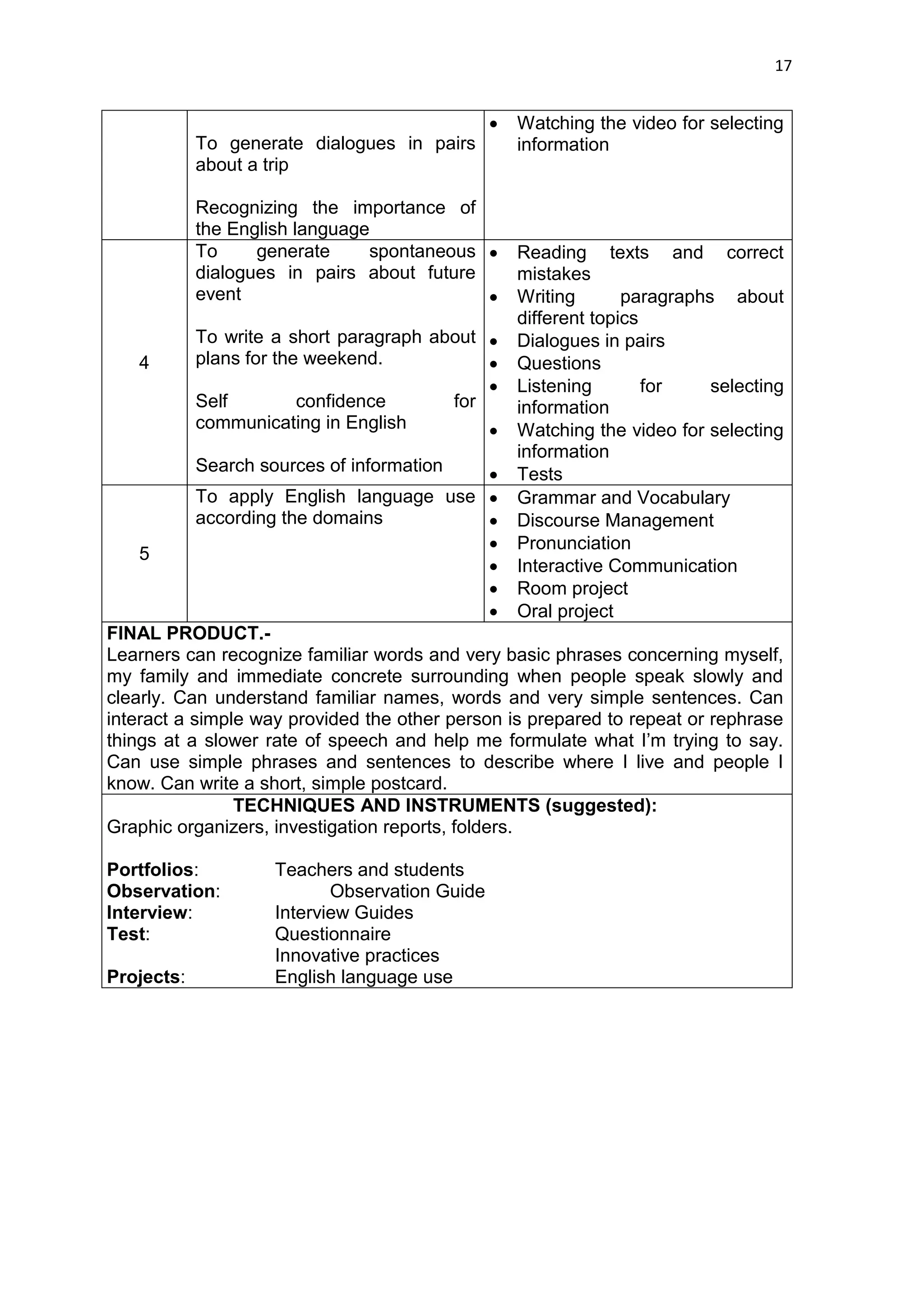
           To match the pictures with the  Reading texts and correct
           words and check the answers.          mistakes
                                               Writing        paragraphs about
           To     differ    countable    and     different topics
    1      uncountable        nouns,    then  Dialogues in pairs, questions
           complete the table                  Listening         for    selecting
                                                 information
           Respecting     likes and dislikes  Watching the video for selecting
           about the food                        information
           To discover the formation and  Reading texts and correct
           use of the present progressive        mistakes
           and simple present, to explain  Writing            paragraphs about
           when we use why or because for        different topics
           answering.                          Dialogues in pairs, questions,
                                               Listening         for    selecting
    2      To understand the reading by          information
           looking at the pictures and  Watching the video for selecting
           predicting new words,                 information
          Expressing needs and feelings.

          Showing interest
          To underline the unknown words        Reading texts and correct
          read all the phrases and guess         mistakes
          the meaning.                          Writing       paragraphs about
                                                 different topics
   3      To play the      CD    and  hear      Dialogues in pairs
          conversations,                        Questions, Texts
                                                Listening        for    selecting
          To listen and distinguish the          information
          sounds / t /, / d /, / id /
17


                                                   Watching the video for selecting
            To generate dialogues in pairs          information
            about a trip

            Recognizing the importance of
            the English language
            To     generate     spontaneous        Reading texts and correct
            dialogues in pairs about future         mistakes
            event                                  Writing       paragraphs about
                                                    different topics
            To write a short paragraph about       Dialogues in pairs
   4        plans for the weekend.                 Questions
                                                   Listening        for    selecting
            Self         confidence      for        information
            communicating in English               Watching the video for selecting
                                                    information
            Search sources of information          Tests
            To apply English language use          Grammar and Vocabulary
            according the domains                  Discourse Management
                                                   Pronunciation
    5
                                                   Interactive Communication
                                                   Room project
                                                   Oral project
FINAL PRODUCT.-
Learners can recognize familiar words and very basic phrases concerning myself,
my family and immediate concrete surrounding when people speak slowly and
clearly. Can understand familiar names, words and very simple sentences. Can
interact a simple way provided the other person is prepared to repeat or rephrase
things at a slower rate of speech and help me formulate what I’m trying to say.
Can use simple phrases and sentences to describe where I live and people I
know. Can write a short, simple postcard.
                TECHNIQUES AND INSTRUMENTS (suggested):
Graphic organizers, investigation reports, folders.

Portfolios:          Teachers and students
Observation:                Observation Guide
Interview:           Interview Guides
Test:                Questionnaire
                     Innovative practices
Projects:            English language use
18


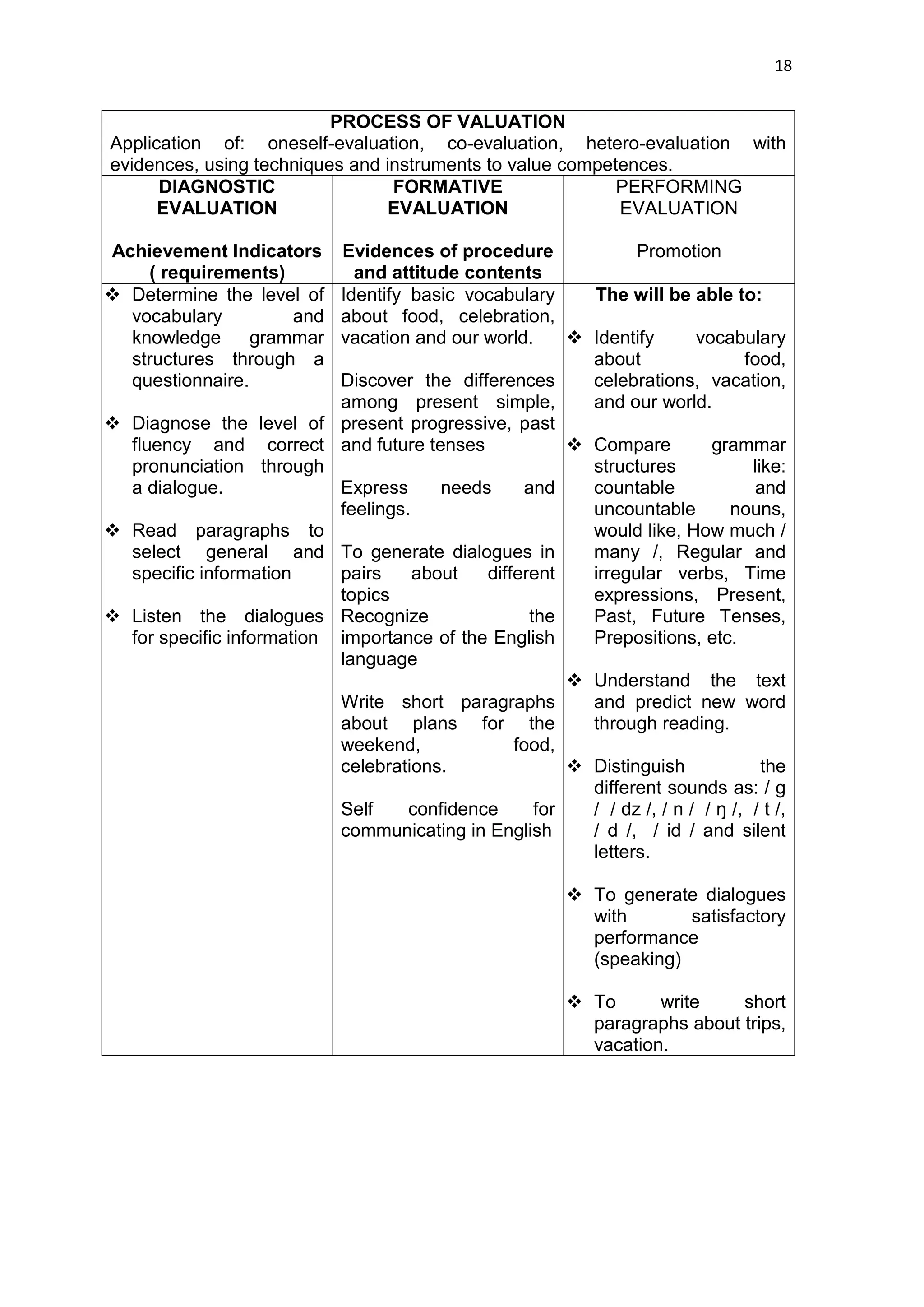
                          PROCESS OF VALUATION
Application of: oneself-evaluation, co-evaluation, hetero-evaluation with
evidences, using techniques and instruments to value competences.
      DIAGNOSTIC                 FORMATIVE                 PERFORMING
      EVALUATION                 EVALUATION                EVALUATION

Achievement Indicators       Evidences of procedure               Promotion
    ( requirements)            and attitude contents
 Determine the level of     Identify basic vocabulary      The will be able to:
  vocabulary         and     about food, celebration,
  knowledge      grammar     vacation and our world.       Identify       vocabulary
  structures through a                                      about                 food,
  questionnaire.             Discover the differences       celebrations, vacation,
                             among present simple,          and our world.
 Diagnose the level of      present progressive, past
  fluency and correct        and future tenses             Compare          grammar
  pronunciation through                                     structures             like:
  a dialogue.                Express      needs     and     countable              and
                             feelings.                      uncountable         nouns,
 Read paragraphs to                                        would like, How much /
  select general and         To generate dialogues in       many /, Regular and
  specific information       pairs     about   different    irregular verbs, Time
                             topics                         expressions, Present,
 Listen the dialogues       Recognize               the    Past, Future Tenses,
  for specific information   importance of the English      Prepositions, etc.
                             language
                                                           Understand the text
                             Write short paragraphs         and predict new word
                             about plans for the            through reading.
                             weekend,              food,
                             celebrations.                 Distinguish              the
                                                            different sounds as: / g
                             Self     confidence      for   / / dz /, / n / / ŋ /, / t /,
                             communicating in English       / d /, / id / and silent
                                                            letters.

                                                            To generate dialogues
                                                             with       satisfactory
                                                             performance
                                                             (speaking)

                                                            To      write    short
                                                             paragraphs about trips,
                                                             vacation.
19


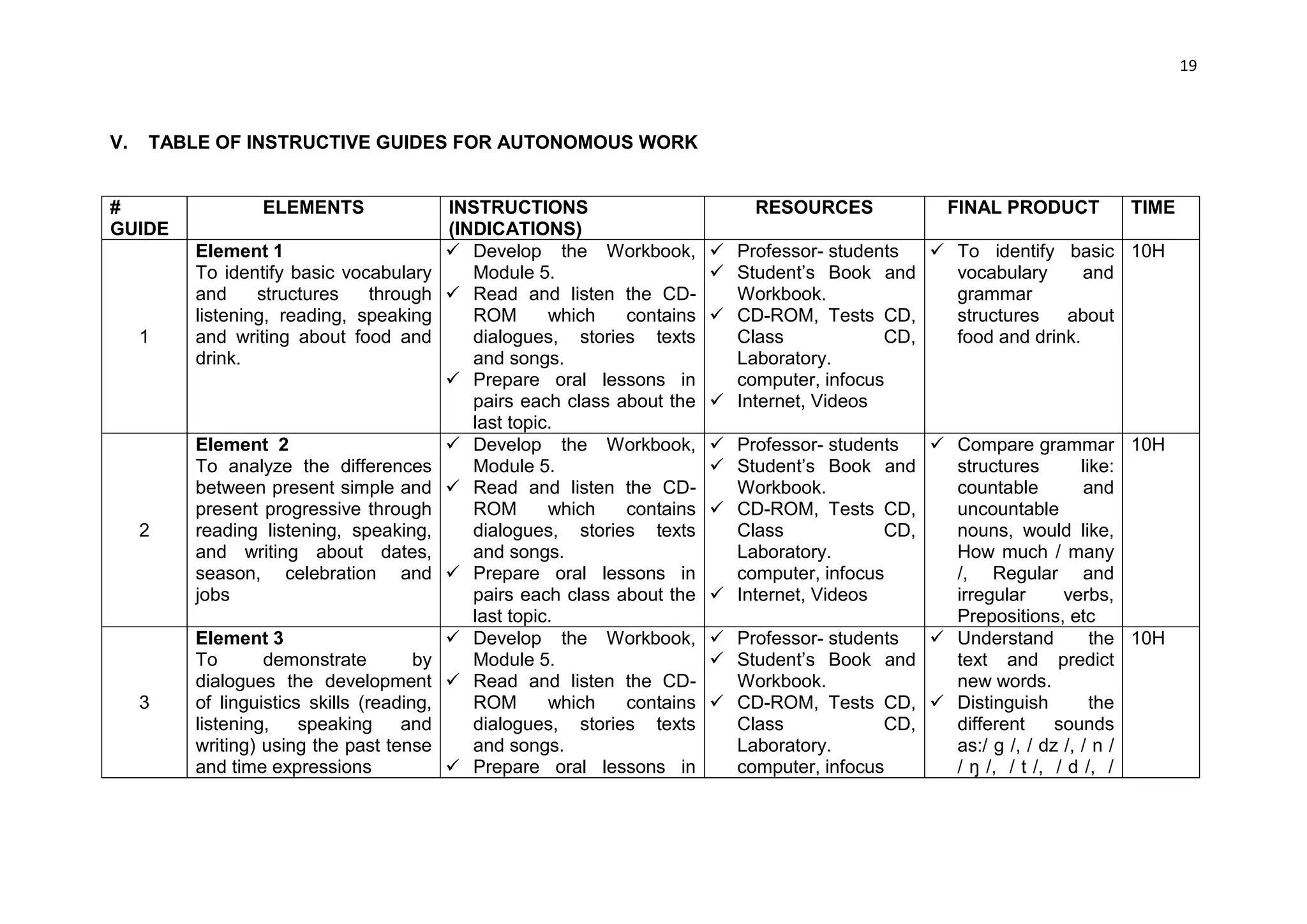
V.   TABLE OF INSTRUCTIVE GUIDES FOR AUTONOMOUS WORK


#                ELEMENTS                  INSTRUCTIONS                         RESOURCES             FINAL PRODUCT        TIME
GUIDE                                      (INDICATIONS)
         Element 1                          Develop the Workbook,          Professor- students   To identify basic 10H
         To identify basic vocabulary         Module 5.                     Student’s Book and     vocabulary      and
         and     structures   through       Read and listen the CD-         Workbook.              grammar
         listening, reading, speaking         ROM       which   contains    CD-ROM, Tests CD,      structures   about
     1   and writing about food and           dialogues, stories texts       Class            CD,   food and drink.
         drink.                               and songs.                     Laboratory.
                                            Prepare oral lessons in         computer, infocus
                                              pairs each class about the    Internet, Videos
                                              last topic.
         Element 2                          Develop the Workbook,          Professor- students   Compare grammar 10H
         To analyze the differences           Module 5.                     Student’s Book and     structures        like:
         between present simple and         Read and listen the CD-         Workbook.              countable         and
         present progressive through          ROM       which   contains    CD-ROM, Tests CD,      uncountable
     2   reading listening, speaking,         dialogues, stories texts       Class            CD,   nouns, would like,
         and writing about dates,             and songs.                     Laboratory.            How much / many
         season, celebration and            Prepare oral lessons in         computer, infocus      /, Regular and
         jobs                                 pairs each class about the    Internet, Videos       irregular      verbs,
                                              last topic.                                           Prepositions, etc
         Element 3                          Develop the Workbook,          Professor- students   Understand          the 10H
         To       demonstrate         by      Module 5.                     Student’s Book and     text and predict
         dialogues the development          Read and listen the CD-         Workbook.              new words.
     3   of linguistics skills (reading,      ROM       which   contains    CD-ROM, Tests CD,  Distinguish            the
         listening,    speaking     and       dialogues, stories texts       Class            CD,   different     sounds
         writing) using the past tense        and songs.                     Laboratory.            as:/ g /, / dz /, / n /
         and time expressions               Prepare oral lessons in         computer, infocus      / ŋ /, / t /, / d /, /
20


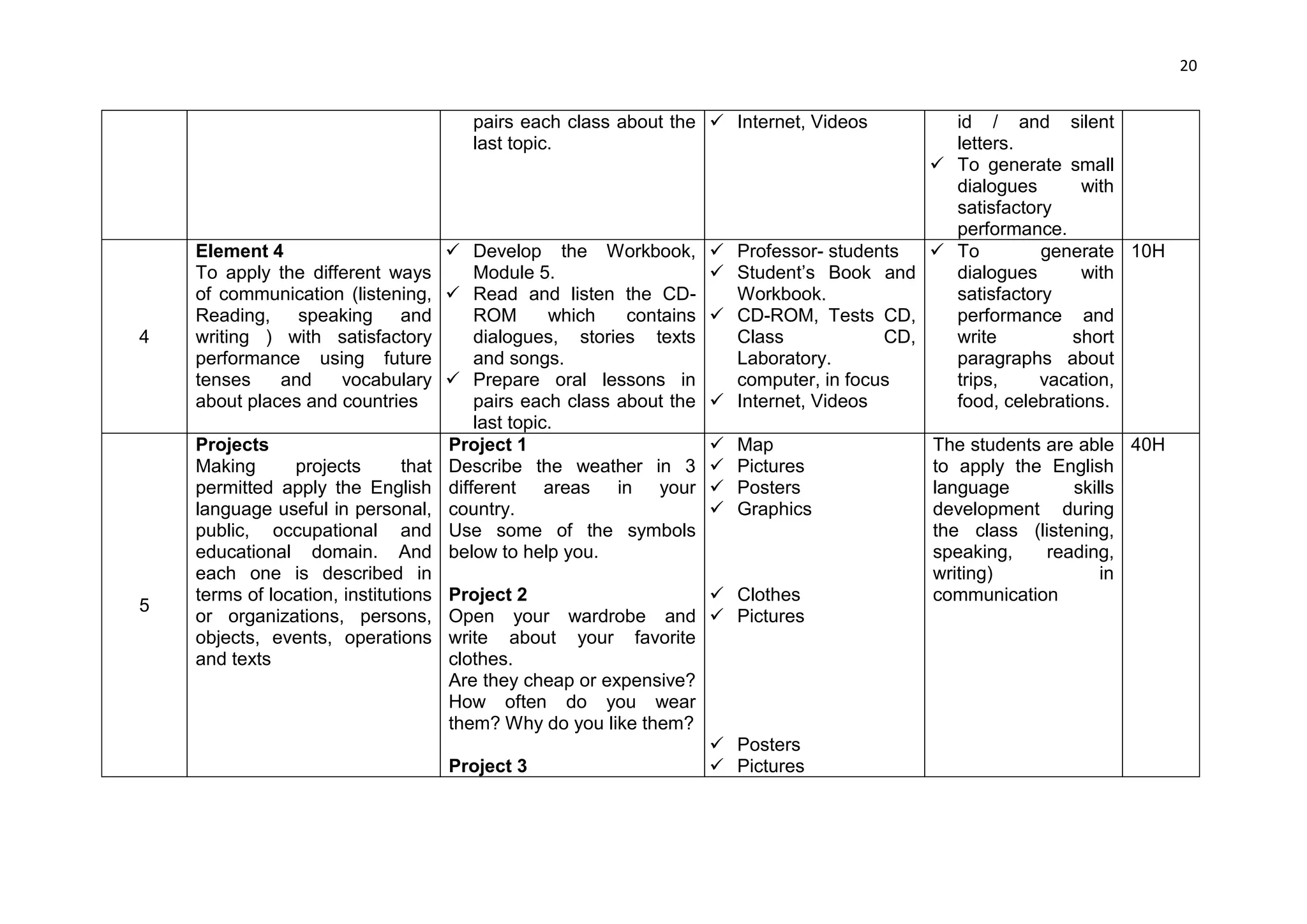
                                      pairs each class about the  Internet, Videos           id / and silent
                                      last topic.                                             letters.
                                                                                             To generate small
                                                                                              dialogues       with
                                                                                              satisfactory
                                                                                              performance.
    Element 4                         Develop the Workbook,          Professor- students   To         generate 10H
    To apply the different ways         Module 5.                     Student’s Book and     dialogues       with
    of communication (listening,  Read and listen the CD-             Workbook.              satisfactory
    Reading,     speaking and           ROM       which   contains    CD-ROM, Tests CD,      performance and
4   writing ) with satisfactory         dialogues, stories texts       Class            CD,   write          short
    performance using future            and songs.                     Laboratory.            paragraphs about
    tenses     and     vocabulary  Prepare oral lessons in            computer, in focus     trips,     vacation,
    about places and countries          pairs each class about the    Internet, Videos       food, celebrations.
                                        last topic.
    Projects                         Project 1                          Map                The students are able 40H
    Making      projects        that Describe the weather in 3          Pictures           to apply the English
    permitted apply the English different areas in your                 Posters            language        skills
    language useful in personal, country.                               Graphics           development during
    public, occupational and Use some of the symbols                                        the class (listening,
    educational domain. And below to help you.                                              speaking,    reading,
    each one is described in                                                                writing)            in
    terms of location, institutions Project 2                         Clothes              communication
5
    or organizations, persons, Open your wardrobe and                 Pictures
    objects, events, operations write about your favorite
    and texts                        clothes.
                                     Are they cheap or expensive?
                                     How often do you wear
                                     them? Why do you like them?
                                                                      Posters
                                   Project 3                          Pictures
21


A famous person's biography.
Write a paragraph about a
famous person and say when
they were born, where, why
they are famous, etc. Attach
photos.                       Pictures
                              Postcard
Project 4                     Time Table
You are going on a trip to
London, and you are going to
follow this timetable.
Write a paragraph about what
you are going to do
tomorrow. 8:00 breakfast
10:00 sightseeing: Big Ben,
the Tower of London, London
Bridge, etc. 13:00 lunch
15:00 shopping 17:00 free
time 19:00 go to the theatre
to watch a Shakespeare play
21:00 dinner
22

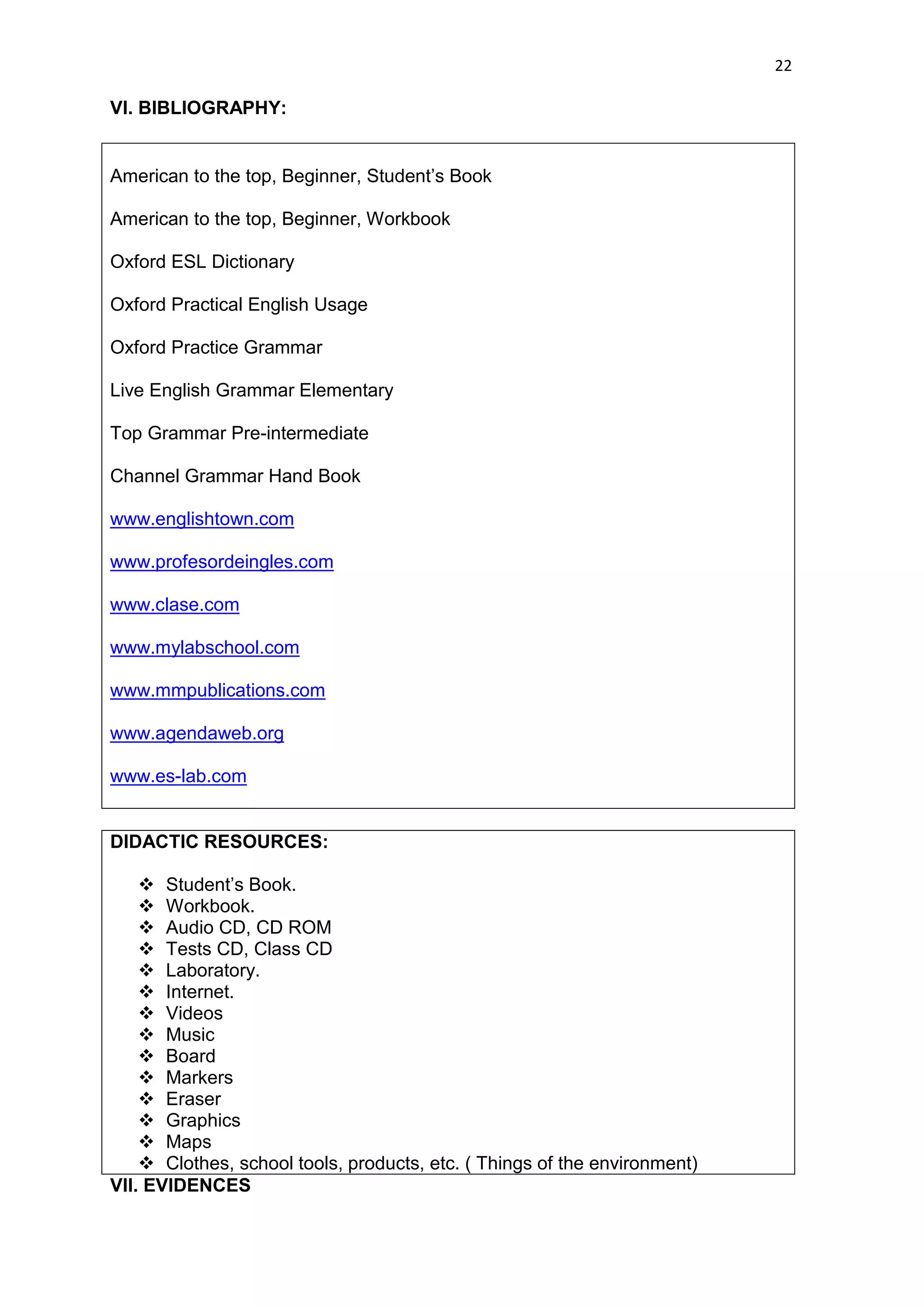
VI. BIBLIOGRAPHY:


American to the top, Beginner, Student’s Book

American to the top, Beginner, Workbook

Oxford ESL Dictionary

Oxford Practical English Usage

Oxford Practice Grammar

Live English Grammar Elementary

Top Grammar Pre-intermediate

Channel Grammar Hand Book

www.englishtown.com

www.profesordeingles.com

www.clase.com

www.mylabschool.com

www.mmpublications.com

www.agendaweb.org

www.es-lab.com


DIDACTIC RESOURCES:

     Student’s Book.
     Workbook.
     Audio CD, CD ROM
     Tests CD, Class CD
     Laboratory.
     Internet.
     Videos
     Music
     Board
     Markers
     Eraser
     Graphics
     Maps
     Clothes, school tools, products, etc. ( Things of the environment)
VII. EVIDENCES
23

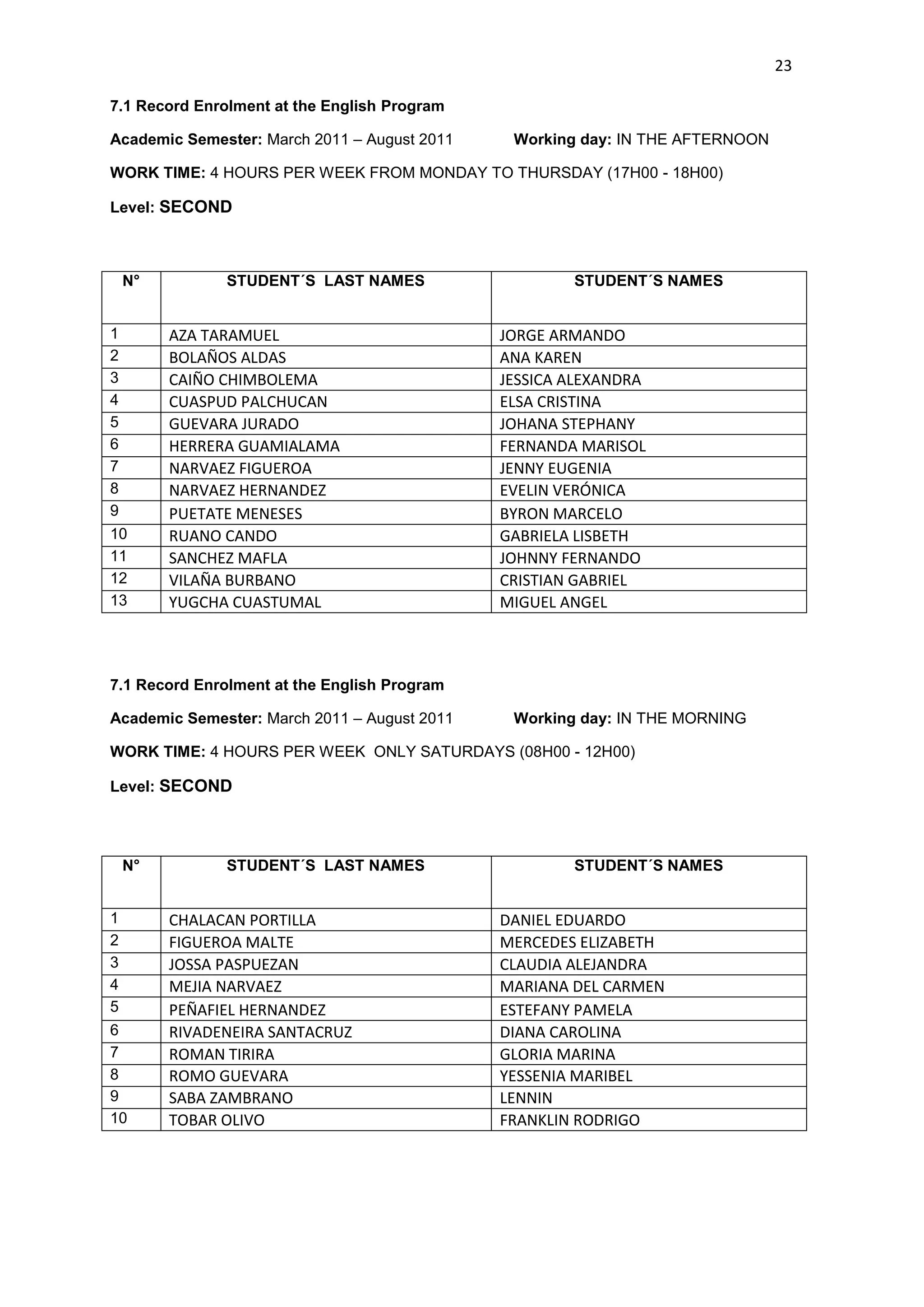
7.1 Record Enrolment at the English Program

Academic Semester: March 2011 – August 2011    Working day: IN THE AFTERNOON

WORK TIME: 4 HOURS PER WEEK FROM MONDAY TO THURSDAY (17H00 - 18H00)

Level: SECOND


    N°         STUDENT´S LAST NAMES                   STUDENT´S NAMES


1        AZA TARAMUEL                         JORGE ARMANDO
2        BOLAÑOS ALDAS                        ANA KAREN
3        CAIÑO CHIMBOLEMA                     JESSICA ALEXANDRA
4        CUASPUD PALCHUCAN                    ELSA CRISTINA
5        GUEVARA JURADO                       JOHANA STEPHANY
6        HERRERA GUAMIALAMA                   FERNANDA MARISOL
7        NARVAEZ FIGUEROA                     JENNY EUGENIA
8        NARVAEZ HERNANDEZ                    EVELIN VERÓNICA
9        PUETATE MENESES                      BYRON MARCELO
10       RUANO CANDO                          GABRIELA LISBETH
11       SANCHEZ MAFLA                        JOHNNY FERNANDO
12       VILAÑA BURBANO                       CRISTIAN GABRIEL
13       YUGCHA CUASTUMAL                     MIGUEL ANGEL


7.1 Record Enrolment at the English Program

Academic Semester: March 2011 – August 2011    Working day: IN THE MORNING

WORK TIME: 4 HOURS PER WEEK ONLY SATURDAYS (08H00 - 12H00)

Level: SECOND


    N°         STUDENT´S LAST NAMES                   STUDENT´S NAMES


1        CHALACAN PORTILLA                    DANIEL EDUARDO
2        FIGUEROA MALTE                       MERCEDES ELIZABETH
3        JOSSA PASPUEZAN                      CLAUDIA ALEJANDRA
4        MEJIA NARVAEZ                        MARIANA DEL CARMEN
5        PEÑAFIEL HERNANDEZ                   ESTEFANY PAMELA
6        RIVADENEIRA SANTACRUZ                DIANA CAROLINA
7        ROMAN TIRIRA                         GLORIA MARINA
8        ROMO GUEVARA                         YESSENIA MARIBEL
9        SABA ZAMBRANO                        LENNIN
10       TOBAR OLIVO                          FRANKLIN RODRIGO
24

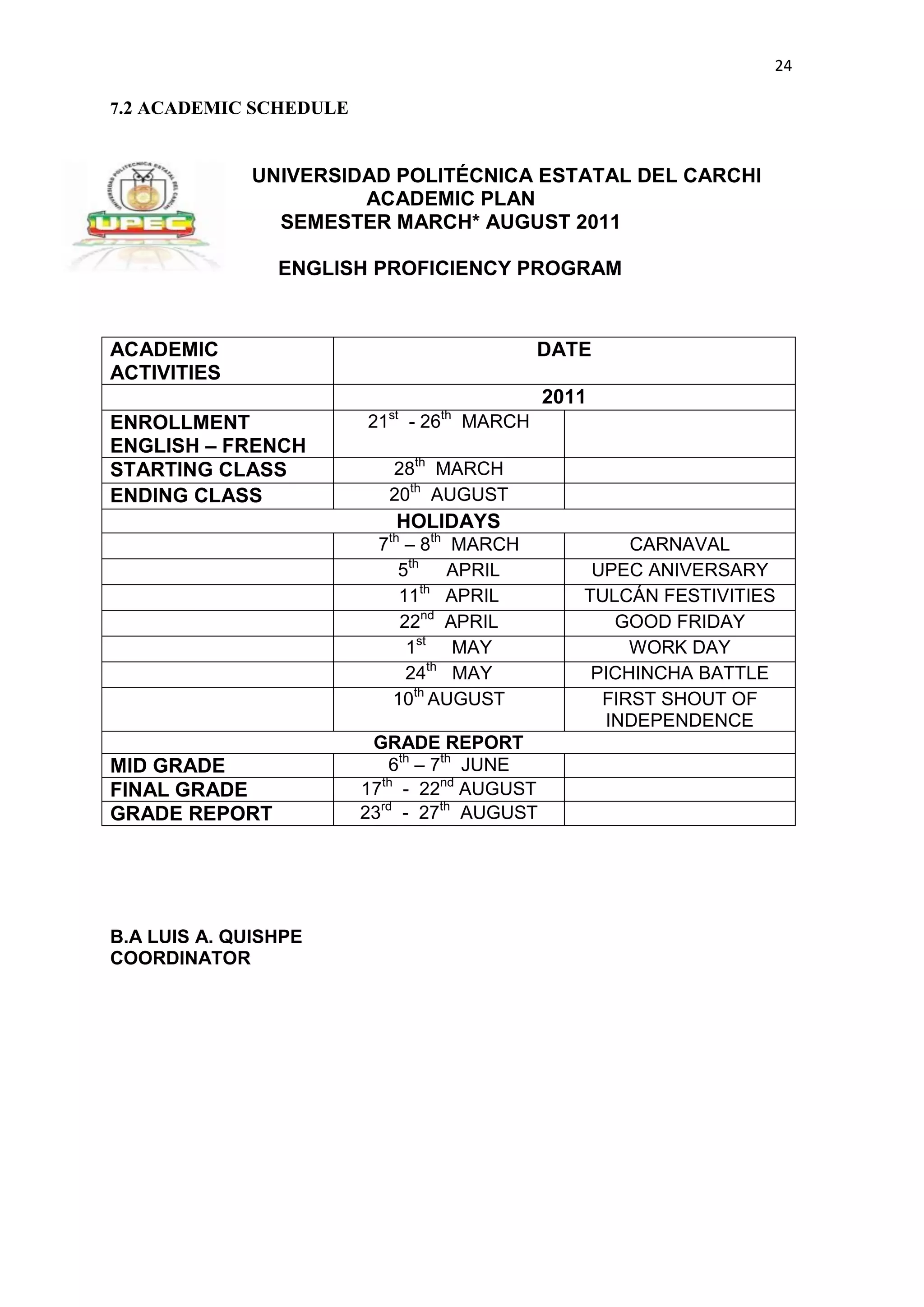
7.2 ACADEMIC SCHEDULE


             UNIVERSIDAD POLITÉCNICA ESTATAL DEL CARCHI
                      ACADEMIC PLAN
               SEMESTER MARCH* AUGUST 2011

                ENGLISH PROFICIENCY PROGRAM


ACADEMIC                                              DATE
ACTIVITIES
                                                      2011
                             st          th
ENROLLMENT              21        - 26        MARCH
ENGLISH – FRENCH
STARTING CLASS               28th MARCH
ENDING CLASS                 20th AUGUST
                              HOLIDAYS
                         7th – 8th MARCH                      CARNAVAL
                            5th APRIL                     UPEC ANIVERSARY
                            11th APRIL                   TULCÁN FESTIVITIES
                            22nd APRIL                      GOOD FRIDAY
                             1st MAY                          WORK DAY
                             24th MAY                     PICHINCHA BATTLE
                           10th AUGUST                     FIRST SHOUT OF
                                                           INDEPENDENCE
                         GRADE REPORT
MID GRADE                  6th – 7th JUNE
FINAL GRADE             17th - 22nd AUGUST
GRADE REPORT            23rd - 27th AUGUST


B.A LUIS A. QUISHPE
COORDINATOR
25

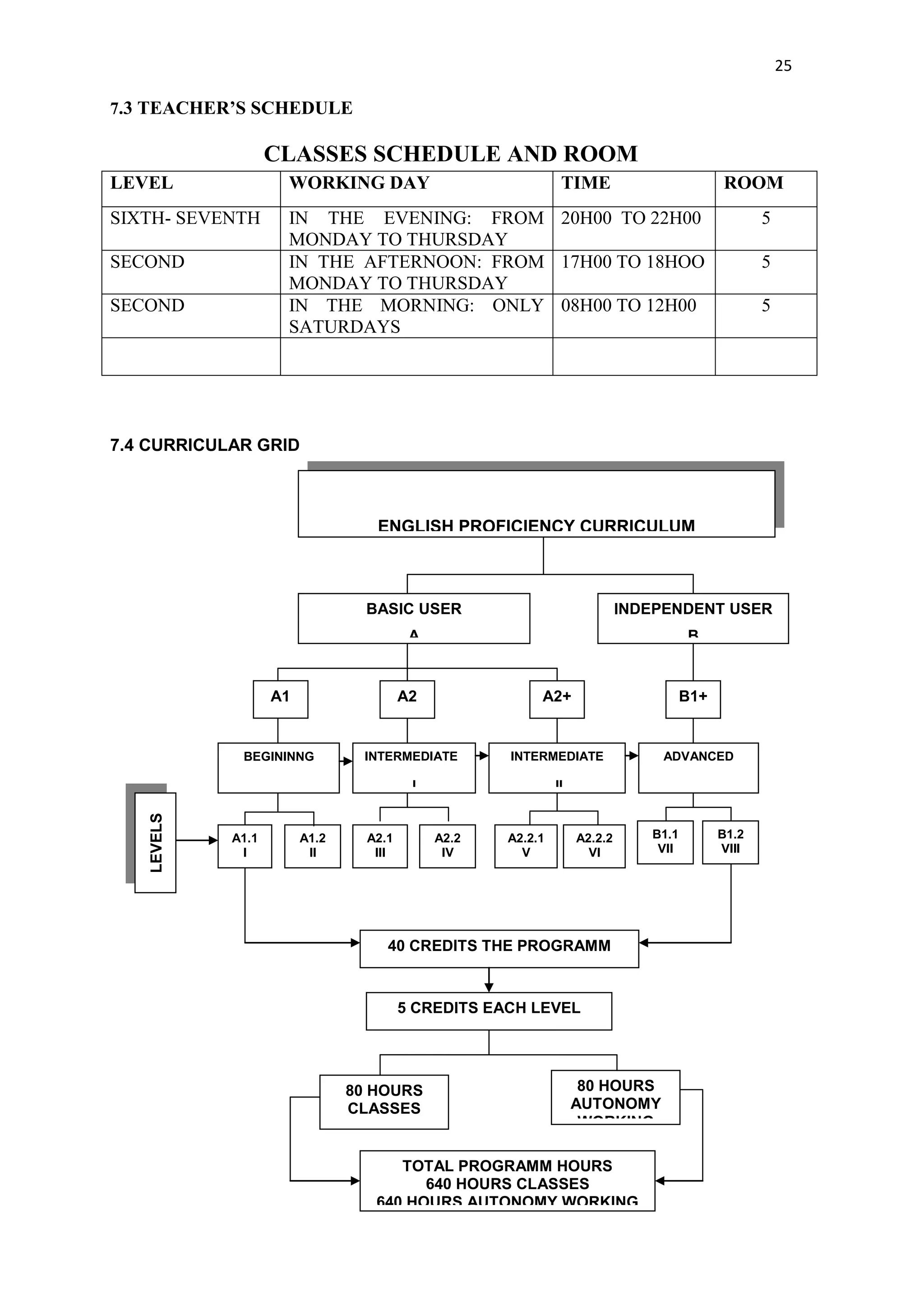
7.3 TEACHER’S SCHEDULE

                    CLASSES SCHEDULE AND ROOM
LEVEL                WORKING DAY                               TIME                         ROOM
SIXTH- SEVENTH       IN THE EVENING: FROM 20H00 TO 22H00                                           5
                     MONDAY TO THURSDAY
SECOND               IN THE AFTERNOON: FROM 17H00 TO 18HOO                                         5
                     MONDAY TO THURSDAY
SECOND               IN THE MORNING: ONLY 08H00 TO 12H00                                           5
                     SATURDAYS


7.4 CURRICULAR GRID


                                   ENGLISH PROFICIENCY CURRICULUM


                                  BASIC USER                                INDEPENDENT USER
                                          A                                           B


                    A1                   A2               A2+                         B1+


              BEGININNG          INTERMEDIATE        INTERMEDIATE                ADVANCED

                                          I                   II
    LEVELS


             A1.1        A1.2     A2.1        A2.2   A2.2.1        A2.2.2      B1.1         B1.2
              I           II       III         IV      V             VI         VII         VIII


                                     40 CREDITS THE PROGRAMM


                                         5 CREDITS EACH LEVEL


                                80 HOURS                            80 HOURS
                                CLASSES                            AUTONOMY
                                                                    WORKING

                                      TOTAL PROGRAMM HOURS
                                         640 HOURS CLASSES
                                   640 HOURS AUTONOMY WORKING
26


PROFESSOR:

                         …………………………………………

                              (SIGNATURE)


DELIVERY DATE: APRIL, 2011.

Second level modulo a1.2 jairo castro 29 th april 2011 a

  • 1.
    UNIVERSIDAD POLITÉCNICA ESTATALDEL CARCHI CURRICULUM CATEDRÁTICO CEDULA 040093893-2 APELLIDO PATERNO CASTRO APELLIDO MATERNO GUERRERO NOMBRES JAIRO IVÁN FECHA_NACIMIENTO 12-11-1970 EDAD 40 ESTADO_CIVIL SOLTERO TELEFONO Fijo: 2982-932 Cel.: 097103746 Cdla del Chofer: Rio Putumayo y DIRECCION_DOMICILIARIA Guayas esq. FORMACIÓN_ PROFESIONAL Bachiller en Ciencias Sociales: COLEGIO NACIONAL BOLÍVAR Licenciado en Ciencias de la Educación, Profesor de Enseñanza media en la Especialización de Idiomas: Inglés y Francés: UNIVERSIDAD CENTRAL DEL ECUADOR. Tecnólogo en Análisis de Sistemas Informáticos: SECAP CARCHI Diploma Superior En Currículo por Competencias : UTA-UPEC FORMACION COMPLEMENTARIA Módulo de Diseño Curricular por Competencias: UTA Módulo de Aprendizaje Basado en Problemas: UTA Módulo de Elaboración de Módulos: UTA Módulo de Evaluación con base en Normas de Competencia: UTA Seminario-Taller de “ Formación por competencias”
  • 2.
    Seminario-taller TEACHING KNOWLEDGETEST, Modulo 1 : MEC Proyecto CRADLE- C Curso "KEY ENGLISH TEST”: MEC “DINAMEP” Seminar –workshop “ Impacts of the Technology in English Teaching” UPEC Training Seminar-Workshop: “Methodology of language Teaching and Curriculum Evaluation” UPEC DOMINIO_PAQUETES_ INFORMATICOS Windows /2000/XP/ Vista Paquete Office: Word, Excel, Power Point Traductor Globalink Microsoft Encarta, 2010: Biblioteca de consulta Internet - Correo Electrónico – Navegación EXPERIENCIA_ DOCENTE Profesor de Inglés: Colegio Nacional "José de la Cuadra" Quito Profesor Titular de Inglés: Instituto Tecnológico "Bolívar" Tulcán Docente de la UPEC : Septiembre 2008-Febrero 2009 Marzo-Agosto 2009 Septiembre 2009 – Febrero 2010 Marzo-Agosto 2010 Septiembre 2010 – Febrero 2011 Marzo 2011 – Agosto 2011
  • 3.
    3 STATE POLYTECHNIC UNIVERSITYOF CARCHI ENGLISH PROFICIENCY PROGRAM Module “BEGINNING A1.2” PROFESSOR: JAIRO CASTRO G. ACADEMIC SEMESTER: MARCH -AUGUST 2011 LEVEL: SECOND Tulcán, April 2011
  • 4.
    4 I. BASIC DATA OF THE MODULE CODE:EPPUPEC REQUIREMENTS: KIND OF COMPETENCE:  Have approved English A1.1 GENERIC: ( X )  Have taken the placement test. SPECIFIC: ( )  Basic Knowledge of NTICs. CREDITS: LEVEL  Interest for learning and active 5 SECOND performance.  Attitude to work in team.  Attitude to participate in class. PROFESSOR PROFILE: NAME:JAIRO IVÁN CASTRO GUERRERO CONTACT TELEPHONE: HOUSE 062982932 E-MAIL: ivancas2004@yahoo.es
  • 5.
    5 II. FORMATIVE ROUTE Problematicnode Limited development of the macro communicative English skills (listening, speaking, reading and writing). Global Competence Learners can understand the main points of clear standard input on familiar matters regularly encountered in work, schools, leisure, etc. Can deal with most situations likely to arrive whilst traveling in an area where the language is spoken. Can produce simple connected texts on topics which are familiar or of personal interest. Can describe experiences and events, dreams, hopes and ambitions and briefly give reasons and explanation for opinions and plans. Specific Competence Learners can recognize familiar words and very basic phrases concerning myself, my family and immediate concrete surrounding when people speak slowly and clearly. Can understand familiar names, words and very simple sentences. Can interact a simple way provided the other person is prepared to repeat or rephrase things at a slower rate of speech and help me formulate what I’m trying to say. Can use simple phrases and sentences to describe where I live and people I know. Can write a short, simple postcard. ACHIEVEMENT COMPETENCE ELEMENTS Nº LEVELS (Systematic actions to make the competence) To identify basic vocabulary and structures through Basic Theoretic 1 listening, reading, speaking and writing about food and Understanding drink. To analyze the differences between present simple Superior and present progressive through reading listening, 2 Theoretic speaking, and writing about dates, season, celebration Critical analysis and jobs. Practice To demonstrate by dialogues the development of 3 Theoretic linguistics skills (reading, listening, speaking and Acceptable writing) using the past tense and time expressions Apply the different ways of communication (listening, Practice Reading, speaking and writing ) with satisfactory 4 Theoretic performance using future tenses and vocabulary about advance places and countries Making projects that permitted apply the English Practice language useful in personal, public, occupational and 5 Theoretic educational domain. And each one is described in Creative terms of location, institutions or organizations, persons, objects, events, operations and texts.
  • 6.
    6 Inter-discipline Work (integratedknowledge of the modules in the same semester which help to get this competence)  Oral and writing report according to the level  Use of study techniques to draw the interest of the student and motivate him or her To be dedicated to learning English.  NTICs and Elaboration of Projects
  • 7.
    7 III. LEARNING METHODOLOGY DIDACTICAPPROACH: ( Methodology for performing the competences ) Methodology of Learning Based in Problems Methodology to develop the logical thought Simulations. Experiential cycle. Multiple Intelligences, Communicative Approach, Total Physical Response, Community Language Learning Whole Language, Task-Based Language Teaching, Showing videos, readings, articles etc. UNIT COMPETENCE: The student learns to express likes and dislikes regarding food and discussing food and eating habits various aspects of their daily life, like current events, celebrations, the weather or people´s jobs activities in the past like, vacations, past situations and accidents. Making comparisons, predictions and on-the- spot decisions. All this is done by using the right grammar structures and working with the right values and morals such as respect, discipline, honesty, truth and patience. MODULE COMPETENCE ELEMENTS OF COMPETENCE MODULE 1.Expressing likes and dislikes. Making, accepting  Expressing likes and dislikes about food and refusing offers  Ordering food  Making offers  Accepting and refusing offers  Asking and answering about quantities  Discussing food and eating habits
  • 8.
    8  Asking and answering about dates  Discussing current events MODULE 2. Discussing current events, weather and  Describing people´s clothes celebrations. Telling what people do and wear.  Giving reasons  Discussing celebrations  Discussing between habitual actions and current events  Discussing the weather  Identifying people´s clothes MODULE 3.Telling about things that happened to us in the  Discussing activities in the past past such as vacations we have had certain situation and or  Discussing a vacation accidents. Telling others how we feel  Describing feelings  Narrating a story  Discussing past situations/accidents  Understanding sequence  Discussing future plans and arrangements MODULE 4. Conversing about what one plans to do in the  Expressing obligation and prohibition future while making predictions and spontaneous decisions.  Making predictions and on the spot decisions  Making comparisons Understanding information about countries
  • 9.
    9 SPECIFIC MOTIVATIONAL DIDACTIC COMPETENCE COGNITIVE AFFECTIVE PROCEDURE CONTENTS STRATEGIES ELEMENTS CONTENTS CONTENTS TIME How to apply? Strategies, What knowledge? Which attitudes methods and with? techniques 1 FOOD: Vocabulary Having interest on  Role play 15 H Expressing likes Knowledge and To match the pictures with the topic.  Work in pairs and dislikes about Application of the words and check the  Exchange food. vocabulary: answers. Respecting likes information Ordering food. Food, Drink, Structures: and dislikes about  Match Making offers. containers. To differ countable and the food.  Analysis Accepting and Structures: uncountable nouns  Individual refusing offers. countable and Reading: Sharing development Asking and uncountable nouns, To find through the reading information with  Heuristic answering about and, some, any, specific information. others conversation quantities. would like, How Listening / Pronunciation  Observation Discussing food and much, How many, To play the CD and hear  Watch the eating habits. Object personal conversations, a street video pronouns. survey; then answer the Difference between questions. the sounds: /g/, /ʤ/ To distinguish the sounds /g/ Listening: -A /ʤ/ conversation Speaking between two friends. To act out a role play in Three short pairs conversation Writing -A conversation To replace some words with about a party pronouns, then write their Reading: -A dialogue eating habits.
  • 10.
    10 between two teenagers. -A magazine article about birthdays, mother´s day and valentine´s day 2. CELEBRATIONS Vocabulary Respecting the  Role play 15H Asking and To compare the photos with turn to talk.  Work in pairs answering about Knowledge and the words and match, to  Exchange dates. Application of deduce the meaning of the Expressing needs information Discussing current vocabulary: words. Structures and feelings.  Match events. Months, Ordinals, To discover the formation  Analysis Describing people´s Dates, Clothes, and use of the present Honesty  Individual clothes. Celebrations, Jobs, progressive and simple development Giving reasons. weather, seasons. present, to explain when we Showing interest.  Heuristic Discussing Structures: Present use why or because for conversation celebrations. Simple vs. Present answering. Reading  Observation Discussing between Progressive, Why? / To understand the reading  Watch the habitual actions and Because….. by looking at the pictures video current events. Difference between and predicting new words, Discussing the the sounds: / n /, / ŋ / Listening / Pronunciation weather. To play the CD and hear Identifying people´s conversations, a radio show, clothes to distinguish the sounds /n/ and / ŋ / predict.
  • 11.
    11 Speaking To dramatize the dialogues in pairs Writing To complete the text with the words in the box 3. VACATION Vocabulary Interesting on the  Role play 20H Discussing activities Knowledge and To look at the pictures with topic.  Work in pairs in the past. Application of the words and deduce the  Exchange Discussing a vocabulary: meaning. Recognizing the information vacation. Geographical Structures importance of the  Match Describing feelings. Features, Vacation To notice the formation and English language.  Analysis Narrating a story. activities, Adjectives, use of the past simple with  Individual Discussing past transportation, Years, regular and irregular verbs, Correcting others’ development situations/accidents. Camping equipment. then circle the correct mistakes with  Heuristic Understanding Structures: answer. respect conversation sequence. Past simple, Regular  Observation and irregular verbs, Reading Respecting other  Watch the Time expressions, To underline the unknown cultures video Prepositions (by, in). words read all the phrases Difference the “-ed” and guess the meaning. Listening to other endings sounds: / t /, Listening/Pronunciation people. / d /, / ɪd / To play the CD and hear conversations. To listen and distinguish the sounds / t /, / d /, / ɪd /in speaking. To generate dialogues in pairs about a trip Writing To write a short paragraph about a trip.
  • 12.
    12 4. OUR WORLD Vocabulary Doing tasks with  Role play 15H Discussing future Knowledge and To match the opposites and responsibility and  Work in pairs plans and Application of deduce the meaning. enthusiasm.  Exchange arrangements. vocabulary: Structures information Expressing Points of the To identify the different Self-confidence for  Match obligation and compass Opposite forms of future then communicating in  Analysis prohibition. adjectives, numbers, complete the table. English.  Individual Making predictions vacations. Reading development and on the spot Structures: Future To deduce the meaning of Accepting  Heuristic decisions. with Present the unknown words from the criticisms. conversation Making progressive, Going context, explain when  Observation comparisons. to, Will; Time necessary.  Watch the Understanding expressions, Listening / Pronunciation Correcting video information about must/mustn’t. To listen to conversations, mistakes with countries. Comparative and advertisements then, kindness. superlative forms. students choose the correct Identify the silent answers. Search sources of letters. To listen and distinguish the information. silent letters Speaking Working in groups. To generate spontaneous dialogues in pairs about Correcting each TOTAL future event other with Writing kindness. To write a short paragraph about plans for the weekend.
  • 13.
    13 20H LAB ACTIVITIES Use the English - Listening to get the main Self-confidence for - Working material provided by idea communicating in individually the English English Proficiency Program - Listening for details - Enthusiasm in - Sharing Use the English learning English information Computer Program - Helping each “American English” other - Activities for pre according to the level - Inference details - respecting other – listening, during of the students. people’s turn Use The English during speaking listening and post Computer Program - Respecting the listening “English for All” - Understanding new others according to the level vocabulary - Being a good Singing the song of the students. listener in group Use songs and - practicing pronunciation - feeling motivated videos to learn in English class Asking and English. answering questions about the song
  • 14.
    14 5. Project 1 80H Making projects that Describe the weather Use some of the symbols Self working  Map permits students to in 3 different areas in below to help you.  Pictures apply the English their country.  Posters language usefully in  Graphics personal, public, Project 2 occupational and Students Open their Are they cheap or Work in group  Clothes educational domain. wardrobe and write expensive? How often do  Pictures And each one is about their favorite you wear them? Why do you described in terms of clothes. like them? location, institutions or organizations, persons, Project 3 Self working  Poster objects, events, A famous Ecuadorian Write a paragraph about a  Picture operations and texts. person's biography. famous person and say when they were born, where, why they are Project 4 famous, etc. Attach photos. Work in group  Pictures Students write about Encourage  Postcard their own country and Write a paragraph about  Time Table what region they like what you are going to do the best tomorrow. 8:00 breakfast 10:00 sightseeing: Big Ben, the Tower of London, London Bridge, etc. 13:00 lunch 15:00 shopping 17:00 free time 19:00 go to the theatre to watch a Shakespeare play 21:00 dinner TOTAL…………………………160 H
  • 15.
    15 FINAL PRODUCT.- Learners canrecognize familiar words and very basic phrases concerning themselves, their family and immediate concrete surrounding when people speak slowly and clearly. They can understand familiar names, words and very simple sentences. They can interact in a simple way provided the other person is prepared to repeat or rephrase things at a slower pace and help them formulate what they are trying to say. Students can use simple phrases and sentences to describe where they live and people they know. They can write a short, simple postcard to a friend.
  • 16.
    16 IV. EVALUATION PLAN WEIGHING UP SCORE 9.0 to 10.0 Distinction- (Pass with merit) 8.0 to 8.9 Credit- ( Pass) 7.0 to 7.9 Pass – ( Narrow Fail) 4.0 to 6.9 Fail Specific Competence Learners can recognize familiar words and very basic phrases concerning myself, my family and immediate concrete surrounding when people speak slowly and clearly. Can understand familiar names, words and very simple sentences. Can interact a simple way provided the other person is prepared to repeat or rephrase things at a slower rate of speech and help me formulate what I’m trying to say. Can use simple phrases and sentences to describe where I live and people I know. Can write a short, simple postcard. ACHIEVEMENT INDICATORS LEVEL INSTRUMENTS OF VALUATION (BASED IN THE LEVELS) To match the pictures with the  Reading texts and correct words and check the answers. mistakes  Writing paragraphs about To differ countable and different topics 1 uncountable nouns, then  Dialogues in pairs, questions complete the table  Listening for selecting information Respecting likes and dislikes  Watching the video for selecting about the food information To discover the formation and  Reading texts and correct use of the present progressive mistakes and simple present, to explain  Writing paragraphs about when we use why or because for different topics answering.  Dialogues in pairs, questions,  Listening for selecting 2 To understand the reading by information looking at the pictures and  Watching the video for selecting predicting new words, information Expressing needs and feelings. Showing interest To underline the unknown words  Reading texts and correct read all the phrases and guess mistakes the meaning.  Writing paragraphs about different topics 3 To play the CD and hear  Dialogues in pairs conversations,  Questions, Texts  Listening for selecting To listen and distinguish the information sounds / t /, / d /, / id /
  • 17.
    17  Watching the video for selecting To generate dialogues in pairs information about a trip Recognizing the importance of the English language To generate spontaneous  Reading texts and correct dialogues in pairs about future mistakes event  Writing paragraphs about different topics To write a short paragraph about  Dialogues in pairs 4 plans for the weekend.  Questions  Listening for selecting Self confidence for information communicating in English  Watching the video for selecting information Search sources of information  Tests To apply English language use  Grammar and Vocabulary according the domains  Discourse Management  Pronunciation 5  Interactive Communication  Room project  Oral project FINAL PRODUCT.- Learners can recognize familiar words and very basic phrases concerning myself, my family and immediate concrete surrounding when people speak slowly and clearly. Can understand familiar names, words and very simple sentences. Can interact a simple way provided the other person is prepared to repeat or rephrase things at a slower rate of speech and help me formulate what I’m trying to say. Can use simple phrases and sentences to describe where I live and people I know. Can write a short, simple postcard. TECHNIQUES AND INSTRUMENTS (suggested): Graphic organizers, investigation reports, folders. Portfolios: Teachers and students Observation: Observation Guide Interview: Interview Guides Test: Questionnaire Innovative practices Projects: English language use
  • 18.
    18 PROCESS OF VALUATION Application of: oneself-evaluation, co-evaluation, hetero-evaluation with evidences, using techniques and instruments to value competences. DIAGNOSTIC FORMATIVE PERFORMING EVALUATION EVALUATION EVALUATION Achievement Indicators Evidences of procedure Promotion ( requirements) and attitude contents  Determine the level of Identify basic vocabulary The will be able to: vocabulary and about food, celebration, knowledge grammar vacation and our world.  Identify vocabulary structures through a about food, questionnaire. Discover the differences celebrations, vacation, among present simple, and our world.  Diagnose the level of present progressive, past fluency and correct and future tenses  Compare grammar pronunciation through structures like: a dialogue. Express needs and countable and feelings. uncountable nouns,  Read paragraphs to would like, How much / select general and To generate dialogues in many /, Regular and specific information pairs about different irregular verbs, Time topics expressions, Present,  Listen the dialogues Recognize the Past, Future Tenses, for specific information importance of the English Prepositions, etc. language  Understand the text Write short paragraphs and predict new word about plans for the through reading. weekend, food, celebrations.  Distinguish the different sounds as: / g Self confidence for / / dz /, / n / / ŋ /, / t /, communicating in English / d /, / id / and silent letters.  To generate dialogues with satisfactory performance (speaking)  To write short paragraphs about trips, vacation.
  • 19.
    19 V. TABLE OF INSTRUCTIVE GUIDES FOR AUTONOMOUS WORK # ELEMENTS INSTRUCTIONS RESOURCES FINAL PRODUCT TIME GUIDE (INDICATIONS) Element 1  Develop the Workbook,  Professor- students  To identify basic 10H To identify basic vocabulary Module 5.  Student’s Book and vocabulary and and structures through  Read and listen the CD- Workbook. grammar listening, reading, speaking ROM which contains  CD-ROM, Tests CD, structures about 1 and writing about food and dialogues, stories texts Class CD, food and drink. drink. and songs. Laboratory.  Prepare oral lessons in computer, infocus pairs each class about the  Internet, Videos last topic. Element 2  Develop the Workbook,  Professor- students  Compare grammar 10H To analyze the differences Module 5.  Student’s Book and structures like: between present simple and  Read and listen the CD- Workbook. countable and present progressive through ROM which contains  CD-ROM, Tests CD, uncountable 2 reading listening, speaking, dialogues, stories texts Class CD, nouns, would like, and writing about dates, and songs. Laboratory. How much / many season, celebration and  Prepare oral lessons in computer, infocus /, Regular and jobs pairs each class about the  Internet, Videos irregular verbs, last topic. Prepositions, etc Element 3  Develop the Workbook,  Professor- students  Understand the 10H To demonstrate by Module 5.  Student’s Book and text and predict dialogues the development  Read and listen the CD- Workbook. new words. 3 of linguistics skills (reading, ROM which contains  CD-ROM, Tests CD,  Distinguish the listening, speaking and dialogues, stories texts Class CD, different sounds writing) using the past tense and songs. Laboratory. as:/ g /, / dz /, / n / and time expressions  Prepare oral lessons in computer, infocus / ŋ /, / t /, / d /, /
  • 20.
    20 pairs each class about the  Internet, Videos id / and silent last topic. letters.  To generate small dialogues with satisfactory performance. Element 4  Develop the Workbook,  Professor- students  To generate 10H To apply the different ways Module 5.  Student’s Book and dialogues with of communication (listening,  Read and listen the CD- Workbook. satisfactory Reading, speaking and ROM which contains  CD-ROM, Tests CD, performance and 4 writing ) with satisfactory dialogues, stories texts Class CD, write short performance using future and songs. Laboratory. paragraphs about tenses and vocabulary  Prepare oral lessons in computer, in focus trips, vacation, about places and countries pairs each class about the  Internet, Videos food, celebrations. last topic. Projects Project 1  Map The students are able 40H Making projects that Describe the weather in 3  Pictures to apply the English permitted apply the English different areas in your  Posters language skills language useful in personal, country.  Graphics development during public, occupational and Use some of the symbols the class (listening, educational domain. And below to help you. speaking, reading, each one is described in writing) in terms of location, institutions Project 2  Clothes communication 5 or organizations, persons, Open your wardrobe and  Pictures objects, events, operations write about your favorite and texts clothes. Are they cheap or expensive? How often do you wear them? Why do you like them?  Posters Project 3  Pictures
  • 21.
    21 A famous person'sbiography. Write a paragraph about a famous person and say when they were born, where, why they are famous, etc. Attach photos.  Pictures  Postcard Project 4  Time Table You are going on a trip to London, and you are going to follow this timetable. Write a paragraph about what you are going to do tomorrow. 8:00 breakfast 10:00 sightseeing: Big Ben, the Tower of London, London Bridge, etc. 13:00 lunch 15:00 shopping 17:00 free time 19:00 go to the theatre to watch a Shakespeare play 21:00 dinner
  • 22.
    22 VI. BIBLIOGRAPHY: American tothe top, Beginner, Student’s Book American to the top, Beginner, Workbook Oxford ESL Dictionary Oxford Practical English Usage Oxford Practice Grammar Live English Grammar Elementary Top Grammar Pre-intermediate Channel Grammar Hand Book www.englishtown.com www.profesordeingles.com www.clase.com www.mylabschool.com www.mmpublications.com www.agendaweb.org www.es-lab.com DIDACTIC RESOURCES:  Student’s Book.  Workbook.  Audio CD, CD ROM  Tests CD, Class CD  Laboratory.  Internet.  Videos  Music  Board  Markers  Eraser  Graphics  Maps  Clothes, school tools, products, etc. ( Things of the environment) VII. EVIDENCES
  • 23.
    23 7.1 Record Enrolmentat the English Program Academic Semester: March 2011 – August 2011 Working day: IN THE AFTERNOON WORK TIME: 4 HOURS PER WEEK FROM MONDAY TO THURSDAY (17H00 - 18H00) Level: SECOND N° STUDENT´S LAST NAMES STUDENT´S NAMES 1 AZA TARAMUEL JORGE ARMANDO 2 BOLAÑOS ALDAS ANA KAREN 3 CAIÑO CHIMBOLEMA JESSICA ALEXANDRA 4 CUASPUD PALCHUCAN ELSA CRISTINA 5 GUEVARA JURADO JOHANA STEPHANY 6 HERRERA GUAMIALAMA FERNANDA MARISOL 7 NARVAEZ FIGUEROA JENNY EUGENIA 8 NARVAEZ HERNANDEZ EVELIN VERÓNICA 9 PUETATE MENESES BYRON MARCELO 10 RUANO CANDO GABRIELA LISBETH 11 SANCHEZ MAFLA JOHNNY FERNANDO 12 VILAÑA BURBANO CRISTIAN GABRIEL 13 YUGCHA CUASTUMAL MIGUEL ANGEL 7.1 Record Enrolment at the English Program Academic Semester: March 2011 – August 2011 Working day: IN THE MORNING WORK TIME: 4 HOURS PER WEEK ONLY SATURDAYS (08H00 - 12H00) Level: SECOND N° STUDENT´S LAST NAMES STUDENT´S NAMES 1 CHALACAN PORTILLA DANIEL EDUARDO 2 FIGUEROA MALTE MERCEDES ELIZABETH 3 JOSSA PASPUEZAN CLAUDIA ALEJANDRA 4 MEJIA NARVAEZ MARIANA DEL CARMEN 5 PEÑAFIEL HERNANDEZ ESTEFANY PAMELA 6 RIVADENEIRA SANTACRUZ DIANA CAROLINA 7 ROMAN TIRIRA GLORIA MARINA 8 ROMO GUEVARA YESSENIA MARIBEL 9 SABA ZAMBRANO LENNIN 10 TOBAR OLIVO FRANKLIN RODRIGO
  • 24.
    24 7.2 ACADEMIC SCHEDULE UNIVERSIDAD POLITÉCNICA ESTATAL DEL CARCHI ACADEMIC PLAN SEMESTER MARCH* AUGUST 2011 ENGLISH PROFICIENCY PROGRAM ACADEMIC DATE ACTIVITIES 2011 st th ENROLLMENT 21 - 26 MARCH ENGLISH – FRENCH STARTING CLASS 28th MARCH ENDING CLASS 20th AUGUST HOLIDAYS 7th – 8th MARCH CARNAVAL 5th APRIL UPEC ANIVERSARY 11th APRIL TULCÁN FESTIVITIES 22nd APRIL GOOD FRIDAY 1st MAY WORK DAY 24th MAY PICHINCHA BATTLE 10th AUGUST FIRST SHOUT OF INDEPENDENCE GRADE REPORT MID GRADE 6th – 7th JUNE FINAL GRADE 17th - 22nd AUGUST GRADE REPORT 23rd - 27th AUGUST B.A LUIS A. QUISHPE COORDINATOR
  • 25.
    25 7.3 TEACHER’S SCHEDULE CLASSES SCHEDULE AND ROOM LEVEL WORKING DAY TIME ROOM SIXTH- SEVENTH IN THE EVENING: FROM 20H00 TO 22H00 5 MONDAY TO THURSDAY SECOND IN THE AFTERNOON: FROM 17H00 TO 18HOO 5 MONDAY TO THURSDAY SECOND IN THE MORNING: ONLY 08H00 TO 12H00 5 SATURDAYS 7.4 CURRICULAR GRID ENGLISH PROFICIENCY CURRICULUM BASIC USER INDEPENDENT USER A B A1 A2 A2+ B1+ BEGININNG INTERMEDIATE INTERMEDIATE ADVANCED I II LEVELS A1.1 A1.2 A2.1 A2.2 A2.2.1 A2.2.2 B1.1 B1.2 I II III IV V VI VII VIII 40 CREDITS THE PROGRAMM 5 CREDITS EACH LEVEL 80 HOURS 80 HOURS CLASSES AUTONOMY WORKING TOTAL PROGRAMM HOURS 640 HOURS CLASSES 640 HOURS AUTONOMY WORKING
  • 26.
    26 PROFESSOR: ………………………………………… (SIGNATURE) DELIVERY DATE: APRIL, 2011.