Antonio Carta
antonio.carta@unipi.it
Continual Learning Beyond
Catastrophic Forgetting in
Class-Incremental Scenarios
CoLLAs 2023 Tutorial
Vincenzo Lomonaco
University of Pisa, ContinualAI
vincenzo.lomonaco@unipi.it
Antonio Carta
University of Pisa
Antonio.carta@unipi.it
2
Pervasive AI Lab @ UniPi
3
ContinualAI Non-Profit
Part I
Deep Continual Learning
Fundamental concepts and current focus
4
5
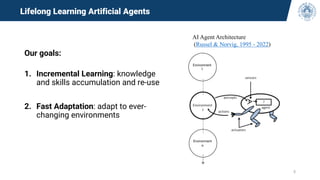
Lifelong Learning Artificial Agents
Our goals:
1. Incremental Learning: knowledge
and skills accumulation and re-use
2. Fast Adaptation: adapt to ever-
changing environments
AI Agent Architecture
(Russel & Norvig, 1995 - 2022)
Environment
1
Environment
𝑛
𝑖
6
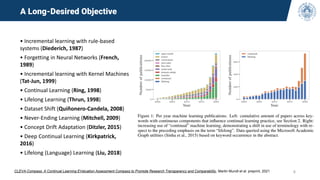
A Long-Desired Objective
• Incremental learning with rule-based
systems (Diederich, 1987)
• Forgetting in Neural Networks (French,
1989)
• Incremental learning with Kernel Machines
(Tat-Jun, 1999)
• Continual Learning (Ring, 1998)
• Lifelong Learning (Thrun, 1998)
• Dataset Shift (Quiñonero-Candela, 2008)
• Never-Ending Learning (Mitchell, 2009)
• Concept Drift Adaptation (Ditzler, 2015)
• Deep Continual Learning (Kirkpatrick,
2016)
• Lifelong (Language) Learning (Liu, 2018)
CLEVA-Compass: A Continual Learning EValuation Assessment Compass to Promote Research Transparency and Comparability, Martin Mundt et al. preprint, 2021
Dealing with Non-Stationary
Environments
“The world is changing and we must change with it" - Ragnar Lothbrok
7
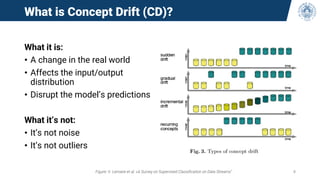
What is Concept Drift (CD)?
What it is:
• A change in the real world
• Affects the input/output
distribution
• Disrupt the model’s predictions
What it’s not:
• It’s not noise
• It’s not outliers
Figure: V. Lemaire et al. «A Survey on Supervised Classification on Data Streams” 8
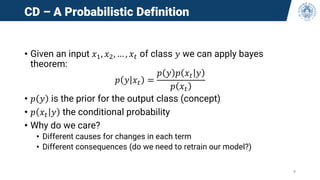
CD – A Probabilistic Definition
• Given an input 𝑥1, 𝑥2, … , 𝑥𝑡 of class 𝑦 we can apply bayes
theorem:
𝑝 𝑦 𝑥𝑡 =
𝑝 𝑦 𝑝 𝑥𝑡 𝑦
𝑝 𝑥𝑡
• 𝑝 𝑦 is the prior for the output class (concept)
• 𝑝 𝑥𝑡 𝑦 the conditional probability
• Why do we care?
• Different causes for changes in each term
• Different consequences (do we need to retrain our model?)
9
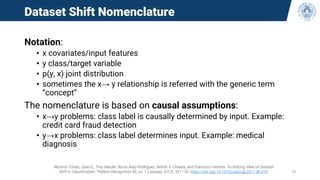
Dataset Shift Nomenclature
Notation:
• x covariates/input features
• y class/target variable
• p(y, x) joint distribution
• sometimes the x→ y relationship is referred with the generic term
“concept“
The nomenclature is based on causal assumptions:
• x→y problems: class label is causally determined by input. Example:
credit card fraud detection
• y→x problems: class label determines input. Example: medical
diagnosis
Moreno-Torres, Jose G., Troy Raeder, Rocío Alaiz-Rodríguez, Nitesh V. Chawla, and Francisco Herrera. “A Unifying View on Dataset
Shift in Classification.” Pattern Recognition 45, no. 1 (January 2012): 521–30. https://doi.org/10.1016/j.patcog.2011.06.019. 10
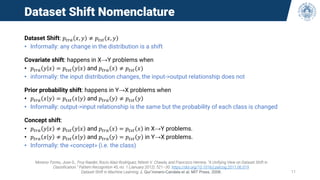
Dataset Shift Nomenclature
Dataset Shift: 𝑝𝑡𝑟𝑎 𝑥, 𝑦 ≠ 𝑝𝑡𝑠𝑡 𝑥, 𝑦
• Informally: any change in the distribution is a shift
Covariate shift: happens in X→Y problems when
• 𝑝𝑡𝑟𝑎 𝑦 𝑥 = 𝑝𝑡𝑠𝑡 𝑦 𝑥 and 𝑝𝑡𝑟𝑎 𝑥 ≠ 𝑝𝑡𝑠𝑡(𝑥)
• informally: the input distribution changes, the input->output relationship does not
Prior probability shift: happens in Y→X problems when
• 𝑝𝑡𝑟𝑎 𝑥 𝑦 = 𝑝𝑡𝑠𝑡 𝑥 𝑦 and 𝑝𝑡𝑟𝑎 𝑦 ≠ 𝑝𝑡𝑠𝑡 𝑦
• Informally: output->input relationship is the same but the probability of each class is changed
Concept shift:
• 𝑝𝑡𝑟𝑎 𝑦 𝑥 ≠ 𝑝𝑡𝑠𝑡 𝑦 𝑥 and 𝑝𝑡𝑟𝑎 𝑥 = 𝑝𝑡𝑠𝑡 𝑥 in X→Y problems.
• 𝑝𝑡𝑟𝑎 𝑥 𝑦 ≠ 𝑝𝑡𝑠𝑡 𝑥 𝑦 and 𝑝𝑡𝑟𝑎 𝑦 = 𝑝𝑡𝑠𝑡 𝑦 in Y→X problems.
• Informally: the «concept» (i.e. the class)
Moreno-Torres, Jose G., Troy Raeder, Rocío Alaiz-Rodríguez, Nitesh V. Chawla, and Francisco Herrera. “A Unifying View on Dataset Shift in
Classification.” Pattern Recognition 45, no. 1 (January 2012): 521–30. https://doi.org/10.1016/j.patcog.2011.06.019.
Dataset Shift in Machine Learning, J. Qui˜nonero-Candela et al. MIT Press, 2008. 11
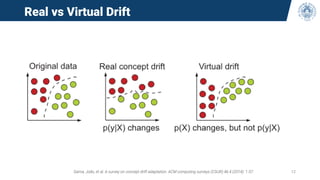
Real vs Virtual Drift
Gama, João, et al. A survey on concept drift adaptation. ACM computing surveys (CSUR) 46.4 (2014): 1-37. 12
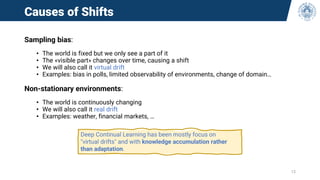
Causes of Shifts
Sampling bias:
• The world is fixed but we only see a part of it
• The «visible part» changes over time, causing a shift
• We will also call it virtual drift
• Examples: bias in polls, limited observability of environments, change of domain…
Non-stationary environments:
• The world is continuously changing
• We will also call it real drift
• Examples: weather, financial markets, …
13
Deep Continual Learning has been mostly focus on
"virtual drifts" and with knowledge accumulation rather
than adaptation.
Controlled Forgetting: Targeted Stimulation and Dopaminergic Plasticity Modulation for Unsupervised Lifelong Learning in Spiking Neural Networks 14
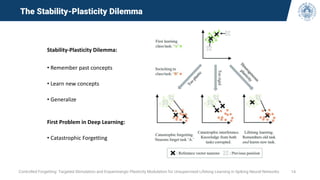
The Stability-Plasticity Dilemma
Stability-Plasticity Dilemma:
• Remember past concepts
• Learn new concepts
• Generalize
First Problem in Deep Learning:
• Catastrophic Forgetting
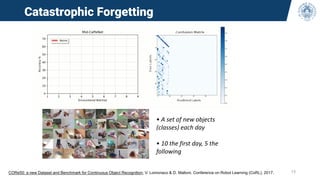
Catastrophic Forgetting
15
CORe50: a new Dataset and Benchmark for Continuous Object Recognition, V. Lomonaco & D. Maltoni. Conference on Robot Learning (CoRL), 2017.
• A set of new objects
(classes) each day
• 10 the first day, 5 the
following
Deep Continual Learning
Definition, Objectives, Desiderata
16
17
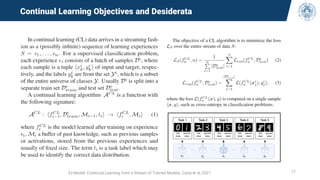
Continual Learning Objectives and Desiderata
Ex-Model: Continual Learning from a Stream of Trained Models, Carta et al, 2021.
18
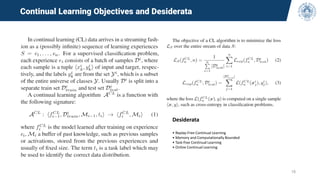
Continual Learning Objectives and Desiderata
Desiderata
• Replay-Free Continual Learning
• Memory and Computationally Bounded
• Task-free Continual Learning
• Online Continual Learning
Continual Learning
Approaches
19
20
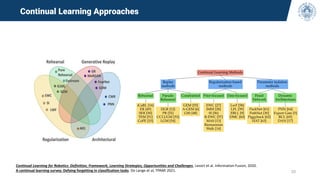
Continual Learning Approaches
Continual Learning for Robotics: Definition, Framework, Learning Strategies, Opportunities and Challenges, Lesort et al. Information Fusion, 2020.
A continual learning survey: Defying forgetting in classification tasks. De Lange et al, TPAMI 2021.
21
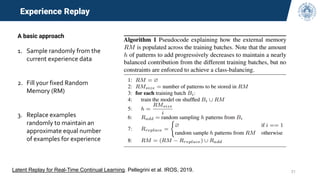
Experience Replay
A basic approach
1. Sample randomly from the
current experience data
2. Fill your fixed Random
Memory (RM)
3. Replace examples
randomly to maintain an
approximate equal number
of examples for experience
Latent Replay for Real-Time Continual Learning. Pellegrini et al. IROS, 2019.
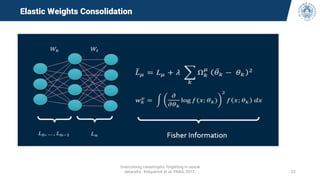
Overcoming catastrophic forgetting in neural
networks, Kirkpatrick et al. PNAS, 2017. 22
Elastic Weights Consolidation
Continual Learning
Benchmarks
Datasets, Scenarios and Evaluation metrics
23
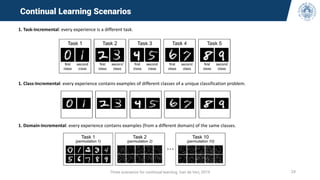
Three scenarios for continual learning, Van de Ven, 2019 24
Continual Learning Scenarios
1. Task-Incremental: every experience is a different task.
1. Class-Incremental: every experience contains examples of different classes of a unique classification problem.
1. Domain-Incremental: every experience contains examples (from a different domain) of the same classes.
25
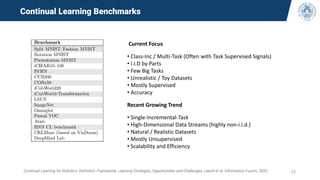
Continual Learning Benchmarks
Current Focus
• Class-Inc / Multi-Task (Often with Task Supervised Signals)
• I.I.D by Parts
• Few Big Tasks
• Unrealistic / Toy Datasets
• Mostly Supervised
• Accuracy
Recent Growing Trend
• Single-Incremental-Task
• High-Dimensional Data Streams (highly non-i.i.d.)
• Natural / Realistic Datasets
• Mostly Unsupervised
• Scalability and Efficiency
Continual Learning for Robotics: Definition, Framework, Learning Strategies, Opportunities and Challenges, Lesort et al. Information Fusion, 2020.
26
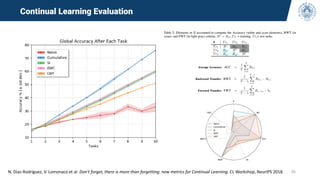
Continual Learning Evaluation
N. Díaz-Rodríguez, V. Lomonaco et al. Don't forget, there is more than forgetting: new metrics for Continual Learning. CL Workshop, NeurIPS 2018.
27
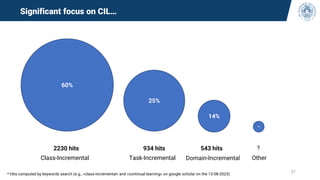
Significant focus on CIL…
60%
25%
14%
1%
2230 hits 934 hits 543 hits ?
Class-Incremental Task-Incremental Domain-Incremental Other
* Hits computed by keywords search (e.g., «class-incremental» and «continual learning» on google scholar on the 13-08-2023)
Is Class-Incremental Enough
For Continual Learning?
Short answer: No
«Is Class-Incremental Enough For Continual Learning?», Cossu et al, Frontiers in CS, 2021 28
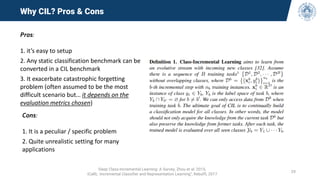
Deep Class-Incremental Learning: A Survey, Zhou et al. 2015,
iCaRL: Incremental Classifier and Representation Learning”, Rebuffi, 2017
29
Why CIL? Pros & Cons
Pros:
1. it’s easy to setup
2. Any static classification benchmark can be
converted in a CIL benchmark
3. It exacerbate catastrophic forgetting
problem (often assumed to be the most
difficult scenario but… it depends on the
evaluation metrics chosen)
Cons:
1. It is a peculiar / specific problem
2. Quite unrealistic setting for many
applications
30
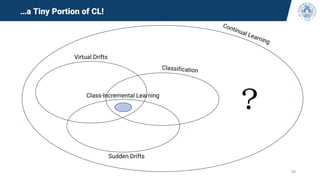
…a Tiny Portion of CL!
Class-Incremental Learning
Virtual Drifts
Sudden Drifts
https://course.continualai.org 31
More on the basics…
https://unconf.continualai.org 32
ContinualAI Unconf: completely free and virtual!
Part 2 – Beyond CIL
Real World Streams
Metrics and Evaluation
Distributed Continual Learning
33
Towards Realistic Streams
Existing benchmarks with natural streams and controllable simulators
• Benchmarks desiderata
• Real drifts and streaming data
• Simulators and synthetic generators
34
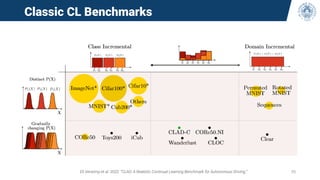
Classic CL Benchmarks
Eli Verwimp et al. 2022. “CLAD: A Realistic Continual Learning Benchmark for Autonomous Driving.” 35
Properties of Real World Streams
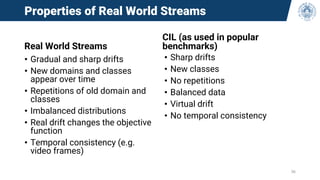
Real World Streams
• Gradual and sharp drifts
• New domains and classes
appear over time
• Repetitions of old domain and
classes
• Imbalanced distributions
• Real drift changes the objective
function
• Temporal consistency (e.g.
video frames)
CIL (as used in popular
benchmarks)
• Sharp drifts
• New classes
• No repetitions
• Balanced data
• Virtual drift
• No temporal consistency
36
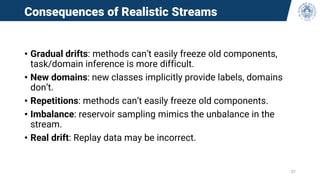
Consequences of Realistic Streams
• Gradual drifts: methods can’t easily freeze old components,
task/domain inference is more difficult.
• New domains: new classes implicitly provide labels, domains
don’t.
• Repetitions: methods can’t easily freeze old components.
• Imbalance: reservoir sampling mimics the unbalance in the
stream.
• Real drift: Replay data may be incorrect.
37
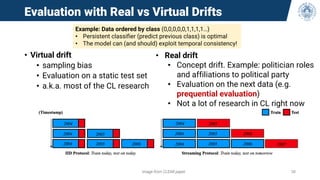
Evaluation with Real vs Virtual Drifts
• Virtual drift
• sampling bias
• Evaluation on a static test set
• a.k.a. most of the CL research
Image from CLEAR paper 38
• Real drift
• Concept drift. Example: politician roles
and affiliations to political party
• Evaluation on the next data (e.g.
prequential evaluation)
• Not a lot of research in CL right now
Example: Data ordered by class (0,0,0,0,0,1,1,1,1…)
• Persistent classifier (predict previous class) is optimal
• The model can (and should) exploit temporal consistency!
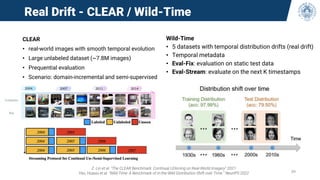
Real Drift - CLEAR / Wild-Time
CLEAR
• real-world images with smooth temporal evolution
• Large unlabeled dataset (~7.8M images)
• Prequential evaluation
• Scenario: domain-incremental and semi-supervised
Z. Lin et al. “The CLEAR Benchmark: Continual LEArning on Real-World Imagery” 2021
Yao, Huaxiu et al. “Wild-Time: A Benchmark of in-the-Wild Distribution Shift over Time.” NeurIPS 2022 39
Wild-Time
• 5 datasets with temporal distribution drifts (real drift)
• Temporal metadata
• Eval-Fix: evaluation on static test data
• Eval-Stream: evaluate on the next K timestamps
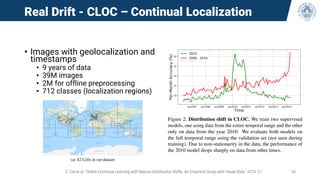
Real Drift - CLOC – Continual Localization
• Images with geolocalization and
timestamps
• 9 years of data
• 39M images
• 2M for offline preprocessing
• 712 classes (localization regions)
Z. Cai et al. “Online Continual Learning with Natural Distribution Shifts: An Empirical Study with Visual Data.” ICCV ‘21 40
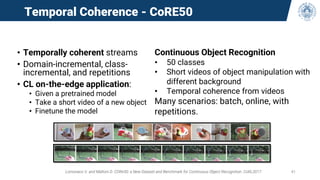
Temporal Coherence - CoRE50
• Temporally coherent streams
• Domain-incremental, class-
incremental, and repetitions
• CL on-the-edge application:
• Given a pretrained model
• Take a short video of a new object
• Finetune the model
Lomonaco V. and Maltoni D. CORe50: a New Dataset and Benchmark for Continuous Object Recognition. CoRL2017. 41
Continuous Object Recognition
• 50 classes
• Short videos of object manipulation with
different background
• Temporal coherence from videos
Many scenarios: batch, online, with
repetitions.
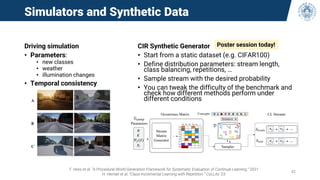
Simulators and Synthetic Data
Driving simulation
• Parameters:
• new classes
• weather
• illumination changes
• Temporal consistency
T. Hess et al. “A Procedural World Generation Framework for Systematic Evaluation of Continual Learning.” 2021
H. Hemati et al. “Class-Incremental Learning with Repetition.” CoLLAs ‘23
42
CIR Synthetic Generator
• Start from a static dataset (e.g. CIFAR100)
• Define distribution parameters: stream length,
class balancing, repetitions, …
• Sample stream with the desired probability
• You can tweak the difficulty of the benchmark and
check how different methods perform under
different conditions
Poster session today!
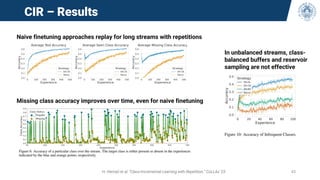
CIR – Results
H. Hemati et al. “Class-Incremental Learning with Repetition.” CoLLAs ‘23 43
Missing class accuracy improves over time, even for naive finetuning
Naive finetuning approaches replay for long streams with repetitions
In unbalanced streams, class-
balanced buffers and reservoir
sampling are not effective
Recap
• Benchmarks desiderata: gradual drifts, new domains and
classes, repetitions, temporal coherence, real drift
• Real drifts: Wild-Time, CLEAR, CLOC. Prequential evaluation for
real drifts
• Streaming data: CoRE50 (and many others)
• Simulators and synthetic generators: allow to control drift and
evaluate over many different configurations
44
Metrics and Evaluation in
Online CL
Metrics for online continual learning: cumulative accuracy, continual stability, linear
probing
Results in online continual learning
Continual hyperparameter selection and robustness
45
Online CL (OCL)
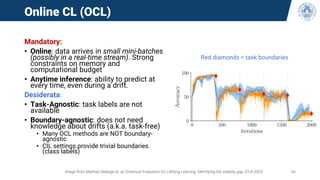
Mandatory:
• Online: data arrives in small mini-batches
(possibly in a real-time stream). Strong
constraints on memory and
computational budget
• Anytime inference: ability to predict at
every time, even during a drift.
Desiderata:
• Task-Agnostic: task labels are not
available
• Boundary-agnostic: does not need
knowledge about drifts (a.k.a. task-free)
• Many OCL methods are NOT boundary-
agnostic
• CIL settings provide trivial boundaries
(class labels)
Image from Mathias Delange et. al, Continual Evaluation for Lifelong Learning: Identifying the stability gap, ICLR 2023 46
Red diamonds = task boundaries
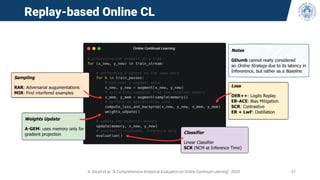
Replay-based Online CL
A. Soutif et al. “A Comprehensive Empirical Evaluation on Online Continual Learning“ 2023 47
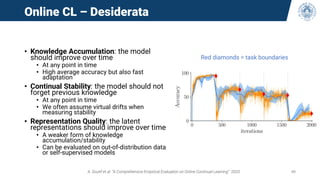
Online CL – Desiderata
• Knowledge Accumulation: the model
should improve over time
• At any point in time
• High average accuracy but also fast
adaptation
• Continual Stability: the model should not
forget previous knowledge
• At any point in time
• We often assume virtual drifts when
measuring stability
• Representation Quality: the latent
representations should improve over time
• A weaker form of knowledge
accumulation/stability
• Can be evaluated on out-of-distribution data
or self-supervised models
A. Soutif et al. “A Comprehensive Empirical Evaluation on Online Continual Learning“ 2023 48
Red diamonds = task boundaries
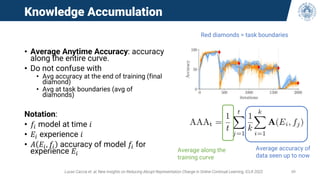
Knowledge Accumulation
• Average Anytime Accuracy: accuracy
along the entire curve.
• Do not confuse with
• Avg accuracy at the end of training (final
diamond)
• Avg at task boundaries (avg of
diamonds)
Notation:
• 𝑓𝑖 model at time 𝑖
• 𝐸𝑖 experience 𝑖
• 𝐴 𝐸𝑖, 𝑓𝑖 accuracy of model 𝑓𝑖 for
experience 𝐸𝑖
Lucas Caccia et. al, New Insights on Reducing Abrupt Representation Change in Online Continual Learning, ICLR 2022 49
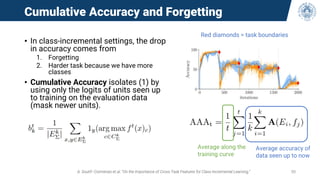
Red diamonds = task boundaries
Average accuracy of
data seen up to now
Average along the
training curve
Cumulative Accuracy and Forgetting
• In class-incremental settings, the drop
in accuracy comes from
1. Forgetting
2. Harder task because we have more
classes
• Cumulative Accuracy isolates (1) by
using only the logits of units seen up
to training on the evaluation data
(mask newer units).
A. Soutif–Cormerais et al. “On the Importance of Cross-Task Features for Class-Incremental Learning,” 50
Red diamonds = task boundaries
Average accuracy of
data seen up to now
Average along the
training curve
Continual Stability
• Observe the behavior of the accuracy during training (curve from one diamond to the next)
• CL methods forget and re-learn old experiences during training
• This phenomenon is masked with the typical metrics measured only at boundaries (red
diamonds)
[1] Mathias Delange et. al, Continual Evaluation for Lifelong Learning: Identifying the stability gap, ICLR 2023
[2] Lucas Caccia et. al, New Insights on Reducing Abrupt Representation Change in Online Continual Learning, ICLR 2022 51
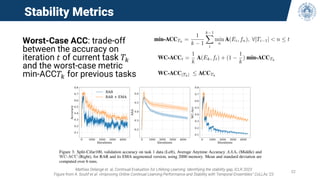
Stability Metrics
Worst-Case ACC: trade-off
between the accuracy on
iteration 𝑡 of current task 𝑇𝑘
and the worst-case metric
min-ACC𝑇𝑘 for previous tasks
Mathias Delange et. al, Continual Evaluation for Lifelong Learning: Identifying the stability gap, ICLR 2023
Figure from A. Soutif et al. «Improving Online Continual Learning Performance and Stability with Temporal Ensembles” CoLLAs ’23
52
Knowledge Accumulation and Linear Probing
• Forgetting may result from a misaligned classifier
• Easy to fix (e.g. finetune only the linear classifier on replay
buffer) if the representations are good
• Linear probing measures the quality of the representation
• Train linear classifier with the current feature extractor using replay
data
• Evaluate the accuracy of the classifier
• useful for continual self-supervised models and continual
pretraining
53
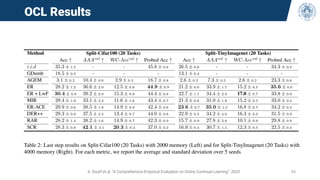
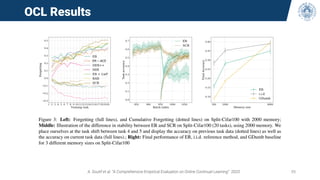
OCL Results
A. Soutif et al. “A Comprehensive Empirical Evaluation on Online Continual Learning“ 2023 54
OCL Results
A. Soutif et al. “A Comprehensive Empirical Evaluation on Online Continual Learning“ 2023 55
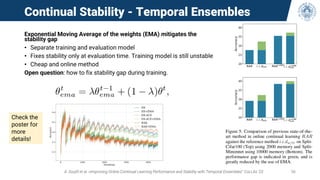
Continual Stability - Temporal Ensembles
Exponential Moving Average of the weights (EMA) mitigates the
stability gap
• Separate training and evaluation model
• Fixes stability only at evaluation time. Training model is still unstable
• Cheap and online method
Open question: how to fix stability gap during training.
56
A. Soutif et al. «Improving Online Continual Learning Performance and Stability with Temporal Ensembles” CoLLAs ’23
Check the
poster for
more
details!
Continual Hyperparameter Selection
• Most researchers perform a full
hyperparameter selection on the entire
validation stream.
• It’s not a CL method and it’s suboptimal
because optimal parameters may vary over
time
• Some methods are quite sensitive to
hyperparameters (e.g. EWC)
Existing methods:
• [1] finds optimal stability-plasticity tradeoff
at each step. Assumes that a single
hyperparameter controls the tradeoff
monotonically (e.g. regularization strength)
• [2] uses reinforcement learning to find
optimal parameters. Online RL (bandit)
• [3] uses only the first part of the validation
stream
[1] M. De Lange et al. “A Continual Learning Survey: Defying Forgetting in Classification Tasks.” TPAMI 2022
[2] Y. Liu et al. “Online Hyperparameter Optimization for Class-Incremental Learning.” AAAI ’23
[3] A. Chaudhry et al. “Efficient Lifelong Learning with A-GEM.” 2019
57
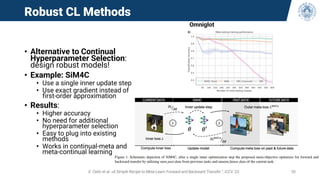
Robust CL Methods
• Alternative to Continual
Hyperparameter Selection:
design robust models!
• Example: SiM4C
• Use a single inner update step
• Use exact gradient instead of
first-order approximation
• Results:
• Higher accuracy
• No need for additional
hyperparameter selection
• Easy to plug into existing
methods
• Works in continual-meta and
meta-continual learning
E. Cetin et al. «A Simple Recipe to Meta-Learn Forward and Backward Transfer “, ICCV ‘23 58
Omniglot
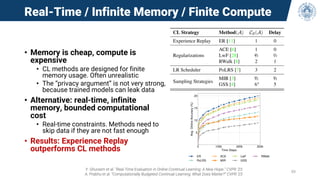
Real-Time / Infinite Memory / Finite Compute
• Memory is cheap, compute is
expensive
• CL methods are designed for finite
memory usage. Often unrealistic
• The “privacy argument” is not very strong,
because trained models can leak data
• Alternative: real-time, infinite
memory, bounded computational
cost
• Real-time constraints. Methods need to
skip data if they are not fast enough
• Results: Experience Replay
outperforms CL methods
Y. Ghunaim et al. “Real-Time Evaluation in Online Continual Learning: A New Hope.” CVPR ’23
A. Prabhu et al. “Computationally Budgeted Continual Learning: What Does Matter?” CVPR ‘23
59
Conclusion
Unsolved CL questions:
• Continual stability
• Robustness to stream parameters
• Continual hyperparameter selection (and robustness)
• Compute-bounded continual learning
60
Beyond Single CL Agents
Continual pretraining
Distributed continual agents
61
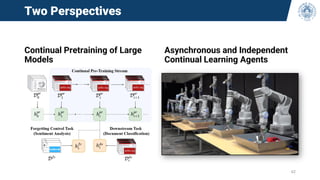
Two Perspectives
Continual Pretraining of Large
Models
Asynchronous and Independent
Continual Learning Agents
62
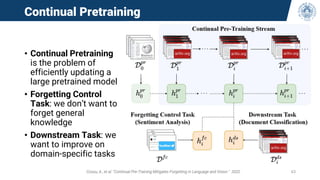
Continual Pretraining
• Continual Pretraining
is the problem of
efficiently updating a
large pretrained model
• Forgetting Control
Task: we don’t want to
forget general
knowledge
• Downstream Task: we
want to improve on
domain-specific tasks
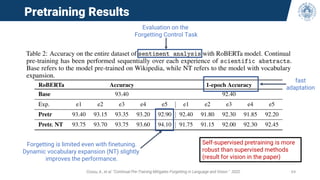
Cossu, A., et al. "Continual Pre-Training Mitigates Forgetting in Language and Vision." 2022. 63
Pretraining Results
Cossu, A., et al. "Continual Pre-Training Mitigates Forgetting in Language and Vision." 2022. 64
Evaluation on the
Forgetting Control Task
Forgetting is limited even with finetuning.
Dynamic vocabulary expansion (NT) slightly
improves the performance.
fast
adaptation
Self-supervised pretraining is more
robust than supervised methods
(result for vision in the paper)
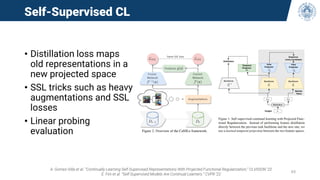
Self-Supervised CL
• Distillation loss maps
old representations in a
new projected space
• SSL tricks such as heavy
augmentations and SSL
losses
• Linear probing
evaluation
A. Gomez-Villa et al. “Continually Learning Self-Supervised Representations With Projected Functional Regularization,” CLVISION ‘22
E. Fini et al. “Self-Supervised Models Are Continual Learners.” CVPR ‘22
65
Continual Federated Learning
[1] G. Legate et al. “Re-Weighted Softmax Cross-Entropy to Control Forgetting in Federated Learning.” CoLLAs ‘23 66
• FL methods fail in simple heterogeneous settings.
• Local forgetting happens in heterogeneous FL if the local models are not aggregated often
enough, resulting in a local drift and forgetting of the global knowledge.
Open question: can continual learning improve federated learning in heterogeneous settings?
• [1] proposes WSM loss, a weighted cross-entropy to mitigate this problem
Not my paper,
But this is also
a CoLLas paper
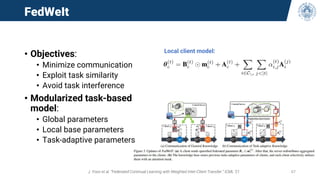
FedWeIt
• Objectives:
• Minimize communication
• Exploit task similarity
• Avoid task interference
• Modularized task-based
model:
• Global parameters
• Local base parameters
• Task-adaptive parameters
J. Yoon et al. “Federated Continual Learning with Weighted Inter-Client Transfer.” ICML ‘21 67
Local client model:
Ex-Model CL
• Model aggregation is the critical
missing component in
heterogeneous FL!
• We know how to train the local
model (continual learning)
• We know how to aggregate
homogeneous models as long as
the aggregation is frequent
enough (homogeneous federated
learning)
• If we can aggregate independent
models (Ex-Model CL)
• we can train on multiple tasks in
parallel
• Without frequent synchnonous
aggregations
• Allows decentralized training
• related to model patching [1]
A. Carta. “Ex-Model: Continual Learning From a Stream of Trained Models,” CLVISION ‘22
[1] Raffel, Colin. “Building Machine Learning Models Like Open Source Software.” Communications of the ACM 2023 68
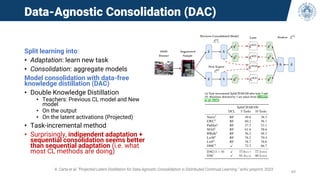
Data-Agnostic Consolidation (DAC)
Split learning into:
• Adaptation: learn new task
• Consolidation: aggregate models
Model consolidation with data-free
knowledge distillation (DAC)
• Double Knowledge Distillation
• Teachers: Previous CL model and New
model
• On the output
• On the latent activations (Projected)
• Task-incremental method
• Surprisingly, indipendent adaptation +
sequential consolidation seems better
than sequential adaptation (i.e. what
most CL methods are doing)
A. Carta et al. “Projected Latent Distillation for Data-Agnostic Consolidation in Distributed Continual Learning.” arXiv preprint, 2023
69
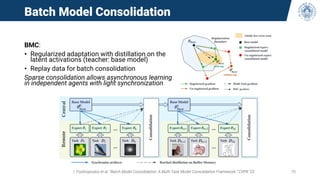
Batch Model Consolidation
BMC:
• Regularized adaptation with distillation on the
latent activations (teacher: base model)
• Replay data for batch consolidation
Sparse consolidation allows asynchronous learning
in independent agents with light synchronization
I. Fostiropoulos et al. “Batch Model Consolidation: A Multi-Task Model Consolidation Framework.” CVPR ‘23 70
Conclusion
71
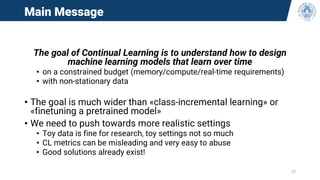
Main Message
The goal of Continual Learning is to understand how to design
machine learning models that learn over time
• on a constrained budget (memory/compute/real-time requirements)
• with non-stationary data
• The goal is much wider than «class-incremental learning» or
«finetuning a pretrained model»
• We need to push towards more realistic settings
• Toy data is fine for research, toy settings not so much
• CL metrics can be misleading and very easy to abuse
• Good solutions already exist!
72
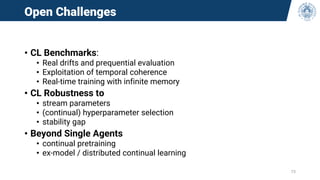
Open Challenges
• CL Benchmarks:
• Real drifts and prequential evaluation
• Exploitation of temporal coherence
• Real-time training with infinite memory
• CL Robustness to
• stream parameters
• (continual) hyperparameter selection
• stability gap
• Beyond Single Agents
• continual pretraining
• ex-model / distributed continual learning
73
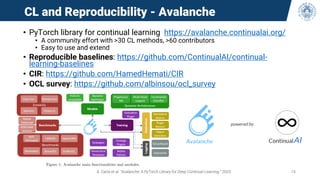
CL and Reproducibility - Avalanche
• PyTorch library for continual learning https://avalanche.continualai.org/
• A community effort with >30 CL methods, >60 contributors
• Easy to use and extend
• Reproducible baselines: https://github.com/ContinualAI/continual-
learning-baselines
• CIR: https://github.com/HamedHemati/CIR
• OCL survey: https://github.com/albinsou/ocl_survey
A. Carta et al. “Avalanche: A PyTorch Library for Deep Continual Learning.” 2023 74

2023-08-22 CoLLAs Tutorial - Beyond CIL.pdf

  • 1.
    Antonio Carta antonio.carta@unipi.it Continual LearningBeyond Catastrophic Forgetting in Class-Incremental Scenarios CoLLAs 2023 Tutorial Vincenzo Lomonaco University of Pisa, ContinualAI vincenzo.lomonaco@unipi.it Antonio Carta University of Pisa Antonio.carta@unipi.it
  • 2.
  • 3.
  • 4.
    Part I Deep ContinualLearning Fundamental concepts and current focus 4
  • 5.
    5 Lifelong Learning ArtificialAgents Our goals: 1. Incremental Learning: knowledge and skills accumulation and re-use 2. Fast Adaptation: adapt to ever- changing environments AI Agent Architecture (Russel & Norvig, 1995 - 2022) Environment 1 Environment 𝑛 𝑖
  • 6.
    6 A Long-Desired Objective •Incremental learning with rule-based systems (Diederich, 1987) • Forgetting in Neural Networks (French, 1989) • Incremental learning with Kernel Machines (Tat-Jun, 1999) • Continual Learning (Ring, 1998) • Lifelong Learning (Thrun, 1998) • Dataset Shift (Quiñonero-Candela, 2008) • Never-Ending Learning (Mitchell, 2009) • Concept Drift Adaptation (Ditzler, 2015) • Deep Continual Learning (Kirkpatrick, 2016) • Lifelong (Language) Learning (Liu, 2018) CLEVA-Compass: A Continual Learning EValuation Assessment Compass to Promote Research Transparency and Comparability, Martin Mundt et al. preprint, 2021
  • 7.
    Dealing with Non-Stationary Environments “Theworld is changing and we must change with it" - Ragnar Lothbrok 7
  • 8.
    What is ConceptDrift (CD)? What it is: • A change in the real world • Affects the input/output distribution • Disrupt the model’s predictions What it’s not: • It’s not noise • It’s not outliers Figure: V. Lemaire et al. «A Survey on Supervised Classification on Data Streams” 8
  • 9.
    CD – AProbabilistic Definition • Given an input 𝑥1, 𝑥2, … , 𝑥𝑡 of class 𝑦 we can apply bayes theorem: 𝑝 𝑦 𝑥𝑡 = 𝑝 𝑦 𝑝 𝑥𝑡 𝑦 𝑝 𝑥𝑡 • 𝑝 𝑦 is the prior for the output class (concept) • 𝑝 𝑥𝑡 𝑦 the conditional probability • Why do we care? • Different causes for changes in each term • Different consequences (do we need to retrain our model?) 9
  • 10.
    Dataset Shift Nomenclature Notation: •x covariates/input features • y class/target variable • p(y, x) joint distribution • sometimes the x→ y relationship is referred with the generic term “concept“ The nomenclature is based on causal assumptions: • x→y problems: class label is causally determined by input. Example: credit card fraud detection • y→x problems: class label determines input. Example: medical diagnosis Moreno-Torres, Jose G., Troy Raeder, Rocío Alaiz-Rodríguez, Nitesh V. Chawla, and Francisco Herrera. “A Unifying View on Dataset Shift in Classification.” Pattern Recognition 45, no. 1 (January 2012): 521–30. https://doi.org/10.1016/j.patcog.2011.06.019. 10
  • 11.
    Dataset Shift Nomenclature DatasetShift: 𝑝𝑡𝑟𝑎 𝑥, 𝑦 ≠ 𝑝𝑡𝑠𝑡 𝑥, 𝑦 • Informally: any change in the distribution is a shift Covariate shift: happens in X→Y problems when • 𝑝𝑡𝑟𝑎 𝑦 𝑥 = 𝑝𝑡𝑠𝑡 𝑦 𝑥 and 𝑝𝑡𝑟𝑎 𝑥 ≠ 𝑝𝑡𝑠𝑡(𝑥) • informally: the input distribution changes, the input->output relationship does not Prior probability shift: happens in Y→X problems when • 𝑝𝑡𝑟𝑎 𝑥 𝑦 = 𝑝𝑡𝑠𝑡 𝑥 𝑦 and 𝑝𝑡𝑟𝑎 𝑦 ≠ 𝑝𝑡𝑠𝑡 𝑦 • Informally: output->input relationship is the same but the probability of each class is changed Concept shift: • 𝑝𝑡𝑟𝑎 𝑦 𝑥 ≠ 𝑝𝑡𝑠𝑡 𝑦 𝑥 and 𝑝𝑡𝑟𝑎 𝑥 = 𝑝𝑡𝑠𝑡 𝑥 in X→Y problems. • 𝑝𝑡𝑟𝑎 𝑥 𝑦 ≠ 𝑝𝑡𝑠𝑡 𝑥 𝑦 and 𝑝𝑡𝑟𝑎 𝑦 = 𝑝𝑡𝑠𝑡 𝑦 in Y→X problems. • Informally: the «concept» (i.e. the class) Moreno-Torres, Jose G., Troy Raeder, Rocío Alaiz-Rodríguez, Nitesh V. Chawla, and Francisco Herrera. “A Unifying View on Dataset Shift in Classification.” Pattern Recognition 45, no. 1 (January 2012): 521–30. https://doi.org/10.1016/j.patcog.2011.06.019. Dataset Shift in Machine Learning, J. Qui˜nonero-Candela et al. MIT Press, 2008. 11
  • 12.
    Real vs VirtualDrift Gama, João, et al. A survey on concept drift adaptation. ACM computing surveys (CSUR) 46.4 (2014): 1-37. 12
  • 13.
    Causes of Shifts Samplingbias: • The world is fixed but we only see a part of it • The «visible part» changes over time, causing a shift • We will also call it virtual drift • Examples: bias in polls, limited observability of environments, change of domain… Non-stationary environments: • The world is continuously changing • We will also call it real drift • Examples: weather, financial markets, … 13 Deep Continual Learning has been mostly focus on "virtual drifts" and with knowledge accumulation rather than adaptation.
  • 14.
    Controlled Forgetting: TargetedStimulation and Dopaminergic Plasticity Modulation for Unsupervised Lifelong Learning in Spiking Neural Networks 14 The Stability-Plasticity Dilemma Stability-Plasticity Dilemma: • Remember past concepts • Learn new concepts • Generalize First Problem in Deep Learning: • Catastrophic Forgetting
  • 15.
    Catastrophic Forgetting 15 CORe50: anew Dataset and Benchmark for Continuous Object Recognition, V. Lomonaco & D. Maltoni. Conference on Robot Learning (CoRL), 2017. • A set of new objects (classes) each day • 10 the first day, 5 the following
  • 16.
    Deep Continual Learning Definition,Objectives, Desiderata 16
  • 17.
    17 Continual Learning Objectivesand Desiderata Ex-Model: Continual Learning from a Stream of Trained Models, Carta et al, 2021.
  • 18.
    18 Continual Learning Objectivesand Desiderata Desiderata • Replay-Free Continual Learning • Memory and Computationally Bounded • Task-free Continual Learning • Online Continual Learning
  • 19.
  • 20.
    20 Continual Learning Approaches ContinualLearning for Robotics: Definition, Framework, Learning Strategies, Opportunities and Challenges, Lesort et al. Information Fusion, 2020. A continual learning survey: Defying forgetting in classification tasks. De Lange et al, TPAMI 2021.
  • 21.
    21 Experience Replay A basicapproach 1. Sample randomly from the current experience data 2. Fill your fixed Random Memory (RM) 3. Replace examples randomly to maintain an approximate equal number of examples for experience Latent Replay for Real-Time Continual Learning. Pellegrini et al. IROS, 2019.
  • 22.
    Overcoming catastrophic forgettingin neural networks, Kirkpatrick et al. PNAS, 2017. 22 Elastic Weights Consolidation
  • 23.
  • 24.
    Three scenarios forcontinual learning, Van de Ven, 2019 24 Continual Learning Scenarios 1. Task-Incremental: every experience is a different task. 1. Class-Incremental: every experience contains examples of different classes of a unique classification problem. 1. Domain-Incremental: every experience contains examples (from a different domain) of the same classes.
  • 25.
    25 Continual Learning Benchmarks CurrentFocus • Class-Inc / Multi-Task (Often with Task Supervised Signals) • I.I.D by Parts • Few Big Tasks • Unrealistic / Toy Datasets • Mostly Supervised • Accuracy Recent Growing Trend • Single-Incremental-Task • High-Dimensional Data Streams (highly non-i.i.d.) • Natural / Realistic Datasets • Mostly Unsupervised • Scalability and Efficiency Continual Learning for Robotics: Definition, Framework, Learning Strategies, Opportunities and Challenges, Lesort et al. Information Fusion, 2020.
  • 26.
    26 Continual Learning Evaluation N.Díaz-Rodríguez, V. Lomonaco et al. Don't forget, there is more than forgetting: new metrics for Continual Learning. CL Workshop, NeurIPS 2018.
  • 27.
    27 Significant focus onCIL… 60% 25% 14% 1% 2230 hits 934 hits 543 hits ? Class-Incremental Task-Incremental Domain-Incremental Other * Hits computed by keywords search (e.g., «class-incremental» and «continual learning» on google scholar on the 13-08-2023)
  • 28.
    Is Class-Incremental Enough ForContinual Learning? Short answer: No «Is Class-Incremental Enough For Continual Learning?», Cossu et al, Frontiers in CS, 2021 28
  • 29.
    Deep Class-Incremental Learning:A Survey, Zhou et al. 2015, iCaRL: Incremental Classifier and Representation Learning”, Rebuffi, 2017 29 Why CIL? Pros & Cons Pros: 1. it’s easy to setup 2. Any static classification benchmark can be converted in a CIL benchmark 3. It exacerbate catastrophic forgetting problem (often assumed to be the most difficult scenario but… it depends on the evaluation metrics chosen) Cons: 1. It is a peculiar / specific problem 2. Quite unrealistic setting for many applications
  • 30.
    30 …a Tiny Portionof CL! Class-Incremental Learning Virtual Drifts Sudden Drifts
  • 31.
  • 32.
  • 33.
    Part 2 –Beyond CIL Real World Streams Metrics and Evaluation Distributed Continual Learning 33
  • 34.
    Towards Realistic Streams Existingbenchmarks with natural streams and controllable simulators • Benchmarks desiderata • Real drifts and streaming data • Simulators and synthetic generators 34
  • 35.
    Classic CL Benchmarks EliVerwimp et al. 2022. “CLAD: A Realistic Continual Learning Benchmark for Autonomous Driving.” 35
  • 36.
    Properties of RealWorld Streams Real World Streams • Gradual and sharp drifts • New domains and classes appear over time • Repetitions of old domain and classes • Imbalanced distributions • Real drift changes the objective function • Temporal consistency (e.g. video frames) CIL (as used in popular benchmarks) • Sharp drifts • New classes • No repetitions • Balanced data • Virtual drift • No temporal consistency 36
  • 37.
    Consequences of RealisticStreams • Gradual drifts: methods can’t easily freeze old components, task/domain inference is more difficult. • New domains: new classes implicitly provide labels, domains don’t. • Repetitions: methods can’t easily freeze old components. • Imbalance: reservoir sampling mimics the unbalance in the stream. • Real drift: Replay data may be incorrect. 37
  • 38.
    Evaluation with Realvs Virtual Drifts • Virtual drift • sampling bias • Evaluation on a static test set • a.k.a. most of the CL research Image from CLEAR paper 38 • Real drift • Concept drift. Example: politician roles and affiliations to political party • Evaluation on the next data (e.g. prequential evaluation) • Not a lot of research in CL right now Example: Data ordered by class (0,0,0,0,0,1,1,1,1…) • Persistent classifier (predict previous class) is optimal • The model can (and should) exploit temporal consistency!
  • 39.
    Real Drift -CLEAR / Wild-Time CLEAR • real-world images with smooth temporal evolution • Large unlabeled dataset (~7.8M images) • Prequential evaluation • Scenario: domain-incremental and semi-supervised Z. Lin et al. “The CLEAR Benchmark: Continual LEArning on Real-World Imagery” 2021 Yao, Huaxiu et al. “Wild-Time: A Benchmark of in-the-Wild Distribution Shift over Time.” NeurIPS 2022 39 Wild-Time • 5 datasets with temporal distribution drifts (real drift) • Temporal metadata • Eval-Fix: evaluation on static test data • Eval-Stream: evaluate on the next K timestamps
  • 40.
    Real Drift -CLOC – Continual Localization • Images with geolocalization and timestamps • 9 years of data • 39M images • 2M for offline preprocessing • 712 classes (localization regions) Z. Cai et al. “Online Continual Learning with Natural Distribution Shifts: An Empirical Study with Visual Data.” ICCV ‘21 40
  • 41.
    Temporal Coherence -CoRE50 • Temporally coherent streams • Domain-incremental, class- incremental, and repetitions • CL on-the-edge application: • Given a pretrained model • Take a short video of a new object • Finetune the model Lomonaco V. and Maltoni D. CORe50: a New Dataset and Benchmark for Continuous Object Recognition. CoRL2017. 41 Continuous Object Recognition • 50 classes • Short videos of object manipulation with different background • Temporal coherence from videos Many scenarios: batch, online, with repetitions.
  • 42.
    Simulators and SyntheticData Driving simulation • Parameters: • new classes • weather • illumination changes • Temporal consistency T. Hess et al. “A Procedural World Generation Framework for Systematic Evaluation of Continual Learning.” 2021 H. Hemati et al. “Class-Incremental Learning with Repetition.” CoLLAs ‘23 42 CIR Synthetic Generator • Start from a static dataset (e.g. CIFAR100) • Define distribution parameters: stream length, class balancing, repetitions, … • Sample stream with the desired probability • You can tweak the difficulty of the benchmark and check how different methods perform under different conditions Poster session today!
  • 43.
    CIR – Results H.Hemati et al. “Class-Incremental Learning with Repetition.” CoLLAs ‘23 43 Missing class accuracy improves over time, even for naive finetuning Naive finetuning approaches replay for long streams with repetitions In unbalanced streams, class- balanced buffers and reservoir sampling are not effective
  • 44.
    Recap • Benchmarks desiderata:gradual drifts, new domains and classes, repetitions, temporal coherence, real drift • Real drifts: Wild-Time, CLEAR, CLOC. Prequential evaluation for real drifts • Streaming data: CoRE50 (and many others) • Simulators and synthetic generators: allow to control drift and evaluate over many different configurations 44
  • 45.
    Metrics and Evaluationin Online CL Metrics for online continual learning: cumulative accuracy, continual stability, linear probing Results in online continual learning Continual hyperparameter selection and robustness 45
  • 46.
    Online CL (OCL) Mandatory: •Online: data arrives in small mini-batches (possibly in a real-time stream). Strong constraints on memory and computational budget • Anytime inference: ability to predict at every time, even during a drift. Desiderata: • Task-Agnostic: task labels are not available • Boundary-agnostic: does not need knowledge about drifts (a.k.a. task-free) • Many OCL methods are NOT boundary- agnostic • CIL settings provide trivial boundaries (class labels) Image from Mathias Delange et. al, Continual Evaluation for Lifelong Learning: Identifying the stability gap, ICLR 2023 46 Red diamonds = task boundaries
  • 47.
    Replay-based Online CL A.Soutif et al. “A Comprehensive Empirical Evaluation on Online Continual Learning“ 2023 47
  • 48.
    Online CL –Desiderata • Knowledge Accumulation: the model should improve over time • At any point in time • High average accuracy but also fast adaptation • Continual Stability: the model should not forget previous knowledge • At any point in time • We often assume virtual drifts when measuring stability • Representation Quality: the latent representations should improve over time • A weaker form of knowledge accumulation/stability • Can be evaluated on out-of-distribution data or self-supervised models A. Soutif et al. “A Comprehensive Empirical Evaluation on Online Continual Learning“ 2023 48 Red diamonds = task boundaries
  • 49.
    Knowledge Accumulation • AverageAnytime Accuracy: accuracy along the entire curve. • Do not confuse with • Avg accuracy at the end of training (final diamond) • Avg at task boundaries (avg of diamonds) Notation: • 𝑓𝑖 model at time 𝑖 • 𝐸𝑖 experience 𝑖 • 𝐴 𝐸𝑖, 𝑓𝑖 accuracy of model 𝑓𝑖 for experience 𝐸𝑖 Lucas Caccia et. al, New Insights on Reducing Abrupt Representation Change in Online Continual Learning, ICLR 2022 49 Red diamonds = task boundaries Average accuracy of data seen up to now Average along the training curve
  • 50.
    Cumulative Accuracy andForgetting • In class-incremental settings, the drop in accuracy comes from 1. Forgetting 2. Harder task because we have more classes • Cumulative Accuracy isolates (1) by using only the logits of units seen up to training on the evaluation data (mask newer units). A. Soutif–Cormerais et al. “On the Importance of Cross-Task Features for Class-Incremental Learning,” 50 Red diamonds = task boundaries Average accuracy of data seen up to now Average along the training curve
  • 51.
    Continual Stability • Observethe behavior of the accuracy during training (curve from one diamond to the next) • CL methods forget and re-learn old experiences during training • This phenomenon is masked with the typical metrics measured only at boundaries (red diamonds) [1] Mathias Delange et. al, Continual Evaluation for Lifelong Learning: Identifying the stability gap, ICLR 2023 [2] Lucas Caccia et. al, New Insights on Reducing Abrupt Representation Change in Online Continual Learning, ICLR 2022 51
  • 52.
    Stability Metrics Worst-Case ACC:trade-off between the accuracy on iteration 𝑡 of current task 𝑇𝑘 and the worst-case metric min-ACC𝑇𝑘 for previous tasks Mathias Delange et. al, Continual Evaluation for Lifelong Learning: Identifying the stability gap, ICLR 2023 Figure from A. Soutif et al. «Improving Online Continual Learning Performance and Stability with Temporal Ensembles” CoLLAs ’23 52
  • 53.
    Knowledge Accumulation andLinear Probing • Forgetting may result from a misaligned classifier • Easy to fix (e.g. finetune only the linear classifier on replay buffer) if the representations are good • Linear probing measures the quality of the representation • Train linear classifier with the current feature extractor using replay data • Evaluate the accuracy of the classifier • useful for continual self-supervised models and continual pretraining 53
  • 54.
    OCL Results A. Soutifet al. “A Comprehensive Empirical Evaluation on Online Continual Learning“ 2023 54
  • 55.
    OCL Results A. Soutifet al. “A Comprehensive Empirical Evaluation on Online Continual Learning“ 2023 55
  • 56.
    Continual Stability -Temporal Ensembles Exponential Moving Average of the weights (EMA) mitigates the stability gap • Separate training and evaluation model • Fixes stability only at evaluation time. Training model is still unstable • Cheap and online method Open question: how to fix stability gap during training. 56 A. Soutif et al. «Improving Online Continual Learning Performance and Stability with Temporal Ensembles” CoLLAs ’23 Check the poster for more details!
  • 57.
    Continual Hyperparameter Selection •Most researchers perform a full hyperparameter selection on the entire validation stream. • It’s not a CL method and it’s suboptimal because optimal parameters may vary over time • Some methods are quite sensitive to hyperparameters (e.g. EWC) Existing methods: • [1] finds optimal stability-plasticity tradeoff at each step. Assumes that a single hyperparameter controls the tradeoff monotonically (e.g. regularization strength) • [2] uses reinforcement learning to find optimal parameters. Online RL (bandit) • [3] uses only the first part of the validation stream [1] M. De Lange et al. “A Continual Learning Survey: Defying Forgetting in Classification Tasks.” TPAMI 2022 [2] Y. Liu et al. “Online Hyperparameter Optimization for Class-Incremental Learning.” AAAI ’23 [3] A. Chaudhry et al. “Efficient Lifelong Learning with A-GEM.” 2019 57
  • 58.
    Robust CL Methods •Alternative to Continual Hyperparameter Selection: design robust models! • Example: SiM4C • Use a single inner update step • Use exact gradient instead of first-order approximation • Results: • Higher accuracy • No need for additional hyperparameter selection • Easy to plug into existing methods • Works in continual-meta and meta-continual learning E. Cetin et al. «A Simple Recipe to Meta-Learn Forward and Backward Transfer “, ICCV ‘23 58 Omniglot
  • 59.
    Real-Time / InfiniteMemory / Finite Compute • Memory is cheap, compute is expensive • CL methods are designed for finite memory usage. Often unrealistic • The “privacy argument” is not very strong, because trained models can leak data • Alternative: real-time, infinite memory, bounded computational cost • Real-time constraints. Methods need to skip data if they are not fast enough • Results: Experience Replay outperforms CL methods Y. Ghunaim et al. “Real-Time Evaluation in Online Continual Learning: A New Hope.” CVPR ’23 A. Prabhu et al. “Computationally Budgeted Continual Learning: What Does Matter?” CVPR ‘23 59
  • 60.
    Conclusion Unsolved CL questions: •Continual stability • Robustness to stream parameters • Continual hyperparameter selection (and robustness) • Compute-bounded continual learning 60
  • 61.
    Beyond Single CLAgents Continual pretraining Distributed continual agents 61
  • 62.
    Two Perspectives Continual Pretrainingof Large Models Asynchronous and Independent Continual Learning Agents 62
  • 63.
    Continual Pretraining • ContinualPretraining is the problem of efficiently updating a large pretrained model • Forgetting Control Task: we don’t want to forget general knowledge • Downstream Task: we want to improve on domain-specific tasks Cossu, A., et al. "Continual Pre-Training Mitigates Forgetting in Language and Vision." 2022. 63
  • 64.
    Pretraining Results Cossu, A.,et al. "Continual Pre-Training Mitigates Forgetting in Language and Vision." 2022. 64 Evaluation on the Forgetting Control Task Forgetting is limited even with finetuning. Dynamic vocabulary expansion (NT) slightly improves the performance. fast adaptation Self-supervised pretraining is more robust than supervised methods (result for vision in the paper)
  • 65.
    Self-Supervised CL • Distillationloss maps old representations in a new projected space • SSL tricks such as heavy augmentations and SSL losses • Linear probing evaluation A. Gomez-Villa et al. “Continually Learning Self-Supervised Representations With Projected Functional Regularization,” CLVISION ‘22 E. Fini et al. “Self-Supervised Models Are Continual Learners.” CVPR ‘22 65
  • 66.
    Continual Federated Learning [1]G. Legate et al. “Re-Weighted Softmax Cross-Entropy to Control Forgetting in Federated Learning.” CoLLAs ‘23 66 • FL methods fail in simple heterogeneous settings. • Local forgetting happens in heterogeneous FL if the local models are not aggregated often enough, resulting in a local drift and forgetting of the global knowledge. Open question: can continual learning improve federated learning in heterogeneous settings? • [1] proposes WSM loss, a weighted cross-entropy to mitigate this problem Not my paper, But this is also a CoLLas paper
  • 67.
    FedWeIt • Objectives: • Minimizecommunication • Exploit task similarity • Avoid task interference • Modularized task-based model: • Global parameters • Local base parameters • Task-adaptive parameters J. Yoon et al. “Federated Continual Learning with Weighted Inter-Client Transfer.” ICML ‘21 67 Local client model:
  • 68.
    Ex-Model CL • Modelaggregation is the critical missing component in heterogeneous FL! • We know how to train the local model (continual learning) • We know how to aggregate homogeneous models as long as the aggregation is frequent enough (homogeneous federated learning) • If we can aggregate independent models (Ex-Model CL) • we can train on multiple tasks in parallel • Without frequent synchnonous aggregations • Allows decentralized training • related to model patching [1] A. Carta. “Ex-Model: Continual Learning From a Stream of Trained Models,” CLVISION ‘22 [1] Raffel, Colin. “Building Machine Learning Models Like Open Source Software.” Communications of the ACM 2023 68
  • 69.
    Data-Agnostic Consolidation (DAC) Splitlearning into: • Adaptation: learn new task • Consolidation: aggregate models Model consolidation with data-free knowledge distillation (DAC) • Double Knowledge Distillation • Teachers: Previous CL model and New model • On the output • On the latent activations (Projected) • Task-incremental method • Surprisingly, indipendent adaptation + sequential consolidation seems better than sequential adaptation (i.e. what most CL methods are doing) A. Carta et al. “Projected Latent Distillation for Data-Agnostic Consolidation in Distributed Continual Learning.” arXiv preprint, 2023 69
  • 70.
    Batch Model Consolidation BMC: •Regularized adaptation with distillation on the latent activations (teacher: base model) • Replay data for batch consolidation Sparse consolidation allows asynchronous learning in independent agents with light synchronization I. Fostiropoulos et al. “Batch Model Consolidation: A Multi-Task Model Consolidation Framework.” CVPR ‘23 70
  • 71.
  • 72.
    Main Message The goalof Continual Learning is to understand how to design machine learning models that learn over time • on a constrained budget (memory/compute/real-time requirements) • with non-stationary data • The goal is much wider than «class-incremental learning» or «finetuning a pretrained model» • We need to push towards more realistic settings • Toy data is fine for research, toy settings not so much • CL metrics can be misleading and very easy to abuse • Good solutions already exist! 72
  • 73.
    Open Challenges • CLBenchmarks: • Real drifts and prequential evaluation • Exploitation of temporal coherence • Real-time training with infinite memory • CL Robustness to • stream parameters • (continual) hyperparameter selection • stability gap • Beyond Single Agents • continual pretraining • ex-model / distributed continual learning 73
  • 74.
    CL and Reproducibility- Avalanche • PyTorch library for continual learning https://avalanche.continualai.org/ • A community effort with >30 CL methods, >60 contributors • Easy to use and extend • Reproducible baselines: https://github.com/ContinualAI/continual- learning-baselines • CIR: https://github.com/HamedHemati/CIR • OCL survey: https://github.com/albinsou/ocl_survey A. Carta et al. “Avalanche: A PyTorch Library for Deep Continual Learning.” 2023 74