1. Meaning of fun and engagement
2. Approaches, examples and tools
3. Designing a science lesson for deep fun
RUMPUS
Dr. Alexandra Okada
Ale.Okada@open.ac.uk
We explore fun
Dr. Tony Sherborne
TonySherborne@gmail.com
John Farrant
Science! Fun? With purpose?
Senior Researcher in Education
Head of Curriculum development
Secondary School Science Teacher
Research funded Projects
Science! Fun? With purpose?
DESIGN
DISCOVER DECIDE
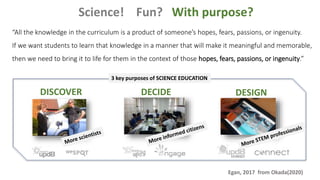
“All the knowledge in the curriculum is a product of someone’s hopes, fears, passions, or ingenuity.
If we want students to learn that knowledge in a manner that will make it meaningful and memorable,
then we need to bring it to life for them in the context of those hopes, fears, passions, or ingenuity.”
Egan, 2017 from Okada(2020)
3 key purposes of SCIENCE EDUCATION
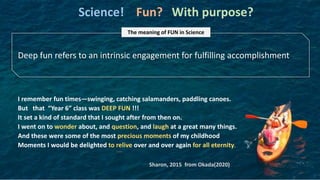
I remember fun times—swinging, catching salamanders, paddling canoes.
But that “Year 6” class was DEEP FUN !!!
It set a kind of standard that I sought after from then on.
I went on to wonder about, and question, and laugh at a great many things.
And these were some of the most precious moments of my childhood
Moments I would be delighted to relive over and over again for all eternity.
Sharon, 2015 from Okada(2020)
Science! Fun? With purpose?
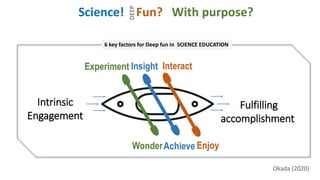
Deep fun refers to an intrinsic engagement for fulfilling accomplishment
The meaning of FUN in Science
Intrinsic
Engagement
Achieve
Insight
Experiment
Wonder
Interact
Enjoy
Fulfilling
accomplishment
Okada (2020)
Science! Fun? With purpose?
DEEP
6 key factors for Deep fun in SCIENCE EDUCATION
The year 11s that have just gone…
I mean I had some children in the year 11 class,
and they had just had enough.
Their enthusiasm and the sense of FUN had been extinguished
so early on from the chalk and talk
and the not getting involved in stuff.
And maybe, I don’t know,
maybe they had a bad experience or whatever,
so the shutters come down.
And trying to get them to even revise
for their upcoming exams was like trying to push sand uphill.
It was absolutely terrible.
Year 7 Science Teacher from Okada (2020)
Science! Fun? With purpose?
BORING!
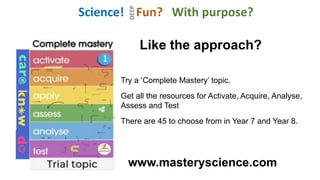
Like the approach?
Try a ‘Complete Mastery’ topic.
Get all the resources for Activate, Acquire, Analyse,
Assess and Test
There are 45 to choose from in Year 7 and Year 8.
www.masteryscience.com
Science! Fun? With purpose?
DEEP
Science! Fun? With purpose?
Accomplishment
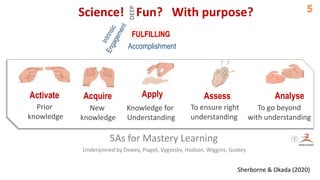
Prior
knowledge
Activate Acquire Assess Analyse
New
knowledge
Knowledge for
Understanding
To go beyond
with understanding
To ensure right
understanding
C
Sherborne & Okada (2020)
5As for Mastery Learning
Apply
Underpinned by Dewey, Piaget, Vygotsky, Hodson, Wiggins, Guskey
FULFILLING
DEEP
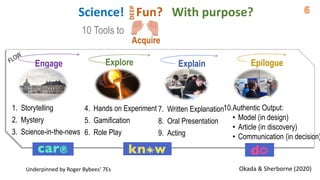
1. Storytelling
2. Mystery
3. Science-in-the-news
Explain Epilogue
Explore
4. Hands on Experiment
5. Gamification
6. Role Play
7. Written Explanation
8. Oral Presentation
9. Acting
Engage
10.Authentic Output:
• Model (in design)
• Article (in discovery)
• Communication (in decision)
Acquire
10 Tools to
Okada & Sherborne (2020)
Underpinned by Roger Bybees’ 7Es
Science! Fun? With purpose?
DEEP
© Mastery Science, 2019
https://shop.masteryscience.com/
Science! Fun? With purpose?
DEEP
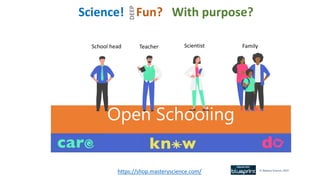
Open Schooling
School head Scientist Family
Teacher
© Mastery Science, 2019
https://shop.masteryscience.com/
Science! Fun? With purpose?
DEEP
Chemical & physical
© Mastery Science, 2019
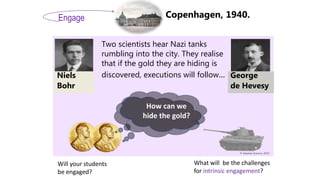
Copenhagen, 1940.
Niels
Bohr
George
de Hevesy
Two scientists hear Nazi tanks
rumbling into the city. They realise
that if the gold they are hiding is
discovered, executions will follow...
Engage
How can we
hide the gold?
What will be the challenges
for intrinsic engagement?
Will your students
be engaged?
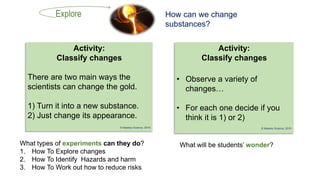
How can we change
substances?
Activity:
Classify changes
• Observe a variety of
changes…
• For each one decide if you
think it is 1) or 2)
Explore
Activity:
Classify changes
There are two main ways the
scientists can change the gold.
1) Turn it into a new substance.
2) Just change its appearance.
© Mastery Science, 2019
What will be students’ wonder?
What types of experiments can they do?
1. How To Explore changes
2. How To Identify Hazards and harm
3. How To Work out how to reduce risks
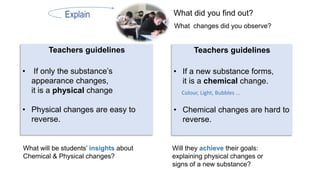
What did you find out?
Explain
Teachers guidelines
• If only the substance’s
appearance changes,
it is a physical change
• Physical changes are easy to
reverse.
Teachers guidelines
• If a new substance forms,
it is a chemical change.
• Chemical changes are hard to
reverse.
What changes did you observe?
What will be students’ insights about
Chemical & Physical changes?
Will they achieve their goals:
explaining physical changes or
signs of a new substance?
Colour, Light, Bubbles …
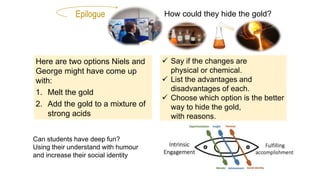
Epilogue How could they hide the gold?
 Say if the changes are
physical or chemical.
 List the advantages and
disadvantages of each.
 Choose which option is the better
way to hide the gold,
with reasons.
Here are two options Niels and
George might have come up
with:
1. Melt the gold
2. Add the gold to a mixture of
strong acids
Can students have deep fun?
Using their understand with humour
and increase their social identity
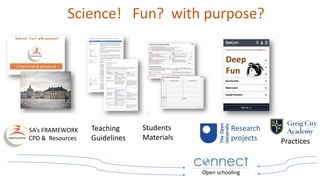
Science! Fun? with purpose?
5A’s FRAMEWORK
CPD & Resources
Teaching
Guidelines
Students
Materials
Research
projects
Open schooling
Deep
Fun
Practices
Changes in teachers
1. Sound framework around which to build our curriculum.
It’s now important to get KS3 right…
2. We’ve slowed down - spend more time on a concept to deepen
understanding and develop skills. Less teaching them facts and words…
3. Greater awareness of common misconceptions.
4. Beginning to realise how bad some our lessons were before!
5. Students are encouraged to find out for themselves – not tell them
everything.
6. Used mastery approach in other years.
7. This is all provided the teachers understand it…
8. Ofsted…
Changes in students
• Students are more engaged. It’s no longer just the bright students that
like science.
• We find even lower ability pupils are picking up complicated concepts far
better.
• Improved ability to Apply. Some year 7 students can answer GCSE
questions better than our current year 11.
• Students are aware of the journey…
Science with purpose!
Deep Fun!
So what mastery’s doing is it making it fun, it’s keeping it fun.
It’s making every lesson interesting for students.
And they are really really engaging in it.
And what we can see now with year 7s having done this for nearly a year now,
is that students are now starting to ask the what-if questions.
So they’re considering science not just as a subject they do at school
but as a subject that actually is all around them, and it’s allowing them to kind of look at the
world around them and ask scientific questions critically,
because normally they don’t get any of this.
If the enthusiasm that we’ve got with the current year 7s carried through
the sky’s the limit really for what these kids can achieve.
Year 7 Science Teacher from Okada (2020)
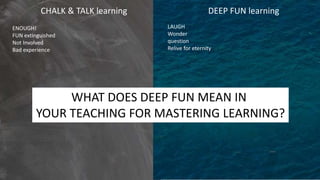
CHALK & TALK learning DEEP FUN learning
ENOUGH!
FUN extinguished
Not Involved
Bad experience
LAUGH
Wonder
question
Relive for eternity
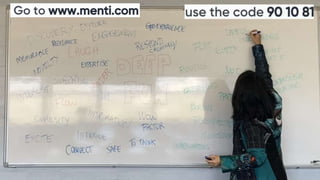
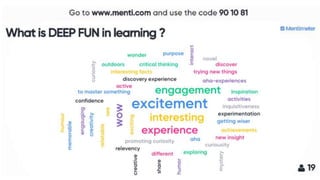
WHAT DOES DEEP FUN MEAN IN
YOUR TEACHING FOR MASTERING LEARNING?
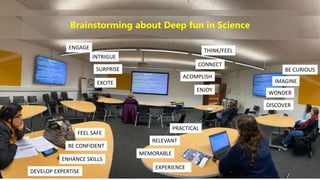
PRACTICAL
ENGAGE
BE CURIOUS
SURPRISE
DISCOVER
FEEL SAFE
MEMORABLE
EXCITE IMAGINE
BE CONFIDENT
RELEVANT
ENJOY
DEVELOP EXPERTISE
ACOMPLISH
WONDER
ENHANCE SKILLS
EXPERIENCE
CONNECT
THINK/FEEL
INTRIGUE
Brainstorming about Deep fun in Science
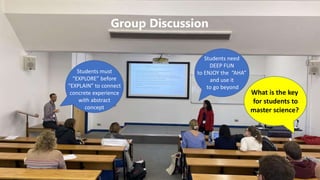
Students must
“EXPLORE” before
“EXPLAIN” to connect
concrete experience
with abstract
concept
Students need
DEEP FUN
to ENJOY the “AHA”
and use it
to go beyond
What is the key
for students to
master science?
Group Discussion
SCIENCE
MUSEUM
PRIMARY
SCIENCE
ZOO
ASE
Consultant
Teacher Researcher
Trainer Student
Head
SECONDARY
SCIENCE
UNIVERSITY SCIENCE
PUBLISHER
OUTDOOR
SCIENCE
BUSINESS
SECTOR
CURRICULUM
DEVELOPMENT
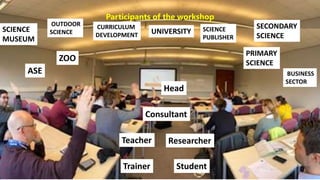
Participants of the workshop
Science! DEEP Fun? With purpose?
Thank you for your participation !
Dr. Alexandra Okada
Ale.Okada@open.ac.uk
Scientific Coordinator

2020:2021 CONNECT - ASE Conference

  • 1.
    1. Meaning offun and engagement 2. Approaches, examples and tools 3. Designing a science lesson for deep fun RUMPUS Dr. Alexandra Okada Ale.Okada@open.ac.uk We explore fun Dr. Tony Sherborne TonySherborne@gmail.com John Farrant Science! Fun? With purpose? Senior Researcher in Education Head of Curriculum development Secondary School Science Teacher
  • 2.
  • 3.
    Science! Fun? Withpurpose? DESIGN DISCOVER DECIDE “All the knowledge in the curriculum is a product of someone’s hopes, fears, passions, or ingenuity. If we want students to learn that knowledge in a manner that will make it meaningful and memorable, then we need to bring it to life for them in the context of those hopes, fears, passions, or ingenuity.” Egan, 2017 from Okada(2020) 3 key purposes of SCIENCE EDUCATION
  • 4.
    I remember funtimes—swinging, catching salamanders, paddling canoes. But that “Year 6” class was DEEP FUN !!! It set a kind of standard that I sought after from then on. I went on to wonder about, and question, and laugh at a great many things. And these were some of the most precious moments of my childhood Moments I would be delighted to relive over and over again for all eternity. Sharon, 2015 from Okada(2020) Science! Fun? With purpose? Deep fun refers to an intrinsic engagement for fulfilling accomplishment The meaning of FUN in Science
  • 5.
  • 6.
    The year 11sthat have just gone… I mean I had some children in the year 11 class, and they had just had enough. Their enthusiasm and the sense of FUN had been extinguished so early on from the chalk and talk and the not getting involved in stuff. And maybe, I don’t know, maybe they had a bad experience or whatever, so the shutters come down. And trying to get them to even revise for their upcoming exams was like trying to push sand uphill. It was absolutely terrible. Year 7 Science Teacher from Okada (2020) Science! Fun? With purpose? BORING!
  • 7.
    Like the approach? Trya ‘Complete Mastery’ topic. Get all the resources for Activate, Acquire, Analyse, Assess and Test There are 45 to choose from in Year 7 and Year 8. www.masteryscience.com Science! Fun? With purpose? DEEP
  • 8.
    Science! Fun? Withpurpose? Accomplishment Prior knowledge Activate Acquire Assess Analyse New knowledge Knowledge for Understanding To go beyond with understanding To ensure right understanding C Sherborne & Okada (2020) 5As for Mastery Learning Apply Underpinned by Dewey, Piaget, Vygotsky, Hodson, Wiggins, Guskey FULFILLING DEEP
  • 9.
    1. Storytelling 2. Mystery 3.Science-in-the-news Explain Epilogue Explore 4. Hands on Experiment 5. Gamification 6. Role Play 7. Written Explanation 8. Oral Presentation 9. Acting Engage 10.Authentic Output: • Model (in design) • Article (in discovery) • Communication (in decision) Acquire 10 Tools to Okada & Sherborne (2020) Underpinned by Roger Bybees’ 7Es Science! Fun? With purpose? DEEP
  • 11.
    © Mastery Science,2019 https://shop.masteryscience.com/ Science! Fun? With purpose? DEEP Open Schooling School head Scientist Family Teacher
  • 12.
    © Mastery Science,2019 https://shop.masteryscience.com/ Science! Fun? With purpose? DEEP Chemical & physical
  • 13.
    © Mastery Science,2019 Copenhagen, 1940. Niels Bohr George de Hevesy Two scientists hear Nazi tanks rumbling into the city. They realise that if the gold they are hiding is discovered, executions will follow... Engage How can we hide the gold? What will be the challenges for intrinsic engagement? Will your students be engaged?
  • 14.
    How can wechange substances? Activity: Classify changes • Observe a variety of changes… • For each one decide if you think it is 1) or 2) Explore Activity: Classify changes There are two main ways the scientists can change the gold. 1) Turn it into a new substance. 2) Just change its appearance. © Mastery Science, 2019 © Mastery Science, 2019 What will be students’ wonder? What types of experiments can they do? 1. How To Explore changes 2. How To Identify Hazards and harm 3. How To Work out how to reduce risks
  • 15.
    What did youfind out? Explain Teachers guidelines • If only the substance’s appearance changes, it is a physical change • Physical changes are easy to reverse. Teachers guidelines • If a new substance forms, it is a chemical change. • Chemical changes are hard to reverse. What changes did you observe? What will be students’ insights about Chemical & Physical changes? Will they achieve their goals: explaining physical changes or signs of a new substance? Colour, Light, Bubbles …
  • 16.
    Epilogue How couldthey hide the gold?  Say if the changes are physical or chemical.  List the advantages and disadvantages of each.  Choose which option is the better way to hide the gold, with reasons. Here are two options Niels and George might have come up with: 1. Melt the gold 2. Add the gold to a mixture of strong acids Can students have deep fun? Using their understand with humour and increase their social identity
  • 17.
    Science! Fun? withpurpose? 5A’s FRAMEWORK CPD & Resources Teaching Guidelines Students Materials Research projects Open schooling Deep Fun Practices
  • 18.
    Changes in teachers 1.Sound framework around which to build our curriculum. It’s now important to get KS3 right… 2. We’ve slowed down - spend more time on a concept to deepen understanding and develop skills. Less teaching them facts and words… 3. Greater awareness of common misconceptions. 4. Beginning to realise how bad some our lessons were before! 5. Students are encouraged to find out for themselves – not tell them everything. 6. Used mastery approach in other years. 7. This is all provided the teachers understand it… 8. Ofsted…
  • 19.
    Changes in students •Students are more engaged. It’s no longer just the bright students that like science. • We find even lower ability pupils are picking up complicated concepts far better. • Improved ability to Apply. Some year 7 students can answer GCSE questions better than our current year 11. • Students are aware of the journey…
  • 20.
    Science with purpose! DeepFun! So what mastery’s doing is it making it fun, it’s keeping it fun. It’s making every lesson interesting for students. And they are really really engaging in it. And what we can see now with year 7s having done this for nearly a year now, is that students are now starting to ask the what-if questions. So they’re considering science not just as a subject they do at school but as a subject that actually is all around them, and it’s allowing them to kind of look at the world around them and ask scientific questions critically, because normally they don’t get any of this. If the enthusiasm that we’ve got with the current year 7s carried through the sky’s the limit really for what these kids can achieve. Year 7 Science Teacher from Okada (2020)
  • 21.
    CHALK & TALKlearning DEEP FUN learning ENOUGH! FUN extinguished Not Involved Bad experience LAUGH Wonder question Relive for eternity WHAT DOES DEEP FUN MEAN IN YOUR TEACHING FOR MASTERING LEARNING?
  • 24.
    PRACTICAL ENGAGE BE CURIOUS SURPRISE DISCOVER FEEL SAFE MEMORABLE EXCITEIMAGINE BE CONFIDENT RELEVANT ENJOY DEVELOP EXPERTISE ACOMPLISH WONDER ENHANCE SKILLS EXPERIENCE CONNECT THINK/FEEL INTRIGUE Brainstorming about Deep fun in Science
  • 25.
    Students must “EXPLORE” before “EXPLAIN”to connect concrete experience with abstract concept Students need DEEP FUN to ENJOY the “AHA” and use it to go beyond What is the key for students to master science? Group Discussion
  • 26.
    SCIENCE MUSEUM PRIMARY SCIENCE ZOO ASE Consultant Teacher Researcher Trainer Student Head SECONDARY SCIENCE UNIVERSITYSCIENCE PUBLISHER OUTDOOR SCIENCE BUSINESS SECTOR CURRICULUM DEVELOPMENT Participants of the workshop
  • 27.
    Science! DEEP Fun?With purpose? Thank you for your participation ! Dr. Alexandra Okada Ale.Okada@open.ac.uk Scientific Coordinator

Editor's Notes

  • #3 Tools
  • #5 Meaning
  • #6 Approaches,
  • #10 Tools
  • #12 This example is available in Mastery Science website
  • #13 This example is available in Mastery Science website
  • #14 This is a real life or death story in history About two scientists that had to make the gold invisible for the Nazis It is all about honour trust and friendship and fear !!!! How can I ensure that the nazis won’t find two gold medal of my Jewish friends Otherwise we will be killed !!!!!! Please discuss it with your colleagues and provide me some ideas urgently !!!!!!
  • #15 Student pairs visit stations set around the classroom (see materials required). They discuss if each change creates a new substance, or if just the appearance of the substance changes.
  • #16 Present information about physical changes. Ask pairs to feedback which changes they observed were physical and why they think this.
  • #19 Designing Lessons
  • #20 Designing Lessons
  • #28 Meaning