Physics and
Astronomy videos for
parents of children at
primary school
José GONÇALVES, Paulo Simeão CARVALHO, Luciano MEDEIROS JR
why do parents matter?
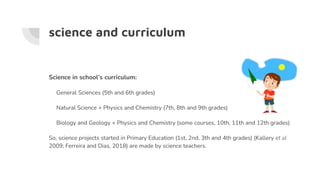
science and curriculum
Science in school’s curriculum:
General Sciences (5th and 6th grades)
Natural Science + Physics and Chemistry (7th, 8th and 9th grades)
Biology and Geology + Physics and Chemistry (some courses, 10th, 11th and 12th grades)
So, science projects started in Primary Education (1st, 2nd, 3th and 4th grades) (Kallery et al
2009; Ferreira and Dias, 2018) are made by science teachers.
parents
● 'good parenting at home' has a significant positive effect on children's performance
and adjustment (Desforges and Abouchaar, 2003).
● they are important to the acquisition of mathematical and scientific skills, and
produces a great impact on the development of children's own perceptions of self-
competence (Jacobs and Bleeker, 2004).
● There is a greater retention of scientific information by the children when they talk
about the subjects addressed in the classroom with their parents, even when they do
not have a specific scientific knowledge (Kelly, 2016).
parents
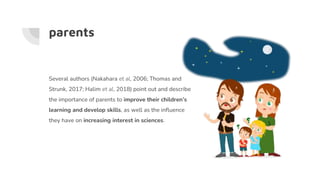
Several authors (Nakahara et al, 2006; Thomas and
Strunk, 2017; Halim et al, 2018) point out and describe
the importance of parents to improve their children’s
learning and develop skills, as well as the influence
they have on increasing interest in sciences.
objective
This project aims to raise the awareness of parents about the importance of science in
people’s life and how they can help to develop proactive attitudes towards science in
young people.
Although a few parents feel very confident in their ability to support students in learning
science, we want to instill the idea that science is not dogmatic but questionable, through
active processes that include exploring, observing, presenting plausible ideas, testing,
collecting data, concluding and proposing solutions to problems (Vahey et al, 2019).
Parents as science
disseminators
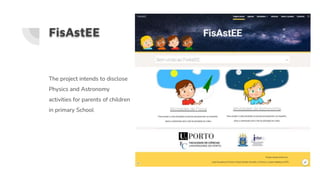
FisAstEE
The project intends to disclose
Physics and Astronomy
activities for parents of children
in primary School
practical activities
The activities will be available online in a video format.
The guidance video can assure that parents can conduct the activity at home with their
children. Each activity is hands-on, fun and low-cost.
Parents will be trained at schools.
There will be a simple explanation at the end of each video about the science behind the
experiment.
sample
This sample
activity can be
made at home,
with low cost
materials.
evaluation
evaluation
We intend to evaluate the resources to measure the impact of this kind of dissemination in
parents and children.
We will evaluate through:
➔ Questionnaires
○ before and after each video
○ in training sessions
➔ Observation in training sessions
➔ Interviews to parents and children
Thank You
José Gonçalves (UPorto, PT)
Paulo Simeão Carvalho (UPorto, PT)
Luciano G. de Medeiros Jr. (UFF, BR)

FisAstEE project presentation

  • 1.
    Physics and Astronomy videosfor parents of children at primary school José GONÇALVES, Paulo Simeão CARVALHO, Luciano MEDEIROS JR
  • 2.
  • 3.
    science and curriculum Sciencein school’s curriculum: General Sciences (5th and 6th grades) Natural Science + Physics and Chemistry (7th, 8th and 9th grades) Biology and Geology + Physics and Chemistry (some courses, 10th, 11th and 12th grades) So, science projects started in Primary Education (1st, 2nd, 3th and 4th grades) (Kallery et al 2009; Ferreira and Dias, 2018) are made by science teachers.
  • 4.
    parents ● 'good parentingat home' has a significant positive effect on children's performance and adjustment (Desforges and Abouchaar, 2003). ● they are important to the acquisition of mathematical and scientific skills, and produces a great impact on the development of children's own perceptions of self- competence (Jacobs and Bleeker, 2004). ● There is a greater retention of scientific information by the children when they talk about the subjects addressed in the classroom with their parents, even when they do not have a specific scientific knowledge (Kelly, 2016).
  • 5.
    parents Several authors (Nakaharaet al, 2006; Thomas and Strunk, 2017; Halim et al, 2018) point out and describe the importance of parents to improve their children’s learning and develop skills, as well as the influence they have on increasing interest in sciences.
  • 6.
    objective This project aimsto raise the awareness of parents about the importance of science in people’s life and how they can help to develop proactive attitudes towards science in young people. Although a few parents feel very confident in their ability to support students in learning science, we want to instill the idea that science is not dogmatic but questionable, through active processes that include exploring, observing, presenting plausible ideas, testing, collecting data, concluding and proposing solutions to problems (Vahey et al, 2019).
  • 7.
  • 8.
    FisAstEE The project intendsto disclose Physics and Astronomy activities for parents of children in primary School
  • 9.
    practical activities The activitieswill be available online in a video format. The guidance video can assure that parents can conduct the activity at home with their children. Each activity is hands-on, fun and low-cost. Parents will be trained at schools. There will be a simple explanation at the end of each video about the science behind the experiment.
  • 10.
    sample This sample activity canbe made at home, with low cost materials.
  • 11.
  • 12.
    evaluation We intend toevaluate the resources to measure the impact of this kind of dissemination in parents and children. We will evaluate through: ➔ Questionnaires ○ before and after each video ○ in training sessions ➔ Observation in training sessions ➔ Interviews to parents and children
  • 13.
    Thank You José Gonçalves(UPorto, PT) Paulo Simeão Carvalho (UPorto, PT) Luciano G. de Medeiros Jr. (UFF, BR)