Joint
Webinar #5
Barcelona Data Science and Machine Learning Meetup
Budapest Deep Learning Reading Seminar
Budapest Data Science Meetup
&
Want to give a talk,
support or …?
joint-meetup@googlegroups.com
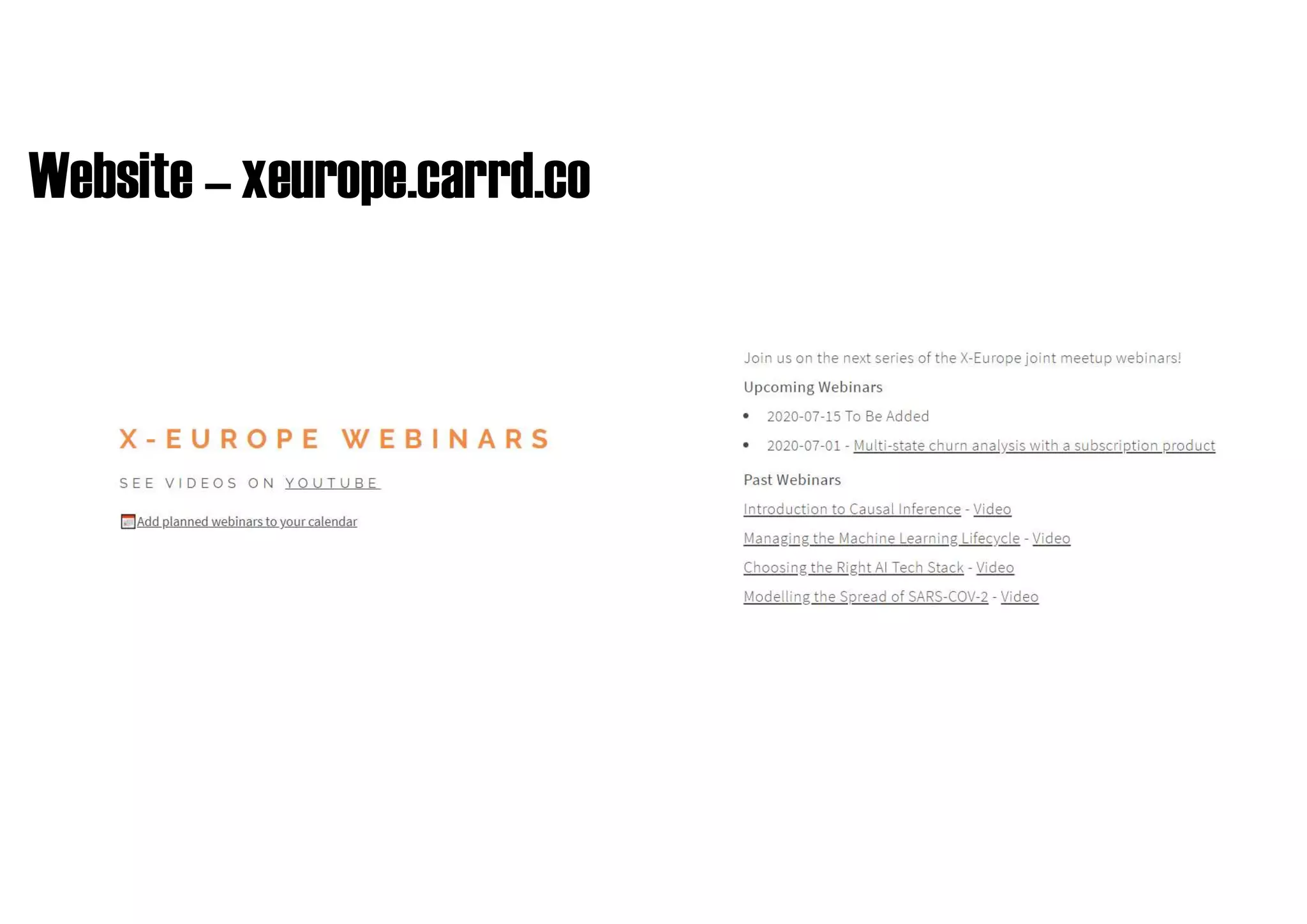
Website – xeurope.carrd.co
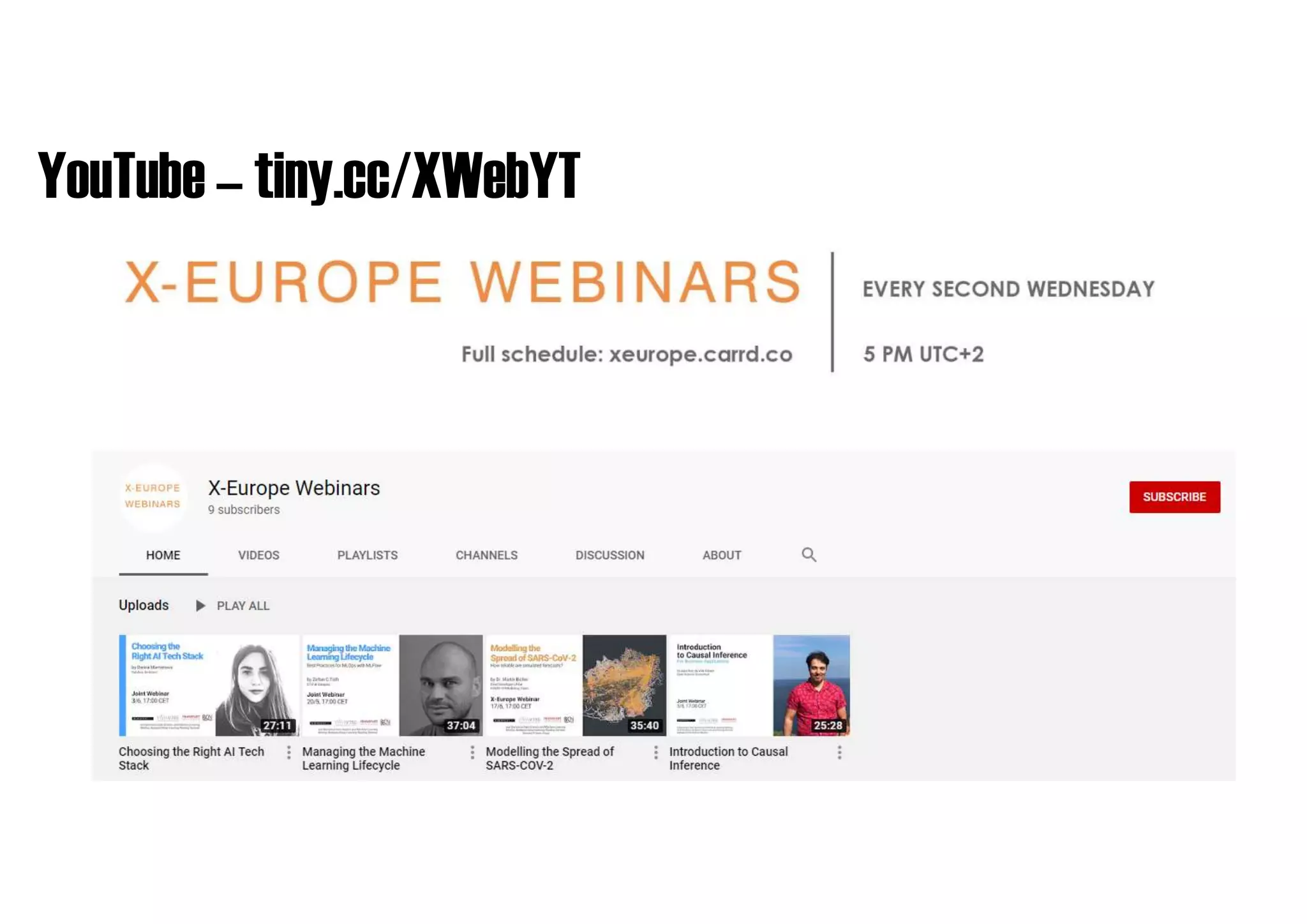
YouTube – tiny.cc/XWebYT
DEVELOPING INTELLIGENCE POWERED BY DATA
MULTI-STATE CHURN ANALYSIS
WITH A SUBSCRIPTION PRODUCT
WHO IS THIS GUY?
MARCIN KOSIŃSKI
- WARSAW RUG
- R BLOGGER R-ADDICT.COM
- WHYR.PL/2020/
MARCIN@GRADIENTMETRICS.COM
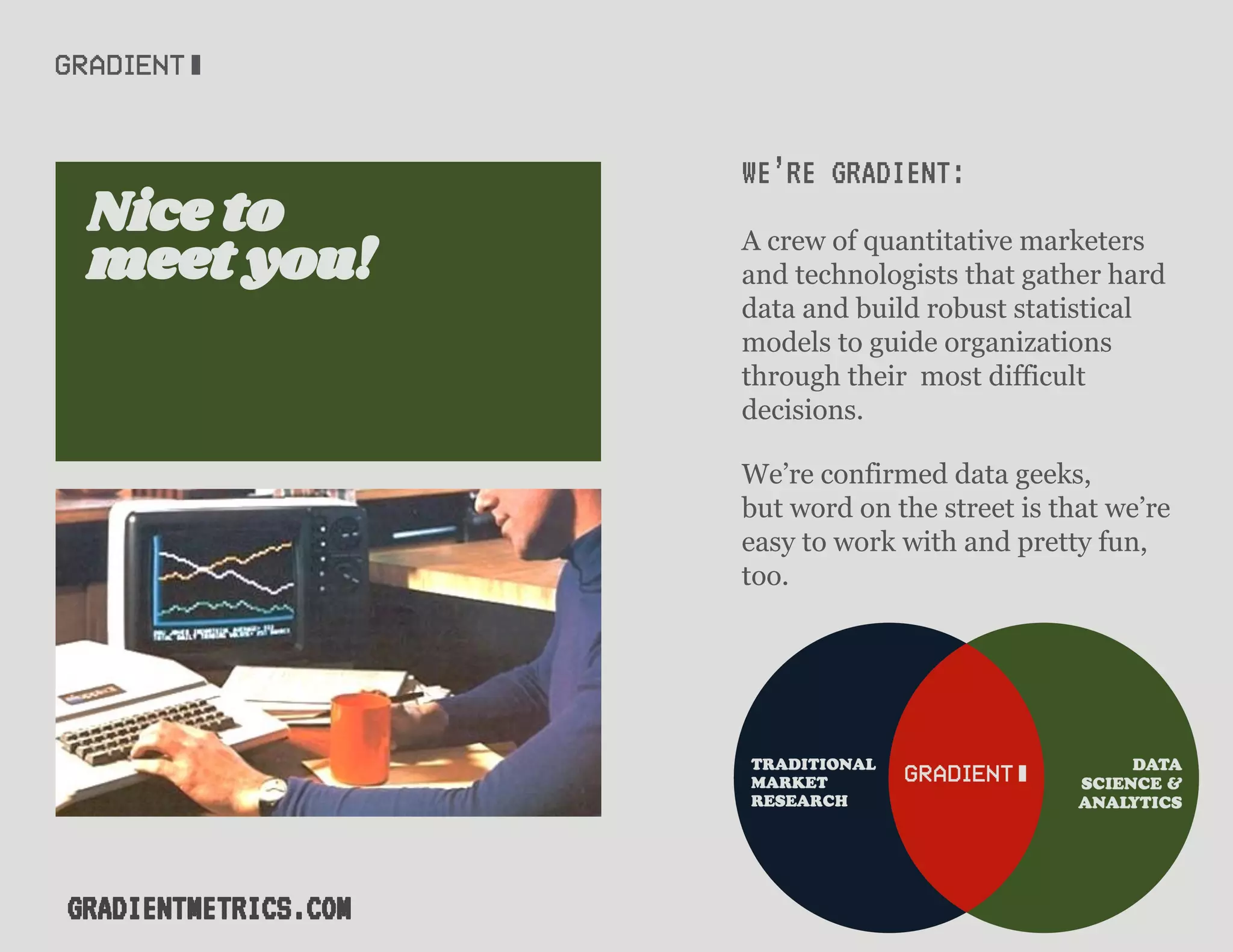
WE’RE GRADIENT:
A crew of quantitative marketers
and technologists that gather hard
data and build robust statistical
models to guide organizations
through their most difficult
decisions.
We’re confirmed data geeks,
but word on the street is that we’re
easy to work with and pretty fun,
too.
meet you!
Nice to
GRADIENTMETRICS.COM
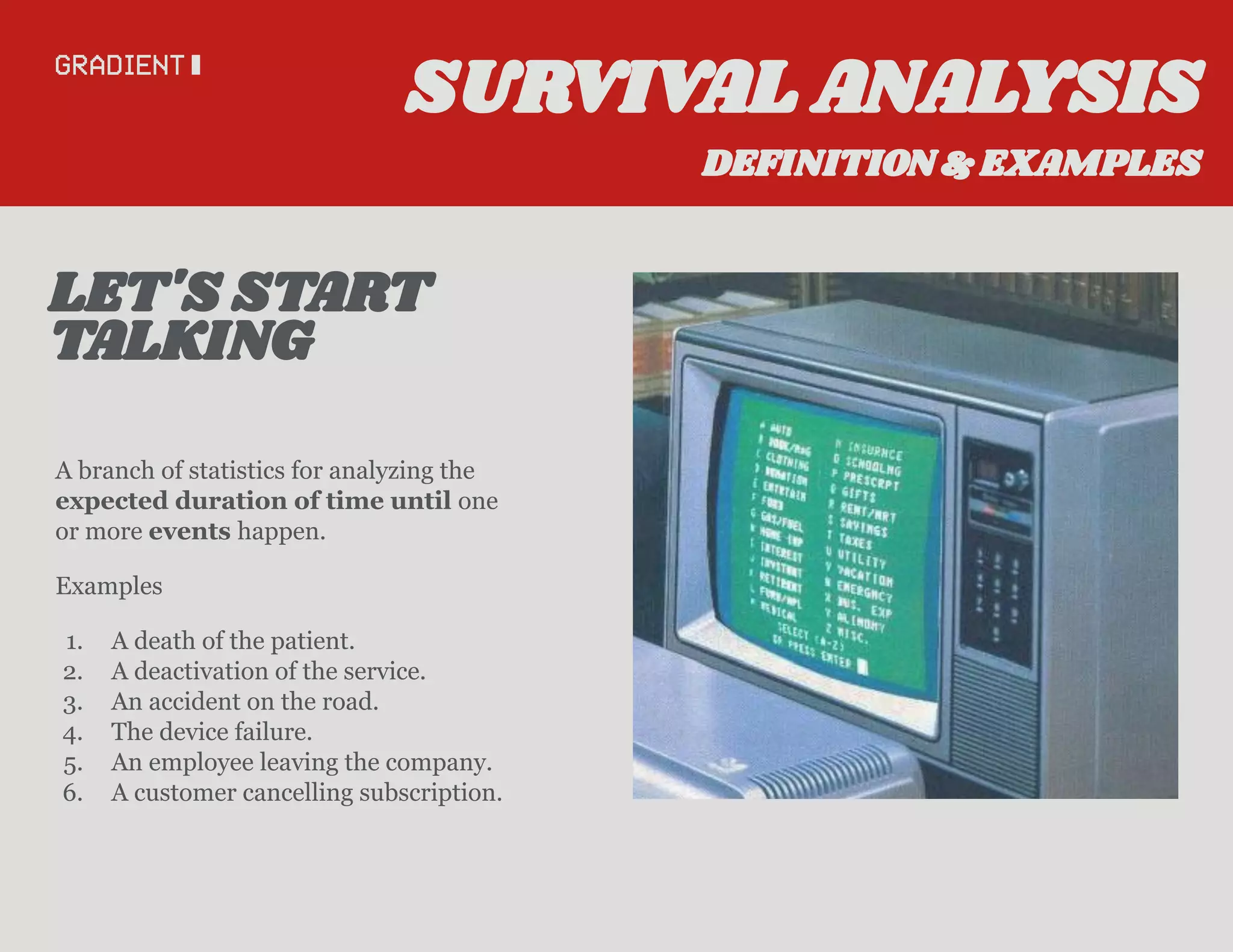
A branch of statistics for analyzing the
expected duration of time until one
or more events happen.
Examples
1. A death of the patient.
2. A deactivation of the service.
3. An accident on the road.
4. The device failure.
5. An employee leaving the company.
6. A customer cancelling subscription.
TALKING
LET'S START
SURVIVAL ANALYSIS
DEFINITION & EXAMPLES
What’s the probability an event will (not)
occur after a specific period of time?
Which characteristics indicate a reduced or
increased risk of occurrence of an event?
What periods of time are most (or least)
exposed to the risk of an event?
ASKING
LET'S START
SURVIVAL ANALYSIS
QUESTIONS IT (MIGHT) ANSWER
Data
1. Censoring.
2. Interval data.
3. Observations may not be
independent.
4. Time varying features.
Events
1. Recurring events - one event might
occur multiple times.
2. Competing risks - one of multiple
events might occur.
3. A multi-state (cyclic/acyclic) nature
of the process.
THE SCENARIO
DEPENDING ON
SURVIVAL ANALYSIS
CHALLENGES IT FACES
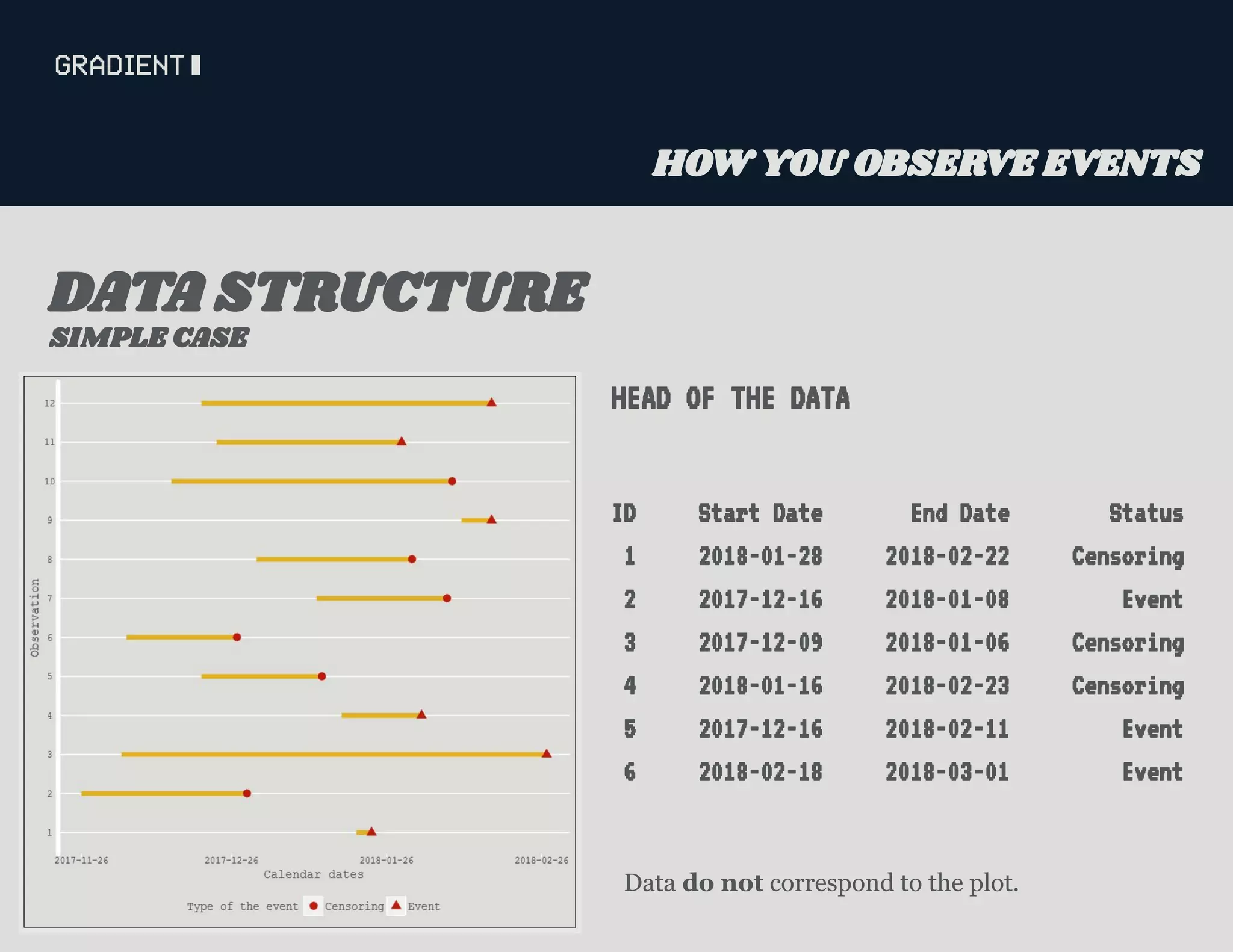
HEAD OF THE DATA
ID Start Date End Date Status
1 2018-01-28 2018-02-22 Censoring
2 2017-12-16 2018-01-08 Event
3 2017-12-09 2018-01-06 Censoring
4 2018-01-16 2018-02-23 Censoring
5 2017-12-16 2018-02-11 Event
6 2018-02-18 2018-03-01 Event
SIMPLE CASE
DATA STRUCTURE
HOW YOU OBSERVE EVENTS
Data do not correspond to the plot.
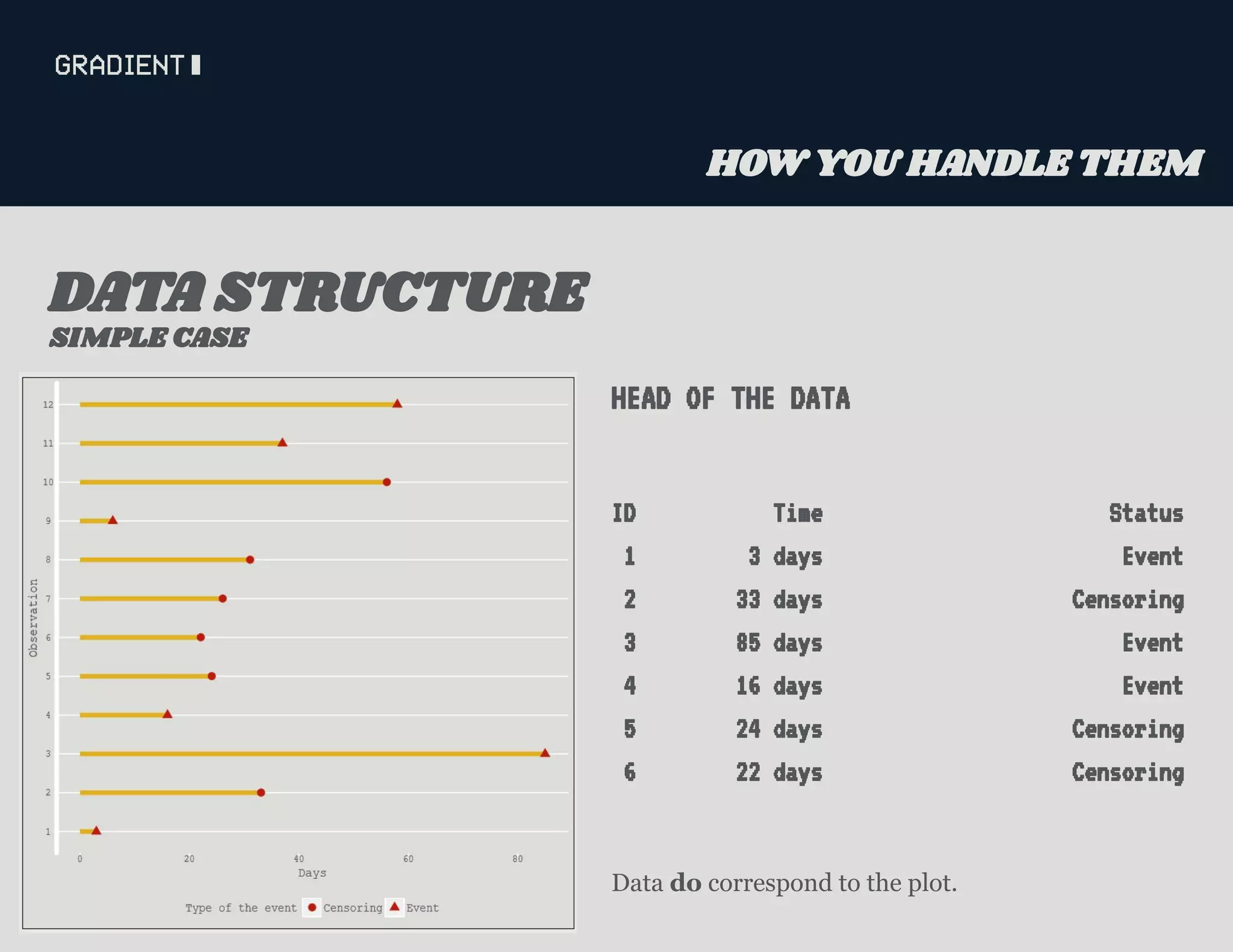
HEAD OF THE DATA
ID Time Status
1 3 days Event
2 33 days Censoring
3 85 days Event
4 16 days Event
5 24 days Censoring
6 22 days Censoring
Data do correspond to the plot.
SIMPLE CASE
DATA STRUCTURE
HOW YOU HANDLE THEM
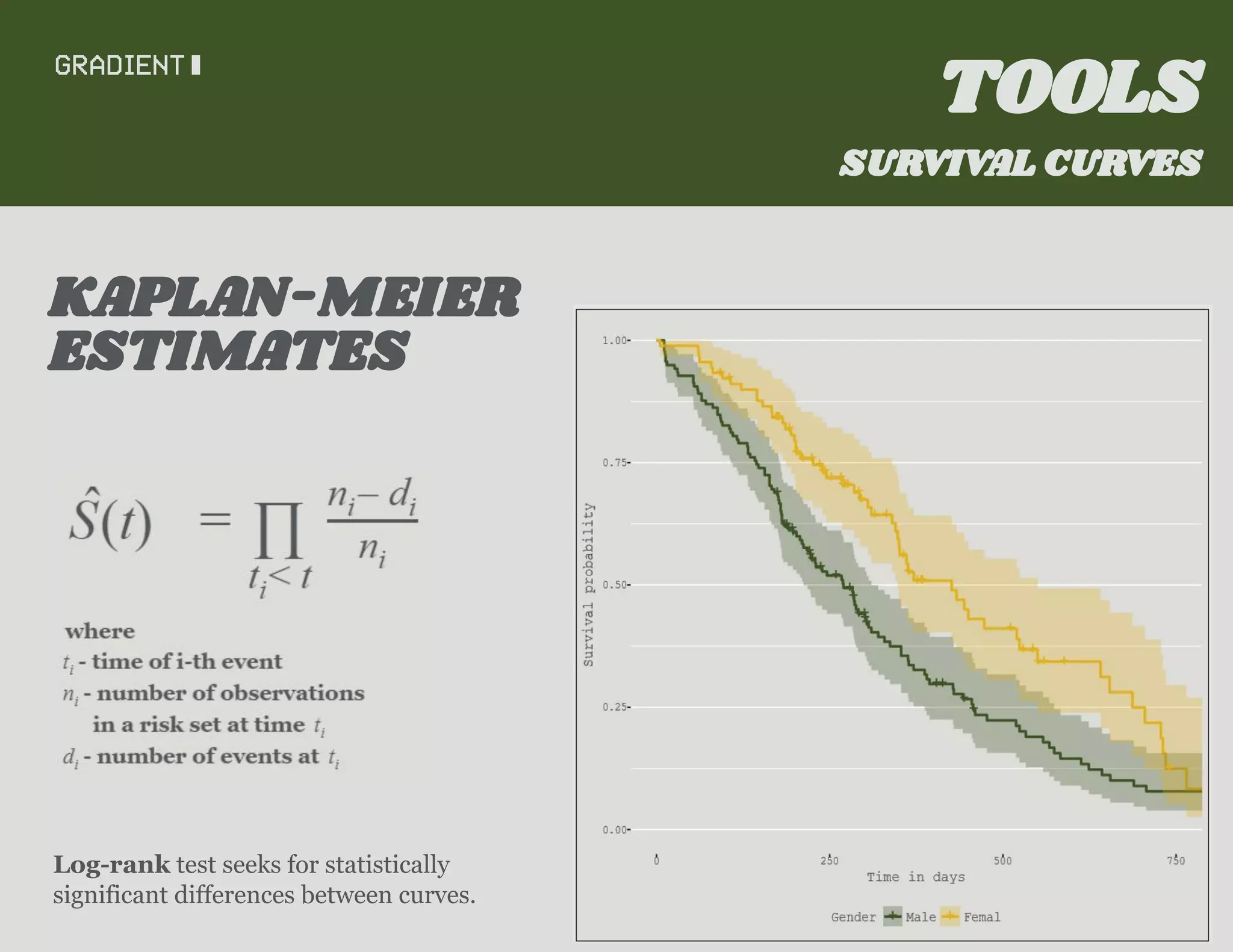
KAPLAN-MEIER
TOOLS
ESTIMATES
SURVIVAL CURVES
Log-rank test seeks for statistically
significant differences between curves.
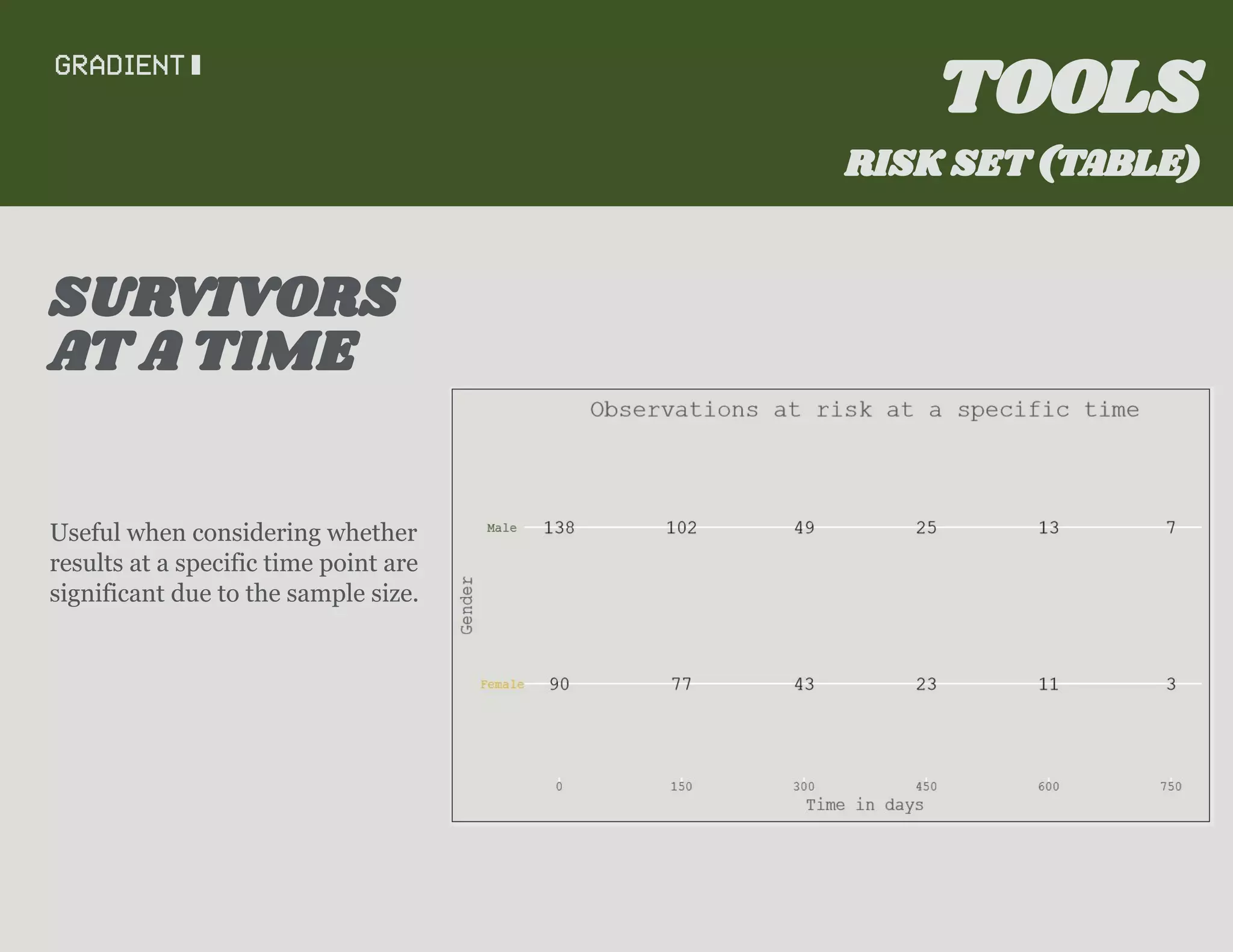
Useful when considering whether
results at a specific time point are
significant due to the sample size.
SURVIVORS
TOOLS
AT A TIME
RISK SET (TABLE)
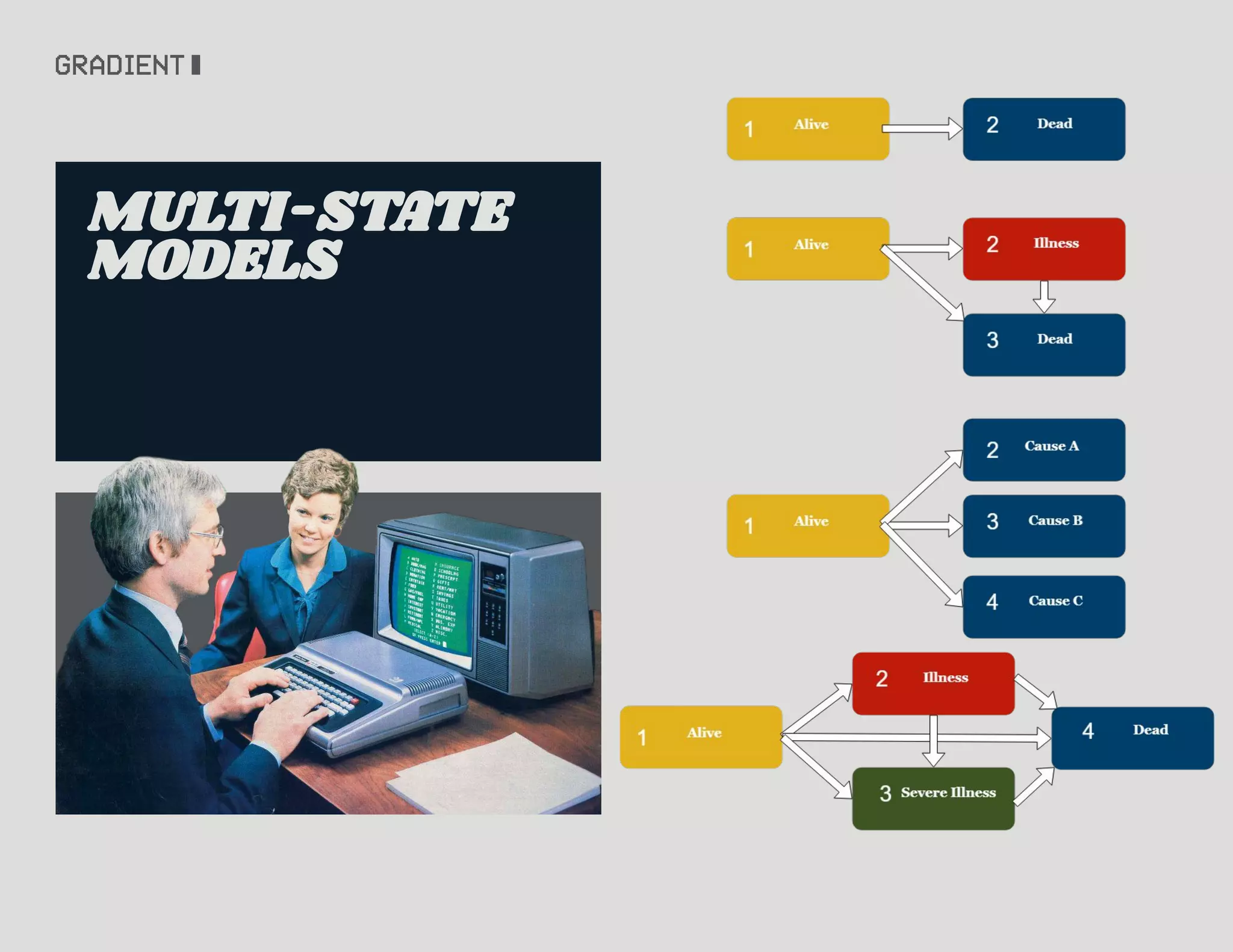
MODELS
MULTI-STATE
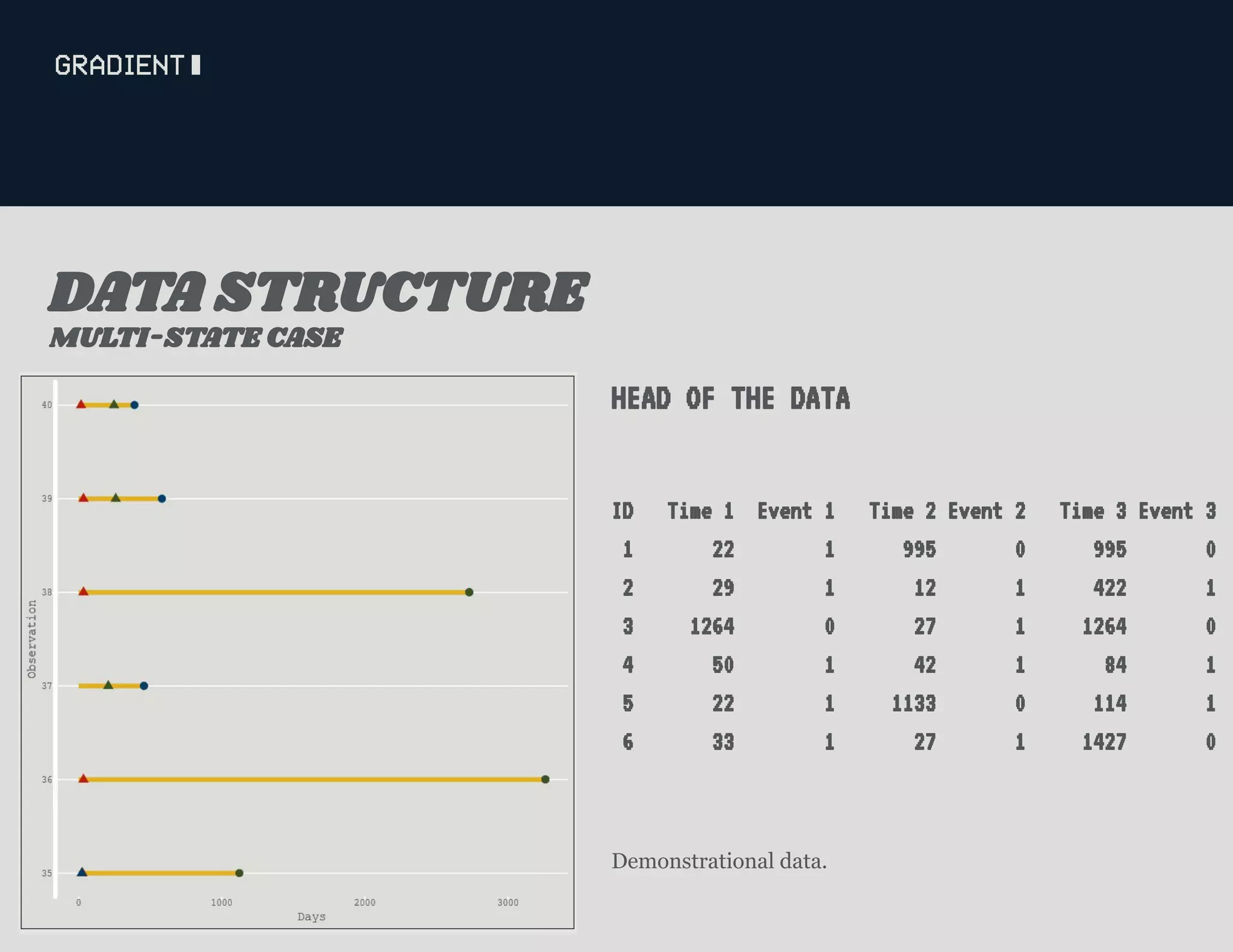
HEAD OF THE DATA
ID Time 1 Event 1 Time 2 Event 2 Time 3 Event 3
1 22 1 995 0 995 0
2 29 1 12 1 422 1
3 1264 0 27 1 1264 0
4 50 1 42 1 84 1
5 22 1 1133 0 114 1
6 33 1 27 1 1427 0
Demonstrational data.
MULTI-STATE CASE
DATA STRUCTURE
USE CASES
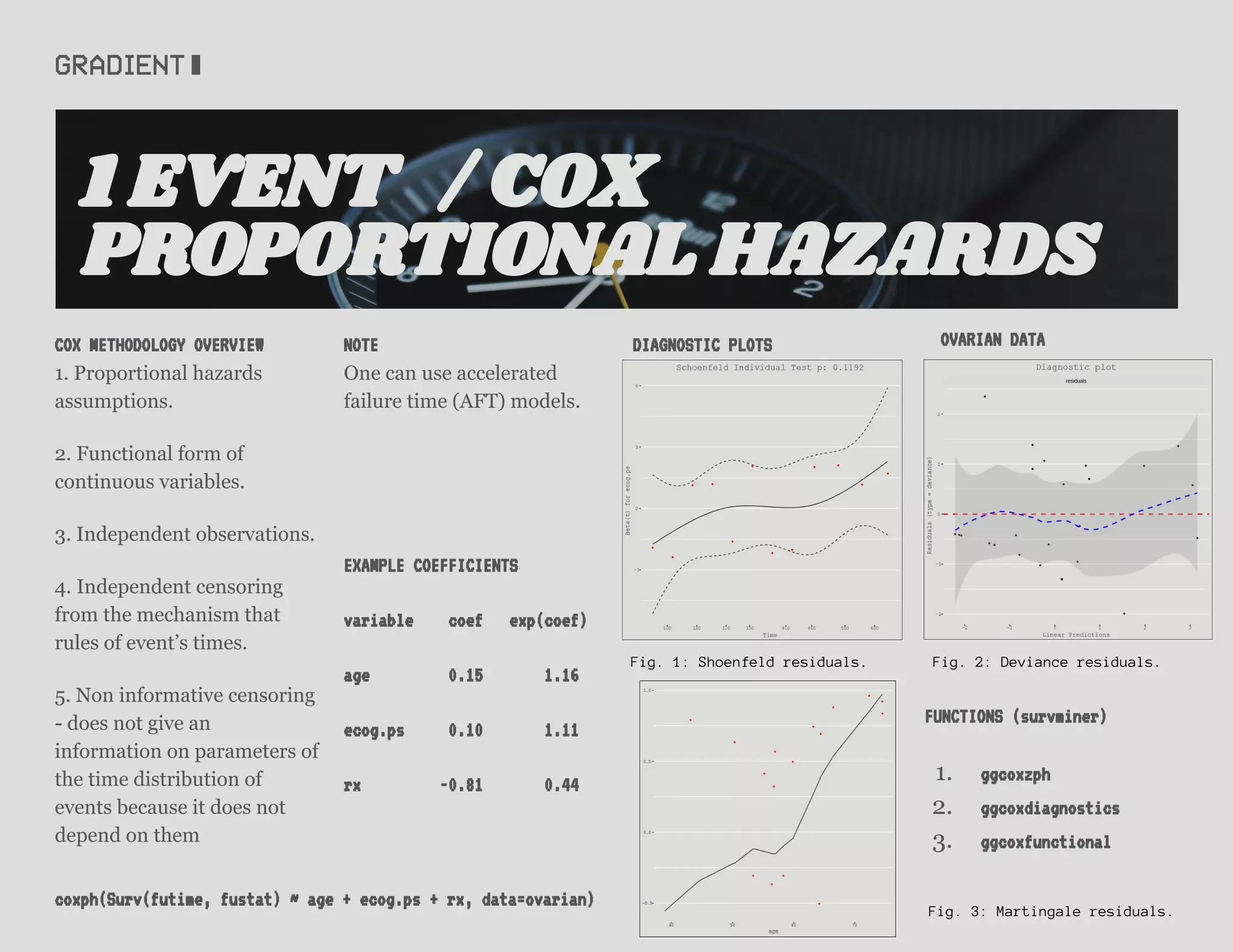
COX METHODOLOGY OVERVIEW
1. Proportional hazards
assumptions.
2. Functional form of
continuous variables.
3. Independent observations.
4. Independent censoring
from the mechanism that
rules of event’s times.
5. Non informative censoring
- does not give an
information on parameters of
the time distribution of
events because it does not
depend on them
1 EVENT / COX
PROPORTIONAL HAZARDS
NOTE
One can use accelerated
failure time (AFT) models.
EXAMPLE COEFFICIENTS
variable coef exp(coef)
age 0.15 1.16
ecog.ps 0.10 1.11
rx -0.81 0.44
DIAGNOSTIC PLOTS
Fig. 1: Shoenfeld residuals. Fig. 2: Deviance residuals.
Fig. 3: Martingale residuals.
FUNCTIONS (survminer)
1. ggcoxzph
2. ggcoxdiagnostics
3. ggcoxfunctional
OVARIAN DATA
coxph(Surv(futime, fustat) ~ age + ecog.ps + rx, data=ovarian)
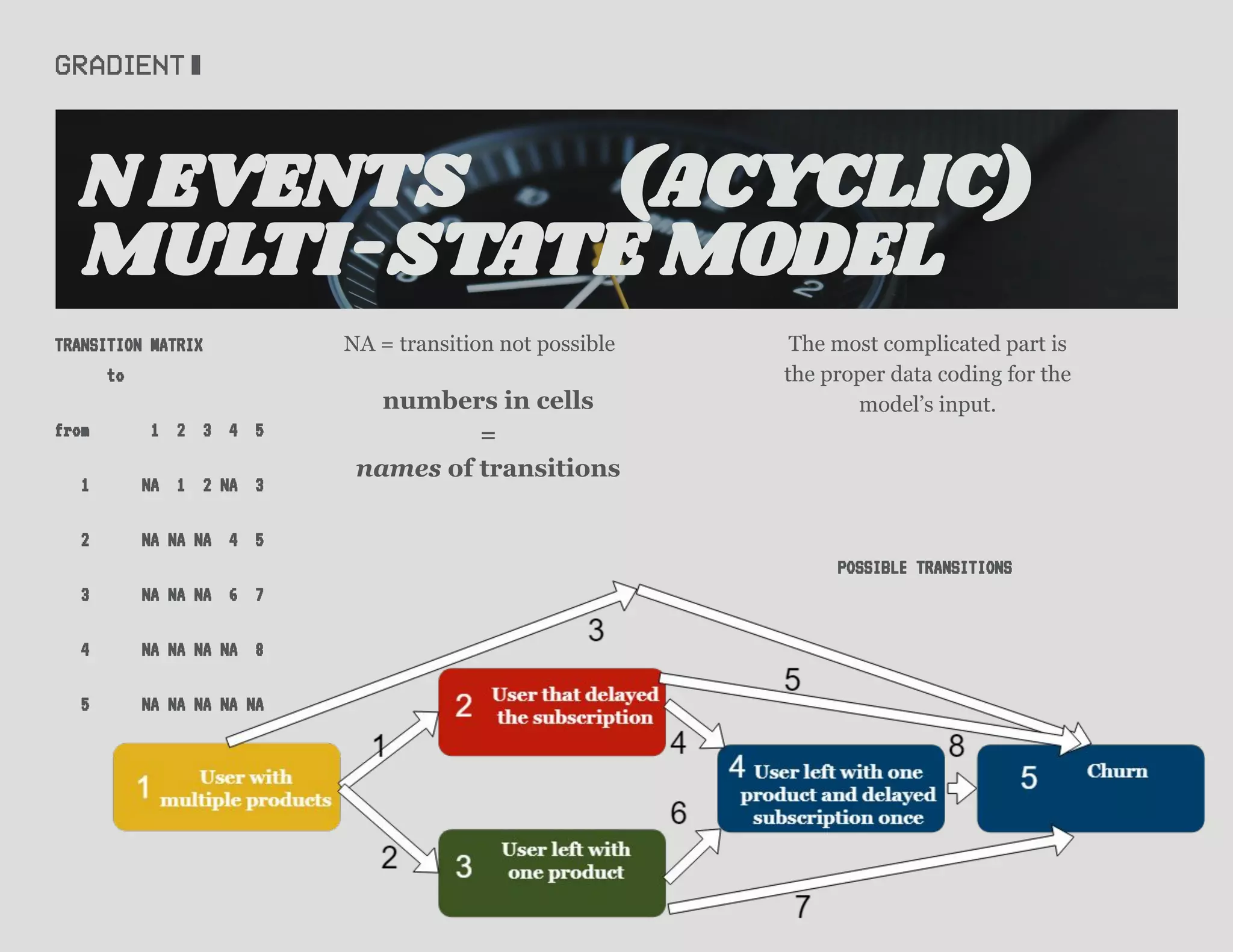
TRANSITION MATRIX
to
from 1 2 3 4 5
1 NA 1 2 NA 3
2 NA NA NA 4 5
3 NA NA NA 6 7
4 NA NA NA NA 8
5 NA NA NA NA NA
N EVENTS (ACYCLIC)
MULTI-STATE MODEL
NA = transition not possible
numbers in cells
=
names of transitions
POSSIBLE TRANSITIONS
The most complicated part is
the proper data coding for the
model’s input.
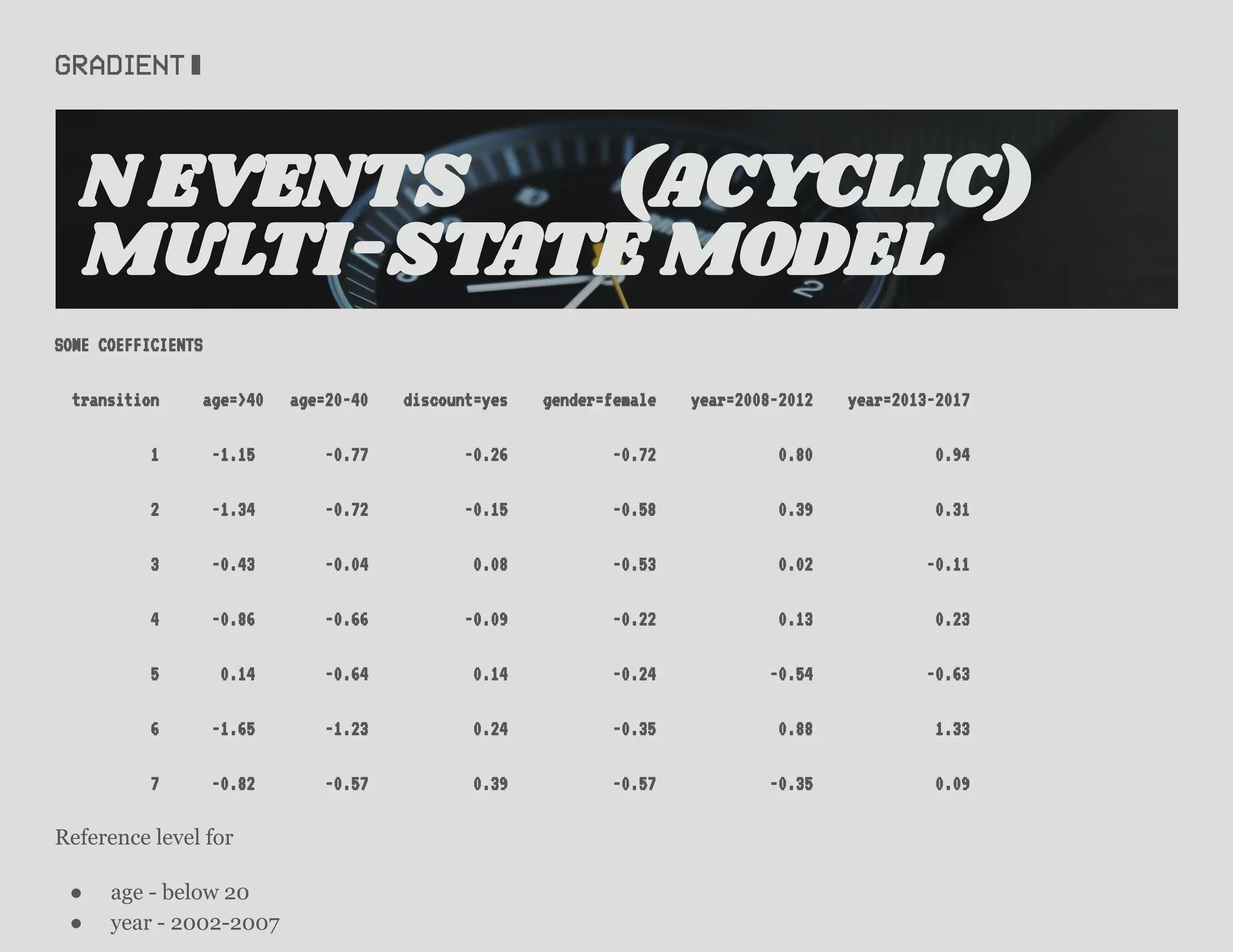
SOME COEFFICIENTS
transition age=>40 age=20-40 discount=yes gender=female year=2008-2012 year=2013-2017
1 -1.15 -0.77 -0.26 -0.72 0.80 0.94
2 -1.34 -0.72 -0.15 -0.58 0.39 0.31
3 -0.43 -0.04 0.08 -0.53 0.02 -0.11
4 -0.86 -0.66 -0.09 -0.22 0.13 0.23
5 0.14 -0.64 0.14 -0.24 -0.54 -0.63
6 -1.65 -1.23 0.24 -0.35 0.88 1.33
7 -0.82 -0.57 0.39 -0.57 -0.35 0.09
Reference level for
● age - below 20
● year - 2002-2007
N EVENTS (ACYCLIC)
MULTI-STATE MODEL
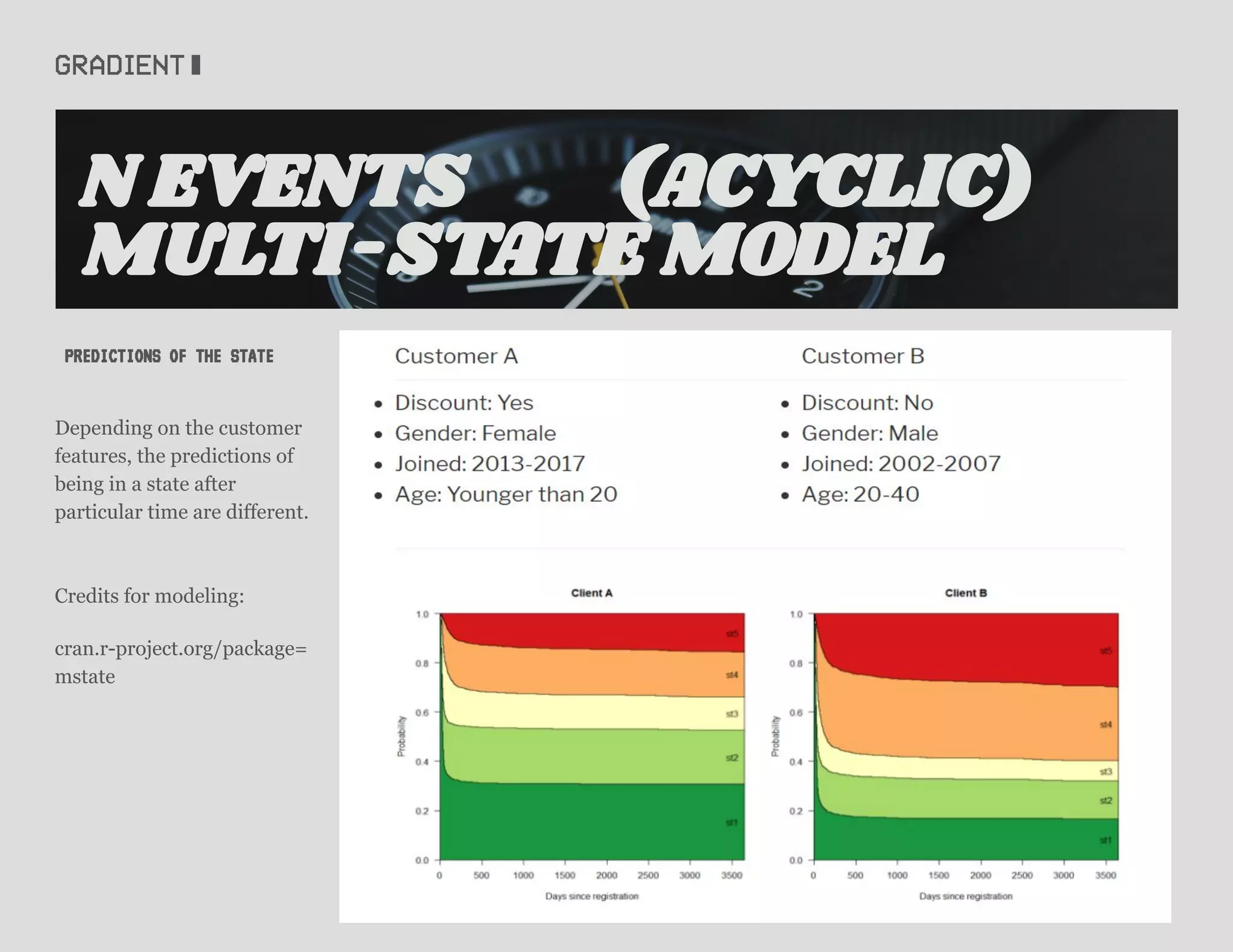
Depending on the customer
features, the predictions of
being in a state after
particular time are different.
Credits for modeling:
cran.r-project.org/package=
mstate
N EVENTS (ACYCLIC)
MULTI-STATE MODEL
PREDICTIONS OF THE STATE
NOTES
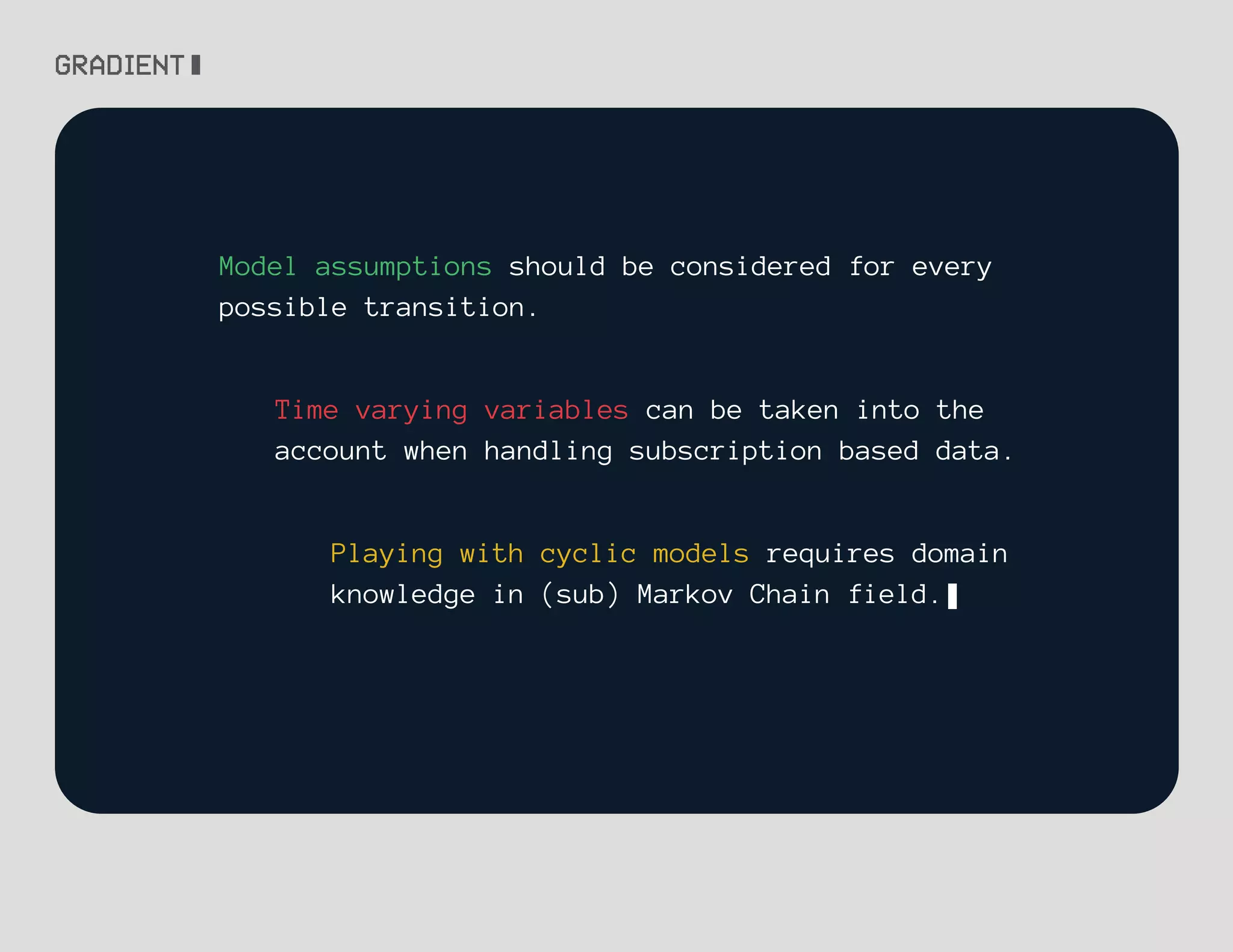
Model assumptions should be considered for every
possible transition.
Time varying variables can be taken into the
account when handling subscription based data.
Playing with cyclic models requires domain
knowledge in (sub) Markov Chain field.
SURVMINER
PLOTS BASED ON
Credits:
cran.r-project.org/package=survminer
github.com/kassambara/survminer
www.ggplot2-exts.org/gallery/
stdha.com/english/rpkgs/survminer
DID YOU LIKE THE TALK? JOIN US AT WHY R? 2020.
24-27 SEPTEMBER
WHYR.PL/2020/
github.com/g6t/mchurn
THANK YOU FOR THE ATTENTION
youtube.com/WhyRFoundation

Multi state churn analysis with a subscription product

  • 1.
  • 2.
    Barcelona Data Scienceand Machine Learning Meetup Budapest Deep Learning Reading Seminar Budapest Data Science Meetup &
  • 4.
    Want to givea talk, support or …? joint-meetup@googlegroups.com
  • 6.
  • 7.
  • 9.
    DEVELOPING INTELLIGENCE POWEREDBY DATA MULTI-STATE CHURN ANALYSIS WITH A SUBSCRIPTION PRODUCT
  • 10.
    WHO IS THISGUY? MARCIN KOSIŃSKI - WARSAW RUG - R BLOGGER R-ADDICT.COM - WHYR.PL/2020/ MARCIN@GRADIENTMETRICS.COM
  • 11.
    WE’RE GRADIENT: A crewof quantitative marketers and technologists that gather hard data and build robust statistical models to guide organizations through their most difficult decisions. We’re confirmed data geeks, but word on the street is that we’re easy to work with and pretty fun, too. meet you! Nice to GRADIENTMETRICS.COM
  • 12.
    A branch ofstatistics for analyzing the expected duration of time until one or more events happen. Examples 1. A death of the patient. 2. A deactivation of the service. 3. An accident on the road. 4. The device failure. 5. An employee leaving the company. 6. A customer cancelling subscription. TALKING LET'S START SURVIVAL ANALYSIS DEFINITION & EXAMPLES
  • 13.
    What’s the probabilityan event will (not) occur after a specific period of time? Which characteristics indicate a reduced or increased risk of occurrence of an event? What periods of time are most (or least) exposed to the risk of an event? ASKING LET'S START SURVIVAL ANALYSIS QUESTIONS IT (MIGHT) ANSWER
  • 14.
    Data 1. Censoring. 2. Intervaldata. 3. Observations may not be independent. 4. Time varying features. Events 1. Recurring events - one event might occur multiple times. 2. Competing risks - one of multiple events might occur. 3. A multi-state (cyclic/acyclic) nature of the process. THE SCENARIO DEPENDING ON SURVIVAL ANALYSIS CHALLENGES IT FACES
  • 15.
    HEAD OF THEDATA ID Start Date End Date Status 1 2018-01-28 2018-02-22 Censoring 2 2017-12-16 2018-01-08 Event 3 2017-12-09 2018-01-06 Censoring 4 2018-01-16 2018-02-23 Censoring 5 2017-12-16 2018-02-11 Event 6 2018-02-18 2018-03-01 Event SIMPLE CASE DATA STRUCTURE HOW YOU OBSERVE EVENTS Data do not correspond to the plot.
  • 16.
    HEAD OF THEDATA ID Time Status 1 3 days Event 2 33 days Censoring 3 85 days Event 4 16 days Event 5 24 days Censoring 6 22 days Censoring Data do correspond to the plot. SIMPLE CASE DATA STRUCTURE HOW YOU HANDLE THEM
  • 17.
    KAPLAN-MEIER TOOLS ESTIMATES SURVIVAL CURVES Log-rank testseeks for statistically significant differences between curves.
  • 18.
    Useful when consideringwhether results at a specific time point are significant due to the sample size. SURVIVORS TOOLS AT A TIME RISK SET (TABLE)
  • 19.
  • 20.
    HEAD OF THEDATA ID Time 1 Event 1 Time 2 Event 2 Time 3 Event 3 1 22 1 995 0 995 0 2 29 1 12 1 422 1 3 1264 0 27 1 1264 0 4 50 1 42 1 84 1 5 22 1 1133 0 114 1 6 33 1 27 1 1427 0 Demonstrational data. MULTI-STATE CASE DATA STRUCTURE
  • 21.
  • 22.
    COX METHODOLOGY OVERVIEW 1.Proportional hazards assumptions. 2. Functional form of continuous variables. 3. Independent observations. 4. Independent censoring from the mechanism that rules of event’s times. 5. Non informative censoring - does not give an information on parameters of the time distribution of events because it does not depend on them 1 EVENT / COX PROPORTIONAL HAZARDS NOTE One can use accelerated failure time (AFT) models. EXAMPLE COEFFICIENTS variable coef exp(coef) age 0.15 1.16 ecog.ps 0.10 1.11 rx -0.81 0.44 DIAGNOSTIC PLOTS Fig. 1: Shoenfeld residuals. Fig. 2: Deviance residuals. Fig. 3: Martingale residuals. FUNCTIONS (survminer) 1. ggcoxzph 2. ggcoxdiagnostics 3. ggcoxfunctional OVARIAN DATA coxph(Surv(futime, fustat) ~ age + ecog.ps + rx, data=ovarian)
  • 23.
    TRANSITION MATRIX to from 12 3 4 5 1 NA 1 2 NA 3 2 NA NA NA 4 5 3 NA NA NA 6 7 4 NA NA NA NA 8 5 NA NA NA NA NA N EVENTS (ACYCLIC) MULTI-STATE MODEL NA = transition not possible numbers in cells = names of transitions POSSIBLE TRANSITIONS The most complicated part is the proper data coding for the model’s input.
  • 24.
    SOME COEFFICIENTS transition age=>40age=20-40 discount=yes gender=female year=2008-2012 year=2013-2017 1 -1.15 -0.77 -0.26 -0.72 0.80 0.94 2 -1.34 -0.72 -0.15 -0.58 0.39 0.31 3 -0.43 -0.04 0.08 -0.53 0.02 -0.11 4 -0.86 -0.66 -0.09 -0.22 0.13 0.23 5 0.14 -0.64 0.14 -0.24 -0.54 -0.63 6 -1.65 -1.23 0.24 -0.35 0.88 1.33 7 -0.82 -0.57 0.39 -0.57 -0.35 0.09 Reference level for ● age - below 20 ● year - 2002-2007 N EVENTS (ACYCLIC) MULTI-STATE MODEL
  • 25.
    Depending on thecustomer features, the predictions of being in a state after particular time are different. Credits for modeling: cran.r-project.org/package= mstate N EVENTS (ACYCLIC) MULTI-STATE MODEL PREDICTIONS OF THE STATE
  • 26.
  • 27.
    Model assumptions shouldbe considered for every possible transition. Time varying variables can be taken into the account when handling subscription based data. Playing with cyclic models requires domain knowledge in (sub) Markov Chain field.
  • 28.
  • 29.
    DID YOU LIKETHE TALK? JOIN US AT WHY R? 2020. 24-27 SEPTEMBER WHYR.PL/2020/ github.com/g6t/mchurn THANK YOU FOR THE ATTENTION youtube.com/WhyRFoundation