High Blood Pressure in Adults
Guideline
The2017
for
Prevention, Detection,
Evaluation & Management
of
Dr. Chaithanya Malalur
A Summary report
of the 2017 guideline
American College of Cardiology/American Heart
Association Task Force on Clinical Practice Guidelines
million adults worldwide,
have an SBP of 140mmHg or higher
874,000,000
Contents of the presentation
Background of
hypertension
Evaluation
& diagnosis
Initiating
therapy
Management
options
Hypertension is a leading risk factor for mortality
and disability
With its association with CVD, stroke, heart failure, and
chronic kidney disease,
o hypertension is second only to cigarette smoking as a
preventable cause of death in the United States
Whelton PK, Carey RM, Aronow WS, et al. 2017 ACC/AHA/AAPA/ABC/ACPM/AGS/APhA/ASH/ASPC/NMA/PCNA Guideline for the Prevention, Detection, Evaluation, and Management of High
Blood Pressure in Adults: A Report of the American College of Cardiology/American Heart Association Task Force on Clinical Practice Guidelines. Hypertension 2017.
Reference
“
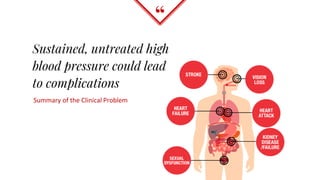
Sustained, untreated high
blood pressure could lead
to complications
Summary of the Clinical Problem
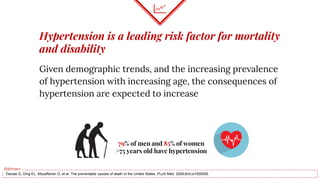
Hypertension is a leading risk factor for mortality
and disability
Given demographic trends, and the increasing prevalence
of hypertension with increasing age, the consequences of
hypertension are expected to increase
79% of men and 85% of women
>75 years old have hypertension
Danaei G, Ding EL, Mozaffarian D, et al. The preventable causes of death in the United States. PLoS Med. 2009;6(4):e1000058.
Reference
Evaluation
&
diagnosis
2
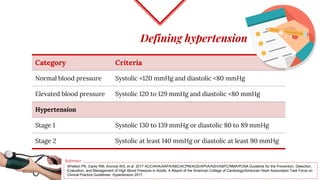
Defining hypertension
Category Criteria
Normal blood pressure Systolic <120 mmHg and diastolic <80 mmHg
Elevated blood pressure Systolic 120 to 129 mmHg and diastolic <80 mmHg
Hypertension
Stage 1 Systolic 130 to 139 mmHg or diastolic 80 to 89 mmHg
Stage 2 Systolic at least 140 mmHg or diastolic at least 90 mmHg
Whelton PK, Carey RM, Aronow WS, et al. 2017 ACC/AHA/AAPA/ABC/ACPM/AGS/APhA/ASH/ASPC/NMA/PCNA Guideline for the Prevention, Detection,
Evaluation, and Management of High Blood Pressure in Adults: A Report of the American College of Cardiology/American Heart Association Task Force on
Clinical Practice Guidelines. Hypertension 2017.
Reference
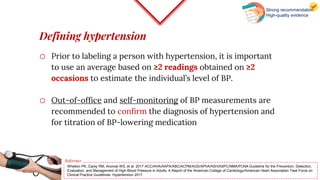
Defining hypertension
o Prior to labeling a person with hypertension, it is important
to use an average based on ≥2 readings obtained on ≥2
occasions to estimate the individual’s level of BP.
o Out-of-office and self-monitoring of BP measurements are
recommended to confirm the diagnosis of hypertension and
for titration of BP-lowering medication
Whelton PK, Carey RM, Aronow WS, et al. 2017 ACC/AHA/AAPA/ABC/ACPM/AGS/APhA/ASH/ASPC/NMA/PCNA Guideline for the Prevention, Detection,
Evaluation, and Management of High Blood Pressure in Adults: A Report of the American College of Cardiology/American Heart Association Task Force on
Clinical Practice Guidelines. Hypertension 2017.
Reference
Strong recommendation
High-quality evidence
Why is
Hypertension,
a concern?
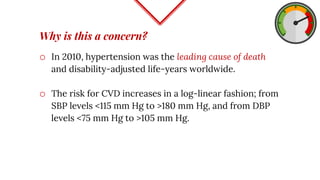
Why is this a concern?
o In 2010, hypertension was the leading cause of death
and disability-adjusted life-years worldwide.
o The risk for CVD increases in a log-linear fashion; from
SBP levels <115 mm Hg to >180 mm Hg, and from DBP
levels <75 mm Hg to >105 mm Hg.
Why is this a concern?
o A 20 mm Hg higher SBP and 10 mm Hg higher DBP are
each associated with a doubling in the risk of death
from stroke, heart disease, or other vascular disease.
Why is this a concern?
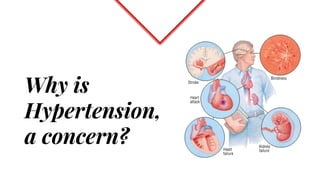
In persons ≥30 years of age, higher SBP and DBP are
associated with increased risk for:
CVD
Angina
Myocardial infarction (MI)
Heart failure (HF)
Stroke
Peripheral arterial disease
Abdominal aortic aneurysm
3
Initiating therapy
Non-pharmacological intervention
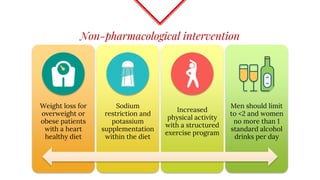
Weight loss for
overweight or
obese patients
with a heart
healthy diet
Sodium
restriction and
potassium
supplementation
within the diet
Increased
physical activity
with a structured
exercise program
Men should limit
to <2 and women
no more than 1
standard alcohol
drinks per day
Non-pharmacological intervention
o The usual impact of each lifestyle change is a 4-5 mm Hg
decrease in SBP and 2-4 mm Hg decrease in DBP
o But diet low in sodium, saturated fat, and total fat and
increase in fruits, vegetables, and grains may decrease SBP by
approximately 11 mm Hg.
Strong recommendation
High-quality evidence
Pharmacotherapy for hypertension
Drug-therapy is recommended for:
o Patients with clinical CVD
o (or) an estimated 10-year atherosclerotic CVD (ASCVD) risk of
10% or higher patients who have a SBP ≥ 130mmHg or a
DBP ≥ 80mmHg
Strong recommendation
High-quality evidence
[for SBP] and expert
opinion [for DBP]
Pharmacotherapy for hypertension
For patients with no history of CVD and an ASCVD risk of less
than 10%, BP-lowering medication is recommended:
 for patients who have an SBP of ≥ 140mmHg
 or a DBP of ≥ 90mmHg
Strong recommendation
High-quality evidence
[for SBP] and expert
opinion [for DBP]
Management options
3
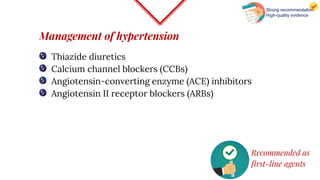
Management of hypertension
Thiazide diuretics
Calcium channel blockers (CCBs)
Angiotensin-converting enzyme (ACE) inhibitors
Angiotensin II receptor blockers (ARBs)
Recommended as
first-line agents
Strong recommendation
High-quality evidence
Management of hypertension
Patients with stage 2 hypertension & an average BP of >
20/10mmHg above their BP target:
should begin therapy with 2 first-line agents of
different classes
Strong recommendation
Expert opinion
Drug considerations
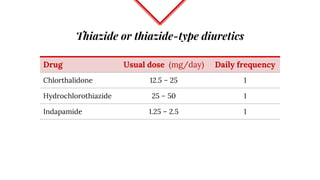
Thiazide or thiazide-type diuretics
Drug Usual dose (mg/day) Daily frequency
Chlorthalidone 12.5 – 25 1
Hydrochlorothiazide 25 – 50 1
Indapamide 1.25 – 2.5 1
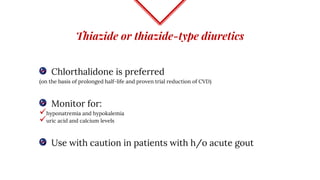
Thiazide or thiazide-type diuretics
Chlorthalidone is preferred
(on the basis of prolonged half-life and proven trial reduction of CVD)
Monitor for:
hyponatremia and hypokalemia
uric acid and calcium levels
Use with caution in patients with h/o acute gout
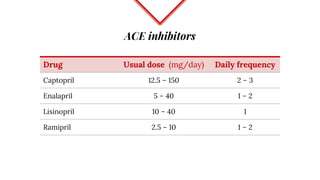
ACE inhibitors
Drug Usual dose (mg/day) Daily frequency
Captopril 12.5 – 150 2 – 3
Enalapril 5 – 40 1 – 2
Lisinopril 10 – 40 1
Ramipril 2.5 – 10 1 – 2
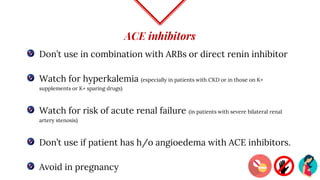
ACE inhibitors
Don’t use in combination with ARBs or direct renin inhibitor
Watch for hyperkalemia (especially in patients with CKD or in those on K+
supplements or K+ sparing drugs)
Watch for risk of acute renal failure (in patients with severe bilateral renal
artery stenosis)
Don’t use if patient has h/o angioedema with ACE inhibitors.
Avoid in pregnancy
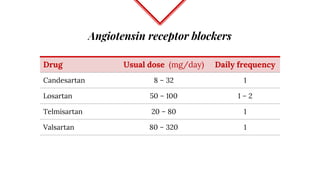
Angiotensin receptor blockers
Drug Usual dose (mg/day) Daily frequency
Candesartan 8 – 32 1
Losartan 50 – 100 1 – 2
Telmisartan 20 – 80 1
Valsartan 80 – 320 1
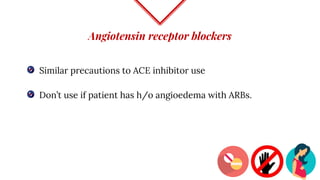
Angiotensin receptor blockers
Similar precautions to ACE inhibitor use
Don’t use if patient has h/o angioedema with ARBs.
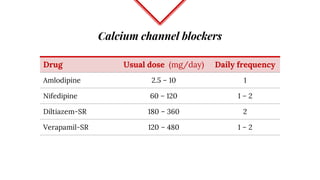
Calcium channel blockers
Drug Usual dose (mg/day) Daily frequency
Amlodipine 2.5 – 10 1
Nifedipine 60 – 120 1 – 2
Diltiazem-SR 180 – 360 2
Verapamil-SR 120 – 480 1 – 2
Angiotensin receptor blockers
Avoid routine use with beta blockers
(because of increased risk of bradycardia and heart block)
Don’t use in patients with HFrEF
HFrEF: Heart failure with reduced ejection fraction
Critical review of the
guideline
JAMA Clinical Guidelines Synopsis
Adam S. Cifu, Andrew M. Davis. Prevention, Detection, Evaluation, and Management of High Blood Pressure in Adults. JAMA. 2017;318(21):2132–2134. doi:10.1001/jama.2017.18706
Reference
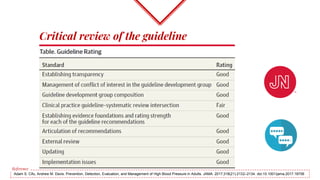
Critical review of the guideline
Adam S. Cifu, Andrew M. Davis. Prevention, Detection, Evaluation, and Management of High Blood Pressure in Adults. JAMA. 2017;318(21):2132–2134. doi:10.1001/jama.2017.18706
Reference
Areas in need of future study or
ongoing research
Areas in need of future study or ongoing research
Because lower BP is associated with better outcomes,
future trials should refine knowledge regarding the
balance between harms and benefits of BP treatment
This is especially true for stage 1 hypertension, for
which there is little information regarding the balance
between harms and benefits of treatment
Related Guidelines & Other Resources
7th Report of the Joint National Committee on Prevention,
Detection, Evaluation, and Treatment of High Blood Pressure
8th Report of the Joint National Committee on Prevention,
Detection, Evaluation, and Treatment of High Blood Pressure
2017 ACC/AHA Guideline—20-Page Summary
ASCVD Risk Estimator
Thank you
Questions and discussion

2017 hypertension guidelines

  • 1.
    High Blood Pressurein Adults Guideline The2017 for Prevention, Detection, Evaluation & Management of Dr. Chaithanya Malalur
  • 2.
    A Summary report ofthe 2017 guideline American College of Cardiology/American Heart Association Task Force on Clinical Practice Guidelines
  • 3.
    million adults worldwide, havean SBP of 140mmHg or higher 874,000,000
  • 4.
    Contents of thepresentation Background of hypertension Evaluation & diagnosis Initiating therapy Management options
  • 5.
    Hypertension is aleading risk factor for mortality and disability With its association with CVD, stroke, heart failure, and chronic kidney disease, o hypertension is second only to cigarette smoking as a preventable cause of death in the United States Whelton PK, Carey RM, Aronow WS, et al. 2017 ACC/AHA/AAPA/ABC/ACPM/AGS/APhA/ASH/ASPC/NMA/PCNA Guideline for the Prevention, Detection, Evaluation, and Management of High Blood Pressure in Adults: A Report of the American College of Cardiology/American Heart Association Task Force on Clinical Practice Guidelines. Hypertension 2017. Reference
  • 6.
    “ Sustained, untreated high bloodpressure could lead to complications Summary of the Clinical Problem
  • 7.
    Hypertension is aleading risk factor for mortality and disability Given demographic trends, and the increasing prevalence of hypertension with increasing age, the consequences of hypertension are expected to increase 79% of men and 85% of women >75 years old have hypertension Danaei G, Ding EL, Mozaffarian D, et al. The preventable causes of death in the United States. PLoS Med. 2009;6(4):e1000058. Reference
  • 8.
  • 9.
    Defining hypertension Category Criteria Normalblood pressure Systolic <120 mmHg and diastolic <80 mmHg Elevated blood pressure Systolic 120 to 129 mmHg and diastolic <80 mmHg Hypertension Stage 1 Systolic 130 to 139 mmHg or diastolic 80 to 89 mmHg Stage 2 Systolic at least 140 mmHg or diastolic at least 90 mmHg Whelton PK, Carey RM, Aronow WS, et al. 2017 ACC/AHA/AAPA/ABC/ACPM/AGS/APhA/ASH/ASPC/NMA/PCNA Guideline for the Prevention, Detection, Evaluation, and Management of High Blood Pressure in Adults: A Report of the American College of Cardiology/American Heart Association Task Force on Clinical Practice Guidelines. Hypertension 2017. Reference
  • 10.
    Defining hypertension o Priorto labeling a person with hypertension, it is important to use an average based on ≥2 readings obtained on ≥2 occasions to estimate the individual’s level of BP. o Out-of-office and self-monitoring of BP measurements are recommended to confirm the diagnosis of hypertension and for titration of BP-lowering medication Whelton PK, Carey RM, Aronow WS, et al. 2017 ACC/AHA/AAPA/ABC/ACPM/AGS/APhA/ASH/ASPC/NMA/PCNA Guideline for the Prevention, Detection, Evaluation, and Management of High Blood Pressure in Adults: A Report of the American College of Cardiology/American Heart Association Task Force on Clinical Practice Guidelines. Hypertension 2017. Reference Strong recommendation High-quality evidence
  • 11.
  • 12.
    Why is thisa concern? o In 2010, hypertension was the leading cause of death and disability-adjusted life-years worldwide. o The risk for CVD increases in a log-linear fashion; from SBP levels <115 mm Hg to >180 mm Hg, and from DBP levels <75 mm Hg to >105 mm Hg.
  • 13.
    Why is thisa concern? o A 20 mm Hg higher SBP and 10 mm Hg higher DBP are each associated with a doubling in the risk of death from stroke, heart disease, or other vascular disease.
  • 14.
    Why is thisa concern? In persons ≥30 years of age, higher SBP and DBP are associated with increased risk for: CVD Angina Myocardial infarction (MI) Heart failure (HF) Stroke Peripheral arterial disease Abdominal aortic aneurysm
  • 15.
  • 16.
    Non-pharmacological intervention Weight lossfor overweight or obese patients with a heart healthy diet Sodium restriction and potassium supplementation within the diet Increased physical activity with a structured exercise program Men should limit to <2 and women no more than 1 standard alcohol drinks per day
  • 17.
    Non-pharmacological intervention o Theusual impact of each lifestyle change is a 4-5 mm Hg decrease in SBP and 2-4 mm Hg decrease in DBP o But diet low in sodium, saturated fat, and total fat and increase in fruits, vegetables, and grains may decrease SBP by approximately 11 mm Hg. Strong recommendation High-quality evidence
  • 18.
    Pharmacotherapy for hypertension Drug-therapyis recommended for: o Patients with clinical CVD o (or) an estimated 10-year atherosclerotic CVD (ASCVD) risk of 10% or higher patients who have a SBP ≥ 130mmHg or a DBP ≥ 80mmHg Strong recommendation High-quality evidence [for SBP] and expert opinion [for DBP]
  • 19.
    Pharmacotherapy for hypertension Forpatients with no history of CVD and an ASCVD risk of less than 10%, BP-lowering medication is recommended:  for patients who have an SBP of ≥ 140mmHg  or a DBP of ≥ 90mmHg Strong recommendation High-quality evidence [for SBP] and expert opinion [for DBP]
  • 20.
  • 21.
    Management of hypertension Thiazidediuretics Calcium channel blockers (CCBs) Angiotensin-converting enzyme (ACE) inhibitors Angiotensin II receptor blockers (ARBs) Recommended as first-line agents Strong recommendation High-quality evidence
  • 22.
    Management of hypertension Patientswith stage 2 hypertension & an average BP of > 20/10mmHg above their BP target: should begin therapy with 2 first-line agents of different classes Strong recommendation Expert opinion
  • 23.
  • 24.
    Thiazide or thiazide-typediuretics Drug Usual dose (mg/day) Daily frequency Chlorthalidone 12.5 – 25 1 Hydrochlorothiazide 25 – 50 1 Indapamide 1.25 – 2.5 1
  • 25.
    Thiazide or thiazide-typediuretics Chlorthalidone is preferred (on the basis of prolonged half-life and proven trial reduction of CVD) Monitor for: hyponatremia and hypokalemia uric acid and calcium levels Use with caution in patients with h/o acute gout
  • 26.
    ACE inhibitors Drug Usualdose (mg/day) Daily frequency Captopril 12.5 – 150 2 – 3 Enalapril 5 – 40 1 – 2 Lisinopril 10 – 40 1 Ramipril 2.5 – 10 1 – 2
  • 27.
    ACE inhibitors Don’t usein combination with ARBs or direct renin inhibitor Watch for hyperkalemia (especially in patients with CKD or in those on K+ supplements or K+ sparing drugs) Watch for risk of acute renal failure (in patients with severe bilateral renal artery stenosis) Don’t use if patient has h/o angioedema with ACE inhibitors. Avoid in pregnancy
  • 28.
    Angiotensin receptor blockers DrugUsual dose (mg/day) Daily frequency Candesartan 8 – 32 1 Losartan 50 – 100 1 – 2 Telmisartan 20 – 80 1 Valsartan 80 – 320 1
  • 29.
    Angiotensin receptor blockers Similarprecautions to ACE inhibitor use Don’t use if patient has h/o angioedema with ARBs.
  • 30.
    Calcium channel blockers DrugUsual dose (mg/day) Daily frequency Amlodipine 2.5 – 10 1 Nifedipine 60 – 120 1 – 2 Diltiazem-SR 180 – 360 2 Verapamil-SR 120 – 480 1 – 2
  • 31.
    Angiotensin receptor blockers Avoidroutine use with beta blockers (because of increased risk of bradycardia and heart block) Don’t use in patients with HFrEF HFrEF: Heart failure with reduced ejection fraction
  • 32.
    Critical review ofthe guideline JAMA Clinical Guidelines Synopsis Adam S. Cifu, Andrew M. Davis. Prevention, Detection, Evaluation, and Management of High Blood Pressure in Adults. JAMA. 2017;318(21):2132–2134. doi:10.1001/jama.2017.18706 Reference
  • 33.
    Critical review ofthe guideline Adam S. Cifu, Andrew M. Davis. Prevention, Detection, Evaluation, and Management of High Blood Pressure in Adults. JAMA. 2017;318(21):2132–2134. doi:10.1001/jama.2017.18706 Reference
  • 34.
    Areas in needof future study or ongoing research
  • 35.
    Areas in needof future study or ongoing research Because lower BP is associated with better outcomes, future trials should refine knowledge regarding the balance between harms and benefits of BP treatment This is especially true for stage 1 hypertension, for which there is little information regarding the balance between harms and benefits of treatment
  • 36.
    Related Guidelines &Other Resources 7th Report of the Joint National Committee on Prevention, Detection, Evaluation, and Treatment of High Blood Pressure 8th Report of the Joint National Committee on Prevention, Detection, Evaluation, and Treatment of High Blood Pressure 2017 ACC/AHA Guideline—20-Page Summary ASCVD Risk Estimator
  • 37.