Matthew Sorrentino MD FACC FASH
Professor of Medicine
Cardiology
University of Chicago Medicine
12 May, Nha Trang City, Vietnam, VSH Conference
Redefining Hypertension – Assessing the
New Blood Pressure Guidelines
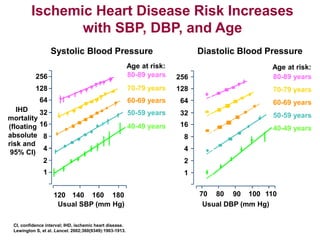
Ischemic Heart Disease Risk Increases
with SBP, DBP, and Age
CI, confidence interval; IHD, ischemic heart disease.
Lewington S, et al. Lancet. 2002;360(9349):1903-1913.
Systolic Blood Pressure
40-49 years
50-59 years
60-69 years
70-79 years
80-89 years
Age at risk:
IHD
mortality
(floating
absolute
risk and
95% CI)
256
128
64
32
16
8
4
2
1
120 140 160 180
Usual SBP (mm Hg)
Diastolic Blood Pressure
256
128
64
32
16
8
4
2
1
70 80 90 100 110
Usual DBP (mm Hg)
Age at risk:
40-49 years
50-59 years
60-69 years
70-79 years
80-89 years
Wright, JT Jr., et al. N.Engl.J.Med. 2015;373 : 2103-2116
SPRINT Trial
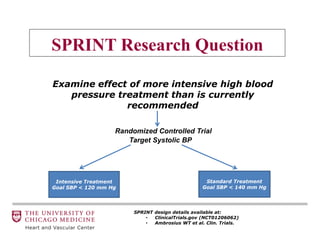
SPRINT Research Question
Examine effect of more intensive high blood
pressure treatment than is currently
recommended
Randomized Controlled Trial
Target Systolic BP
Intensive Treatment
Goal SBP < 120 mm Hg
Standard Treatment
Goal SBP < 140 mm Hg
SPRINT design details available at:
• ClinicalTrials.gov (NCT01206062)
• Ambrosius WT et al. Clin. Trials. 2014;11:532-546.
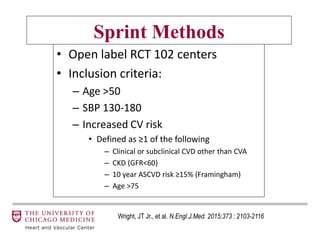
Sprint Methods
• Open label RCT 102 centers
• Inclusion criteria:
– Age >50
– SBP 130-180
– Increased CV risk
• Defined as ≥1 of the following
– Clinical or subclinical CVD other than CVA
– CKD (GFR<60)
– 10 year ASCVD risk ≥15% (Framingham)
– Age >75
Wright, JT Jr., et al. N.Engl.J.Med. 2015;373 : 2103-2116
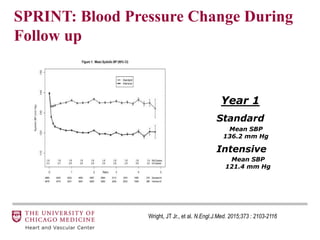
Mean SBP
136.2 mm Hg
Mean SBP
121.4 mm Hg
Standard
Intensive
Year 1
SPRINT: Blood Pressure Change During
Follow up
Wright, JT Jr., et al. N.Engl.J.Med. 2015;373 : 2103-2116
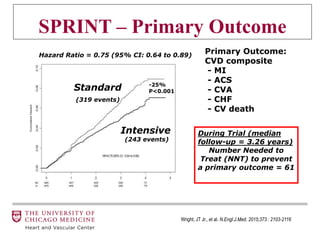
Hazard Ratio = 0.75 (95% CI: 0.64 to 0.89)
Standard
Intensive
(243 events)
During Trial (median
follow-up = 3.26 years)
Number Needed to
Treat (NNT) to prevent
a primary outcome = 61
SPRINT – Primary Outcome
(319 events)
-25%
P<0.001
Primary Outcome:
CVD composite
- MI
- ACS
- CVA
- CHF
- CV death
Wright, JT Jr., et al. N.Engl.J.Med. 2015;373 : 2103-2116
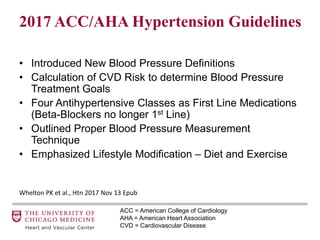
2017 ACC/AHA Hypertension Guidelines
• Introduced New Blood Pressure Definitions
• Calculation of CVD Risk to determine Blood Pressure
Treatment Goals
• Four Antihypertensive Classes as First Line Medications
(Beta-Blockers no longer 1st Line)
• Outlined Proper Blood Pressure Measurement
Technique
• Emphasized Lifestyle Modification – Diet and Exercise
ACC = American College of Cardiology
AHA = American Heart Association
CVD = Cardiovascular Disease
Whelton PK et al., Htn 2017 Nov 13 Epub
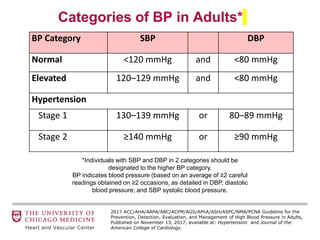
Categories of BP in Adults*
*Individuals with SBP and DBP in 2 categories should be
designated to the higher BP category.
BP indicates blood pressure (based on an average of ≥2 careful
readings obtained on ≥2 occasions, as detailed in DBP, diastolic
blood pressure; and SBP systolic blood pressure.
BP Category SBP DBP
Normal <120 mmHg and <80 mmHg
Elevated 120–129 mmHg and <80 mmHg
Hypertension
Stage 1 130–139 mmHg or 80–89 mmHg
Stage 2 ≥140 mmHg or ≥90 mmHg
2017 ACC/AHA/AAPA/ABC/ACPM/AGS/APhA/ASH/ASPC/NMA/PCNA Guideline for the
Prevention, Detection, Evaluation, and Management of High Blood Pressure in Adults,
Published on November 13, 2017, available at: Hypertension and Journal of the
American College of Cardiology.
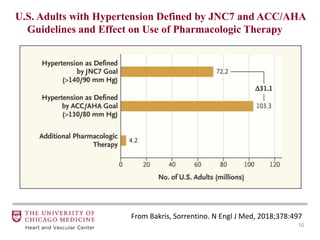
U.S. Adults with Hypertension Defined by JNC7 and ACC/AHA
Guidelines and Effect on Use of Pharmacologic Therapy
10
From Bakris, Sorrentino. N Engl J Med, 2018;378:497
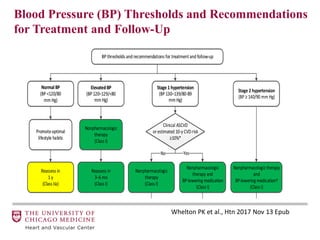
Normal BP
(BP <120/80
mm Hg)
Promoteoptimal
lifestyle habits
Elevated BP
(BP 120–129/<80
mm Hg)
Stage 1 hypertension
(BP 130–139/80-89
mm Hg)
Nonpharmacologic
therapy
(Class I)
Reassess in
3–6 mo
(Class I)
Reassess in
1 mo
(Class I)
Nonpharmacologic
therapy and
BP-lowering medication
(Class I)
Reassess in
1 y
(Class IIa)
Clinical ASCVD
orestimated 10-y CVDrisk
≥10%*
YesNo
Nonpharmacologic
therapy
(Class I)
BP thresholds and recommendations for treatment and follow-up
Nonpharmacologictherapy
and
BP-lowering medication†
(Class I)
Reassess in
3–6 mo
(Class I)
Stage 2 hypertension
(BP ≥ 140/90 mm Hg)
Blood Pressure (BP) Thresholds and Recommendations
for Treatment and Follow-Up
Whelton PK et al., Htn 2017 Nov 13 Epub
12
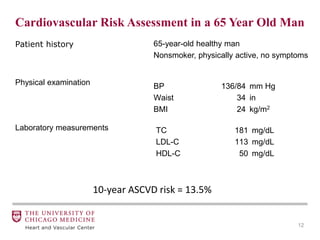
Cardiovascular Risk Assessment in a 65 Year Old Man
Patient history
Physical examination
Laboratory measurements
65-year-old healthy man
Nonsmoker, physically active, no symptoms
BP 136/84 mm Hg
Waist 34 in
BMI 24 kg/m2
TC 181 mg/dL
LDL-C 113 mg/dL
HDL-C 50 mg/dL
10-year ASCVD risk = 13.5%
Risk Calculators
• Used Pooled Cohort Risk calculator in non-Hispanic Whites and non-
Hispanic African Americans age 40-79 without ASCVD and not on
statin therapy
• May overestimate risk in other populations
• May overestimate risk if on therapy for other risk factors
• 10% 10-year risk category definition of high risk is arbitrary – SPRINT
trial defined high risk as 15% ten-year risk
• May not be widely used by busy primary care physicians leading to
over treatment of elevated blood pressure
13
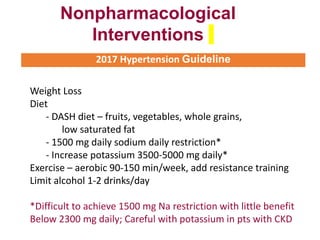
Nonpharmacological
Interventions
2017 Hypertension Guideline
Weight Loss
Diet
- DASH diet – fruits, vegetables, whole grains,
low saturated fat
- 1500 mg daily sodium daily restriction*
- Increase potassium 3500-5000 mg daily*
Exercise – aerobic 90-150 min/week, add resistance training
Limit alcohol 1-2 drinks/day
*Difficult to achieve 1500 mg Na restriction with little benefit
Below 2300 mg daily; Careful with potassium in pts with CKD
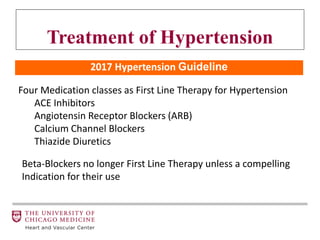
Treatment of Hypertension
Four Medication classes as First Line Therapy for Hypertension
ACE Inhibitors
Angiotensin Receptor Blockers (ARB)
Calcium Channel Blockers
Thiazide Diuretics
Beta-Blockers no longer First Line Therapy unless a compelling
Indication for their use
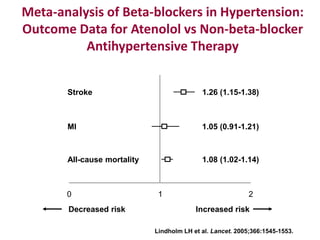
0 1 2
Meta-analysis of Beta-blockers in Hypertension:
Outcome Data for Atenolol vs Non-beta-blocker
Antihypertensive Therapy
1.26 (1.15-1.38)
1.05 (0.91-1.21)
1.08 (1.02-1.14)
Stroke
MI
All-cause mortality
Lindholm LH et al. Lancet. 2005;366:1545-1553.
Increased riskDecreased risk
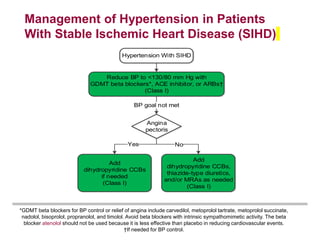
Management of Hypertension in Patients
With Stable Ischemic Heart Disease (SIHD)
Hypertension With SIHD
Reduce BP to <130/80 mm Hg with
GDMT beta blockers*, ACE inhibitor, or ARBs†
(Class I)
Add
dihydropyridine CCBs
if needed
(Class I)
Add
dihydropyridine CCBs,
thiazide-type diuretics,
and/or MRAs as needed
(Class I)
Angina
pectoris
No
BP goal not met
Yes
*GDMT beta blockers for BP control or relief of angina include carvedilol, metoprolol tartrate, metoprolol succinate,
nadolol, bisoprolol, propranolol, and timolol. Avoid beta blockers with intrinsic sympathomimetic activity. The beta
blocker atenolol should not be used because it is less effective than placebo in reducing cardiovascular events.
†If needed for BP control.
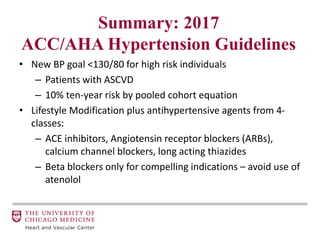
Summary: 2017
ACC/AHA Hypertension Guidelines
• New BP goal <130/80 for high risk individuals
– Patients with ASCVD
– 10% ten-year risk by pooled cohort equation
• Lifestyle Modification plus antihypertensive agents from 4-
classes:
– ACE inhibitors, Angiotensin receptor blockers (ARBs),
calcium channel blockers, long acting thiazides
– Beta blockers only for compelling indications – avoid use of
atenolol

Cd2.15 redefining hypertension

  • 1.
    Matthew Sorrentino MDFACC FASH Professor of Medicine Cardiology University of Chicago Medicine 12 May, Nha Trang City, Vietnam, VSH Conference Redefining Hypertension – Assessing the New Blood Pressure Guidelines
  • 2.
    Ischemic Heart DiseaseRisk Increases with SBP, DBP, and Age CI, confidence interval; IHD, ischemic heart disease. Lewington S, et al. Lancet. 2002;360(9349):1903-1913. Systolic Blood Pressure 40-49 years 50-59 years 60-69 years 70-79 years 80-89 years Age at risk: IHD mortality (floating absolute risk and 95% CI) 256 128 64 32 16 8 4 2 1 120 140 160 180 Usual SBP (mm Hg) Diastolic Blood Pressure 256 128 64 32 16 8 4 2 1 70 80 90 100 110 Usual DBP (mm Hg) Age at risk: 40-49 years 50-59 years 60-69 years 70-79 years 80-89 years
  • 3.
    Wright, JT Jr.,et al. N.Engl.J.Med. 2015;373 : 2103-2116 SPRINT Trial
  • 4.
    SPRINT Research Question Examineeffect of more intensive high blood pressure treatment than is currently recommended Randomized Controlled Trial Target Systolic BP Intensive Treatment Goal SBP < 120 mm Hg Standard Treatment Goal SBP < 140 mm Hg SPRINT design details available at: • ClinicalTrials.gov (NCT01206062) • Ambrosius WT et al. Clin. Trials. 2014;11:532-546.
  • 5.
    Sprint Methods • Openlabel RCT 102 centers • Inclusion criteria: – Age >50 – SBP 130-180 – Increased CV risk • Defined as ≥1 of the following – Clinical or subclinical CVD other than CVA – CKD (GFR<60) – 10 year ASCVD risk ≥15% (Framingham) – Age >75 Wright, JT Jr., et al. N.Engl.J.Med. 2015;373 : 2103-2116
  • 6.
    Mean SBP 136.2 mmHg Mean SBP 121.4 mm Hg Standard Intensive Year 1 SPRINT: Blood Pressure Change During Follow up Wright, JT Jr., et al. N.Engl.J.Med. 2015;373 : 2103-2116
  • 7.
    Hazard Ratio =0.75 (95% CI: 0.64 to 0.89) Standard Intensive (243 events) During Trial (median follow-up = 3.26 years) Number Needed to Treat (NNT) to prevent a primary outcome = 61 SPRINT – Primary Outcome (319 events) -25% P<0.001 Primary Outcome: CVD composite - MI - ACS - CVA - CHF - CV death Wright, JT Jr., et al. N.Engl.J.Med. 2015;373 : 2103-2116
  • 8.
    2017 ACC/AHA HypertensionGuidelines • Introduced New Blood Pressure Definitions • Calculation of CVD Risk to determine Blood Pressure Treatment Goals • Four Antihypertensive Classes as First Line Medications (Beta-Blockers no longer 1st Line) • Outlined Proper Blood Pressure Measurement Technique • Emphasized Lifestyle Modification – Diet and Exercise ACC = American College of Cardiology AHA = American Heart Association CVD = Cardiovascular Disease Whelton PK et al., Htn 2017 Nov 13 Epub
  • 9.
    Categories of BPin Adults* *Individuals with SBP and DBP in 2 categories should be designated to the higher BP category. BP indicates blood pressure (based on an average of ≥2 careful readings obtained on ≥2 occasions, as detailed in DBP, diastolic blood pressure; and SBP systolic blood pressure. BP Category SBP DBP Normal <120 mmHg and <80 mmHg Elevated 120–129 mmHg and <80 mmHg Hypertension Stage 1 130–139 mmHg or 80–89 mmHg Stage 2 ≥140 mmHg or ≥90 mmHg 2017 ACC/AHA/AAPA/ABC/ACPM/AGS/APhA/ASH/ASPC/NMA/PCNA Guideline for the Prevention, Detection, Evaluation, and Management of High Blood Pressure in Adults, Published on November 13, 2017, available at: Hypertension and Journal of the American College of Cardiology.
  • 10.
    U.S. Adults withHypertension Defined by JNC7 and ACC/AHA Guidelines and Effect on Use of Pharmacologic Therapy 10 From Bakris, Sorrentino. N Engl J Med, 2018;378:497
  • 11.
    Normal BP (BP <120/80 mmHg) Promoteoptimal lifestyle habits Elevated BP (BP 120–129/<80 mm Hg) Stage 1 hypertension (BP 130–139/80-89 mm Hg) Nonpharmacologic therapy (Class I) Reassess in 3–6 mo (Class I) Reassess in 1 mo (Class I) Nonpharmacologic therapy and BP-lowering medication (Class I) Reassess in 1 y (Class IIa) Clinical ASCVD orestimated 10-y CVDrisk ≥10%* YesNo Nonpharmacologic therapy (Class I) BP thresholds and recommendations for treatment and follow-up Nonpharmacologictherapy and BP-lowering medication† (Class I) Reassess in 3–6 mo (Class I) Stage 2 hypertension (BP ≥ 140/90 mm Hg) Blood Pressure (BP) Thresholds and Recommendations for Treatment and Follow-Up Whelton PK et al., Htn 2017 Nov 13 Epub
  • 12.
    12 Cardiovascular Risk Assessmentin a 65 Year Old Man Patient history Physical examination Laboratory measurements 65-year-old healthy man Nonsmoker, physically active, no symptoms BP 136/84 mm Hg Waist 34 in BMI 24 kg/m2 TC 181 mg/dL LDL-C 113 mg/dL HDL-C 50 mg/dL 10-year ASCVD risk = 13.5%
  • 13.
    Risk Calculators • UsedPooled Cohort Risk calculator in non-Hispanic Whites and non- Hispanic African Americans age 40-79 without ASCVD and not on statin therapy • May overestimate risk in other populations • May overestimate risk if on therapy for other risk factors • 10% 10-year risk category definition of high risk is arbitrary – SPRINT trial defined high risk as 15% ten-year risk • May not be widely used by busy primary care physicians leading to over treatment of elevated blood pressure 13
  • 14.
    Nonpharmacological Interventions 2017 Hypertension Guideline WeightLoss Diet - DASH diet – fruits, vegetables, whole grains, low saturated fat - 1500 mg daily sodium daily restriction* - Increase potassium 3500-5000 mg daily* Exercise – aerobic 90-150 min/week, add resistance training Limit alcohol 1-2 drinks/day *Difficult to achieve 1500 mg Na restriction with little benefit Below 2300 mg daily; Careful with potassium in pts with CKD
  • 15.
    Treatment of Hypertension FourMedication classes as First Line Therapy for Hypertension ACE Inhibitors Angiotensin Receptor Blockers (ARB) Calcium Channel Blockers Thiazide Diuretics Beta-Blockers no longer First Line Therapy unless a compelling Indication for their use
  • 16.
    0 1 2 Meta-analysisof Beta-blockers in Hypertension: Outcome Data for Atenolol vs Non-beta-blocker Antihypertensive Therapy 1.26 (1.15-1.38) 1.05 (0.91-1.21) 1.08 (1.02-1.14) Stroke MI All-cause mortality Lindholm LH et al. Lancet. 2005;366:1545-1553. Increased riskDecreased risk
  • 17.
    Management of Hypertensionin Patients With Stable Ischemic Heart Disease (SIHD) Hypertension With SIHD Reduce BP to <130/80 mm Hg with GDMT beta blockers*, ACE inhibitor, or ARBs† (Class I) Add dihydropyridine CCBs if needed (Class I) Add dihydropyridine CCBs, thiazide-type diuretics, and/or MRAs as needed (Class I) Angina pectoris No BP goal not met Yes *GDMT beta blockers for BP control or relief of angina include carvedilol, metoprolol tartrate, metoprolol succinate, nadolol, bisoprolol, propranolol, and timolol. Avoid beta blockers with intrinsic sympathomimetic activity. The beta blocker atenolol should not be used because it is less effective than placebo in reducing cardiovascular events. †If needed for BP control.
  • 18.
    Summary: 2017 ACC/AHA HypertensionGuidelines • New BP goal <130/80 for high risk individuals – Patients with ASCVD – 10% ten-year risk by pooled cohort equation • Lifestyle Modification plus antihypertensive agents from 4- classes: – ACE inhibitors, Angiotensin receptor blockers (ARBs), calcium channel blockers, long acting thiazides – Beta blockers only for compelling indications – avoid use of atenolol