2017 ACC/AHA
Guidelines
Scope of the Guideline
• Update of the JNC 7
• Information from studies of office-based
BP-related risk of CVD, ambulatory
blood pressure monitoring (ABPM),
home blood pressure monitoring
(HBPM), telemedicine, and various
other areas
BP AND CVD RISK
• Associations between higher systolic
blood pressure (SBP) and diastolic blood
pressure (DBP) and increased CVD risk
• Increased in the risk of CVD from SBP
<115 mmHg to >180 mmHg; DBP <75
mmHg and >105 mmHg
• Higher SBP and DBP were also
associated with increased risk:
– CVD incidence and angina
– Myocardial infarction (MI)
– HF
– Stroke
– Peripheral artery disease
– Abdominal aortic aneurysm
CVD Risk Factors in Patients
with Hypertension
Modifiable Relatively Fixed
Current cigarette smoking,
second hand smoking
CKD
Diabetes mellitus Family history
Dyslipidemia Increased age
Overweight/Obesity Low socioeconomic/educational
status
Physical inactivity/low fitness Male sex
Unhealthy diet Obstructive sleep apnea
Psychosocial stress
CLASSIFICATION OF BP
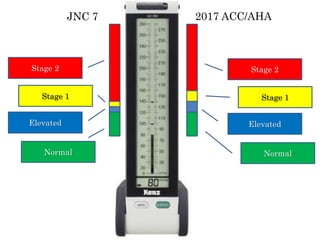
BP Category SBP DBP
Normal < 120 mmHg And < 80 mmHg
Elevated 120-129 mmHg And < 80 mmHg
Hypertension
Stage 1 130-139 mmHg Or 80-89 mmHg
Stage 2 ≥ 140 mmHg Or ≥ 90 mmHg
2017 ACC/AHA Hypertension Guidelines
BP Classification SBP DBP
Normal < 120 mmHg And < 80 mmHg
Prehypertension 120-139 mmHg Or 80-89 mmHg
Stage 1 hypertension 140-159 mmHg Or 90-99 mmHg
Stage 2 hypertension ≥ 160 mmHg Or ≥ 100 mmHg
7th Joint National Committee (JNC) on
Prevention, Detection, Evaluation, and Treatment
of High Blood Pressure (2003)
JNC 7 2017 ACC/AHA
Normal
Elevated
Stage 1
Stage 2
Normal
Elevated
Stage 1
Stage 2
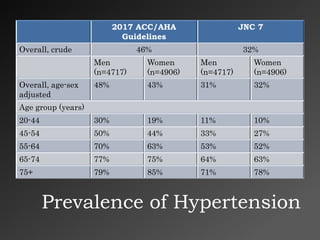
Prevalence of Hypertension
2017 ACC/AHA
Guidelines
JNC 7
Overall, crude 46% 32%
Men
(n=4717)
Women
(n=4906)
Men
(n=4717)
Women
(n=4906)
Overall, age-sex
adjusted
48% 43% 31% 32%
Age group (years)
20-44 30% 19% 11% 10%
45-54 50% 44% 33% 27%
55-64 70% 63% 53% 52%
65-74 77% 75% 64% 63%
75+ 79% 85% 71% 78%
MEASUREMENT OF BP
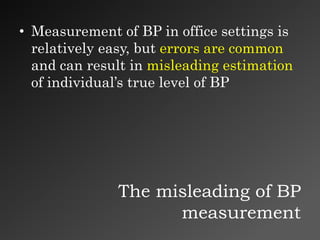
The misleading of BP
measurement
• Measurement of BP in office settings is
relatively easy, but errors are common
and can result in misleading estimation
of individual’s true level of BP
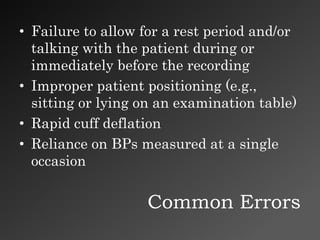
Common Errors
• Failure to allow for a rest period and/or
talking with the patient during or
immediately before the recording
• Improper patient positioning (e.g.,
sitting or lying on an examination table)
• Rapid cuff deflation
• Reliance on BPs measured at a single
occasion
Accurate Measurement of BP
• Have the patient relax, sitting in a chair (feet on floor,
back supported) for >5 min
• The patient should avoid caffeine, exercise, and
smoking for at least 30 min before measurement
• Ensure patient has emptied his/her bladder
• Neither the patient nor the observer should talk
during the rest period or during the measurement
• Remove all clothing covering the location of cuff
placement
• Measurements made while the patient is sitting or
lying on an examining table do not fulfill these
criteria
1. Properly prepare the patient
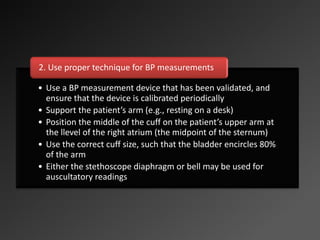
• Use a BP measurement device that has been validated, and
ensure that the device is calibrated periodically
• Support the patient’s arm (e.g., resting on a desk)
• Position the middle of the cuff on the patient’s upper arm at
the llevel of the right atrium (the midpoint of the sternum)
• Use the correct cuff size, such that the bladder encircles 80%
of the arm
• Either the stethoscope diaphragm or bell may be used for
auscultatory readings
2. Use proper technique for BP measurements
• At the first visit, record BP in both arms. Use the arm
that gives the higher reading for subsequent readings
• Separate repeated measurements by 1-2 min
• For auscultatory determinations, use a palpated
estimate of radial pulse obliteration pressure to
estimate SBP. Inflate the cuff 20-30 mmHg above this
level for an auscultatory determination of the BP level
• For auscultatory readings, deflate the cuff pressure 2
mmHg per second, and listen for Korotkoff sounds
3. Take the proper measurements
needed for diagnosis and treatment of
elevated BP/hypertension
• Record SBP and DBP. If using the auscultatory
technique, record SBP and DBP as onset of the first
Korotkoff sound and disappearance of all Korotkoff
sounds, respectively using the nearest even number
• Note the time of most recent BP medication taken
before measurements
4. Properly document accurate BP readings
• Use an average of ≥ 2 readings obtained on ≥ 2
occasions to estimate the individual’s level of BP
5. Average the readings
Class of Recommendation Level of Evidence
I ASR
Out-of-office BP measurements are recommended to
confirm the diagnosis of hypertension and for titration of
BP-lowering medication, in conjunction with telehealth
counseling or clinical interventions
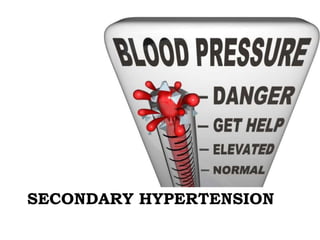
SECONDARY HYPERTENSION
Secondary Hypertension
• A specific, remediable cause of
hypertension can be identified in
approximately 10% of adult patients
with hypertension
• Secondary hypertension can underlie:
– Severe elevation of BP
– Pharmacologically resistant hypertension
– Sudden onset of hypertension
– Increased BP in patients with hypertension
previously controlled on drug therapy
– Onset of diastolic hypertension in older
adults
– Target organ damage disproportionate to
the duration or severity of the hypertension
MASKED AND WHITE COAT
HYPERTENSION
NON PHARMACOLOGICAL
INTERVENTION
Approximate Impact on SBP
Dose Hypertension Normotension
Weight loss Best goal is ideal body
weight, but aim for at least a
1-kg reduction in body
weight for most adults who
are overweight. Expect about
1 mmHg for every 1 kg
reduction in body weight
- 5 mmHg - 2/3 mmHg
Approximate Impact on SBP
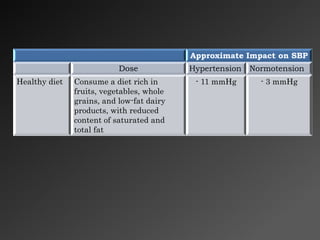
Dose Hypertension Normotension
Healthy diet Consume a diet rich in
fruits, vegetables, whole
grains, and low-fat dairy
products, with reduced
content of saturated and
total fat
- 11 mmHg - 3 mmHg
Approximate Impact on SBP
Dose Hypertension Normotension
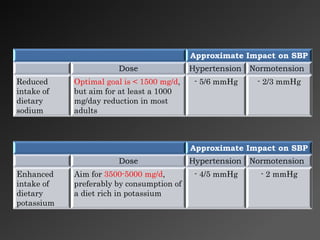
Reduced
intake of
dietary
sodium
Optimal goal is < 1500 mg/d,
but aim for at least a 1000
mg/day reduction in most
adults
- 5/6 mmHg - 2/3 mmHg
Approximate Impact on SBP
Dose Hypertension Normotension
Enhanced
intake of
dietary
potassium
Aim for 3500-5000 mg/d,
preferably by consumption of
a diet rich in potassium
- 4/5 mmHg - 2 mmHg
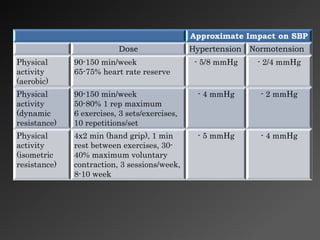
Approximate Impact on SBP
Dose Hypertension Normotension
Physical
activity
(aerobic)
90-150 min/week
65-75% heart rate reserve
- 5/8 mmHg - 2/4 mmHg
Physical
activity
(dynamic
resistance)
90-150 min/week
50-80% 1 rep maximum
6 exercises, 3 sets/exercises,
10 repetitions/set
- 4 mmHg - 2 mmHg
Physical
activity
(isometric
resistance)
4x2 min (hand grip), 1 min
rest between exercises, 30-
40% maximum voluntary
contraction, 3 sessions/week,
8-10 week
- 5 mmHg - 4 mmHg
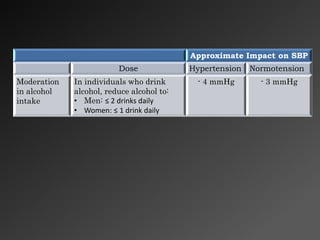
Approximate Impact on SBP
Dose Hypertension Normotension
Moderation
in alcohol
intake
In individuals who drink
alcohol, reduce alcohol to:
• Men: ≤ 2 drinks daily
• Women: ≤ 1 drink daily
- 4 mmHg - 3 mmHg
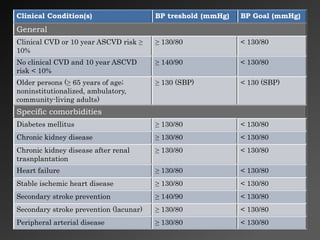
BP TARGET
Clinical Condition(s) BP treshold (mmHg) BP Goal (mmHg)
General
Clinical CVD or 10 year ASCVD risk ≥
10%
≥ 130/80 < 130/80
No clinical CVD and 10 year ASCVD
risk < 10%
≥ 140/90 < 130/80
Older persons (≥ 65 years of age;
noninstitutionalized, ambulatory,
community-living adults)
≥ 130 (SBP) < 130 (SBP)
Specific comorbidities
Diabetes mellitus ≥ 130/80 < 130/80
Chronic kidney disease ≥ 130/80 < 130/80
Chronic kidney disease after renal
trasnplantation
≥ 130/80 < 130/80
Heart failure ≥ 130/80 < 130/80
Stable ischemic heart disease ≥ 130/80 < 130/80
Secondary stroke prevention ≥ 140/90 < 130/80
Secondary stroke prevention (lacunar) ≥ 130/80 < 130/80
Peripheral arterial disease ≥ 130/80 < 130/80
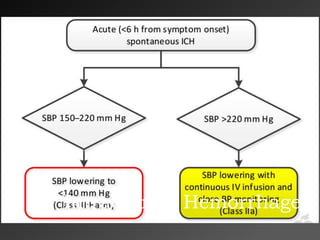
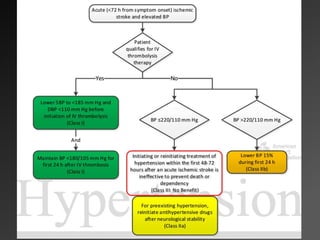
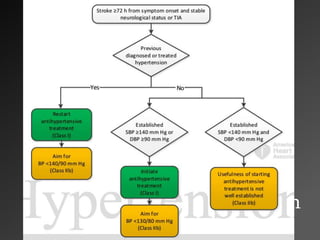
HYPERTENSION AND STROKE
Intracranial Hemorrhage
Acute Ischemic Stroke
Secondary Stroke Prevention
2017 ACC Hypertension Guidelines

2017 ACC Hypertension Guidelines

  • 1.
  • 3.
    Scope of theGuideline • Update of the JNC 7 • Information from studies of office-based BP-related risk of CVD, ambulatory blood pressure monitoring (ABPM), home blood pressure monitoring (HBPM), telemedicine, and various other areas
  • 4.
  • 5.
    • Associations betweenhigher systolic blood pressure (SBP) and diastolic blood pressure (DBP) and increased CVD risk • Increased in the risk of CVD from SBP <115 mmHg to >180 mmHg; DBP <75 mmHg and >105 mmHg
  • 6.
    • Higher SBPand DBP were also associated with increased risk: – CVD incidence and angina – Myocardial infarction (MI) – HF – Stroke – Peripheral artery disease – Abdominal aortic aneurysm
  • 7.
    CVD Risk Factorsin Patients with Hypertension Modifiable Relatively Fixed Current cigarette smoking, second hand smoking CKD Diabetes mellitus Family history Dyslipidemia Increased age Overweight/Obesity Low socioeconomic/educational status Physical inactivity/low fitness Male sex Unhealthy diet Obstructive sleep apnea Psychosocial stress
  • 8.
  • 9.
    BP Category SBPDBP Normal < 120 mmHg And < 80 mmHg Elevated 120-129 mmHg And < 80 mmHg Hypertension Stage 1 130-139 mmHg Or 80-89 mmHg Stage 2 ≥ 140 mmHg Or ≥ 90 mmHg 2017 ACC/AHA Hypertension Guidelines BP Classification SBP DBP Normal < 120 mmHg And < 80 mmHg Prehypertension 120-139 mmHg Or 80-89 mmHg Stage 1 hypertension 140-159 mmHg Or 90-99 mmHg Stage 2 hypertension ≥ 160 mmHg Or ≥ 100 mmHg 7th Joint National Committee (JNC) on Prevention, Detection, Evaluation, and Treatment of High Blood Pressure (2003)
  • 10.
    JNC 7 2017ACC/AHA Normal Elevated Stage 1 Stage 2 Normal Elevated Stage 1 Stage 2
  • 11.
    Prevalence of Hypertension 2017ACC/AHA Guidelines JNC 7 Overall, crude 46% 32% Men (n=4717) Women (n=4906) Men (n=4717) Women (n=4906) Overall, age-sex adjusted 48% 43% 31% 32% Age group (years) 20-44 30% 19% 11% 10% 45-54 50% 44% 33% 27% 55-64 70% 63% 53% 52% 65-74 77% 75% 64% 63% 75+ 79% 85% 71% 78%
  • 12.
  • 13.
    The misleading ofBP measurement • Measurement of BP in office settings is relatively easy, but errors are common and can result in misleading estimation of individual’s true level of BP
  • 14.
    Common Errors • Failureto allow for a rest period and/or talking with the patient during or immediately before the recording • Improper patient positioning (e.g., sitting or lying on an examination table) • Rapid cuff deflation • Reliance on BPs measured at a single occasion
  • 15.
    Accurate Measurement ofBP • Have the patient relax, sitting in a chair (feet on floor, back supported) for >5 min • The patient should avoid caffeine, exercise, and smoking for at least 30 min before measurement • Ensure patient has emptied his/her bladder • Neither the patient nor the observer should talk during the rest period or during the measurement • Remove all clothing covering the location of cuff placement • Measurements made while the patient is sitting or lying on an examining table do not fulfill these criteria 1. Properly prepare the patient
  • 16.
    • Use aBP measurement device that has been validated, and ensure that the device is calibrated periodically • Support the patient’s arm (e.g., resting on a desk) • Position the middle of the cuff on the patient’s upper arm at the llevel of the right atrium (the midpoint of the sternum) • Use the correct cuff size, such that the bladder encircles 80% of the arm • Either the stethoscope diaphragm or bell may be used for auscultatory readings 2. Use proper technique for BP measurements
  • 17.
    • At thefirst visit, record BP in both arms. Use the arm that gives the higher reading for subsequent readings • Separate repeated measurements by 1-2 min • For auscultatory determinations, use a palpated estimate of radial pulse obliteration pressure to estimate SBP. Inflate the cuff 20-30 mmHg above this level for an auscultatory determination of the BP level • For auscultatory readings, deflate the cuff pressure 2 mmHg per second, and listen for Korotkoff sounds 3. Take the proper measurements needed for diagnosis and treatment of elevated BP/hypertension
  • 18.
    • Record SBPand DBP. If using the auscultatory technique, record SBP and DBP as onset of the first Korotkoff sound and disappearance of all Korotkoff sounds, respectively using the nearest even number • Note the time of most recent BP medication taken before measurements 4. Properly document accurate BP readings • Use an average of ≥ 2 readings obtained on ≥ 2 occasions to estimate the individual’s level of BP 5. Average the readings
  • 19.
    Class of RecommendationLevel of Evidence I ASR Out-of-office BP measurements are recommended to confirm the diagnosis of hypertension and for titration of BP-lowering medication, in conjunction with telehealth counseling or clinical interventions
  • 20.
  • 21.
    Secondary Hypertension • Aspecific, remediable cause of hypertension can be identified in approximately 10% of adult patients with hypertension
  • 22.
    • Secondary hypertensioncan underlie: – Severe elevation of BP – Pharmacologically resistant hypertension – Sudden onset of hypertension – Increased BP in patients with hypertension previously controlled on drug therapy – Onset of diastolic hypertension in older adults – Target organ damage disproportionate to the duration or severity of the hypertension
  • 24.
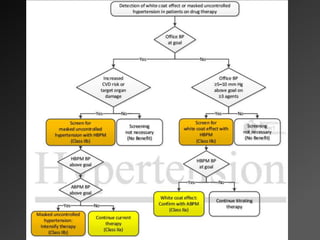
    MASKED AND WHITECOAT HYPERTENSION
  • 28.
  • 29.
    Approximate Impact onSBP Dose Hypertension Normotension Weight loss Best goal is ideal body weight, but aim for at least a 1-kg reduction in body weight for most adults who are overweight. Expect about 1 mmHg for every 1 kg reduction in body weight - 5 mmHg - 2/3 mmHg
  • 30.
    Approximate Impact onSBP Dose Hypertension Normotension Healthy diet Consume a diet rich in fruits, vegetables, whole grains, and low-fat dairy products, with reduced content of saturated and total fat - 11 mmHg - 3 mmHg
  • 31.
    Approximate Impact onSBP Dose Hypertension Normotension Reduced intake of dietary sodium Optimal goal is < 1500 mg/d, but aim for at least a 1000 mg/day reduction in most adults - 5/6 mmHg - 2/3 mmHg Approximate Impact on SBP Dose Hypertension Normotension Enhanced intake of dietary potassium Aim for 3500-5000 mg/d, preferably by consumption of a diet rich in potassium - 4/5 mmHg - 2 mmHg
  • 32.
    Approximate Impact onSBP Dose Hypertension Normotension Physical activity (aerobic) 90-150 min/week 65-75% heart rate reserve - 5/8 mmHg - 2/4 mmHg Physical activity (dynamic resistance) 90-150 min/week 50-80% 1 rep maximum 6 exercises, 3 sets/exercises, 10 repetitions/set - 4 mmHg - 2 mmHg Physical activity (isometric resistance) 4x2 min (hand grip), 1 min rest between exercises, 30- 40% maximum voluntary contraction, 3 sessions/week, 8-10 week - 5 mmHg - 4 mmHg
  • 33.
    Approximate Impact onSBP Dose Hypertension Normotension Moderation in alcohol intake In individuals who drink alcohol, reduce alcohol to: • Men: ≤ 2 drinks daily • Women: ≤ 1 drink daily - 4 mmHg - 3 mmHg
  • 34.
  • 35.
    Clinical Condition(s) BPtreshold (mmHg) BP Goal (mmHg) General Clinical CVD or 10 year ASCVD risk ≥ 10% ≥ 130/80 < 130/80 No clinical CVD and 10 year ASCVD risk < 10% ≥ 140/90 < 130/80 Older persons (≥ 65 years of age; noninstitutionalized, ambulatory, community-living adults) ≥ 130 (SBP) < 130 (SBP) Specific comorbidities Diabetes mellitus ≥ 130/80 < 130/80 Chronic kidney disease ≥ 130/80 < 130/80 Chronic kidney disease after renal trasnplantation ≥ 130/80 < 130/80 Heart failure ≥ 130/80 < 130/80 Stable ischemic heart disease ≥ 130/80 < 130/80 Secondary stroke prevention ≥ 140/90 < 130/80 Secondary stroke prevention (lacunar) ≥ 130/80 < 130/80 Peripheral arterial disease ≥ 130/80 < 130/80
  • 36.
  • 37.
  • 38.
  • 39.