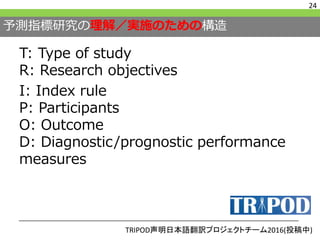
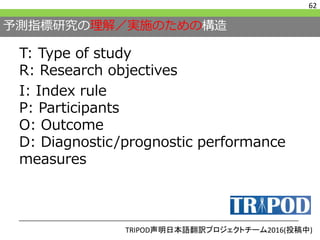
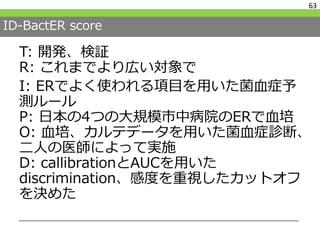
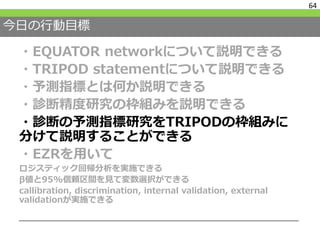
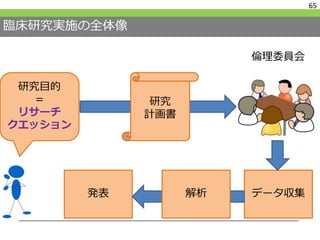
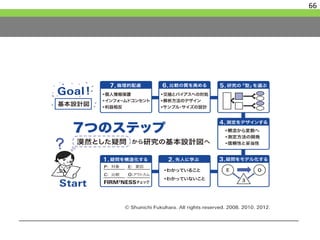
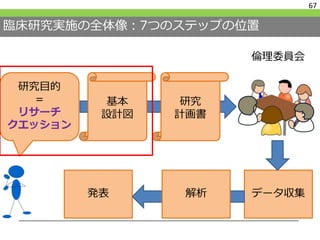
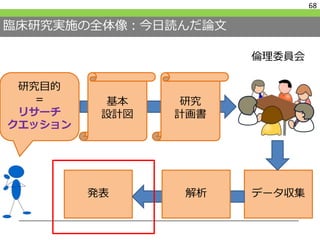
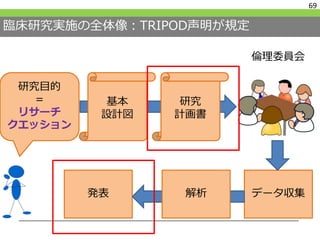
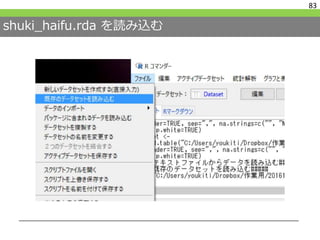
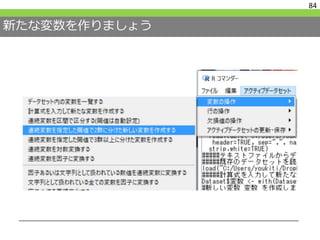
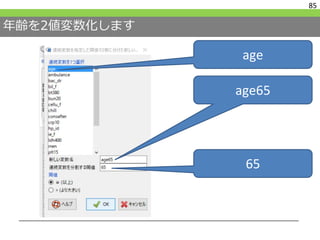
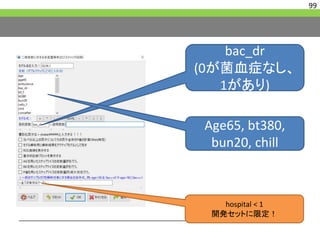
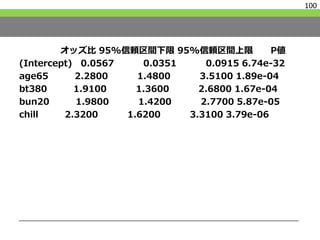
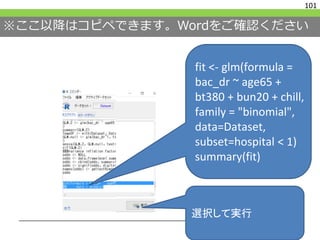
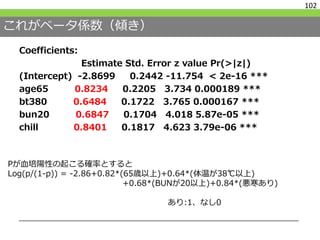
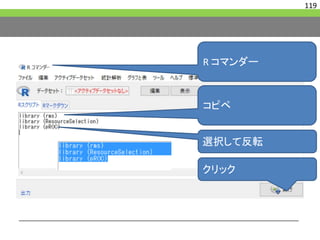
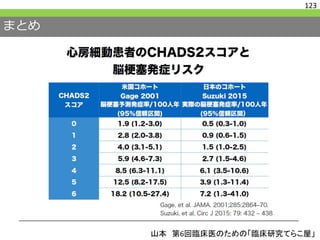
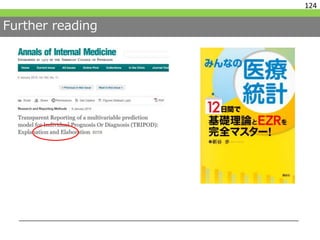
予測指標研究の理解/実施のための構造
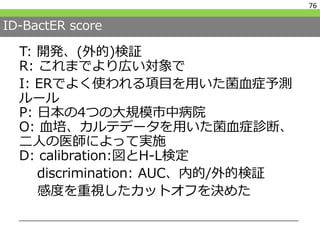
T: Type ofstudy
R: Research objectives
I: Index rule
P: Participants
O: Outcome
D: Diagnostic/prognostic performance
measures
24
TRIPOD声明日本語翻訳プロジェクトチーム2016(投稿中)
25.
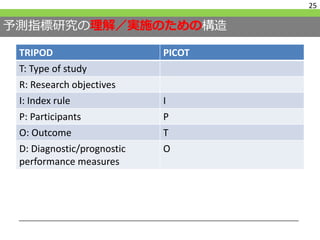
予測指標研究の理解/実施のための構造
TRIPOD PICOT
T: Typeof study
R: Research objectives
I: Index rule I
P: Participants P
O: Outcome T
D: Diagnostic/prognostic
performance measures
O
25
26.
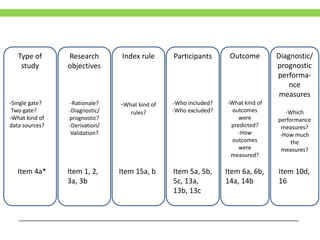
Type of
study
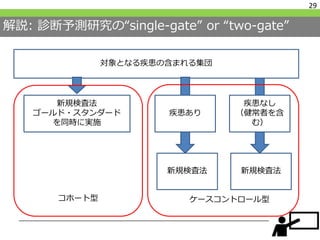
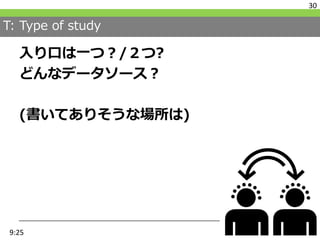
-Single gate?
Twogate?
-What kind of
data sources?
Research
objectives
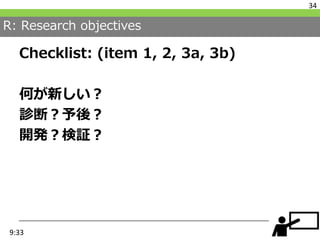
-Rationale?
-Diagnostic/
prognostic?
-Derivation/
Validation?
Index rule
-What kind of
rules?
Participants
-Who included?
-Who excluded?
Outcome
-What kind of
outcomes
were
predicted?
-How
outcomes
were
measured?
Diagnostic/
prognostic
performa-
nce
measures
-Which
performance
measures?
-How much
the
measures?
Item 4a* Item 1, 2,
3a, 3b
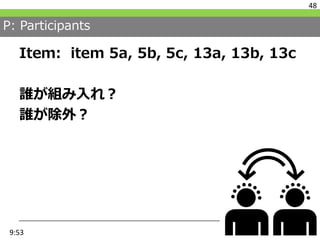
Item 15a, b Item 5a, 5b,
5c, 13a,
13b, 13c
Item 6a, 6b,
14a, 14b
Item 10d,
16
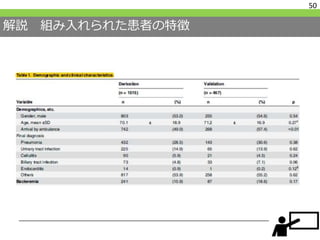
解説:入り口
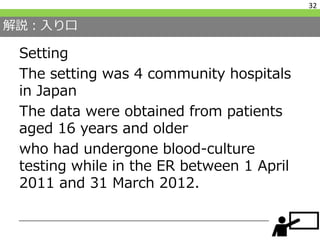
Setting
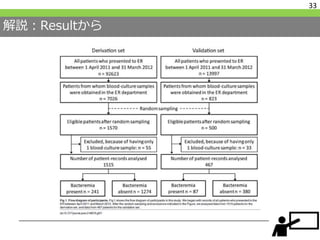
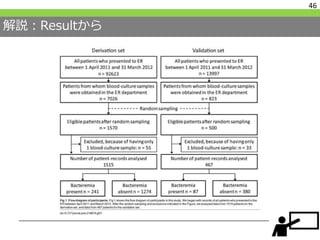
The setting was4 community hospitals
in Japan
The data were obtained from patients
aged 16 years and older
who had undergone blood-culture
testing while in the ER between 1 April
2011 and 31 March 2012.
32
解説
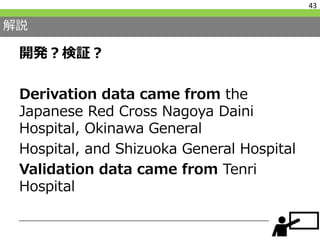
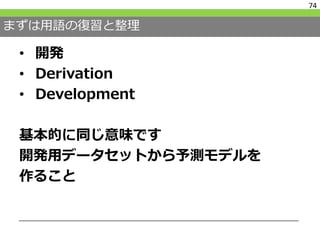
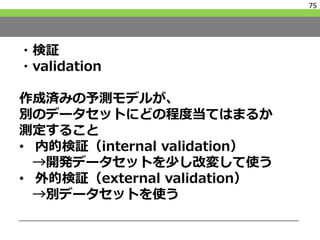
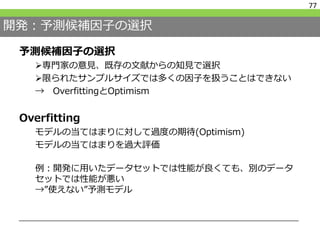
開発?検証?
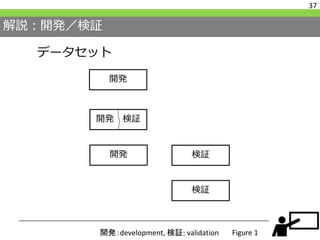
Derivation data camefrom the
Japanese Red Cross Nagoya Daini
Hospital, Okinawa General
Hospital, and Shizuoka General Hospital
Validation data came from Tenri
Hospital
43
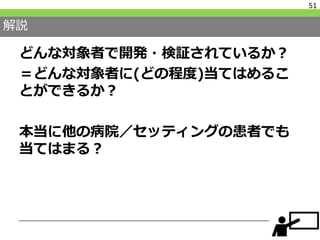
解説
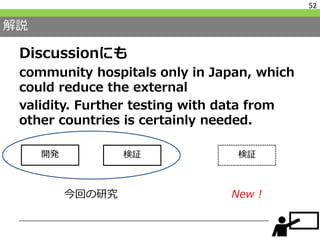
Discussionにも
community hospitals onlyin Japan, which
could reduce the external
validity. Further testing with data from
other countries is certainly needed.
52
開発 検証 検証
New !今回の研究
解説
どうやって測定?
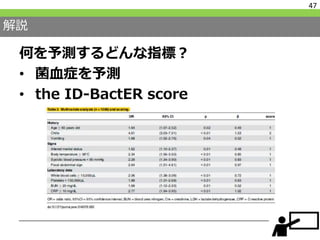
True bacteremia wasdefined as
growth of known pathogenic
bacteria in 1 blood culture or as
growth of common skin pathogens in
2 blood cultures.
55
55.
解説
・アウトカム評価時のマスク化?
True bacteremia wasdistinguished from
contamination by the judgment of 2
physicians working independently, each of
whom had more than 10 years of clinical
experience. They referred to the results of
at least 2 blood cultures and to the
patient’s clinical course.
…やりようがない
56
#41 Attempts to devise a quick procedure to identify patients with bacteremia have had only
limited success. [12] Some are useful only in elderly patients [13] or only in those with urinarytract
infections [14] or with pneumonia. [15] Others require complex calculations, [16] or use
rare or difficult-to-obtain measurements. [17, 18] While some studies reported rules for predicting
hospital-acquired bacteremia, [3, 13, 16, 19–21] at least three procedures have been
developed to identify community acquired bacteremia among ER patients. [17, 18, 22] They
were developed using data from one university hospital each, so their utility in ERs of various
community hospitals is unclear. In addition, they use bands or procalcitonin values, which are
Identifying Patients with Bacteremia in Community-Hospital Emergency Rooms
PLOS ONE | DOI:10.1371/journal.pone.0148078 March 29, 2016 2 / 17
usually not available in ERs of community hospitals, [17, 18] and their development did not
include validation studies. [18, 22]